
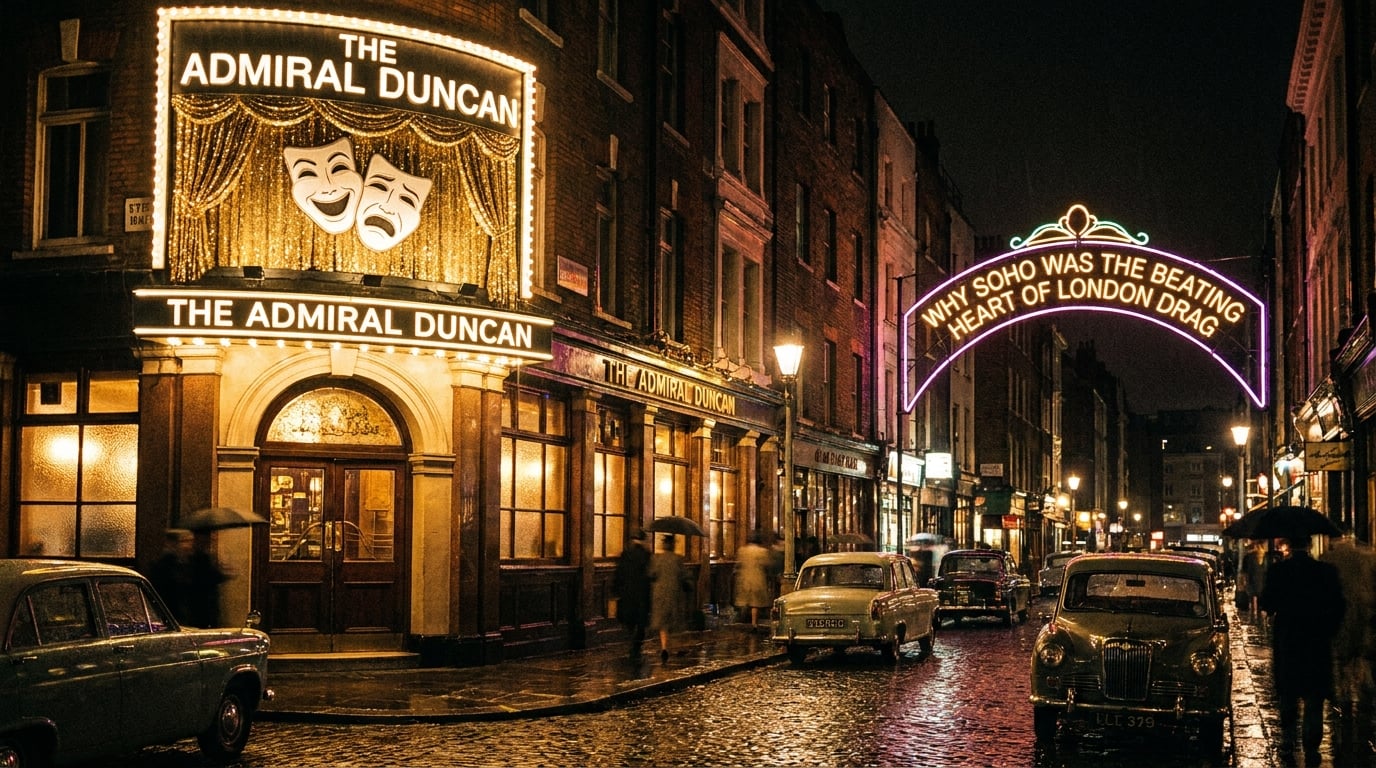
Soho became the beating heart of London drag because it offered a rare convergence of underground theatre culture, affordable rents, relative anonymity, and a pre-existing reputation as a district outside conventional morality. For over two centuries, this dense grid of narrow streets in the West End allowed drag performers to develop their art in an environment of both safety and creative freedom that no other London neighbourhood could match.
Few places in Britain carry the cultural weight of Soho when it comes to queer history. The name alone evokes images of neon-lit streets, packed basements, glittering stages, and an atmosphere where the rules of respectable society simply did not apply. Understanding why Soho was the beating heart of London drag means tracing a story that runs from Shakespearean cross-dressing traditions through Victorian music halls, wartime blackouts, the sexual revolution of the 1960s, the devastation of the AIDS crisis, and into a present where gentrification threatens the very spaces that made drag possible.
What made Soho different from every other London district was its identity as a liminal space. It sat between the respectable West End theatres and the working-class communities to the east. It drew immigrants, artists, sex workers, musicians, and outsiders of every kind. Drag performers found audiences here who were willing to be challenged, entertained, and transformed. The pubs and clubs of Old Compton Street and its surrounding lanes became both performance spaces and community anchors in ways that changed British culture forever.
In this article, our team traces the full arc of that story. You will learn when and how drag took root in Soho, which venues defined the scene, how political events shaped the community, and what remains today. Whether you are a drag enthusiast, a student of London history, or simply curious about one of Britain’s most colourful cultural movements, this guide covers everything you need to understand why Soho was the beating heart of London drag.
Table of Contents
Quick-Fire Facts: Soho Drag at a Glance
Before diving into the full history, here is a snapshot of the key facts that define Soho’s drag legacy. These are the details that come up again and again in conversations, forums, and historical accounts of the London drag scene.
- Old Compton Street has been the focal point of London’s gay community since the 1970s, though its queer roots stretch back much further.
- Comptons of Soho became the first openly gay pub on Old Compton Street around 1983 to 1984, marking a turning point for visible queer life in the area.
- The Admiral Duncan pub survived a devastating nail bomb attack in April 1999 that killed three people and injured dozens more. It remains open today and stands as a symbol of Soho’s resilience.
- Madame Jojo’s, one of Soho’s most iconic drag and cabaret venues, closed in 2014 after losing its licence, a loss that many consider a turning point in the gentrification of the area.
- The Royal Vauxhall Tavern, though technically just south of the river in Vauxhall rather than in Soho proper, is widely regarded as the spiritual home of British drag and has hosted performances since the 1940s.
- Soho’s queer history predates the modern gay rights movement by centuries. The area was known for gender non-conforming performance as far back as the 18th century.
Five Reasons Soho Became London’s Drag Capital
Soho’s dominance did not happen by accident. A specific combination of geography, economics, culture, and law created the conditions for drag to flourish here rather than elsewhere in London.
- Geographic centrality: Sitting in the heart of the West End, Soho was accessible to people from across London and beyond, making it a natural meeting point.
- Reputation for tolerance: Soho’s long history as an entertainment district with a relaxed attitude toward morality meant queer performers faced less hostility here than in more residential neighbourhoods.
- Affordable commercial rents: For decades, rents in Soho were low enough that small pubs and basement clubs could survive, giving drag performers intimate stages to develop their craft.
- Density of venues: The sheer number of pubs, clubs, and theatres packed into a few square blocks created a critical mass of performance spaces unlike anywhere else in Britain.
- Anonymity: Soho’s crowded streets and transient population allowed queer people to gather without drawing the attention that would have been inevitable in smaller communities.
What Is Drag? Theatrical Origins from Shakespeare to Soho
Drag is the art of performing gender through clothing, makeup, movement, and character. The word itself is widely believed to originate from theatre terminology, where male actors playing female roles noted that their costumes would “drag” along the stage floor. Whether or not that etymology is definitively accurate, it captures something essential about drag’s deep roots in British theatrical tradition.
In Shakespeare’s time, all female stage roles were performed by men because women were forbidden from acting professionally. This meant that audiences routinely watched male actors performing femininity on stage, and the conventions of cross-dressed performance were woven into the fabric of British theatre from its earliest days. Plays like Twelfth Night and As You Like It built entire plots around gender disguise, making the performance of gender a central feature of English dramatic tradition.
The Victorian music hall tradition took these theatrical roots and made them more accessible to working-class audiences. Male performers in elaborate dresses became stars of the variety circuit. Acts like Julian Eltinge in America and Dan Leno in Britain proved that drag could be mainstream entertainment rather than something hidden in the shadows. By the time Soho emerged as an entertainment district in the late 19th century, drag had a long theatrical pedigree to draw on.
What changed in Soho was context. In the music hall, drag was a novelty act performed for predominantly straight audiences. In Soho’s pubs and clubs, drag became something more personal and politically charged. It was performed by and for queer people. It became a way of expressing identity, building community, and resisting a society that criminalised gender and sexual difference.
The distinction between drag queens and drag kings matters here. Drag queens perform exaggerated femininity, while drag kings perform exaggerated masculinity. Both traditions have deep roots in Soho, though drag queens have historically received more visibility and attention. Drag kings have been part of the scene just as long, and their contributions are increasingly recognised as an essential part of the story.
Why Soho Was the Beating Heart of London Drag: The 18th and 19th Century Roots
Long before the term “drag” entered common use, Soho was already a gathering place for people who existed outside the gender and sexual norms of their time. The area’s transformation from rural farmland into a densely populated urban district began in the late 17th century, and it quickly developed a reputation as a place where conventional rules did not quite apply.
In the 18th century, Soho was home to a thriving community of French Huguenot refugees, Italian immigrants, and other outsiders who brought their own cultural traditions with them. This diversity created an atmosphere of tolerance that attracted still more marginalised groups. Historians have documented gatherings of men who wore women’s clothing in Soho’s streets and private clubs as early as the 1700s, though such gatherings were dangerous and deeply illegal under laws that could punish cross-dressing with public humiliation, imprisonment, or worse.
The most famous case from this era is that of the “molly houses” that existed in and around Soho and the City of London. These were private spaces where men could meet, socialise, and sometimes wear women’s clothing. The most notorious molly house raids occurred in 1726 at Mother Clap’s establishment, but similar spaces dotted the map of central London throughout the 18th century. While these were not drag venues in the modern sense, they represent the earliest documented instances of gender non-conforming community formation in the area.
By the 19th century, Soho had become firmly established as London’s premier entertainment district. Theatres, music halls, gin palaces, and dance halls filled the narrow streets. Performers who pushed boundaries of gender presentation found willing audiences here in ways they simply could not find in more respectable neighbourhoods. The theatrical drag tradition that grew out of the music halls found a natural home in Soho, where audiences were already accustomed to provocative and boundary-pushing entertainment.
The construction of new theatres and the growth of Soho’s reputation as a nightlife destination created a feedback loop. More venues attracted more performers, and more performers attracted more venues. By the end of the Victorian era, Soho had become synonymous with entertainment that existed on the edge of respectability. This reputation would prove essential in the decades to come.
The Interwar Years: Hidden Queer Culture in Soho’s Underworld
Between the two World Wars, Soho solidified its identity as a district where rules could be bent. The interwar period was a paradox for queer people in Britain. On one hand, the law remained aggressively hostile. Homosexual acts between men were criminal offences, and prosecution could destroy lives. On the other hand, the growth of urban anonymity in areas like Soho made it possible for queer communities to form and survive, even if they had to do so in hidden or semi-hidden ways.
Soho during this period was ethnically and sexually diverse in ways that set it apart from the rest of London. Historic England has documented how interwar Soho became a haven for queer Black artists and musicians who made significant contributions to British culture and LGBTQ heritage. The area’s existing diversity meant that difference of any kind was less remarkable here than elsewhere, and this relative tolerance created space for gender non-conforming performance to continue even under the threat of prosecution.
The underground nature of interwar queer life in Soho meant that much of what happened was never documented. We know from court records, diaries, and later oral histories that private clubs and back rooms hosted drag performances throughout the 1920s and 1930s. These were small, intimate gatherings rather than the spectacular shows that would come later. But they kept the tradition alive during a period when public visibility was impossible.
The Second World War transformed everything. The blackout conditions of wartime London made it easier for queer people to move through the city without being observed. American and Canadian servicemen stationed in Britain brought with them a somewhat more open attitude toward sexuality, at least in the context of wartime. Soho’s pubs and clubs filled with soldiers, sailors, and locals looking for escape from the relentless pressure of the bombing campaign. Drag performances provided a form of entertainment that felt both subversive and defiant, a way of laughing in the face of death.
Post-War Jazz and the Seeds of Modern Drag (1940s-1950s)
After the war, Soho became the centre of Britain’s jazz scene. Traditional jazz, modern jazz, and skiffle clubs opened across the district, drawing young audiences who were hungry for new forms of expression. Old Compton Street in particular became known for its jazz venues, which hosted musicians late into the night and created the kind of bohemian atmosphere in which drag could begin to emerge from the underground.
The connection between jazz culture and drag was not accidental. Both were art forms that thrived on improvisation, performance, and the breaking of conventional rules. Musicians and drag performers moved in the same circles, frequented the same clubs, and shared the same stages. The jazz era of Soho created a template for the performance spaces that would later become the backbone of the drag scene.
Wikipedia’s entry on Old Compton Street notes that after World War II, the street became a centre for modern and trad jazz. This musical heritage attracted a diverse, open-minded crowd that would prove receptive to the drag performances that followed. The audience for jazz was also the audience for early drag. Both art forms offered something that could not be found in mainstream British entertainment of the period.
It is worth noting that the 1950s were still a deeply dangerous time for queer people in Britain. The arrest and prosecution of gay men continued at high rates, and public visibility of any kind carried enormous risk. The drag performances that existed in Soho during this decade were necessarily discreet, often confined to private members’ clubs or the back rooms of pubs. But they were growing in number and sophistication, laying the groundwork for the explosion that would come in the following decade.
The Swinging Sixties: Sexual Revolution in Soho
The 1960s changed everything for drag in Soho. The decade’s broader cultural upheaval, the rise of youth culture, the relaxation of censorship laws, and the growing visibility of countercultural movements all created conditions in which drag could move closer to the mainstream without losing its edge.
Soho in the 1960s was a district in full transformation. The phrase “swinging London” was coined to describe a cultural moment in which fashion, music, art, and sexuality were all being reinvented. Soho sat at the centre of this transformation. Its clubs, boutiques, cafes, and bars drew people from across the country and around the world. Drag performers found that audiences were more curious and less hostile than they had been even a decade earlier.
The Sexual Offences Act of 1967 partially decriminalised homosexual acts between men in private in England and Wales. While this legislation was limited in scope and full of caveats, it marked a turning point. It did not legalise everything, and it did not protect people from discrimination, but it did signal that the state’s approach to sexuality was beginning to shift. For drag performers, the change in legal atmosphere meant that queer spaces could operate with slightly less fear of police raids and prosecution.
Soho’s nightlife during the 1960s was unlike anything that had come before. The Hippodrome, originally a theatre, began hosting events that blurred the line between mainstream entertainment and queer culture. Smaller venues across the district offered drag shows that ranged from polished cabaret acts to raw, improvisational performances. The variety and quality of drag in Soho during this period established the district’s reputation as the undisputed capital of British drag.
It was also during this period that Soho began to be described as London’s gay village. The concentration of queer-friendly venues on and around Old Compton Street gave the area a visible identity that it had not had before. People travelled from across the country to experience Soho’s nightlife, and many of them encountered drag for the first time in the clubs and pubs of the district.
Gay Liberation, Clause 28, and the AIDS Crisis (1970s-1980s)
The 1970s brought both progress and devastating setbacks to Soho’s drag community. The gay liberation movement that emerged after the 1969 Stonewall riots in New York reached Britain quickly, and London became a centre of activism. The first British Gay Pride rally took place in London in 1972, and Soho’s venues served as meeting places and organising hubs for a growing movement.
Drag played a complex role in the gay liberation movement. Some activists saw drag as an expression of gender stereotypes that the movement should move beyond. Others saw it as a powerful form of political theatre that challenged rigid gender norms in ways that no political speech could match. This tension played out in Soho’s venues, where drag shows could be simultaneously celebratory and confrontational, entertaining and provocative.
The founding of the Stonewall charity at Ian McKellen’s home in 1989 was a direct response to a new wave of political hostility. In 1988, the Conservative government under Margaret Thatcher passed Section 28 (also known as Clause 28), a law that prohibited local authorities from “promoting homosexuality” or teaching about the acceptability of same-sex relationships in schools. The law had a chilling effect on LGBTQ+ life across Britain.
Clause 28 affected drag in Soho in direct and indirect ways. Venues feared losing their licences if they were seen as promoting homosexuality. Performers had to be more careful about what they said on stage. The law sent a message that queer visibility was dangerous and that the state was watching. But it also provoked a fierce backlash that galvanised the community.
The AIDS crisis of the 1980s and early 1990s devastated Soho’s queer community. Performers, venue owners, promoters, and audience members fell ill and died in staggering numbers. The community lost a generation of talent and leadership. Drag performances during this period often took on a memorial quality, with performers dedicating shows to friends and lovers who had died.
Despite the devastation, drag in Soho became a form of resistance during the AIDS crisis. Performers raised money for AIDS charities, challenged government inaction through their shows, and provided spaces where grieving communities could come together. The resilience of Soho’s drag scene during this period is one of the most powerful chapters in the story of why Soho was the beating heart of London drag.
The Admiral Duncan Bombing and Soho’s Legacy of Resilience
On 30 April 1999, a nail bomb was detonated inside the Admiral Duncan pub on Old Compton Street. The attack killed three people: Andrea Dykes, John Light, and Nik Moore. More than 70 people were injured, many severely. The bomber was a man motivated by hatred of gay, Black, and Asian communities, and the Admiral Duncan was targeted specifically because it was a well-known gay pub in the heart of Soho.
The bombing sent shockwaves through Soho and through the broader LGBTQ+ community in Britain. The Admiral Duncan was not just a pub. It was a symbol of the visible, open queer life that Old Compton Street had come to represent. Attacking it was an attack on the entire community and on the idea that queer people could gather openly without fear.
What happened next defined Soho’s legacy of resilience. Thousands of people gathered on Old Compton Street in the days following the bombing to mourn, to show solidarity, and to insist that they would not be driven back into hiding. The community’s response made national headlines and drew attention to the ongoing reality of homophobic violence in Britain.
The Admiral Duncan reopened and remains open today. On Reddit forums, users describe it as steeped in queer history and still having what they call real British drag. The venue is both a memorial and a living performance space, a place where the history of Soho’s drag scene is present in the walls.
This resilience is central to understanding why Soho was the beating heart of London drag. The community did not just survive the bombing. It continued to perform, to gather, to celebrate, and to resist. Drag in Soho was never just about entertainment. It was about visibility in the face of violence, community in the face of isolation, and joy in the face of grief.
Key Venues That Defined the Soho Drag Scene
Soho’s drag scene has always been defined by its venues. The pubs, clubs, and cabaret spaces of the district provided the physical infrastructure that made performance possible. Understanding why Soho was the beating heart of London drag means understanding the spaces where drag happened.
The Admiral Duncan on Old Compton Street remains one of the most historically significant venues in British drag history. Despite the 1999 bombing, it continues to host performances and serve as a gathering place for the queer community. Its survival is itself a statement of defiance.
Comptons of Soho, also on Old Compton Street, was the first openly gay pub on the street when it came out as a gay venue around 1983 to 1984. Its significance cannot be overstated. Before Comptons, gay venues in Soho tended to be discreet or hidden. Comptons made queer visibility a permanent feature of the street that would become the epicentre of London’s gay village.
Madame Jojo’s on Walker’s Court was perhaps the most iconic drag and cabaret venue in Soho’s history. Known for its glamorous interior, spectacular drag shows, and boundary-pushing performances, it defined a certain style of Soho cabaret for decades. Its closure in 2014 after losing its licence was met with widespread grief and is often cited as a key moment in the gentrification of the district.
The Hippodrome on Charing Cross Road, while not exclusively a drag venue, played an important role in Soho’s entertainment ecosystem. Its large capacity and central location made it a venue where drag could reach mainstream audiences, blurring the line between queer culture and popular entertainment.
Heaven, located just beneath the Arches of Charing Cross Station at the edge of Soho, became one of the most famous gay clubs in the world after opening in 1979. Its massive dance floors and regular drag events drew crowds from across the country and beyond. Heaven proved that drag could be part of large-scale, high-production nightlife rather than confined to small pubs.
The Royal Vauxhall Tavern deserves special mention even though it sits south of the river rather than in Soho itself. Since the 1940s, it has hosted drag and cabaret performances and is widely regarded as the spiritual home of British drag. Its relationship with Soho’s scene has always been close, with performers, audiences, and cultural trends flowing freely between the two venues.
Soho’s Key Drag Venues: Past and Present
Here is a quick reference guide to the venues that shaped the scene, along with their current status.
- The Admiral Duncan (Old Compton Street): Open since the 19th century as a pub, gay since the 1980s. Survived the 1999 nail bomb. Still open and hosting drag.
- Comptons of Soho (Old Compton Street): First openly gay pub on the street, circa 1983 to 1984. Still open and serving the community.
- Madame Jojo’s (Walker’s Court): Iconic cabaret and drag venue. Closed in 2014. Mourned as a major loss to the scene.
- Heaven (Charing Cross): Opened in 1979. One of the world’s most famous gay clubs. Still operating with regular events.
- The Hippodrome (Charing Cross Road): Historic theatre and nightlife venue that hosted events bridging queer and mainstream culture. Now a casino, but its legacy endures.
- Molly Moggs (Old Compton Street): A smaller, intimate drag pub that has hosted performances for years. Represents the smaller venues that are essential to the ecosystem.
- The Astoria (Charing Cross Road): A larger venue that hosted club nights and drag events. Demolished for Crossrail construction, a major loss for the scene.
Drag Kings and the Broader Gender Performance Movement
While drag queens have historically dominated the visibility of drag in Soho, drag kings have been part of the scene just as long. Drag kings are performers who adopt exaggerated masculine personas, using facial hair, padding, voice modulation, and choreography to create compelling characters that both celebrate and critique masculinity.
The history of drag kings in London has been under-documented compared to that of drag queens, partly because masculine presentation by women has often been less visible or less sensationalised in mainstream culture. But oral histories, archival photographs, and community memories confirm that drag king performances have been a feature of Soho’s nightlife for decades.
In the modern era, drag kings have gained greater recognition. London’s drag king scene has grown in confidence and visibility, with regular nights dedicated specifically to king performances. These events often attract audiences who are interested in gender performance as a form of artistic and political exploration rather than simply entertainment.
The broader gender performance movement in Soho encompasses more than queens and kings. Genderqueer performers, non-binary artists, and performers who resist any single label have all found stages in Soho’s venues. Ballroom culture, which originated in Black and Latino queer communities in New York and Philadelphia, has also had a growing influence on the London scene. Voguing, walking, and ballroom competitions have become part of the fabric of drag in London, and Soho venues have hosted ballroom events alongside more traditional cabaret performances.
This diversity of gender performance is part of what made Soho the beating heart of London drag. The district was never home to a single style or tradition. It was a space where different approaches to gender, performance, and identity could coexist, cross-pollinate, and evolve together. That creative ferment produced some of the most innovative and influential drag in the world.
Soho vs East London: How the Drag Scenes Compare
One of the most common questions on forums like Reddit and in conversations among drag fans is whether Soho or East London is the true centre of London’s drag scene. The answer is more nuanced than a simple either-or, and understanding the differences between the two scenes helps clarify what made Soho’s contribution unique.
Soho drag has historically been more cabaret-oriented. Think polished performances, established venues, paying audiences, and a style that draws on the traditions of British music hall and variety theatre. The drag of Soho is often described as classic, glamorous, and theatrical. It rewards skill, timing, and the ability to work a crowd.
East London drag, centred on areas like Shoreditch, Dalston, and Hackney, has a different flavour. It tends to be more experimental, more political, and more willing to break with tradition. East London venues have been at the forefront of drag that challenges audiences, subverts expectations, and blends drag with performance art, punk, and club culture. The scene is younger, more diverse, and more openly confrontational.
Reddit users frequently note this distinction. They describe Soho drag as more cabaret-style and East London drag as more experimental. Both descriptions are generalisations, of course, and there is plenty of overlap. Performers move between the two scenes, and audiences follow them.
What matters for our purposes is that the differences between Soho and East London drag reflect the different histories of the two areas. Soho’s drag grew out of a centuries-old entertainment tradition, shaped by theatre, music hall, cabaret, and the specific demographics of the West End. East London’s drag emerged more recently, shaped by post-industrial urban spaces, underground club culture, and a different set of community dynamics.
The result is not a rivalry but a complementary relationship. Soho provided the foundation, the history, and the infrastructure. East London pushed boundaries, experimented with form, and brought new voices into the art. London’s drag scene is richer because both exists, and both continue to influence each other.
Modern Soho: Gentrification, Closures, and What Remains
The story of Soho’s drag scene in the 21st century is one of loss and adaptation. Gentrification has transformed the district in ways that threaten the very venues and communities that gave Soho its identity. Rising rents, redevelopment projects, and the influx of chain businesses have made it increasingly difficult for the small, independent venues that traditionally hosted drag to survive.
The closure of Madame Jojo’s in 2014 was a watershed moment. The venue’s loss was felt across the community as a sign that the Soho drag scene was under existential threat. Other closures followed. The Astoria was demolished to make way for Crossrail construction, removing a large venue that had hosted club nights and drag events for years. Smaller venues have struggled with rising commercial rents and the pressure of competing with corporate entertainment chains.
Long-time Londoners frequently lament the loss of what they call old Soho on online forums. They describe the feeling that the district has become more tourist-focused, more expensive, and less welcoming to the queer community that built its nightlife reputation. Some users note that Soho’s drag scene has become more heteronormative, catering to audiences who treat drag as a novelty experience rather than a community tradition.
The impact of RuPaul’s Drag Race UK, which premiered in 2019, has been double-edged. On one hand, the show has brought unprecedented mainstream attention to British drag, attracting new audiences to venues across London. On the other hand, some fans arrive expecting the polished, competition-style format of the show and are surprised to find that live drag in pubs and clubs is a different experience altogether. The gap between expectations shaped by television and the reality of Soho’s drag scene can create friction.
Despite these challenges, drag in Soho has not disappeared. The Admiral Duncan continues to host performances. Comptons remains a fixture of Old Compton Street. Newer venues and events have emerged to fill some of the gaps left by closures. Pride celebrations continue to draw crowds to the area. The spirit of Soho drag persists, even if the landscape around it has changed dramatically.
The question of whether Soho is still the centre of London’s drag scene has no simple answer. The district has lost some of its dominance to other areas, and the rise of drag in East London, Vauxhall, and beyond has created a more decentralised scene. But Soho’s historical significance is unshakeable, and the venues that remain carry the weight of generations of performance, resistance, and community.
Timeline of Key Dates in Soho Drag History
To help orient the full story, here is a chronological timeline of the events, venues, and movements that shaped why Soho was the beating heart of London drag.
- 18th century: Molly houses in and around Soho provide early spaces for gender non-conforming gatherings, including Mother Clap’s establishment raided in 1726.
- 19th century: Soho’s music halls and theatres host cross-dressing performers as part of mainstream variety entertainment, building an audience for gender performance.
- 1920s-1930s: Interwar Soho becomes an ethnically and sexually diverse haven for queer artists, musicians, and performers operating in hidden or semi-hidden venues.
- 1940s: World War II blackout conditions and the influx of foreign servicemen create new freedoms for queer gatherings in Soho’s pubs and clubs.
- 1950s: Post-war jazz venues on Old Compton Street attract bohemian audiences receptive to boundary-pushing performance, though queer visibility remains dangerous.
- 1960s: The sexual revolution and the 1967 Sexual Offences Act create new conditions for queer visibility. Soho establishes itself as London’s gay village.
- 1972: The first London Gay Pride rally takes place, with Soho venues serving as organising hubs.
- 1979: Heaven opens beneath the Charing Cross arches, becoming one of the world’s most famous gay clubs and a major drag venue.
- 1983-1984: Comptons becomes the first openly gay pub on Old Compton Street, marking a new era of visible queer life.
- 1988: Clause 28 is passed, criminalising the promotion of homosexuality and sending shockwaves through Soho’s queer community.
- 1989: The Stonewall charity is founded at Ian McKellen’s home in direct response to Clause 28.
- 1980s-1990s: The AIDS crisis devastates Soho’s queer community, but drag becomes a form of fundraising, resistance, and memorial.
- 30 April 1999: The Admiral Duncan nail bomb kills three people and injures over 70. The community responds with a massive show of solidarity.
- 2014: Madame Jojo’s closes after losing its licence, a major blow to Soho’s drag and cabaret scene.
- 2019: RuPaul’s Drag Race UK premieres, bringing mainstream attention to British drag and attracting new audiences to Soho venues.
- 2026: Soho’s drag scene continues to adapt, with surviving venues and new events carrying forward a legacy that spans centuries.
FAQs
Why is Soho London so famous?
Soho is famous for its centuries-long history as London’s centre of entertainment, nightlife, and counterculture. It has been home to theatres, jazz clubs, music venues, fashion boutiques, and the city’s most visible LGBTQ+ community. Old Compton Street in Soho has been the focal point of London’s gay village since the 1970s, and the district’s dense concentration of pubs, clubs, and cabaret venues made it the beating heart of British drag culture.
Is Soho still seedy?
Soho today is far less seedy than it was in the mid-20th century. Decades of gentrification, rising rents, and redevelopment have replaced many of the old sex shops, clip joints, and underground venues with chain restaurants, luxury flats, and corporate offices. However, pockets of the old bohemian atmosphere remain, particularly on and around Old Compton Street, where independent venues and queer nightlife continue to operate.
When did Soho become gentrified?
Soho’s gentrification accelerated from the late 1990s and early 2000s onward, driven by rising property values, Crossrail construction, and the area’s desirability as a central London location. Key milestones include the demolition of the Astoria for Crossrail, the closure of Madame Jojo’s in 2014, and the ongoing replacement of independent venues with chain businesses. The process continues today, though community efforts and heritage protections have preserved some historic spaces.
Why do they call it Soho in London?
The name Soho is believed to have originated as a hunting cry used in the 16th or 17th century, when the area was rural farmland used for hunting. The cry ‘Soho!’ was apparently shouted during hunts, and the name stuck to the area as it was developed. A similar origin story applies to SoHo in New York, which took its name from the London district.
What is the most famous drag venue in Soho?
The most famous drag venue in Soho is arguably the Admiral Duncan on Old Compton Street, which survived a 1999 nail bomb attack and continues to host performances today. Comptons of Soho, the first openly gay pub on the street, is also historically significant. Madame Jojo’s, though closed since 2014, remains legendary for its iconic cabaret and drag shows. Heaven, just at the edge of Soho, is one of the most famous gay clubs in the world.
Conclusion: Why Soho’s Drag Legacy Endures
Understanding why Soho was the beating heart of London drag means recognising that this was never just about entertainment. Soho gave drag performers the physical spaces, the audiences, the community, and the relative freedom they needed to develop their art over centuries. From the molly houses of the 18th century to the cabaret stages of Madame Jojo’s, from the resilience after the Admiral Duncan bombing to the ongoing battle against gentrification, Soho’s drag history is a story of creativity surviving against the odds.
The venues that remain carry the weight of that history. The performers who continue to take the stage on Old Compton Street do so in the footsteps of generations who came before them. Even as the landscape changes and new scenes emerge in East London and beyond, Soho’s legacy as the place where British drag was born and nurtured is unshakeable.
Whether you are walking down Old Compton Street for the first time or you have been part of this community for decades, the story of why Soho was the beating heart of London drag is still being written. The venues, the performances, and the people who keep the tradition alive are the living proof that this legacy endures.
1 thought on “Why Soho Was the Beating Heart of London Drag in 2026?”