
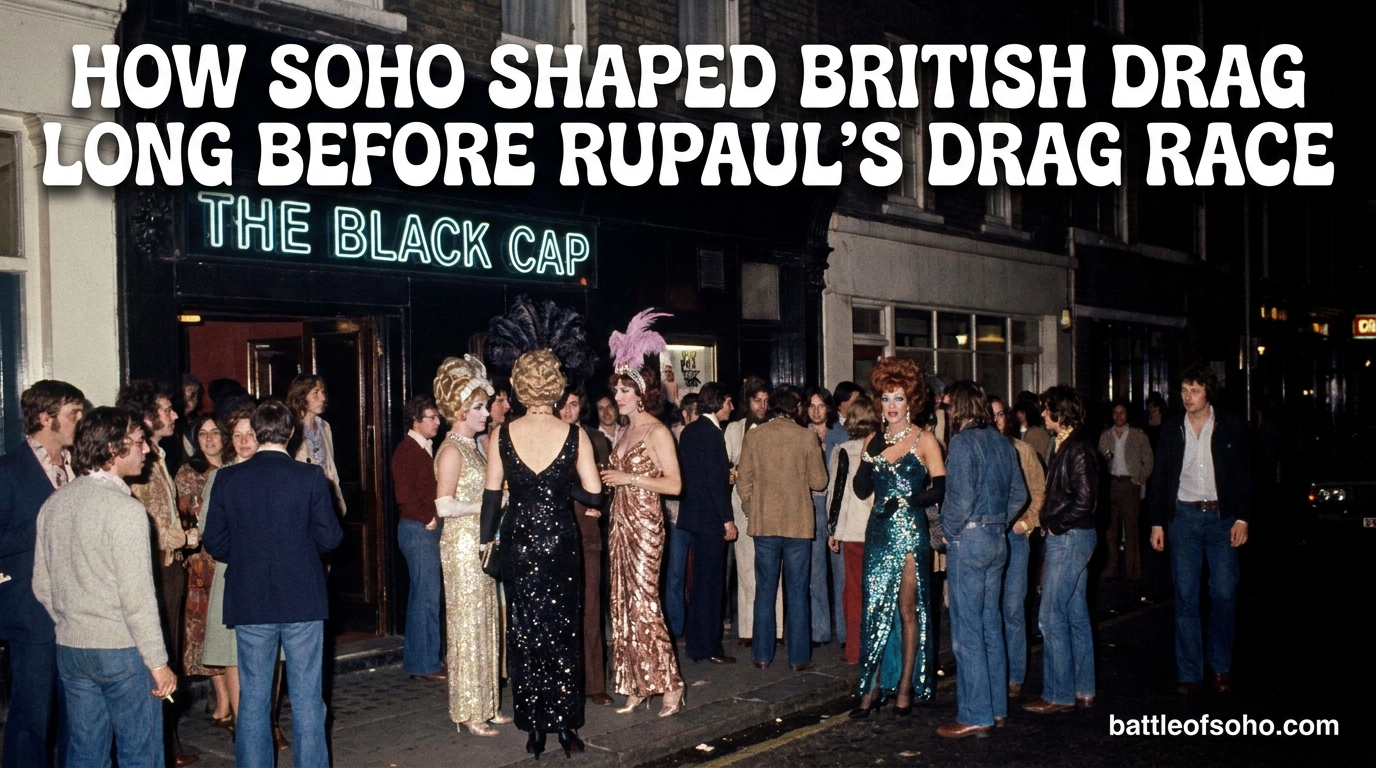
When you think of British drag, RuPaul’s Drag Race UK might be the first thing that comes to mind. But the truth is, Soho shaped British drag long before television cameras ever showed up. For over three centuries, this small square mile in central London served as the beating heart of drag performance, queer community, and theatrical gender-bending.
Soho British drag history runs deep through every cobblestone and basement venue in the neighbourhood. From secret eighteenth-century molly houses to the neon-lit drag bars of Old Compton Street, this district gave British drag its identity, its attitude, and its audience.
I have spent years researching Soho’s nightlife legacy, talking to performers, and digging through archives. What I found is a story that most drag fans have never heard. Soho did not just host drag shows. It built the entire tradition that made British drag what it is today.
This guide walks you through that history chronologically. You will meet the performers, the venues, and the cultural moments that turned a few London blocks into the most important drag district in British history. Long before Drag Race UK crowned its first winner, Soho had already been doing it for 300 years.
Table of Contents
Molly Houses: Soho’s Eighteenth-Century Drag Underground
The story of Soho British drag history begins in the early 1700s with molly houses. These were secret gathering spots where men could dress in feminine clothing, adopt female names and personas, and perform for each other away from the threat of the law.
Soho was the perfect location for this underground scene. Its maze of narrow streets, cheap lodging houses, and transient population made it easy to disappear into the crowd. The neighbourhood had a reputation for bohemian living, street traders, and immigrant communities that created natural cover for queer gatherings.
The most famous molly house was run by Margaret Clap, known as Mother Clap, on Field Lane near Holborn. But Soho had its own network of similar establishments. These were not just places for socialising. They were performance spaces where attendees held mock births, mock weddings, and other theatrical rituals that blended drag performance with community bonding.
In 1726, police raided Mother Clap’s molly house, and the subsequent trial at the Old Bailey became one of the earliest documented records of organised drag culture in London. The court transcripts described men in gowns, using female names, and dancing together in ways that shocked the establishment.
One figure stands out from this era as the first documented drag personality in British history. Princess Seraphina, whose real name was John Cooper, was a well-known figure in early eighteenth-century London. Court records from 1732 describe her appearing in feminine dress and being recognised by other molly house attendees as a performer and personality in her own right.
Princess Seraphina represents something remarkable. She was not just someone who wore women’s clothes. She had a drag persona, a public identity, and a community that recognised her. That happened right here in Soho’s backyard, nearly 300 years before RuPaul told anyone to sashay away.
Victorian Soho and the Theatrical Drag Boom
By the Victorian era, drag had moved from the underground into the spotlight, and Soho sat right at the centre of that transformation. The neighbourhood’s theatres and music halls became spaces where gender performance was not just tolerated but celebrated as entertainment.
Soho’s location mattered enormously. Theatres on the edge of the district drew working-class audiences who loved variety acts, comedy, and spectacle. These crowds had no interest in polite society’s rules about gender and propriety. They wanted to be entertained, and performers who bent gender norms delivered exactly that.
The music hall tradition that flourished in and around Soho from the 1850s onward was foundational to British drag culture. Performers like Vesta Tilley became massive stars by performing as male characters. Tilley dressed as a dandy, a sailor, a soldier, and audiences adored her. She was one of the highest-paid performers of her era.
Male impersonation was just one side of the coin. Female impersonation also thrived on the Soho-adjacent stage. Albert Swan, better known as Hetty King, performed as a female character and became a variety circuit legend. The boundary between what we now call drag and what Victorian audiences called variety entertainment was blurry and fluid.
What made this period so important for Soho British drag history was normalisation. Drag performance was no longer something hidden in basement rooms. It was on stages, in front of paying audiences, advertised on posters. The theatrical establishment might not have called it drag, but that is exactly what it was.
Principal Boys and Pantomime Dames: Soho’s Theatrical Cross-Dressing Legacy
Two theatrical traditions that crystallised during the Victorian period became permanent fixtures of British performance culture. Both had deep connections to the Soho theatre scene, and both shaped how British drag developed in distinct ways from its American counterpart.
The principal boy tradition cast women in heroic male roles, especially in pantomimes. These performers wore tights, boots, and jackets that showed off their legs while projecting confidence and swagger. The principal boy was dashing, bold, and commanding. Audiences loved the gender disruption without ever calling it that.
Then there was the pantomime dame, arguably the most uniquely British contribution to drag history. The dame was a comic male character played by a man in exaggerated female costume. Think enormous dresses, ridiculous wigs, and over-the-top makeup. The dame was loud, bawdy, and unapologetically ridiculous.
The pantomime dame gave British drag its signature comic DNA. While American drag eventually developed around ball culture and runway competition, British drag never lost its connection to music hall comedy and theatrical absurdity. That comedic tradition, rooted in the theatres around Soho, is still visible in British drag today.
Old Compton Street, which runs through the heart of Soho, had theatres and music halls that hosted these performances regularly. The street was becoming the neighbourhood’s entertainment spine, a role it would maintain for the next century and a half.
Post-War Soho: Drag Goes Underground and Then Mainstream
The Second World War changed everything about London, and Soho’s drag scene was no exception. During the war years, servicemen stationed in London discovered the city’s queer nightlife. Drag shows became a staple of entertainment for troops, and concert parties frequently featured men performing as women.
After the war ended, many of these servicemen returned to civilian life but brought their appreciation for drag with them. Soho’s basement clubs and private venues saw a surge in drag performances during the late 1940s and 1950s. The Carrousel Club, located in Soho, became one of the most important post-war drag venues in London.
The Carrousel hosted female impersonation shows that drew both queer and straight audiences. Performers wore elaborate costumes, lip-synced to popular songs, and developed the kind of polished stage shows that would define nightclub drag for decades. This was not pub drag or street performance. This was theatrical, choreographed, and glamorous.
Danny La Rue emerged from this post-war Soho scene and became one of Britain’s biggest drag stars. La Rue was not a niche act. He performed for royalty, appeared in films, and opened his own club in Hanover Square, just minutes from Soho. He proved that a drag performer could become a mainstream celebrity in Britain, something that would have been unthinkable in many other countries.
But this era was not without danger. Police raids on queer venues were common, and performers lived under constant threat of prosecution. The Criminal Law Amendment Act and other Victorian-era legislation were still being used aggressively against anyone suspected of homosexuality. Drag existed in a legal grey area that could turn dangerous at any moment.
Despite the risks, Soho remained the centre of British drag through the 1950s and into the 1960s. The neighbourhood’s density of venues, its tolerance for unconventional entertainment, and its central location made it the natural home for performers who had nowhere else to go.
Madame Jojo’s: The Venue That Defined Soho Drag
No single venue looms larger in Soho British drag history than Madame Jojo’s. Originally opened in the 1960s as a nightclub and cabaret venue on Walker’s Court, just off Old Compton Street, it became the spiritual home of Soho drag for nearly five decades.
The venue started life as Mme Jojo’s, a French-themed cellar club with red velvet interiors and an intimate stage. It was the kind of place where you felt like you had discovered a secret. The low ceilings, the narrow entrance, and the dark interior created an atmosphere that no purpose-built venue could ever replicate.
Through the 1970s and 1980s, Madame Jojo’s hosted drag nights that drew performers and audiences from across London. The venue became known for its Monday night drag shows, which featured some of the most talented female impersonators in the country. These were not amateur nights. The performers were professionals who had honed their craft on Soho stages for years.
The 1990s and 2000s marked the venue’s golden era. Madame Jojo’s became synonymous with high-quality drag entertainment, cabaret, and burlesque. It hosted nights like Wam Bam Club and became a fixture on every list of must-visit London venues. Tourists, locals, and celebrities all walked through those doors.
What made Madame Jojo’s special was not just the performances but the space itself. That basement room on Walker’s Court had witnessed decades of drag history. When you stood on that tiny stage, you were standing where generations of British drag performers had stood before you. The walls held the memory of an entire tradition.
In October 2014, Westminster City Council revoked Madame Jojo’s licence following a violent incident outside the venue. The closure sent shockwaves through London’s drag and LGBTQ+ community. Then, in November 2015, a fire tore through the building, causing extensive damage. The venue that had been the heart of Soho drag for 50 years was gone.
The loss of Madame Jojo’s represented something bigger than the closure of one club. It marked the end of an era in Soho’s drag history. The neighbourhood was changing rapidly, with rising rents and corporate redevelopment pushing out the independent venues that had made it famous. The drag scene that Soho had nurtured for centuries was being forced to find new homes across London.
The Gay Liberation Front and 1970s Soho Drag Activism
The 1970s brought a new dimension to Soho’s drag story. The Gay Liberation Front, formed in London in 1970, turned drag from entertainment into activism. And Soho was at the centre of that transformation.
GLF marches regularly passed through Soho, and drag performers became some of the movement’s most visible participants. When activists marched through central London demanding queer rights, drag queens were on the front lines. Their visibility was itself a political act in an era when simply being seen in drag could lead to arrest.
Bette Bourne emerged from this moment as one of the most important figures in Soho British drag history. A founding member of the GLF, Bourne later formed the troupe Bloolips with a group of like-minded performers. Bloolips combined drag, political theatre, and street performance in ways that challenged every convention of British entertainment.
Bloolips performed in venues across Soho and beyond, bringing a new kind of drag that was explicitly political. Their shows addressed homophobia, sexism, and class politics through camp, comedy, and spectacle. They rejected the polite nightclub drag of earlier decades in favour of something rawer, louder, and more confrontational.
The 1970s also saw the Sisters of Perpetual Indulgence establish a presence in London. This order of drag nuns used religious imagery, camp performance, and public visibility to challenge both homophobia and religious hypocrisy. Their appearances in and around Soho added another layer to the neighbourhood’s drag identity.
What made this period so significant was the fusion of drag with political organising. Soho was no longer just a place where drag happened. It was a place where drag was used as a weapon against oppression. Performers understood that their art had power beyond entertainment, and they wielded it accordingly.
Working-Class Drag: The Beating Heart of Soho’s Scene
One aspect of Soho British drag history that often gets overlooked is its working-class roots. The drag that developed in Soho’s pubs and clubs was not the product of wealthy hobbyists or artistic elites. It came from working-class performers who used drag as a way to make a living, build community, and express themselves.
Pub drag was a distinctly British phenomenon. Performers would do shows in the back rooms of Soho pubs, often for modest pay and rowdy crowds. These shows relied on quick wit, audience interaction, and the kind of camp comedy that could hold a room full of people who had come straight from work.
Lily Savage, played by Paul O’Grady, emerged from this tradition. Before she became a television star, Lily Savage was a fixture of London’s pub drag circuit. Her performances at the Royal Vauxhall Tavern became legendary, but her roots were in the same working-class drag culture that filled Soho’s pubs every weekend.
What separated British pub drag from other drag traditions was its emphasis on comedy over polish. Performers did not need thousand-pound gowns or professional makeup artists. They needed material, stage presence, and the ability to handle any audience that walked through the door. Soho audiences were notoriously demanding, and performers who could win them over could win over anyone.
This working-class tradition gave British drag its distinctive voice. While American drag was developing elaborate ball categories and runway standards, British drag was perfecting the art of the one-liner, the put-down, and the audience roast. Soho’s pubs were the training ground where that voice was forged.
Section 28 and Soho Drag in the 1980s
The 1980s brought a political backlash that tested Soho’s drag community like never before. Margaret Thatcher’s government introduced Section 28 in 1988, a law that prohibited local authorities from promoting homosexuality. The legislation sent a chill through every queer space in Britain, including Soho’s drag venues.
Section 28 did not make drag illegal, but it created a climate of fear and hostility. Venues worried about their licences. Performers worried about their livelihoods. Schools, libraries, and community organisations were forbidden from even acknowledging that queer people existed. The message from the government was clear: you are not welcome.
Drag performers in Soho responded by doing what they had always done. They kept performing. In fact, the hostility of the 1980s gave drag a new sense of purpose. When the political establishment tried to erase queer visibility, drag performers made themselves more visible than ever.
Leigh Bowery became the most provocative figure of this era. His performances at the nightclub Taboo, which opened in Soho in 1985, were unlike anything that had come before. Bowery did not do traditional female impersonation. He created grotesque, beautiful, terrifying looks that challenged every assumption about what drag could be.
Taboo was located on Dean Street, right in the heart of Soho. The club attracted a mix of artists, celebrities, fashion designers, and queer kids who had nowhere else to go. Boy George was a regular. Fashion designers took notes. The influence of Taboo’s aesthetic rippled outward from Soho into the broader culture.
Bowery’s drag was confrontational in a way that felt necessary for the moment. While Section 28 tried to make queer people invisible, performers like Bowery made it impossible to look away. Soho gave them the venue, the audience, and the freedom to push boundaries that no other neighbourhood would tolerate.
Old Compton Street: Soho’s Drag Main Street
You cannot tell the story of Soho British drag history without spending time on Old Compton Street. This single road, running east to west through the heart of Soho, became the most famous LGBTQ+ street in Britain. Every drag performer, every venue, and every audience member eventually passed through it.
Old Compton Street’s transformation into a queer hub happened gradually through the twentieth century. By the 1980s and 1990s, the street was lined with gay bars, pubs, and clubs that hosted drag nights throughout the week. The Admiral Duncan, Comptons of London, and dozens of smaller venues created a density of queer spaces that existed nowhere else in the country.
The street became more than just a collection of venues. It was a community space. On a Saturday night, Old Compton Street was where you went to see and be seen. Drag performers spilled out of pub doorways, crowds gathered on the pavement, and the entire street felt like an extension of the stage.
For many young queer people growing up in Britain, a first visit to Old Compton Street was a rite of passage. It was where you went to discover that you were not alone. The drag shows happening in the bars along this street were not just entertainment. They were proof that a queer life was possible, visible, and celebrated.
The street’s character has changed in recent years. Rising rents, corporate chain stores, and gentrification have altered the mix of businesses. But Old Compton Street remains the symbolic centre of Soho’s drag legacy. Even as venues close and new ones open, the geography of this street is inseparable from the history it holds.
From Soho to the Screen: The British Drag That Paved the Way for Drag Race UK
When RuPaul’s Drag Race UK premiered in 2019, it arrived on a foundation that Soho had been building for centuries. The show did not create British drag. It documented it, polished it, and broadcast it to a global audience. But the raw material came from Soho’s molly houses, music halls, pubs, and nightclubs.
Danny La Rue had already proven that a British drag performer could become a household name. His television appearances in the 1960s and 1970s brought drag into British living rooms decades before Drag Race existed. He performed for members of the royal family and became one of the most recognisable entertainers of his generation.
Lily Savage took the tradition even further. Paul O’Grady’s drag persona became a mainstream television star in the 1990s and 2000s, hosting game shows, chat shows, and prime-time entertainment. Lily Savage was unapologetically working-class, sharp-tongued, and British to the core. She showed that drag could succeed on national television without softening its edges.
British drag developed along a fundamentally different path from American drag. While American drag was shaped by ball culture in New York, Soho’s drag tradition drew from music hall comedy, pub entertainment, and theatrical cross-dressing. The British emphasis on comedy, audience interaction, and character work gave Drag Race UK its distinctive flavour.
The queens who competed on Drag Race UK inherited a tradition that stretched back to Princess Seraphina in the 1730s. They might not have known the full history, but they were performing in the shadow of every Soho drag artist who had come before them. The show was a celebration of a legacy, not the start of one.
FAQs
Did the UK invent drag?
The UK did not invent drag, as gender-bending performance exists in cultures worldwide. However, Britain developed one of the oldest and most distinctive drag traditions, dating back to Shakespearean theatre when men played all female roles. Soho specifically became one of the world’s longest-running centres for organised drag performance, with molly houses hosting regular drag gatherings as early as the 1720s.
What is the history of drag in the UK?
British drag history spans over 400 years. It began with men playing female roles in Elizabethan theatre, evolved through eighteenth-century molly houses in Soho, flourished in Victorian music halls with pantomime dames and principal boys, survived world wars and police raids, became a political tool during the Gay Liberation movement of the 1970s, resisted Section 28 in the 1980s, and eventually reached mainstream television with performers like Danny La Rue and Lily Savage long before Drag Race UK premiered in 2019.
Which Soho venues were most important for British drag?
The most historically significant Soho drag venues include the Carrousel Club in the post-war era, Madame Jojo’s on Walker’s Court which operated from the 1960s until 2014, Taboo on Dean Street in the 1980s, and the various gay bars and pubs along Old Compton Street. Madame Jojo’s is widely considered the most iconic, hosting professional drag shows for nearly 50 years before its licence was revoked and the building was damaged by fire.
Who was the first British drag queen?
The earliest documented drag personality in British history is Princess Seraphina, whose real name was John Cooper. Court records from 1732 describe her appearing in feminine dress and being recognised as a performer and community figure in London’s molly house scene. While gender non-conforming performance certainly existed before her, Princess Seraphina is the first individual we can identify by name with a specific drag persona in British records.
What happened to Madame Jojo’s in Soho?
Madame Jojo’s had its licence revoked by Westminster City Council in October 2014 following a violent incident outside the venue. In November 2015, a fire caused extensive damage to the building. The venue, which had been a cornerstone of Soho drag for nearly 50 years, never reopened. Its closure was widely mourned as a major loss for London’s drag and cabaret community.
How is British drag different from American drag?
British drag developed from music hall comedy, pub entertainment, and theatrical traditions like the pantomime dame, giving it a strong emphasis on comedy, character work, and audience interaction. American drag was heavily shaped by ball culture in New York, with an emphasis on runway categories, vogue, and pageant competition. While the two traditions have influenced each other, British drag retains a distinctly theatrical and comedic DNA rooted in Soho’s performance history.
Soho’s Drag Legacy Lives On
Soho British drag history is not a footnote or a niche interest. It is the foundation of an entire cultural tradition that spans three centuries, from the molly houses of the 1720s to the global phenomenon of Drag Race UK today. No other square mile in Britain has contributed more to how we understand performance, gender, and queer community.
The venues that made this history are largely gone. Madame Jojo’s is closed and damaged. The Carrousel Club is a memory. Taboo shut its doors decades ago. But the legacy of those spaces lives on every time a British drag queen steps on stage with a sharp tongue, a quick wit, and an outfit that refuses to be ignored.
If you want to understand British drag, you have to understand Soho. The neighbourhood gave drag its venues, its audiences, its comedic voice, and its political edge. Every queen who has ever performed in London stands on the shoulders of the performers who worked those basement stages, survived police raids, defied Section 28, and built a community one show at a time.
The next time you watch Drag Race UK, remember that the queens on screen are not starting something new. They are continuing something that started 300 years ago in a Soho basement. And that history deserves to be remembered.