
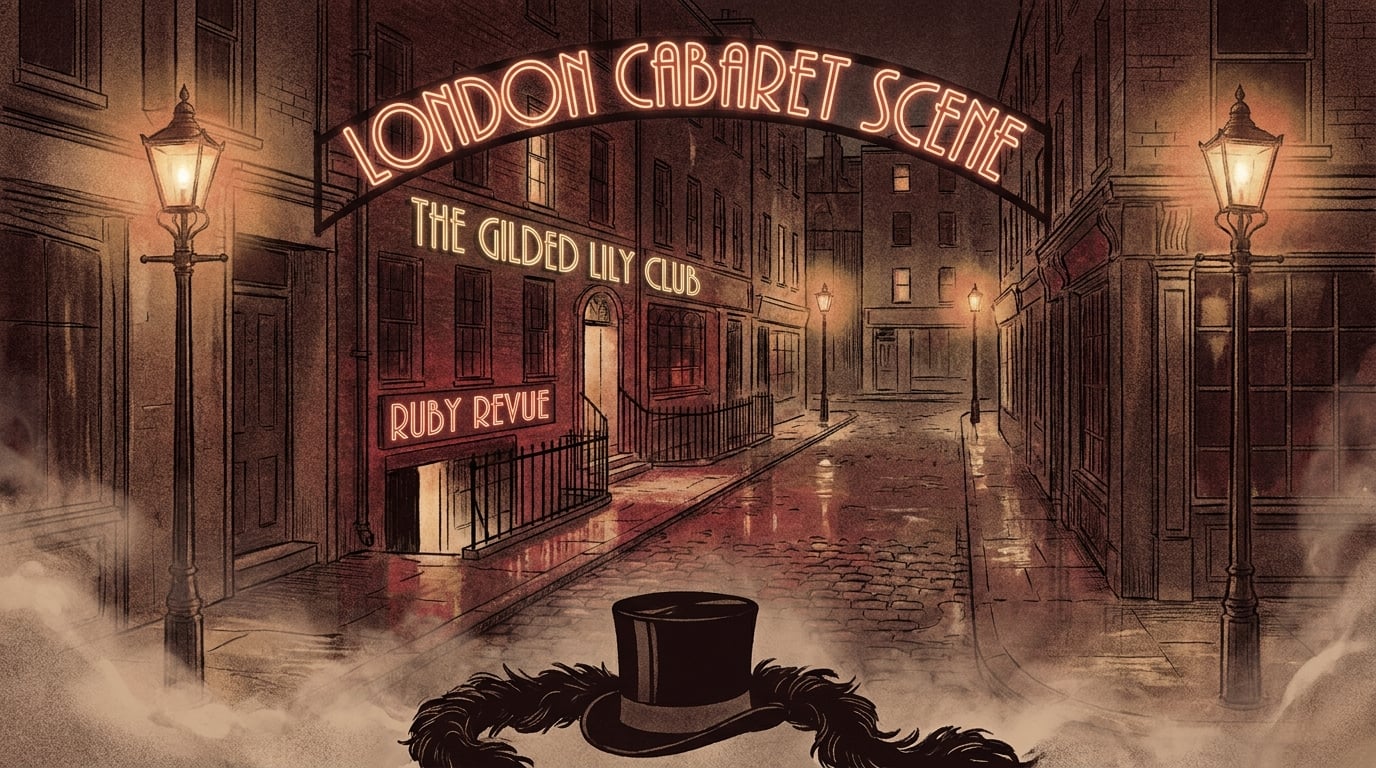
For over a century, Soho’s neon-lit streets pulsed with something you could not find anywhere else in Britain. Feather boas, jazz pianos, sequined corsets, and razor-sharp satire spilled out of basement clubs and converted warehouses. The London cabaret scene was not just entertainment. It was a living, breathing culture that shaped the city’s identity, championed its outsiders, and gave Soho its legendary reputation after dark.
Today, that scene is a fraction of what it once was. Iconic venues have shut their doors. Rents have quadrupled. Performers have scattered. And the question keeps surfacing on forums, in pubs, and across Reddit threads: what actually happened to London’s cabaret scene?
I have spent years following this story, talking to performers who watched the scene transform, and tracking the venue closures that accelerated through the late 2026 period. What follows is the full arc. The birth in smoky Edwardian basements. The golden age of packed houses and headline performers. And the long, painful decline driven by gentrification, changing tastes, and a pandemic that delivered the final blow to venues already on the brink.
Understanding the rise and fall of London’s cabaret scene means understanding Soho itself. Because the two stories are inseparable.
Table of Contents
What Was London’s Cabaret Scene?
Before going further, it helps to clarify what we actually mean by cabaret in the London context. Many people searching for information about London’s cabaret scene land on results about the Broadway musical Cabaret, which is a completely different thing. The musical, based on Christopher Isherwood’s Berlin stories, tells a fictional story set in Weimar Germany. It is a brilliant piece of theatre, but it is not what we are talking about here.
London’s cabaret scene refers to the real, living ecosystem of performance venues, artists, and cultural spaces across the city, particularly concentrated in Soho, that have offered burlesque, drag, jazz, variety acts, satire, and alternative entertainment from the late nineteenth century to the present day. These were small, intimate venues where the audience sat close to the performers. Where the acts could be provocative, political, absurd, or deeply personal. Where the rules of mainstream theatre did not apply.
Burlesque, in its London form, meant elaborate tease performances combining comedy, costume, and choreography. Drag meant everything from lip-sync spectaculars to politically charged gender performance. Variety meant magicians, comedians, singers, and acrobats sharing one bill. Together, these performance traditions created a nightlife culture that was raucous, subversive, and unlike anything in the West End theatres nearby.
Soho was the gravitational center. But the scene rippled outward to Vauxhall, Bethnal Green, Hoxton, and beyond. Understanding the cabaret scene means understanding a century of cultural history compressed into a few square miles of central London.
The Origins: Soho’s Early Nightlife (1890s-1910s)
Soho’s reputation as London’s entertainment district did not happen by accident. By the late Victorian era, the area was already known for its mix of immigrants, artists, bootleggers, and night owls. It was densely packed, affordable, and largely ignored by the wealthy classes who preferred the respectability of the West End. That neglect made it fertile ground for something new.
The true birth of London cabaret culture is often traced to 1912 and the opening of the Cave of the Golden Calf on Heddon Street. Founded by Frida Strindberg, this basement club was modeled on the avant-garde cabarets she had experienced in continental Europe. It featured modernist art on the walls, an eclectic performance program, and an atmosphere of deliberate decadence. Ezra Pound and Jacob Epstein were among its patrons. It was bold, strange, and ahead of its time.
The Cave of the Golden Calf closed within two years. Financial troubles and licensing disputes killed it. But it planted a seed. It proved that London could sustain a venue dedicated to alternative, provocative performance outside the mainstream theatre circuit. The idea survived even when the venue did not.
Music halls were already thriving across London at this point, offering variety entertainment to working-class audiences. But the cabaret concept was different. It was intimate, bohemian, and self-consciously artistic. It attracted people who wanted more than a singalong. They wanted to feel part of something exclusive, slightly dangerous, and culturally significant. That appetite would explode in the decades that followed.
The Rise of London’s Cabaret Scene (1920s-1930s)
The rise of London’s cabaret scene really took hold in the 1920s. The horror of the First World War had left people desperate for escapism, pleasure, and spectacle. Londoners who had survived the trenches were in no mood for restraint. Soho was ready to provide the opposite.
The influence of Weimar Berlin cannot be overstated here. In the 1920s, Berlin was the cabaret capital of the world. Its clubs featured political satire, jazz, nude performances, and a level of sexual openness that shocked and fascinated visitors. British artists, writers, and performers traveled to Berlin and brought back what they saw. The aesthetic, the attitude, and the appetite for provocation crossed the Channel and found a home in Soho.
Jazz arrived in London around the same time, carried by American musicians and British performers who had absorbed the sound. Clubs began incorporating live jazz into their entertainment programs. The combination of music, comedy, and provocative performance created the template that would define London cabaret for decades.
Latin Quarter clubs, nightclubs on Old Compton Street, and basement bars across Soho began offering cabaret-style entertainment. The Café de Paris, opened in 1924, brought a glamorous, high-end version of cabaret to London’s elite. It featured orchestras, dance floors, and floor shows that attracted aristocrats and celebrities. Meanwhile, rougher, more experimental venues in the side streets of Soho catered to a bohemian crowd who wanted something rawer.
This period established the dual character of London cabaret. On one side, there was glamour and spectacle. On the other, there was subversion and artistic experimentation. Both strands would grow stronger as the century progressed, and both would eventually face threats that neither could withstand.
The Golden Age of London Cabaret (1940s-1960s)
The golden age of London cabaret spanned roughly three decades, from the Second World War through the Swinging Sixties. This was the era when the scene reached its cultural peak. Venues were packed. Performers became celebrities. And Soho cemented its reputation as the most exciting nightlife district in Britain.
The Windmill Theatre: “We Never Closed”
No venue symbolizes the resilience of London’s cabaret scene more than the Windmill Theatre. Located on Great Windmill Street in the heart of Soho, it opened in 1931 and became famous for its Revudeville format, a continuous program of variety acts, tableaux vivants, and nude performances that pushed the boundaries of what censors would allow.
During the Blitz, the Windmill earned its legendary motto: “We Never Closed.” While bombs fell on London, the show continued. Performers and audiences sheltered in the theatre while the city burned around them. This defiance became part of the mythology of London nightlife. The Windmill was not just a venue. It was a symbol of the city’s refusal to be beaten.
The theatre’s approach to censorship was famously creative. British law prohibited nude performers from moving on stage. So the Windmill presented static tableaux vivants, where nude performers held poses inspired by classical art and sculpture. It was a loophole that drove authorities mad and delighted audiences for decades.
The Raymond Revuebar and Paul Raymond
In 1958, Paul Raymond opened the Raymond Revuebar in a former cinema on Walker’s Court in Soho. It would become one of the most famous cabaret and strip venues in the world. Raymond, a shrewd businessman with an eye for spectacle, created a venue that combined theatrical staging with adult entertainment in a way London had never seen.
The Raymond Revuebar was not just about titillation. It became a cultural landmark. By the 1960s, it was hosting performances that attracted tourists, celebrities, and curious locals alike. Raymond himself eventually became one of the wealthiest men in Britain, largely through his Soho property empire. His acquisition of Soho real estate would have consequences for the neighborhood that are still being felt today.
The Revuebar also represented a shift in cabaret. Where the Windmill had been cheeky and theatrical, the Raymond was more explicit and commercial. It pointed toward a future where adult entertainment and cabaret would increasingly overlap, sometimes to the detriment of the artistic and satirical traditions that had defined the scene’s earlier years.
Madame JoJo’s and the Birth of Modern Drag Cabaret
When Madame JoJo’s opened its doors at the start of the 1960s, it introduced something new to Soho. Originally a transvestite club, it evolved into one of London’s most important cabaret venues, hosting drag performances, burlesque shows, and live music that attracted a devoted following.
Madame JoJo’s became particularly significant for the LGBTQ+ community. It provided a stage for drag performers at a time when homosexuality was still criminalized in Britain. The Sexual Offences Act of 1967, which partially decriminalized homosexuality in England and Wales, did not create queer spaces in Soho. Those spaces already existed. But the law change allowed them to operate more openly, and cabaret venues like Madame JoJo’s flourished as a result.
The venue’s later incarnation as a host of club nights, burlesque events, and live performances kept it relevant for decades. It was the kind of place where you could see a legendary drag queen, a burlesque troupe, and a DJ set all in one night. It embodied the variety and inclusivity that made London cabaret special.
The LGBTQ+ Heart of Soho Cabaret
You cannot tell the story of London’s cabaret scene without centering the LGBTQ+ community. Queer performers, queer audiences, and queer venue owners built much of what made Soho’s nightlife world-famous. Drag, in particular, has always been a cornerstone of cabaret culture, and London’s drag scene was among the most vibrant in the world.
Old Compton Street became the symbolic heart of London’s gay community, lined with bars, clubs, and cabaret venues that served as safe havens for people who had nowhere else to go. These venues were not just entertainment spaces. They were community centers, meeting places, and sites of resistance against a society that often treated homosexuality as a crime or a disease.
The connection between LGBTQ+ culture and cabaret is profound. Both are about performance, identity, and subversion. Both challenge audiences to question what is normal and what is possible. When drag performers took the stage at venues like Madame JoJo’s, the Royal Vauxhall Tavern, or the Black Cap, they were doing more than entertaining. They were asserting the right to exist visibly and joyfully in a city that often wished they would disappear.
This is why the loss of cabaret venues hits the LGBTQ+ community especially hard. Every closure is not just the loss of a night out. It is the loss of a cultural institution, a safe space, and a piece of communal history. The decline of London’s cabaret scene is inseparable from the decline of London’s queer nightlife infrastructure.
Why London’s Cabaret Scene Declined
The decline of London’s cabaret scene was not caused by a single event. It was a slow accumulation of economic, cultural, and regulatory pressures that eroded the foundations the scene was built on. Understanding these factors is essential to understanding why so many beloved venues are now gone.
Gentrification and Soaring Rents in Soho
Gentrification is the single biggest factor in the decline of London’s cabaret scene. Soho, once affordable and overlooked, became one of the most expensive neighborhoods in one of the most expensive cities in the world. Property values soared. Commercial rents skyrocketed. Independent venue owners who had leased buildings for decades faced renewal terms that were simply unaffordable.
The irony is bitter. Soho became desirable precisely because of the culture that cabaret venues helped create. The edginess, the creativity, and the bohemian atmosphere made the area attractive to developers. But the venues that produced that atmosphere could not survive the property market they helped fuel. Chain restaurants, corporate offices, and luxury apartments replaced the basement clubs and intimate performance spaces that gave Soho its soul.
This pattern is not unique to London. Gentrification has destroyed nightlife and arts scenes in cities around the world. But Soho’s case is particularly stark because the neighborhood is so small and so centrally located. Every square foot is contested. Every lease renewal is a battle. And small, independent venues almost always lose.
Changing Tastes and the Club Era
Cultural tastes shifted dramatically from the 1970s onward. The rise of disco, then house music, then electronic dance music created a new kind of nightlife that competed directly with cabaret for audiences. Why sit and watch a variety show when you could dance until dawn at a superclub?
The nightclub boom of the 1980s and 1990s drew younger audiences away from cabaret venues. Club culture offered a different kind of experience. It was louder, faster, and more anonymous. Cabaret required attention, engagement, and appreciation for craft. Clubbing required energy and stamina. For a generation raised on MTV and rave culture, the appeal of a satirical drag act or a burlesque routine was less obvious.
This does not mean cabaret disappeared. But it did mean venues had to work harder to attract audiences. Many pivoted toward more explicit adult entertainment to compete, which alienated some of the artistic and bohemian audience that had sustained the scene’s creative core. The result was a slow hollowing out. The venues survived, but the culture around them changed.
The Licensing Act and Regulatory Pressure
The Licensing Act of 2003, which came into effect in 2005, fundamentally changed how venues in England and Wales were regulated. It replaced the old system of separate alcohol, entertainment, and public entertainment licenses with a single premises license. In theory, this simplified things. In practice, it created new problems for cabaret venues.
Under the new system, any regulated entertainment, including live music, dance, and performances, required explicit licensing. Small venues that had hosted performances informally for years suddenly found themselves subject to bureaucratic scrutiny and licensing fees they could not afford. Local residents, often newcomers to the area who had moved into flats near established nightlife venues, used licensing reviews to object to noise and disruption.
The cumulative effect was chilling. Venues faced costly license reviews, restrictions on their operating hours, and conditions that made it difficult to host the kind of spontaneous, varied programming that defined cabaret. Some venues gave up their entertainment licenses entirely and became ordinary bars or restaurants. Others spent thousands in legal fees fighting to keep their doors open.
The Closure Wave: Venues We Lost
The toll of these pressures is visible in the sheer number of iconic venues that have closed. Madame JoJo’s shut down in 2014 after its license was revoked following a violent incident involving security staff. The building was later sold and converted. The loss was felt deeply across the cabaret and LGBTQ+ communities.
The Astoria, a legendary live music and club venue on Charing Cross Road, was demolished in 2009 to make way for the Crossrail project. While not exclusively a cabaret venue, it hosted events that were part of the broader alternative nightlife ecosystem. Its removal left a hole in the cultural landscape.
The 12 Bar Club on Denmark Place, a tiny venue that hosted folk, cabaret, and acoustic acts, closed in 2015. The venue was tiny, holding perhaps 70 people, but it was the kind of intimate space where cabaret thrived. Its closure was part of a redevelopment that swept away several independent venues on that block.
Beyond Soho, the losses continued. The Black Cap in Camden, a legendary LGBTQ+ cabaret pub, faced closure battles. The Royal Vauxhall Tavern, one of the oldest surviving LGBTQ+ venues in south London, fought repeated threats to its existence. Each closure or near-closure chipped away at the infrastructure that supported cabaret culture.
COVID-19 and the Final Blow to London Cabaret
If gentrification and changing tastes weakened London’s cabaret scene, the COVID-19 pandemic nearly finished it off. When lockdowns hit in March 2020, every performance venue in the country was forced to close. For an industry built on live, in-person entertainment, this was an existential threat.
The financial damage was catastrophic. Venues that were already operating on thin margins faced months of zero income while still owing rent. Government support programs helped, but they were not enough to save everyone. By the time restrictions eased, several venues had already announced permanent closure.
The Glory, a beloved LGBTQ+ pub and cabaret venue in Hoxton, closed its doors in early 2022. It had been a launching pad for drag performers and a fixture of east London’s alternative nightlife. Its closure was met with grief and anger from the community.
CIRCUS, a cabaret and club night that had been a staple of London’s alternative scene, also shut down. The Aeronaut in Acton, known for its circus-themed cabaret nights, closed as well. Each venue that disappeared took with it a network of performers, crew members, and regular audience members who had formed communities around those spaces.
The pandemic also accelerated trends that were already underway. The shift toward online entertainment, streaming, and social media meant that even when venues reopened, some audience members did not return. Habits changed. And for venues operating at the edge of financial viability, even a small drop in attendance could be fatal.
Forum discussions from the period capture the community’s anxiety. Reddit threads on r/london filled with questions about which venues were still open, which were closing, and whether there was any hope of saving the scene. The consensus was grim. London’s cabaret infrastructure had been gutted.
The Modern Revival: London Cabaret Scene Today
Despite everything, London’s cabaret scene has not died entirely. It has transformed, fragmented, and in some ways adapted to the new reality. But pockets of vibrant, creative performance culture still exist across the city.
Soho Theatre on Dean Street remains a vital hub for cabaret, comedy, and alternative performance. It programs a mix of established acts and emerging performers, and its commitment to diverse, boundary-pushing work makes it one of the most important venues of its kind in the country.
The Kit Kat Club, the immersive production of the musical Cabaret at the Playhouse Theatre, has introduced a new generation to the aesthetics and atmosphere of cabaret, even if it is a theatrical production rather than a traditional cabaret venue. Its success demonstrates that the appetite for cabaret-style entertainment is still strong.
Pop-up cabaret events and temporary venues have become more common. Rather than relying on permanent spaces, promoters and performers organize one-night events in borrowed venues, warehouses, and outdoor spaces. This model is more flexible and less vulnerable to rent increases, but it lacks the continuity and community that permanent venues provide.
Social media has changed how cabaret performers reach audiences. Instagram and TikTok allow drag queens, burlesque artists, and variety performers to build followings and promote shows without traditional marketing channels. This has democratized visibility but has also shifted attention toward individual performers rather than the venues that support them.
Venues like CellarDoor, Phoenix Arts Club, the London Cabaret Club, and Proud Cabaret continue to offer cabaret experiences. Bethnal Green Working Men’s Club, despite facing its own threats, has hosted alternative cabaret and performance art nights that keep the spirit alive. The scene is smaller, more fragmented, and more precarious than it was at its peak. But it has not vanished.
The question is whether this smaller, nimbler scene can sustain itself long-term without the infrastructure of permanent, affordable venues. History suggests that cabaret culture is remarkably resilient. It has survived world wars, censorship, and moral panics. Whether it can survive London’s property market remains to be seen.
FAQs
What is the difference between the Cabaret musical and London’s cabaret scene?
The musical Cabaret is a fictional Broadway and West End show set in 1930s Berlin, based on Christopher Isherwood’s stories. London’s cabaret scene refers to the real, historical ecosystem of performance venues across London, especially in Soho, that hosted burlesque, drag, variety acts, and alternative entertainment for over a century.
What happened to London’s cabaret scene?
London’s cabaret scene declined due to a combination of gentrification, soaring commercial rents in Soho, changing audience tastes, the Licensing Act of 2003, and the COVID-19 pandemic. Iconic venues like Madame JoJo’s, The Glory, and CIRCUS closed permanently, devastating the infrastructure that supported cabaret culture.
Why are London cabaret venues closing?
London cabaret venues are closing primarily because of skyrocketing rents in central London neighborhoods like Soho. Gentrification has replaced independent venues with chain businesses and luxury developments. Regulatory pressure from licensing laws, noise complaints from new residents, and the financial impact of the COVID-19 pandemic have also contributed significantly.
When was London’s cabaret golden age?
London’s cabaret golden age ran roughly from the 1940s through the 1960s. Venues like the Windmill Theatre, which famously never closed during the Blitz, the Raymond Revuebar, and Madame JoJo’s defined the era. Soho was the center of this culture, attracting performers and audiences from around the world.
Is the Emcee in Cabaret queer?
In the musical Cabaret, the Emcee is widely interpreted as a queer character who embodies the sexual and gender fluidity of Weimar Berlin’s Kit Kat Club. This is a theatrical character in a fictional story and is separate from the real London cabaret scene, though the queer themes of the musical reflect the broader connection between cabaret culture and LGBTQ+ history.
Where can I still find cabaret shows in London today?
Active cabaret venues in London include Soho Theatre, CellarDoor, Phoenix Arts Club, Proud Cabaret, the London Cabaret Club, and Bethnal Green Working Men’s Club. The Royal Vauxhall Tavern remains an important LGBTQ+ performance venue. Pop-up cabaret events also take place at various temporary locations across the city.
How did COVID-19 affect London’s cabaret scene?
The COVID-19 pandemic forced all performance venues to close for extended periods, causing catastrophic financial losses. Venues already operating on thin margins could not survive months without income. The Glory in Hoxton, CIRCUS, and The Aeronaut in Acton were among the venues that closed permanently as a result of the pandemic’s financial impact.
The Legacy of London’s Cabaret Scene
The rise and fall of London’s cabaret scene is a story about more than nightlife. It is a story about what happens when a city’s culture is valued less than its property. It is about the communities that form around shared spaces and what is lost when those spaces disappear. And it is about the tension between creativity and commerce that defines every great cultural district.
From the smoky basement of the Cave of the Golden Calf in 1912 to the packed houses of the Windmill Theatre during the Blitz, from the drag pioneers of Madame JoJo’s to the burlesque revivalists of the 2026 era, London’s cabaret scene has been a century-long celebration of performance, provocation, and defiance. It has given voice to outsiders, stage to the unconventional, and a home to anyone who did not fit anywhere else.
The decline is real and documented. Gentrification has gutted Soho. Rents have driven out the independent venues that gave the area its character. The pandemic accelerated losses that were already inevitable. The Glory, CIRCUS, The Aeronaut, and Madame JoJo’s are gone. Each closure represents not just a business failure but a cultural loss that cannot be replaced by a chain restaurant or a luxury flat.
But the story is not over. Soho Theatre still programs boundary-pushing work. The Royal Vauxhall Tavern still hosts legendary drag nights. Performers still find stages, even if those stages are temporary, borrowed, or improvised. The spirit of cabaret, the insistence on live, intimate, subversive performance, survives even when the venues do not.
The question for 2026 and beyond is whether London wants to keep its cabaret culture alive. That means protecting venues from predatory development. It means supporting performers who earn next to nothing. It means recognizing that the things that make a city worth living in are not always the things that generate the highest return on investment.
London’s cabaret scene rose from nothing, survived wars, and defined an era. Whether it rises again depends on whether the city values its own cultural history enough to fight for it.