
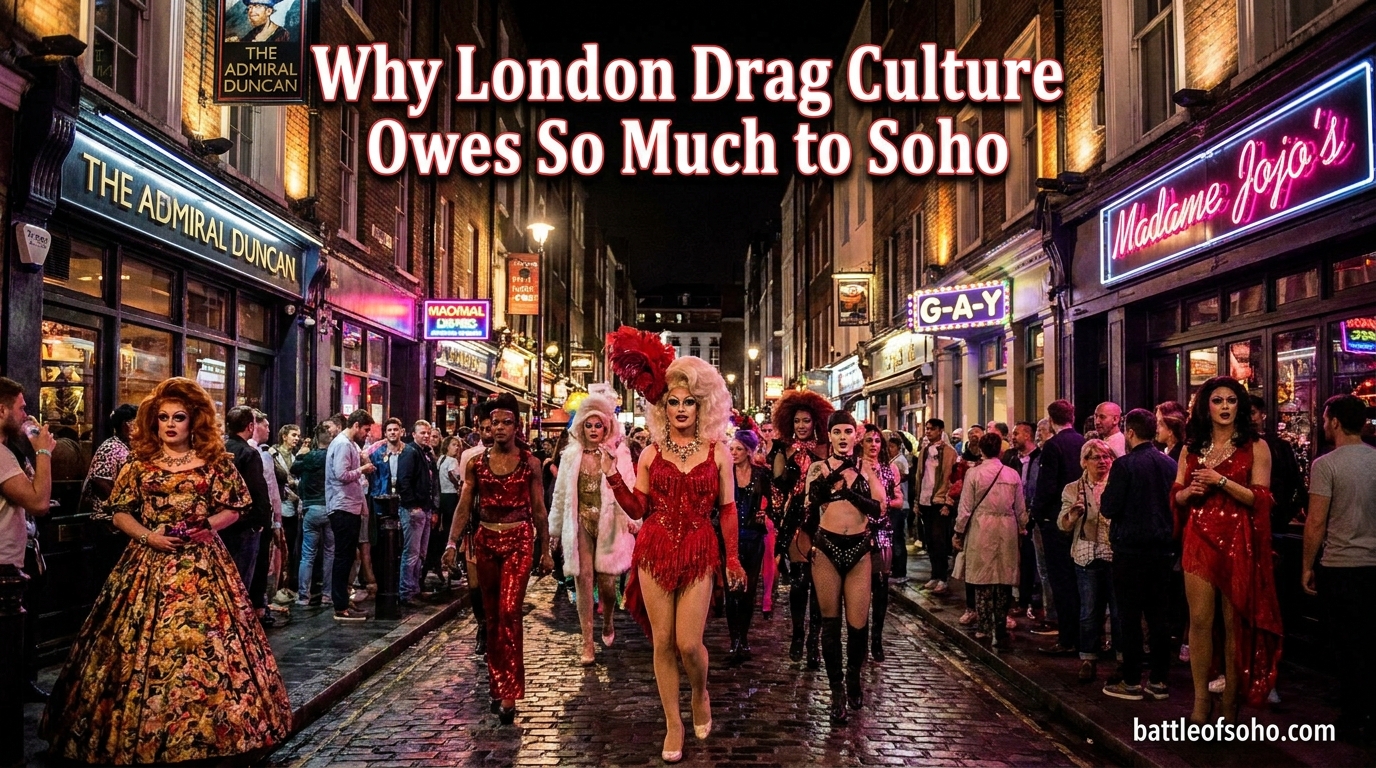
Walk down Old Compton Street on a Saturday night and you will hear it before you see it. The thump of show tunes spilling onto the pavement, the flash of sequins under streetlights, a queen in six-inch heels working a crowd outside the Admiral Duncan. This is Soho after dark, and it has been the beating heart of London drag culture for well over a century.
If you want to understand why London drag culture owes so much to Soho, you have to look beyond the glitter. You have to trace a line from secret 18th-century drinking clubs through wartime music halls, through the devastation of the AIDS crisis, all the way to the global platform of RuPaul’s Drag Race UK. Few neighbourhoods anywhere in the world have such an unbroken thread of queer performance history running through them.
Our team spent weeks digging through National Archives records, performer interviews, and venue histories to piece together this story. What we found is that Soho did not just host drag. It shaped it, protected it, and eventually exported it to the world.
This article traces that full timeline. We cover the molly houses of the 1700s, the legendary Caravan Club of the 1930s, the Colony Room years, the venues that produced household names like Lily Savage, and the modern scene that feeds talent into Drag Race UK. We also address the harder questions. Gentrification, the AIDS crisis, the Admiral Duncan bombing, and what the future holds for queer performance spaces in a changing Soho.
Table of Contents
The Roots: Molly Houses and Theatrical Cross-Dressing
London drag culture owes so much to Soho because the neighbourhood provided a rare pocket of tolerance in a city where gender nonconformity was punishable by death. That tolerance was never official. It existed in the shadows, in the back rooms and cellar clubs where queer people gathered because they had nowhere else to go.
The story begins long before the term “drag” existed. In 18th-century London, the city was home to dozens of molly houses. These were private premises where men could gather, socialise, and dress in clothing considered appropriate for women. Many operated in and around the Clerkenwell and City fringes, but the cultural energy of bohemian London was already shifting westward toward what we now call Soho.
Inside a molly house, men adopted female names and personas. They performed mock birth rituals and dance events. Some sources describe them wearing aprons, gowns, and petticoats. The most famous raid occurred in 1726 at Mother Clap’s molly house, which led to multiple executions. These were not drag shows in the modern sense. But they were the first documented spaces in London where gender performance became a communal, social act.
Alongside the molly houses ran a parallel tradition that was entirely legal and openly celebrated. Shakespearian theatre required male actors to play all female roles, since women were banned from the stage until 1660. Even after that ban lifted, the tradition of male performers in female dress persisted in pantomime, where the “pantomime dame” became a beloved British institution. These theatrical roots gave British drag a distinctive flavour that set it apart from American and European traditions. British drag would always lean heavily on comedy, character work, and audience participation rather than pure illusion.
Soho’s geography made it a natural magnet for this culture. It sat outside the strict jurisdiction of the City of London. It was already a neighbourhood of immigrants, artists, and outsiders. Cheap rents and dense street networks made it easy for discreet gatherings to operate below the notice of authorities. By the 19th century, music halls in the Soho area were hosting female impersonators as part of their variety lineups, bringing gender performance to working-class audiences who saw nothing strange about a man in a dress delivering a comic song.
The Caravan Club and Interwar Queer Soho
The interwar period transformed Soho into something recognisably modern. By the 1920s and 1930s, the neighbourhood had become a hub of bohemian nightlife, cheap restaurants, and subterranean drinking clubs that operated in defiance of licensing laws. This was the Soho of Fitzrovia’s borders, of raffish charm and dangerous reputation, and it created the conditions for queer performance to flourish in new ways.
The most significant venue of this era was the Caravan Club, located at 81 Endell Street on the edge of Soho. Operating in 1934, it was described by police at the time as London’s most unconventional club. The Caravan was an explicitly queer space where men could dance together, cross-dress openly, and socialise without the constant fear of exposure that governed everyday life. National Archives files from the period contain detailed police surveillance reports describing the club’s interior, its patrons, and the performances that took place there.
The Caravan Club was raided and shut down in 1934, but its brief existence proved that there was a hungry audience for queer nightlife in central London. Other venues filled the gap. The Shim Sham Club on Wardour Street drew mixed crowds with jazz-age energy and a deliberately diverse door policy. Billies Club, another Soho-area premise, catered to a queer clientele during a period when homosexuality remained entirely criminalised.
What made these venues different from the earlier molly houses was their connection to performance. They were not just gathering places. They were entertainment venues with stages, acts, and a sense of theatrical occasion. The performers who worked these rooms were developing the skills that would define London drag for decades. Lip sync, comedy timing, crowd work, and the ability to read a room and adjust on the fly were all being honed in Soho’s interwar clubs.
The National Trust and Historic England have since recognised the significance of these sites. In recent years, historians have used police records and court documents to reconstruct what the Caravan Club looked like and who frequented it. These archives paint a picture of a vibrant, defiant community that refused to disappear even under constant threat of prosecution.
Post-War Soho and the Colony Room Years
After the Second World War, Soho entered a period that defined its popular image for generations. The neighbourhood became synonymous with strip clubs, peep shows, and sex shops. Soho was a red light district, and that reputation came with both danger and a strange kind of freedom. The same hands-off policing that allowed the sex industry to operate also created space for queer venues to exist along the margins.
The Colony Room Club at 41 Dean Street became the most famous of Soho’s post-war private drinking clubs. Opened in 1948 by Muriel Belcher, it was a members-only establishment that attracted an extraordinary mix of artists, writers, actors, and queer performers. Francis Bacon was a regular. Lucian Freud drank there. So did a rotating cast of drag performers, camp comedians, and theatrical personalities who found in the Colony Room a space where conventional rules of behaviour simply did not apply.
The Colony Room was not a drag bar. But it was a space where gender play, camp humour, and theatrical self-presentation were valued rather than punished. Performers who honed their acts in Soho’s rougher venues could find a more appreciative, if equally intoxicated, audience behind the Colony Room’s famous green door. The club operated for 60 years until its closure in 2008, and its influence on Soho’s creative culture was immeasurable.
During this same period, female impersonators were working the pub and club circuit in and around Soho. These were not the polished drag queens of today. They were variety performers who sang, told jokes, and worked the crowd with a mix of glamour and bawdy humour. The tradition owed as much to music hall and pantomime as it did to any notion of queer identity. But for many performers, these shows were a lifeline. They provided income, community, and a rare opportunity to express themselves publicly.
Everything changed on 27 July 1967. The Sexual Offences Act partially decriminalised homosexuality in England and Wales for men over 21 acting in private. It did not legalise being gay. It did not protect anyone from discrimination. It certainly did not end police harassment. But it cracked open a door that had been sealed shut for centuries. For Soho’s queer venues, it marked the beginning of a slow transformation from underground secrecy toward something approaching visibility.
Soho’s Golden Age: The Venues That Built Drag Royalty
The decades following partial decriminalisation saw Soho’s drag scene enter its most prolific period. Venues multiplied. Performers built careers that spanned decades. And Old Compton Street established itself as the undisputed centre of gay London, with drag at its core.
The Royal Vauxhall Tavern, while technically south of the river in Vauxhall rather than in Soho itself, functioned as a sister venue and talent pipeline for the Soho scene. Since the 1940s it had hosted queer entertainment, and by the 1980s it had become the venue where the biggest names in British drag either got their start or proved their mettle. Sunday night at the RVT was legendary. It was where Lily Savage built the act that would make her a household name, performing to packed crowds who came specifically for the chaos, the comedy, and the sense that anything could happen.
Back in Soho proper, the Admiral Duncan pub at 54 Old Compton Street became one of the most important queer venues in Britain. A traditional pub by day, it transformed into a hub of drag entertainment most nights of the week. The Admiral Duncan was small, cramped, and gloriously theatrical. Performers worked a room so tight they could reach out and touch the audience, which made for an intimacy that larger venues could never replicate. It became a rite of passage for drag queens in London. If you could win over the crowd at the Admiral Duncan, you could win over anyone.
The Black Cap in Camden was another venue deeply connected to the Soho drag ecosystem. Many of the same performers who worked Old Compton Street would head north to the Black Cap for evening shows. The venue built a reputation for high-quality drag revues and became a fixture of London’s queer nightlife from the 1960s onward. Its eventual closure in 2015 was met with protests and a sustained community campaign that highlighted how threatened queer performance spaces had become.
The Apollo on Wardour Street represented the bigger-budget end of Soho drag. In the 1980s, it hosted drag revues that drew celebrity attendees and gave performers a larger stage to work with. Forum commenters from the era recall encounters with famous faces in the audience and the electric atmosphere of a packed Saturday night show. The Apollo showed that drag could draw crowds comparable to any mainstream entertainment venue in the West End.
The Candy Bar on Carlisle Street served a specific role as a lesbian and queer women’s venue that also hosted drag performances, including drag king nights. It represented the diversity of Soho’s scene, which was never exclusively male or exclusively about female impersonation. Drag kings, bio queens, and performers across the gender spectrum all found space in Soho’s venue ecosystem, even if mainstream coverage often focused only on drag queens.
Drag Royalty: The Performers Who Made Soho Famous
Venues are just walls without the performers who bring them to life. Soho’s drag scene produced some of the most recognisable names in British entertainment, and their stories tell the broader history of London drag better than any timeline.
Lily Savage is the name most people associate with British drag, and for good reason. Created by Paul O’Grady, Lily Savage was born in the clubs of Camden and Vauxhall but came of age performing in and around Soho. The character was sharp, funny, and unapologetically working class. Lily would deliver merciless crowd work, lampoon celebrity culture, and create a persona so compelling that she crossed over into mainstream television. Blankety Blank, chat shows, primetime specials. Lily Savage proved that a drag queen could become one of the most beloved figures in British popular culture. Every drag performer in London who followed owes a debt to the trail Lily Savage blazed.
Phil Starr was a different kind of pioneer. Born in 1953, Starr spent more than 40 years as a working drag performer in Soho and beyond. She was known for her warmth, her quick wit, and her ability to command any room she walked into. Starr was part of the generation that kept drag alive during the darkest years of the AIDS crisis, when performances doubled as fundraisers and community gatherings became acts of survival. She performed at venues across Soho and the wider London circuit, mentoring younger performers and maintaining standards of professionalism that defined what it meant to be a working drag queen in Britain.
Dave Lynn, who began performing in 1975, represents another thread of Soho’s drag story. Lynn was there for the golden years, the crisis years, and the recovery. Her career spanned the transition from underground queer venues to the post-Drag Race landscape, and she has spoken openly about what it was like to perform through the AIDS crisis, watching friends and colleagues disappear while the show had to go on. Performers like Lynn are the living archive of Soho drag, carrying memories of venues, routines, and personalities that no longer exist.
Maisie Trollette, performing since 1972, holds the distinction of being one of Britain’s longest-working drag queens. Based in Brighton but deeply connected to the London and Soho circuit, Trollette represents the comedy drag tradition at its purest. No elaborate costumes or lip sync spectaculars. Just a performer with a microphone, decades of material, and the ability to make a room full of strangers laugh until they ache.
Lola Lasagne, Rose Garden, Miss Jason, and The Duchess all built careers in the Soho circuit during the 1980s and 1990s. Each brought something different. Lasagne was glamour and theatricality. Rose Garden was old-school variety with modern energy. Miss Jason was sharp comedy and audience interaction. The Duchess was polish and professionalism. Together they formed a roster of talent that made Soho a destination for drag fans from across the country.
Taylor Trash emerged from a later generation but carried the Soho tradition forward. Known for bearded queen aesthetics and a punk-inspired approach to drag, Trash represents the evolution of the art form beyond traditional female impersonation. In interviews, Trash has described the Dalston Superstore drag brunch scene as “pure chaos” with “almost no rules” for artistic expression, capturing how newer venues built on Soho’s foundations while pushing the boundaries further.
Son of a Tutu, LoUis CYfer, and Asttina Mandella represent the modern era of Soho-connected drag. Son of a Tutu brings gospel-trained vocals and theatrical glamour. LoUis CYfer is known for horror-themed drag that expands what a drag performance can look like. Asttina Mandella, who began performing around 2015, brought Soho-honed skills to Drag Race UK, showing a national audience what London drag looked like at its most polished and dynamic.
The AIDS Crisis, Section 28, and Community Resilience
You cannot tell the story of Soho drag without telling the story of what nearly destroyed it. The AIDS crisis of the 1980s and 1990s hit London’s queer community with devastating force, and Soho’s drag venues were on the front lines.
Performers watched friends, colleagues, and audience members fall ill and die. Drag shows that had been celebrations of camp and comedy became something else entirely. They became community gatherings where people shared news, raised money for affected individuals, and found moments of joy in the middle of catastrophe. Drag performers organised benefit nights, collected donations, and used their platforms to spread information about safe sex and HIV treatment when the government was doing almost nothing.
Then came Section 28. Passed in 1988, this legislation prohibited local authorities from “promoting homosexuality” or teaching the acceptability of same-sex relationships. It had a chilling effect on LGBTQ+ life across Britain. Queer venues felt it acutely. Performers had to navigate a climate where their very existence was treated as politically dangerous by the governing party. Some venues lost council support. Schools could not mention queer identities. The message was clear: you are not legitimate.
Soho’s drag scene survived through sheer stubbornness and community solidarity. Venues stayed open. Performers kept working. And the tradition of queer performance in central London continued even as the political climate turned hostile.
The community’s resilience was tested again on 30 April 1999, when a neo-Nazi named David Copeland planted a nail bomb at the Admiral Duncan pub. Three people were killed. Dozens were injured. The attack targeted Soho specifically because it was the heart of London’s gay community. The bombing could have broken the neighbourhood’s spirit. Instead, it galvanised it. In the days that followed, crowds gathered on Old Compton Street in defiance. Vigils were held. The queer community of Soho refused to be driven underground again.
The Admiral Duncan reopened and continues to operate today. Its survival is a testament to what drag culture in Soho has always been about: refusing to disappear, no matter what forces try to make you.
From Soho to the World: Drag Race UK and Mainstream Fame
The landscape of British drag shifted fundamentally with the launch of RuPaul’s Drag Race UK in 2019. Suddenly, drag performers who had spent years working the Soho and London circuit had a national television platform. Audiences who had never set foot in a queer venue were watching drag competition shows from their living rooms.
Baga Chipz, a performer deeply rooted in the London and Soho cabaret tradition, appeared on the first series of Drag Race UK and became an instant fan favourite. Her comedy, her quick wit, and her unapologetically British approach to drag introduced global audiences to a style that was distinct from the American Drag Race format. Baga Chipz was not doing polished, pageant-style drag. She was doing the Soho pub tradition. Fast jokes, brutal reads, and a pint glass in hand.
Vanity Milan and Kitty Scott-Claus followed in later series, both bringing London-trained skills to the Drag Race runway and main stage. Their presence on the show underscored how Soho and the broader London scene had functioned as a training ground. The performance skills, the comedy timing, the ability to improvise with a live audience, all of these were developed in venues like the Admiral Duncan, the RVT, and the pubs and clubs of Old Compton Street before being broadcast to millions.
Asttina Mandella brought a different dimension to Drag Race UK. As a performer of colour, her presence highlighted conversations about diversity within the drag scene that the community had been grappling with for years. BAME performers have always been part of Soho’s drag history, but their contributions have often been underrepresented in mainstream coverage. Drag Race UK, for all its flaws, brought some of those stories to wider audiences.
The mainstreaming of drag through Drag Race UK has not been universally celebrated within the community. Some performers argue that television drag bears little resemblance to the live experience that defines the art form. Others worry that the show creates a hierarchy where only Drag Race alumni can command bookings and fees, squeezing out performers who chose not to audition. The tension between mainstream visibility and community integrity is one of the defining conversations in contemporary drag culture, and Soho sits at the centre of it.
Kenny Everett’s character Cupid Stunt, while predating Drag Race by decades, represents an earlier moment when drag-adjacent performance crossed into mainstream British television. The tradition of British drag reaching mass audiences through broadcast media has deep roots, and Drag Race UK is the latest, most globally significant chapter.
Gentrification, Drag Brunches, and the Changing Face of Soho
The biggest existential threat to Soho drag culture today is not homophobia or legislation. It is rent. Soho has been gentrifying rapidly since the early 2000s, and the pace has only accelerated. Property values have skyrocketed. Independent venues that once hosted drag shows have been replaced by chain restaurants, cocktail bars targeting affluent professionals, and corporate offices. Each venue that closes takes a piece of drag history with it.
Soho became gentrified in waves. The sex shops and clip joints of the 1970s and 1980s were the first to go, pushed out by rising rents and changing council policies. Then the smaller, independent gay bars began to disappear. The Candy Bar closed. The Black Cap in Camden, while outside Soho, suffered a similar fate. Each closure sparked community campaigns, petitions, and protests, but the economic pressures proved overwhelming.
The drag brunch phenomenon represents another complicated shift. Modelled on a format that originated in New York, drag brunches have exploded across London. Venues like Soho Zebrano and Dalston Superstore host packed weekend sessions where audiences enjoy bottomless drinks and drag performances. The format has been enormously successful commercially, but it has generated debate within the LGBTQ+ community.
The core tension is about audience. Drag brunches frequently attract predominantly straight crowds, often hen parties and birthday celebrations. Some performers welcome the broader audience and the better pay that corporate events provide. Others feel that queer spaces are being colonised by straight audiences who treat drag as entertainment without understanding or respecting its cultural roots. The fear is that the very spaces queer people built for themselves are being repurposed for consumption by people who do not share the struggle that created them.
The conversation about corporate drag extends beyond brunches. Brands now hire drag performers for advertising campaigns, product launches, and Pride month activations. Some of these partnerships are genuine and respectful. Others are criticised as pinkwashing, using drag aesthetics to sell products without supporting the community. Performers must navigate these tensions while making a living in an industry that has never been well-paid.
Meanwhile, East London has emerged as a rival centre for queer nightlife. Dalston Superstore, The Glory in Haggerston, and venues across Shoreditch have attracted performers and audiences looking for something more avant-garde than the traditional Soho pub drag format. Reddit users and forum commenters regularly debate whether Soho or East London is now the true centre of London’s queer scene. The reality is that both matter. Soho remains the spiritual and historical home, while East London provides space for experimentation and new forms.
Where to Experience Drag in Soho Today
Despite the challenges, you can still experience drag in Soho. The Admiral Duncan continues to host performances most nights of the week. The mix of regular performers and visiting acts keeps the programming fresh while maintaining the venue’s historic character. It remains the single best place in Soho to experience traditional British pub drag.
Old Compton Street still has several venues that programme drag regularly, though the lineup changes as venues open, close, and reinvent themselves. Salsa! Soho offers Latin-themed nights that frequently feature drag hosts and performers. Comptons of Soho, while primarily a traditional gay pub, occasionally hosts drag events and remains an important community space.
For tourists seeking authentic drag experiences, the key piece of advice from working performers is to look beyond the heavily advertised corporate brunches. Seek out the smaller venues where working drag queens perform to regular crowds. These shows offer a more genuine sense of what Soho drag is actually about, and your money goes directly to performers rather than event production companies.
If you want to support Soho’s queer venues, the most effective thing you can do is simple. Go to them. Spend money at the bar. Tip the performers. Bring friends. Tell others. Every pound spent at an independent queer venue is an investment in the survival of the culture that made Soho famous in the first place.
Frequently Asked Questions About Soho and London Drag Culture
Is Soho still seedy?
Soho today is far less seedy than its historical reputation suggests. The sex shops and clip joints that defined the area in the 1970s and 1980s have largely disappeared, replaced by restaurants, bars, and corporate offices. However, Old Compton Street retains its identity as the centre of London’s gay scene, with queer venues and drag shows continuing to operate among the gentrified surroundings.
Why was Soho a red light district?
Soho became a red light district because its location outside the strict jurisdiction of the City of London, combined with cheap rents and a dense street layout, made it attractive to underground businesses. From the post-war period through the 1990s, the area was known for strip clubs, peep shows, and sex shops. The same hands-off policing that allowed the sex industry to operate also created space for queer venues to exist.
When did Soho become gentrified?
Soho began gentrifying noticeably in the early 2000s, with the process accelerating dramatically in the 2010s. Rising property values, council regeneration policies, and the expansion of corporate retail pushed out independent venues and sex industry businesses. The trend has continued into the 2020s, with many long-standing queer venues closing or being forced to adapt to survive.
Why does London have a Soho?
London’s Soho developed as a distinct neighbourhood because of its position between the City of London and Westminster, outside the direct control of either authority. The land was originally hunting ground before being developed in the 17th century. Its location attracted immigrants, artists, and outsiders, creating the bohemian and diverse character that made it a natural home for queer culture and drag performance.
Where did drag culture start?
Drag culture in London traces its roots to two parallel traditions. The first is the molly houses of the 18th century, where men gathered in private to cross-dress and socialise. The second is the theatrical tradition of male actors performing female roles, dating back to Shakespeare and continuing through music hall and pantomime. Soho became the neighbourhood where these traditions converged and evolved into modern drag performance.
Why is Soho London so famous?
Soho is famous because it has been the cultural centre of London’s entertainment, media, and LGBTQ+ scenes for over a century. It houses the film and theatre industries, world-renowned restaurants and bars, and the densest concentration of queer venues in Britain. Old Compton Street in Soho is recognised internationally as one of the most significant streets in LGBTQ+ history.
What percent of drag queens are straight?
There is no definitive statistical data on the sexual orientation of drag performers. Drag has always attracted performers across the full spectrum of sexuality and gender identity. While the majority of drag queens historically identify as gay men, there are heterosexual male drag queens, lesbian queens, bisexual performers, trans performers, and non-binary artists. The art form is open to anyone willing to do the work.
What is the history of Soho London?
Soho’s history spans from 17th-century hunting grounds through bohemian artistic quarters, wartime nightlife, post-war red light district years, and modern gentrification. For LGBTQ+ history specifically, Soho has been central since the 18th-century molly houses, through the interwar queer clubs like the Caravan Club, the post-war Colony Room years, the golden age of drag venues on Old Compton Street, the AIDS crisis, the 1999 Admiral Duncan bombing, and the current era of Drag Race UK fame.
Soho’s Drag Legacy Lives On
When you trace the full arc from 18th-century molly houses to Drag Race UK, the scale of what Soho has contributed to drag culture becomes clear. This small neighbourhood in central London gave the world a continuous tradition of queer performance that survived criminalisation, the AIDS crisis, a hate-motivated bombing, and the slow erosion of gentrification.
The venues matter. The Admiral Duncan, the Royal Vauxhall Tavern, the Caravan Club, the Colony Room, the Apollo on Wardour Street. Each one played a role in developing and sustaining the art form. But the performers matter more. Lily Savage, Phil Starr, Dave Lynn, Maisie Trollette, Taylor Trash, Baga Chipz, Asttina Mandella. These artists and hundreds of others built careers in Soho that shaped what drag looks like in Britain and around the world.
London drag culture owes so much to Soho because Soho was the place where drag was allowed to happen. Not legally, not officially, and never without resistance. But the density of venues, the community of performers, and the audience of queer Londoners who supported them created an ecosystem that produced extraordinary art under extraordinary pressure.
The future of drag in Soho is not guaranteed. Rents continue to rise. Venues continue to close. The balance between mainstream visibility and community integrity remains precarious. But if the history of Soho drag teaches anything, it is that this culture does not give up easily. The performers who worked through the AIDS crisis, who defied Section 28, who reopened the Admiral Duncan after a bomb went off, they built something that cannot be erased by a rent increase.
So the next time you walk down Old Compton Street and hear those show tunes spilling onto the pavement, remember that you are hearing more than a night out. You are hearing centuries of defiance, artistry, and survival. That is why London drag culture owes so much to Soho. And that is why Soho’s queer venues deserve every bit of support we can give them.