
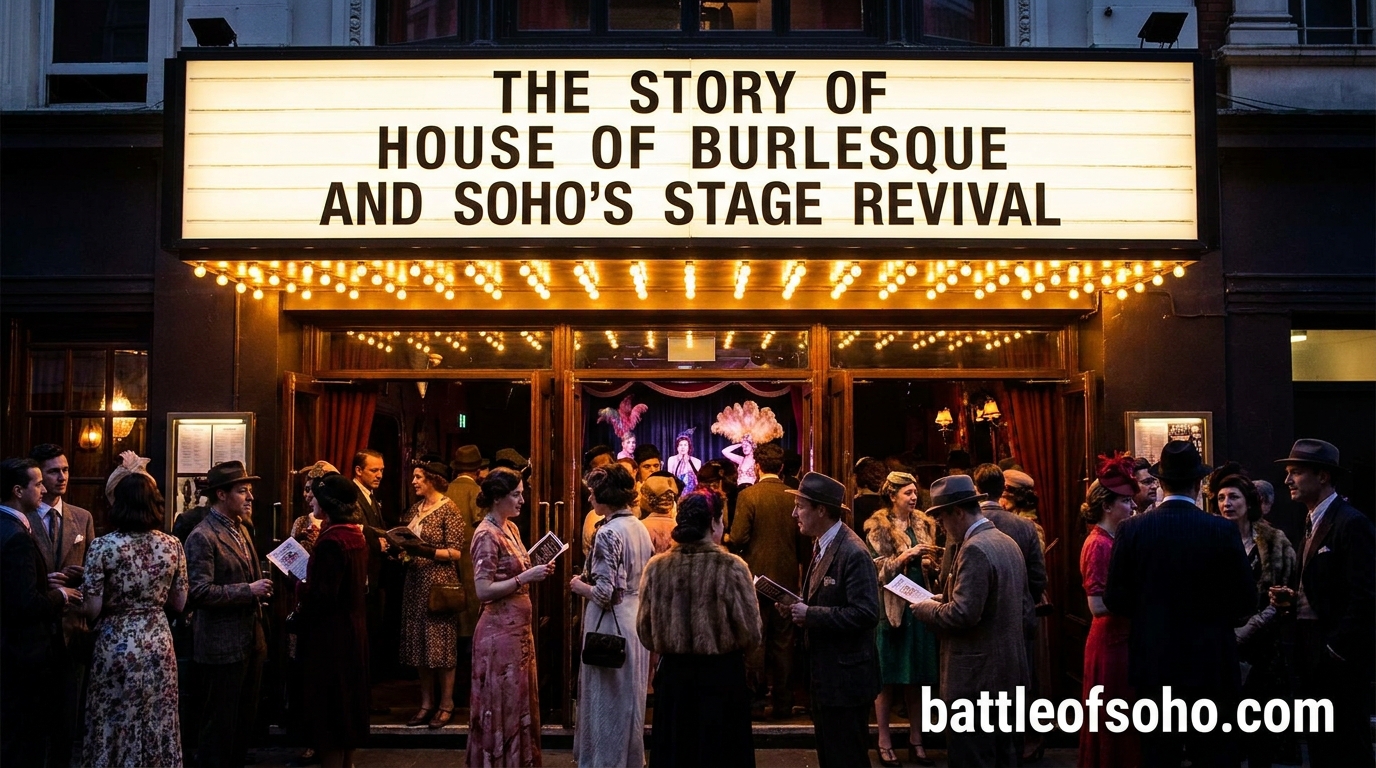
When Madame Jojo’s shut its doors on Brewer Street in 2014, something cracked in the soul of Soho. For decades, that legendary venue had been the beating heart of London’s cabaret and drag scene, a place where feathers, sequins, and unapologetic glamour ruled the night. Its closure felt like a funeral for an entire era of Soho nightlife history.
But the story did not end there. Out of that loss, something remarkable grew. House of Burlesque, founded by international showgirl Tempest Rose, stepped into the void and became the driving force behind Soho’s stage revival. What started as a small production at a fringe theatre in Islington evolved into one of the UK’s most influential burlesque production companies, carrying the torch for a tradition that stretches back to London’s music hall golden age.
This is the story of how a grassroots arts movement kept Soho’s stage alive when developers and licensing disputes threatened to silence it forever. It is a tale of resilience, glitter, and the stubborn refusal to let one of the world’s most famous entertainment districts become what Tempest Rose herself called a “corporate wasteland.”
Table of Contents
The Founding of House of Burlesque (2009-2010)
House of Burlesque began in 2009 at the Kings Head Theatre in Islington, a small fringe venue that gave the company its first stage. Founded by Tempest Rose and Lola La Belle, the production house arrived at a moment when British burlesque was stirring back to life but lacked a permanent home in London.
The early days were modest. Rose and La Belle pooled their experience as performers to build a revue-style show that combined traditional burlesque elements with a contemporary theatrical sensibility. They wanted to prove that burlesque could be sharp, funny, political, and artistic, not just a nostalgic tribute to the past.
The breakthrough came in 2010 with Circus Burlesque, a production that fused circus performance with classic burlesque revue. The show sold out the prestigious Assembly Rooms at the Edinburgh Festival Fringe, one of the largest and most competitive arts festivals in the world. Edinburgh Spotlight named it their Pick of the Fringe, a recognition that put House of Burlesque on the map as a serious production company rather than a novelty act.
That Edinburgh success was a turning point. It gave Rose the credibility and visibility to book larger venues across London and beyond. The company began building a reputation for high production values, theatrical storytelling, and a commitment to burlesque as a legitimate performance art. Within two years, House of Burlesque would find itself at the centre of Soho’s nightlife scene.
The timing mattered. London’s cabaret scene was experiencing a broader resurgence in the early 2010s, with audiences hungry for live, intimate entertainment that felt different from the standard West End fare. House of Burlesque arrived with a product that filled that gap perfectly.
Tempest Rose: The Visionary Behind the Revival
Tempest Rose is not just a producer. She is an international showgirl, singer, compere, and one of the most recognizable figures in British burlesque. Her career has spanned performances at the Burlesque Hall of Fame in Las Vegas, appearances on Channel 4, BBC, and ITV2, and a consistent presence at major venues across the UK.
Rose describes burlesque as “a parody of femininity” that is also “political and satirical.” That philosophy runs through everything House of Burlesque produces. Her shows are not simply about glamorous costumes and choreographed routines. They are constructed as commentary on gender, power, and the performance of sexuality itself.
In interviews, Rose has spoken about the deep roots of burlesque in British entertainment history. The art form traces its lineage back to the music halls of Victorian London, where satire, parody, and variety entertainment were woven into the fabric of popular culture. Rose sees herself as continuing that tradition, updated for contemporary audiences.
Her role as compere, the host who guides the audience through the evening’s acts, is central to the House of Burlesque experience. A skilled compere breaks the fourth wall, builds rapport with the room, and creates an atmosphere where audiences feel they are participating in something alive rather than watching from a distance.
Rose has also been vocal about the challenges facing performers and venues in central London. In a 2019 interview with Westminster Extra, she warned that London was “in danger of becoming dull” as independent venues closed and cultural spaces gave way to chain restaurants and corporate developments. That concern has driven much of her work in keeping burlesque visible and accessible.
Her influence extends beyond performance. Through Burlesque Idol, the talent competition she has run for over 14 years, Rose has nurtured generations of new performers. Many of the burlesque artists working in London today trace their professional debut to that competition stage.
Key Productions That Defined the Movement
Over more than 15 years, House of Burlesque has built a catalogue of productions that charts the evolution of British burlesque. Each show represents a distinct chapter in the company’s growth and in Soho’s broader stage revival.
Circus Burlesque (2010): The show that started it all. Combining circus acts with traditional burlesque revue, this production sold out the Assembly Rooms in Edinburgh and won Edinburgh Spotlight’s Pick of the Fringe. It established House of Burlesque as a company capable of filling major festival venues and proved that burlesque could draw mainstream theatre audiences.
Madame Jojo’s Residency (2012-2014): For two years, House of Burlesque held a Saturday night residency at the iconic Madame Jojo’s on Brewer Street. This was arguably the most culturally significant period in the company’s history, anchoring burlesque firmly in the heart of Soho and making the venue a destination for cabaret lovers from across the country.
London Wonderground (2014): After Madame Jojo’s closure, House of Burlesque moved to the London Wonderground on the Southbank. A reviewer for Everything Theatre called the production “a must see summer show,” noting the company’s ability to translate its intimate Soho energy into a larger festival tent setting. This period demonstrated the company’s adaptability and refusal to fold after losing its flagship venue.
House of Burlesque 2.0 (2017): A relaunch that reimagined the company’s format for a new era. The 2.0 production introduced more immersive elements, blending traditional revue structure with audience interaction and site-specific staging. It marked a deliberate evolution from cabaret show to theatrical experience.
Duke of York’s Theatre West End Event (2022): House of Burlesque made its West End debut at the Duke of York’s Theatre, one of the most significant milestones in the company’s history. Bringing burlesque to a traditional West End stage was a statement of legitimacy, proving that the art form could hold its own alongside conventional theatre productions in one of the world’s most competitive theatre districts.
Saturday Speakeasy (Ongoing): The company’s current flagship production runs every Saturday at the QT Covent Garden on Great Queen Street. The Speakeasy is a full evening of burlesque, cabaret, and variety performance that continues the tradition Rose built at Madame Jojo’s, now in a different corner of London’s West End.
Burlesque Idol (Ongoing since 2010): More than a show, Burlesque Idol is a competition platform that discovers and develops new burlesque talent. Running for over 14 years, it has become a cornerstone of the British burlesque community and a launchpad for performers who go on to careers across the UK and internationally.
Velouria (2025): A newer production that continues House of Burlesque’s tradition of innovation, blending theatrical narrative with the company’s signature burlesque aesthetic.
Other venues that have hosted House of Burlesque productions include the Hippodrome Casino in Leicester Square, Theatre Royal Windsor, Vault Festival, Underbelly Festival Southbank, and The Piece Hall in Halifax. This touring footprint has helped spread the burlesque revival well beyond Soho’s borders.
The Madame Jojo’s Connection and Soho’s Loss
To understand the House of Burlesque story, you have to understand Madame Jojo’s. For decades, the venue on Brewer Street was Soho’s most famous cabaret and drag club, a place where performers pushed boundaries and audiences expected the unexpected. Its walls held the history of London nightlife.
In 2014, Madame Jojo’s lost its licence following a violent incident outside the venue. Westminster City Council revoked the premises licence, and despite campaigns to save it, the venue never reopened. For Soho’s entertainment community, the closure was devastating.
Tempest Rose described the aftermath as a “real sense of loss across Soho.” House of Burlesque had held its Saturday residency there since 2012, making the venue the company’s home base. Losing it meant losing not just a stage but a cultural institution.
The closure of Madame Jojo’s was part of a broader pattern. Throughout the 2010s, Soho saw a wave of venue closures and redevelopment projects that displaced independent nightlife businesses. Long-standing bars, clubs, and theatres gave way to luxury apartments, chain restaurants, and corporate office space. Many in the creative community warned that Soho was losing the very character that made it famous.
The landscape changed dramatically. Where Brewer Street once pulsed with cabaret and drag shows, quieter commercial operations took over. The venues that remained often struggled with rising rents and stricter licensing conditions. Performers found it harder to secure spaces willing to host boundary-pushing entertainment.
House of Burlesque responded by taking its show on the road, moving between venues across London while maintaining its identity as a Soho-rooted production company. The company’s survival through this period is a testament to the strength of its brand and the loyalty of its audience. Rather than fading away after losing its home venue, House of Burlesque expanded its reach.
The Madame Jojo’s story remains a cautionary tale about what happens when cities fail to protect their cultural spaces. But it is also the origin story of House of Burlesque’s role as a guardian of Soho’s entertainment heritage, carrying forward what Madame Jojo’s represented even without the building itself.
How House of Burlesque Drove Soho’s Stage Revival
The House of Burlesque Soho stage revival story is not just about one company surviving. It is about how a single production house became the anchor for an entire cultural movement that kept live variety entertainment alive in central London when market forces and policy decisions were pushing it out.
When Madame Jojo’s closed, there was no obvious successor. The infrastructure that supported intimate cabaret in Soho, venues willing to book risky acts, audiences who knew where to find them, and a community of performers who called the area home, was fractured. House of Burlesque became the connective tissue that held that community together.
The company did this through sheer persistence. By maintaining a regular schedule of productions across multiple venues, House of Burlesque gave audiences a reliable place to experience authentic burlesque even as Soho’s traditional venues disappeared. The Saturday Speakeasy, now based at the QT Covent Garden, serves as the spiritual successor to the Madame Jojo’s residency.
Recognition from Arts Council England was a turning point. In 2020, House of Burlesque received support through the Cultural Recovery Fund, a government programme designed to help cultural organisations survive the pandemic. This funding was significant. It placed burlesque alongside theatres, galleries, and museums as an art form worthy of public investment.
That recognition mattered because it challenged the perception of burlesque as mere entertainment or, worse, as something disreputable. Arts Council England funding signaled that burlesque was a legitimate cultural practice with historical significance and artistic value. House of Burlesque was the vehicle for that recognition.
The company’s presence across multiple West End venues, from the Hippodrome Casino in Leicester Square to the Duke of York’s Theatre, created a network of stages where burlesque could reach mainstream audiences. This was not a revival happening in fringe venues on the margins. It was happening in the heart of London’s theatre district.
House of Burlesque also drove the revival by investing in the next generation. Burlesque Idol, the competition running for over 14 years, has created a pipeline of trained, stage-ready performers. Many of these artists have gone on to perform at venues across Soho, Covent Garden, and beyond, extending the revival far beyond what one company could achieve alone.
The broader movement House of Burlesque sparked has influenced other venues and producers. Restaurants like Courtesan in Brixton, clubs like Sway in Covent Garden, and venues like the Phoenix Arts Club have all built burlesque programming that draws on the model House of Burlesque pioneered. The revival is not just about one company. It is about an ecosystem.
None of this happened without resistance. Soho’s gentrification continues to put pressure on independent venues, and the economic fallout of the pandemic hit the live entertainment sector harder than most. But House of Burlesque’s survival and growth through these challenges demonstrates that the demand for authentic, live, theatrical entertainment in central London has not gone away.
Burlesque Reimagined: Art, Politics, and Satire
One of the most persistent misconceptions about burlesque is that it is simply stripping with better costumes. House of Burlesque has spent over 15 years dismantling that assumption through its productions and public advocacy.
Burlesque as a tradition is rooted in satire, parody, and social commentary. The word itself comes from the Italian “burla,” meaning mockery or joke. In its Victorian music hall form, burlesque involved sending up serious topics through humour, cross-dressing, and exaggerated performance. The striptease element that most people associate with the term was actually a later addition, popularised in mid-twentieth century America.
House of Burlesque emphasises the satirical and theatrical dimensions of the art form. Tempest Rose has described burlesque as “a parody of femininity,” a performance that exaggerates and subverts gender norms rather than simply displaying the body. In this reading, the elaborate costumes, the stylised movements, and the ritual of the reveal are all tools for commenting on how femininity itself is performed in everyday life.
The political dimension is explicit in many House of Burlesque productions. Rose has created sketches that take aim at political figures and policies, including a routine referencing Theresa May and the controversial “tampon tax.” This kind of political burlesque connects directly to the art form’s Victorian roots, when music hall performers routinely mocked politicians and social elites.
Female empowerment is central to the House of Burlesque philosophy. Rather than performing for the male gaze, the company’s shows are designed to give performers agency over their own bodies and narratives. The performers choose their acts, their costumes, and their messaging. The audience experience is shaped by the performer’s vision, not by external expectations.
Body positivity is another key theme. House of Burlesque features performers of diverse body types, ages, and backgrounds, challenging the narrow beauty standards that dominate mainstream entertainment. This inclusivity is not a marketing strategy. It is a deliberate artistic choice that reflects the belief that all bodies can be sites of performance, beauty, and power.
It is worth distinguishing House of Burlesque’s work from the commercial phenomenon of Burlesque the Musical, the stage adaptation of the 2010 film starring Christina Aguilera. That production, directed by Steven Antin, is a conventional musical theatre piece that uses burlesque as a setting. House of Burlesque is the real thing: a company of burlesque artists producing original work rooted in the actual traditions and values of the art form.
Forum discussions reveal that audiences increasingly recognise this distinction. Redditors on r/london and r/TheWestEnd actively recommend House of Burlesque as an “authentic” alternative to the commercial West End musical, with users specifically seeking out “classy not vulgar” burlesque experiences that honour the art form’s history.
The Current Scene and Legacy in 2026
As of 2026, House of Burlesque continues to operate as one of the UK’s premier burlesque production companies. The Saturday Speakeasy runs weekly at the QT Covent Garden, offering audiences a full evening of variety entertainment that carries forward the traditions built over 15 years of production.
The company holds a 4.9-star rating on Facebook across dozens of reviews, reflecting the consistent quality and audience loyalty that have sustained it through venue changes, economic pressures, and the pandemic interruption. Burlesque Idol continues to run, now in its 14th-plus year, maintaining its role as the premier talent development platform in British burlesque.
The legacy extends beyond the company itself. House of Burlesque has normalised burlesque as a visible, respected part of London’s entertainment landscape. Venues that once would never have considered booking burlesque now regularly programme it. A new generation of performers, many of whom debuted at Burlesque Idol, are running their own productions across the city.
The fight for Soho’s cultural identity is far from over. Development pressure continues, and the loss of venues like Madame Jojo’s has not been reversed. But House of Burlesque’s endurance proves that the demand for bold, live, theatrical entertainment in central London remains strong. The revival Tempest Rose championed is not a nostalgic project. It is a living, evolving movement.
FAQs
What is the story of the musical burlesque?
Burlesque the Musical is a West End stage adaptation of the 2010 film starring Christina Aguilera, directed by Steven Antin. It is a conventional musical that uses a burlesque club as its setting. This is different from authentic burlesque, which is a live performance art form rooted in satire, variety entertainment, and the music hall tradition. House of Burlesque, founded in 2009 by Tempest Rose, represents the authentic burlesque tradition rather than the fictionalised stage musical.
Does burlesque require stripping?
No. Burlesque does not require stripping. The art form originated as satirical parody in Victorian music halls, combining comedy, cross-dressing, and social commentary. While modern burlesque often includes a reveal or tease element, it is fundamentally about theatrical performance, not adult entertainment. House of Burlesque emphasises satire, choreography, costume artistry, and storytelling over nudity. Tempest Rose describes burlesque as a parody of femininity that is political and satirical.
Who is the most famous burlesque woman?
In the UK, Tempest Rose is widely regarded as the most prominent burlesque figure. As the founder and director of House of Burlesque, she has performed at the Burlesque Hall of Fame in Las Vegas, appeared on Channel 4, BBC, and ITV2, and produced critically acclaimed shows at the Edinburgh Festival Fringe. Internationally, Dita Von Teese is often cited as the most famous burlesque performer of the modern era.
Can straight men do burlesque?
Yes. Burlesque is an inclusive art form open to performers of all genders and orientations. While it has historically been dominated by female performers, male burlesque artists, known as boylesque performers, are an established part of the scene. House of Burlesque and the broader UK burlesque community welcome performers regardless of gender identity or sexual orientation.
What is the best burlesque show in London?
House of Burlesque’s Saturday Speakeasy at the QT Covent Garden is widely considered one of the best authentic burlesque experiences in London. It runs every Saturday evening and features a full revue of burlesque, cabaret, and variety acts. For audiences seeking the real tradition rather than a commercial musical adaptation, House of Burlesque offers the most established and critically recognised production in the city.
Is Burlesque the Musical worth seeing?
Burlesque the Musical, based on the 2010 film, has divided audiences. Some viewers enjoy its spectacle and soundtrack, while others have called it inauthentic and disconnected from the actual burlesque tradition. Forum discussions reveal polarised reactions, with some calling it amazing and others finding it overlong and disjointed. For those interested in authentic burlesque rather than a fictionalised adaptation, House of Burlesque’s live productions offer a more genuine experience.
How long is the burlesque show in London?
The House of Burlesque Saturday Speakeasy typically runs from approximately 6:00pm to 8:15pm, making it about two hours and fifteen minutes of entertainment. Show lengths can vary depending on the specific production and number of acts. Some special events and festival appearances may run longer or shorter.
Is there a stage version of burlesque?
Yes, there are two distinct types of burlesque on stage. First, authentic burlesque productions like those by House of Burlesque, which have been performed live since 2009 at venues including Madame Jojo’s, the Assembly Rooms Edinburgh, and the Duke of York’s Theatre. Second, Burlesque the Musical, a West End adaptation of the 2010 Christina Aguilera film, which is a conventional musical set in a burlesque club.
The Show Goes On
The story of House of Burlesque and Soho’s stage revival is, at its core, a story about what happens when a community refuses to let its cultural heritage disappear. Tempest Rose and her company took the loss of Madame Jojo’s and turned it into fuel for something bigger, building a network of stages, performers, and audiences that has kept live burlesque thriving in London for over 15 years.
The House of Burlesque Soho stage revival was never just about preserving the past. It was about proving that burlesque, cabaret, and variety entertainment have a permanent place in the cultural life of this city. From the Assembly Rooms in Edinburgh to the Duke of York’s Theatre in the West End, from a fringe venue in Islington to a weekly residency in Covent Garden, the journey has been extraordinary.
Soho’s identity as London’s entertainment district was built over centuries. House of Burlesque has played its part in ensuring that identity survives into the future. The feathers are still flying, the satire is still sharp, and the show, as they say, goes on.