
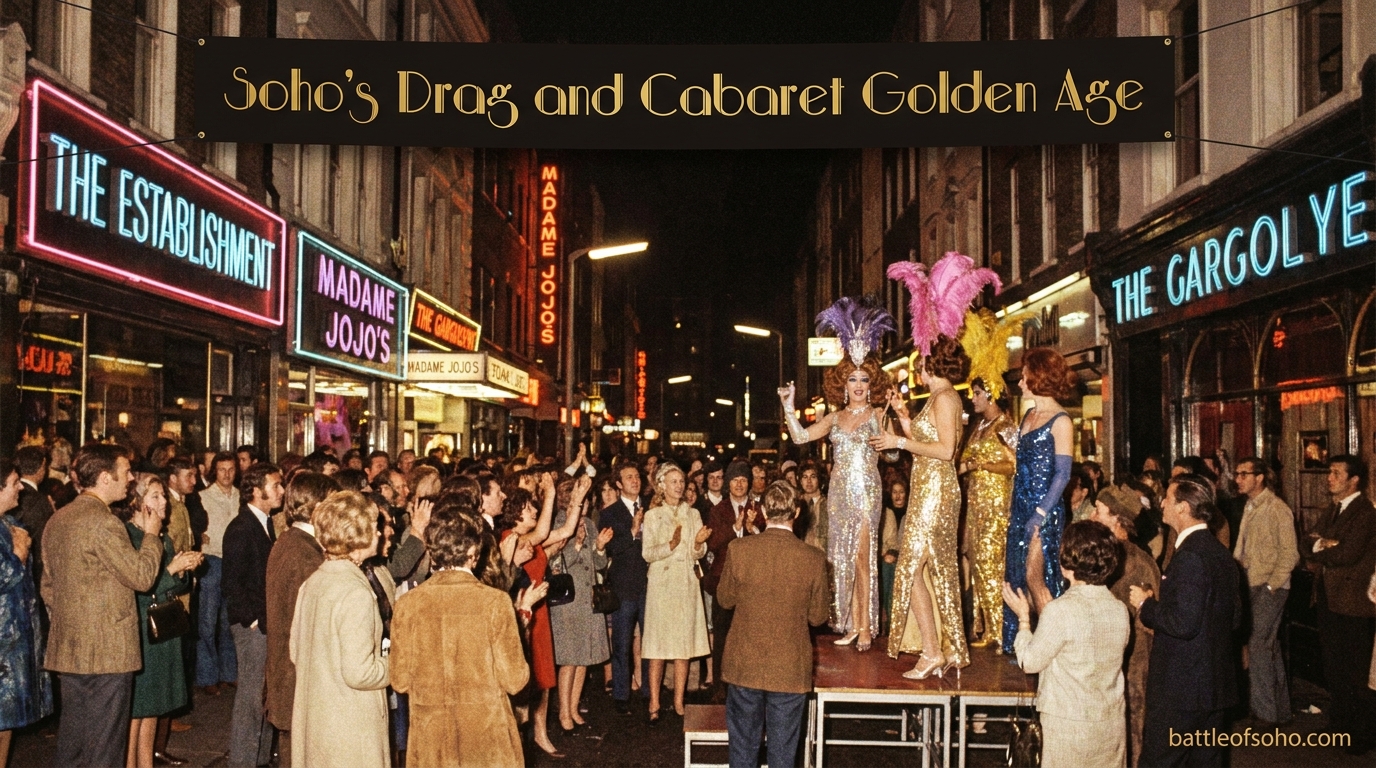
Walk down Brewer Street in Soho today and you will find wine bars, ramen shops, and vape stores where sequins once caught the light. But beneath the pavement, if you know where to look, the ghosts of a thousand lip-sync numbers still linger. The lost glamour of Soho’s drag and cabaret golden age is one of London’s most vivid cultural stories, a tale of feathers, defiance, police raids, and dazzling stage lights that burned brightest between the mid-1960s and the late 1990s.
During those decades, Soho was the beating heart of British drag and cabaret. Legendary venues like Madame Jojo’s, the Colony Room Club, and Heaven Nightclub drew everyone from Francis Bacon to Boy George, from office workers on a Friday night to international celebrities slumming it in the cheap seats. Drag queens in full regalia performed nightly to packed houses, blending sharp comedy with spectacular theatricality in a way that no other city in the world quite matched.
This is the story of that era, how it came to be, who made it glitter, and why so much of it has been swept away.
The lost glamour of Soho’s drag and cabaret golden age refers to the vibrant period from the mid-1960s through the 1990s when London’s Soho district was the epicentre of British drag cabaret, home to legendary venues like Madame Jojo’s, the Colony Room, and Heaven, where iconic performers transformed nightlife into an art form before gentrification and venue closures swept much of it away.
Table of Contents
What Was the Golden Age of Soho Drag and Cabaret?
The golden age of Soho drag and cabaret was not a single moment but a convergence of forces that created something extraordinary. The partial decriminalisation of homosexuality in England and Wales in 1967 gave queer performers a sliver of legal protection they had never known before. Soho, already London’s most permissive neighbourhood with its mix of sex shops, jazz clubs, and late-night drinking dens, became the natural home for a new wave of openly queer entertainment.
What made it a golden age rather than just a good period was the density and quality of what was on offer. Within a few streets of each other, you could watch a drag queen belt out show tunes at Madame Jojo’s, drink with Francis Bacon at the Colony Room until dawn, catch live jazz at Ronnie Scott’s, and then dance until sunrise at Heaven. No other district in Britain, and few in the world, offered anything close to that concentration of queer and cabaret performance.
The era also coincided with a flourishing of British drag as a distinct art form. Unlike American drag, which drew heavily on pageant culture and ballroom traditions, British drag had roots in music hall, pantomime dames, and seaside postcard humour. The performers of Soho’s golden age blended those traditions with sharp social commentary, political satire, and genuine glamour. This was not men in dresses telling mother-in-law jokes. This was theatrical performance art with sequins.
The audiences were part of the magic too. Soho’s cabaret crowds were gloriously mixed. Gay men, lesbians, straight couples on a naughty night out, tourists, artists, politicians, and celebrities all crammed into the same sweaty rooms. That cross-pollination gave the performances an electric, anything-can-happen energy that performers fed off night after night.
And then there was the sheer glamour of it all. We are talking about hand-stitched costumes that cost thousands of pounds, wigs that required hours of preparation, makeup artistry that could transform a face entirely, and stage shows choreographed to professional theatre standards. The glamour was real, it was expensive, and it was created in a community that had to fight for every inch of space it occupied.
Before the Golden Age: From Molly Houses to the Cave of the Golden Calf
Soho’s connection to drag and gender performance goes back much further than the 1960s. To understand the golden age, you need to know what came before it, because the performers of the 1970s and 1980s were standing on the shoulders of people who had risked everything just to put on a different outfit.
Molly Houses and the 18th Century Underground
As far back as the early 1700s, Soho and the surrounding streets were home to molly houses, clandestine gathering places where men could dress in women’s clothing, adopt feminine names, and socialise freely. The most famous was Mother Clap’s molly house in Field Lane, Holborn, just a short walk from the Soho border. These were not cabaret venues in any modern sense, but they were the earliest seeds of a queer performance culture in central London.
Molly houses were illegal, and the men who frequented them risked the death penalty. In 1726, several men from Mother Clap’s circle were arrested and hanged at Tyburn. That brutal reality coloured everything that came after. For more than two centuries, queer performance in London existed in the shadows, always one police raid away from catastrophe.
The Cave of the Golden Calf (1912-1914)
The first true precursor to Soho’s cabaret golden age opened in 1912 on Heddon Street, just off Regent Street at the edge of Soho. The Cave of the Golden Calf was the brainchild of Frida Strindberg, who wanted to bring the avant-garde cabaret culture of Zurich and Berlin to London. It featured music, dancing, and performance in a subterranean room decorated with murals by Wyndham Lewis and sculptures by Jacob Epstein.
The Cave attracted the bohemian elite of Edwardian London. Ezra Pound, T.E. Hulme, and other modernist luminaries drank and danced there. Cross-dressing and gender-fluid performance were part of the entertainment, though always coded and never explicitly political. The venue was also one of the first in London to openly serve alcohol after licensing hours through its private club structure, a model that Soho cabaret would copy for decades.
The Cave of the Golden Calf closed in 1914 after barely two years, undone by financial troubles and the social panic that preceded the First World War. But it proved that a market existed in London for late-night, boundary-pushing cabaret. The template was set.
Interwar Soho: Bottle Parties and Police Raids
Between the wars, Soho became the centre of London’s growing underground queer scene. The phenomenon of the bottle party drove much of this culture. Bottle parties were ostensibly private gatherings where guests brought their own alcohol, circumventing licensing laws. In practice, many were commercially operated nightclubs that catered to queer clientele, featuring drag performances, live music, and dancing that lasted until dawn.
These venues existed in a legal grey area, and that grey area was dangerous. Police raids were frequent and brutal. Officers would burst into clubs, arrest performers for cross-dressing, and publish the names of patrons in newspapers, destroying careers and families. The threat was constant and it shaped every aspect of how queer venues operated.
Despite the persecution, the interwar period saw the emergence of a distinctly British drag aesthetic. Performers drew on music hall traditions, pantomime dames, and the new Hollywood glamour arriving from America. This was the era when British drag began to define itself as something separate from both theatrical cross-dressing and foreign cabaret.
The Shim Sham Club: Black Queer Soho’s Hidden History
One of the most important and least-told stories from interwar Soho is that of the Shim Sham Club, a Black queer venue that operated in the area during the 1930s. The Shim Sham was what was known as a bottle party venue, serving a clientele that included Black queer Londoners, African-American expatriates, and white bohemians who were drawn to the jazz and blues performances on offer.
The Shim Sham connected Soho to the Harlem Renaissance. Performers like Jimmie Daniels, a gay African-American singer, performed in Soho during this period, bringing the musical traditions of Harlem’s queer underground to London. Garland Wilson, another Black American performer, was also part of this circuit. Their presence made interwar Soho a genuinely multiracial queer space at a time when segregation and racism were openly practised in most London venues.
This Black queer history of Soho is barely acknowledged in most accounts of the area’s past. Historic England’s research into LGBTQ+ heritage has begun to uncover it, but the Shim Sham Club and its counterparts remain largely unknown to the public. Their story is a reminder that Soho’s drag and cabaret golden age had roots in communities that conventional histories have too often erased.
The Shim Sham and venues like it were eventually shut down by police action. But their influence lived on in the performers and audiences who would populate Soho’s post-war clubs, carrying with them a tradition of Black queer performance that would continue to shape London’s drag scene for decades.
The Colony Room Club: Francis Bacon’s Soho Salon
Founded in 1948 by Muriel Belcher on Dean Street, the Colony Room Club became the most famous drinking establishment in Soho history. It was a private members club with a drinking licence that allowed it to serve alcohol outside normal hours, which in practice meant it was the place where Soho’s bohemian elite went after everywhere else had closed.
The Colony Room was not a drag venue per se, but it was central to the culture that produced and supported Soho’s drag and cabaret golden age. Muriel Belcher, its openly lesbian proprietor, presided over the room with a sharp tongue and an iron will. She counted Francis Bacon among her closest friends, and Bacon was at the Colony Room almost every night it was open, drinking, arguing, and holding court with an entourage that included artists, criminals, drag queens, and aristocrats.
The Colony Room connected the art world to the drag world. Performers who worked the Soho cabaret circuit would drink at the Colony Room after their shows, mingling with painters, writers, and filmmakers. That cross-pollination gave Soho’s cabaret scene an artistic credibility that the strip clubs and sex shops surrounding it lacked. When you performed in Soho, you were part of a cultural scene, not just a nightlife economy.
The Colony Room survived until 2008, long enough to see the golden age it had helped nurture begin to fade. Its closure was a watershed moment, removing one of the last physical links to the bohemian Soho that had created the conditions for drag and cabaret to flourish.
The Legendary Venues That Defined the Golden Age
The golden age was built on venues. Not websites, not social media, not streaming platforms, but physical rooms where people gathered, performed, drank, and connected. These were the places where the glamour was manufactured nightly, where careers were born, and where a community found its voice. Here are the rooms that mattered most.
Madame Jojo’s: The Crown Jewel of Soho Cabaret
If one venue symbolises the lost glamour of Soho’s drag and cabaret golden age, it is Madame Jojo’s. Located at 8-10 Brewer Street, Madame Jojo’s opened in 1986 under the ownership of Paul Raymond, the self-styled King of Soho who had built a fortune from strip clubs and property. The venue was named after a drag performer called Madame Jojo, though the exact identity of the original Madame Jojo has become something of a Soho legend, with multiple performers claiming the title over the years.
What made Madame Jojo’s special was its commitment to glamour as a philosophy, not just an aesthetic. The interior was decorated like a fantasy bordello, with red walls, gilded mirrors, chandeliers, and a stage that felt intimate despite the room’s capacity. You did not just watch a show at Madame Jojo’s. You entered a different world, one where camp was celebrated, gender was playfully destabilised, and the audience was as much a part of the spectacle as the performers.
The club became famous for its drag cabaret shows, which ran nightly and featured some of the best performers in Britain. The Barbettes, Madame Jojo’s house troupe, were legendary for their synchronised routines and spectacular costumes. Ruby Venzuela, one of the most celebrated drag performers of the era, was closely associated with the venue. Regina Fong, the self-styled Last Queen of Soho, also performed there regularly, turning her shows into community events that blurred the line between performance and activism.
Madame Jojo’s was also important for its drag king nights. Club Naive, later known as Club Geezer, ran regularly at the venue and gave drag king performers a dedicated platform at a time when drag was almost exclusively associated with male-to-female performance. This was genuinely pioneering programming, and it helped launch careers and build a drag king community that had previously had no consistent home in London.
Beyond drag, Madame Jojo’s hosted burlesque, live music, and some of London’s most influential club nights. White Heat, a weekly indie and electronic night, ran for years and became a fixture of London’s alternative music scene. Lady Garden was a popular women-only night. The venue also appeared in Stanley Kubrick’s film Eyes Wide Shut, standing in for a decadent cabaret club, which gives you a sense of its visual impact.
Then came the end. In 2014, Westminster City Council revoked Madame Jojo’s licence following a violent incident outside the venue. The closure was immediate and controversial. Many in the community felt the venue had been unfairly targeted, that one incident should not have been enough to destroy a cultural institution that had operated for nearly 30 years. The Save Soho campaign, led by figures including Stephen Fry and Benedict Cumberbatch, fought to preserve the venue, but the building was eventually sold.
The loss of Madame Jojo’s was not just the loss of a nightclub. It was the loss of a cultural landmark, a community space, and a piece of British drag history. When the venue closed, a particular kind of glamorous, theatrical, proudly camp cabaret lost its most prominent home. Nothing has quite replaced it.
The Colony Room Club and the Artistic Set
The Colony Room Club, at 41 Dean Street, deserves a second mention in the context of the golden age because its influence on Soho cabaret was indirect but enormous. By providing a late-night meeting place where artists, performers, writers, and drag queens could mix freely, the Colony Room functioned as an informal salon for Soho’s creative community.
Muriel Belcher ran the Colony Room from its founding in 1948 until her death in 1979. She was famously rude to customers she did not like and famously generous to those she did. Francis Bacon was her most devoted regular, and the club’s walls were decorated with Bacon’s work and the work of other artists who drank there, including Lucian Freud and John Deakin.
The Colony Room’s connection to drag culture was through its clientele. Performers who worked the Soho circuit would end their nights at the Colony Room, where they rubbed shoulders with the art world elite. That connection gave drag performance an artistic legitimacy that it might otherwise have lacked. When a drag queen drank at the same bar as Britain’s greatest living painter, it sent a message about the cultural value of what drag queens did on stage.
After Belcher’s death, the club continued under new management but never quite recaptured its original magic. It finally closed in 2008, and its loss was felt as a severing of the last direct link between Soho’s bohemian past and its present. The room where Bacon held court, where drag queens mingled with aristocrats, where the boundary between high art and nightlife dissolved nightly, was gone.
Heaven Nightclub: When Drag Went Mainstream
Heaven, located in the railway arches under Charing Cross Station, opened in 1979 and quickly became the largest and most famous gay nightclub in Britain. While Heaven was primarily a dance club rather than a cabaret venue, its role in the golden age of Soho-area drag was significant. Heaven brought drag performance to an audience of thousands in a single night, something that the intimate cabaret rooms of Brewer Street could never do.
The club’s flagship night, Megatripolis, ran in the 1990s and combined dance music, performance art, and political activism. Drag performers appeared on Heaven’s stages alongside DJs, creating a multimedia experience that expanded what drag could be in a club context. Heaven also hosted some of the first large-scale drag events in London, bringing American performers over and creating a transatlantic exchange of drag culture.
Heaven was technically just outside Soho, in the arches between Charing Cross and Embankment, but it was part of the same ecosystem. Performers who worked the Soho cabaret circuit would also appear at Heaven, and audiences moved fluidly between the two scenes. Heaven represented the point where drag crossed over from cabaret intimacy to stadium-scale spectacle.
The club also played a significant role in the mainstreaming of drag culture. When celebrities wanted to be seen at a gay club, they went to Heaven. When television producers needed a gay venue for a location shoot, Heaven was the default choice. This visibility helped normalise drag and queer performance for a wider British public, even as it sometimes diluted the intimacy and edge that the smaller Soho venues offered.
Heaven survived the worst of the venue closure crisis that devastated Soho, though it has faced its own challenges with licensing, noise complaints, and changing ownership. It remains open today, a rare survivor from the golden age, though its programming has evolved significantly from its 1980s and 1990s peak.
The Two Brewers and the Continuing Tradition
The Two Brewers, located in Clapham rather than Soho, deserves mention in any account of London’s drag golden age because it represents both the spread of drag culture beyond Soho and the continuity of traditional British drag cabaret. Opened as a gay pub in the early 1980s, the Two Brewers built its reputation on consistent, high-quality drag shows seven nights a week.
What made the Two Brewers important was its commitment to the traditional British drag cabaret format. While Soho venues experimented with burlesque, neo-cabaret, and performance art, the Two Brewers kept the classic format alive: a host in full glam, quick-fire comedy, audience participation, lip-sync numbers, and a pace that kept the energy high from the first number to the last call.
Many performers who trained or established themselves at Soho venues also worked the Two Brewers circuit. The venue became a reliable training ground for new drag talent, a place where performers could hone their craft in front of a live audience night after night. That consistency helped maintain standards in British drag at a time when the Soho scene was becoming increasingly fragmented.
The Two Brewers is still operating today, which makes it one of the longest-running dedicated drag venues in London. Its survival is a testament to the enduring appeal of the traditional drag cabaret format and to the loyalty of the south London queer community that has supported it for decades.
Ronnie Scott’s and the Jazz-Cabaret Connection
Ronnie Scott’s Jazz Club, located on Frith Street in the heart of Soho since 1959, might seem like an odd inclusion in a history of drag and cabaret. But the connection between Soho’s jazz scene and its drag scene was real and important. Both drew on the same bohemian culture, shared many of the same venues and after-hours drinking spots, and appealed to audiences who valued live performance over recorded music.
Ronnie Scott’s hosted cabaret performers alongside jazz musicians, and the crossover between the two worlds was significant. The musical sophistication of jazz informed the song choices and staging of many cabaret acts. Performers who worked the Soho drag circuit often drew from the Great American Songbook, the same material that jazz musicians were exploring at Ronnie Scott’s around the corner.
The jazz connection also reinforced Soho’s identity as a neighbourhood dedicated to live performance. In an era before recorded music dominated nightlife, Soho was one of the few places in London where you could hear live music performed at a professional level virtually any night of the week. That infrastructure of musicians, sound engineers, lighting designers, and stage technicians supported both the jazz and cabaret scenes, and when one declined, it affected the other.
Ronnie Scott’s remains open today, a survivor of the Soho cultural cull, but the drag and cabaret venues that once surrounded it are largely gone. The jazz club now stands as a monument to the performance culture that once defined the neighbourhood, a culture that included drag and cabaret as equal partners.
The Shim Sham Club: Black Queer Soho’s Hidden Gem
The Shim Sham Club deserves its own entry among the legendary venues because it represents a chapter of Soho’s drag and cabaret history that is almost entirely forgotten. Operating in the interwar period, the Shim Sham was a bottle party venue that catered to Black queer Londoners and their allies. It featured jazz, blues, and performance in an atmosphere that combined the energy of Harlem’s queer underground with the specific conditions of interwar London.
What made the Shim Sham unique was its racial politics. In a city where most venues either excluded Black patrons entirely or segregated them, the Shim Sham was openly welcoming. Black and white patrons socialised together, Black performers took centre stage, and the club became a meeting point for the African-American expatriate community in London, many of whom were queer and had left the United States to escape both racism and homophobia.
Performers like Jimmie Daniels brought the musical traditions of the Harlem Renaissance to Soho through venues like the Shim Sham. Daniels was a singer and actor who had been part of the queer artistic circles in Harlem before coming to London. His performances in Soho helped establish a tradition of Black queer cabaret that would influence London’s drag scene for decades, even as the specific history of venues like the Shim Sham faded from memory.
The Shim Sham was eventually closed by police action, as were most interwar queer venues. But its legacy persisted in the performers and traditions it nurtured. When Soho’s drag golden age proper began in the 1960s, it drew on a performance tradition that included the Shim Sham and its counterparts, even if most people performing did not know the names of the venues that had paved the way.
The Stars of the Stage: Iconic Performers
Venues are buildings. What made the golden age truly golden were the performers who filled those buildings with talent, charisma, and raw star power. These were the drag queens, cabaret artists, and drag kings who defined an era, created the looks, sang the songs, and built the community that made Soho the cabaret capital of Britain.
Danny La Rue: From Soho to the West End
Danny La Rue was arguably the first British drag performer to achieve genuine mainstream stardom, and his career began in the clubs and cabaret rooms of Soho. Born Daniel Patrick Carroll in 1927, La Rue developed his drag act in the post-war club circuit, performing in venues across Soho and the West End throughout the 1950s and 1960s.
What set La Rue apart was his theatrical ambition. He did not just want to perform in clubs. He wanted to play the West End, and he did. In 1966, he opened his own nightclub, Danny La Rue’s, on Hanover Street, just off Regent Street. The club was a lavish affair, designed to recreate the glamour of a Parisian cabaret in the heart of London. It ran for several years and cemented La Rue’s reputation as the premier drag entertainer in Britain.
La Rue’s act was rooted in the music hall and pantomime traditions that defined British drag. He was a female impersonator in the classical sense, creating meticulous impressions of famous women rather than developing a separate drag persona. His performances were family-friendly enough for television but sharp enough for late-night cabaret, a balancing act that allowed him to cross over into mainstream entertainment in a way that few drag performers had managed before.
His success paved the way for every British drag performer who followed. By proving that drag could fill West End theatres and draw television audiences, La Rue opened doors that had been firmly closed. Every drag queen who performed at Madame Jojo’s or the Two Brewers in the decades that followed owed something to the path Danny La Rue had carved.
Lily Savage and Paul O’Grady
If Danny La Rue was the first British drag star of the television age, Lily Savage was the definitive drag star of the Soho golden age proper. Created by Paul O’Grady, a working-class performer from Birkenhead, Lily Savage first appeared in London in the early 1980s and became a fixture of the Soho and Camden cabaret circuits.
Lily Savage was a revelation. She was not a glamorous female impersonator in the Danny La Rue mould. She was a sharp-tongued, peroxide-blonde, leopard-print-wearing Liverpool scouser with a wit that could cut glass. Her act combined caustic comedy, audience humiliation, pop culture parody, and genuine warmth in a way that felt entirely new. She was filthy, she was funny, and she was impossible to ignore.
O’Grady developed Lily Savage through years of performance at venues across Soho and beyond. The character was honed in front of live audiences, refined night after night, until Lily became one of the most recognisable drag personas in British history. The transition to television was inevitable, and by the 1990s, Lily Savage was a mainstream fixture, hosting chat shows, game shows, and even a reboot of Blankety Blank.
What made Lily Savage important to Soho’s golden age was the way she embodied its spirit. She was working-class, she was queer, she was funny, and she was unapologetic. She brought the energy of the Soho cabaret rooms to a national audience without sanitising it. Audiences who had never been to a drag show in their lives fell in love with Lily Savage, and in doing so, they got a taste of what Soho cabaret was all about.
Paul O’Grady eventually retired the Lily Savage persona and built a successful career as himself, but the impact of Lily on British drag culture was permanent. Every drag queen in Britain who followed, from the performers at Madame Jojo’s to the contestants on RuPaul’s Drag Race UK, exists in a world that Lily Savage helped create.
Ruby Venzuela and the Madame Jojo’s Era
Ruby Venzuela was one of the most celebrated drag performers associated with Madame Jojo’s during its golden era. While less internationally known than Lily Savage or Danny La Rue, Ruby was a towering figure in the Soho drag scene, known for spectacular costumes, professional-grade choreography, and a stage presence that could hold a room of 300 people in the palm of her hand.
What distinguished Ruby Venzuela and performers of her calibre was the sheer professionalism of their craft. These were not hobbyists. They were full-time performers who spent hours on costume preparation, choreography, and musical staging. A Ruby Venzuela show at Madame Jojo’s was a theatrical production, not a pub turn. The costumes alone could cost thousands of pounds, and the attention to detail in makeup, hair, and choreography rivalled anything you would see in a West End theatre.
Performers like Ruby Venzuela defined what the glamour of the golden age actually looked like. It was not drag as comedy, though comedy was part of it. It was drag as spectacle, as art, as a serious theatrical form that demanded the same respect as any other kind of performance. When people talk about the lost glamour of Soho’s cabaret golden age, they are talking about the kind of shows that Ruby Venzuela and her peers produced nightly at venues like Madame Jojo’s.
Regina Fong: The Last Queen of Soho
Regina Fong, who billed herself as the Last Queen of Soho, was another defining performer of the golden age. A drag queen of Cuban-Irish heritage, Regina Fong turned her performances into community events, blending cabaret with activism and creating a space where queer people could gather, celebrate, and organise.
What made Regina Fong special was her connection to the audience. She did not just perform at people. She performed with them, drawing crowd members into the show, addressing them by name, and creating a sense of community that went beyond entertainment. Her shows at Madame Jojo’s and other Soho venues were as much social events as performances, places where the queer community could come together in a city that was not always welcoming.
Regina Fong also embodied the political dimension of the golden age. In an era marked by Section 28, the AIDS crisis, and persistent police harassment, drag performance was not just entertainment. It was an act of visibility and defiance. By being openly, flamboyantly queer on a public stage, performers like Regina Fong were making a political statement whether they intended to or not. Their existence was resistance.
The Barbettes: Madame Jojo’s House Troupe
The Barbettes were Madame Jojo’s house performance troupe, and they were central to the venue’s reputation for spectacular drag cabaret. The group performed synchronised routines in matching costumes, combining the precision of a dance troupe with the glamour of a Las Vegas show and the camp sensibility of British drag.
What made the Barbettes important was the way they raised the production values of Soho drag. Individual performers were impressive, but a coordinated troupe delivering professionally choreographed numbers night after night was something else entirely. The Barbettes set a standard that other venues and performers aspired to, and their presence at Madame Jojo’s helped establish the venue as the premier drag destination in London.
The Barbettes also represented the collective, collaborative nature of Soho’s drag golden age. This was not a culture of individual stars competing against each other. It was a community of performers who worked together, supported each other, and created ensemble productions that were greater than the sum of their parts. When Madame Jojo’s closed, the dispersal of the Barbettes and similar troupes scattered that collaborative energy across London’s nightlife, where it was never quite reassembled.
The Drag Kings of Soho: Club Naive and Club Geezer
One of the most overlooked aspects of Soho’s drag golden age was the drag king scene. While drag queens dominated the cabaret stages, drag kings, performers who present masculinely, had their own dedicated nights at venues like Madame Jojo’s. Club Naive, which later became Club Geezer, was the most prominent drag king night in London during this period.
Drag king performance has a different history from drag queen performance. It emerged from lesbian and queer women’s communities and developed its own aesthetic, humour, and political concerns. Club Naive and Club Geezer gave drag kings a consistent platform at a major Soho venue, which was genuinely pioneering. At a time when most drag programming was exclusively queen-focused, these nights asserted that gender performance went in multiple directions.
The drag kings of Soho challenged assumptions about what drag was and who it was for. They expanded the definition of cabaret performance and created space for performers who did not fit the dominant drag queen paradigm. Their contribution to Soho’s golden age has been consistently under-recognised, and the closure of the venues that hosted them has made it harder for new audiences to discover this tradition.
The 1967 Turning Point: How Decriminalisation Changed Everything
The Sexual Offences Act 1967 was the single most important legal change in the history of British queer culture, and its impact on Soho’s drag and cabaret golden age was immediate and profound. The Act partially decriminalised homosexual acts between men over the age of 21, in private, in England and Wales. It did not legalise homosexuality, it did not protect queer people from discrimination, and it contained a raft of exceptions and exclusions. But it did something that mattered enormously for performance culture: it made it slightly less dangerous to be openly queer in public.
Before 1967, performing in a drag show in Soho carried real legal risk. Performers could be arrested for cross-dressing, venues could be shut down for serving queer clientele, and patrons could be publicly identified and prosecuted. The threat was not theoretical. Police raids on queer venues were regular occurrences, and the consequences for those caught could include imprisonment, loss of employment, social ruin, and even suicide.
After 1967, while discrimination and harassment continued, the legal landscape shifted enough for queer venues to operate more openly. New venues opened, existing venues expanded their programming, and performers could begin to build careers without the constant fear that a single police raid would destroy everything. The golden age that followed was a direct response to this change in conditions. When the state loosened its grip, even slightly, queer culture bloomed.
The 1967 Act also changed the relationship between queer venues and the wider Soho community. Before decriminalisation, queer venues had to operate discreetly, camouflaged among the sex shops and strip clubs that gave Soho its seedy reputation. After 1967, queer venues could be more visible, more ambitious, and more explicitly political. Madame Jojo’s, which opened in 1986, was a product of this new confidence. It was not hidden away. It was on Brewer Street, in full view, with a sign on the door and a reputation that spread across London.
But the 1967 Act was only a partial victory, and its limitations continued to shape Soho’s queer culture. The age of consent was set at 21, higher than for heterosexual acts. The Act applied only to England and Wales, not to Scotland or Northern Ireland. And the military, the police, and many professions remained explicitly exempted. These limitations meant that queer culture in Soho continued to operate with one foot in the underground and one in the mainstream, a tension that gave the golden age much of its creative energy.
Why Did the Golden Age End?
The end of Soho’s drag and cabaret golden age was not a single event but a slow, painful process driven by multiple forces. Understanding why it ended is essential to understanding what was lost, and why the loss matters.
Gentrification and Rising Rents
The biggest single factor in the decline of Soho’s cabaret golden age was the steady gentrification of the neighbourhood throughout the 1990s and 2000s. As property values in central London soared, the economics of running a drag and cabaret venue in Soho became increasingly untenable. Venues that had operated for decades on reasonable rents found themselves facing rent increases that made continuation impossible.
Soho Estates, the property company that owned much of Soho including the Madame Jojo’s building, came under pressure to maximise returns on its holdings. Historic cabaret venues were worth more as restaurant sites, office space, or luxury retail than as nightclubs with unpredictable revenues and licensing headaches. The financial logic of redevelopment was relentless, and one by one, the venues that defined the golden age fell to it.
Statistics tell the story starkly. Between 2006 and 2017, London lost 58 percent of its LGBTQ+ venues. Soho was hit particularly hard. Venues that had been community institutions for decades disappeared almost overnight, replaced by chain restaurants, cocktail bars, and retail outlets that served a very different clientele.
Section 28 and the AIDS Crisis
The golden age also coincided with two devastating developments that sapped the queer community’s resources and confidence. Section 28, passed in 1988, prohibited local authorities from intentionally promoting homosexuality or teaching the acceptability of homosexuality as a pretended family relationship. The law did not directly affect private cabaret venues, but it created a climate of fear and hostility that made queer culture feel precarious and embattled.
The AIDS crisis, which devastated the queer community throughout the 1980s and 1990s, had an even more direct impact. Performers, venue staff, promoters, and audience members fell ill and died. The community that had created and sustained the golden age was literally decimated. The grief, the fear, and the sheer logistical burden of caring for the sick and mourning the dead took energy away from creative and cultural production.
At the same time, the AIDS crisis also gave the golden age an urgency and a poignancy that it might not otherwise have had. Drag and cabaret became spaces of communal mourning, political activism, and defiant celebration. The performers who worked through the crisis years were not just entertainers. They were holding a community together through the darkest period in its history.
Changing Tastes and the Mainstreaming of Drag
Paradoxically, one of the factors that eroded the golden age was the growing mainstream acceptance of drag. As drag became more visible on television, in films, and eventually on streaming platforms, the unique appeal of seeing it live in a small Soho venue diminished for some audiences. Why pay for a ticket to a cabaret room when you could watch professional drag on television for free?
The rise of RuPaul’s Drag Race, which launched in 2009 and eventually spawned a UK version, transformed drag from a niche live performance art into a global media franchise. This brought enormous benefits to individual performers and raised the profile of drag generally, but it also changed audience expectations. Audiences raised on the high-production values of Drag Race sometimes found traditional cabaret shows underwhelming by comparison, not understanding that the two are fundamentally different forms.
The Madame Jojo’s Closure: A Symbolic End
The closure of Madame Jojo’s in 2014 is often cited as the symbolic end of Soho’s cabaret golden age. It was not literally the last drag venue in Soho, but it was the most iconic, and its loss was felt as a definitive turning point. The Save Soho campaign that emerged in response was not just about one venue. It was a recognition that an entire cultural ecosystem was being dismantled.
The Save Soho campaign brought together performers, politicians, celebrities, and community members to advocate for the preservation of Soho’s cultural venues. While it achieved some successes, the broader trend was clear. The economic forces driving venue closures were too powerful to be stopped by campaigning alone, and the golden age was not coming back.
The Legacy: What Remains of Soho’s Cabaret Soul
So is Soho still the gay capital of London? The answer is complicated. The golden age of drag and cabaret, as it existed from the 1960s through the 1990s, is gone. But Soho remains a significant centre of queer culture, and the legacy of the golden age is visible everywhere if you know where to look.
Several venues from or connected to the golden age era remain. The Admiral Duncan, on Old Compton Street, survived both the golden age and the horrific nail bomb attack of 1999 that killed three people and injured dozens more. It continues to host drag shows and remains a touchstone venue, steeped in queer history and remembered by the community as a site of both tragedy and resilience.
Halfway to Heaven, near Charing Cross, continues to programme cabaret and drag shows. G-A-Y Bar on Old Compton Street, despite ongoing concerns about its future, remains a fixture of the Soho queer scene. Comptons of Soho, one of the oldest gay pubs in London, continues to serve the community. Heaven, while technically just outside Soho, still operates and still programmes drag and queer performance.
The influence of the golden age also persists in ways that are less obvious. RuPaul’s Drag Race UK, which launched in 2019, draws directly on the traditions of British drag that were forged in Soho’s cabaret rooms. The programme has introduced a new generation to the art form, and many of its contestants have roots in the British drag cabaret tradition that the golden age established.
New venues have also emerged that carry forward elements of the cabaret tradition. Dean Street Cabaret, which opened on the site of the former Soho Revue Bar, has attempted to bring back some of the glamour and theatricality of the golden age. While it operates in a very different economic and cultural context, its existence suggests that the appetite for glamorous cabaret performance in Soho has not entirely disappeared.
The most important legacy of the golden age, though, is not in any single venue or performer. It is in the understanding that queer performance is a legitimate, valuable, and historically significant art form. The performers of Soho’s golden age, from Danny La Rue to Ruby Venzuela, from the Barbettes to the drag kings of Club Geezer, created a body of work and a set of traditions that deserve to be remembered, studied, and celebrated.
When we talk about the lost glamour of Soho’s drag and cabaret golden age, we are not just being nostalgic. We are recognising that something of genuine cultural value was created in those rooms, and that its loss diminishes us all. The glamour was real. The artistry was real. The community was real. And while the venues may be gone, the story of what happened in them deserves to be told.
FAQs
What was the golden age of Soho drag?
The golden age of Soho drag ran from the mid-1960s through the 1990s, when venues like Madame Jojo’s, the Colony Room, and Heaven made Soho the epicentre of British drag and cabaret performance. The era was defined by spectacular costumes, professional-grade shows, and a mix of queer and mainstream audiences.
What happened to Madame Jojo’s in Soho?
Madame Jojo’s was closed in 2014 when Westminster City Council revoked its licence following a violent incident outside the venue. The closure was controversial and sparked the Save Soho campaign, but the building was eventually sold. It remains one of the most significant losses in the history of London’s drag and cabaret scene.
Is Soho still LGBTQ+ friendly?
Yes, Soho remains a significant centre of LGBTQ+ culture in London, with venues like the Admiral Duncan, G-A-Y Bar, Comptons, and Halfway to Heaven still operating. However, the density and glamour of the golden age era have been significantly reduced by venue closures, rising rents, and gentrification.
Who were the most famous drag performers in Soho?
The most iconic performers associated with Soho’s drag golden age include Danny La Rue, who achieved mainstream television stardom, Lily Savage (Paul O’Grady), who became a national treasure, Ruby Venzuela, a celebrated Madame Jojo’s performer, Regina Fong, the self-styled Last Queen of Soho, and the Barbettes, Madame Jojo’s house performance troupe.
Why did Soho’s drag scene decline?
Soho’s drag scene declined due to a combination of gentrification and rising rents, the AIDS crisis, Section 28, changing audience tastes, and the closure of key venues like Madame Jojo’s in 2014. Between 2006 and 2017, London lost 58 percent of its LGBTQ+ venues, with Soho hit particularly hard.
What was the Colony Room Club in Soho?
The Colony Room Club was a private members drinking club on Dean Street, founded in 1948 by Muriel Belcher. It was famously frequented by Francis Bacon and served as an after-hours salon for Soho’s bohemian elite, including artists, performers, and drag queens. It closed in 2008.
When did drag cabaret start in Soho?
Drag and gender-fluid performance in Soho dates back to the molly houses of the early 1700s. The first modern cabaret venue in the area was the Cave of the Golden Calf, which opened in 1912. However, the true golden age of Soho drag cabaret began in the mid-1960s following the partial decriminalisation of homosexuality in 1967.
What was the Shim Sham Club in Soho?
The Shim Sham Club was a Black queer bottle party venue that operated in Soho during the interwar period. It catered to Black queer Londoners and African-American expatriates and connected Soho to the Harlem Renaissance through performers like Jimmie Daniels. It is one of the least-known but most important chapters in Soho’s drag and cabaret history.
The lost glamour of Soho’s drag and cabaret golden age is not just a story about buildings that closed or costumes that were packed away. It is a story about a community that created something beautiful under enormous pressure, about performers who turned marginalisation into art, and about a neighbourhood that became a beacon for queer culture in Britain and beyond. The venues may be gone, but their story endures, and it deserves to be remembered.