
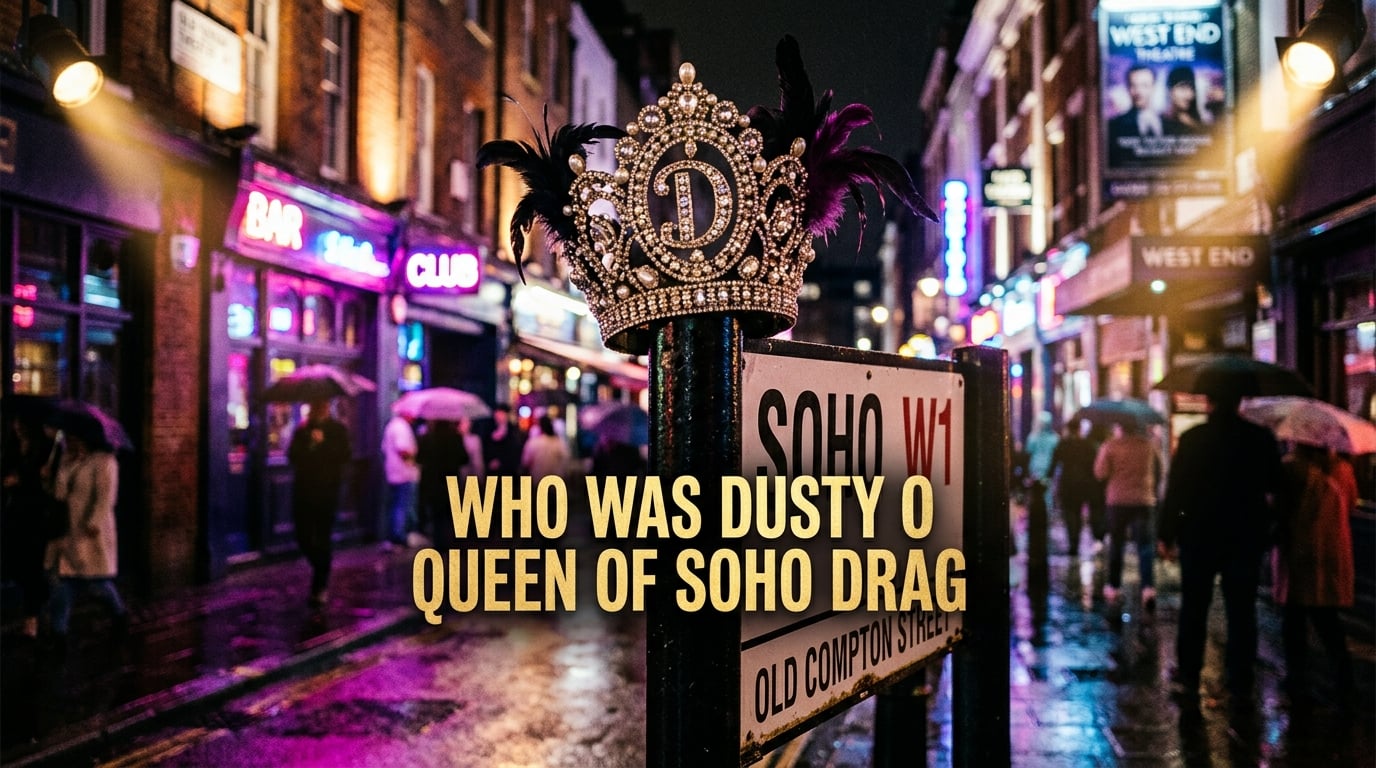
Dusty O, whose real name was David Hodge, was a legendary British drag queen, DJ, club promoter, fashion muse, visual artist, and author who earned the soubriquet “Queen of Soho” during a career spanning more than a quarter of a century in London’s West End. Born in Birmingham in the West Midlands, Dusty O became one of the most visible and recognizable faces of Soho nightlife from the mid-1980s through the 2010s, performing at iconic venues including Madame JoJo’s on Dean Street. If you are searching for the American drag queen Dusty Ray Bottoms from RuPaul’s Drag Race Season 10, that is a completely different performer whose real name is Dustin Rayburn. This article is about the British Dusty O, the Queen of Soho.
As a performer, DJ, writer, fashion muse, and club promoter, Dusty O carved out a career that took him all over the world. He co-hosted and co-promoted Trannyshack, one of London’s most influential drag club nights, and later became a celebrated visual artist whose paintings have been exhibited everywhere from the Houses of Parliament to galleries in Tokyo. In 2014, Dusty O appeared on the London Live reality television series Drag Queens of London, introducing a new generation of viewers to the pre-Drag Race British drag scene.
There is currently no comprehensive biographical article about Dusty O anywhere on the web. Search results routinely conflate this British performer with the American queen Dusty Ray Bottoms, and the limited existing sources are scattered across gallery profiles, a brief Wikipedia mention, and Dusty O’s own art website. This article brings all of that information together into one definitive resource, covering everything from those early Birmingham roots to the international art career.
Table of Contents
Dusty O at a Glance
Before we get into the full story, here are the essential facts about the Queen of Soho:
- Real Name: David Hodge
- Also Known As: The Very Miss Dusty O, Miss Dusty O
- Title: Queen of Soho
- Origin: Birmingham, West Midlands, UK
- Career Span: Approximately 25 to 30 years in Soho nightlife
- Key Roles: Drag queen, DJ, club host, club promoter, recording artist, fashion muse, painter, author
- Known For: Co-founding Trannyshack, appearing on Drag Queens of London (2014), writing the memoir The Boy Who Sat By The Window, exhibiting at the Houses of Parliament
- Current Work: Visual artist (painting since approximately 2016)
From Birmingham to Soho: Dusty O’s Early Life
Dusty O was born David Hodge in Birmingham, in the West Midlands. The journey from the Midlands to the heart of London’s nightlife scene is one that many LGBTQ+ performers made during the late twentieth century, seeking the freedom and community that Soho offered. Birmingham had its own queer scene, but Soho in the 1980s was the undisputed center of British gay life, and for a young drag performer with ambition, it was the only place to be.
Little has been publicly documented about Dusty O’s childhood in detail, though the memoir The Boy Who Sat By The Window offers a window into those formative years. The book addresses themes of bullying, alienation, growing up queer in the Midlands, and the challenges of navigating identity during the Thatcher era. These were difficult years for LGBTQ+ people in Britain, with Section 28 looming and the AIDS crisis devastating communities across the country.
What is clear from every account is that young David Hodge arrived in London with a determination to build something. The drag persona that would become Dusty O was not born overnight. It was crafted over years of performing, experimenting, and refining a look and a presence that would eventually make Dusty O impossible to ignore on any Soho street. The transformation from a Midlands kid into the Queen of Soho did not happen by accident. It was the product of relentless work, undeniable talent, and a deep understanding of what made Soho tick.
Rise to Fame: How Dusty O Became the Queen of Soho
Dusty O became the Queen of Soho through sheer visibility and longevity. For over twenty-five years, if you walked down Old Compton Street or Dean Street on a weekend evening, you would likely see Dusty O holding court. The title was not self-appointed. It was earned through decades of showing up, performing, hosting, and becoming woven into the very fabric of the neighborhood.
The career was multifaceted. Dusty O worked as a drag performer, yes, but also as a DJ spinning sets at clubs across London and beyond. As a club promoter, Dusty O brought people together and kept the Soho scene vibrant during years when gay venues were under threat from rising rents and changing cultural tides. As a recording artist, Dusty O released music that extended the brand beyond the club walls. And as a fashion muse, Dusty O caught the attention of designers including Vivienne Westwood, becoming a walking embodiment of Soho glamour.
Speaking to Attitude magazine in 2017, Dusty O described the approach to drag with characteristic directness: “It’s either all or nothing. I wear nothing, or I wear full make-up and the full look.” That philosophy defined an era of British drag that predated the mainstream visibility brought by RuPaul’s Drag Race. In those years, drag was something you experienced live, in a packed club, at close range, and Dusty O was one of the very best at commanding that kind of room.
The Soho Drag Scene of the 1980s Through 2000s
To understand why Dusty O mattered, you have to understand what Soho meant to British LGBTQ+ culture during those decades. Soho was not just a neighborhood. It was a sanctuary. Old Compton Street was the main artery of a community that had few safe spaces elsewhere. Venues like Madame JoJo’s, The Admiral Duncan, G-A-Y, and dozens of others formed an ecosystem where drag performers could build careers, develop their craft, and find audiences night after night.
Madame JoJo’s, on Dean Street, was particularly significant. The venue was known for its cabaret, burlesque, and drag nights, and it became one of the key stages where Dusty O performed and hosted. The club’s iconic interior, with its opulent decor and intimate stage, provided the perfect backdrop for the kind of high-glamour, high-finish drag that Dusty O was known for. When Madame JoJo’s had its license revoked in 2014 and eventually closed, it was treated as a cultural loss for the entire Soho community.
This was the world Dusty O dominated. It was a scene built on live performance, personal connection, and the kind of glamour that required genuine skill to pull off. There were no television cameras or streaming platforms to build a following. You became a star by being undeniably talented, consistently present, and impossible to forget. Dusty O was all three, for decades.
Trannyshack: The Legendary Soho Drag Night
One of Dusty O’s most significant contributions to London drag culture was Trannyshack. Co-hosted and co-promoted by Dusty O, Trannyshack became one of the most important and influential drag club nights in London. The night brought together established performers and newcomers, creating a platform where drag artistry could flourish and evolve.
Trannyshack was not just another club night. It was a cultural institution that helped define what London drag looked like during a critical period. The night attracted performers who pushed boundaries, experimented with gender performance, and created looks that went far beyond traditional lip-sync cabaret. Under Dusty O’s guidance as co-host, Trannyshack became a space where the next generation of drag talent could cut their teeth in front of real, live, demanding audiences.
The significance of Trannyshack becomes even clearer when you consider what came after. When RuPaul’s Drag Race launched and brought drag to global television audiences, many of the British queens who found success had roots in the kind of live-performance scene that Trannyshack represented. The skills, the fearlessness, the ability to read a room and command it, those were the qualities that venues like Trannyshack cultivated. Dusty O was at the center of that.
Trannyshack Academy: Mentoring the Next Generation
Beyond the weekly club night, Trannyshack Academy served as a drag competition that gave emerging performers a structured opportunity to develop and showcase their talents. Run under the Trannyshack banner, the Academy was part talent show, part mentorship program, and part community event.
Dusty O’s role in Trannyshack Academy reflected a broader pattern in the Queen of Soho’s career: the willingness to nurture younger talent. Wikipedia’s entry for Drag Queens of London describes Dusty O as “the voice of reason, and an idol to most young queens.” That reputation was not earned through a single act of kindness. It was built over years of showing up, offering advice, creating opportunities, and setting a standard that others aspired to reach.
For many younger drag performers in London, Dusty O represented a link to an earlier era of British drag. An era before social media followers determined your booking value, before viral moments replaced consistent craft, and before television exposure became the primary path to drag stardom. Dusty O showed that you could build a career, a reputation, and a legacy through live performance alone, and that example continued to inspire performers long after the landscape of drag had shifted.
Drag Queens of London: Dusty O on Television
In 2014, Dusty O reached a new audience through the London Live reality television series Drag Queens of London. The ten-part series followed the lives and careers of several London-based drag performers, offering viewers an inside look at the British drag scene that existed before RuPaul’s Drag Race UK brought the format to British shores.
The show’s cast included Dusty O alongside Silver Summers, Baga Chipz, Meth, Munroe Bergdorf, and Rosie Beaver, among others. For Dusty O, the show was a milestone that brought national television exposure after what was already more than two decades of professional drag work. At the time of filming, Dusty O told Attitude magazine: “I’ve worked professionally and solely doing drag for 23 years.” That longevity alone set Dusty O apart from younger cast members who were earlier in their careers.
On the show, Dusty O was positioned as the veteran. The experienced performer who had seen scenes come and go, venues open and close, and trends rise and fall. That role suited someone who had literally been called the Queen of Soho for years. The Drag Queens of London Wikipedia entry notes that “with over three decades of experience on the drag scene, Dusty O is the voice of reason, and an idol to most young queens.”
The series aired on London Live, a channel that was itself relatively new at the time. While it did not achieve the massive viewership of international drag reality shows, it was significant as one of the first British television programs to focus seriously on the London drag scene. For Dusty O, it represented a new chapter in a career that had already spanned every other medium available to a drag performer: live performance, club promotion, music, print media, and fashion.
Baga Chipz, who appeared alongside Dusty O on the show, would go on to achieve wider fame through RuPaul’s Drag Race in 2026. The fact that a performer from the Drag Queens of London cast later found mainstream success underscores the show’s role as a proving ground for British drag talent. Dusty O was the veteran presence on that proving ground.
From Stage to Canvas: Dusty O’s Art Career
After approximately twenty-five years dominating Soho nightlife, Dusty O transitioned into a serious career as a visual artist. Painting since around 2016, Dusty O produced a body of work that has been exhibited in galleries across the UK and internationally, including a milestone exhibition at the Houses of Parliament that made Dusty O the first openly Queer artist invited to exhibit there.
The transition from drag performance to painting might seem like a dramatic shift, but the two disciplines share more DNA than is immediately obvious. Both require a commanding sense of color, composition, and self-expression. Both demand the courage to put something deeply personal in front of an audience. And both, in Dusty O’s hands, drew from the same well of autobiographical experience.
Artistic Style and Themes
Dusty O’s paintings have been described as vivid, autobiographical, and psychedelic. Working primarily in acrylic on canvas, the work draws directly from a life lived at the center of Soho nightlife. The subjects are often personal, drawing on memories of clubbing, hedonism, glamour, alienation, and the full spectrum of experiences that came with being a visible Queer performer in London across multiple decades.
Hammond Galleries, which has represented Dusty O’s work, describes the artistic style as featuring a unique combination of cartoon-influenced figures, vivid color palettes, and autobiographical content. The work captures the energy and excess of the Soho scene while also reflecting on its darker undercurrents. These are not decorative paintings. They are documents of a life, rendered in the same bold, unapologetic style that characterized Dusty O’s drag performances.
Boy George, a longtime friend and cultural icon, has been quoted as an enthusiastic supporter of Dusty O’s artwork. The endorsement from one of Britain’s most recognizable LGBTQ+ cultural figures speaks to the way Dusty O’s creative output resonated across different artistic communities. The paintings have been compared to the visual energy of the nightlife they depict, with Hammond Galleries noting that Dusty O “carved out a unique, high finish brand of drag” that translated directly into a distinctive visual art practice.
Milestone: Houses of Parliament Exhibition
Perhaps the single most significant moment in Dusty O’s art career came with an invitation to exhibit at the Houses of Parliament. This was not a typical gallery show. It was a historic milestone that made Dusty O the first openly Queer artist to be invited to exhibit work in the seat of British political power.
The symbolism of this achievement cannot be overstated. For a Queer performer who had lived through the Thatcher era, the AIDS crisis, and Section 28 to then have their artwork displayed in Parliament represents a profound cultural shift. The institution that once legislated against the “promotion of homosexuality” in schools was now displaying the work of an openly Queer artist whose entire career had been built on unapologetic self-expression.
This exhibition also demonstrated that Dusty O’s creative reach extended far beyond the Soho club scene. The art world took the work seriously, and the political establishment acknowledged its cultural significance. For someone who had spent decades performing in the clubs of Soho, this was a remarkable transformation.
Solo Exhibitions and International Presence
Dusty O’s art career has included multiple solo exhibitions across the UK and internationally. Galleries that have shown the work include Hammond Galleries in the UK, and the Brain Brunn Gallery in Tokyo, Japan, bringing Dusty O’s paintings to an international audience that may never have set foot in a Soho nightclub but could connect with the universal themes of identity, community, and self-expression in the work.
The exhibition history spans venues in London, Birmingham, and other UK locations including Brick Lane and Bloomsbury, as well as Barcelona, Spain, where Dusty O exhibited at Larticafe. The Tokyo exhibition at Brain Brunn Gallery was particularly significant, representing the globalization of a career that began on the streets of Soho and ended up in some of the world’s most respected art spaces.
With an estimated 500 paintings produced, the sheer volume of Dusty O’s artistic output is remarkable. This is not the work of a dabbler or a hobbyist. It is the production of a dedicated artist who approached painting with the same intensity and commitment that defined decades of drag performance. The career trajectory from Soho clubs to international galleries is a testament to the fact that creative talent, when applied with genuine passion, can transcend any single medium.
The Boy Who Sat By The Window: Dusty O’s Memoir
In addition to performing and painting, Dusty O is also an author. The memoir, titled The Boy Who Sat By The Window, tells the story of a life that spans bullying, alienation, the AIDS crisis, the Thatcher era, and the full arc of a career in British drag. The book became an Amazon bestseller and remains available for purchase.
The memoir’s title is evocative and poignant. It suggests the perspective of an observer, someone who watched the world from the margins before stepping into the center of it. For a performer who became known for commanding attention and filling rooms, the image of a boy sitting quietly by a window carries enormous emotional weight. It speaks to the distance traveled between childhood in the Midlands and becoming the Queen of Soho.
The themes addressed in the book are heavy ones. Growing up queer in Britain during the late twentieth century meant confronting bullying, social ostracism, and institutional discrimination. The memoir reportedly touches on experiences that carry undertones of conversion therapy, the devastation of the AIDS epidemic on the LGBTQ+ community, and the specific challenges of living under a government that was openly hostile to gay rights. These are not light subjects, and the fact that Dusty O chose to address them directly speaks to a desire to document the full truth of the experience, not just the glamorous highlights.
Reviews of the memoir on Amazon have been strong, with readers praising the honesty, humor, and emotional depth of the writing. The book is not simply a recounting of nightlife anecdotes. It is a serious piece of autobiographical literature that places Dusty O’s personal story within the broader context of British LGBTQ+ history. For anyone interested in what it was actually like to live and perform in Soho during its most iconic decades, the memoir is essential reading.
Celebrity Connections and Cultural Influence
Over a career spanning more than two decades in the public eye, Dusty O built relationships with some of the most prominent figures in British culture. These connections were not name-dropping exercises. They were genuine relationships forged through shared experiences in the overlapping worlds of nightlife, fashion, art, and entertainment.
Boy George, the Culture Club frontman and LGBTQ+ icon, has been a vocal supporter of Dusty O’s artwork. The two moved in similar circles for years, and Boy George’s endorsement of Dusty O’s paintings carries weight in both the music and art worlds. Stephen Fry, the actor, comedian, and writer known for his LGBTQ+ advocacy, and Sir Ian McKellen, one of Britain’s most celebrated actors and a founding member of Stonewall UK, are also among the notable figures connected to Dusty O’s orbit.
In the fashion world, Vivienne Westwood’s connection to Dusty O is particularly significant. Westwood, the legendary designer who revolutionized British fashion, recognized in Dusty O a kindred spirit. Dusty O served as a muse for the London College of Fashion, bringing the perspective of a working drag performer into an academic and design context. This role as muse was not merely decorative. It was a recognition that the looks, the styling, and the visual identity Dusty O created over decades represented genuine fashion expertise.
These connections matter because they demonstrate the reach of Dusty O’s influence. This was not a performer known only within the Soho club scene. Dusty O’s presence extended into the highest levels of British cultural life, from fashion houses to art galleries to the entertainment industry. The Queen of Soho was also a fixture of the broader British cultural landscape.
Legacy: Dusty O’s Lasting Impact on Soho and British Drag
Dusty O’s legacy is multifaceted and enduring. As a performer, the Queen of Soho set a standard for British drag that emphasized polish, glamour, and consistency over the course of decades. In an era before social media metrics determined a performer’s worth, Dusty O built a following through the old-fashioned method of being genuinely, consistently excellent, night after night, year after year.
As a mentor and promoter, Dusty O helped create the infrastructure that allowed the London drag scene to thrive. Trannyshack was not just a club night. It was an ecosystem that nurtured talent, provided performance opportunities, and kept the art form alive during years when LGBTQ+ venues were under constant threat. The performers who came through that system carried its influence forward into the Drag Race era and beyond.
As an artist, Dusty O proved that creative talent does not have to be confined to a single medium. The transition from drag performance to painting was seamless because the underlying skill set, the boldness, the color sense, the autobiographical honesty, translated directly from one art form to another. The Houses of Parliament exhibition alone secured Dusty O’s place in British art history as a trailblazer for openly Queer artists.
And as an author, Dusty O documented a life and a scene that might otherwise have been lost to history. The Boy Who Sat By The Window preserves the memory of a specific time and place in British LGBTQ+ culture, told from the perspective of someone who lived at its center. For future generations interested in what Soho meant before it became a tourist destination, the memoir is an irreplaceable primary source.
Today, Dusty O’s paintings continue to be exhibited and collected, and the memoir remains in print. The clubs have changed, the scene has evolved, and the landscape of British drag looks very different from the one Dusty O first entered in the 1980s. But the mark left on Soho, on London, and on British drag culture is permanent. That is what it means to be the Queen of Soho. Not a title for a night or a season, but a legacy measured in decades.
FAQs
What was Dusty O’s real name?
Dusty O’s real name was David Hodge. Born in Birmingham in the West Midlands, David Hodge created the drag persona that would become known as the Queen of Soho over a career spanning more than 25 years in London nightlife.
Was Dusty O on Drag Queens of London?
Yes, Dusty O appeared on the 2014 London Live reality series Drag Queens of London. The ten-part show featured Dusty O alongside Silver Summers, Baga Chipz, Meth, Munroe Bergdorf, and others, offering a documentary-style look at the London drag scene.
Is Dusty O the same person as Dusty Ray Bottoms?
No. Dusty O is a British drag queen (real name David Hodge) from Birmingham who became the Queen of Soho. Dusty Ray Bottoms is a completely different American drag queen (real name Dustin Rayburn) who appeared on RuPaul’s Drag Race Season 10. They are unrelated performers who happen to share a first name in their drag personas.
What was Trannyshack in Soho?
Trannyshack was a legendary drag club night in Soho, co-hosted and co-promoted by Dusty O. It served as one of London’s most important platforms for drag performance, bringing together established and emerging queens. Trannyshack Academy, an associated drag competition, helped develop new talent in the London scene.
Did Dusty O write a memoir?
Yes, Dusty O wrote a memoir titled The Boy Who Sat By The Window. The book became an Amazon bestseller and covers themes including bullying, growing up queer in the Midlands, the AIDS crisis, the Thatcher era, and a decades-long career in Soho nightlife.
Where can I see Dusty O’s artwork?
Dusty O’s artwork has been exhibited at Hammond Galleries in the UK, the Brain Brunn Gallery in Tokyo, Larticafe in Barcelona, and at the Houses of Parliament. With approximately 500 paintings produced, the work is primarily autobiographical acrylic on canvas featuring vivid, psychedelic imagery inspired by Soho nightlife.
How did Dusty O become the Queen of Soho?
Dusty O earned the title Queen of Soho through more than 25 years of continuous presence in Soho nightlife as a drag performer, DJ, club host, and promoter. The title was not self-appointed but was earned through decades of visibility, influence, and contributions to the Soho drag scene at venues like Madame JoJo’s and through the co-founded Trannyshack night.
Is Dusty O still performing?
Dusty O transitioned from live drag performance to a full-time career as a visual artist around 2016. While no longer regularly performing in Soho clubs, Dusty O remains creatively active as a painter with an extensive exhibition history, and the memoir The Boy Who Sat By The Window remains available.
Remembering the Queen of Soho
Dusty O, the Queen of Soho, built a career that few performers in any medium could match. From the clubs of Dean Street to the walls of the Houses of Parliament, from Trannyshack to Tokyo galleries, from the stage to the canvas to the printed page, David Hodge created something extraordinary under the name Dusty O. The drag scene has changed dramatically since those early days in Soho, but the foundation that performers like Dusty O built remains the bedrock of British drag culture. That is a legacy worth remembering.