
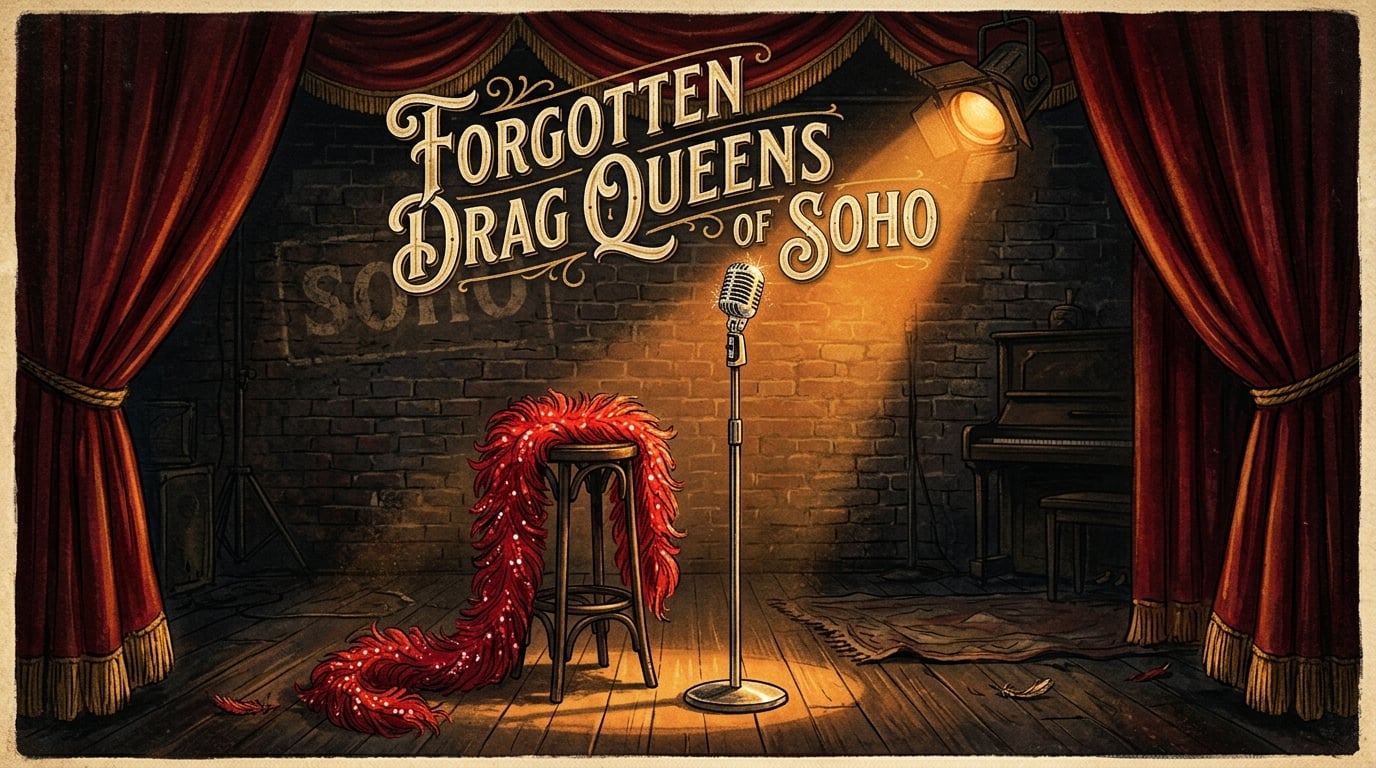
Soho has always been London’s rebellious heart. Long before the neon lights of Old Compton Street drew crowds of tourists, this tangled web of narrow streets was where drag queens carved out a world of glamour, comedy, and defiance in the face of the law.
When you walk through Soho today, past the cocktail bars and chain restaurants, you are treading on sacred ground. Every brick holds a story of forgotten drag queens who built Soho’s cabaret culture from nothing. These were performers who risked arrest, ridicule, and worse to stand on tiny stages and entertain rooms full of people who needed escape.
In this guide, I want to introduce you to the names that rarely make it into the mainstream histories. We all know about Danny La Rue and the legacy of RuPaul’s Drag Race UK. But what about the queens who packed out basement clubs in the 1950s? The ones who held communities together through the AIDS crisis? The performers whose names have faded from marquees but whose influence shaped everything that came after?
Their stories are the real foundation of Soho nightlife history. Let me walk you through who they were, where they performed, and why we owe them more than we realise.
Table of Contents
Soho’s Drag Origins: From Music Hall to Midnight Shows
Soho drag history does not begin with a single performer or a single night. It grows out of a much older British tradition. The music hall era of the late 1800s and early 1900s normalised male performers dressing as women for comedy and entertainment. Acts like impersonator Herbert Asquith and the tradition of pantomime dames gave audiences a taste of gender performance long before the term “drag queen” entered common use.
By the 1930s and 1940s, Soho had become London’s entertainment district. It was scruffy, cheap, and largely ignored by respectable society. That made it the perfect home for drag revue history to take root. During World War II, service revues like “This Was The Army” featured men performing as women to packed houses. The London Museum has documented how these shows blurred the line between comedy and something more personal for the men involved.
After the war, female impersonator London acts began appearing in clubs and basement venues around Soho. Collins’ Music Hall on Islington’s doorstep and various rooms within Soho itself hosted variety shows where drag was part of a broader bill. These performers were not celebrities. They were working entertainers who did three or four shows a night, often for very little money.
The legal landscape made everything harder. Until the Sexual Offences Act of 1967 partially decriminalised homosexuality in England and Wales, simply performing in drag could attract police attention. Venues were raided. Performers were arrested. Yet the shows went on, because the community needed them.
The Forgotten Drag Queens Who Built Soho’s Cabaret Culture
This is where most articles stop. They mention Danny La Rue, perhaps reference a modern star, and move on. I want to go deeper. The forgotten drag queens who built Soho’s cabaret culture were not household names, but they were the ones doing the work night after night, year after year, in rooms that no longer exist.
Phil Starr: The Godfather of Soho Drag
Phil Starr performed for over 50 years and was widely regarded as one of the foundational figures of London drag. He started in the 1960s, a time when every show carried real risk. Starr was known for sharp comedy, quick crowd work, and a warmth that made audiences feel like family. He performed at venues across Soho and South London, including the famous Black Cap in Camden, but his influence reached deep into Soho’s scene.
What made Starr special was his generosity. Younger performers credit him with teaching them the craft. He understood that drag was about more than the look. It was about commanding a room, reading an audience, and giving people a night they would remember. He passed away in 2020, and with him went decades of stories that no book has captured.
Maisie Trollette: Britain’s Oldest Working Drag Queen
Maisie Trollette is a name that deserves far more recognition. Born in 1935, she has been performing since the early 1960s and at the time of writing remains active. She represents an unbroken thread connecting modern drag to its post-war roots. Trollette’s act is classic glamour drag: big wigs, sequinned gowns, and a sharp wit honed over six decades of stage time.
She has performed at countless Soho and Brighton venues over the years. Her endurance is remarkable when you consider everything the community went through during her career. The police raids of the 1960s, the AIDS crisis of the 1980s, the commercialisation of the 2000s. Through all of it, Maisie kept performing. She is living proof that drag is not a trend but a tradition.
Dave Lynn: The Soho Regular
Dave Lynn was another fixture of the London drag scene whose name deserves wider recognition. He performed for decades across Soho venues and was known for a style that blended traditional drag with sharp, working-class comedy. Lynn came up in an era when drag was not televised or glamorous. It was hard graft in smoky back rooms.
Performers like Lynn were the backbone of Soho nightlife history. They did not have agents or brand deals. They had regular slots at pubs and clubs, loyal audiences who came back week after week, and a deep connection to the community they served. That kind of drag is harder to find now, and it is worth understanding what made it special.
Regina Fong: The Last of the Red Hot Mamas
Regina Fong was the stage name of Reg Bundy, a performer, dancer, and choreographer who became a beloved figure in London’s drag and cabaret world. Fong performed widely, including at Soho venues, and was known for a high-energy act that combined comedy, dance, and audience participation. Her signature title, “The Last of the Red Hot Mamas,” tells you everything about her stage persona: big, brash, and impossible to ignore.
Fong represented something important in cabaret culture London. She proved that drag could be theatrical, athletic, and intelligent all at once. She was not just a man in a dress telling jokes. She was a fully realised character with depth, timing, and presence. Performers like her raised the artistic bar for everyone who followed.
The Duchess and the Working Drag Circuit
Beyond the names that appear in interviews and documentaries, there were dozens of performers who worked the Soho circuit without ever becoming famous. The Duchess was one of them. These were the queens who held down weekly residencies at pubs, hosted charity events, performed at community fundraisers, and kept the lights on at venues that operated on razor-thin margins.
Many of these forgotten drag performers left behind no recordings, no photographs, and no press coverage. Their legacy lives on in the memories of the people who saw them and the performers they influenced. That is exactly why writing about them matters. Without the working drag circuit, there would be no mainstream drag scene today.
The Venues That Made It Possible
You cannot tell the story of Soho drag without telling the story of the rooms where it happened. The performers needed stages, and the stages needed performers. Together they created an ecosystem that survived decades of legal and social pressure.
The Admiral Duncan
The Admiral Duncan on Old Compton Street is one of the most significant venues in LGBTQ+ history Soho. Forum users consistently describe it as a historic pub steeped in queer history, with authentic British drag that connects directly to the old-school tradition. The pub has hosted drag shows for decades and survived the horrific nail bombing in 1999 that killed three people and wounded dozens more.
The fact that the Admiral Duncan reopened and continued hosting drag after that attack tells you everything about the resilience of this community. It remains a place where you can see traditional British drag performed by people who understand the craft and its history.
The Black Cap
Though technically in Camden rather than Soho, the Black Cap was part of the same ecosystem and is essential to understanding London drag queens and their circuit. It hosted legendary drag shows for over 50 years. Performers like Phil Starr and countless others made it a fixture of the scene. The venue’s closure in 2015 and the ongoing campaign to save it illustrate how fragile this history is.
Madame Jojo’s
Madame Jojo’s was a Soho institution. Located on Brewer Street, it hosted cabaret, drag, and burlesque nights that drew crowds from across London. The venue was known for its ornate interior and its commitment to variety entertainment. Its licence was revoked in 2014 after a violent incident, and its closure left a massive gap in Soho’s cabaret landscape.
For performers, losing a venue like Madame Jojo’s was not just about losing a gig. It was about losing a room with a particular energy, a history, and an audience that understood what they were watching. Every venue closure erases a piece of the story.
Collins’ Music Hall and the Variety Tradition
Going further back, Collins’ Music Hall represents the bridge between the old variety tradition and the drag revue era. Though located just outside Soho in Islington, it was part of the same entertainment network that fed performers into Soho’s clubs. The London Museum’s research into post-war drag shows highlights how venues like this nurtured the performers who would go on to define Soho nightlife.
How Drag Culture Developed in Soho Through the Decades
Drag in Soho did not develop in a straight line. It evolved in waves, shaped by law, social attitudes, and the performers themselves.
1940s to 1950s: Post-war drag shows were part of a broader variety tradition. Performers worked bills alongside comedians, singers, and dancers. Drag was coded as entertainment rather than identity, which gave performers some cover but also limited how authentic they could be.
1960s: The partial decriminalisation of homosexuality in 1967 changed things slowly. Venues became slightly bolder about hosting explicitly queer drag. Performers like Phil Starr and Maisie Trollette were building their careers during this period, working rooms that were still semi-hidden.
1970s: Soho’s gay scene flourished. More venues opened, drag became more visible, and the community grew more confident. The Royal Vauxhall Tavern, though south of the river, became a key working-class venue that connected to the Soho scene through shared performers and audiences.
1980s: The AIDS crisis devastated the community. Many performers lost friends, colleagues, and audience members. Drag became a form of resistance and mourning as well as entertainment. Benefit shows raised money for those affected. Some of the forgotten drag queens who built Soho’s cabaret culture were lost during this period, and their absence is still felt.
1990s to 2000s: Soho became increasingly commercialised. Rents rose. Independent venues struggled. Some forum users note that Soho has become “too touristy and straight,” with authentic old-school drag harder to find amid the cocktail bars and chain pubs.
2010s to 2026: The arrival of RuPaul’s Drag Race UK in 2019 brought mainstream attention to British drag. While this visibility is welcome, it has also created a gap between the new generation of television-famous queens and the working performers who built the scene. Understanding this history helps bridge that gap.
The Cultural Legacy of Soho’s Drag Pioneers
The forgotten drag queens who built Soho’s cabaret culture left behind more than memories. They created a template for how drag functions as entertainment, community, and resistance all at once.
Every modern drag show owes something to the performers who figured out how to work a room before there were cameras or social media. The art of crowd interaction, the comedy timing, the ability to read an audience and adjust in real time. These skills were developed in Soho’s basement clubs by people whose names we have largely forgotten.
They also created safe spaces. At a time when being gay was illegal and being visibly gender-nonconforming was dangerous, drag venues were among the few places where people could be themselves. The performers on stage were not just entertainers. They were beacons of possibility for audience members who had nowhere else to go.
The legacy is also a warning. As venues close and rents rise, we risk losing the physical spaces that made this culture possible. The Black Cap, Madame Jojo’s, and many smaller rooms have already disappeared. Each closure breaks another link in the chain connecting today’s drag scene to its roots.
FAQs
Who were the first drag queens in Soho?
The first drag performers in Soho grew out of the British music hall and variety tradition of the late 1800s and early 1900s. After World War II, dedicated female impersonator acts began appearing in Soho clubs, with performers working variety bills alongside comedians and singers. Names from the earliest era are largely undocumented, but post-war performers like Phil Starr and Maisie Trollette represent the oldest surviving connection to Soho’s foundational drag scene.
What venues hosted drag shows in Soho?
Key Soho drag venues included the Admiral Duncan on Old Compton Street, Madame Jojo’s on Brewer Street, and various basement clubs that no longer exist. Nearby venues like the Black Cap in Camden and the Royal Vauxhall Tavern were part of the same circuit. Collins’ Music Hall in Islington was an important earlier venue connected to the variety tradition that fed performers into the Soho scene.
How did drag culture develop in Soho?
Drag culture in Soho developed in waves. It began as part of the music hall variety tradition in the early 1900s, grew into dedicated club nights after World War II, became more openly queer after partial decriminalisation in 1967, survived the AIDS crisis of the 1980s, and faced commercialisation pressures from the 1990s onward. Each era shaped the performers and venues differently.
Is Soho still good for drag shows?
Soho still has drag shows, particularly at venues like the Admiral Duncan, but many locals feel the area has become more touristy and less connected to its working drag roots. Historic venues like Madame Jojo’s have closed, and authentic old-school British drag is harder to find than it once was. The scene persists but in a changed form shaped by commercial pressures and the mainstream popularity of television drag.
Why These Stories Still Matter
It is easy to look at drag today, with its global television franchises and stadium tours, and forget how hard-won every stage was. The forgotten drag queens who built Soho’s cabaret culture did not perform for fame. They performed because it was who they were and because their community needed them.
Remembering them is not just an exercise in nostalgia. It is a way of understanding how communities build culture under pressure. When the law is against you, when society rejects you, when your friends are dying around you, the act of putting on a wig and making a room full of people laugh becomes something close to heroism.
If you want to experience the legacy of these performers today, start at the Admiral Duncan. Talk to the people who have been in the scene for decades. Seek out the performers who do not have television deals but who work the rooms week after week. They are the direct inheritors of the tradition that Phil Starr, Maisie Trollette, Dave Lynn, Regina Fong, and so many unnamed others built in the basements and back rooms of Soho.
The forgotten drag queens who built Soho’s cabaret culture deserve more than a footnote. They deserve to be remembered, by name where possible and by spirit where names have been lost. Their stages may be gone, but their influence is in every drag show you will ever see.