
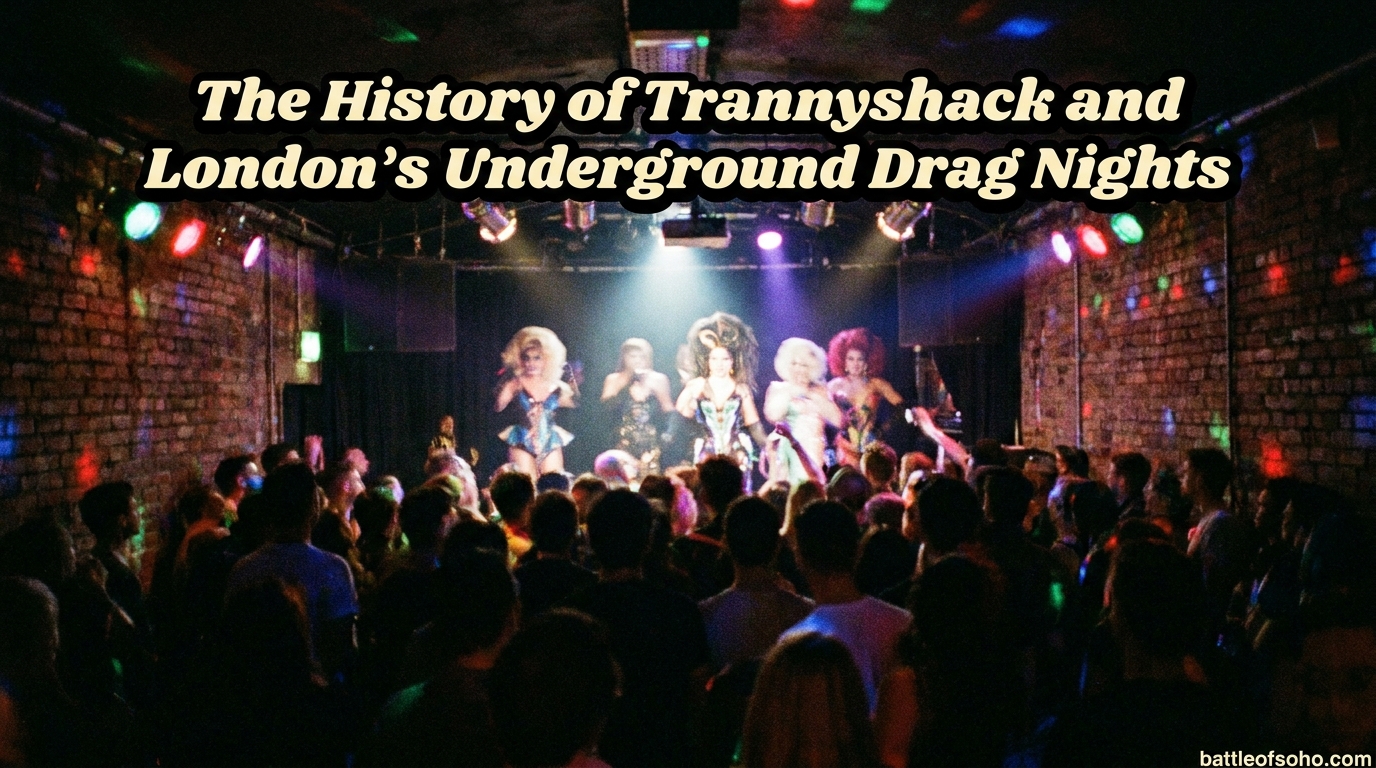
Trannyshack was a legendary drag club night founded in San Francisco in 1996 by the performer Heklina, running weekly at The Stud bar before spawning a licensed London offshoot at Madame JoJo’s in Soho. The History of Trannyshack and London’s Underground Drag Nights spans two continents, decades of queer nightlife, and a generation of drag performers who reshaped how the world thinks about gender, performance, and underground culture.
I have spent years researching queer nightlife history, and few stories are as rich and under-documented as this one. Most people know drag from television. But long before mainstream reality competitions, there were smoky basement rooms, fierce pageants, and tight-knit communities building something radical on Tuesday nights.
This article traces the full arc of Trannyshack, from its birth in San Francisco’s Mission District through its cross-Atlantic journey to Soho, the personalities who defined it, the venues that housed it, and the cultural forces that ultimately closed its doors. The History of Trannyshack and London’s Underground Drag Nights is a story about more than drag. It is about belonging, resistance, and the spaces that queer communities build when the mainstream will not have them.
A note on language: the name “Trannyshack” reflects the terminology of its era. In 2015, Heklina changed the San Francisco night’s name to “Mother” in response to evolving sensitivities within the trans community. This article uses the historical name in context while acknowledging that shift.
Table of Contents
Quick Overview: What Was Trannyshack?
Trannyshack was a weekly drag club night launched in February 1996 at The Stud bar in San Francisco. Founded by Heklina (born Stefan Grygelko) as an offshoot of the earlier club night Klubstitute, it ran every Tuesday for 12 years and became the longest-running drag event in San Francisco history.
The London version, known as Tranny Shack (UK), launched at Madame JoJo’s on Brewer Street in Soho. Heklina granted the London organizers legal rights to use the name, making it the only officially licensed international offshoot. London’s Tranny Shack introduced its own signature format: the Tranny Shack Academy, a judged drag competition that became a launchpad for emerging UK drag talent.
Together, these two nights anchored underground drag culture on both sides of the Atlantic through the late 1990s and 2000s, long before drag entered the global mainstream.
Founding and Origins: Heklina and San Francisco 1996
The story begins with Klubstitute, a San Francisco club night that ran in the early-to-mid 1990s. Klubstitute was itself a response to the city’s drag scene becoming too polished and pageant-focused. It embraced punk energy, camp, and the rawer edges of gender performance.
Heklina, a fixture of that scene, launched Trannyshack in February 1996 as a dedicated weekly Tuesday night at The Stud, a storied bar in San Francisco’s Mission District. The concept was simple but radical for its time: open the stage to anyone willing to perform drag, regardless of experience, gender identity, or polish level.
According to the Online Archive of California (OAC), which holds the Trannyshack Collection at the San Francisco Public Library’s James C. Hormel Gay and Lesbian Center, the night quickly attracted a diverse cast of performers. Transsexuals, drag kings, faux queens (cisgender women performing as drag queens), and gender illusionists all shared the same stage. This inclusivity was not a marketing slogan. It was baked into the founding ethos.
The OAC finding aid notes that the competitive atmosphere at Trannyshack “spurred creative excellence,” with performers pushing each other toward increasingly inventive and avant-garde acts. Tuesday nights at The Stud became the place to be for anyone interested in the cutting edge of drag.
Within a few years, Trannyshack had grown far beyond a local curiosity. Performers traveled from across the country to appear. Audiences packed The Stud until midnight and beyond. Heklina had created something that the drag world had not quite seen before: a weekly institution that treated drag as serious art while never taking itself too seriously.
The Miss Trannyshack Pageant
One of the defining features of the San Francisco Trannyshack was the Miss Trannyshack Pageant, an annual competition that crowned the year’s top performer. Far from a conventional beauty pageant, this event rewarded creativity, shock value, humor, and theatrical ambition.
The pageant became a major event on the San Francisco queer calendar. Performers spent months preparing elaborate numbers, often with full production values, backup dancers, and scripted narratives. Winning Miss Trannyshack carried real prestige in the drag world. It signaled that a performer had earned the respect of peers and audiences alike.
A landmark moment came in 2003, when Fauxnique (performer Monica Carmichael) won the pageant. Fauxnique was a faux queen, meaning a cisgender woman performing in drag. Her victory was historically significant, as it challenged assumptions about who could be a drag queen and what drag itself could mean. The OAC archive specifically documents this win as a first for a faux queen in the pageant’s history.
The pageant embodied everything Trannyshack stood for: fierce competition, boundary-pushing artistry, and a willingness to challenge conventions even within the drag community itself.
Special Trannyshack Events in San Francisco
Beyond the weekly Tuesday nights and the annual pageant, Trannyshack became known for staging ambitious special events that took drag out of the club and into unexpected spaces.
One of the most talked-about was the Reno trip, a themed excursion that brought the Trannyshack sensibility to the Nevada casino town. These road-trip events combined performance, party, and cultural commentary, transplanting San Francisco’s avant-garde drag scene into a deeply unexpected setting.
Another legendary production was the SS Trannyshack cruise, which took the show onto the water. These themed cruises combined the intimacy of a club night with the spectacle of a full-scale production, creating experiences that attendees still talk about decades later.
Themed parties and special cabarets ran throughout the year, often tied to holidays, pop culture moments, or pure creative whimsy. A burlesque ball variant brought in elements of striptease and classic cabaret. These events kept the weekly night fresh and gave performers new formats to explore.
What set these events apart was their sense of adventure. Trannyshack never settled for repeating a formula. Every special night was an opportunity to try something that had not been done before in drag.
The London Connection: How Trannyshack Crossed the Atlantic
As Trannyshack’s reputation grew in the late 1990s and early 2000s, it attracted international attention. Heklina began taking the show on the road, with touring appearances in various cities. But London was different. London did not just host a touring version. It built its own permanent offshoot.
According to the OAC archival finding aid, the London club was the only international version granted legal rights by Heklina to keep the Trannyshack name. This was not a franchise deal in the corporate sense. It was a personal blessing from one drag pioneer to another, acknowledging that the London scene had the talent and the commitment to carry the brand forward.
The London Tranny Shack found its home at Madame JoJo’s, a legendary Soho nightclub on Brewer Street. Madame JoJo’s had been a fixture of Soho nightlife since 1986, known for cabaret, burlesque, drag shows, and live music. It was the perfect venue for a drag night that wanted to honor the Trannyshack ethos while developing its own distinctly British identity.
The London night was structured as a monthly event rather than a weekly one, which gave organizers time to curate each edition carefully. This pacing allowed for bigger productions, more rehearsed numbers, and a sense of occasion that made each Tranny Shack night feel like a major event on the Soho calendar.
The cross-Atlantic connection between the two Trannyshacks was more than just a shared name. It represented a cultural bridge between two of the world’s most important queer nightlife cities, each with its own traditions, sensibilities, and drag lineages.
Tranny Shack Academy: London’s Drag Competition
The single most distinctive contribution of the London Tranny Shack was the Tranny Shack Academy, a competition format that became a cornerstone of the UK drag scene. While San Francisco had the Miss Trannyshack Pageant as its signature competitive event, London developed its own format tailored to the needs of the growing British drag community.
The Academy functioned as both a competition and a training ground. Emerging drag performers would compete in judged performances, receiving feedback and exposure in front of live Soho audiences. The format encouraged performers to develop their craft under real conditions, with real audiences and real stakes.
Documentation of the Tranny Shack Academy’s specific winners and seasons remains sparse online, which is one of the reasons this history matters. The Wikipedia article on Drag Queens of London, a 2014 reality television series that aired on London Live, provides some of the most detailed publicly available information about the Academy and its key figures. The series itself was a testament to how significant the Soho drag scene had become.
The Academy’s impact went beyond crowning winners. It created a pipeline for drag talent in London, giving newcomers a stage, an audience, and a community. Many performers who would go on to wider recognition in the UK drag scene cut their teeth at Madame JoJo’s through the Academy format.
What made the Academy format powerful was its emphasis on growth. Rather than a single winner-takes-all pageant, it created an ongoing series of opportunities for performers to develop and be seen. This reflected a fundamentally supportive ethos within the London drag community, where competition was fierce but not destructive.
Key Figures in London’s Underground Drag Scene
The London Tranny Shack was driven by a constellation of performers, hosts, and promoters who each brought their own distinctive energy to Soho’s drag scene. Understanding the night means understanding the people who made it.
Miss Dusty O served as host and co-promoter of Trannyshack London. Known for her sharp wit, commanding stage presence, and deep knowledge of drag history, Dusty O was the connective tissue that held the night together. Attendees from the era recall her as an incredibly welcoming host who made newcomers feel at home while keeping the energy high for regulars.
Lady Lloyd was another central figure, working as DJ and host at the Soho Trannyshack. She is also known as a member of The Buffalo Girls, identified by the Drag Queens of London Wikipedia entry as London’s first drag pop band. The Buffalo Girls represented something new in UK drag: a group that combined music performance with drag artistry, creating a hybrid form that prefigured later trends in drag entertainment.
Walt was another name associated with the London Trannyshack scene, contributing to the night’s distinctive atmosphere and creative direction. The broader Soho drag ecosystem also included figures like Jodie Harsh, who would go on to become one of the UK’s most prominent DJs and club promoters, and performers connected to groups like the Supreme Fabulettes.
What united these figures was a commitment to drag as a living, evolving art form. They were not content to simply recreate what had been done before. Each brought their own influences, from punk to pop to cabaret, and the London Tranny Shack was richer for the collision of those sensibilities.
The Drag Queens of London television series, which aired in 2014 on London Live, captured some of this scene at what would prove to be a pivotal moment. The show documented the lives and performances of London-based drag queens, several of whom were connected to the Trannyshack and Soho drag ecosystem. For many viewers, it was their first window into a scene that had been thriving underground for years.
Madame JoJo’s: The Venue and Its Atmosphere
To understand the London Tranny Shack, you have to understand Madame JoJo’s. The venue at 16-18 Brewer Street in Soho was opened in 1986 by Paul Raymond, the Soho property and entertainment magnate. It was named after a drag performer called Madame Jojo, reflecting the venue’s drag roots from its very inception.
Madame JoJo’s was never just a drag venue. Over its nearly three decades of operation, it hosted cabaret, burlesque, live music, and club nights spanning genres and subcultures. It featured Drag King nights (Club Naive and later Club Geezer) starting in 1995, making it a pioneer in showcasing drag king performance alongside drag queen acts. The venue even appeared in Stanley Kubrick’s 1999 film Eyes Wide Shut, cementing its place in broader cultural history.
The indie club night White Heat, which ran at Madame JoJo’s, launched or boosted the careers of artists including Lorde, Jamie T, The xx, Adele, and Anna Calvi. This musical pedigree gave the venue a cultural weight that extended far beyond the drag and cabaret scenes.
But for the drag community, Madame JoJo’s was something special. Forum users who attended Trannyshack nights there describe the atmosphere as “electric” and “family-like.” Performers and audience members mingled freely, breaking down the barrier between stage and crowd. The room felt raw and experimental compared to more mainstream or commercialized drag venues.
The OAC archive, describing the broader Trannyshack ethos that the London night inherited, emphasizes the inclusive atmosphere that welcomed transsexuals, drag kings, faux queens, and performers of all gender expressions. Madame JoJo’s physical space, with its intimate layout and storied walls, amplified that inclusivity into something that attendees describe as transformative.
Competition among performers at Trannyshack London was described by those who were there as “fierce but supportive.” Queens pushed each other to be better without tearing each other down. That balance is rare in any competitive creative scene, and it was a defining characteristic of the Madame JoJo’s drag nights.
San Francisco vs London Trannyshack: A Comparison
The two Trannyshacks shared a name and a founding spirit, but they developed distinct personalities shaped by their cities, venues, and communities. Understanding the differences helps explain why the Trannyshack story is really two stories running in parallel.
The San Francisco Trannyshack was a weekly Tuesday night event running for 12 years at The Stud. Its rhythm was relentless: every week, new performances, new faces, new creative risks. This frequency allowed for experimentation and a build-as-you-go creative process. The Miss Trannyshack Pageant provided an annual focal point, but the heart of the night was the weekly grind of showing up and performing.
The London Tranny Shack was a monthly event at Madame JoJo’s. This cadence meant each night was more curated, more produced, and more of an occasion. The Tranny Shack Academy competition format reflected this approach, giving structure and narrative arc to each edition of the night.
San Francisco’s scene drew from the city’s deep countercultural traditions: punk, the avant-garde, and decades of queer activism. London’s scene drew from Soho’s entertainment history, British cabaret and music hall traditions, and the specific dynamics of UK queer nightlife. The result was two nights that felt connected but unmistakably different.
Both venues faced existential threats from gentrification and changing urban economies. The Stud sat in San Francisco’s Mission District, an area that underwent massive transformation during the Trannyshack years. Madame JoJo’s sat in Soho, where Westminster Council’s campaigns to “clean up” the area had been reshaping queer nightlife since the 1980s. These pressures would eventually catch up with both venues.
The comparison between the two Trannyshacks is ultimately a story about how the same idea, transplanted across an ocean, adapts to local soil. The SF version was raw, frequent, and punk-inflected. The London version was curated, theatrical, and deeply rooted in British cabaret traditions. Both were essential.
Closure and Aftermath
The end came for both venues within a narrow window, creating a poignant bookend to the Trannyshack era.
In November 2014, Madame JoJo’s was forced to close after Westminster City Council revoked its license. The revocation followed an incident of violence outside the venue, but for many in the LGBTQ+ community, it felt like part of a broader pattern of Soho venues being lost to development and regulatory pressure. The Guardian reported extensively on the closure, noting the venue’s legendary status as the home of burlesque and cabaret in Soho.
The closure prompted the Save Soho campaign, backed by high-profile figures including Stephen Fry and Benedict Cumberbatch. The campaign highlighted the broader erosion of Soho’s cultural spaces and the impact on the LGBTQ+ community. For drag performers who had called Madame JoJo’s home, the closure was devastating. Forum users describe it as leaving a gap in Soho’s drag scene that many feel has never been properly filled.
In San Francisco, the original Trannyshack had already evolved. After 12 years at The Stud, Heklina moved the night to various venues including DNA Lounge and the Regency Ballroom. In 2015, she renamed the event “Mother,” a decision driven partly by changing attitudes toward the original name within the trans community. The name change was a recognition that language evolves and that cultural institutions must sometimes evolve with it.
Heklina went on to co-found Oasis, a drag venue in San Francisco, ensuring that the spirit of Trannyshack continued in a new physical home. Tragically, Heklina passed away, sending shockwaves through the global drag community. Her legacy as a founder of one of the most important drag institutions in history remains secure.
In 2024, an American company applied for a strip club license in the former Madame JoJo’s premises, a development that underscored how thoroughly the cultural character of the space had been erased. For those who remember the Trannyshack nights, the transformation of the building stands as a symbol of what gets lost when queer spaces disappear.
Cultural Significance and Lasting Legacy
The History of Trannyshack and London’s Underground Drag Nights is not just nostalgia. It is a record of how underground queer spaces shape culture in ways that often only become visible years later.
Trannyshack launched careers. Performers who appeared on its stages in San Francisco and London went on to national and international recognition. The night provided a platform for emerging talent at a time when drag had virtually no mainstream media infrastructure. There was no television show, no streaming platform, no social media algorithm to amplify drag performers. There was only the stage, the audience, and the work.
The night also served as a social acceptance space. For many attendees, Trannyshack was the first place they felt truly welcome as themselves. Forum testimonies from people who attended the London nights in the 2000s describe a community where you could be whoever you were, without judgment. In an era before broader LGBTQ+ acceptance, these spaces were lifelines.
The gentrification that ultimately contributed to the closure of both The Stud’s Trannyshack era and Madame JoJo’s is part of a larger story about the erosion of queer spaces in major cities. Rising rents, development pressure, and regulatory campaigns have thinned the ranks of underground venues in both San Francisco and London. The Trannyshack story is, in part, a cautionary tale about what communities lose when these spaces disappear.
Many younger drag fans today are unaware of the pre-RuPaul’s Drag Race era of UK and US drag. The Trannyshack generation built the infrastructure that later drag performers benefited from. They created the performance traditions, the audience expectations, and the community norms that made the mainstream drag boom possible. Documenting this history is not just about looking backward. It is about understanding the foundations on which contemporary drag culture stands.
Archival materials from the Trannyshack era, including the collection at the San Francisco Public Library, remain difficult to access for many researchers and enthusiasts. The scarcity of documentation for the London scene, in particular, represents a significant gap in queer cultural history. Articles like this one, drawing on archival sources, journalistic reporting, and community testimony, help fill that gap.
FAQs
What is Trannyshack?
Trannyshack was a legendary drag club night founded in San Francisco in 1996 by Heklina as a weekly Tuesday event at The Stud bar. It ran for 12 years and later spawned a licensed London offshoot at Madame JoJo’s in Soho, becoming a cornerstone of both cities’ underground drag scenes.
What happened to Madame JoJo’s?
Madame JoJo’s, the legendary Soho nightclub on Brewer Street that hosted Tranny Shack UK, was forced to close in November 2014 after Westminster City Council revoked its license. The closure prompted the Save Soho campaign backed by Stephen Fry and Benedict Cumberbatch. In 2024, an American company applied for a strip club license in the former premises.
What was the atmosphere like at Madame JoJo’s?
Madame JoJo’s was known for an electric, family-like atmosphere where performers and audiences mingled freely. The drag nights were raw and experimental compared to mainstream venues, with fierce but supportive competition among performers. The venue welcomed transsexuals, drag kings, faux queens, and performers of all gender expressions.
Who founded Trannyshack?
Trannyshack was founded in February 1996 by Heklina (born Stefan Grygelko), a San Francisco drag performer. It began as an offshoot of an earlier club night called Klubstitute and ran weekly at The Stud bar for 12 years before Heklina renamed it Mother in 2015.
What is Tranny Shack Academy?
Tranny Shack Academy was the signature drag competition format of the London Tranny Shack at Madame JoJo’s. Emerging drag performers competed in judged performances in front of live Soho audiences, making it both a competition and a training ground that launched numerous UK drag careers.
When did Trannyshack close?
The original San Francisco Trannyshack evolved rather than closed outright, running for 12 years at The Stud before Heklina renamed it Mother in 2015. The London Tranny Shack ended when Madame JoJo’s was forced to close in November 2014 due to license revocation by Westminster City Council.
Are drag queens usually straight men?
Drag queens span all sexual orientations and gender identities. While many are gay men, drag also includes straight men, bisexual performers, trans women, and cisgender women known as faux queens or AFAB queens. Trannyshack specifically welcomed this full diversity of performers.
What is a booger in drag?
In drag slang, a booger typically refers to a deliberately messy or unpolished drag look or performance. The term is context-dependent and can be used affectionately or critically within drag culture, with meanings that vary by region and era.
Conclusion
The History of Trannyshack and London’s Underground Drag Nights is a story about what happens when communities build spaces for themselves. From Heklina’s first Tuesday night at The Stud in 1996 to the final Tranny Shack nights at Madame JoJo’s before its 2014 closure, these events shaped drag culture in ways that are still being felt in 2026.
The venues are gone. Many of the flyers, photos, and recordings are scattered or lost. But the influence lives on in every drag performer who benefits from the traditions these nights established. If you want to understand modern drag, you need to understand where it came from.
For researchers, performers, and fans interested in preserving this history, the Trannyshack Collection at the San Francisco Public Library remains an invaluable resource. For the London side, community archives and personal testimonies are the best available record, and they deserve to be documented before more is lost.