
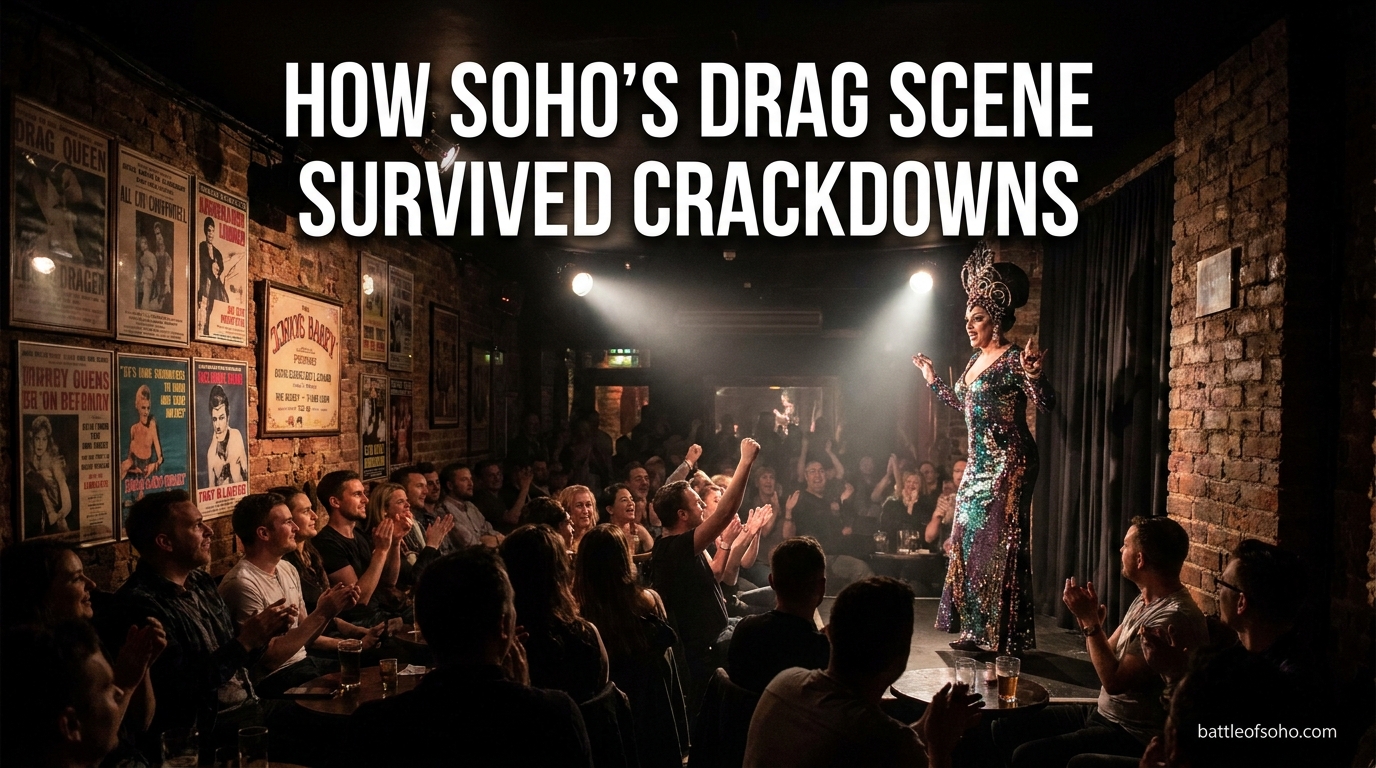
Imagine the scene. It is a Friday night in 1987, somewhere on Old Compton Street. The lights are low, the lip-sync is flawless, and a crowd of regulars have packed into a basement venue to forget about everything happening outside those walls. Then the house lights snap on. Plain clothes police officers are at the door. The music cuts dead. Performers in full wigs and sequins are told to stand still while officers walk through the room, taking names, checking licences, looking for any excuse to shut the place down.
This was not a one-off event. It was a routine feature of Soho’s drag scene crackdowns for decades. From the 1960s through to the present day, the drag performers and venue owners of Soho have faced police raids, licensing attacks, moral panics, homophobic legislation, a devastating health crisis, a literal nail bomb, and the slow erosion of gentrification. And yet the scene survived every single one of them.
I have spent years researching London’s LGBTQ+ history, talking to veteran performers, and tracing the archival record of how Soho’s drag community responded to each wave of pressure. What I found is not a story of passive endurance. It is a story of active, creative, sometimes furious resistance. The drag scene did not merely survive Soho’s crackdowns. It used them as fuel, sharpening its comedy, deepening its community bonds, and reinventing itself over and over again.
This is the complete history of how Soho’s drag scene survived decades of crackdowns, told decade by decade, venue by venue, and raid by raid.
Table of Contents
Soho’s Drag Scene: A Quick Overview
Soho’s drag scene survived decades of crackdowns through a combination of community solidarity, legal adaptation, performer resilience, and the sheer cultural value of the venues themselves. Every time an external force tried to shut the scene down, performers and owners found a new way to keep going.
The crackdowns came in waves. In the 1960s, performers faced outright criminalisation and police harassment. The 1970s brought partial liberation followed by organised backlash. The 1980s delivered the AIDS crisis and Section 28. The 1990s saw continued police raids and a fascist nail bomb. The 2000s brought the quiet violence of gentrification. The 2010s introduced commercialisation and licensing disputes.
The survival strategies evolved with each threat. Performers built informal networks to warn each other about raids. Venue owners navigated licensing laws and corrupt police. The community created mutual aid systems during the AIDS crisis. And when mainstream culture finally caught up, the old school drag scene was still there, ready to show everyone how it was really done.
Key venues anchored the scene throughout: the Royal Vauxhall Tavern, Madame Jojo’s, the Admiral Duncan, the Black Cap, and dozens of pubs and clubs that opened, adapted, and sometimes closed. Each one played a role in keeping drag alive in London’s most famous nightlife district.
The 1960s: Foundations of Soho’s Drag Underground
To understand how Soho’s drag scene survived, you have to understand what it was up against from the very beginning. Before the Sexual Offences Act of 1967, homosexual acts between men were criminal offences in England and Wales. Drag performance existed in a legal grey zone that was dangerous by design. Performers could be arrested for indecency, for wearing clothing associated with the opposite sex, or simply for being present in a venue that police decided was disorderly.
Soho in the early 1960s was London’s bohemian heart. The area had been a nightlife district since the jazz age, and its reputation for vice, creativity, and tolerance made it a natural home for marginalised communities. The Colony Room on Dean Street, a private members’ drinking club run by Muriel Belcher, was a gathering point for artists, writers, and queer people who needed a space away from the judgmental eyes of mainstream society. Francis Bacon was a regular. So were countless others whose names never made the history books.
The French House on Dean Street served a similar function. Its no-spirits policy and artistic clientele created an atmosphere where difference was accepted rather than policed. These were not drag venues in the way we would understand today. But they were the soil from which Soho’s drag culture would grow.
The Raymond Revuebar, opened by Paul Raymond in 1958, brought theatrical spectacle to the heart of Soho. While it was primarily a nude revue venue, its existence normalised the idea of Soho as a place where the body, gender, and performance could be openly explored. The boundary between theatrical performance and what we now call drag was porous in this environment.
The Flamingo Club on Wardour Street was another vital piece of the puzzle. It hosted American jazz musicians and attracted a mixed crowd that included Afro-Caribbean Londoners, beatniks, and queer people. The cross-pollination between music culture, Black culture, and queer culture in this era laid the groundwork for the drag scenes that would emerge in the following decades.
Police corruption was a fact of life in 1960s Soho. The Messina Brothers ran a prostitution empire with the tacit cooperation of corrupt officers. Protection rackets were common, and venue owners who wanted to operate outside the mainstream had to navigate a landscape of bribery, threats, and arbitrary enforcement. This created a paradoxical situation: some queer spaces survived precisely because corrupt police had an interest in keeping Soho’s vice economy running. When that corruption was periodically cleaned up, the crackdowns that followed often hit gay and drag venues hardest.
The 1967 Sexual Offences Act partially decriminalised homosexuality in England and Wales, but it was a limited reform. It applied only to men over 21, only in private, and it excluded the armed forces and merchant navy. For drag performers, the law changed almost nothing in practical terms. Cross-dressing was not directly criminalised, but the constellation of laws around indecency, disorderly conduct, and obscenity gave police ample tools to target venues that hosted drag shows.
What the 1960s established was a pattern that would define the next sixty years. Soho offered space for drag culture to exist. The authorities periodically tried to shut it down. And the community found ways to adapt and continue. This pattern would repeat with increasing intensity in the decades that followed.
The 1970s: Gay Liberation and the First Backlash
The 1970s transformed everything for Soho’s drag scene. The Gay Liberation Front, founded in London in 1970, brought a new spirit of militant visibility to LGBTQ+ life. Inspired by the Stonewall uprising in New York, the GLF demanded public space, legal equality, and cultural recognition. Drag was central to this movement. The GLF organised drag benefits, street theatre, and public demonstrations that put gender performance at the heart of the liberation struggle.
This new visibility was exhilarating but it also triggered a backlash. Venues that had operated in a quiet, semi-tolerated grey zone suddenly found themselves in the crosshairs. Police who had previously turned a blind eye to discreet drag shows now saw them as symbols of a movement they were determined to suppress.
The Royal Vauxhall Tavern, just across the river from Soho in Vauxhall, became the anchor venue for this era. Originally built in 1865 as a Victorian music hall, the RVT had been a meeting place for gay men since at least the Second World War. In the 1970s, it established itself as London’s principal drag venue, hosting performers who combined the traditions of music hall comedy with the new energy of gay liberation.
Bloolips emerged in this decade as a radical drag theatre collective that pushed the form beyond pub entertainment into genuine theatrical art. Based in London but touring internationally, Bloolips brought together elements of clowning, political satire, and gender performance. Lavinia Co-op, who would become one of Britain’s most respected drag performers, was closely associated with this radical drag tradition. The work of Bloolips demonstrated that drag could be intellectually serious, politically sharp, and commercially viable all at once.
The connection between Soho and the RVT was tighter than geography might suggest. Performers moved between venues on both sides of the river. Audiences followed. The drag scene was not confined to a single postcode. It was a network of venues, performers, and regulars who sustained each other through a period of intense social change.
Police activity in the 1970s reflected the contradictions of the era. The Sexual Offences Act had partially decriminalised homosexuality, but the policing of public morality continued with full force. Venues were raided under the Disorderly House Act, a piece of legislation dating back to 1751 that gave authorities broad power to shut down any establishment they deemed a nuisance. The vagueness of this law made it a perfect tool for targeting gay and drag venues, because almost any enthusiastic crowd could be classified as disorderly.
Plain clothes police officers would enter venues, observe the crowd, and then return with uniformed backup to make arrests. Performers were sometimes charged with outraging public decency. Venue owners faced licence reviews that could strip them of their livelihood overnight. The constant threat created an atmosphere of anxiety that performers learned to manage through dark humour, mutual support, and sheer professional determination.
What made the 1970s different from the 1960s was the emergence of organised community response. The GLF and its successor organisations provided a framework for resistance that had not existed before. When a venue was raided, word spread through community networks. When a performer was arrested, others rallied. The foundations of collective defence that would prove so important in the dark years ahead were laid in this decade.
By the end of the 1970s, Soho’s drag scene was more visible, more organised, and more threatened than ever before. The stage was set for the most challenging decade in its history.
The 1980s: AIDS, Section 28, and Escalating Crackdowns
The 1980s hit Soho’s drag scene like a series of body blows. The AIDS crisis, Section 28, and intensified police crackdowns combined to create the most hostile environment the community had ever faced. That the drag scene not only survived this decade but emerged from it with deeper roots and stronger bonds is a testament to the extraordinary resilience of the people involved.
The AIDS epidemic arrived in London in the early 1980s and began tearing through the LGBTQ+ community with terrifying speed. Drag performers lost friends, colleagues, lovers, and audience members. Venues that had been packed on a Saturday night saw their regulars dwindle as illness and grief took their toll. The emotional weight of this loss is difficult to overstate. Entire social networks were devastated.
Lavinia Co-op, in interviews about this period, has described the experience of inheriting drag wardrobes from friends who died of AIDS-related illnesses. Each sequined dress, each feathered headdress was a memorial. Performers kept going partly because stopping meant surrendering the spaces where their friends had lived and created. The show had to go on, not as entertainment, but as an act of remembrance and defiance.
The institutional response to AIDS made things worse, not better. The Thatcher government’s refusal to engage meaningfully with the crisis created an information vacuum that was filled with fear and prejudice. Mainstream newspapers ran sensationalist stories about gay men and disease that fuelled a moral panic. In this atmosphere, police felt emboldened to crack down on LGBTQ+ venues with renewed vigour.
The Royal Vauxhall Tavern raid during the AIDS crisis became one of the most infamous incidents of the decade. Lily Savage, the drag persona created by Paul O’Grady, was performing at the RVT when police conducted a raid. O’Grady later recalled the surreal experience of being in full Lily Savage regalia, complete with wig and heels, while officers interrogated him about the venue’s activities. The juxtaposition of a health crisis that was killing the community and a police force that was still prioritising raids on drag venues crystallised the absurdity and cruelty of the era.
Paul O’Grady had been performing as Lily Savage at the RVT four nights a week for eight years by this point. His experiences during police raids of this period shaped his comedy and his political outlook. He understood viscerally that drag was not just entertainment. It was a act of resistance against a system that wanted queer people to disappear.
Section 28, passed in 1988, prohibited local authorities from intentionally promoting homosexuality or teaching the acceptability of homosexuality as a pretended family relationship. While Section 28 did not directly target drag venues, its cultural impact was devastating. It sent a clear message that LGBTQ+ lives were not just marginal but actively dangerous. Venues that hosted drag shows found themselves under increased scrutiny from licensing authorities. Performers who worked with young people or in community settings faced new barriers. The legislation created a chill effect that made every aspect of queer cultural life harder.
The Disorderly House Act continued to be weaponised against drag venues throughout the 1980s. Police would cite noise complaints, overcrowding, or alleged drug use as pretexts for raids, but the real target was always the queer community itself. The 1751 legislation had been designed to control gin shops and brothels. In the 1980s, it was being used to shut down drag shows.
What kept the scene alive during this decade was the transformation of venues into community support centres. Drag venues became places where people shared information about HIV prevention, organised fundraising for affected individuals, and provided emotional support to those who had lost loved ones. The comedy got darker, the performances more pointed, and the bond between performers and audiences grew stronger through shared adversity.
Dina Jacobs, a veteran drag performer, has described how audiences during the AIDS years needed drag more than ever. The laughter was a coping mechanism. The community gathering was a survival strategy. And the performers who got on stage night after night, sometimes grieving themselves, were providing a service that went far beyond entertainment.
By the end of the 1980s, Soho’s drag scene had been tested in ways that would have destroyed a less resilient community. It had lost people, faced legal persecution, and weathered a moral panic that sought to erase it entirely. And it was still standing.
The 1990s: Raids, Bombs, and Unbreakable Community
If the 1980s tested Soho’s drag scene, the 1990s tried to destroy it outright. The decade brought continued police harassment, a neo-Nazi nail bomb, and the relentless pressure of a society that was slowly becoming more tolerant in theory while remaining hostile in practice. That the scene not only survived but actually grew stronger during this period is one of the most remarkable stories in London’s cultural history.
The most defining moment of the decade came on April 30, 1999. David Copeland, a neo-Nazi extremist, planted a nail bomb in the Admiral Duncan pub on Old Compton Street in the heart of Soho. The Admiral Duncan was one of Soho’s best-known gay venues, a gathering place for the LGBTQ+ community and a cornerstone of the area’s drag culture. The bomb killed three people: Andrea Dykes, John Light, and Nik Moore. Andrea was pregnant with her first child. More than 79 people were injured, many seriously.
The Admiral Duncan bombing was not just an attack on a single venue. It was an attack on the idea that Soho could be a safe space for the LGBTQ+ community. Copeland specifically targeted the pub because it was a gay venue, and his stated goal was to stir up fear and division. The blast shattered windows along Old Compton Street and sent shockwaves through the entire Soho community.
What happened next defines the story of Soho’s drag scene. The community refused to be driven underground. Within days, the area around Old Compton Street became a site of mourning and defiance. Crowds gathered, flowers piled up, and the message was clear: the community would not abandon its spaces. The Admiral Duncan itself would eventually reopen. The nail bomb intended to destroy Soho’s drag and gay scene instead became a catalyst for deeper community solidarity.
The 1990s also saw the rise of Madame Jojo’s as Soho’s premier drag venue. Located on Walker’s Court, just off Old Compton Street, Madame Jojo’s combined the traditions of Soho cabaret with cutting-edge drag performance. Its mirrored walls and theatrical interior made it a natural home for the kind of glamour, camp, and subversion that defined the era’s drag scene. For more than two decades, Madame Jojo’s would be the venue that performers aspired to and audiences flocked to.
The Duckie collective, founded in the mid-1990s, brought a new dimension to London’s drag and cabaret scene. Duckie started as a Saturday night club at the Royal Vauxhall Tavern and grew into a cultural phenomenon that blended drag, performance art, live music, and interactive entertainment. Amy Lame was among the key figures. Duckie demonstrated that drag could be intellectually challenging, artistically ambitious, and commercially successful simultaneously. Over 27 years, the collective would become one of the longest-running queer cabaret nights in British history.
Police raids continued throughout the 1990s despite the growing cultural acceptance of LGBTQ+ people. The vice squad maintained its interest in Soho’s nightlife, and licensing authorities used their powers to pressure venues. The moral panic around ecstasy and club culture in the early 1990s gave police additional pretexts for raids, and gay venues were not exempt from the crackdown.
The tension between growing mainstream tolerance and continued institutional harassment defined the decade. On paper, things were getting better. The Criminal Justice and Public Order Act of 1994 lowered the age of consent for gay men from 21 to 18, though still not to 16. Public attitudes were slowly shifting. Television programmes began to feature LGBTQ+ characters and storylines. But the lived experience of drag performers and venue owners in Soho remained one of vigilance and caution.
Old Compton Street cemented its identity as the centre of London’s gay village during this decade. Bars, cafes, and shops catering to the LGBTQ+ community opened along the street, creating a visible, public presence that would have been unimaginable twenty years earlier. Drag performances were a central part of this ecosystem, drawing crowds and creating the atmosphere that made Old Compton Street a destination.
The performers who defined this era, including Miss Dusty O, Regina Fong, and a generation of artists who blended old school comedy with new energy, kept the scene vibrant. They performed in venues that could be raided at any time, for audiences that had survived a health crisis and a bombing, and they made people laugh through all of it. That is what survival looked like in the 1990s.
The 2000s: The ‘Bad Drag’ Era and Gentrification Wars
The 2000s are the decade that most articles about London’s drag scene skip over. Sandwiched between the trauma of the 1980s and 1990s and the explosion of RuPaul’s Drag Race in the 2010s, this period has been called the era of bad drag. That label does a disservice to the performers who kept the art form alive during a decade that presented its own unique challenges.
The term bad drag was used, sometimes affectionately and sometimes dismissively, to describe the old school drag that continued in Soho’s pubs and clubs while the cultural spotlight moved elsewhere. This was character-driven comedy drag, rooted in the traditions of music hall and variety. Performers created personas with distinct voices, backstories, and comedic styles. It was not the polished, lip-sync-focused drag that would later dominate television screens, and some people looked down on it for that reason.
But the performers of this era were doing something important. They were maintaining a living tradition of drag that stretched back decades, keeping the skills, the jokes, and the community connections alive. Without the old school drag of the 2000s, there would have been no foundation for the revival that came later. The so-called bad drag era was actually a bridge period that prevented a cultural break.
Madame Jojo’s was the epicentre of Soho drag during this decade. Its Wednesday night drag shows, hosted for years by figures including Miss Dusty O, became a Soho institution. The venue attracted a mix of local regulars, tourists, celebrities, and drag enthusiasts. It represented the height of what Soho drag could be: glamorous, outrageous, funny, and slightly dangerous in the best possible way.
The rise of YouTube and social media began to change the landscape in the late 2000s. Performers who had previously been known only to Soho regulars could now build audiences online. This was a double-edged sword. Online visibility brought new fans to live shows, but it also began to shift expectations about what drag should look like and sound like. The gap between old school pub drag and the emerging online drag aesthetic would eventually create tensions within the community.
Gentrification emerged as the defining crackdown of the 2000s. It was slower and less dramatic than a police raid, but it was arguably more destructive. As property values in central London soared, the economics of running a small, independent venue in Soho became increasingly difficult. Rents rose. Developers circled. Long-standing venues that had served the drag and LGBTQ+ community for decades suddenly found themselves under financial pressure that no amount of community solidarity could fix.
The nature of this crackdown was insidious precisely because it was not personal. A developer who buys a building to convert it into luxury flats does not care whether the ground floor was a legendary drag venue or a dry cleaner. The result is the same. The venue closes. The community loses a space. And the loss is framed as progress rather than erasure.
Soho’s character began to change. Chain restaurants replaced independent bars. Tourists drawn by the area’s reputation for sleaze and bohemia found an increasingly sanitised version of what had once been a genuinely transgressive neighbourhood. The drag scene that had defined Soho’s identity for decades was being priced out of the very area it had helped make famous.
But the scene adapted. Venues moved. New nights launched. Performers found alternative spaces in East London, in Vauxhall, and in the pubs that still clung to their place in Soho. The drag community’s ability to pick up and start again somewhere new, honed through decades of raids and closures, proved to be one of its most powerful survival skills.
Performers like Jonny Woo and Boogaloo Stu emerged in this period, bridging the gap between old school drag and the new wave that was coming. They understood the traditions they inherited but were not bound by them. Their work pointed toward the future while remaining rooted in the past.
The 2000s were not a golden age. They were not a dark age. They were a period of quiet, determined persistence that kept drag alive in Soho when nobody else was paying attention. The performers who worked through this decade deserve recognition for maintaining a cultural tradition through a period when the wider world had largely moved on.
The 2010s and Beyond: Drag Race, Revival, and New Threats
RuPaul’s Drag Race premiered in 2009 and changed everything. By the time the show found its massive international audience in the early 2010s, drag had entered the global mainstream in a way that would have been unthinkable during the Soho police raids of the 1980s. For Soho’s drag scene, this mainstream explosion brought both opportunities and challenges.
On the positive side, the Drag Race effect brought unprecedented interest in live drag performance. Soho venues saw new audiences flooding in. Drag brunch became a weekend staple. Performers who had been working the pub circuit for years suddenly found themselves with larger crowds and better pay. The visibility that the GLF had demanded in the 1970s had finally arrived, albeit in a form they might not have predicted.
But the commercialisation of drag also created tensions. The polished, competition-focused style popularised by Drag Race began to overshadow the character-driven comedy drag that had been Soho’s trademark. Some veteran performers felt that decades of craft were being dismissed in favour of a television format that valued lip-sync spectaculars over the slow art of building a relationship with a room. The old school versus new school debate became a recurring theme in community discussions.
The most significant loss of the decade came in 2014, when Madame Jojo’s lost its licence after a violent incident outside the venue. Westminster City Council revoked the venue’s operating licence, effectively ending its life as a drag and cabaret space. The closure sent shockwaves through the drag community. Madame Jojo’s had been the spiritual home of Soho drag for over two decades. Its loss was felt as a cultural earthquake.
The circumstances of the closure were contentious. The incident that triggered the licence review involved violence that was not directly connected to the drag performances themselves. Many in the community felt that the council used the incident as a pretext to shut down a venue that had long been a target for those who wanted to sanitise Soho. The licensing dispute highlighted the continuing vulnerability of drag venues to bureaucratic pressure, even in an era of apparent acceptance.
The Glory, opened in East London by Jonny Woo and John Sizzle, stepped into some of the void left by Madame Jojo’s. While technically outside Soho, The Glory became a vital venue for the drag community and helped ensure that the tradition of venue-based drag performance continued. The shift of drag energy from Soho to East London was a significant demographic change that reflected the broader pattern of LGBTQ+ spaces being pushed outward from central London by rising costs.
The Royal Vauxhall Tavern achieved Grade II listed status, recognising its historical and cultural significance. This was a landmark moment. It meant that the building itself, the oldest continuously operating LGBTQ+ venue in London, would be protected from demolition or radical alteration. The RVT had survived the 1970s, the AIDS crisis, police raids, and decades of financial pressure. Now it had official recognition as a piece of British heritage.
Prince William visited the RVT in 2023, the first time a member of the British royal family had visited an LGBTQ+ venue. The moment would have been unimaginable to the performers who faced police raids there in the 1980s. It was a powerful symbol of how far public attitudes had come, even as the structural pressures on drag venues continued.
In Soho itself, the contemporary drag scene is smaller than it was at its peak but far from dead. The Admiral Duncan remains a fixture on Old Compton Street. Mollie Moggs continues to serve the community. The area still draws drag tourists and hosts performances. But the scene is undeniably more fragmented than it was when Madame Jojo’s was open and Soho was the undisputed centre of London drag.
The latest crackdown is not police raids or moral legislation. It is the ongoing pressure of commercial development, rising rents, and the gradual transformation of Soho from a genuinely bohemian neighbourhood into a sanitised entertainment district. The question for 2026 and beyond is whether Soho’s drag scene can maintain its identity and its spaces in the face of economic forces that are harder to resist than any police raid.
Key Venues: The Buildings That Wouldn’t Die
The survival of Soho’s drag scene is inseparable from the venues that housed it. These buildings were more than performance spaces. They were community centres, safe havens, meeting places, and symbols of resistance. Here are the venues that defined the story.
Royal Vauxhall Tavern: Built in 1865 as a Victorian music hall, the RVT is the oldest continuously operating LGBTQ+ venue in London. It hosted Lily Savage for eight years. It survived police raids during the AIDS crisis. It earned Grade II listed status. Duckie ran there for 27 years. Princess Diana and Freddie Mercury reportedly visited in disguise. The RVT is not just a venue. It is a living archive of British drag history.
Madame Jojo’s: For over two decades, Madame Jojo’s was the beating heart of Soho drag. Its mirrored interior and theatrical atmosphere made it the venue every performer wanted to play. Its closure in 2014 after a licensing dispute left a void that has never been fully filled. The story of its loss is a reminder that even beloved venues are vulnerable to bureaucratic pressure.
Admiral Duncan: The Admiral Duncan on Old Compton Street survived a neo-Nazi nail bomb in 1999 that killed three people. The fact that it reopened and continues to operate is one of the most powerful statements of community resilience in the history of London’s LGBTQ+ scene. It remains a Soho landmark and a living memorial.
The Black Cap: A historic LGBTQ+ venue in Camden that was part of the broader London drag ecosystem. Its fight against closure demonstrated the community’s willingness to organise and resist when venues come under threat. The campaign to save it showed that the spirit of collective defence that emerged in the 1970s remains alive.
The Globe: Often overlooked in accounts of Soho’s drag history, The Globe pub contributed to the area’s drag heritage for years. It represents the dozens of smaller, less famous venues that collectively formed the infrastructure of Soho’s drag scene. Without these pubs and their willingness to host drag nights, the scene would have had no grassroots foundation.
Mollie Moggs: A compact, enduring Old Compton Street venue that has weathered decades of change in Soho. Its survival through waves of gentrification and cultural shift is a testament to the value that the community places on maintaining a presence in the heart of the neighbourhood.
Frequently Asked Questions
Is Soho still seedy?
Soho is significantly less seedy than it was in its mid-20th-century heyday. Gentrification, rising property values, and the closure of historic vice establishments have transformed the area into a more sanitised entertainment and dining district. However, remnants of its bohemian and counter-cultural character survive in its remaining LGBTQ+ venues, independent bars, and late-night culture. The drag scene persists, though on a smaller scale than during its peak.
What makes the Royal Vauxhall Tavern famous?
The Royal Vauxhall Tavern is famous for being the oldest continuously operating LGBTQ+ venue in London, originally built in 1865 as a Victorian music hall. It became London’s principal drag venue in the 1960s and 1970s, hosted Lily Savage (Paul O’Grady) for eight years, survived police raids during the AIDS crisis, earned Grade II listed status, and was visited by Prince William in 2023. It is considered a foundational venue in British drag and LGBTQ+ history.
Why was Madame Jojo’s closed down?
Madame Jojo’s was closed in 2014 after Westminster City Council revoked its operating licence following a violent incident outside the venue. Many in the drag community believed the council used the incident as a pretext to shut down a venue that had long been a target for those seeking to sanitise Soho. The closure ended over two decades of drag and cabaret performance at one of Soho’s most beloved venues, and the building was later redeveloped.
How did Section 28 affect drag venues in Soho?
Section 28, passed in 1988, prohibited local authorities from promoting homosexuality. While it did not directly criminalise drag venues, it created a cultural chill effect that increased scrutiny on LGBTQ+ spaces. Licensing authorities felt emboldened to pressure gay and drag venues. Performers who worked in community or educational settings faced new barriers. Section 28 signalled that LGBTQ+ culture was officially suspect, making every aspect of running a drag venue more difficult throughout its 15-year existence.
What happened during the Admiral Duncan nail bomb attack in 1999?
On April 30, 1999, neo-Nazi extremist David Copeland planted a nail bomb in the Admiral Duncan pub on Old Compton Street in Soho. The explosion killed three people, including a pregnant woman, and injured over 79 others. Copeland targeted the venue specifically because it was a gay pub. The attack was intended to terrorise London’s LGBTQ+ community, but instead it became a catalyst for deeper community solidarity as crowds gathered to mourn and the venue eventually reopened.
How did RuPaul’s Drag Race change London’s drag scene?
RuPaul’s Drag Race brought massive mainstream visibility to drag from the early 2010s onward, bringing new audiences to London venues and increasing demand for drag shows, brunches, and events. However, it also shifted expectations toward a polished, competition-style format that sometimes overshadowed the character-driven comedy drag that had defined Soho for decades. The show created new opportunities for performers but also raised tensions between old school and new school drag traditions.
The Show Goes On
Soho’s drag scene survived decades of crackdowns because the people who built it refused to let it die. Through police raids, homophobic legislation, the AIDS crisis, a nail bomb, licensing disputes, and the slow violence of gentrification, performers got on stage and did their jobs. Venue owners kept their doors open. Audiences kept showing up.
The survival strategies evolved with each threat, but the core principle never changed. When the state tried to criminalise them, they built underground networks. When the police raided, they warned each other and carried on. When the community was devastated by AIDS, they turned venues into support centres. When a bomb went off, they gathered in the street and refused to leave. When the rents went up, they moved and started again.
Soho’s drag history is a survival story, but it is not over. The scene faces new pressures in 2026: rising costs, commercialisation, the loss of historic venues, and the ongoing challenge of maintaining authentic queer culture in a neighbourhood that is increasingly designed for tourists. The question of whether Soho’s drag scene can survive the latest wave of crackdowns is one that the community itself is actively answering.
If there is one lesson from sixty years of Soho drag scene crackdowns, it is this. The scene has been pronounced dead more times than anyone can count. It has never actually died. The show goes on.