
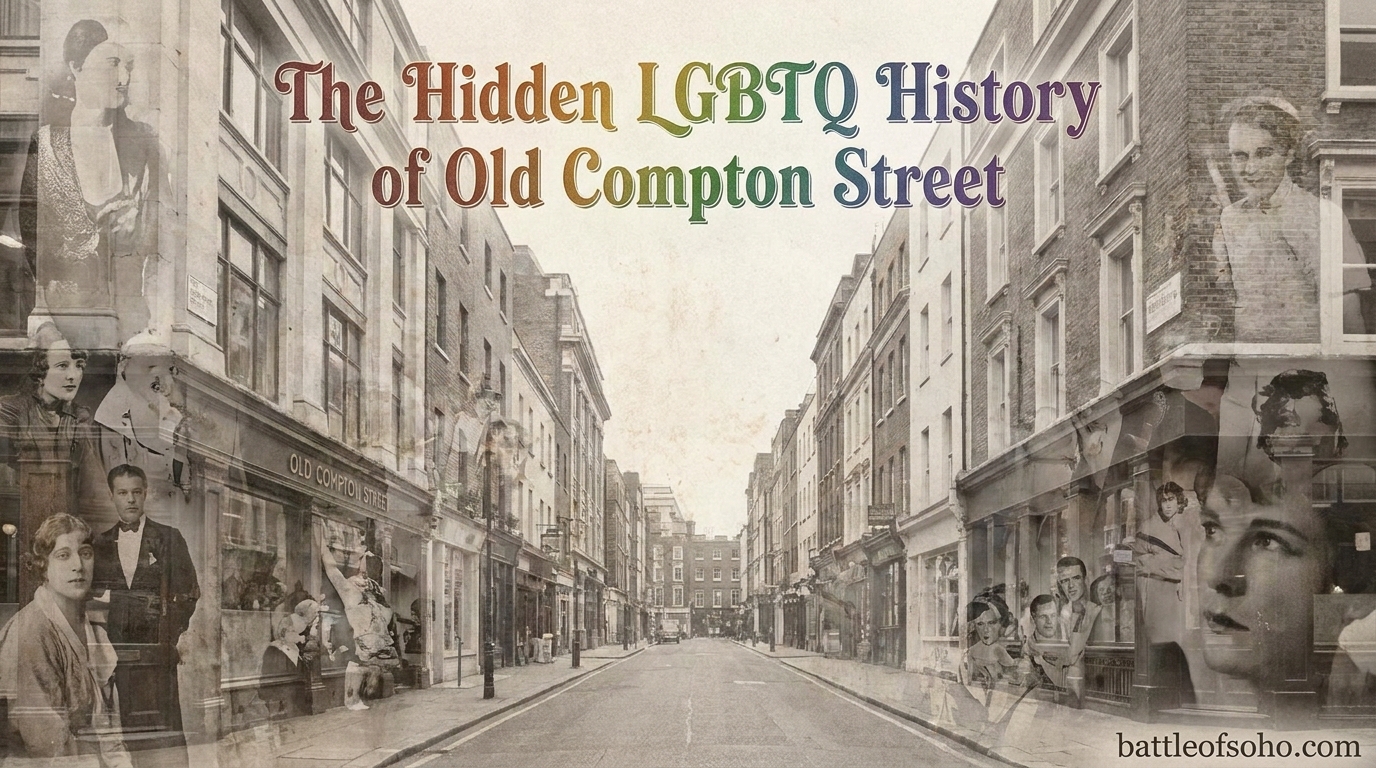
Walk down Old Compton Street at midnight and you will feel something electric beneath your feet. Neon signs flicker across packed pavements. Music spills from doorways that have served pints for over a century. For most visitors, this is simply the heart of Soho on a Friday night. But beneath the surface lies a story that stretches back more than 130 years, one of survival, resistance, and community.
The hidden LGBTQ history of Old Compton Street is not just a tale of bars and clubs. It is the story of how a single London street became a sanctuary for people who had nowhere else to go. From clandestine Victorian gatherings to the neon-lit gaybourhood we know today, this road has witnessed revolutions in civil rights, survived tragedy, and adapted to waves of change that continue reshaping it in 2026.
As longtime observers of Soho, we have spent years tracing the layers of history buried under this street. What follows is our attempt to piece together that story, from the farmland of the 1600s to the gentrification debates of today. Whether you are a history buff, a member of the LGBTQ community, or simply curious about why this particular stretch of tarmac matters so much, there is something here for you.
Table of Contents
How Old Compton Street Got Its Name
The story begins long before gay bars or espresso machines arrived. Old Compton Street takes its name from Henry Compton, the Bishop of London from 1675 to 1713. Compton was a powerful figure in the Church of England, and the land that now bears his name was once part of the extensive holdings tied to his office.
In the late 17th century, this part of Soho was still largely open fields and farmland on the edge of a rapidly expanding London. The area had been hunting ground for royalty, with the name Soho itself originating as a hunting call. As the city pushed westward, developers began laying out streets and squares across what had been rural land.
By the early 1700s, Old Compton Street had taken shape as a residential road connecting Charing Cross Road to Wardour Street. It was built for the emerging middle class, with Georgian townhouses lining both sides. The street quickly became part of a fashionable district, attracting artisans, merchants, and immigrants who gave Soho its cosmopolitan character from the very beginning.
That diversity would prove essential to everything that followed. Soho has always been a neighborhood of outsiders, and Old Compton Street sat right at its center. The stage was set, though no one could have predicted what would unfold over the coming centuries.
Victorian Queer Roots: The Hidden 130 Years
Many people assume that the LGBTQ history of Old Compton Street began in the 1970s, when gay bars started appearing openly along the road. The reality goes much deeper. Through Historic England’s Pride of Place project, researchers have documented more than 130 years of uninterrupted alternative lifestyles existing within Soho’s historic walls.
During the late Victorian era, homosexuality was a criminal offense punishable by imprisonment. Men caught engaging in same-sex relationships faced ruin, public disgrace, and sometimes worse. Yet despite the crushing weight of the law, queer people found ways to meet, connect, and build community. They gathered in parks, bathhouses, and discreet establishments that catered to those who understood the unspoken codes.
Soho became a natural magnet for this underground world. Its reputation as a bohemian, slightly disreputable quarter meant that people who lived outside conventional society could blend in more easily than in respectable neighborhoods. Old Compton Street, with its mix of immigrants, artists, and night owls, offered a degree of tolerance that was rare in Victorian London.
Restaurants and cafes played a particularly important role. Establishments like Chez Victor, a French restaurant on the street, served as discreet meeting places where queer men could socialize without drawing attention. The lights were low, the staff understood, and nobody asked questions. These were not gay bars in the modern sense, but they filled the same need: a safe space in a hostile world.
This hidden history is what makes Old Compton Street so significant. The visible gay scene that emerged decades later did not appear from nowhere. It was built on more than a century of quiet, courageous resistance by people who refused to disappear, even when the law demanded it.
Italian Immigration and Coffee Culture
Before Old Compton Street became synonymous with gay nightlife, it went through a transformation shaped by Italian immigration. In the post-war years, Italian families settled in Soho in significant numbers, bringing with them a cafe culture that would reshape the street’s identity.
The 1950s saw an explosion of espresso bars and coffee houses along Old Compton Street and the surrounding alleys. Bar Italia, founded in 1949 by Lou and Caterina Polledri, became an institution that still stands today at number 22. Its gleaming espresso machine and pavement seating created a social hub that attracted everyone from local workers to visiting celebrities.
Just around the corner on Old Compton Street itself, the legendary 2i’s Coffee Bar opened in 1956. While technically situated at 59 Old Compton Street, 2i’s became the birthplace of British rock and roll. Tommy Hicks, who would become Tommy Steele, was discovered performing there, and the venue launched the skiffle craze that swept across Britain.
This coffee culture mattered for the LGBTQ community in ways that might not be immediately obvious. Espresso bars were among the few places where young people could gather without adult supervision. They were informal, relatively unpoliced, and attracted a bohemian crowd that tolerated difference. For queer people in the 1950s, these spaces offered a way to meet others without the risks associated with more explicitly gay venues.
The Italian community also gave Old Compton Street a continental European feel that set it apart from the rest of London. Restaurants, delicatessens, and gelaterias created an atmosphere of openness and cosmopolitanism. That cultural foundation would prove essential when the gay scene began to emerge more visibly in the decades that followed.
1967 Decriminalisation and the Underground Scene
Everything changed on 27 July 1967. The Sexual Offences Act partially decriminalised homosexuality in England and Wales, making it legal for men over 21 to engage in consensual same-sex relationships in private. It was a watershed moment for civil rights, though far from full equality. The age of consent would remain unequal for decades, and public displays of affection could still lead to arrest.
For Old Compton Street, decriminalisation opened a door that had been locked for centuries. Venues could begin to operate more openly, though discretion remained the watchword. The first gay bars on the street did not advertise themselves with rainbow flags. They were identified by word of mouth, by a certain look in a window, by the simple fact that the regulars knew and the outsiders did not.
The Shim Sham Club, named after the popular jazz dance, was one of the venues that helped bridge the gap between hidden and visible. Its jazz heritage attracted a diverse crowd, and within that diversity, queer patrons found space to breathe. The club’s legacy is often overlooked in accounts that jump straight from Victorian secrecy to the 1980s gay boom, but it represents an important transitional moment.
Through the 1970s, Old Compton Street began to accumulate a critical mass of gay-friendly venues. Gay pubs, clubs, and shops clustered together, creating something that had never existed before in London: a recognisable gay street. The community that had been scattered across secret locations for over a century was finally finding a home it could point to on a map.
That sense of home was hard-won. Regular police raids, blackmail, and public hostility remained facts of life throughout this period. But the momentum was undeniable. Each venue that opened made the next one easier, and each patron who walked through a door made the street a little more visible.
1980s and 1990s: Coming Out of the Shadows
The 1980s were a decade of paradox for Old Compton Street. On one hand, the street’s gay identity grew stronger and more visible than ever. On the other, the community faced devastating new challenges, from the AIDS crisis to the oppressive legislation of Section 28.
Section 28, passed in 1988, prohibited local authorities from intentionally promoting homosexuality or teaching its acceptability in schools. The law sent a chill through the LGBTQ community and became a rallying point for activism. Organizations like OutRage! emerged in response, staging direct-action protests that often centered on Soho as the symbolic heart of gay London.
The Colony Room, a private members’ club at 41 Dean Street just off Old Compton Street, became legendary during this era. Founded in 1948 by Muriel Belcher, the club was known for its sharp-tongued atmosphere, heavy drinking, and exclusive guest list. Francis Bacon was a fixture there for decades, and the club attracted artists, writers, and performers who existed at the intersection of queer culture and the British establishment.
The French House, another Soho institution on Dean Street, played a different role. This pub had been a gathering place for Free French forces during World War II under Charles de Gaulle. By the 1980s, it had become a beloved queer-friendly space where artists, intellectuals, and drag performers mingled over glasses of Ricard. Its policy of serving beer in half-pints became part of its charm, encouraging conversation over consumption.
The filmmaker Derek Jarman, one of Britain’s most outspoken gay artists, embodied the spirit of this era. Jarman lived openly with HIV and used his work to challenge homophobia and prejudice. His connection to Soho and Old Compton Street helped cement the area’s reputation as a center of queer cultural production, not just nightlife.
By the 1990s, Old Compton Street had arrived. It was widely regarded as the gay street in London, a place where same-sex couples could hold hands, where rainbow flags hung from lampposts, and where the community felt, for perhaps the first time, like it truly belonged.
Key Venues That Shaped the Street
Understanding the LGBTQ history of Old Compton Street means understanding its venues. These are not just places to drink. They are landmarks in a civil rights journey, each with its own story to tell.
Comptons of Soho
Comptons of Soho, at number 53 Old Compton Street, is one of the most important gay venues in British history. The building itself dates back to the 19th century, but its life as a gay pub began in earnest in the 1980s. Comptons became known as Britain’s highest grossing pub at one point, a testament to the loyalty and spending power of its clientele.
What made Comptons special was its role as a bridge between generations. Older gay men who remembered the pre-decriminalisation era rubbed shoulders with younger patrons discovering the scene for the first time. The pub’s ground-floor location, large windows, and prominent position on the street made it one of the most visible gay venues in the country. There was no hiding behind darkened glass. Comptons was out and proud, and that visibility mattered.
The Admiral Duncan
The Admiral Duncan, at number 54 Old Compton Street, is a historic pub that became one of the street’s most beloved gay venues. Named after an 18th-century admiral, the pub’s transformation into a gay institution reflected the broader change happening on the street throughout the 1980s and 1990s.
With its traditional pub facade and warm interior, the Admiral Duncan became known as a friendly, unpretentious space where everyone was welcome. It embodied the community spirit that defined Old Compton Street at its best: inclusive, defiant, and full of life. The pub would go on to become the site of one of the darkest moments in the street’s history, a tragedy that tested that community spirit to its limits.
The French House
The French House, while technically on Dean Street rather than Old Compton Street itself, is impossible to separate from the story of Queer Soho. This iconic pub has served everyone from Charles de Gaulle to Dylan Thomas, and its bohemian, anything-goes atmosphere made it a natural haven for LGBTQ patrons. The pub’s refusal to serve pints, its eclectic decor, and its position at the heart of Soho’s drinking culture cemented its status as a queer-friendly institution decades before such a thing was common.
The Colony Room
The Colony Room closed its doors in 2008, but its legend lives on. This private members’ club, perched up a narrow staircase on Dean Street, was one of the most extraordinary spaces in British cultural life. Muriel Belcher ran it with iron-fisted wit, deciding who was worthy of membership and who was not. For queer artists and intellectuals, the Colony Room offered a space where sexuality was simply not an issue. You were judged on your conversation and your capacity for drink, not on who you loved.
New Voices: COVEN and Beyond
As older venues face closure, new spaces are emerging to carry the torch. COVEN, a relatively recent addition to the Soho landscape, represents a new generation of queer venues that blend nightlife with community programming, art exhibitions, and activism. These spaces understand that preserving queer heritage means more than keeping old buildings open. It means creating environments where the community can continue to gather, organize, and celebrate.
The 1999 Nail Bomb Attack
On 30 April 1999, the Admiral Duncan pub became the target of a horrific hate crime. David Copeland, a neo-Nazi extremist, planted a nail bomb in the crowded pub on a busy Friday evening. The device exploded at 6:37 PM, killing three people: Andrea Dykes, John Light, and Nick Moore. Andrea was four months pregnant. Seventy-nine others were injured, many severely.
The attack was part of a bombing campaign targeting minority communities in London. Copeland had previously bombed Brixton, a predominantly Black neighborhood, and Brick Lane, home to London’s Bangladeshi community. His intention was to stir racial hatred and trigger a backlash. The Soho bomb targeted the LGBTQ community directly.
The response from London was immediate and powerful. Thousands gathered at the site of the bombing in the days that followed, laying flowers, candles, and messages of solidarity. The attack could have shattered the community. Instead, it galvanized it. The tragedy underscored exactly why spaces like Old Compton Street matter: they are not just entertainment venues but sanctuaries for people who face real violence simply for being who they are.
A memorial plaque now marks the site of the bombing at the Admiral Duncan. The names of the three victims are remembered each year. The pub itself reopened and continues to operate, a living memorial to resilience. For many in the community, the bombing was a defining moment that reinforced the importance of visibility and solidarity.
The nail bomb attack also drew national attention to the LGBTQ community in a way that activism alone had struggled to achieve. Newspapers that had previously been indifferent or hostile suddenly published sympathetic coverage. The attack exposed the real dangers of homophobia and forced a reckoning with the prejudice that still existed in British society.
Modern Day: Gentrification and Change
Old Compton Street in 2026 is a place of tension. The LGBTQ community that fought for visibility on this street now faces a different kind of threat: economic pressure. Rising rents, property development, and the encroachment of chain restaurants and bars have led to the closure of several iconic queer venues over the past decade.
Many community members have voiced their concern on forums like Reddit. One longtime resident wrote that Old Compton Street was where they congregated, made friends, lovers, frenemies, contacts, and community. Another lamented that Soho has lost a lot of its LGBT identity, which is really sad. The emotional attachment to these spaces runs deep, and their disappearance is felt as a personal loss.
The closure of G-A-Y Bar on Old Compton Street marked a particularly significant moment. For years, G-A-Y had been one of the most recognizable queer venues in London, drawing huge crowds and serving as an entry point for young LGBTQ people experiencing Soho nightlife for the first time. Its loss prompted widespread debate about whether the gaybourhood model can survive in an era of skyrocketing commercial rents.
Is Soho still a gayborhood? The answer depends on who you ask. Old Compton Street still has a concentration of LGBTQ venues unmatched anywhere else in London. Comptons of Soho, the Admiral Duncan, and several other establishments continue to serve the community. Rainbow crossings and Pride flags remain visible. But the trend lines are worrying, and many fear that without intervention, the street could lose the very identity it spent over a century building.
Is Soho still seedy? That question comes up often. The sex shops and clip joints that once defined Soho’s seedier side have largely disappeared, replaced by cocktail bars and media offices. In some ways, this is progress. But it also reflects a sanitization that has swept away some of the diversity that made Soho a refuge for outsiders in the first place. The challenge for 2026 and beyond is finding a way to preserve what makes Old Compton Street special without turning it into a museum piece.
Conclusion: Why This History Matters
The hidden LGBTQ history of Old Compton Street is a story of extraordinary resilience. From the discreet gatherings of the Victorian era to the neon-lit gaybourhood of today, this single street has carried the weight of an entire community’s struggle for recognition, safety, and belonging. That history is still being written, and it deserves to be remembered.
If you want to experience it for yourself, walk the street slowly. Look at the buildings, read the plaques, and step inside the venues that are still open. Better yet, book a place on one of the Queer Soho walking tours that Historic England and local organizations run throughout the year. The more we understand what this street has meant to generations of LGBTQ people, the better equipped we are to protect its future.
FAQs
What is the history of LGBTQ+ culture on Old Compton Street?
Old Compton Street has been a focal point for London’s LGBTQ+ community since the 1970s, but research from Historic England’s Pride of Place project has traced over 130 years of queer history in the area. From discreet Victorian meeting places like Chez Victor restaurant to iconic modern venues like Comptons of Soho and the Admiral Duncan, the street evolved from a hidden sanctuary into the symbolic heart of gay London.
How did Old Compton Street get its name?
Old Compton Street is named after Henry Compton, who served as the Bishop of London from 1675 to 1713. The street was laid out in the late 17th century on land connected to his office as Soho developed from rural farmland into a fashionable residential and commercial district.
Is Soho still seedy?
Soho today is far less seedy than it was in the mid-20th century. The sex shops, clip joints, and illicit businesses that once defined its reputation have largely been replaced by restaurants, cocktail bars, media offices, and entertainment venues. While some mourn the loss of Soho’s edgy character, the area is now considered one of London’s safest and most cosmopolitan neighborhoods.
Is Soho a gayborhood?
Yes, Soho remains London’s most prominent gayborhood, with Old Compton Street at its center. While rising rents and venue closures have raised concerns about the area losing its LGBTQ identity, the street still hosts the highest concentration of gay venues in London, including Comptons of Soho, the Admiral Duncan, and several newer queer-focused spaces.