
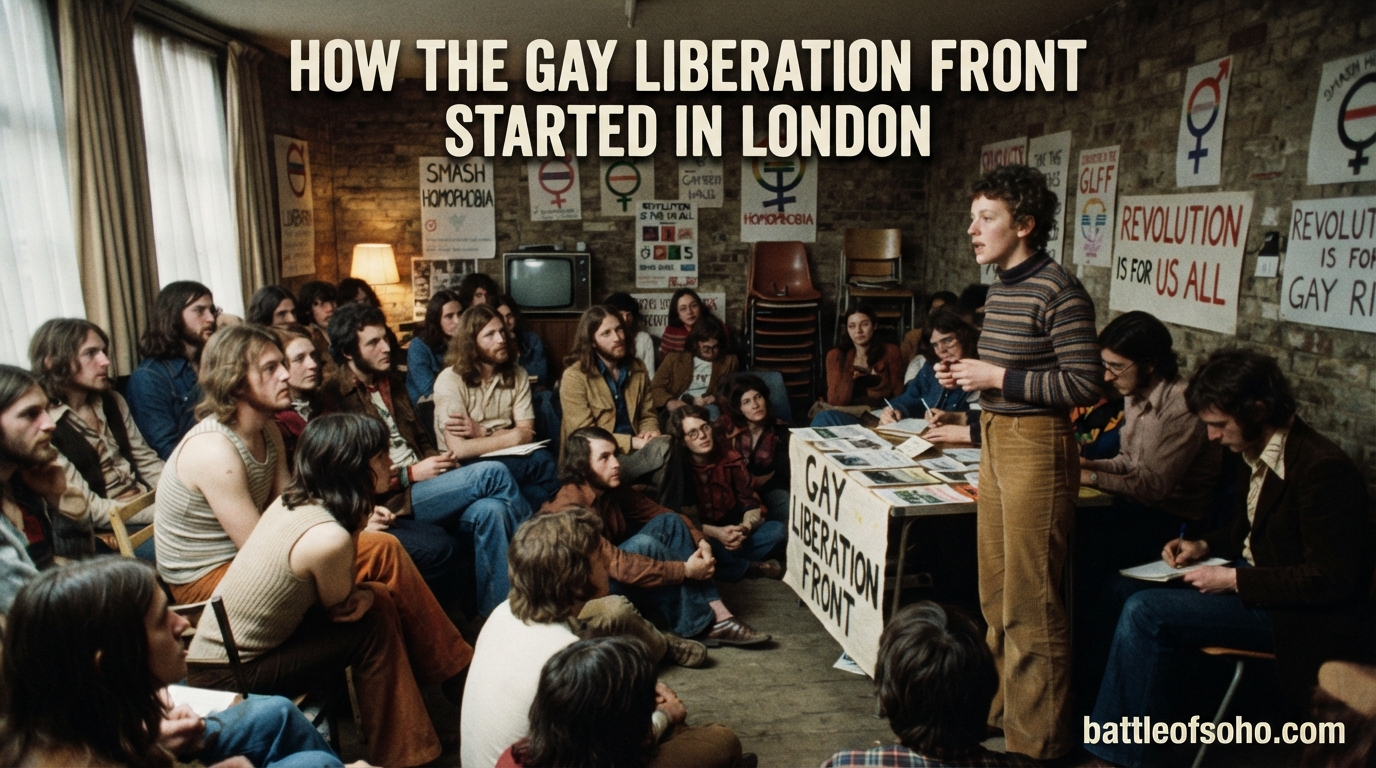
On October 13, 1970, nineteen people gathered in a basement room at the London School of Economics. They were there to do something that had never been done in Britain before: launch a radical, unapologetic, and publicly visible movement for gay liberation. That meeting was the founding moment of the Gay Liberation Front in London, and it changed the course of LGBTQ+ history in this country forever.
If you have ever attended a Pride march in London, walked through Soho on a Saturday night, or felt the freedom to be openly yourself in a public space, you are walking through doors that the GLF kicked open. Before that basement meeting in 1970, homosexuality in Britain had been partially decriminalised for just three years, and the law still treated gay men as second-class citizens. The police continued to arrest people for simply existing. Bars were raided. Lives were destroyed in silence.
The GLF refused that silence. They did not ask for tolerance. They demanded liberation. And they did it right here in the streets of London, in the lecture halls of the LSE, in the pubs of Soho, and in the parks where they staged their radical kiss-ins. This is the story of how the Gay Liberation Front started in London, from its transatlantic origins to the first Pride march, and how its legacy still shapes the city we know today.
Table of Contents
Before the GLF: Britain in the Shadows of Partial Decriminalisation
The Sexual Offences Act of 1967 is often remembered as the moment homosexuality was “legalised” in England and Wales. That framing hides a much darker reality. The Act decriminalised homosexual acts only between two men, both over the age of 21, in private. For everyone else, and in every other circumstance, the full force of the law remained.
The age of consent for gay men was set at 21, compared to 16 for heterosexual couples. That five-year gap criminalised thousands of relationships and gave police a permanent excuse for surveillance. The Act also applied only to England and Wales. Scotland and Northern Ireland maintained full criminalisation well into the 1980s.
Police harassment did not slow down after 1967. It intensified. Officers used laws against “importuning” (soliciting in public), “gross indecency,” and “breaching the peace” to entrap gay men in parks, public toilets, and bars. Undercover officers would flirt with men, wait for a response, and then arrest them. Courts convicted men based on nothing more than a conversation in a pub.
Against this backdrop, the Campaign for Homosexual Equality (CHE) had been working since 1964 for gradual legal reform. CHE lobbied politicians, held private meetings, and pursued a strategy of respectability. Their approach was careful, quiet, and firmly within the boundaries of the British establishment. Many gay people owed CHE a debt of gratitude for keeping the conversation alive during the bleakest years.
But by 1970, a younger generation was losing patience. The polite lobbying strategy had produced the 1967 Act, but everyday life had barely changed. Gay people were still fired from jobs, thrown out of homes, disowned by families, and arrested on the street. The CHE wanted a seat at the table. The emerging radicals wanted to flip the table over entirely.
Stonewall and the Transatlantic Spark
The story of how the Gay Liberation Front started in London does not begin in London. It begins at the Stonewall Inn, a gay bar on Christopher Street in Greenwich Village, New York City. In the early hours of June 28, 1969, police raided the Stonewall Inn. This was routine. What followed was not.
Patrons and neighbourhood residents fought back. The uprising lasted several nights, drawing thousands of people into the streets of Greenwich Village. Among those present were transgender activists and sex workers, particularly Black and Latina women, including Marsha P. Johnson and Sylvia Rivera. Their resistance became the spark that ignited a global movement.
Within weeks of the Stonewall uprising, the first Gay Liberation Front was formed in New York City. The name was deliberately provocative. The word “liberation” echoed anti-colonial and anti-imperial movements around the world. “Front” was modelled on the National Liberation Front of Vietnam and the Algerian National Liberation Front. This was not a polite request for rights. It was a declaration of revolutionary intent.
Word spread fast. Two young British men, Bob Mellors and Aubrey Walter, were among those inspired by the transatlantic ripple. Mellors was a student at the London School of Economics. Walter had been travelling in the United States, where he encountered the American GLF and the broader counterculture movement that was sweeping American campuses.
Walter also attended the Black Panthers’ Revolutionary People’s Constitutional Convention in Philadelphia in September 1970. There, the Black Panther Party issued a statement of solidarity with gay liberation, declaring that the oppression of gay people was connected to the oppression of Black people, women, and all marginalised communities. This intersectional analysis would become central to the GLF’s ideology in Britain.
Mellors and Walter returned to London carrying more than just enthusiasm. They carried a blueprint for radical organising, a manifesto of demands, and the conviction that silence and shame were weapons used against gay people by a society that feared them. They believed that coming out publicly, collectively, and defiantly was the most powerful act of resistance available.
How the Gay Liberation Front Started in London: The First Meeting
The first meeting of the UK Gay Liberation Front took place on October 13, 1970, in a basement room at the London School of Economics on Houghton Street, just a short walk from the Aldwych and the Strand. Bob Mellors, as an LSE student, was able to book the room through the student union. That small administrative detail mattered enormously. The LSE had a long tradition of radical student politics, and the institution provided a space that no commercial venue would have offered.
Nineteen people attended that first meeting. They sat in the basement, discussed what they had learned from the American movement, and agreed to form a British chapter of the Gay Liberation Front. The name was adopted directly from the New York group. It was bold, confrontational, and impossible to ignore.
What happened next astonished everyone involved, including the founders. Word spread through underground networks, student common rooms, and queer social circles across London. Within weeks, the meetings grew from 19 to dozens. Within months, hundreds were attending weekly gatherings at the LSE.
The weekly meetings became the beating heart of the movement. They were held on Sunday evenings at the LSE, and they were unlike anything the British LGBTQ+ community had experienced before. People stood up and spoke openly about their lives. They shared stories of persecution, family rejection, workplace discrimination, and police harassment. For many attendees, it was the first time they had ever been in a room full of other gay people.
The GLF did not just hold meetings. It organised itself into functional working groups. There was a demonstrations group, a media workshop, an education group, a counter-psychiatry group, a street theatre group, a schools group, and a “Sisters” caucus for women within the movement. Each group pursued its own projects while reporting back to the main weekly assembly.
This structure was directly influenced by the consciousness-raising model of the Women’s Liberation Movement. Small groups would meet separately to discuss their personal experiences and then bring those insights to the larger collective. The GLF believed that personal experience was political, and that sharing stories of oppression was the first step toward collective action.
The LSE remained the GLF’s headquarters throughout its most active period. The institution’s willingness to host the group reflected its radical student culture and its history of political engagement. For many GLF members, the LSE campus became a second home, a place where they could be themselves without fear for the first time in their lives.
The GLF Manifesto and Radical Vision
In 1971, the GLF published its Manifesto, a document that remains one of the most radical statements of LGBTQ+ politics ever produced in Britain. The Manifesto was not written by a single author. It emerged from a collective “think-in” process in early 1971, where members debated, argued, and eventually agreed on a shared vision.
The Manifesto’s central argument was that gay people were not just denied legal rights. They were oppressed by an entire social system built on rigid gender roles, the nuclear family, and patriarchal power. Mere legal reform would not fix this. The system itself needed to be challenged and transformed.
The Manifesto demanded the abolition of gender roles that confined both men and women to prescribed behaviours. It called for an end to the nuclear family as the only legitimate unit of social organisation. It argued that capitalism exploited gay people by commodifying their desires while denying their humanity. And it declared solidarity with all oppressed people, including the Black community, the women’s movement, and anti-colonial struggles worldwide.
Perhaps the most radical idea in the Manifesto was the concept of “self-oppression.” The GLF argued that gay people had internalised society’s hatred so deeply that they policed their own behaviour, hid their identities, and attacked those who refused to conform. Coming out, publicly and unapologetically, was the antidote to self-oppression. The phrase “Gay is Good” became a rallying cry, directly countering the message of shame that society had imposed for centuries.
This vision placed the GLF in direct opposition to the Campaign for Homosexual Equality. Where CHE sought to prove that gay people were “just like everyone else” and deserved a place within existing social structures, the GLF rejected those structures entirely. CHE wanted integration. The GLF wanted liberation. The two approaches were not just different in strategy. They were fundamentally incompatible in philosophy.
The Manifesto’s influence extended far beyond the GLF’s active years. It was reprinted, debated, and cited for decades. Its analysis of how gender, sexuality, and capitalism intersect predated academic queer theory by nearly twenty years. Many of its arguments about the family, gender roles, and social control remain relevant in 2026, more than half a century later.
Taking to the Streets: Key GLF Protests and Actions
The GLF was not a discussion group. It was an organisation built for action, and its members wasted no time in taking that action to the streets of London. Their protests were bold, theatrical, and designed to provoke maximum visibility. They called their disruptive actions “zaps,” a term borrowed from American activist tactics.
The GLF’s first public protest took place on November 27, 1970, at Highbury Fields in north London. The trigger was the arrest of Louis Eaks, a young gay man and GLF member, for “importuning” in the park. Eaks had been approached by a plainclothes police officer who enticed him into a conversation and then arrested him. This was entrapment, and it was entirely legal under existing law.
Approximately 80 GLF members gathered at Highbury Fields to protest the arrest and the broader pattern of police entrapment in public cruising areas. They carried placards, distributed leaflets, and staged a public demonstration against police harassment. It was the first openly gay public protest in Britain, and it established the template for everything that followed.
In August 1971, the GLF organised a major demonstration in Trafalgar Square to protest the unequal age of consent. At the time, the age of consent for gay men was 21, while for heterosexuals it was 16. The demonstration drew a large crowd and featured speeches from GLF members and supporters. Trafalgar Square, the symbolic heart of British national identity, became the stage for a direct challenge to the state’s treatment of gay citizens.
One of the GLF’s most famous actions was the disruption of the Nationwide Festival of Light in September 1971. The Festival of Light was a conservative Christian campaign against the “permissive society,” organised by Mary Whitehouse and held at the Methodist Central Hall in Westminster. GLF members infiltrated the event and released a pair of white mice into the auditorium, causing chaos among the delegates. It was humorous, theatrical, and impossible to ignore. The action perfectly embodied the GLF’s use of street theatre and provocation as political tools.
The GLF also targeted businesses that discriminated against gay people. They organised a demonstration at Foyles bookshop on Charing Cross Road after the shop dismissed an employee for being gay. The protest drew attention to employment discrimination, which was entirely legal at the time. There was no protection against being fired for your sexuality in 1970s Britain. The GLF wanted to change that, one zapping at a time.
Street theatre became one of the GLF’s signature tactics. The street theatre group staged impromptu performances in public spaces, using drag, satire, and spectacle to challenge homophobic attitudes. These performances were not just entertainment. They were a form of direct action that forced the public to confront the existence of gay people in spaces where they had previously been invisible.
Kiss-ins were another radical tactic. GLF members would gather in public parks and squares and kiss each other openly, deliberately violating the social taboo against public displays of same-sex affection. This was not just protest. It was an assertion of the right to exist, to love, and to be seen in public space. For many participants, it was the first time they had ever shown physical affection to someone of the same sex in public.
Pub sit-ins targeted venues that refused to serve gay customers or that had a reputation for colluding with police raids. GLF members would enter a pub in groups, order drinks, and refuse to leave when asked. These actions drew on the tradition of the American civil rights sit-ins and adapted the tactic for the British context. They forced public confrontation with discrimination that had previously been hidden behind closed doors.
Building Community: Gay Days, Dances, and Come Together
The GLF was not just about protest. It was about building a community from scratch, creating spaces where gay people could gather, socialise, and support each other outside the commercial bar scene. This community-building work was as important as the demonstrations, because it gave people a reason to stay involved and a network to fall back on when the protests were over.
Gay Days were one of the GLF’s most popular community initiatives. Members would gather in London parks, including Hyde Park, Victoria Park, and Finsbury Park, for picnics, games, music, and socialising. These events were part politics, part party, and part public statement. Hundreds of gay people occupying a public park on a Sunday afternoon was itself a radical act in 1971. The Gay Days also featured kiss-ins, dancing, and open displays of affection that challenged the invisibility of gay life in public space.
The GLF also organised communal dances and social events that provided an alternative to the commercial gay bar scene. These dances were held in community halls and student venues, and they attracted people who were not comfortable in the West End’s expensive and often exclusionary bars. The dances were fundraisers, social gatherings, and consciousness-raising events all rolled into one.
The GLF’s newsletter, Come Together, became the voice of the movement. It was produced by the Media Workshop and distributed at meetings, in pubs, and through the mail. Come Together carried news of protests, announcements of upcoming events, political analysis, personal testimonials, and poetry. It gave members a sense of belonging to a movement that extended beyond the weekly meetings.
The Media Workshop itself was a key innovation. GLF members recognised early on that the mainstream press would either ignore them or portray them negatively. So they created their own media. The workshop produced leaflets, posters, newsletters, and press releases. It trained members in how to speak to journalists, how to write copy, and how to manage the movement’s public image. This was decades before social media made self-publishing easy. The GLF was doing it with typewriters and photocopiers.
The functional working groups also did serious political work. The counter-psychiatry group challenged the medical establishment’s classification of homosexuality as a mental illness. The education group worked to get accurate information about homosexuality into schools and universities. The schools group organised workshops and produced educational materials. Each of these groups extended the GLF’s reach into a different area of British society.
Consciousness-raising groups, modelled on the Women’s Liberation Movement, allowed members to explore their personal experiences of oppression in a structured, supportive setting. Small groups of 8 to 12 people would meet regularly to discuss topics like family, work, sex, and identity. These groups were transformative for many participants. They turned private pain into collective political understanding.
The First London Pride March: July 1, 1972
On July 1, 1972, approximately 2,000 people gathered in London for the first Pride march in Britain. The march was organised by the GLF and began near Trafalgar Square, proceeding through the streets of central London to Hyde Park. It was a Saturday, and the route took marchers through some of the busiest parts of the city.
The atmosphere was part protest, part carnival. Marchers carried banners with slogans like “Gay Pride” and “Gay is Good.” Some played tambourines and sang. Others wore drag or elaborate costumes. The mood was defiant but joyful. For many participants, it was the first time they had ever been openly gay in public, surrounded by people who shared their experience.
The march was not without danger. Police provided an escort, but public hostility was intense. Bystanders shouted abuse, threw objects, and attempted to block the march’s progress. Some shopkeepers shuttered their windows. The National Front, a far-right fascist organisation, staged counter-demonstrations. Marchers knew they could face violence, arrest, and public exposure that might cost them their jobs, their homes, and their families. They marched anyway.
The 1972 march established the tradition of London Pride, which has taken place every year since (with the exception of a few years during the early period and more recently during the pandemic). Today, London Pride attracts over a million people and is sponsored by major corporations. The contrast with that first march of 2,000 brave souls is stark. Many veterans of the original GLF have spoken about their concern that Pride has become a commercial party rather than a political protest. The radical spirit of 1972, they argue, has been diluted by pink capitalism and corporate sponsorship.
That first Pride march was not a celebration. It was a demand. It said to the British public, the government, and the police: we are here, we are not going away, and we will not be invisible. The tradition that the GLF established that day continues to evolve, with alternative events like UK Black Pride and Trans+ Pride carrying forward the intersectional, radical vision that the GLF pioneered.
GLF and Soho: The Heart of London’s LGBTQ+ World
You cannot tell the story of how the Gay Liberation Front started in London without talking about Soho. While the GLF was founded at the LSE and held its meetings in academic buildings, Soho was the gravitational centre of London’s queer world in the 1970s. It was where gay people gathered, socialised, and built a culture in the spaces between the cracks of respectable society.
Soho had been London’s bohemian quarter for decades. By the late 1960s, it was home to a cluster of gay bars and clubs that operated in a legal grey zone. The pubs of Old Compton Street and the surrounding lanes were places where gay men and lesbians could meet, but always with one eye on the door. Police raids were a constant threat, and landlords could refuse service or call the authorities at any moment.
The GLF’s direct action tactics intersected directly with Soho’s bar culture. Pub sit-ins and visibility actions often targeted venues in and around Soho that discriminated against gay customers. When a pub refused to serve known GLF members, the response was swift and public. Groups of activists would descend on the venue, fill the bar, and refuse to leave until the policy changed. These actions forced Soho’s commercial establishments to reckon with a new kind of gay customer: one who was organised, visible, and unwilling to be treated as a criminal.
The GLF also had a more indirect but equally powerful impact on Soho. By normalising public visibility and open discussion of homosexuality, the GLF created the cultural conditions for Soho to emerge as an openly queer neighbourhood. Before the GLF, Soho’s gay bars were hidden, deniable, and vulnerable. After the GLF, they became visible, assertive, and politically connected. The transformation did not happen overnight, but the GLF was the catalyst.
Members of the GLF and its successor organisations were deeply embedded in Soho’s cultural life. Activists, artists, writers, and performers who had been radicalised by the GLF went on to shape Soho’s identity as a centre of LGBTQ+ culture. The Royal Vauxhall Tavern, just across the river from Soho, became a legendary venue connected to the queer performance and drag traditions that the GLF’s street theatre group had pioneered.
The connection between the GLF and Soho lives on today. When you walk down Old Compton Street and see rainbow flags hanging from pub windows, same-sex couples holding hands on the pavement, and drag shows advertised on lampposts, you are seeing the legacy of a movement that began in a basement at the LSE and spread through the streets of London. The GLF did not just demand rights. It created a culture, and Soho became that culture’s most visible expression.
It is worth noting, however, that the relationship between radical activism and commercial gay spaces was always complicated. Some GLF members were critical of the bar scene, seeing it as a product of capitalism that exploited gay people’s loneliness and isolation. They wanted to build community through consciousness-raising, not through buying drinks in a pub. This tension between political activism and commercial culture is still visible in Soho today, where the radical origins of LGBTQ+ liberation sometimes feel buried beneath a party atmosphere.
Splits, Fractures, and the End of the GLF
The GLF’s explosive growth and radical energy could not be sustained indefinitely. By 1972, internal tensions were tearing the organisation apart. These tensions were not petty disagreements. They were deep ideological divisions about the nature of oppression, the goals of the movement, and the meaning of liberation itself.
One major fault line ran between radical revolutionaries and civil rights reformists. Some GLF members believed that the movement should focus on overthrowing capitalism and dismantling the family, as the Manifesto argued. Others wanted to concentrate on practical, achievable goals like lowering the age of consent, ending employment discrimination, and stopping police harassment. These two visions could not easily coexist within a single organisation.
A second fracture emerged between men and women within the movement. Lesbian members of the GLF increasingly felt that the organisation was dominated by men and that women’s concerns were marginalised. Many lesbian activists were also involved in the Women’s Liberation Movement, and some concluded that their primary political home should be with other women, not in a mixed-gender organisation that replicated patriarchal dynamics. The emergence of lesbian separatism drew many women away from the GLF.
The 1972 GLF conference in Birmingham is often cited as the breaking point. Arguments over ideology, structure, and priorities became so intense that the conference effectively collapsed. Key figures left the organisation. Working groups splintered into independent projects. The weekly meetings at the LSE grew smaller and more fractious.
Class and race divisions also played a role. The GLF’s membership was predominantly white, male, and middle-class, reflecting the demographics of the LSE student body. Working-class gay people, many of whom did not have access to university spaces, sometimes felt excluded. Black and Asian LGBTQ+ people were present in the movement but often felt that their specific experiences of racism within both the gay community and broader society were not adequately addressed.
By 1973, the GLF had effectively ceased to function as a unified organisation. By 1974, it was formally dissolved. The organisation that had begun with 19 people in a basement and grown to hundreds of active members was gone. But its dissolution was not a failure. The GLF’s energy did not disappear. It dispersed into dozens of new organisations and projects that carried its work forward in different forms.
The Lasting Legacy: From GLF to Modern Activism
The organisations that emerged from the ashes of the GLF shaped the landscape of British LGBTQ+ life for the next five decades. The London Lesbian and Gay Switchboard, founded in 1974 by GLF members, became one of the most important support services for LGBTQ+ people in Britain. For decades, Switchboard’s phone line was the first point of contact for people coming out, seeking advice, or in crisis. It was staffed entirely by volunteers, many of whom had been radicalised by their time in the GLF.
Gay News, the national LGBTQ+ newspaper founded in 1972 by GLF members including Andrew Lumsden, gave the community a voice in the media for over a decade. Gay Men’s Press, founded by David Fernbach, became a pioneering publisher of LGBTQ+ literature. Icebreakers, a counselling service set up by former GLF members, provided support for people coming to terms with their sexuality at a time when no other service existed.
The direct action tradition of the GLF found its most visible heir in OutRage!, the activist group founded in 1990 and led most famously by Peter Tatchell. OutRage! used the same tactics of street theatre, zaps, and public confrontation that the GLF had pioneered. Tatchell himself had been involved in the GLF’s youth wing and carried its radical spirit into the fight against Section 28, the AIDS crisis, and ongoing discrimination.
ACT UP, the AIDS activist organisation that emerged in the late 1980s, also drew on GLF tactics. The AIDS crisis was not handled by the GLF directly (the organisation had dissolved before HIV was identified), but the infrastructure, the networks, and the culture of activism that the GLF created were essential to the community’s response. Without the GLF’s legacy of visible, organised resistance, the fight for AIDS treatment and against homophobic government indifference would have been far harder.
The Hall-Carpenter Archives, established with materials from GLF members and held at the LSE Library, remain one of the most important collections of LGBTQ+ history in Britain. They preserve the newsletters, posters, photographs, and personal papers of the movement, ensuring that future generations can study and learn from this pivotal period. The Bishopsgate Institute also holds significant GLF-related collections.
In 2026, the GLF’s legacy is visible every time LGBTQ+ people take to the streets in protest. UK Black Pride, founded in 2005, carries forward the GLF’s intersectional analysis by centring Black, Asian, and minority ethnic LGBTQ+ voices. London Trans+ Pride, established more recently, continues the tradition of radical, visible protest for trans rights. These movements may not use the GLF name, but they are direct descendants of the vision that was born in that LSE basement.
The Stonewall charity, founded in 1989, is sometimes described as a descendant of the GLF, but the relationship is more complex. Stonewall was created as a professional lobbying organisation, closer in spirit to CHE than to the GLF. Many GLF veterans have been critical of Stonewall’s assimilationist approach, arguing that it abandoned the radical vision of social transformation in favour of incremental legal reform. The tension between these two approaches continues to shape LGBTQ+ politics today.
FAQs
When was the Gay Liberation Front founded in London?
The Gay Liberation Front was founded in London on October 13, 1970, when 19 people gathered for the first meeting in a basement room at the London School of Economics. The organisation grew rapidly from that initial gathering, attracting hundreds of members within months.
Who founded the Gay Liberation Front in Britain?
The UK Gay Liberation Front was founded by Bob Mellors, an LSE student, and Aubrey Walter, who had travelled to the United States and been inspired by the American GLF and the Black Panthers. Both men brought the transatlantic ideas of radical gay liberation back to London and organised the first meeting at the LSE.
Why did the gay liberation movement start?
The gay liberation movement started because existing approaches to LGBTQ+ rights, such as the Campaign for Homosexual Equality, were too cautious and incremental. Despite the partial decriminalisation of homosexuality in 1967, gay people still faced police harassment, employment discrimination, and social ostracism. The Stonewall uprising in New York in 1969 inspired a new generation to demand radical change through visible, direct action rather than quiet lobbying.
When did Gay Pride start in London?
The first London Pride march took place on July 1, 1972, organised by the Gay Liberation Front. Approximately 2,000 people marched from Trafalgar Square to Hyde Park, making it the first publicly visible gay rights demonstration of its kind in Britain. London Pride has taken place annually ever since, growing to over a million attendees in recent years.
What was the GLF Manifesto?
The GLF Manifesto, published in 1971, was a radical document that argued gay people were oppressed not just by law but by an entire social system based on rigid gender roles, the nuclear family, and capitalism. It demanded the abolition of gender roles, called for solidarity with all oppressed people, and argued that coming out publicly was the most powerful act of resistance available to gay individuals.
Why did the Gay Liberation Front split and end?
The GLF split due to deep ideological divisions between radical revolutionaries who wanted to transform society and reformists who focused on practical legal change. Additional tensions emerged between men and women in the movement, with many lesbians leaving for the women’s liberation movement. The 1972 Birmingham conference marked the breaking point, and the GLF formally dissolved by 1974.
Is the Gay Liberation Front still active?
The original Gay Liberation Front was formally dissolved in 1974 and is no longer active. However, its legacy lives on through organisations founded by former GLF members, including the London Lesbian and Gay Switchboard, OutRage!, and the broader tradition of direct action LGBTQ+ activism that continues today through groups like UK Black Pride and Trans+ Pride.
What was the GLF’s connection to the Black Panthers?
The GLF had a direct connection to the Black Panthers through Aubrey Walter, who attended the Black Panthers’ Revolutionary People’s Constitutional Convention in Philadelphia in September 1970. The Black Panthers issued a statement of solidarity with gay liberation, arguing that the oppression of gay people was connected to the oppression of Black people and other marginalised groups. This intersectional analysis deeply influenced the GLF’s ideology in Britain.
Conclusion: The Basement That Changed London
The story of how the Gay Liberation Front started in London is really a story about courage. Nineteen people walked into a basement at the LSE on October 13, 1970, and decided that they would no longer live in silence. Within two years, they had organised the first Pride march, published a revolutionary manifesto, disrupted the conservative establishment, and created a community that had never existed before in Britain.
The GLF was not perfect. It fractured under the weight of its own contradictions, and its membership did not always reflect the full diversity of the LGBTQ+ community. But its impact was enormous and enduring. Every organisation, every publication, every support service, and every protest that followed owed something to the vision that was forged in that LSE basement.
For Soho, the GLF’s legacy is particularly profound. The neighbourhood that is now synonymous with London’s LGBTQ+ culture owes its openness to the activists who refused to be invisible. The next time you walk through Soho and see the rainbow flags, the packed bars, and the visible queer life on the streets, remember the people who made that visibility possible. They started with a basement meeting and a simple, radical idea: that gay people deserved not just tolerance, but liberation.