
On a Saturday afternoon in April 2015, more than 200 people gathered outside a corner pub in Camden, North London. Drag performers in towering wigs and sequined gowns stood beside activists with megaphones. They were there because The Black Cap, a gay bar that had served the LGBTQ+ community for over 50 years, had been sold to developers who planned to turn it into luxury apartments.
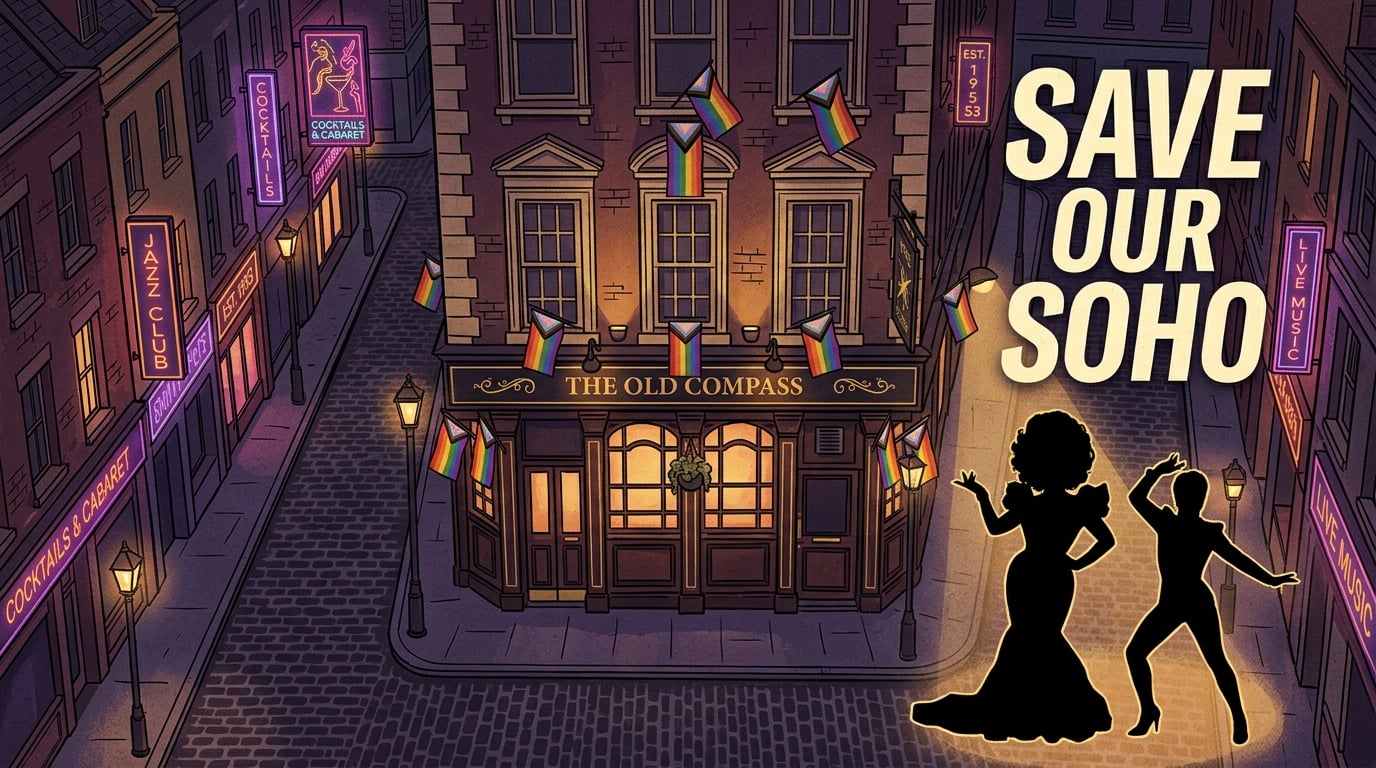
What happened next became a defining moment in modern British queer activism. The protest launched a wave of campaigns across London, as drag performers stepped to the front lines to fight for spaces they considered not just workplaces or nightspots, but homes. This is the story of how drag performers fought to save their Soho homes and the broader movement that changed the conversation about queer venue preservation forever.
Between 2014 and 2025, London lost dozens of LGBTQ+ venues to rising rents, property speculation, and redevelopment. Drag performers, who depended on these spaces for their art, income, and community, became some of the most visible and vocal campaigners against the losses. They organized protests, filed legal applications, gathered petitions, and refused to let decades of queer culture disappear quietly.
Table of Contents
The Great Queer Venue Exodus
Soho has been the beating heart of London’s queer community since at least the 1960s. Old Compton Street became synonymous with gay life in Britain, lined with bars, clubs, and cabaret venues that served generations of LGBTQ+ people. For many, Soho was the only place where they could be openly themselves.
That identity started eroding rapidly in the 2010s. Between 2000 and 2016, London lost 151 gay bars and clubs, according to research by University College London. The closures accelerated dramatically after 2014, when a perfect storm of skyrocketing property prices, aggressive speculative development, and hostile licensing decisions hit the community simultaneously.
The losses hit Soho particularly hard. Madame Jojo’s, the legendary cabaret and burlesque venue on Walker’s Court, closed in November 2014 after Westminster Council revoked its license following a violent incident. The Candy Bar, one of London’s most prominent lesbian venues, shut its doors. Molly Moggs, a drag pub on Old Compton Street that had hosted performers for decades, was another casualty.
But the crisis extended well beyond Soho’s borders. The Joiners Arms on Hackney Road in East London, a vital late-night queer venue, was sold to developers who planned to demolish it. First Out Cafe near Tottenham Court Road closed after 30 years. The pressure was city-wide, and it was relentless.
The driving force behind these closures was gentrification. Property developers saw prime central London real estate occupied by bars and clubs and saw opportunity. Queer venues, often operating on tight margins and saddled with older leases, were easy targets. A developer could buy a gay bar, sit on the property, and flip it for luxury housing or a high-end restaurant chain at enormous profit.
For the people who used these venues, the loss was staggering. These were not just places to drink. They were community centers, performance spaces, first-date locations, coming-out sanctuaries, and refuges from a world that was often hostile. Queer people had built their social lives, support networks, and cultural traditions around these physical spaces. When the venues closed, those networks fractured.
Daytime queer spaces were already vanishing. Losing the nighttime venues meant the community had fewer and fewer places to gather at all. The people who felt this loss most acutely were the performers who worked in these venues every week, sometimes for decades.
How Drag Performers Fought to Save Their Soho Homes: The Black Cap Uprising
The Black Cap was not technically in Soho. It sat on the corner of Parkway and Camden High Street, in North London. But its significance to the drag and queer community was woven into the same cultural fabric as any Soho venue. Known as the “Palladium of Drag,” The Black Cap had hosted drag performances since the 1960s.
When the pub was sold in April 2015 to a company called Common Ground Finance, which was linked to property developer Immovate, the community responded with fury. The owners, Faucet Inn, had sold the lease without warning. Performers who had worked there for years arrived to find the doors locked and the future of a beloved space in jeopardy.
The protest that followed was organized in a matter of days. Drag performers, former staff, local residents, and LGBTQ+ activists assembled outside the boarded-up pub on April 18, 2015. What made this protest different from typical community demonstrations was who stood at the front.
Titti La Camp, a drag performer who had been performing at The Black Cap since 1992, addressed the crowd with the authority of someone whose entire performing life was bound up in this building. She had spent 23 years on that stage. For her, The Black Cap was not a workplace. It was home.
Speaking to the crowd, Titti La Camp described the venue as a sanctuary where generations of performers had honed their craft and found their people. She talked about the drag mothers who had mentored younger performers in the dressing rooms, the regulars who came every week for decades, and the sense of belonging that could not be replaced by a gastropub or apartment block.
Meth, another drag performer and activist, spoke about the broader pattern of venue closures. This was not just about one pub. It was about a systematic stripping away of queer cultural infrastructure across London. Meth framed the fight in explicitly political terms, connecting The Black Cap closure to the wider gentrification of working-class and minority communities.
Father Bernard Lynch, a gay Catholic priest and longtime activist, delivered one of the most powerful speeches of the day. He explicitly connected the Black Cap protest to the Stonewall riots of 1969, reminding the crowd that drag queens and transgender people had been at the forefront of that uprising too. He argued that the fight to save queer venues was part of the same struggle for liberation that had defined the LGBTQ+ rights movement for half a century.
The crowd took up a chant that would echo across London’s queer activism for years: “We are The Black Cap.” It was a declaration of identity and belonging. The venue was not just a building. It was the people who had made it what it was.
Bernard Lynch’s invocation of Stonewall was not accidental. It was a deliberate framing of the Black Cap closure as part of a long history of erasure and resistance. Drag performers have always been on the front lines of queer liberation, from Stonewall to the AIDS crisis to the fight for marriage equality. The Black Cap protest placed venue preservation squarely within that tradition.
Ben Walters, a journalist and queer culture historian who spoke at the protest, described venues like The Black Cap as the “canary in the coalmine” for broader cultural erasure. When a community loses its physical spaces, he argued, it loses its visibility, its memory, and its ability to organize. The fight to save queer venues was a fight for the community’s continued existence in the physical world.
The protest generated significant media coverage. The Independent, BuzzFeed News, and other outlets ran detailed reports. The hashtag #SaveTheBlackCap spread across social media. A campaign group called the Black Cap Foundation was formed to pursue legal and political avenues to save the venue.
What made the Black Cap uprising so significant was the visibility of drag performers as organizers and spokespeople. They were not background figures at someone else’s protest. They were leading it, speaking to cameras, filing planning objections, and galvanizing a community that had been quietly mourning venue losses for years.
A Movement Spreads Across London
The energy from the Black Cap protest did not stay in Camden. It ignited a wave of similar campaigns across London, as communities at other threatened venues realized they did not have to accept closures as inevitable.
The Save Our Scene network emerged as a coordinating body, connecting activists from different venue campaigns and sharing strategies. What had been isolated, local fights became a connected movement with shared tactics and mutual support.
The most prominent of these sister campaigns was RVT Future, organized to protect the Royal Vauxhall Tavern in South London. The RVT was Britain’s oldest surviving LGBTQ+ entertainment venue, with a drag and cabaret tradition stretching back to the 1940s. Paul O’Grady had performed there as Lily Savage. It was, in every meaningful sense, a queer landmark.
When the RVT was put up for sale in 2014, a group of performers, patrons, and community organizers came together to fight for its survival. Amy Lame, a performer, broadcaster, and longtime RVT host, became one of the campaign’s most visible faces. She described the potential loss of the RVT as an act of cultural vandalism driven by greed and a disregard for queer history.
RVT Future pursued multiple strategies simultaneously. They organized community meetings, gathered petition signatures, lobbied Lambeth Council, and filed an application for Asset of Community Value status. They also worked to build a financial model that could see the venue taken into community ownership.
In East London, the fight to save The Joiners Arms took a different path. The venue had been sold to developers who planned to demolish the building entirely and replace it with flats. Campaigners argued that the loss of The Joiners Arms would leave East London’s queer community with almost no late-night venues. They filed planning objections, organized demonstrations, and pressured Hackney Council to intervene.
Not every campaign ended in loss. The Yard, a queer-friendly venue in Hackney, faced closure threats but survived through a combination of community pressure and council support. Its survival became a model for what successful campaigning could look like. The owners engaged with the community, maintained the venue’s inclusive character, and demonstrated that queer spaces could be commercially viable without sacrificing their identity.
Cross-venue solidarity became a hallmark of the movement. Activists from the Black Cap campaign showed up at RVT demonstrations. RVT Future supporters signed petitions for The Joiners Arms. Drag performers who worked across multiple venues used their platform to amplify every campaign. The message was clear: an injury to one queer venue was an injury to all.
This networking proved critical. Campaigns that might have struggled alone benefited from shared expertise, shared media contacts, and shared moral support. Activists learned from each other’s successes and failures, refining their tactics with each new fight.
How Campaigners Fought Back With the Law
Protests and petitions were only part of the story. Drag performers and their allies also wielded an arsenal of legal tools to protect threatened venues. These mechanisms, created by parliament for community protection, gave campaigners real leverage against developers.
The most important of these tools was Asset of Community Value status, created under the Localism Act 2011. ACV status allows local communities to nominate buildings that are important to their social life or cultural identity. Once a building is listed, if the owner decides to sell, the community has six months to put together a bid to buy it. This does not guarantee the community can outbid a developer, but it buys time and forces the owner to pause.
The process for obtaining ACV status involves submitting a nomination to the local council, demonstrating that the building has been used for community purposes and that community use is either ongoing or realistic for the near future. The council reviews the nomination and makes a determination. If approved, the listing lasts for five years and can be renewed.
Campaigners at The Black Cap, the Royal Vauxhall Tavern, and The Joiners Arms all pursued ACV status. At the RVT, the application was successful, giving RVT Future crucial breathing room to organize a community ownership bid.
The second powerful legal tool was Grade II listing, administered by Historic England. Grade II listing protects buildings of special architectural or historic interest from demolition or significant alteration without special permission. This is normally applied to churches, stately homes, and other traditional heritage buildings.
In 2015, the Royal Vauxhall Tavern became the first LGBTQ+ venue in the UK to receive a Grade II listing. This was a landmark moment. Historic England recognized the building not just for its architecture but for its cultural significance to British queer history. The listing made it significantly harder for any future owner to demolish or radically alter the building.
The third tool was sui generis classification in the planning use class system. Venues classified as sui generis, meaning “of its own kind,” have a unique planning status that recognizes their specific function. For LGBTQ+ venues, this classification can help ensure that if a venue closes, the property cannot simply be converted to a different use without going through the planning process, giving the community an opportunity to object.
Campaigners also used standard planning objections to challenge development proposals. When developers submitted plans to convert or demolish queer venues, community groups submitted formal objections to the local council, citing loss of cultural amenity, community impact, and heritage concerns. Large numbers of objections could force planning committees to reject applications or impose conditions.
These legal tools were powerful but not foolproof. ACV status did not guarantee community ownership. Grade II listing did not prevent a venue from closing or being sold. Planning objections could be overruled. But each tool added friction to the development process, making it harder, slower, and more expensive to erase queer venues.
Legal strategies worked best when combined with public pressure. A planning objection was more likely to succeed when accompanied by a petition with thousands of signatures and media coverage of the campaign. Drag performers brought visibility and emotional resonance to what could otherwise have been dry bureaucratic processes.
When Madame Jojo’s Closed, the Neighborhood Fought Back
Madame Jojo’s was not just a nightclub. It was a Soho institution. For decades, the venue on Walker’s Court hosted some of the most celebrated cabaret, burlesque, and drag performances in London. Its mirrored walls and theatrical stage had witnessed generations of queer performance art. When it closed on November 23, 2014, the loss was felt across the entire city.
The closure came after Westminster Council revoked the venue’s license following a violent incident involving security staff. Many in the community argued that the punishment was disproportionate and that the council had been looking for an excuse to shut down a venue that sat on increasingly valuable real estate.
The response was immediate and organized. Within days, a group of performers, venue workers, and community advocates launched the Save Soho campaign. The campaign aimed not just to save Madame Jojo’s but to protect all of Soho’s remaining queer venues from the wave of closures threatening the neighborhood.
The Save Soho campaign held a vigil and march through Soho, drawing hundreds of participants who walked past shuttered venues and those still fighting to survive. The march was emotional and defiant, with drag performers leading the way in full costume, turning grief into spectacle and spectacle into political action.
The campaign gathered thousands of petition signatures and attracted high-profile support. Stephen Fry publicly backed the effort, calling the loss of queer venues a cultural tragedy. Benedict Cumberbatch added his voice, urging Londoners to recognize what was being lost. The campaign also won support from local politicians and cultural figures who recognized Soho’s queer identity as part of Britain’s national heritage.
Tim Arnold, a musician and Soho resident, became one of the leading voices in the Save Soho campaign. He worked to bring together residents, business owners, performers, and politicians under a shared vision of Soho as a cultural quarter that deserved protection. The campaign argued that Soho’s queer venues were as important to London’s identity as its museums and theaters.
Despite the energy and support, Madame Jojo’s did not reopen quickly. The venue sat empty for years, a boarded-up reminder of what had been lost. The building was eventually acquired by new owners, and in 2019, permission was granted for the venue to reopen under a new name, believeia, though the restored venue was a different proposition from the Madame Jojo’s that generations of performers had called home.
The Save Soho campaign succeeded in ways that went beyond a single venue. It forced Westminster Council and the broader London establishment to take queer venue preservation seriously. It kept the conversation alive in the media and in political circles. And it demonstrated that when drag performers and community members organized, they could make the loss of queer spaces a political issue that decision-makers could not ignore.
Won and Lost: The Scorecard of a Decade
A decade of activism produced a mixed record. Some venues were saved. Others were lost despite the best efforts of passionate campaigns. Understanding what worked and what failed provides lessons for future preservation efforts.
The clearest victory was the Royal Vauxhall Tavern. The combination of ACV status, Grade II listing, community organization, and sustained public pressure kept the RVT alive. It remains a functioning queer venue, a testament to what determined campaigning can achieve. The RVT proved that legal tools, when used strategically alongside community mobilization, can genuinely protect threatened spaces.
The Yard in Hackney was another success. By engaging constructively with the local community and maintaining its inclusive character, The Yard demonstrated that queer venues could be commercially sustainable. Its survival showed that not every preservation story requires a fight against developers. Sometimes, venues can be saved through collaboration and good faith.
New venues also emerged. The Glory in East London, opened by Jon and Pat Courage, became a vital new drag and cabaret space. Bloc South in Vauxhall added to the South London queer scene. These openings proved that the community was still creating spaces, even as older ones were lost.
The losses were significant. The Black Cap never reopened as a queer venue. Despite the protest, the campaign, the hashtags, and the community’s best efforts, the building was eventually converted. The “Palladium of Drag” became a gastropub. For the performers who had spent decades on its stage, the loss was devastating and permanent.
The Joiners Arms was demolished. Despite a sustained campaign that included planning objections and community meetings, the developers won approval to tear down the building and replace it with flats. A community lost its late-night refuge, and no amount of activism could overcome the financial forces driving the redevelopment.
G-A-Y Late, a popular Soho venue, closed in December 2023, proving that the crisis was far from over. The closure prompted renewed protests and demonstrated that more than a decade after the Black Cap uprising, queer venues remained vulnerable to the same economic pressures.
Molly Moggs, the drag pub on Old Compton Street, was another loss. For performers who had worked its tiny stage, the closure meant the disappearance of one of Soho’s most intimate and beloved performance spaces.
The emotional toll on performers and community members was immense. Each closure represented the loss of a home, a workplace, and a community hub. Drag performers who had invested years building audiences at specific venues found themselves starting over at new spaces, or leaving performance altogether.
What separated successful campaigns from failures was a combination of timing, legal leverage, and community capacity. The RVT had early warning and organized quickly. The Black Cap’s sale happened fast, and by the time the community mobilized, the deal was done. Legal tools like Grade II listing were most effective when applied before a sale, not after.
Is Soho’s Queer Future Still Worth Fighting For?
The short answer is yes. Despite the losses, Soho remains a significant queer neighborhood, and the fight for its character continues.
Heaven Nightclub, the iconic venue under the Arches off Villiers Street, was granted a special historic status recognition, acknowledging its importance as one of the most significant LGBTQ+ venues in the world. This recognition reinforced the argument that queer venues are cultural institutions deserving of the same protections as theaters and galleries.
New queer spaces continue to open in and around Soho. Coven, a queer women’s venue, emerged as a welcome addition. Other bars and performance spaces have opened along Old Compton Street and the surrounding lanes, though the pace of new openings has not matched the rate of closures.
The community has also spread beyond Soho. Dalston, Vauxhall, and Clapham have developed their own queer scenes, each with venues that serve local LGBTQ+ populations. This geographic dispersal has benefits, making queer spaces more accessible to people across London. But it also means that Soho’s historic role as the single center of London queer life is diminishing.
Amy Lame’s appointment as London’s Night Tsar by Mayor Sadiq Khan in 2016 was a significant signal. A queer performer and activist now held a formal role advising the Mayor of London on nightlife policy. Lame used the position to advocate for venue protection and to push for policies that would slow the rate of closures.
The argument for formal legal protection of queer cultural venues continues to grow. Campaigners have called for a specific cultural institution status that would recognize venues not just for their architecture but for their community function. This would go beyond Grade II listing to protect the actual use of the building as a queer space, not just the building itself.\
FAQs
Has Soho been gentrified?
Yes, Soho has undergone significant gentrification since the 1980s, with the process accelerating dramatically in the 2010s. Rising property prices, luxury housing developments, and chain restaurant expansions have transformed the area, leading to the closure of over a dozen iconic LGBTQ+ venues between 2014 and 2024.
What happened to Madame Jojo’s?
Madame Jojo’s, the legendary Soho cabaret and burlesque venue, closed in November 2014 after Westminster Council revoked its license following a violent incident. The closure sparked the Save Soho campaign, which gathered thousands of petition signatures and celebrity support from figures including Stephen Fry and Benedict Cumberbatch. The venue sat empty for years and was eventually reopened under new ownership in 2019 as a different establishment.
Why are London’s gay bars closing?
London’s gay bars closed due to a combination of skyrocketing property prices, speculative property development, rent increases, licensing disputes, and the broader forces of gentrification. Between 2000 and 2016, 151 gay bars and clubs in London shut down, according to University College London research. Many venues sat on prime real estate that developers were eager to convert into luxury housing or upscale restaurants.
What is Asset of Community Value status?
Asset of Community Value (ACV) status is a legal designation created under the Localism Act 2011 that allows communities to nominate buildings important to their social or cultural life. If a building with ACV status is put up for sale, the community has six months to prepare a bid to buy it. This does not guarantee purchase but pauses the sale and gives communities time to organize. ACV status lasts for five years and can be renewed.
Did the Royal Vauxhall Tavern get saved?
Yes. The Royal Vauxhall Tavern was successfully saved through a combination of Asset of Community Value status, a Grade II listing from Historic England (making it the first LGBTQ+ venue to receive this designation), and the sustained campaigning of the RVT Future community group. The RVT remains a functioning queer venue and stands as the most significant victory in the London queer venue preservation movement.
Were drag queens at Stonewall?
Yes, drag queens were at the forefront of the Stonewall riots in June 1969 in New York City. The Stonewall Inn catered to some of the most marginalized members of the gay community, including drag queens, who were among the first to resist police raids. This history was explicitly invoked by activists at the 2015 Black Cap protest in London, drawing a direct line between the Stonewall uprising and the fight to save British queer venues.
The Drag Queens Were Right: We Are Still Here
When the chant “We are The Black Cap” first rang out across Camden in April 2015, it became something larger than a single campaign slogan. It became a template. “We are the RVT” followed. “We are The Joiners.” “We are every venue under threat.” The phrase captured something essential about what drag performers understood from the start: these buildings mattered because of the people inside them.
The story of how drag performers fought to save their Soho homes is not a story of unqualified victory. The Black Cap is gone. The Joiners Arms is demolished. Molly Moggs is shuttered. G-A-Y Late closed its doors in 2023. The forces of gentrification and property speculation that drove these closures remain powerful and persistent.
But the Royal Vauxhall Tavern still stands, protected by legal designations won through community organizing. Heaven has been recognized as a historic venue. New spaces continue to open. And the activists who cut their teeth at the Black Cap protest have carried those lessons into every subsequent fight.
The most important outcome may be the shift in public understanding. Before 2015, queer venue closures were treated as a niche concern, a matter of nightlife economics. After the drag performers took to the streets with their megaphones and their sequins and their fury, it became clear that these venues were community infrastructure, cultural heritage, and homes. That framing has permanently changed how London thinks about its queer spaces.
The fight continues. Every new threat to a queer venue is met with the accumulated knowledge of a decade of activism. Drag performers are still on the front lines, still using their visibility and their voices to demand that community spaces be treated as more than real estate opportunities. They were right in 2015, and they are right now. We are still here, and the homes we have left are still worth fighting for.