
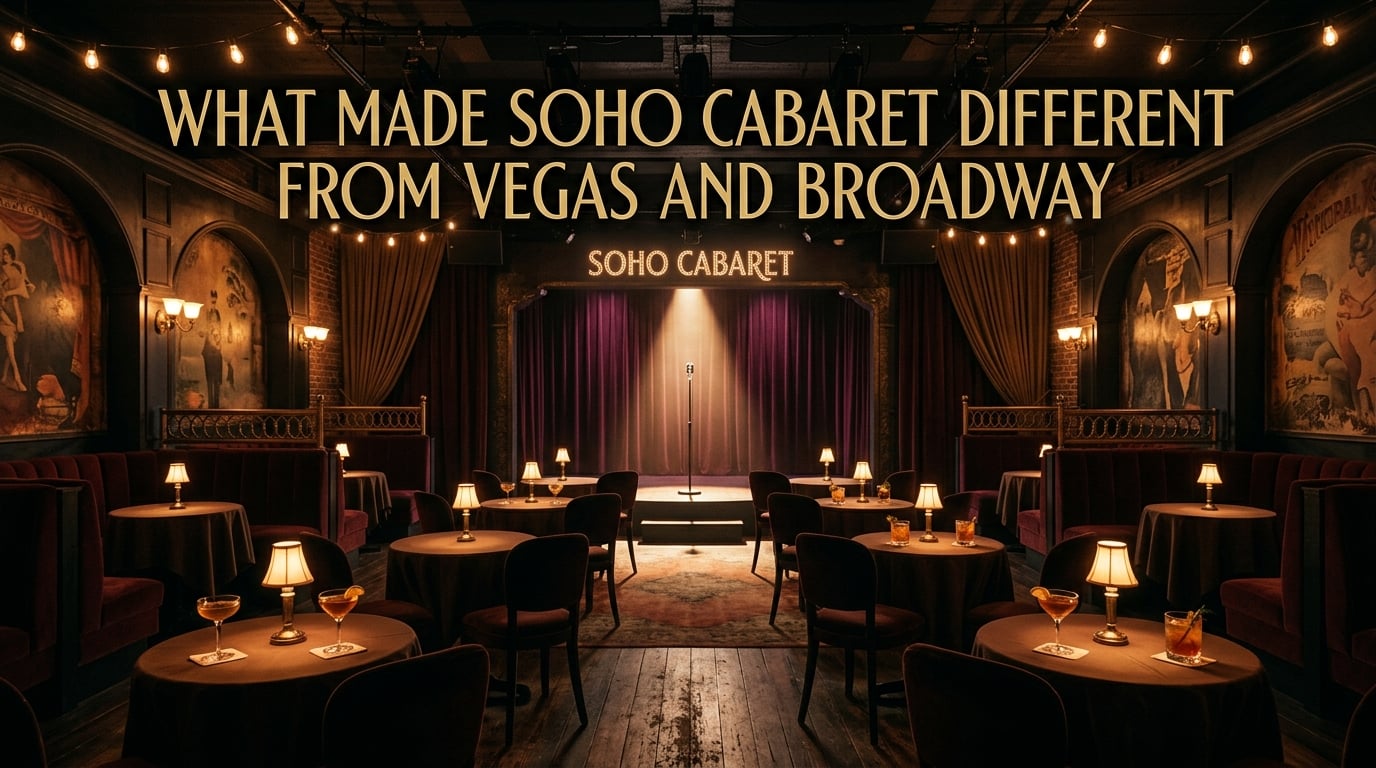
Las Vegas has always been a city of contrasts. You can stand on the Strip and watch a Cirque du Soleil acrobat soar above a 1,500-seat theater, then drive ten minutes north and find yourself in a 150-seat room where a performer is singing a torch song five feet from your cocktail. That second experience is what SoHo Cabaret offers, and it represents something genuinely new for a city that built its reputation on excess.
When the question comes up, what made Soho Cabaret different from Vegas and Broadway, the answer is not just about seat counts or ticket prices. The difference runs deeper. It is about philosophy, about what live performance is supposed to do to the people watching it, and about whether an audience is a group of consumers or a community of participants.
Three distinct theatrical traditions now share the same desert city. The Strip offers spectacle at industrial scale. The Smith Center delivers touring Broadway productions with all the polish and prestige that implies. And tucked into the historic Huntridge Theater in Downtown Las Vegas, SoHo Cabaret offers something neither of those models can replicate: radical intimacy, artistic risk, and a direct connection between performer and audience that large venues simply cannot manufacture.
This article breaks down exactly how these three worlds differ and why that difference matters for anyone who cares about live entertainment.
Table of Contents
The Short Answer: What Made Soho Cabaret Different From Vegas and Broadway
SoHo Cabaret differs from Vegas and Broadway in three fundamental ways. First, scale: its 150-seat venue places audiences within feet of performers, compared to the 500 to 2,000-seat theaters on Broadway and the 1,000-plus-seat arenas on the Strip. Second, artistic philosophy: it operates on an Off-Broadway model that prioritizes new work and creative risk over commercial certainty. Third, audience relationship: it functions as a cultural hub where communal energy and artist-audience connection replace the passive consumption model of both Strip spectacles and Broadway productions.
What Is SoHo Cabaret, Anyway?
SoHo Cabaret is the intimate performance space operated by SoHo Playhouse Las Vegas inside the historic Huntridge Theater in Downtown Las Vegas. It is not a Strip show. It is not a Broadway musical. It is a 150-seat room designed for the kind of performance that only works when the audience is close enough to see the performer breathe.
The Venue: 150 Seats and a Big Idea
The numbers tell the story before you even walk through the door. SoHo Cabaret seats 150 people across a mix of booths, cabaret tables, and bar seating. The space features state-of-the-art sound, lighting, and stagecraft, plus recording and broadcast capabilities that allow performances to reach streaming audiences beyond the room itself.
That capacity number matters more than it might seem. In a 150-seat room, there is no bad seat. There is no moment where a performer becomes a distant figure on a stage. Every person in the audience is close enough to make eye contact. Every joke lands differently when you can see the comedian’s face. Every torch song hits harder when the singer is close enough that you can hear the breath before the note.
The venue also has a cocktail bar integrated into the experience. This is not an afterthought. Having a drink in your hand while watching a jazz trio or a Broadway belter changes the social dynamic of the evening. It feels less like attending a performance and more like being invited to something exclusive. The atmosphere the physical space creates is part of the art.
The SoHo Playhouse Legacy: 80 Years of Off-Broadway Innovation
The Las Vegas venue did not appear from nowhere. It is the western outpost of New York’s SoHo Playhouse, an institution with roots stretching back to 1944. Originally founded as the Vandam Playhouse, the SoHo Playhouse has spent decades developing and presenting work that sits in what artistic director Darren Lee Cole calls the middle ground of theater, the space between massive commercial productions and scrappy DIY stages.
That middle ground is where some of the most exciting theater happens. The NYC flagship has hosted productions that went on to significant runs, including Nanette, Fleabag, Killer Joe, and Boys in the Band. Killer Joe is a particularly telling example: it started in a 64-seat venue, moved to a 99-seat space, expanded to 200 seats, and eventually reached a 1,000-seat West End production. That trajectory is the Off-Broadway dream, and it is the DNA that SoHo Cabaret brings to Las Vegas.
The Fringe Encore Series, another SoHo Playhouse initiative, has built relationships with theater artists from around the world. When you sit in the Las Vegas cabaret space, you are sitting in a room connected to an 80-year tradition of finding and developing talent that the commercial theater system might otherwise overlook.
Bringing New York’s Artistic Spirit to the Las Vegas Arts District
Darren Lee Cole has been open about why he brought SoHo Playhouse to Las Vegas. As he told the Las Vegas Review-Journal in 2021, the city was the largest metropolitan area in the United States without an Off-Broadway-style theater presence. That is a striking statement when you think about it. Las Vegas has more live performances per square mile than almost anywhere in the world, yet it lacked the mid-size professional theater ecosystem that cities like New York, Chicago, and Los Angeles take for granted.
The choice of the Huntridge Theater as a home is deliberate. Opened in 1944 and listed on the National Register of Historic Places, the Huntridge has its own cultural significance in Las Vegas. It is located in the Arts District, a neighborhood that has been steadily building a creative identity distinct from the Strip’s tourist-driven economy. SoHo Cabaret fits naturally into that neighborhood because both the venue and the district are trying to answer the same question: what would Las Vegas look like if it invested in art alongside spectacle?
The approach has been collaborative rather than colonial. Cole and his team did not arrive claiming to save Las Vegas theater. They arrived looking for partners, connecting with existing venues like The Smith Center and local companies to build an ecosystem rather than a monopoly. That philosophy is baked into how the cabaret space operates.
The Vegas Entertainment Model: Bigger Is Always Better
To understand what makes SoHo Cabaret different, you have to understand what it is different from. The Las Vegas Strip has developed its own theatrical tradition over seven decades, and that tradition is built on a single overriding principle: scale.
Scale and Spectacle on the Strip
Vegas shows are engineered for scale in a way that no other entertainment market in the world matches. Cirque du Soleil’s “O” at Bellagio performs in a 1,800-seat theater built around a 1.5-million-gallon pool. “Absinthe” at Caesars Palace seats 650 but feels larger because the performers are practically in your lap while executing feats that belong in an arena. Blue Man Group built a 1,700-seat custom venue at Luxor. These are not theaters. They are entertainment machines.
The production budgets behind these shows are equally massive. A major Strip production can cost $30 million to $100 million to develop before a single ticket is sold. That money goes toward custom-built theaters, hydraulic stages, underwater rigging systems, pyrotechnics, and the kind of technical infrastructure that would make a Broadway production designer weep with envy.
The result is an experience designed to overwhelm the senses. When you watch a Cirque du Soleil show, you are not following a narrative or connecting with a character. You are being immersed in a total sensory environment where the performers are part of a larger visual spectacle. There is real artistry in that, but it is a fundamentally different kind of artistry than what happens in a small room.
The Celebrity Residency Machine
The Strip’s other major entertainment format is the celebrity residency. Adele at the Colosseum at Caesars Palace. Bruno Mars at Park MGM. U2 at the Sphere, a venue so technologically ambitious it essentially created a new category of live performance. These residencies operate on a different logic than traditional theater.
A Vegas residency is not about artistic development or creative risk. It is about delivering a polished, repeatable experience that meets audience expectations night after night. The production is locked. The setlist rarely changes. The staging is identical from the first show to the last. This is not a criticism. It is the rational response to an economic model where audiences are paying premium prices to see a specific artist perform a specific show they already know they will enjoy.
But this model leaves no room for the unexpected. There is no moment where a performer tries something new, reads the room, and adjusts. There is no artistic discovery happening in real time. The residency is a product, beautifully executed, but a product nonetheless.
Tourism-Driven Theater: Designed for First-Time Visitors
The fundamental economic reality of Strip entertainment is that the audience is always turning over. Most people attending a Vegas show are visitors who will see it once and never return. This shapes everything about how shows are designed.
Strip shows need to make an immediate, overwhelming impression. They cannot rely on subtlety or gradual emotional build because they have one shot to wow an audience that may include people who rarely attend live performance. The result is entertainment that front-loads its impact: big opening numbers, spectacular set pieces, recognizable music, and visual moments designed to be photographed and shared.
There is nothing wrong with this approach. It produces genuinely thrilling entertainment. But it creates an audience dynamic that is fundamentally transactional. The audience is there to be entertained, to consume an experience, and to move on to the next item on their Vegas itinerary. The relationship between performer and audience is that of service provider and customer.
This is the exact opposite of what happens in a cabaret space. And that contrast is the point.
The Broadway Model: Tradition, Grandeur, and the Canon
Broadway represents the other pole of the comparison. If the Strip is about spectacle, Broadway is about institutional prestige. Both are large-scale commercial enterprises, but they operate according to very different values and traditions.
The Institutional Power of Broadway
Broadway is not just a street in Manhattan. It is an institution with over a century of history, a rigorous set of industry standards, and a cultural cachet that extends worldwide. The 41 theaters that comprise Broadway are operated under agreements with Actors’ Equity Association, the Broadway League, and other industry bodies that govern everything from minimum salaries to rehearsal schedules to the physical specifications of the theaters themselves.
When a show makes it to Broadway, it has passed through a gauntlet of development, workshops, out-of-town tryouts, and capital raising that can take years and cost millions of dollars. A typical Broadway musical costs $10 million to $25 million to mount before it opens. That financial structure demands commercial certainty. Producers need shows that will run for years, fill 500 to 2,000 seats eight times a week, and recoup their investment through ticket sales, merchandising, and eventual licensing to regional and touring markets.
The result is a theatrical ecosystem that values polish, professionalism, and proven formulas. Broadway shows are, by design, the most finished version of whatever they are trying to be. The sets are detailed. The orchestrations are complete. The performances are calibrated to fill a large room without losing nuance. This is theater as fine craftsmanship, and when it works, there is nothing else like it.
Production Scale and Budget
The physical scale of Broadway is where the comparison with SoHo Cabaret becomes most vivid. A typical Broadway theater seats between 500 and 2,000 people. The Gershwin Theatre, Broadway’s largest house, seats 1,933. Even the smallest Broadway venues, like the Helen Hayes at 597 seats, dwarf SoHo Cabaret’s 150-seat room by a factor of four.
That scale demands a different style of performance. A Broadway actor needs to project to the back row of a 1,500-seat house without amplification (though most modern productions use body microphones). The blocking, the set design, and the lighting are all calibrated for visibility at distance. A subtle facial expression that would be devastating in a 150-seat room is invisible from the mezzanine of a Broadway theater.
The recent trend toward immersive Broadway productions, most notably the Kit Kat Club revival of Cabaret at the August Wilson Theatre, represents an attempt to bridge this gap. That production transformed the theater into a Weimar-era nightclub, with table seating, pre-show performers in the lobby, and an environmental design that puts the audience inside the world of the show. Reddit users who attended described feeling like they were literally in a nightclub in Berlin.
But even this immersive Broadway production operates at a scale that SoHo Cabaret does not. The August Wilson Theatre seats roughly 1,000 people. The immersive elements are impressive, but the fundamental architecture of a large Broadway house means that the intimacy is manufactured through design rather than organic to the space.
The Broadway Audience: Tourists and Theater Aficionados
Broadway audiences are a mix of international tourists, domestic travelers making a pilgrimage to the theater district, and dedicated theater aficionados who attend regularly. This mix shapes what gets produced. Broadway needs shows that appeal to a broad enough audience to fill large houses eight times a week, week after week, year after year.
This creates a natural conservatism in programming. Revivals of known properties, musical adaptations of familiar films, and star-driven productions are safer bets than original work by unknown writers. When Broadway does take risks, those risks are usually calculated. A show like “Hadestown” or “A Strange Loop” represents artistic risk, but it arrived on Broadway only after building reputations through smaller productions, workshops, and critical acclaim.
The economics of Broadway make it very good at what it does. It produces large-scale, professionally calibrated theatrical experiences that represent the pinnacle of commercial theater craft. But those same economics make it structurally inhospitable to the kind of intimate, risky, in-progress work that defines the Off-Broadway and cabaret traditions. That is the gap SoHo Cabaret was built to fill.
The Three Things That Make SoHo Cabaret Truly Different
Strip it all down, and what made Soho Cabaret different from Vegas and Broadway comes down to three core distinctions. Each one builds on the others to create something that neither the Strip nor Broadway can replicate.
1. Radical Intimacy: Being 10 Feet From the Performer Changes Everything
The most obvious difference is also the most profound. In a 150-seat room, you are never more than 10 to 15 feet from the performer. In a 1,500-seat Strip theater, you might be 100 feet away even from a good seat. On Broadway, the back row of the mezzanine can put you 150 feet or more from the stage. That physical distance is not just a matter of sightlines. It fundamentally changes the psychological experience of watching a performance.
When a performer can see your face, the performance becomes a conversation. A comedian in a cabaret room can read the room in real time, adjusting timing based on who laughed and who did not. A singer can make eye contact with individual audience members, turning a song into something that feels personally addressed. A poet or storyteller can gauge whether the room is with them and slow down or speed up accordingly.
This kind of real-time responsiveness is impossible in large venues. A Broadway performer delivering a soliloquy cannot see the faces in the back rows. A Cirque du Soleil performer executing a death-defying routine is focused on the apparatus, not the audience. In those contexts, the performance is delivered to a crowd. In a cabaret, it is delivered to people.
The physical environment reinforces this psychological shift. Cabaret tables, booth seating, and a bar create a social atmosphere that a row of theater seats cannot match. You are facing other audience members as well as the stage. You can lean over and comment to your companion. You can raise a glass when something moves you. The audience becomes part of the room’s energy rather than passive observers of it.
Forum discussions about immersive theater consistently highlight this quality. Reddit users describe the feeling of being close enough to performers that the boundary between stage and audience dissolves. One user said the Cabaret at the Kit Kat Club felt like being in an actual Berlin nightclub. SoHo Cabaret achieves a similar effect not through elaborate immersive staging but through the simple fact of proximity.
2. Artistic Risk Over Commercial Certainty
The second difference is about what gets programmed and why. Strip shows and Broadway productions are commercial enterprises that require predictable returns on massive investments. This creates a natural bias toward proven material, recognizable brands, and safe artistic choices. There is nothing wrong with this. Hamilton is a masterpiece and also a commercial juggernaut. But the financial structure of large-scale theater makes true artistic risk difficult.
SoHo Cabaret operates on the Off-Broadway model, where the financial stakes are lower and the tolerance for risk is higher. A 150-seat venue does not need to gross millions of dollars a week to stay solvent. It can program a jazz trio on Tuesday, a new one-person show on Wednesday, a poetry reading on Thursday, and a Broadway belter on Friday. It can give stage time to performers who are developing material, workshopping ideas, or trying something that might not work.
This is what Darren Lee Cole meant when he talked about the middle ground where Off-Broadway lives. It is the space where artists take chances, where new work is born, and where audiences get to see something that might be terrible or might be transcendent and will certainly be unlike anything they could see on the Strip or in a Broadway house.
The Off-Broadway model also allows for a different relationship with time. A Strip show runs for years with the same staging. A Broadway production is locked once it opens. But a cabaret can evolve. A performer can bring material back week after week, refining it based on audience response, adding new pieces, dropping what does not work. The audience gets to be part of that process in a way that is impossible in larger venues.
The diversity of programming is itself a form of artistic risk. Rather than committing to a single show for months or years, SoHo Cabaret presents variety: jazz, comedy, torch songs, poetry, new work, established acts. This means every visit is different. It also means the venue functions as a platform for artistic exploration rather than a content delivery system for a single product.
3. Community Over Consumption
The third difference is the most philosophical and perhaps the most important. Both Strip entertainment and Broadway operate on a consumption model. The audience pays for a product, receives the product, and leaves. The relationship is transactional and temporary. This is not a criticism. It is simply how large-scale commercial entertainment works.
SoHo Cabaret aims for something different. By creating an intimate, varied, and social environment, it functions as a cultural hub rather than a product. Regular attendees get to know the space, the performers, and each other. The venue becomes a gathering place for people who share an interest in live performance as an art form, not just as entertainment.
This communal energy is something that forum users and theater enthusiasts consistently identify as the quality they value most in intimate venues. The feeling of being part of something, of sharing an experience with a roomful of people who are all close enough to the performance to be genuinely affected by it, creates a sense of connection that large venues cannot manufacture.
The location in the Arts District reinforces this community orientation. Rather than catering to tourists on the Strip, SoHo Cabaret is embedded in a neighborhood with its own creative identity. It draws local audiences, visiting theater enthusiasts, and anyone curious enough to venture beyond the obvious attractions. The result is a more diverse audience than you would find at a typical Strip show, where the crowd is primarily visitors following a standard entertainment itinerary.
When Troy Heard of Majestic Repertory Theatre talked about the SoHo Playhouse expansion, he framed it in terms of competition driving artistic excellence. More venues means more theater, which means more audiences, which means a healthier ecosystem. SoHo Cabaret is not trying to compete with the Strip. It is trying to build something the Strip does not offer: a local arts scene with professional standards and a commitment to artistic development.
From Weimar Berlin to Las Vegas: The Cabaret Tradition Reimagined
Cabaret as an art form has always been about intimacy and risk. The tradition traces back to 1920s Weimar Berlin, where venues like the Kit Kat Klub offered a mix of political satire, sexual frankness, musical performance, and social commentary in small rooms where the audience was part of the show. The Nazi rise to power crushed that world, but the idea survived.
Cabaret’s Origins: 1920s Berlin to Broadway
When Cabaret the musical opened on Broadway in 1966, it brought the form to a mass audience. The show, with music by John Kander and lyrics by Fred Ebb, used the framework of the Berlin cabaret to explore themes of political complacency, sexual freedom, and the rise of fascism. Theater critic Walter Kerr noted that Cabaret turned the idea of a Broadway musical on its head. There was no traditional overture. The story dealt with anti-Semitism, abortion, and bisexuality. The Emcee character, originated by Joel Grey, was coded as queer in a way that pushed boundaries for 1960s Broadway.
The 1972 film adaptation, directed by Bob Fosse and starring Liza Minnelli, made further changes, streamlining the narrative and emphasizing visual decadence. It won eight Academy Awards and essentially revived the concept of the movie musical. The 1998 Roundabout Theatre revival, starring Alan Cumming, transformed the Studio 54 venue into an immersive nightclub environment and set the template for the immersive productions that followed, including the recent Kit Kat Club production at the August Wilson Theatre.
SoHo Cabaret’s Place in the Lineage
SoHo Cabaret sits in this lineage but takes a different path. Rather than producing a single immersive musical in a large theater, it offers a rotating program of intimate performances in a small room. It returns cabaret to its roots: variety, proximity, spontaneity, and a social atmosphere where the audience is part of the experience. The spirit of Weimar Berlin lives in the format, not in the content of any single show.
This is what makes SoHo Cabaret distinct from both the Broadway tradition of large-scale cabaret musicals and the Vegas tradition of spectacle entertainment. It is cabaret as an ongoing practice rather than a single production. It is a room where the form can evolve night after night, performer after performer, audience after audience.
SoHo Cabaret vs. Vegas vs. Broadway: At a Glance
| Feature | SoHo Cabaret | Vegas Strip Show | Broadway Production |
|---|---|---|---|
| Seating Capacity | 150 seats | 650 to 2,000+ seats | 500 to 2,000 seats |
| Typical Price Range | Moderate | Premium to ultra-premium | High |
| Show Format | Rotating variety: jazz, comedy, cabaret, spoken word | Long-running spectacle production or celebrity residency | Long-running book musical or play |
| Distance From Stage | 10 to 15 feet maximum | 50 to 150+ feet | 30 to 150+ feet |
| Typical Show Length | 60 to 90 minutes | 90 minutes to 2 hours | 2 to 3 hours with intermission |
| Dress Code | Casual to smart casual | Resort wear to formal | Smart casual to formal |
| Artistic Focus | New work, artistic risk, performer development | Visual spectacle, technical precision, brand recognition | Theatrical craft, narrative storytelling, production polish |
| Best For | Theater enthusiasts seeking intimacy and variety | Visitors wanting a once-in-a-lifetime spectacle | Theater lovers wanting the pinnacle of commercial craft |
| Atmosphere | Intimate, social, communal | Spectacular, overwhelming, impressive | Grand, polished, prestigious |
| Audience Relationship | Participants in a shared experience | Consumers of a premium product | Audience members at a professional production |
What This Means for the Future of Live Entertainment in Las Vegas
The arrival of SoHo Cabaret in Las Vegas signals something larger than a single venue opening. For decades, the city has been defined by a binary entertainment model: Strip spectacle for tourists and local theater for residents, with very little in between. The Smith Center brought touring Broadway productions to downtown, filling part of that gap. But a touring production is still a finished product imported from elsewhere. It is not grown in the city.
SoHo Cabaret represents an investment in artistic infrastructure. By creating a space where performers can develop work, where audiences can experience something new, and where the format itself encourages experimentation, it plants the seeds for a local creative ecosystem. This is how theater scenes grow. Not from a single blockbuster production but from a network of smaller venues where artists can take risks, build audiences, and develop the work that eventually reaches larger stages.
The Killer Joe trajectory is instructive here. That show started in a 64-seat venue and ended up in a 1,000-seat West End theater. That kind of artistic development pipeline has existed in New York, Chicago, and London for decades. Las Vegas has not had it. The presence of SoHo Cabaret, alongside existing venues like Cabaret Jazz at The Smith Center and companies like Majestic Repertory Theatre, suggests that pipeline is starting to form.
For audiences, this means more choices and more interesting choices. Not every visitor to Las Vegas wants to spend $200 on a Cirque du Soleil show. Some want to discover something they have never seen before. Some want to sit close enough to a performer to feel the emotional weight of a song. Some want to be part of a room where something might happen that has never happened before and might not happen again. That is what SoHo Cabaret offers, and it is something neither the Strip nor Broadway can deliver.
FAQs
What is SoHo Cabaret and where is it located?
SoHo Cabaret is a 150-seat intimate performance venue at the historic Huntridge Theater in Downtown Las Vegas, operated by New York’s SoHo Playhouse. It features booths, cabaret tables, bar seating, a cocktail bar, and state-of-the-art sound and lighting. The venue programs a rotating mix of jazz, comedy, cabaret performance, spoken word, and new theatrical work.
How is SoHo Cabaret different from other Las Vegas shows?
SoHo Cabaret differs from typical Las Vegas shows in three ways: its 150-seat capacity creates radical intimacy between performers and audience, it programs rotating variety shows rather than a single long-running production, and it operates on an Off-Broadway artistic philosophy that values creative risk over spectacle. Strip shows typically seat 650 to 2,000-plus people and are designed as large-scale visual experiences for tourist audiences.
What is the seating capacity of SoHo Cabaret?
SoHo Cabaret seats 150 people across a mix of booths, cabaret tables, and bar seating. This makes it one of the most intimate professional performance venues in Las Vegas, especially compared to Strip theaters that seat 650 to 2,000-plus and Broadway houses that seat 500 to 2,000.
How does immersive theater at SoHo Cabaret compare to Broadway?
SoHo Cabaret achieves intimacy through physical proximity rather than elaborate immersive staging. In a 150-seat room, every audience member is within 10 to 15 feet of the performer, creating a natural conversational dynamic. Broadway immersive productions like the Kit Kat Club revival use environmental design, pre-show performers, and table seating to manufacture intimacy in a 1,000-seat theater, but the fundamental scale difference means the connection is designed rather than organic.
What kind of shows are performed at SoHo Cabaret?
SoHo Cabaret programs a rotating variety of intimate performances including jazz trios, cabaret singers, Broadway belters performing torch songs, comedy, poetry readings, solo shows, and new theatrical work in development. Unlike Strip venues that run a single production or Broadway houses that host long-running musicals, SoHo Cabaret functions as a multi-format cultural hub with different programming throughout the week.
Why the Difference Matters
What made Soho Cabaret different from Vegas and Broadway is ultimately about what we want from live performance. The Strip offers spectacle that overwhelms. Broadway offers craft that inspires. SoHo Cabaret offers connection that lingers. In a city that has spent decades perfecting the first two, the third represents something genuinely new: a belief that Las Vegas can be a place where art grows, not just a place where entertainment is consumed. That difference is worth experiencing firsthand.