
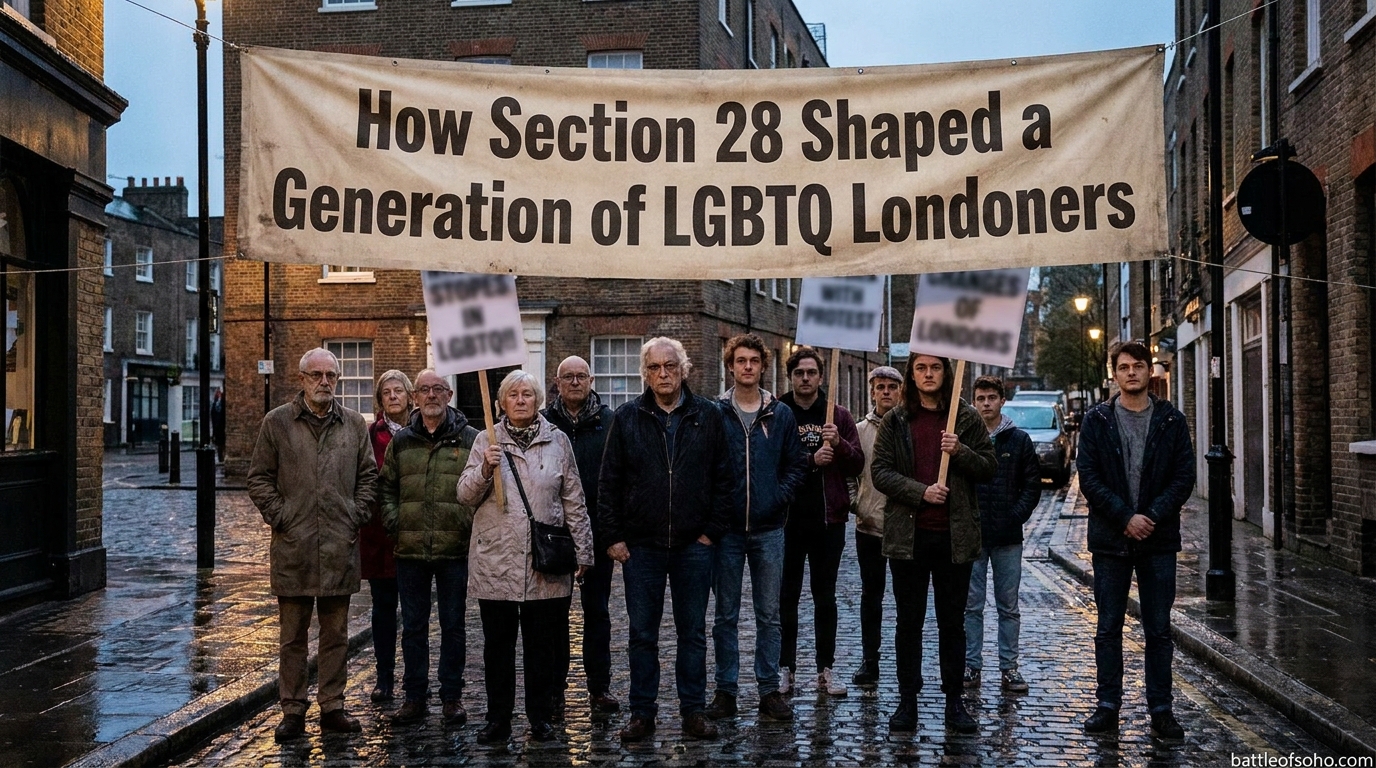
Section 28 was a UK law, enacted on 24 May 1988, that prohibited local authorities and schools from “promoting homosexuality” as a acceptable family relationship. For fifteen years, this single piece of legislation cast a shadow over the lives of LGBTQ Londoners, silencing teachers, isolating young people, and fuelling a climate of fear across the capital.
For those who grew up in London during the Section 28 era, the impact was personal. Teachers could not acknowledge their existence. Support groups shut their doors. Young people searching for language to describe who they were found only silence.
In this article, we trace how Section 28 shaped a generation of LGBTQ Londoners, from the classrooms of Islington to the streets of Soho. We look at the law itself, the human cost, the resistance it sparked, and the legacy that still reverberates through London’s LGBTQ+ community today.
Table of Contents
What Was Section 28?
Section 28 was a clause added to the Local Government Act 1988, amending the earlier Local Government Act 1986. The law stated that a local authority “shall not intentionally promote homosexuality or publish material with the intention of promoting homosexuality.” It also prohibited councils from “promoting the teaching in any maintained school of the acceptability of homosexuality as a pretended family relationship.”
Those two sentences did enormous damage. The wording was deliberately vague, and that vagueness was the point. No one knew exactly where the legal line sat, so schools and councils erred on the side of total silence.
The clause was known by different names depending on where you were. In England and Wales, it was Section 28. In Scotland, it was Section 2A. But the effect was the same: a blanket of institutional silence about LGBTQ+ lives.
The law was introduced by Margaret Thatcher’s Conservative government. It was passed on 24 May 1988 and remained on the statute book for fifteen years. It was finally repealed in England and Wales on 18 November 2003, with Scotland having already repealed its equivalent in 2000.
Section 28 applied specifically to local authorities, which at the time included the Inner London Education Authority and the London borough councils that ran schools. This made London, with its patchwork of progressive and conservative councils, a particular battleground for how the law was interpreted and resisted.
Why Was Section 28 Introduced?
To understand why Section 28 was introduced, you have to understand the political and cultural climate of 1980s Britain. The Thatcher government had spent years stoking moral panic about the visibility of LGBTQ+ people in public life, particularly in education.
The trigger was a controversy over a children’s book called “Jenny Lives with Eric and Martin,” which depicted a girl growing up with her father and his male partner. The book was available in some school libraries, and right-wing media seized on it as evidence that councils were “promoting” homosexuality to children.
The Daily Mail ran furious headlines. Conservative MPs warned that children were being corrupted. The tabloid frenzy created political pressure that the government was happy to exploit. Thatcher herself framed the legislation as protecting “the rights of parents” against liberal councils.
London was at the centre of this storm. Several London boroughs, including Haringey, Islington, and Camden, had been actively promoting LGBTQ+ equality through their education policies. They had funded support groups, stocked LGBTQ+ materials in libraries, and trained teachers on inclusivity. To the Conservative government, this progressive work was exactly what needed to be stopped.
The law was also introduced against the backdrop of the AIDS crisis. Homophobia was rampant in the press and in politics. The government’s own AIDS awareness campaigns were deliberately vague and avoided showing same-sex couples. In this atmosphere, Section 28 was less a new idea than a codification of existing prejudice.
How Section 28 Affected London’s Schools and Classrooms
London schools were ground zero for the impact of Section 28. The law did not explicitly ban teachers from mentioning homosexuality. But because no one could define what “promoting” actually meant, the safest course for schools was to say nothing at all.
The result was systematic self-censorship. Teachers who wanted to support LGBTQ+ students feared for their jobs. Teachers who were themselves LGBTQ+ went back into the closet at work. The law created a chilling effect that went far beyond its narrow legal scope.
For LGBTQ+ young people in London schools, this meant growing up without a single mention of their existence in the classroom. Sex education classes covered reproduction, contraception, and heterosexual relationships. Same-sex attraction was simply absent from the curriculum.
Bullying went unaddressed because teachers felt they could not intervene. If a student was called homophobic slurs, a teacher who challenged it might be accused of “promoting homosexuality.” Many LGBTQ+ Londoners who were in school during the Section 28 years recall that homophobic bullying was treated as normal behaviour, not as a problem requiring action.
Support groups that had been helping young people were forced to close or go underground. In Haringey, the council’s equality work was dismantled. Groups that had offered counselling and community to LGBTQ+ youth lost their funding or their meeting spaces because councils feared legal repercussions.
The Inner London Education Authority, which had been a leader in inclusive education, was abolished by the Conservative government in 1990. Its replacement, individual borough education departments, were far more cautious. The loss of London’s centralised education body made it even harder to maintain any progressive policies.
This silence had a specific geography in London. In progressive boroughs like Islington and Camden, some schools found quiet ways to support students without technically breaking the law. In more conservative boroughs, the silence was absolute. Where you lived in London determined whether you had any access to support at all.
The AIDS Crisis: Fuel on the Fire
You cannot separate Section 28 from the AIDS crisis. They arrived at the same moment and reinforced each other in devastating ways. London was the epicentre of the AIDS epidemic in the UK, with the highest concentration of cases and the most visible community response.
Section 28 made AIDS prevention work significantly harder. Organisations trying to distribute safe-sex information to gay men feared that their materials could be deemed to “promote homosexuality.” Some councils withdrew funding from HIV prevention groups because of the legal risk.
The combination was toxic. LGBTQ+ people in London were dealing with a deadly epidemic that was killing their friends and partners. At the same time, the law prevented schools and councils from acknowledging their relationships or providing them with affirming information.
Community organisations stepped into the gap. Groups like the Terrence Higgins Trust, founded in London in 1982, carried on despite the hostile legal environment. But they had to work around the law, choosing their words carefully and relying on voluntary funding rather than council support.
The AIDS crisis also shaped how Section 28 was experienced emotionally. LGBTQ+ Londoners were grieving lost loved ones while being told by their government that their relationships were not real and should not be spoken about. The law added legal stigma on top of personal devastation.
For young LGBTQ+ people, the association between homosexuality and death was inescapable. The only context in which being gay was discussed was illness and dying. Section 28 ensured that no positive counter-narrative could be offered in schools to balance this out.
The Human Cost: Growing Up LGBTQ+ in London Under Section 28
The statistics about Section 28 are important, but the human cost is what matters most. Growing up LGBTQ+ in London during the Section 28 years meant navigating a world that refused to acknowledge your existence. The emotional and psychological impact of that silence shaped an entire generation.
Many LGBTQ+ Londoners who attended school between 1988 and 2003 describe the same experience: a complete absence of role models. There were no out teachers. There were no LGBTQ+ characters in textbooks or classroom materials. There was no one to tell a young person that what they were feeling was normal and valid.
That absence created shame. When the only messages you receive about being gay, lesbian, bisexual, or trans are negative or non-existent, you internalise the idea that there is something wrong with you. Multiple people who grew up during this era describe spending their teenage years convinced they were broken.
The impact on mental health was severe and long-lasting. Anxiety, depression, and substance use were common among LGBTQ+ Londoners who came of age under Section 28. Community organisations in London, such as London Friend, reported seeing the consequences for decades afterwards. People who were denied support as teenagers arrived at adult services carrying deep scars.
Bisexual people faced their own specific challenges under Section 28. The law only mentioned homosexuality, which meant bisexual experiences were even more invisible. Bisexual young people in London had no language for what they were feeling and no framework to understand their identity. They fell through every gap.
Trans people were similarly invisible. Section 28 did not explicitly mention gender identity, but the climate of fear it created extended to any expression of gender non-conformity. Trans youth in London during this period had virtually no access to information, support, or affirmation. The silence around homosexuality reinforced a broader silence about all forms of gender and sexual difference.
Black and minority ethnic LGBTQ+ Londoners experienced Section 28 at a specific intersection of oppression. They faced racism within the LGBTQ+ community and homophobia within their own communities, with no institutional support from either direction. London’s diverse neighbourhoods meant that Black LGBTQ+ youth often had even less access to affirming spaces than their white peers. The law compounded existing inequalities rather than operating in isolation.
The isolation was particularly acute outside central London. In outer London boroughs, where LGBTQ+ venues were scarce and community networks were thinner, young people had nowhere to turn. The journey to Soho or Vauxhall for community was not possible for a teenager without money, transport, or the confidence to go.
How London Fought Back: Activism and Resistance
Section 28 was devastating, but it also galvanised a movement. The law inadvertently created a generation of activists who were furious, organised, and determined to fight back. London was at the heart of that resistance.
Stonewall UK was founded in London in 1989, directly in response to Section 28. The organisation was created by people who had been fighting the legislation and realised they needed a permanent lobbying presence. From its London base, Stonewall went on to become one of the most influential LGBTQ+ rights organisations in Europe.
Outrage! was formed in London in 1990 by a group of queer activists who believed that polite lobbying was not enough. They organised direct action protests that were bold, theatrical, and impossible to ignore. Their campaigns targeted homophobic institutions, politicians, and media outlets from their base in the capital.
Peter Tatchell, one of London’s most prominent LGBTQ+ activists, was central to the fight against Section 28. His campaign group has staged hundreds of protests across the capital, from the steps of Parliament to the doors of discriminatory institutions. The energy of that era of London activism shaped the city’s LGBTQ+ community for decades.
One of the most iconic moments of resistance came before the law was even passed. In 1988, a group of lesbians abseiled into the House of Lords from the public gallery during a debate on the legislation. Their protest made national headlines and became a lasting symbol of defiance.
Pride marches in London swelled during the Section 28 years. What had been a relatively modest annual event became a massive act of collective defiance. Hundreds of thousands of people took to the streets of London to demand visibility and rights that the law was trying to deny them.
Local councils in London also resisted. Despite the legal risk, several Labour-controlled boroughs continued to fund LGBTQ+ support services on the quiet. They found creative ways to channel money to community groups without explicitly framing it as promoting homosexuality. This quiet defiance kept some support systems alive through the darkest years.
The London LGBTQ+ scene itself became an act of resistance. Venues in Soho, Vauxhall, and Hackney provided spaces where people could be themselves in a world that demanded their silence. These venues were not just bars and clubs. They were community centres, information hubs, and lifelines for people who had nowhere else to go.
How Section 28 Was Repealed
The fight to repeal Section 28 took years and faced fierce opposition. Scotland led the way, repealing Section 2A in 2000 under the Scottish Parliament, which had been established the previous year. The repeal was pushed through by the Labour-Liberal Democrat coalition despite a campaign against it led by Cardinal Thomas Winning and conservative groups.
In England and Wales, the path was harder. Tony Blair’s New Labour government, elected in 1997, was committed to repeal but faced sustained resistance from the Conservative-dominated House of Lords. Multiple attempts to repeal the legislation were blocked by peers who argued it would endanger children.
The repeal of Section 28 in England and Wales finally passed on 18 November 2003. The Local Government Act 2003 removed the clause from the statute book, ending fifteen years of institutional silence. For LGBTQ+ Londoners who had lived under the law since childhood, it was a moment of profound relief and exhaustion.
The repeal did not undo the damage. You cannot give back the years of silence to the teenager who needed support and found none. But it did open the door to a different future. Schools could, in theory, finally acknowledge that LGBTQ+ people existed.
However, the legacy of caution persisted long after repeal. Many teachers who had spent years under Section 28 continued to self-censor. The law was gone, but the fear it had instilled remained embedded in school cultures and institutional practices across London.
The Lasting Legacy: How Section 28 Still Shapes LGBTQ Londoners Today
Section 28 was repealed in 2003, but its shadow is still visible in the lives of LGBTQ Londoners today. The generation that grew up under the law carries the effects into their adult lives. And the cultural patterns it established have proven remarkably persistent.
Teachers in London schools are still hesitant about discussing LGBTQ+ topics. Despite the repeal, despite subsequent equality legislation, the instinct to avoid the subject runs deep. Surveys of teachers have consistently shown that many feel ill-equipped and nervous about addressing LGBTQ+ issues in the classroom. Section 28 trained a generation of educators to stay silent, and that training is hard to unlearn.
The mental health impacts are still being felt. LGBTQ+ people who grew up during the Section 28 years are now in their thirties, forties, and fifties. Many continue to struggle with shame, anxiety, and difficulty forming relationships. London’s LGBTQ+ mental health services still see clients whose wounds trace directly back to the silence of that era.
Perhaps most strikingly, the rhetoric used to justify Section 28 is being recycled today. The language of “protecting children” from LGBTQ+ people, the moral panic about education, the framing of LGBTQ+ identities as inherently dangerous to the young. All of this has returned in the debate over trans rights and gender identity in schools.
For trans Londoners and their allies, the parallels are chilling. The same arguments that were used to justify Section 28 in 1988 are now being deployed against trans youth. The claim that acknowledging a marginalised identity constitutes “promoting” or “indoctrinating” children is exactly the logic that kept homosexuality unmentionable for fifteen years.
Remembering Section 28 is not just about history. It is about recognising the patterns of discrimination so that they are not repeated. The law showed how quickly institutional silence can be imposed, how devastating its effects can be, and how long it takes to undo the damage.
Frequently Asked Questions
What was Section 28 UK?
Section 28 was a UK law enacted on 24 May 1988 as part of the Local Government Act 1988. It prohibited local authorities and schools from intentionally promoting homosexuality or teaching that it was acceptable as a pretended family relationship.
When was Section 28 repealed?
Section 28 was repealed in Scotland in 2000 and in England and Wales on 18 November 2003. The repeal was part of the Local Government Act 2003, ending fifteen years of institutional silence about LGBTQ+ lives in schools and local authorities.
How did Section 28 affect LGBT people?
Section 28 created a climate of fear and self-censorship in schools and councils. Teachers could not support LGBTQ+ students, bullying went unaddressed, support groups closed, and young LGBTQ+ people grew up without role models, information, or affirmation. The long-term mental health impacts are still felt today.
Why was Section 28 introduced?
Section 28 was introduced by Margaret Thatcher’s Conservative government in 1988 amid a moral panic about LGBTQ+ visibility in education. It was triggered by controversies over LGBTQ+ materials in school libraries and was driven by homophobic media coverage and political pressure to rein in progressive London councils.
Is Section 28 still in effect?
No. Section 28 was fully repealed across the UK by 2003. However, its cultural legacy persists, and many argue that similar rhetoric has reappeared in current debates about trans rights and LGBTQ+ education in schools.
Conclusion
Section 28 was more than a single line of legislation. It was a fifteen-year experiment in institutional silence that reshaped the lives of an entire generation of LGBTQ Londoners. From the classrooms where homosexuality went unmentioned to the venues where a community found refuge, the law touched every corner of LGBTQ+ life in the capital.
The damage was real and lasting. But so was the resistance. Section 28 gave birth to Stonewall, supercharged Outrage!, filled London’s Pride marches, and forged a generation of activists who refused to be silenced. The story of how Section 28 shaped LGBTQ Londoners is one of both pain and defiance.
Understanding this history matters now more than ever. As the same arguments about protecting children from LGBTQ+ lives resurface in debates about trans rights, we need to remember where those arguments led last time. Section 28 was repealed in 2003, but the prejudice that created it did not disappear. It simply found new targets.
If you or someone you know was affected by the legacy of Section 28, there are still organisations in London offering support. London Friend, Stonewall, and the Terrence Higgins Trust continue the work that began during those dark years. The silence that Section 28 imposed can still be broken, one conversation at a time.