
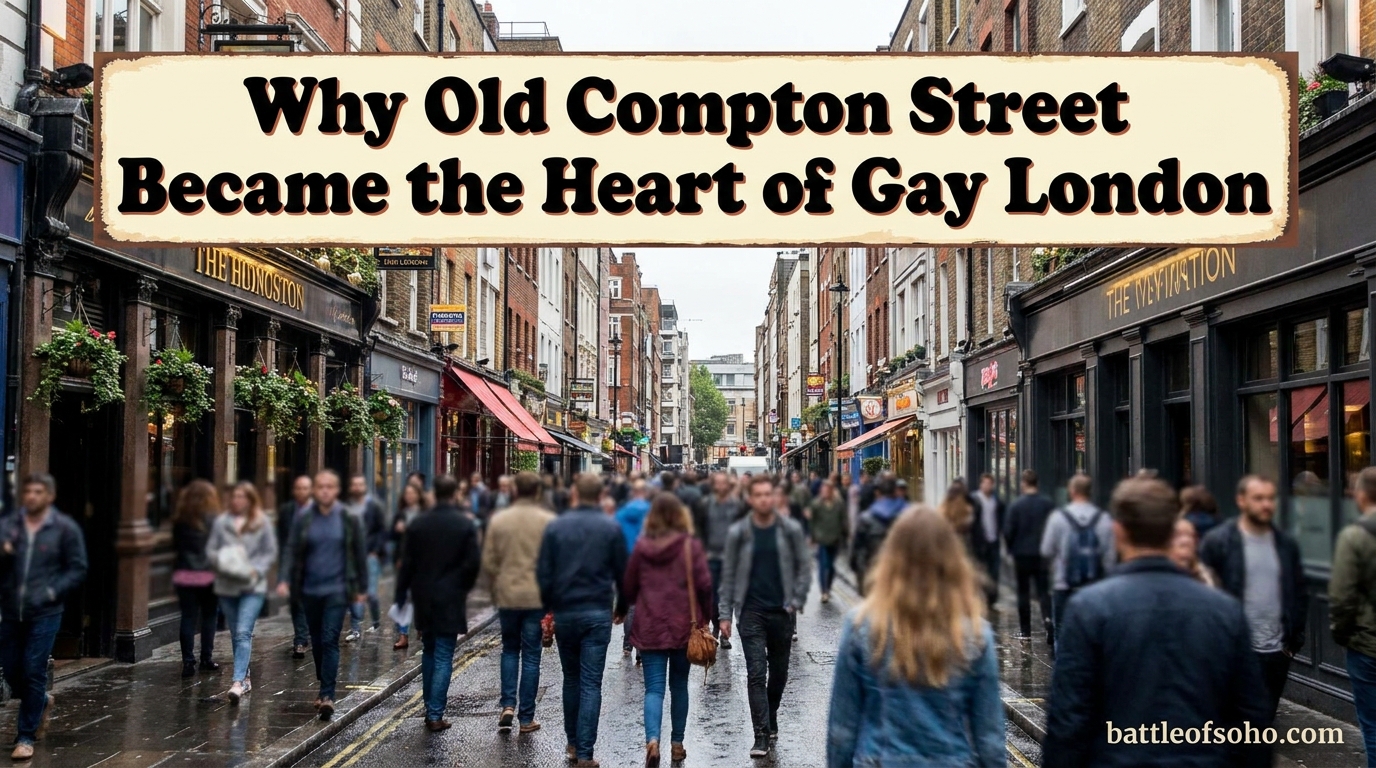
Walk down Old Compton Street on a Friday night and you feel it before you see it. Bass from nightclub doors. Rainbow flags stitched into the awnings of bars that have served pints for decades. Groups spilling onto pavements, laughing, arguing, flirting, simply existing in a space that was hard-won for them. This short stretch of road in the middle of Soho has been the beating heart of gay London for over fifty years.
But why here? Why this particular street, in this particular neighbourhood, and not somewhere else in a city of eight million people? The answer involves centuries of immigration, a music revolution, a devastating terrorist attack, and the quiet stubbornness of a community that refused to be moved.
Old Compton Street is a short east-west road in Soho, London, that has been the recognised centre of the city’s gay community since the 1970s, known for its concentration of LGBTQ+ bars, restaurants, and cultural venues. It sits between Charing Cross Road and Wardour Street, anchoring a neighbourhood that became London’s gay village through decades of visible, unapologetic presence.
Our team has spent years documenting Soho’s queer history, interviewing venue owners, community members, and historians who have watched this street transform. What follows is the full story of how Old Compton Street became the heart of gay London, from its 17th-century origins to the closures and openings reshaping it in 2026.
Table of Contents
Quick Summary: Old Compton Street at a Glance
For those who want the essentials before diving into the full history, here is what makes Old Compton Street significant.
What it is: A short street in Soho, London’s West End, widely regarded as the centre of the city’s LGBTQ+ community.
When it became gay: The street emerged as a visibly gay area in the 1970s, though queer venues existed in Soho earlier. By the 1990s, Old Compton Street was firmly established as London’s gay high street.
Key venues: Comptons of Soho (since 1986), the Admiral Duncan pub, the now-closed G-A-Y Bar, Bar Italia, and the Prince Edward Theatre.
Defining moments: The 1999 nail bomb attack on the Admiral Duncan, which killed three people and injured 79, became a turning point that galvanised the community rather than scattering it.
Current status in 2026: The street faces gentrification pressures and venue closures, including the G-A-Y Bar shutting its doors in October 2025. But new investment, including the Coven nightclub opening in 2026, signals that the area is far from finished.
Why Old Compton Street Became the Heart of Gay London
The question of why Old Compton Street became the heart of gay London has several layers, and none of them involve a single decision or a grand plan. Instead, a series of historical accidents, economic conditions, and community choices converged on this one street.
Soho itself has always been a neighbourhood of outsiders. From Huguenot refugees in the 1680s to Italian immigrants in the 1950s, the area absorbed wave after wave of people who did not quite fit into mainstream London. That history of tolerance, born from diversity, created soil where a gay community could eventually take root.
The geography mattered too. Soho sat in the West End, close enough to theatres and nightlife to feel connected to London’s entertainment culture, but dense and maze-like enough to offer privacy. Gay bars could exist here without drawing the kind of attention they would attract on a major thoroughfare like Oxford Street.
By the 1970s, a cluster of gay venues had established themselves on or near Old Compton Street. That clustering effect was self-reinforcing. Once a few gay bars opened, LGBTQ+ people knew where to go. The footfall attracted more gay-friendly businesses, which in turn drew more of the community. Within a decade, the street had become a destination rather than just a place that happened to have a gay pub or two.
The AIDS crisis of the 1980s and 1990s deepened the street’s significance. When the wider society often treated gay men with fear and disgust, Old Compton Street became a place of solidarity. People came here not just to drink but to grieve, to organise, to support each other through a catastrophe that was devastating their community. The street became more than a nightlife hub. It became a lifeline.
The Origins: From Huguenot Refugees to Bohemian Soho (1677-1900)
Old Compton Street’s story begins long before the first rainbow flag was ever hung from one of its lampposts. Understanding its deeper history helps explain why this particular street was primed to become what it did.
Henry Compton and the Street’s Founding
The street takes its name from Henry Compton, the Bishop of London from 1675 to 1713. Compton was a significant figure in the Church of England, known for his opposition to James II’s Catholic policies and his role in the Glorious Revolution of 1688. The land through which the street runs was part of the parish he oversaw.
Development of the street began around 1677, as Soho transformed from rural fields into a fashionable residential area. The original layout, with its narrow frontages and mixed-use character, established a pattern that persists to this day. Small premises, close together, each with its own identity. This physical structure would later prove ideal for a street full of independent bars and restaurants.
By the Victorian era, Soho had lost much of its fashionable sheen. Wealthier residents moved west to Mayfair and Belgravia, and the neighbourhood became known for its cheap rents, immigrant communities, and somewhat raffish reputation. That reputation for being a little rough around the edges, a little outside respectable society, would become one of its most important assets.
The Huguenot Arrival
In 1685, Louis XIV revoked the Edict of Nantes, stripping French Protestants known as Huguenots of their religious freedoms. The result was one of the largest refugee waves in European history. Tens of thousands of Huguenots fled France, and a significant number settled in Soho.
The Huguenots brought skills in silk weaving, watchmaking, and other trades. They also brought a culture of religious dissent and a deep familiarity with persecution. Their presence established Soho as a place where newcomers could find a foothold and where different ways of living could coexist.
This pattern repeated itself across centuries. Irish immigrants, Italian families, Eastern European Jews, Chinese merchants, and eventually counterculture communities of all kinds passed through or settled in Soho. The neighbourhood became a living argument for diversity, a place where being different was simply normal. That cultural DNA would later make it fertile ground for the LGBTQ+ community.
The Italian Community and the Birth of Coffee Culture (1950s-1960s)
Before Old Compton Street was gay, it was Italian. The post-war Italian immigrant community left an imprint on the street that is still visible today, and their influence helped create the social infrastructure that the gay community would later build on.
Italian families began arriving in significant numbers in the late 1940s and 1950s, drawn by work in Soho’s restaurant and hospitality trade. They brought with them a cafe culture that was entirely new to London. At a time when most of the city shut down at 5pm, Italian coffee bars on Old Compton Street stayed open late into the evening.
The most famous was the 2i’s Coffee Bar, which opened at 59 Old Compton Street in 1956. The 2i’s became the birthplace of British rock and roll. Tommy Hicks, later known as Tommy Steele, was discovered performing there. The skiffle craze that spawned a generation of British musicians can trace its roots directly to that small basement venue.
This mattered for the street’s future in ways nobody could have predicted. The 2i’s proved that Old Compton Street could be a place where new cultural movements took hold. It established the street as somewhere young, creative, and slightly rebellious people gathered. The coffee bars that the Italian community opened also created a model for socialising that did not revolve entirely around alcohol, which would later make the street feel more welcoming to a wider range of people.
Bar Italia, which opened at 125 Old Compton Street in 1949, remains one of the street’s most beloved institutions. Founded by the Polledri family, it has served espresso to Soho’s night owls for over seven decades. Standing at its counter at 2am, you are participating in a tradition that predates the street’s gay identity by a quarter century.
The Italian community also established something else that would prove critical: a sense that Old Compton Street belonged to the people who used it. It was not a thoroughfare you passed through. It was a destination. You went there on purpose, because something you wanted was there. That psychology of intentionality would define the street’s gay era too.
The 1970s Turning Point: How the Gay Community Claimed the Street
The 1970s were the decade when everything changed for Old Compton Street. The Sexual Offences Act of 1967 had partially decriminalised homosexuality in England and Wales, and the following years saw a slow but real shift in what was possible for LGBTQ+ people in London.
Gay venues had existed in Soho before the 1970s, but they were often hidden, unmarked, and operating under the constant threat of police raids. What changed in this decade was visibility. Bars began to advertise themselves openly. Windows that had been painted over or boarded up were cleared. For the first time, you could walk down a London street and see gay life happening openly.
Old Compton Street became the focal point for this new visibility. Its existing character as a night-time destination, its concentration of small premises with street-level frontages, and its location in a neighbourhood already known for tolerance made it the natural centre. Gay bars did not need to hide here because the street was already associated with after-hours culture.
The clustering happened quickly once it started. Each new venue that opened made the street more attractive to LGBTQ+ customers, which in turn attracted more venues. By the end of the decade, Old Compton Street had a recognisable gay identity that set it apart from any other street in London.
Why Soho? The Geography of Acceptance
Other cities had their gay neighbourhoods. San Francisco had the Castro. New York had the West Village. Berlin had Schoneberg. London had Soho, and within Soho, Old Compton Street became the spine.
The reasons were practical as much as cultural. Soho’s property market in the 1970s and 1980s was volatile. Rents fluctuated, buildings changed hands, and there were always premises available for entrepreneurs willing to take a risk. Gay bar operators, who often struggled to secure leases in more conservative areas, found landlords in Soho who did not care who their tenants served as long as the rent was paid.
The West End location also meant the street benefited from London’s tourist economy. Visitors from across the UK and around the world came to Soho for theatre, dining, and nightlife. For LGBTQ+ tourists, Old Compton Street became a known destination, a place you could find community in an unfamiliar city.
Compare this to other areas of London where gay venues existed. Earls Court had a gay scene, but it was more residential and less central. Vauxhall would later develop a club-focused scene, but it lacked the street-level visibility of Soho. Old Compton Street offered something unique: a public, walkable, mixed-use street where gay life was woven into the fabric of the neighbourhood rather than hidden behind a door in an industrial estate.
The Venues That Built Gay Soho
You cannot tell the story of Old Compton Street without telling the story of its venues. These are the places where community was built, where friendships and relationships began, where grief was processed, and where resistance was organised.
Comptons of Soho: The Pioneer
Comptons opened at 53-55 Old Compton Street in 1986, taking its name from the street itself. It was one of the first venues to establish the street as a gay destination rather than just a place that happened to have a gay bar. Comptons built a reputation as a traditional pub with a gay clientele, offering something more restrained than the high-energy nightclub scene. It became particularly important for older gay men who wanted a social space without the pressure of loud music and dancing.
Nearly forty years later, Comptons is still open. That longevity is remarkable in a neighbourhood where venues come and go with alarming speed. It has survived the AIDS crisis, the 1999 bombing, the 2008 financial crash, and the pandemic. For many in the community, Comptons represents continuity, a thread connecting the street’s past to its present.
The Admiral Duncan: Tragedy and Resilience
The Admiral Duncan is one of the oldest pub sites on Old Compton Street, with a building dating back to the 18th century. It became a gay pub in the 1980s and developed a reputation as a friendly, unpretentious venue popular with a broad cross-section of the LGBTQ+ community.
On April 30, 1999, the Admiral Duncan became the site of one of the darkest moments in the street’s history. A neo-Nazi named David Copeland planted a nail bomb in the pub, targeting London’s gay community as part of a campaign of terror that also included attacks in Brixton and Brick Lane. The explosion killed three people, Andrea Dykes, John Light, and Nick Moore, and injured 79 others. Andrea Dykes was four months pregnant.
The bombing was meant to terrorise the community into hiding. It did the opposite. In the days and weeks that followed, thousands of people gathered on Old Compton Street in vigils and protests. The community’s response was not retreat but defiance. The Admiral Duncan reopened within months, and the street’s identity as a place of resistance was cemented.
G-A-Y Bar: An Era Ends
G-A-Y Bar, located at 30 Old Compton Street, was for many people the face of gay Soho. Owned by Jeremy Joseph, the brand expanded to include G-A-Y Late and Heaven, creating a nightlife empire that defined a generation of LGBTQ+ London. The bar was known for its cheap drinks, pop music, and young, energetic crowd.
In October 2025, G-A-Y Bar closed its doors on Old Compton Street. The closure followed the earlier shutting of G-A-Y Late in 2023 and reflected broader pressures on the street’s nightlife economy. Jeremy Joseph spoke openly about the challenges, citing rising rents, changing consumer habits, and the lingering impact of the pandemic. For many in the community, the closure felt like the end of an era.
The closure also sparked a wider conversation about whether Old Compton Street was losing its gay identity. Reddit threads filled with personal memories of first visits to G-A-Y, of coming out in its crowded rooms, of the sense of safety that came from being surrounded by other LGBTQ+ people. One user wrote that it was one of the first LGBTQ venues they went to in London, and growing up it was reassuring to have such a visible gay venue, out and proud.
The loss of G-A-Y Bar is real and significant. But it is not the whole story of the street in 2026. New venues continue to open, and the community continues to adapt.
The 1999 Nail Bomb: The Day That Changed Everything
The Admiral Duncan bombing deserves its own section because its impact on Old Compton Street went far beyond the immediate horror of the attack. It reshaped the street’s identity in ways that are still felt today.
David Copeland was a 22-year-old engineering student from Hampshire who had joined the British National Party and later the National Socialist Movement. His goal was to spark a race war by targeting London’s minority communities. His attacks on Brixton and Brick Lane targeted Black and South Asian communities. His third bomb was aimed squarely at gay people.
The choice of the Admiral Duncan was not random. Copeland reportedly visited several gay pubs before selecting the one on Old Compton Street. He wanted maximum casualties in a space where LGBTQ+ people felt safe. The bomb was packed with up to 1,500 four-inch nails, designed to cause devastating injuries.
In the aftermath, something remarkable happened. Rather than scattering in fear, the LGBTQ+ community and its allies converged on Old Compton Street. Crowds gathered outside the Admiral Duncan within hours of the blast. Vigils were held. Flowers covered the pavement. The message was clear: this community would not be driven from its home.
The bombing also forced a wider public reckoning with homophobic violence. For many Londoners who had never thought about Old Compton Street, the attack made the street’s gay community suddenly, viscerally visible. The media coverage was extensive, and for perhaps the first time, the human cost of anti-LGBTQ+ hatred was brought into living rooms across the country through the lens of this one street.
A memorial plaque was later installed at the Admiral Duncan, and annual remembrance events continue to be held. The street carries the memory of that day, and that memory has become part of its identity. Old Compton Street is not just a place where gay people gather. It is a place that was attacked for being exactly that, and that refused to change.
The AIDS Crisis and Community Bonds
None of our competitors cover this in depth, which is a significant gap. The AIDS crisis of the 1980s and 1990s was arguably the single most important event in shaping Old Compton Street’s community identity, and omitting it leaves the story incomplete.
When HIV/AIDS began its devastating spread through the gay community in the early 1980s, the impact on Old Compton Street was immediate and profound. The street’s bars and pubs were not just places to drink. They were places where information was shared, where support networks formed, where memorial events were held, and where men who were sick could find others who understood.
The mainstream response to AIDS in Britain was often cruel. Section 28, passed in 1988, prohibited local authorities from promoting homosexuality as a pretended family relationship. The tabloid press ran headlines that stigmatised gay men as carriers of disease. In that climate, spaces like Old Compton Street were not optional amenities. They were essential infrastructure for a community under siege.
Bars on the street organised fundraising events for AIDS charities and hospices. Staff watched regular customers grow ill and disappear. Some venues kept informal lists of patrons who had died. The street became a place of mourning as much as celebration, and that dual identity, joy and grief intertwined, is part of what gives Old Compton Street its emotional weight.
The community bonds forged during the AIDS crisis are part of why the street’s identity has proved so durable. People who survived that era, and the younger generation who learned about it, carry a sense that Old Compton Street is not just a nightlife destination. It is a place that was tested by catastrophe and held together.
Gentrification, Closure, and Change in 2026
Old Compton Street in 2026 is a place of tension. The street remains the centre of gay London, but that centrality is under pressure from forces that show no sign of relenting.
Rising rents are the most immediate threat. Soho property values have soared as the wider neighbourhood has been redeveloped and corporatised. Independent venue operators, including gay bar owners, face lease renewals at rates that are simply unsustainable for businesses operating on thin margins. The G-A-Y Bar closure in October 2025 was the most high-profile example, but it was part of a longer pattern of LGBTQ+ venues disappearing from the street.
Gentrification has also changed the character of the surrounding area. Chain restaurants and luxury developments have replaced some of the independent businesses that gave Soho its scruffy, bohemian charm. The worry, expressed repeatedly on forums like Reddit, is that Old Compton Street is becoming less a living gay community and more a heritage attraction, a place tourists visit to see where gay London used to be.
There are counter-arguments and signs of resilience. Comptons remains open and busy. The Admiral Duncan continues to serve customers. Pride celebrations still fill the street every summer, drawing hundreds of thousands of people. And new investment is arriving. The Coven nightclub, set to open in 2026, represents a significant new LGBTQ+ venue on or near the street, signalling that entrepreneurs still see a future here.
The economic pressures facing gay venues in London are not unique to Old Compton Street. Across the city, LGBTQ+ spaces have been closing at an alarming rate. But Old Compton Street’s concentration of venues, its history, and its cultural recognition give it a degree of protection that a single isolated pub does not have. The street’s identity is an asset, and enough people are invested in preserving it that the story is not over.
Community responses to these pressures have been creative. Campaign groups have organised to save threatened venues. Some operators have diversified their offerings, adding food service or daytime hours to supplement evening trade. The conversation about what Old Compton Street should be, and who it should be for, is ongoing and sometimes contentious. But the fact that the conversation is happening at all is itself a sign that the community is still here, still fighting for the street.
Why Old Compton Street Still Matters
Old Compton Street matters because it represents something that cannot be replicated by an app or a website. It is physical, visible, public space where LGBTQ+ people have existed openly for decades. In a world where queer rights remain contested and where isolation is epidemic, that kind of space has not lost its value.
The street matters historically. It carries the memory of the Huguenots and the Italian coffee bar owners and the rock and roll pioneers and the AIDS activists and the survivors of the Admiral Duncan bombing. Every pavement and pub front on Old Compton Street is layered with stories of people who found a home there when nowhere else would have them.
It matters practically. For a young person questioning their sexuality, stepping off the Tube at Tottenham Court Road and walking into a bar on Old Compton Street can be a life-changing experience. For an older gay man who has been coming to Comptons for thirty years, the street is a constant in a life that may have seen enormous change. For tourists, it is a destination. For locals, it is a neighbourhood. For the community, it is a symbol.
The street faces real challenges in 2026. Gentrification, economic pressure, and the closure of landmark venues like G-A-Y Bar have raised genuine questions about its future. But Old Compton Street has survived worse. It survived a terrorist attack designed to destroy it. It survived an epidemic that devastated its community. It survived decades of legal discrimination and social stigma. The forces pressing on it now are serious, but they are not new, and they are not insurmountable.
Why Old Compton Street became the heart of gay London is ultimately a story about people choosing, over and over again, to be visible. To take up space. To refuse to be moved. That choice has been made on this street for fifty years, and it is still being made today.
FAQs
What is Compton Street known for?
Old Compton Street is known as the centre of London’s gay community, with a concentration of LGBTQ+ bars, restaurants, and cultural venues that has defined the street since the 1970s. It is located in Soho in London’s West End.
Why is Old Compton Street called the heart of gay London?
Old Compton Street is called the heart of gay London because it became the first street in the city where LGBTQ+ venues clustered visibly and openly, starting in the 1970s. Its combination of central location, tolerant neighbourhood culture, and concentration of gay bars made it the recognised gay village of London.
Where do older gay men go in London?
Older gay men in London often visit Comptons of Soho on Old Compton Street, which has served the community since 1986 and offers a traditional pub atmosphere. Other popular venues include the King’s Arms in Soho, the Two Brewers in Vauxhall, and the Royal Vauxhall Tavern, all of which attract a more mature LGBTQ+ clientele.
What is Comptons Soho known for?
Comptons of Soho is known as one of the longest-running gay pubs in London, open since 1986 on Old Compton Street. It is popular for its traditional pub setting, friendly atmosphere, and appeal to a wide age range within the LGBTQ+ community, particularly older gay men seeking a relaxed social space.
What happened at the Admiral Duncan pub in 1999?
On April 30, 1999, a neo-Nazi named David Copeland detonated a nail bomb in the Admiral Duncan pub on Old Compton Street, killing three people and injuring 79. The attack targeted London’s gay community but led to a massive show of solidarity, with thousands gathering on the street in the days that followed.
Is Old Compton Street still worth visiting?
Yes, Old Compton Street remains worth visiting as the historic and cultural centre of gay London. Despite venue closures including G-A-Y Bar in 2025, the street still hosts active LGBTQ+ venues like Comptons and the Admiral Duncan, and new spaces such as the Coven nightclub opening in 2026 signal continued investment in the area.