
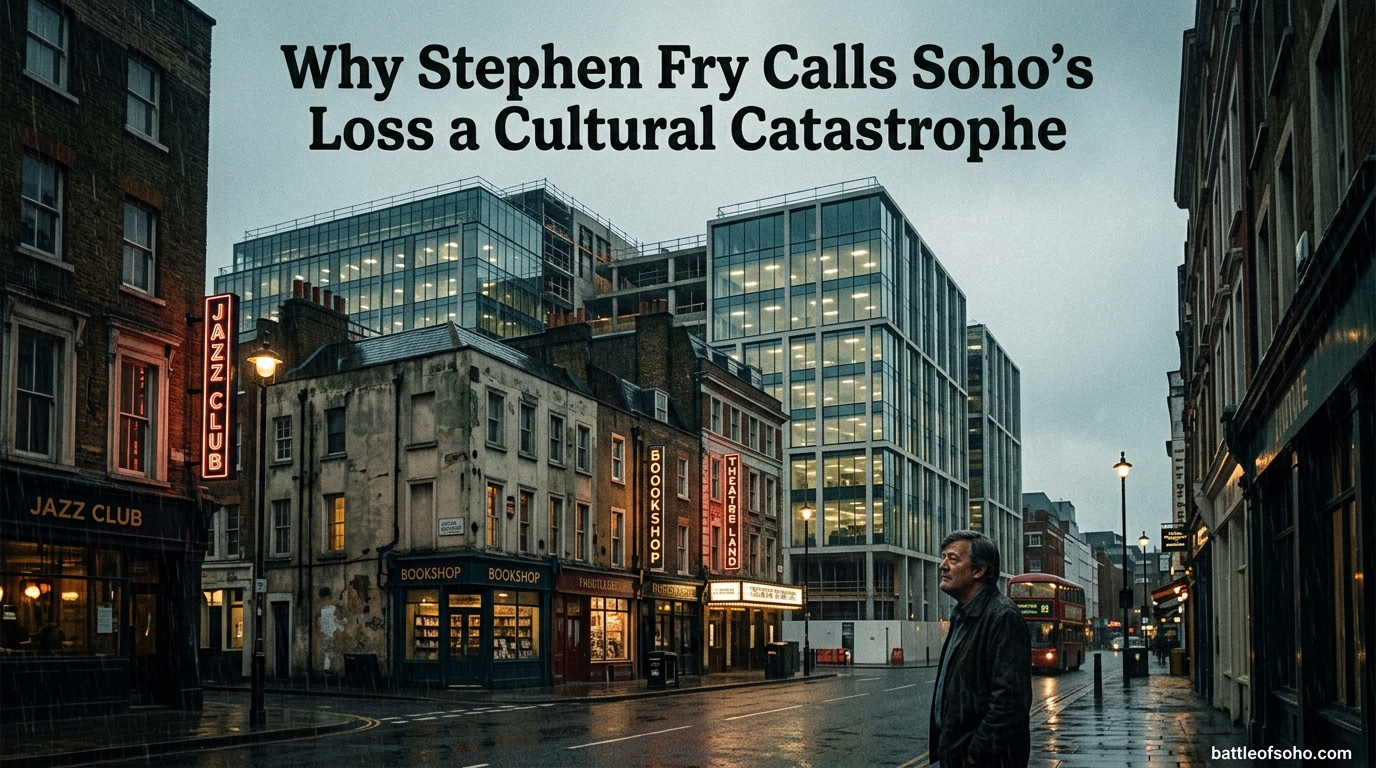
Stephen Fry has warned that Soho is facing a “cultural catastrophe” as decades of LGBTQ+ history, iconic venues, and community safe spaces disappear under the weight of gentrification, rising rents, and large-scale development. His voice has become one of the most prominent in a growing chorus of activists, venue owners, and community members fighting to preserve what remains of London’s most storied nightlife district.
In 2026, Fry narrated the feature documentary This Is Soho, which charts the evolution of London’s most famous queer neighbourhood at a moment of existential crisis. The film arrived with Soho at a crossroads, reeling from years of venue closures and cultural erosion that have fundamentally changed the character of the area.
For Fry, who has been a visible presence in British cultural life for decades, the loss of Soho is not just about buildings and businesses. It is about the erasure of a living archive of queer history, a place where generations found acceptance, community, and the freedom to be themselves.
This article explores exactly why Stephen Fry calls Soho’s loss a cultural catastrophe, which venues have been lost, what forces are driving the decline, and what can still be done to protect what remains.
Table of Contents
What Stephen Fry Actually Said About Soho
Stephen Fry described the transformation of Soho as nothing short of a cultural catastrophe, arguing that the systematic closure of LGBTQ+ venues represents an irreplaceable loss for London’s cultural and social fabric. His comments have appeared across multiple platforms, including the 2017 documentary Battle of Soho and the 2026 film This Is Soho, both of which document the rapid gentrification reshaping the area.
In Battle of Soho, Fry appeared alongside figures like fashion activist Joseph Corre and musician Johnny Deluxe, each bringing their own perspective on what was being lost. Fry’s contribution centred on the idea that Soho was never just a nightlife district. It was a sanctuary, a cultural engine, and a symbol of defiance against a society that historically criminalised and marginalised LGBTQ+ people.
The 2026 documentary This Is Soho gave Fry a broader canvas. The film charts the neighbourhood’s full evolution, from its bohemian and artistic roots through its decades as the beating heart of London’s queer community. Deadline reported that the documentary arrived at a moment when rising rents and the rapid closure of iconic institutions had pushed Soho to the brink of losing its identity entirely.
Fry’s personal connection to Soho runs deep. As an openly gay man who came of age in Britain during a time when homosexuality was stigmatised and criminalised, he understands firsthand what Soho’s venues meant to people who had nowhere else to go. His advocacy is not abstract or academic. It is rooted in lived experience and a genuine fear that future generations will have no equivalent spaces.
What makes Fry’s voice so powerful in this debate is his ability to frame the issue in terms anyone can understand. He is not simply mourning the loss of a few clubs. He is warning that when a city loses the spaces where marginalised communities gathered, built culture, and found safety, it loses something that cannot be rebuilt with planning permission and developer incentives.
Soho’s History as London’s Queer Heartland
To understand why Stephen Fry calls Soho’s loss a cultural catastrophe, you have to understand what Soho has meant to the LGBTQ+ community for well over a century. Old Compton Street has served as the epicentre of London’s queer scene since at least the mid-twentieth century, though the area’s reputation for bohemian culture stretches back even further.
Soho was never a sanitised, corporate entertainment zone. It was messy, vibrant, and unapologetically diverse. The neighbourhood housed queer bars next to jazz clubs, independent theatres next to sex shops, and late-night cafes next to record stores. This patchwork of venues created an ecosystem where different communities overlapped and cross-pollinated.
For LGBTQ+ people, Soho offered something that was genuinely rare: a public space where they could exist without fear. In an era when homosexuality was criminalised in Britain until 1967, and when social stigma persisted for decades after, Soho’s bars and clubs were sanctuaries. People travelled from across the country to experience the freedom of being surrounded by others like them.
The cultural significance of these venues went far beyond nightlife. Soho was where queer art was made, where political organising happened, where relationships were formed, and where a visible community asserted its right to exist. Venues like Madame Jojo’s, the Astoria, and the Black Cap were not just places to drink and dance. They were cultural institutions in every meaningful sense.
This is the history that is being erased. Each venue that closes takes with it decades of memories, relationships, and cultural production. When Fry speaks of a cultural catastrophe, he is talking about the loss of this accumulated heritage, the kind that cannot be recreated in a new development or a pop-up bar.
The Timeline: Iconic Venues Soho Has Lost
The scale of venue loss in Soho and the wider London nightlife scene is staggering. Research has shown that more than 1,400 nightclubs closed across the UK between 2005 and 2015 alone. Soho has been hit particularly hard, losing some of its most iconic and culturally significant venues in a steady drumbeat of closures.
Here is a timeline of the most significant losses:
2009: The Astoria. One of London’s most beloved live music venues, the Astoria was demolished to make way for the Crossrail development, now known as the Elizabeth Line. The venue had hosted everyone from Nirvana to the Rolling Stones and was a cornerstone of the alternative music scene. Its demolition also took down the neighbouring Ghetto, a queer club that had been a fixture of the area.
2014: Madame Jojo’s. The closure of Madame Jojo’s sent shockwaves through Soho’s LGBTQ+ community. The venue, famous for its cabaret, drag shows, and the legendary Wednesday-night event Lipsync, had its licence revoked by Westminster City Council after a violent incident outside the venue. For many, the closure felt disproportionate and marked a turning point in the neighbourhood’s cultural decline.
2014: First Out Cafe. A short walk from Soho on St Giles High Street, First Out was one of London’s longest-running queer cafes and a crucial community space. It closed its doors the same year as Madame Jojo’s, another casualty of rising rents and redevelopment pressure from the Crossrail project.
2023: G-A-Y Late. The closure of G-A-Y Late was a particularly bitter blow. Owner Jeremy Joseph cited repeated attacks on customers and staff, including incidents of abusive and discriminatory behaviour, as a primary reason for shutting down. Joseph shared accounts of customers being assaulted and staff facing harassment, painting a picture of a space that had become untenable despite its popularity.
2025: G-A-Y. The loss of the main G-A-Y venue on Old Compton Street represented perhaps the most visible closure of all. G-A-Y had been a fixture of Soho’s queer landscape for decades, hosting pop performances, drag shows, and serving as a gathering point for the community. Its closure left a massive void on the street that had been the heart of London’s LGBTQ+ scene.
These are just the headline closures. The wider picture includes numerous smaller bars, cafes, and independent venues that have quietly disappeared over the years, each one removing another piece of the cultural mosaic that made Soho what it was.
Why Are Soho Clubs Closing Down? The Forces at Work
There is no single cause behind the decline of Soho’s cultural venues. Instead, multiple forces have converged to create what feels like an existential threat to the neighbourhood’s identity.
Crossrail and Large-Scale Development. The Crossrail project, now operating as the Elizabeth Line, required the demolition of multiple buildings in and around the Soho area. The Astoria, the Ghetto, and First Out cafe were all direct casualties of this infrastructure project. While the new transport link has brought more foot traffic to the area, the venues that gave Soho its character were bulldozed to make way for it. The developments that have replaced them tend to cater to corporate chains and luxury consumers rather than independent cultural operators.
Rising Commercial Rents. Commercial rents in Soho have climbed steadily as property owners chase higher returns. Independent venue operators, who typically operate on thin margins, are increasingly unable to compete with chain restaurants, corporate offices, and high-end retail. When a lease expires, landlords can often command significantly higher rents from tenants who have no connection to the area’s cultural heritage.
License Revocations and Noise Complaints. Westminster City Council’s licensing policies have played a significant role in venue closures. Madame Jojo’s lost its licence after a single violent incident, despite years of responsible operation. Noise complaints from new residential developments have also been used to curtail the operating hours and conditions of remaining venues. This creates a vicious cycle where new developments move in, complain about existing nightlife, and contribute to venue closures.
NIMBYism and Changing Demographics. As wealthier residents move into areas near Soho, complaints about noise, crowds, and late-night activity have increased. These residents often chose to live near one of the world’s most famous nightlife districts and then campaign against the nightlife that made the area desirable in the first place. This pattern of NIMBYism (Not In My Back Yard) has been documented across London and other global cities.
The Shift to Heteronormativity. Several commentators have noted that Soho is undergoing a process of heteronormatisation, where queer spaces are replaced by venues catering to a mainstream, predominantly heterosexual clientele. The unique character of Soho as a queer safe haven is being diluted as chain pubs, cocktail bars, and corporate entertainment venues move in. This shift means that even when a physical venue remains open, its cultural function may have fundamentally changed.
Together, these forces create an environment where it is increasingly difficult for the kind of independent, culturally significant venues that defined Soho to survive. Each closure makes the next one easier, as the critical mass of venues that drew people to the area diminishes.
The Human Cost: What Losing Soho Means for the LGBTQ+ Community
Behind every statistic about venue closures is a human story. The loss of Soho’s queer spaces is not an abstract planning issue. It has real, measurable effects on the people who relied on those spaces for community, safety, and belonging.
The closure of G-A-Y Late illustrated this painfully. When owner Jeremy Joseph explained his decision to shut down, he described a pattern of attacks on customers and staff that had made the venue untenable. Community members reported incidents of abusive language directed at them outside venues. For a neighbourhood that was supposed to be a safe haven, these incidents felt like a betrayal of everything Soho stood for.
Many LGBTQ+ people have responded to these closures and incidents by relocating their social lives to other areas. Dalston in east London and Vauxhall in south London have emerged as alternative hubs for queer nightlife. While these areas offer their own vibrant scenes, the dispersal of the community fragments the sense of concentration and visibility that Old Compton Street once provided.
There is also an intergenerational dimension to this loss. Older LGBTQ+ people who came of age in Soho during the 1970s, 1980s, and 1990s are watching the physical spaces of their memories disappear. Younger queer people, meanwhile, are growing up without access to the kind of dedicated community spaces that previous generations took for granted. Online communities have partially filled the gap, but they cannot replicate the experience of being physically surrounded by your community.
The emotional toll is real. People who have spoken about the loss of Soho venues describe feelings of grief, anger, and displacement. For a community that has spent decades fighting for the right to exist openly, the loss of hard-won spaces feels like a rollback of progress. Stephen Fry’s description of a cultural catastrophe captures this emotional reality as much as the practical one.
Can Soho Be Saved? Campaigns, Solutions, and the Fight Ahead
The situation is dire, but it is not hopeless. A range of campaigns, policy proposals, and community initiatives are fighting to preserve what remains of Soho’s cultural heritage and to rebuild what has been lost.
Heritage Zone Proposals. One of the most discussed solutions is the creation of a cultural heritage zone for Soho. This would give special protections to existing LGBTQ+ venues, making it harder for landlords to close them or convert them to other uses. The idea draws on the understanding that these venues are cultural assets, not just commercial businesses. A heritage zone could include measures like requiring planning permission for change of use, offering rent protections, and prioritising cultural operators in licensing decisions.
Lessons from Berlin’s Berghain Model. Commentators have pointed to Germany as a model for how to protect nightlife culture. Venues like Berghain in Berlin enjoy a special cultural status under German law, which grants them tax advantages and protections similar to those given to theatres and museums. This recognition acknowledges that nightlife venues serve a cultural function that goes beyond entertainment. Applying a similar framework in the UK could provide a legal foundation for protecting Soho’s remaining venues.
The Nightlife Task Force. The establishment of a nightlife task force has been proposed to address the broader decline of London’s night-time economy. Such a body could coordinate between venues, local authorities, transport providers, and residents to create a more supportive environment for nightlife. It could also serve as an advocate for venues facing licensing challenges or development pressure.
Community Activism. Grassroots campaigns have been at the forefront of the fight to save Soho. From petitions and protests to documentary films and social media campaigns, community members have refused to accept the loss of their spaces quietly. The very existence of films like Battle of Soho and This Is Soho is a testament to this activism. Stephen Fry’s involvement has brought mainstream attention to a cause that might otherwise have remained niche.
What You Can Do. For those who want to support the preservation of Soho’s cultural venues, there are practical steps to take. Visit and spend money at independent queer venues rather than chains. Support campaigns for heritage protection and sign petitions advocating for venue protections. Attend community meetings and make your voice heard in local planning consultations. Share the stories of what these venues mean to you and your community.
Frequently Asked Questions
What did Stephen Fry say about Soho?
Stephen Fry described the transformation and decline of Soho as a cultural catastrophe, warning that the closure of iconic LGBTQ+ venues represents an irreplaceable loss for London’s cultural and social fabric. He narrated the 2025 documentary This Is Soho and appeared in the 2017 film Battle of Soho, both of which document the neighbourhood’s rapid gentrification.
Which Soho venues have closed in recent years?
Major venue closures include the Astoria (2009, demolished for Crossrail), Madame Jojo’s (2014, licence revoked), First Out cafe (2014), G-A-Y Late (2023, closed after attacks on customers and staff), and the main G-A-Y venue on Old Compton Street (2025). More than 1,400 nightclubs closed across the UK between 2005 and 2015.
Why is Soho important to the LGBTQ+ community?
Soho, particularly Old Compton Street, has been the epicentre of London’s LGBTQ+ scene for decades. During a time when homosexuality was criminalised in Britain until 1967, Soho’s venues served as sanctuaries where queer people could gather safely. The area was a hub for queer art, political organising, and community building, making it a living archive of LGBTQ+ history.
What is causing gentrification in Soho?
Multiple forces are driving Soho’s transformation, including the Crossrail development, rising commercial rents, licensing restrictions, noise complaints from new residents, and a shift toward heteronormative venues. Corporate chains and luxury developments are replacing the independent, culturally significant venues that defined the area.
What can be done to protect Soho’s cultural venues?
Proposed solutions include creating a cultural heritage zone with special protections for LGBTQ+ venues, adopting a model similar to Germany’s Berghain that grants cultural status to nightlife spaces, establishing a nightlife task force, and supporting grassroots activism. Individuals can help by patronising independent queer venues and supporting preservation campaigns.
Has Stephen Fry been involved in Soho preservation campaigns?
Yes. Stephen Fry has used his platform to draw attention to Soho’s cultural decline through his involvement in the documentaries Battle of Soho (2017) and This Is Soho (2025). His advocacy has brought mainstream visibility to the fight to preserve London’s queer nightlife heritage.
The Future of Soho Depends on What We Do Now
Stephen Fry calls Soho’s loss a cultural catastrophe because that is exactly what it is. The neighbourhood that served as London’s queer heartland for generations is being hollowed out, venue by venue, year by year. The Astoria, Madame Jojo’s, First Out, G-A-Y Late, and G-A-Y are not just names on a list of closures. They were living institutions that held decades of community history, art, activism, and human connection.
The forces driving this decline, from Crossrail development to rising rents to licensing pressures, are not natural or inevitable. They are the result of policy choices, commercial decisions, and planning priorities that treat cultural heritage as expendable. Recognising this is the first step toward changing course.
Fry’s voice matters because it reaches audiences who might never set foot in a queer venue but who understand that a city without spaces for marginalised communities is a diminished city. His involvement in both Battle of Soho and This Is Soho has ensured that this story is told on the largest possible stage.
The fight for Soho is far from over. Heritage zone proposals, the Berghain model, nightlife task forces, and grassroots activism all offer real, practical paths forward. But none of these solutions will work without public pressure, community engagement, and a willingness to value cultural spaces as much as commercial ones.
Soho’s story is a warning, but it is also a call to action. What happens next depends on whether enough people, armed with the kind of conviction Stephen Fry has expressed, are willing to stand up and say that this matters. Because once these spaces are gone, no amount of regeneration can bring back what was lost.