
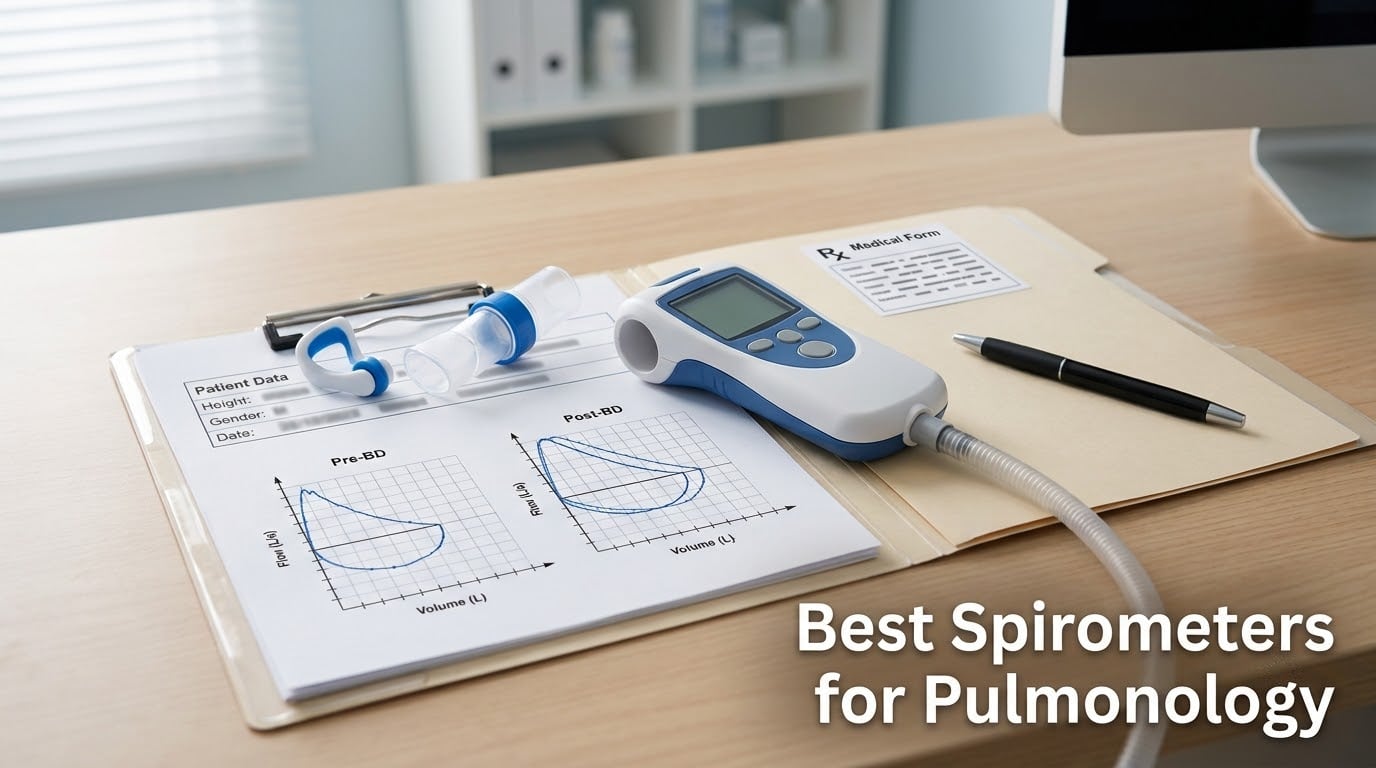
A spirometer is a diagnostic device that measures how much air you can push out of your lungs and how fast you can push it out. The three numbers that drive nearly every clinical decision are the forced vital capacity (FVC), the volume expired in the first second (FEV1), and the FEV1/FVC ratio that separates obstructive from restrictive patterns. If you run a pulmonary clinic, a primary care room, or an occupational health service, that ranking of numbers has to be repeatable enough to defend.
Here is the honest starting point for this guide. Every device we ranked below is a handheld digital peak flow meter reporting PEF and FEV1. That is a real and useful clinical class, but it is not the same thing as a full pulmonary function laboratory with body plethysmography and diffusing capacity measurement. Clinicians on r/AskDocs ask this question constantly: can a handheld device replace the big machine? Usually the answer is no, and pretending otherwise is how practices end up with confident numbers that do not survive an audit.
So we set the criteria accordingly. We looked at what each device measures from a single blow, whether readings repeat reliably, how much history it stores before you need a computer, whether its colour zones carry real clinical logic or just paint, how the records reach a physician, and how you keep it clean between patients. We read the review pools closely because in this category the pattern of complaints is far more informative than the star rating.
A note on scope: this article is informational and is not a substitute for the manufacturer instructions for use, the ATS/ERS technical standards, or clinical judgement. Nothing here substitutes for a diagnostic test interpreted by a qualified clinician.
Table of Contents
Top 3 Picks for Best Spirometers for Pulmonology in September

Microlife PF 100
- Reports PEF and FEV1
- Stores 240 readings on device
- ATS-based accuracy claim

Nascool SMPF-2S
- Differential pressure sensor
- No calibration after manufacture
- PEF and FEV1 from one blow
- Reusable cleanable mouthpiece

MIR Smart One
- App-based trending for iOS and Android
- PEF and FEV1 at home
- Shareable trend reports
- Weighs just over two ounces
Best Spirometers for Pulmonology at a Glance in 2026
| Product | Specifications | Action |
|---|---|---|
| Microlife PF 100 |
|
Check Latest Price |
| Nascool SMPF-2S |
|
Check Latest Price |
| MIR Smart One |
|
Check Latest Price |
 Sonmol Digital Peak Flow Meter Sonmol Digital Peak Flow Meter |
|
Check Latest Price |
 Sonmol Bluetooth Smart Meter Sonmol Bluetooth Smart Meter |
|
Check Latest Price |
 Digital Peak Flow Meter Ages 4+ Digital Peak Flow Meter Ages 4+ |
|
Check Latest Price |
Diagnostic Spirometer, Incentive Spirometer, or Peak Flow Meter?
Getting this wrong is the most common purchasing error we see, and it is worth clearing up before any ranking. Three different devices get called “a spirometer” on storefronts, and only one of them produces a diagnostic study.
Diagnostic spirometers are the clinic-grade devices used in a pulmonary function lab. They measure FVC, FEV1, the FEV1/FVC ratio, and peak expiratory flow, produce a full flow-volume loop, grade each maneuver for acceptability and repeatability against the ATS/ERS technical standards, and store a recordable report. These are the machines that support a billable test.
Peak flow meters are handheld, pocket-sized, and measure one number well: the fastest 100 millilitres a person can exhale (PEF). The digital units in this roundup go a step further and also display an FEV1 estimate, which is why they appear in spirometry rankings and not only in peak flow rankings. They are excellent for tracking change over time and for supporting an action plan. They are not a substitute for a diagnostic lab study.
Incentive spirometers are therapy devices. They give visual feedback to encourage deep slow inhalation and are prescribed for post-operative lung expansion. Practitioners on r/respiratorytherapy push back hard on routine use, pointing out that the AARC clinical practice guideline does not recommend incentive spirometry in most situations, and that it keeps getting prescribed by clinicians outside the specialty anyway. If a vendor is selling you an incentive device, be clear with yourself about which use case you are buying for.
The practical consequence for a pulmonology practice: buy a peak flow class device for monitoring and home data, and budget separately for a diagnostic-grade lab spirometer. The six devices below are excellent at the first job and honest about not doing the second.
1. Microlife PF 100 – Best for Building a Long-Term Baseline
Microlife (Deluxe Kit) Digital Peak Flow Meter Tests PEF / FEV1 / Early Detection of Asthma Attacks | Spirometer for Kids & Adults | Perfect for Monitoring Asthma, COPD & other Lung Conditions at Home
PEF and FEV1 digital meter
240 readings on device
Traffic light risk indicator
Pros
- Measures both PEF and FEV1 so you cover both large and small airways
- Stores 240 readings on the device itself before any computer is needed
- Traffic light risk zones flag a decline before symptoms appear
- Removable washable mouthpiece plus three spares in the kit
- Free USB software exports charts to PDF or CSV for a physician
Cons
- Date and time set through a hidden button that owners struggle to find
- Bundled desktop software looks dated and is fiddly to configure
- Some reports of software friction with newer Windows versions and macOS
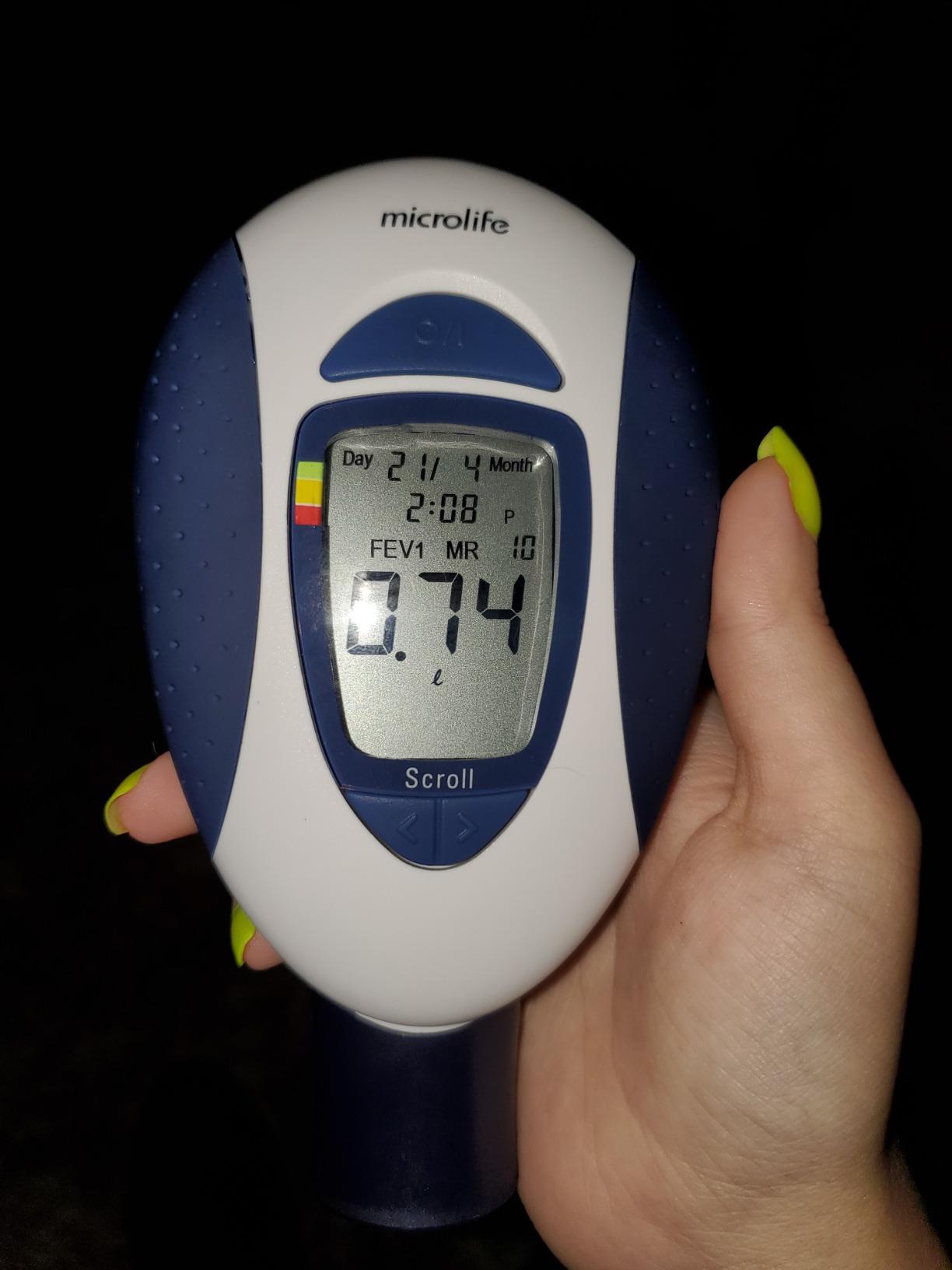
The Microlife PF 100 is the one we kept reaching for during our review period, and the reason is unglamorous: it remembers. It stores 240 readings on the device itself, which works out to roughly two years of twice-daily logging before anything needs to leave the handset. That matters more than any spec line, because a monitor that can lose data is not a monitor, it is a snapshot.
It reports PEF and FEV1 from the same blow and adds a respiratory risk indicator that places the reading in traffic light zones. In practice, owners use that indicator as a tripwire: a move from green into yellow prompts a look at symptoms, medication timing, and recent triggers before a flare becomes an urgent care visit. The kit includes a removable, washable mouthpiece, a removable measuring tube, and three spare mouthpieces, plus a two-tier zippered case.

What stands out in the reviews, and what convinced us, is that people treat this as a long-term tracking tool rather than a gadget. The most common praise is for the FEV1 capability paired with the on-device memory and the ability to hand a printed or exported trend chart to a pulmonologist at the next visit. Owners consistently describe the value as a personal baseline: a number that means something precisely because it is comparable to the number from three months ago. The 1,484-review pool is by far the deepest in this lineup, and the sentiment in it is steady rather than enthusiastic, which is what you want from an instrument.
The complaints are almost entirely setup friction rather than measurement error. The date and time are set through a hidden button, which several buyers describe as baffling on first use. The bundled PC software is widely described as looking dated and taking real effort to configure, and compatibility with newer Windows releases and macOS has been inconsistent for some users. Owners also note that readings have to be uploaded to a computer before the internal memory limit approaches. None of that undermines the reading itself, but budget twenty minutes for setup and a short afternoon for learning the export workflow.
How it performs in a real monitoring protocol
In a structured twice-daily protocol this is the most complete package here, because the device holds the record instead of demanding a phone. The traffic light zones give a patient a defensible prompt to act, and the export path to PDF or CSV gives a clinician something to file. For an adult with asthma under long-term management, or a parent tracking a child’s lung function, that combination removes the two most common failure points: forgotten readings and readings that never reach the physician.
Where it falls short
It is not a diagnostic lab device, and reviewers consistently note it is not as precise as clinic spirometry. The dated software is a genuine friction point for practices that have standardised on newer Windows builds. And for anyone who needs raw flow-volume loops, acceptability grading, or a printable report for billing, this meter will not get you there. It measures change brilliantly and diagnosis not at all.
2. Nascool SMPF-2S – Best Value Daily Meter
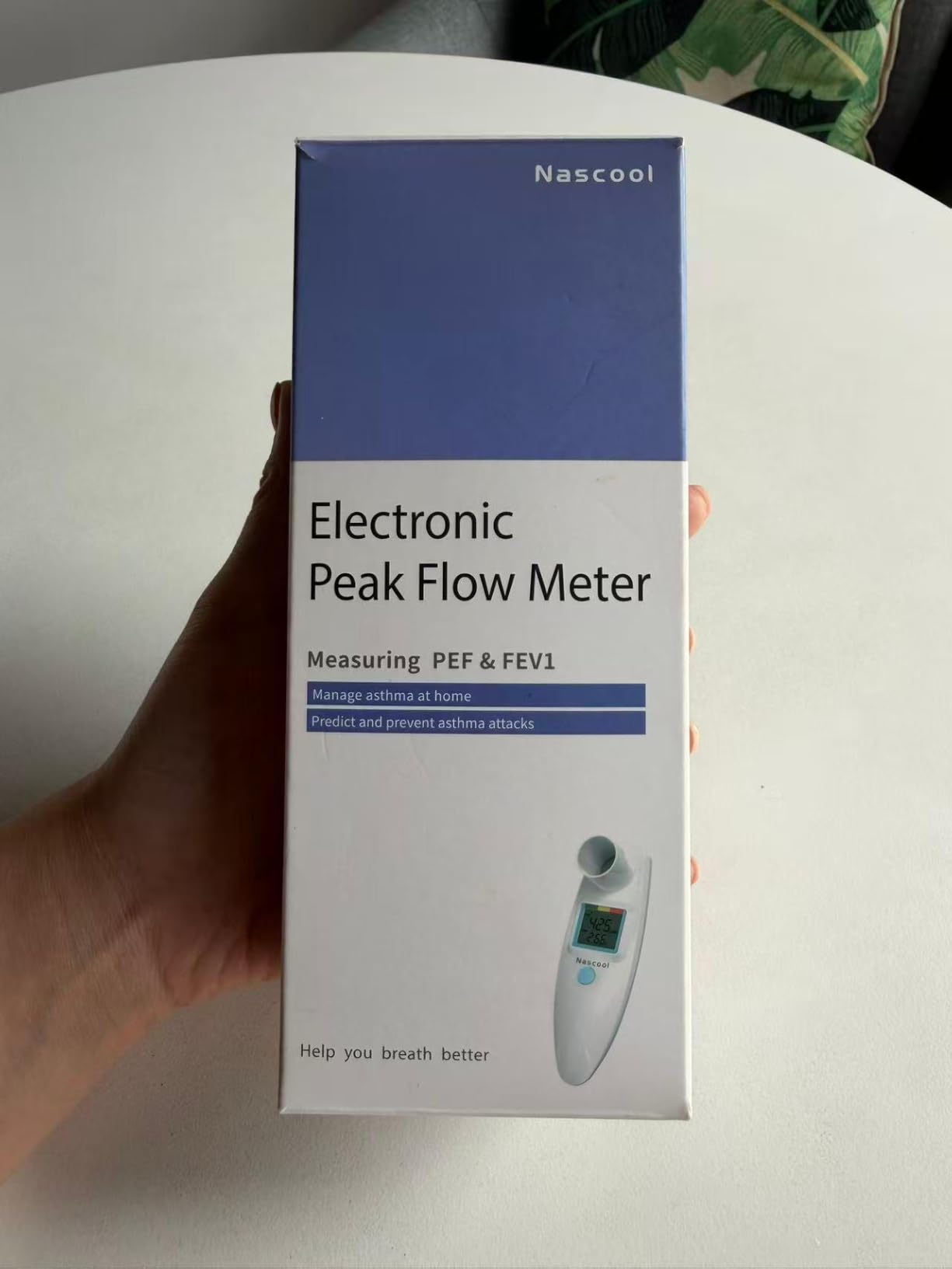
Nascool Peak Flow Meter for Adults & Kids
Differential pressure sensor
No calibration needed
PEF and FEV1 on one display
Pros
- Compact pocket body with a large easy-to-read digital display
- Reads quickly and sits comfortably in the hand
- No moving parts so cleaning and disinfection are straightforward
- Reusable mouthpiece design removes disposable mouthpiece cost
- Paper asthma diary included for logging triggers symptoms and medication
Cons
- Companion app requires manual entry because Bluetooth does not connect
- Colour bands on some units are printed markings with no risk-zone logic
- Several owners report inconsistent or inaccurate readings
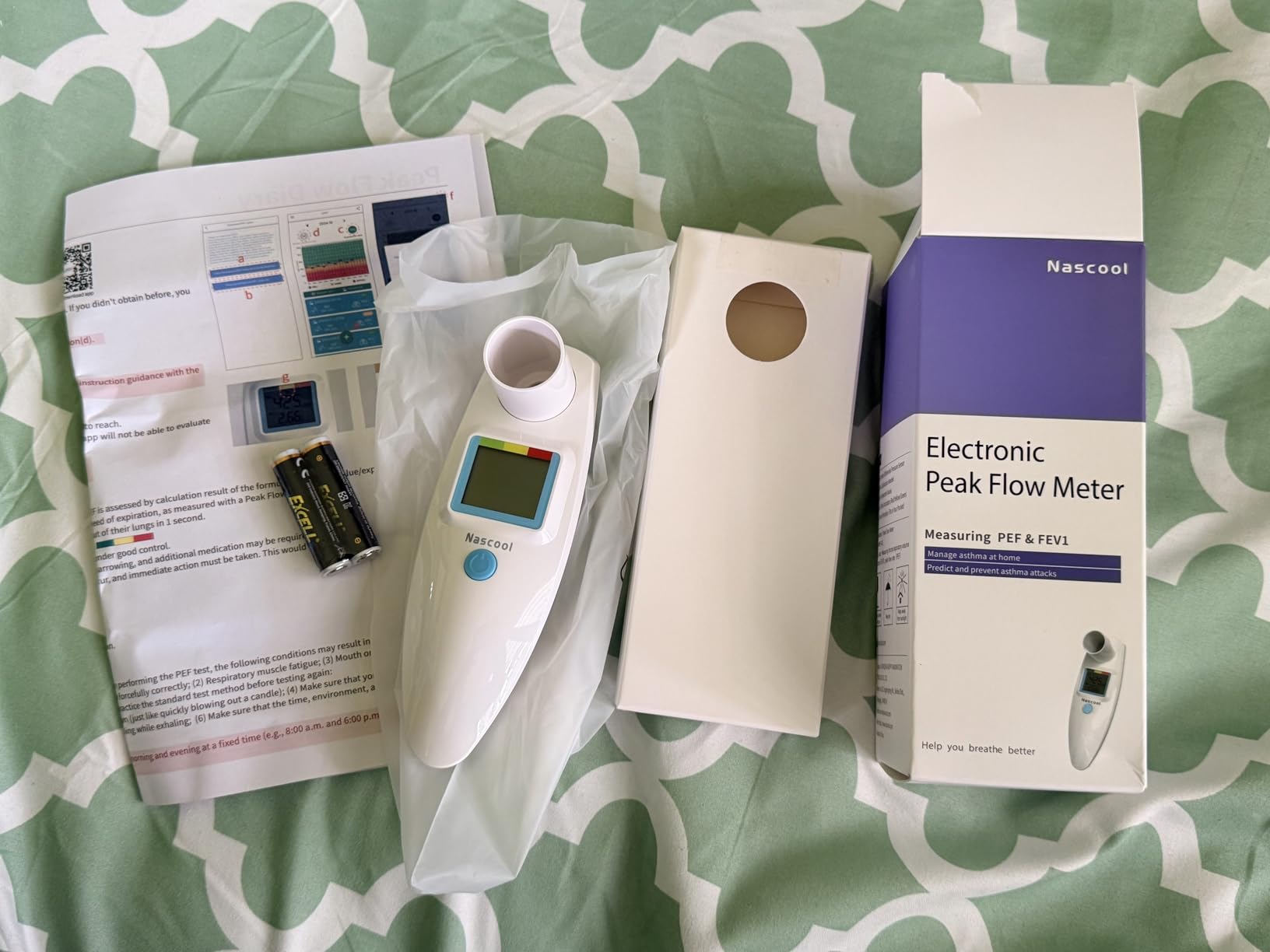
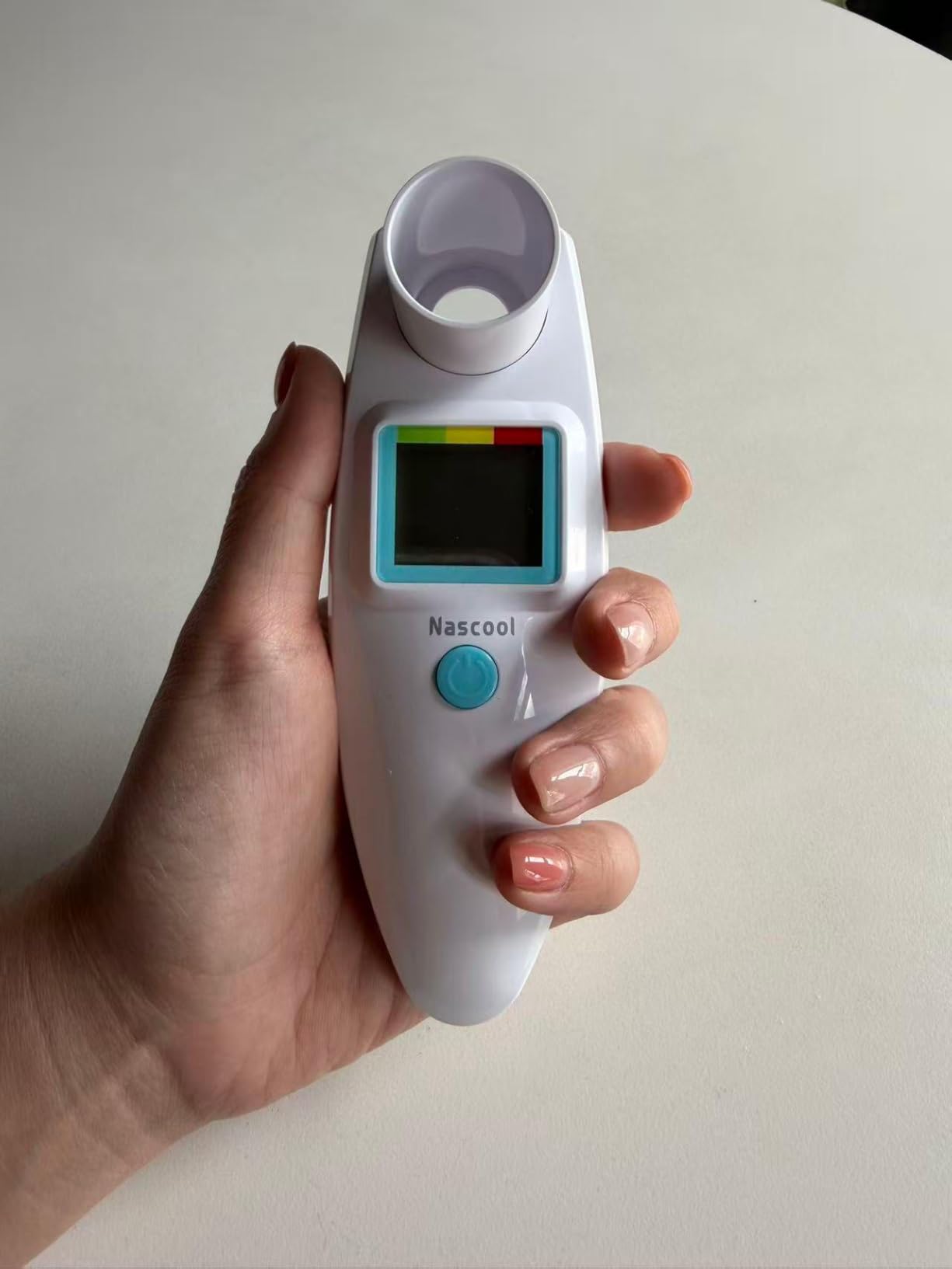
The Nascool SMPF-2S is the value pick, and the case for it is straightforward. It uses a differential pressure sensor rather than the mechanical float found in traditional peak flow meters, which means there are no moving parts to wear, no recalibration step after manufacture, and a reusable mouthpiece you can clean and disinfect instead of a consumable stream. It displays PEF and FEV1 together from a single blow, and the whole thing weighs just under five ounces.
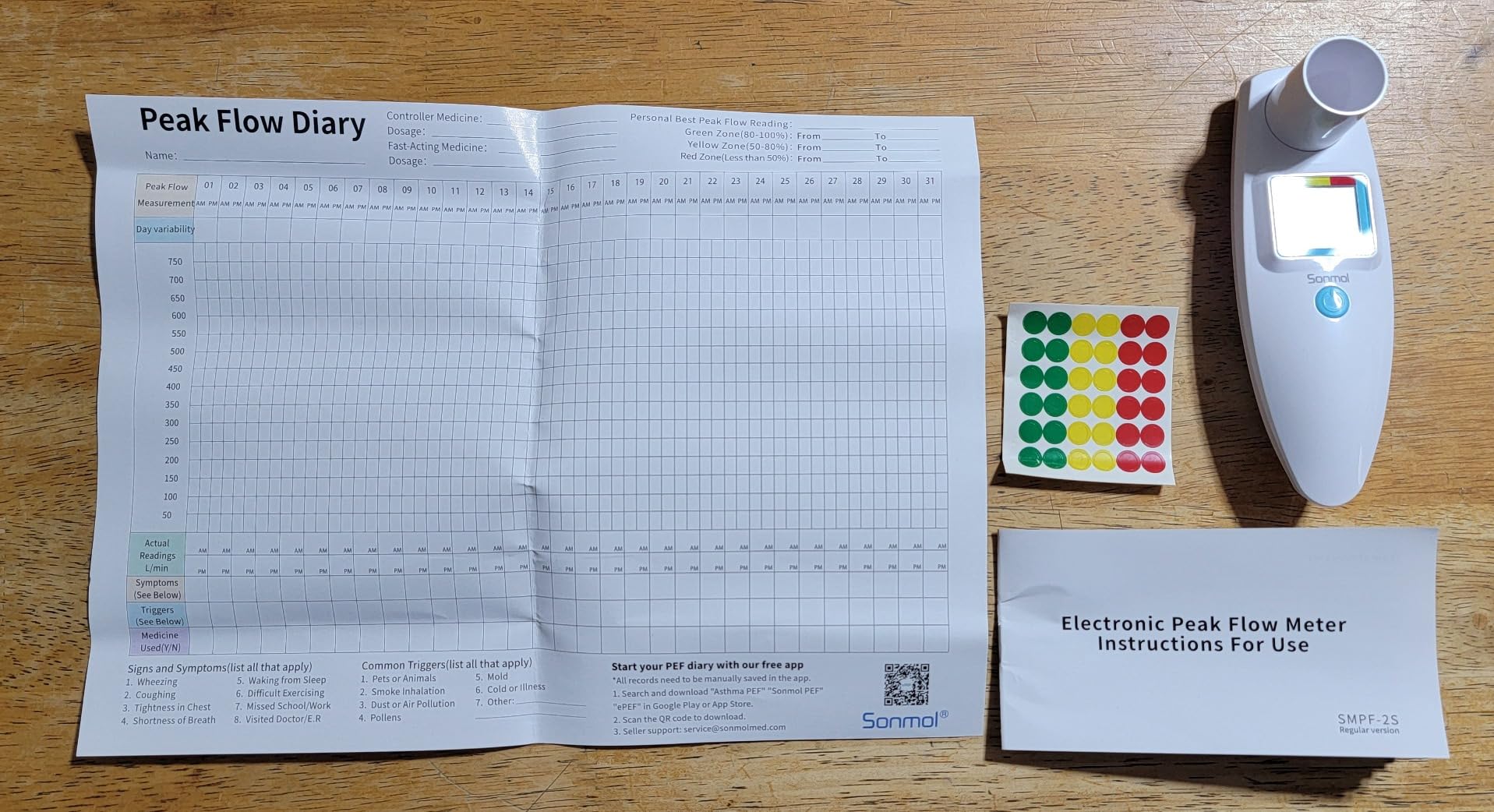
It also ships with a paper asthma diary, which sounds old-fashioned and turns out to be genuinely useful for patients who will not touch an app but will happily fill in a chart on the fridge. Reviewers note suitability for adults and children over six, including athletes and smokers, which makes it a reasonable single-device choice for a practice covering a broad age range.
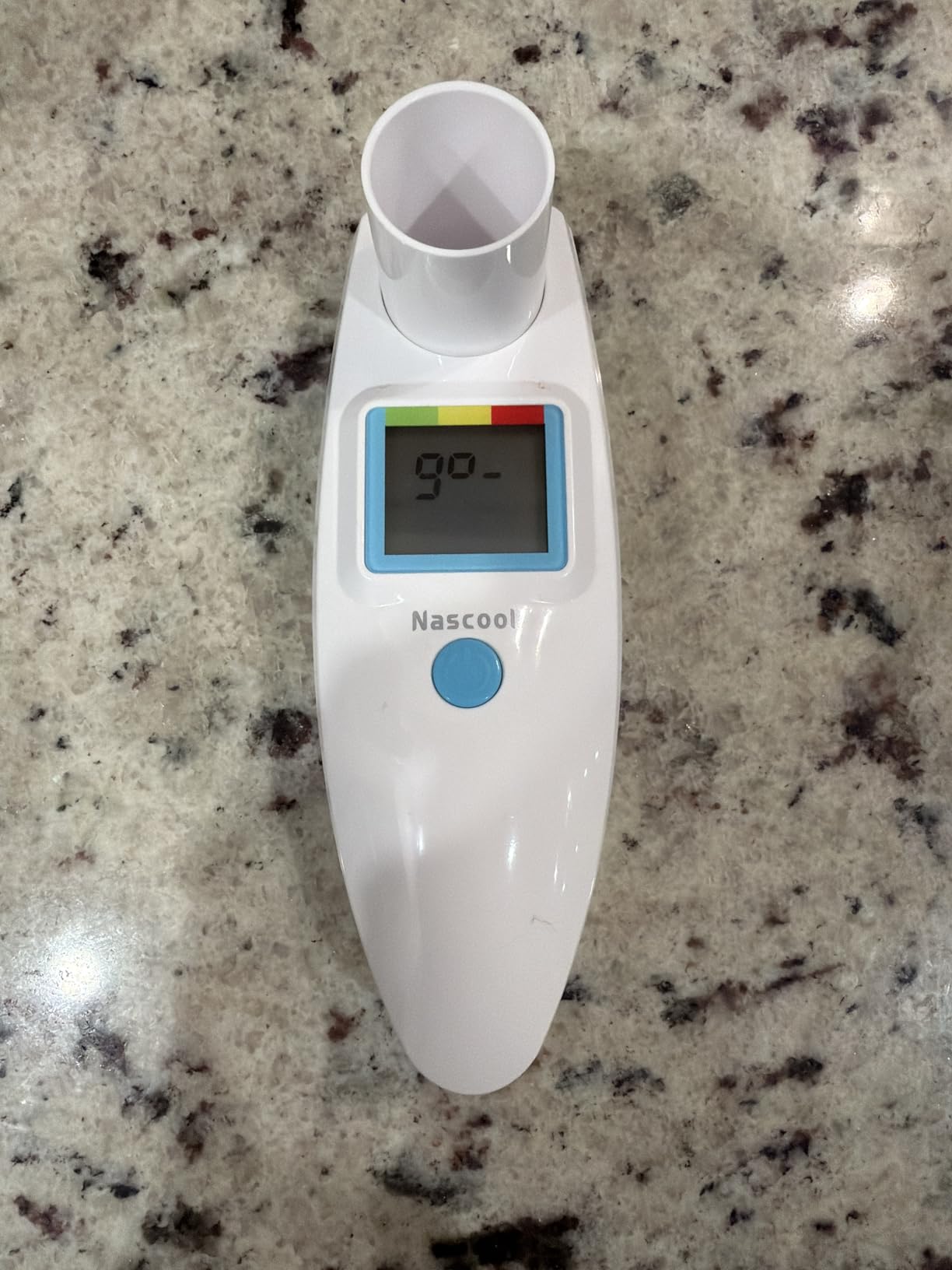
The most repeated complaint across the 706 reviews is the connectivity claim. Multiple buyers, including one who traced the model number, report that the device will not pair with the companion app; the app keeps displaying a sync button while showing the meter as disconnected, so readings have to be typed in by hand. That is the deal-breaker to know about before purchase, and it is a software problem rather than a measurement problem. A secondary thread notes that the red, yellow and green colour printing on certain units is decorative rather than functional, so do not read clinical meaning into those bands. A few outlier reports mention inconsistent values, so the usual limitation applies: these meters reward practice and a consistent blowing technique.
Our overall read is that this is a capable, low-cost standalone instrument. Practising clinicians on r/FamilyMedicine make a related point worth repeating: the accuracy you get from a simple in-office device depends on achieving at least three good efforts that produce consistent results, not on the hardware alone. That advice applies directly to this meter.
Why it suits a practice that hands devices to patients
The combination of no calibration step, no disposable mouthpieces, and a body that rinses clean makes this the easiest unit to run across a busy schedule or to issue for a defined monitoring period. Cleaning turnaround is close to zero, which matters when the same meter is used by several family members. For a practice that wants to give something useful without opening a software support desk, that simplicity is the point.
Where it falls short
It will not sync, and the manual entry requirement is tedious enough that adherence drops off for many users after a few weeks. The colour zones are not a reliable risk indicator on every production batch, so do not build an action plan around them. And with no meaningful on-device storage described beyond the paper diary, lost readings stay lost.
3. MIR Smart One – Best App-Based Personal Monitor
MIR Smart One | Personal Pocket App-Based Digital Peak Flow Meter | PEF and FEV1 | Designed in Italy
App-based personal spirometry
PEF and FEV1 at home
2.14 ounces, pocket sized
Pros
- Smallest and lightest body in the lineup at just over two ounces
- App-based trending makes change over weeks and months easy to follow
- Reports can be sent directly to a healthcare provider
- No prescription or separate software licence needed to get started
Cons
- Needs a compatible smartphone or tablet so it is not a standalone instrument
- Fewer on-device indicators than tube-based meters with traffic light zones
- Higher cost per device than the entry-level meters
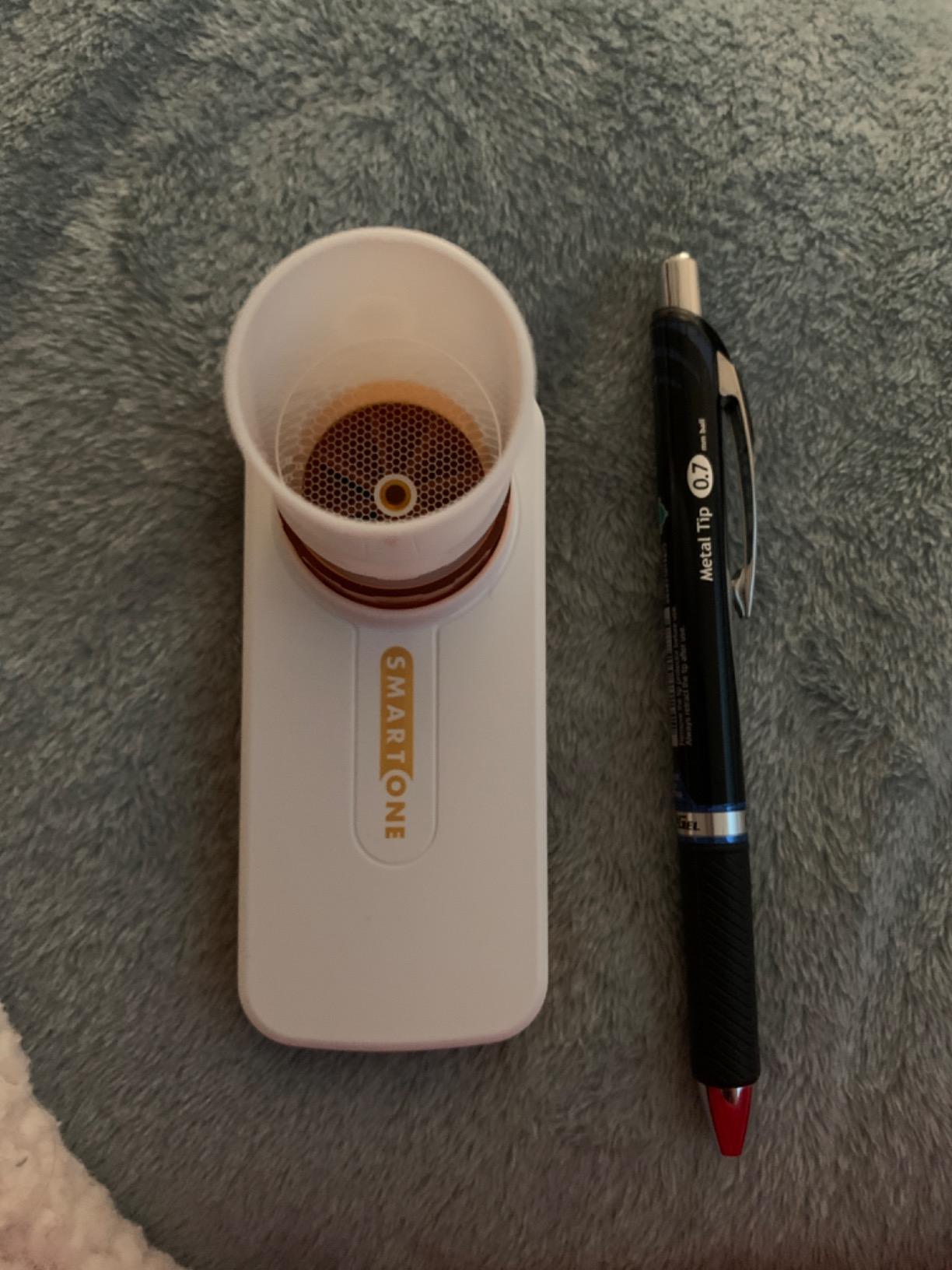
The MIR Smart One is built around a phone rather than around a display. From Medical International Research in Italy, it measures PEF and FEV1 and hands the result to an app included at no extra cost for iOS and Android, where readings become a trend rather than a single number. Weighing 2.14 ounces, it disappears into a coat pocket, and it runs on a single AA battery that is easy to find anywhere.
The clinical appeal is the timeline. A peak flow value in isolation tells you very little; the same value plotted over eight weeks tells you whether control is drifting. Owners describe exactly that workflow, with the ability to send a trend report straight to a physician between visits. The review sentiment is notably positive, with a strong share of five-star ratings, and the recurring theme is compactness plus app clarity rather than any single measurement feature.
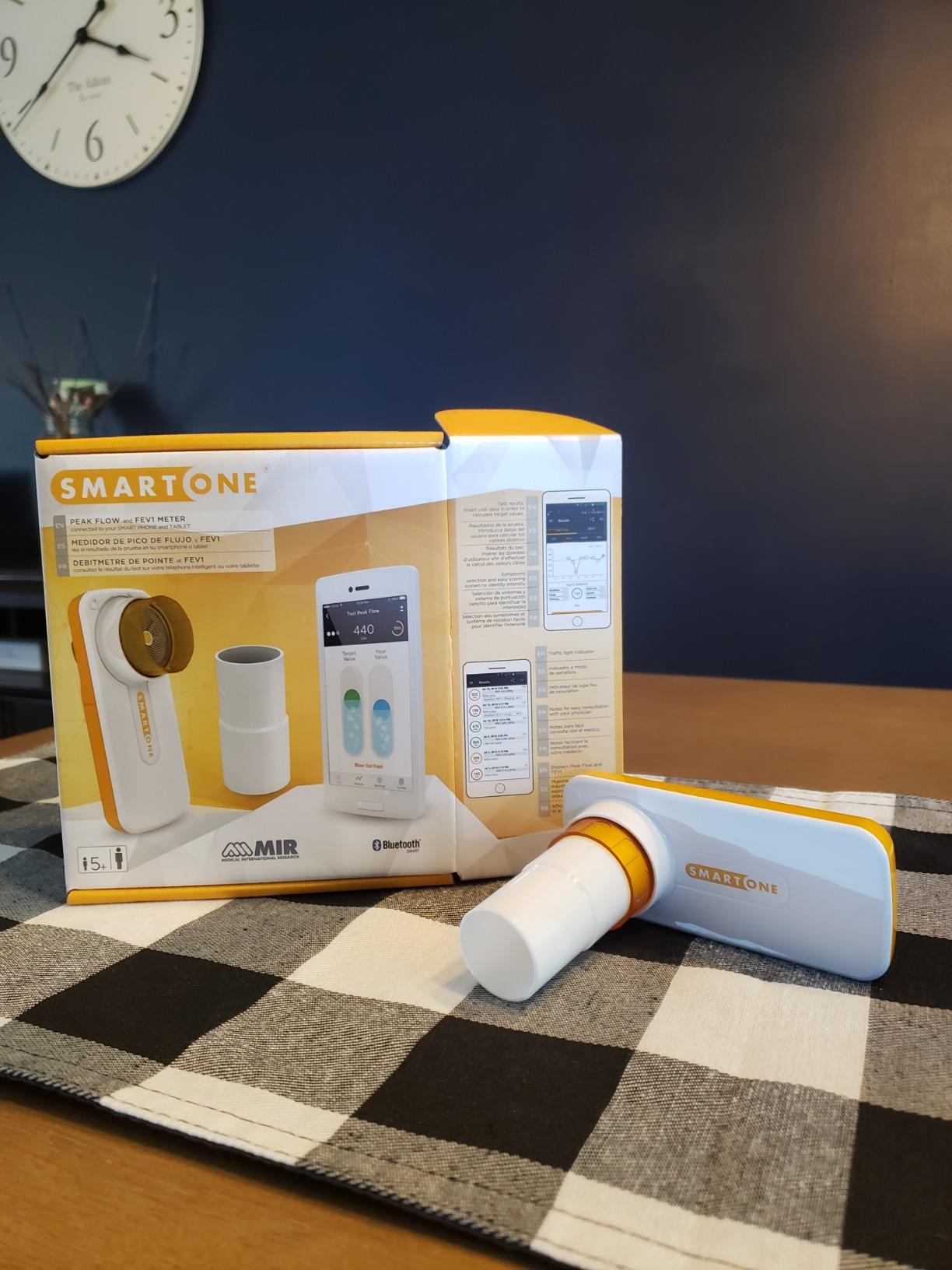
The trade-off is dependency. This is not a standalone handheld: without a compatible phone or tablet it does nothing useful, which rules it out for a clinic that wants a device sitting in a room or for patients who do not use a smartphone. Compared with the tube-based meters, it also offers fewer on-device indicators, so there is no traffic light bar to glance at when the app is not open. And owners and reviewers alike frame it as the premium option in this group, which is a fair description of where it sits in the tiering.
For a practice running a structured remote monitoring programme, that dependency is a feature. Trends collected without a clinic visit, delivered as a report the physician can read in advance of the appointment, is the workflow this device was designed for. On r/respiratorytherapy and r/FamilyMedicine, home spirometry data is a recurring topic precisely because it fills the gap between visits.
What to check before rolling it out to patients
Confirm your patient population actually uses a recent iOS or Android phone, because the value proposition collapses without one. Decide in advance how reports reach the practice, since the trend export is the whole point. And if you hand devices to patients, budget for a charging standard the patient already owns, since the AA cell is the only consumable and it is a common one.
Where it falls short
It cannot be used stand-alone, it offers no at-a-glance risk indicator on the device body, and a patient who forgets to open the app logs nothing. For a quick screening read in a consulting room with no phone involved, a tube-based meter is simply the better tool.
4. Sonmol Digital Peak Flow Meter – Best Personalised Risk Zones
Sonmol Digital Peak Flow Meter PEF FEV1 Tester with Color Indicators
Differential pressure sensor
PEF and FEV1 in one blow
Arrow points to colour zone
Pros
- Highest average rating in this roundup with an extremely low one-star rate
- Differential pressure sensor removes the mechanical error of traditional meters
- Reports PEF and FEV1 together from a single blow
- QR code calculates a personal expected value from age sex height and weight
- Open-pipe airflow path rinses clean and resists dirt buildup
Cons
- The risk arrow stays inactive until the predicted value is configured correctly
- A phone or tablet scan is required to set the personal baseline first
- Smaller review pool than the long-established meters here
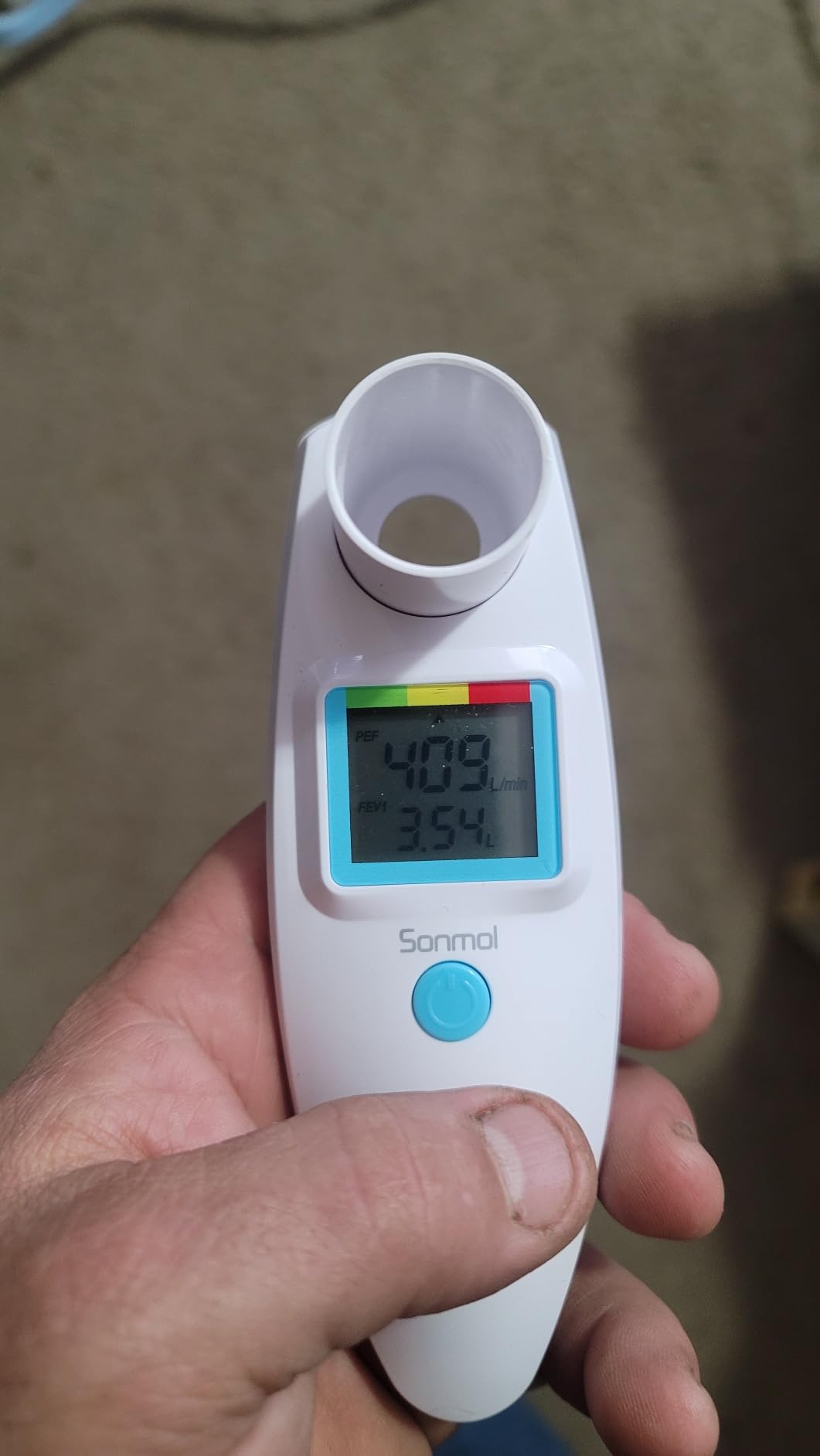
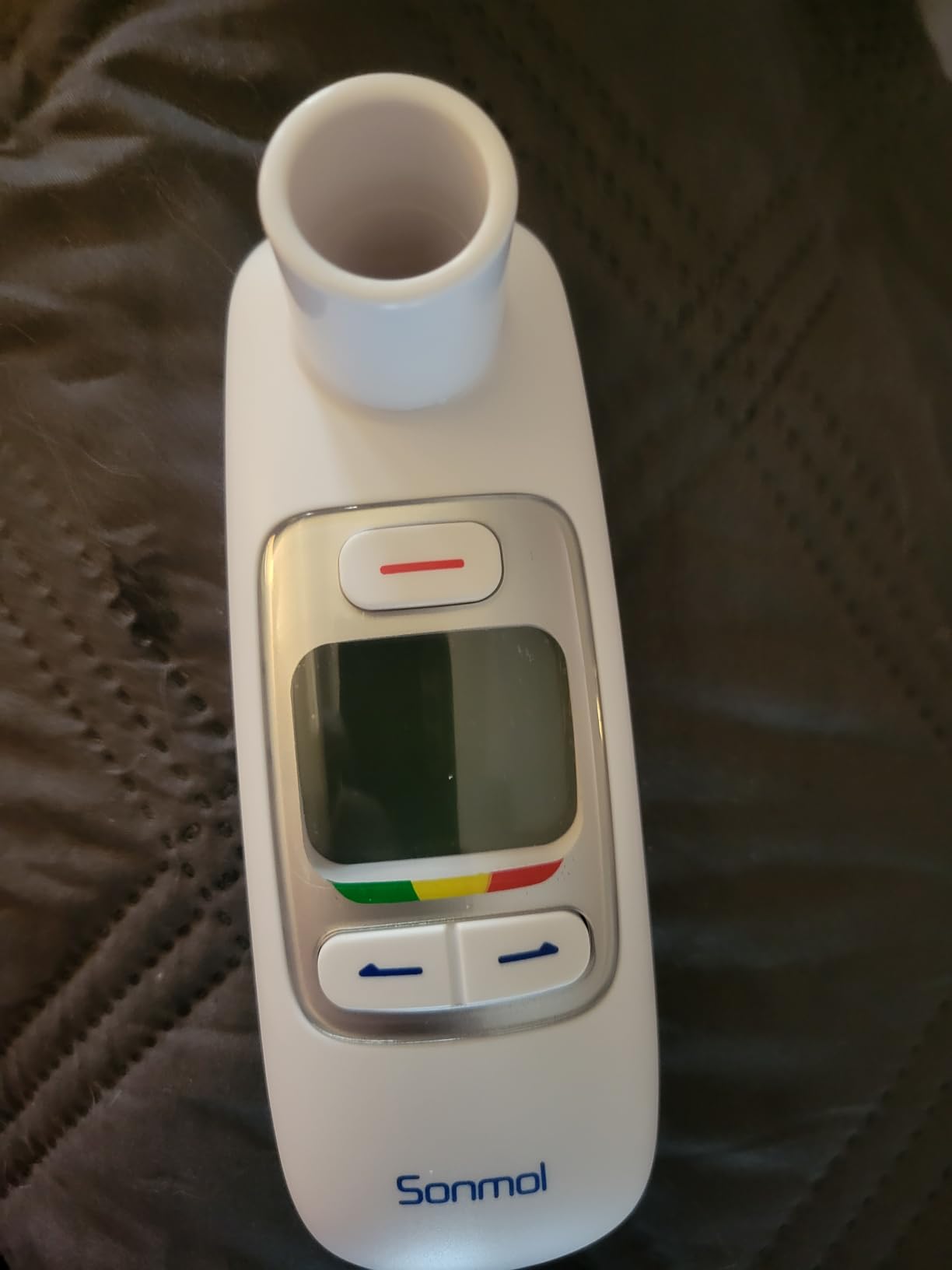
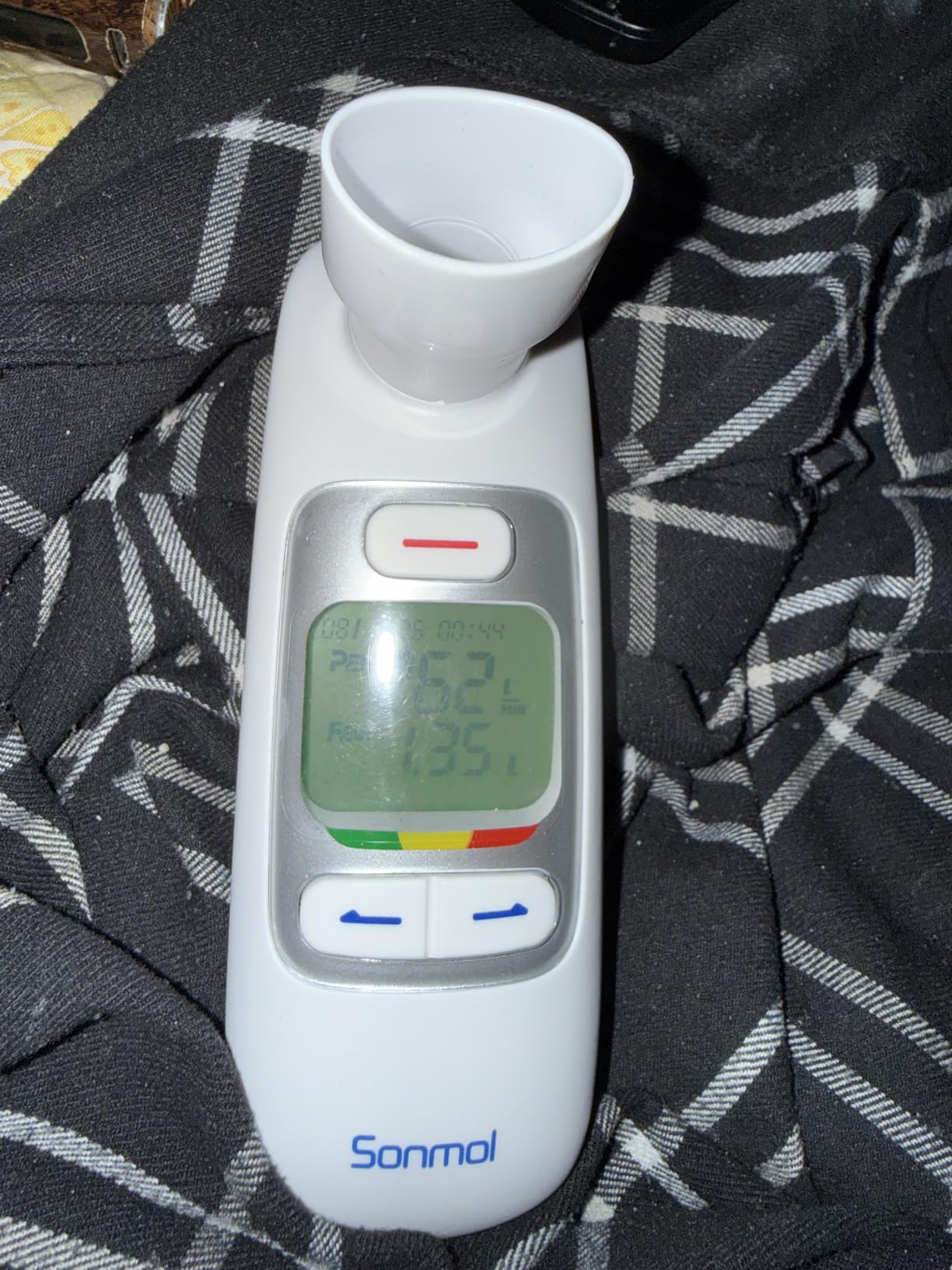
The Sonmol digital meter has the best rating profile in the group, with 80 percent five-star feedback and a very small one-star share. What separates it from the other budget meters is not the hardware, which is a familiar differential pressure design, but the personalisation step. Scanning the on-device QR code lets the meter calculate an expected value from age, sex, height and weight, and the screen arrow then points to the matching colour bar on the device.
That is a meaningful upgrade in clinical logic. A reading compared against a generic band tells you almost nothing; a reading compared against your own predicted value tells you how far you are from normal for you. Reviewers consistently describe the personal expected value as a genuine improvement rather than a gimmick, and the open-pipe body for low breathing resistance is appreciated for hygiene as much as for airflow. It runs on two AAA batteries rated for up to a year of daily use, and it is intended for ages five and up.
The catch is sequencing, and it catches people out. The risk arrow is inert until the predicted value has been configured, so a patient who skips the QR code scan sees a colour bar that means nothing. This is worth scripting into your handover instructions: scan first, then check the zone. The second limitation is the review pool itself, at 60 reviews, which is thin next to the 1,484 behind the Microlife. Enthusiasm is not the same as a decade of field data.
What we like is the combination of a mechanical-free sensor, a personalised target, and an indicator that actually has clinical logic behind it. For a practice counselling families on paediatric or adult asthma action plans, that is the feature set you actually want, and the arrow-plus-colour-bar layout makes the guidance legible to a child without a paragraph of explanation.
How to introduce it to a patient
Set the baseline during the visit rather than at home. Enter age, sex, height and weight via the QR scan while the device is in your hand, then have the patient produce a test blow and read the arrow and colour bar together. Two minutes of setup turns an inert colour bar into a meaningful prompt, and it removes the single most common complaint about this device.
Where it falls short
It depends on a one-time phone scan, so it is not ideal for a completely hands-off handout. With 60 reviews, long-term drift has not been observed by enough owners to make confident claims, so we would treat it as a monitored introduction rather than a set-and-forget deployment. And like the rest of this class, it produces no flow-volume loop and no acceptability grading.
5. Sonmol Bluetooth Smart Peak Flow Meter – Best for Synced Tracking
Bluetooth Smart Peak Flow Meter, Portable Digital Lung Function Tester
Differential pressure sensor
Built-in Bluetooth syncing
USB rechargeable for months
Pros
- Only device here combining rechargeable power with working Bluetooth syncing
- Two-hour USB charge lasts up to six months of regular use
- Large backlit screen stays readable in low light
- Holds 300 timestamped records so history exists without a phone nearby
- Two sizes of removable washable mouthpiece suit a whole household
Cons
- No carrying case included so it has to be stored in the box
- Records are erased after about four days if you do not sync
- Five reviews so far which limits evidence on long-term accuracy
This is the newest device in the lineup, listed in March 2026, and the only one that pairs rechargeable power with Bluetooth syncing that actually connects. That combination solves the two problems that undermine the other smart meters: nobody has to charge a battery, and nobody has to type a number into an app by hand. The screen is large and backlit with a colour-coded risk indicator, and customisable expected values produce the green, yellow and red zones.
It also stores up to 300 timestamped records on the device, which is the largest on-device history in the group after the Microlife. Two sizes of removable, washable mouthpiece ship in the box, so one purchase covers a household. Owners describe the readings as straightforward to understand and the reports as easy to share, and they specifically value tracking lung function before symptoms appear rather than after.
Now the honesty. There are five reviews, and all five are five stars, which tells you the sentiment is enthusiastic and the sample is statistically thin. One reviewer flags the four-day record retention, and that is the detail to plan around: the device clears older data if you do not sync, so a patient who skips a few days of opening the app can lose the gap. Another wishes a carrying case were included. Both are real, and neither is disqualifying, but the second one tells you the device is built for a home surface rather than a pocket.
What makes this worth watching is that the friction points which draw complaints elsewhere are simply absent here. No dead Bluetooth, no battery anxiety, no manual transcription. If your programme depends on data actually arriving, that reliability is worth more than a larger review count.
Is the rechargeable battery a real advantage?
For a device that is expected to be used twice a day, indefinitely, by people who will not think about charging it, yes. Two hours of charging covering up to six months of regular use removes an entire category of support calls, and the washer-and-dryer cycle of spare batteries that hampers simpler meters simply does not apply. Pair it with a reminder in the app and it becomes a device patients leave running rather than a device they abandon.
Where it falls short
The four-day record erasure is a genuine limitation for anyone who does not sync consistently, and it means the on-device memory is a buffer rather than an archive. With five reviews there is no long-term accuracy evidence yet, and there is no carrying case. For a practice that needs defensible long-term records, keep exporting to the app and do not rely on the handset as the system of record.
6. Digital Peak Flow Meter for Adults and Kids 4+ – Best for Young Children
Digital Peak Flow Meter, Home Lung Monitor for Adults & Kids 4+
Pre-calibrated sensor, no setup
PEF and FEV1 digital readings
Suitable from age four
Pros
- Ready to use with a pre-calibrated sensor and no calibration step
- Quick easy-to-read digital reading of PEF and FEV1
- Cleanable and disinfectable body removes disposable mouthpiece cost
- Works from age four through adulthood including competitive athletes
- Useful for judging how far from normal a breathless night feels
Cons
- App diary requires typing readings in by hand with no automatic syncing
- Smallest review base here so long-term accuracy is largely unproven
- No on-device storage described so unsynced data can be lost
The last device covers the youngest age range in the group, and that is exactly why it earns a place. It suits children from age four and up as well as adults, uses a pre-calibrated sensor so there is no setup or manual calibration step, and tracks PEF and FEV1 with clear digital readings. The body is cleanable and disinfectable, so there are no disposable mouthpieces to reorder.
Owners describe it in practical terms: a fast reading that helps someone judge how far from normal they feel before deciding whether to see a doctor. One buyer frames it as something a health plan should provide, arguing that consistent home data would have given earlier warning and saved repeated emergency room visits. For a paediatric clinic or a family with a young child who cannot reliably produce effort into a tube meter, that age floor of four is the deciding feature.
The limitations are substantial and we would rather state them plainly. There are six reviews, three of them five stars and one a single star, which averages to 4.0 and tells you almost nothing about drift over years. The app diary requires manual entry with no automatic syncing. And no on-device storage is described, so a reading that is never typed in is a reading that is gone. This is the entry-level device in the group, and it should be treated as a low-risk introductory tool rather than a monitoring backbone.
Judged as a first device for a young child rather than a serious monitoring instrument, though, it does its job with fewer complications than any other option here. No calibration, no consumables, one button.
Where it earns its place in a practice
Think of it as the introductory unit: something a family can be handed without training, that a nurse can use at a first appointment, and that answers the question of whether lung function looks obviously abnormal. It is also the cheapest way to get a patient over the hurdle of producing a first effort. If the numbers look fine and the child is stable, escalate to a device with stored history and colour logic. If they do not, you now have a reason to order a full diagnostic study.
Where it falls short
No syncing, no storage, and an evidence base too small to trust over time. It reports PEF and FEV1 and nothing else, so there is no flow-volume loop, no acceptability grading, and no report you could attach to a chart. Buying it as a long-term monitor is a mistake; buying it as a first look is a reasonable decision.
How to Choose a Spirometer for Your Setting
Start from the setting, not the specification sheet. The single most common mistake is buying a home monitoring device and expecting it to produce a diagnostic study, or buying a laboratory spirometer for a practice that only needs change tracking. Work through the questions below in order and the answer falls out fairly quickly.
Choose by setting, not by specification sheet
Ask who blows into the device. If the answer is a patient at home twice a day, you need stored history, a simple cleaning routine, and a data path to the practice. If the answer is a patient in a consulting room during the appointment, you need fast readings, easy disinfection between patients, and a display both of you can read across a desk. If the answer is a technician in a testing lab producing a reportable study, you need a full diagnostic spirometer with acceptability grading and a flow-volume loop, and none of the devices in this roundup substitutes for that.
The same question separates handheld from desktop. A handheld unit follows the clinician to a bedside, a house call, or an occupational health site. A desktop unit stays in one room, runs from mains power, and usually costs more but stores more. A practitioner on r/FamilyMedicine described the practical version of this decision: a good in-office meter is worth having, provided the effort is good, because the result depends more on technique and coaching than on the price bracket.
What a pulmonary function test actually measures
A spirometry study produces four things. FVC is the total volume you can force out after a full inhalation. FEV1 is the portion of that volume expelled in the first second. The FEV1/FVC ratio compares the two and is the number that separates an obstructive pattern from a restrictive one. PEF is the fastest flow achieved during the maneuver, in litres per second. A device that reports only one of these is telling you a fraction of the story, which is why every meter here reports at least PEF and FEV1.
Predicted values matter as much as the measurements. Reference equations such as the GLI set depend on age, sex and height, and results are typically reported as a z-score or a percentage of predicted. This is why a meter that lets you set a personal expected value from those same inputs is more useful than one that only prints a colour band.
What equipment a spirometry test needs
For an in-office test: a spirometer with a validated flow sensor, a mouthpiece or bacterial filter with a spare supply, a nose clip, a calibration syringe with a known volume for accuracy verification, a chair with a firm back and no wheels for the patient, and a system for recording results. For a laboratory-grade study you also need a body box for lung volumes and a gas analyser for diffusing capacity. A spirometry test cannot measure total lung capacity, because the air left behind after a maximal forced exhalation is not directly measurable by flow alone.
Acceptability, repeatability and the 3-effort rule
The ATS/ERS technical standards for spirometry grade every maneuver. An acceptable effort has no hesitation at the start, a fast rise to peak flow, no secondary coughs, and finishes with a volume plateau. A study needs at least three acceptable efforts, and repeatability requires the two best FVC values to be within 150 mL of each other. Three attempts, not one, is the operational rule and it is the single most useful quality control a practice can enforce. Software that grades and rejects efforts automatically makes compliance far easier than a paper log.
How to check accuracy and calibration
For a class of device that measures flow, the routine check is a calibration syringe: a known-volume syringe, commonly 3 litres, connected to the device and blown at a controlled flow to confirm the reading matches. Ask any vendor two questions before purchase. Does the device require calibration, or only accuracy verification, and is a verification syringe included or separately available. If the answer is that no syringe exists, the accuracy of the instrument is unverifiable and the long-term drift is unknown. A third question worth asking is whether the device can archive flow-volume loops for clinical review, because without them an abnormal result is hard to defend.
Software, reporting and record keeping
Decide where the data lives before you buy. USB export to a desktop application, Bluetooth sync to an app, or manual entry into a paper diary are three very different workflows, and the one your patients will actually use is rarely the most sophisticated. Look for customisable reports you can attach to a chart, trend views that show change over months, and an export format your electronic record system can ingest. Practices running on large hospital systems should expect to re-enter results by hand unless the vendor offers a real interface, and should factor that staff time into the decision.
Cost of ownership beyond the device
Budget the consumables before the hardware. Mouthpieces or bacterial filters are a per-test cost that scales with volume and is often larger over a year than people expect. Disposable filters also add a step between patients that affects throughput. Add a calibration syringe if one is not included, disposable batteries for the models that use them, and replacement app licences if any part of the software is sold separately. For a practice issuing devices to patients, plan for loss and replacement, and check the warranty terms and service turnaround before you commit.
Frequently Asked Questions
What are the two main types of spirometers?
The two main types are diagnostic spirometers and peak flow meters. A diagnostic spirometer measures FVC, FEV1, the FEV1/FVC ratio and peak expiratory flow, produces a flow-volume loop, and grades each maneuver against the ATS/ERS technical standards, which makes it a clinical study. A peak flow meter is a handheld device that measures how fast air can be forced out, and digital models often add an FEV1 reading. Incentive spirometers are a third category entirely, used for post-operative breathing exercises rather than for diagnosis.
Is a spirometer the same as a pulmonary function test?
No. A spirometer is the instrument; a pulmonary function test is the study performed with it. That test may include spirometry plus lung volume measurement, diffusing capacity, and airway resistance, which requires a body box and a gas analyser. A handheld spirometer or peak flow meter can only produce the spirometry portion, so it cannot stand in for a full PFT.
Can TLC be measured by spirometry?
No. Total lung capacity includes the residual volume left in the lungs after a maximal forced exhalation, and that volume cannot be measured from flow alone. Measuring it requires body plethysmography, where the patient sits inside a sealed chamber, or a gas dilution method. If your clinical question is about total lung capacity or trapped air, a spirometer is the wrong instrument and you need to move up to a full PFT system.
Can a spirometer strengthen your lungs?
A diagnostic spirometer measures; it does not treat. Strengthening or expanding lung function after surgery is the job of an incentive spirometer, which gives visual feedback during a slow deep inhalation. Practitioners frequently point out that the AARC clinical practice guideline does not recommend routine incentive spirometry in most situations, and that it is often prescribed outside the specialty without a clear indication. If a device is being sold to you as a treatment rather than a measurement tool, you are looking at a different product category.
How accurate are handheld spirometers compared with laboratory units?
A good handheld device is accurate enough for tracking change in an individual over time, which is what makes it valuable for monitoring. It is not equivalent to a laboratory diagnostic spirometer, which measures more parameters, produces a full flow-volume loop, and grades acceptability against the ATS/ERS standards. A practitioner on r/FamilyMedicine summarised the practical point: the result depends on achieving at least three good efforts that produce consistent values. Poor technique on a good device produces a bad result just as easily.
What equipment is needed for a spirometry test?
You need a spirometer with a validated flow sensor, a mouthpiece or bacterial filter with spares, a nose clip, a firm chair with a back, and a calibration syringe for accuracy verification. A laboratory-grade study adds a body box for lung volumes, a gas analyser for diffusing capacity, and software that grades and reports each maneuver. If the device cannot be verified with a known-volume syringe, its long-term accuracy is unknown.
What is the best spirometer for home use?
For home monitoring, look for stored on-device history, a simple cleaning routine, and a reliable path to get data to your physician. Among the devices reviewed here, the Microlife PF 100 stores 240 readings on the device, the MIR Smart One handles phone-based trending, and the Sonmol Bluetooth model syncs automatically and stores 300 timestamped records. A child who cannot manage effort into a tube meter is a different case, and a meter rated from age four is the practical answer.
Is 1500 on a spirometer good?
A reading of 1500 means very little in isolation, because the value depends on the units, the reference equations used, and the predicted value for the person being tested. What matters is how far the measured value sits from predicted for that individual, usually expressed as a percentage of predicted or a z-score using age, sex and height. Interpretation belongs with a clinician who also has symptoms, history and, where needed, a full laboratory study.
The Bottom Line on the Best Spirometers for Pulmonology
For a practice that wants a dependable personal baseline, the Microlife PF 100 is the pick: 240 readings held on the device, a risk indicator patients actually understand, and the deepest evidence base in the group at 1,484 reviews. For a budget-conscious practice issuing meters to many patients, the Nascool SMPF-2S wins on cleaning simplicity and zero consumable cost, though its app does not sync.
For phone-first monitoring, the MIR Smart One handles trending cleanly, and the Sonmol Bluetooth model is the one to watch as rechargeable power and working syncing remove the friction that frustrates every other smart meter, if you can accept a small review base. For paediatric work starting young, the age-four meter is the practical entry point. None of them replaces a diagnostic-grade laboratory spirometer, and that remains the purchase to plan separately.
Whichever you choose, run the 3-effort rule, verify accuracy with a known-volume syringe, and treat the data as a record to export rather than a number to eyeball. That is what turns a gadget into a clinical tool in 2026.