
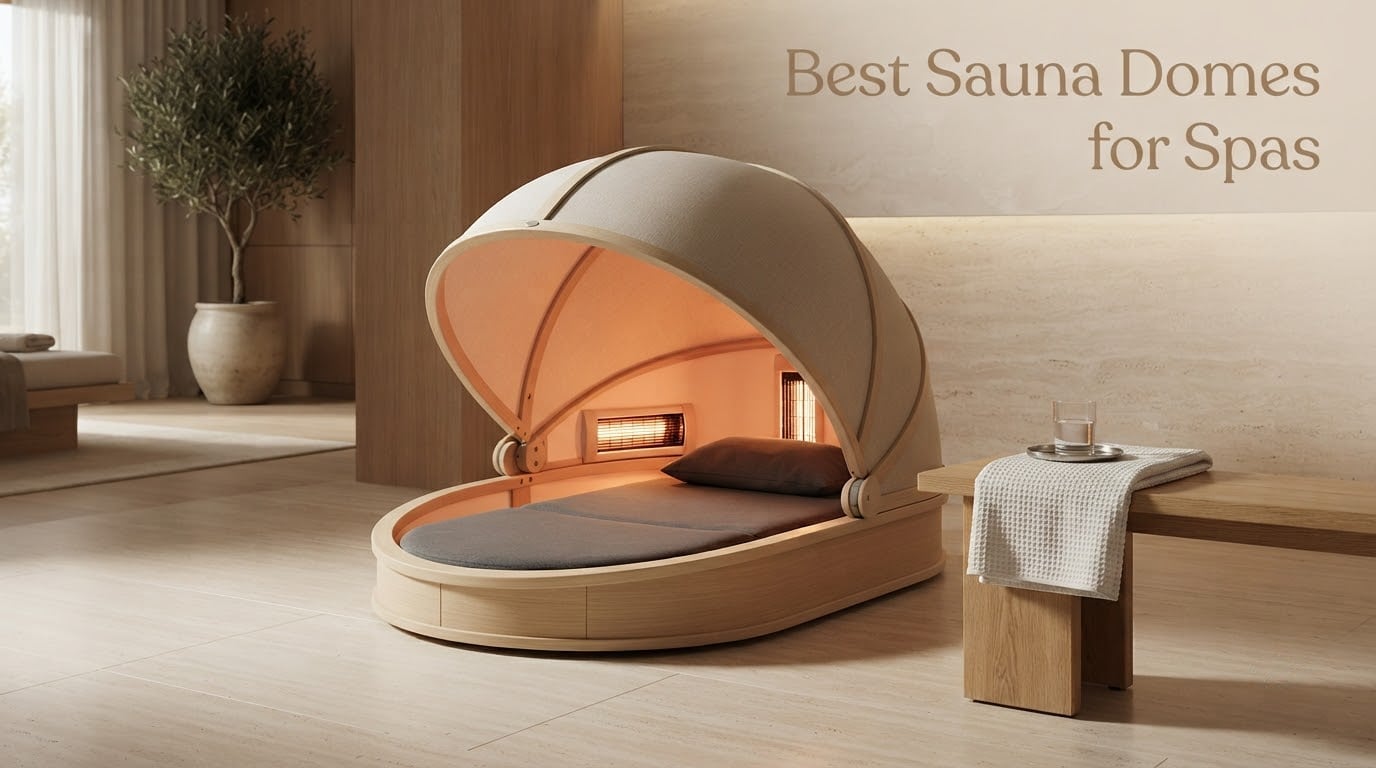
If you run a day spa, a gym recovery corner, or a mobile wellness service and someone asks for a sauna experience, a full wood cabin is usually the wrong answer. A full cabin needs a dedicated circuit, a floor footprint most treatment rooms do not have, and 30 to 45 minutes of preheat before the first guest walks in. That is why the best sauna domes for spas have become the format most operators land on: a floor-level, single-person infrared capsule that reaches a usable temperature in minutes, rolls between rooms, and turns a 45-minute booking into an actual revenue slot.
Amazon currently lists only a handful of genuine lie-down sauna domes, and the category is thick with near-identical listings and thin with verified feedback. We read the review data on all seven, cross-checked the specifications against the manufacturer claims, and sorted them by the things that decide whether a dome works in a commercial room: preheat speed, the real temperature ceiling, cleaning turnaround, and whether the warranty survives business use. Several of these domes are excellent in a home gym and poor buys for a booked treatment room, and we flag exactly where that line falls.
One note before we start. A residential warranty is a residential warranty. If you intend to run a dome commercially, get the business-use question answered in writing before you buy, and treat the specs in each review below as the starting point rather than the final word. We will walk through the specifics in the buying guide near the end.
If you are still laying out your treatment rooms, our guides to the best pedicure chairs for spas and the best cryotherapy chambers for spas cover the other two pieces of equipment that tend to anchor a heat-therapy room.
Table of Contents
What Is a Sauna Dome?
A sauna dome is a single-person, collapsible infrared pod shaped like a wide igloo that you lie inside on the floor. Far-infrared or full-spectrum carbon heaters warm your body to roughly 120 to 190 degrees Fahrenheit without the humidity of a steam room. For a spa, the practical part is speed: a dome reaches session temperature in minutes rather than the half hour a wood cabin needs, so it fits inside a standard treatment slot.
How that heat works matters for how you schedule around it. Carbon fiber panels emit infrared wavelengths that warm the body directly, which triggers sweating at air temperatures far below what a traditional 176 to 212 degree sauna needs. That is why the 194 degree ceilings on the domes below feel more like a warm room than a steam room, and why a 131 degree ceiling can still produce a full sweat session.
Top 3 Best Sauna Dome Picks for Spas in 2026

1Love Luxor Pro Sauna Dome
- 5-10 minute preheat
- 194F ceiling
- Three-zone control
- Copper-lined


All 7 Sauna Domes Compared in September
| Product | Specifications | Action |
|---|---|---|
| 1Love Luxor Pro Sauna Dome |
|
Check Latest Price |
| Golden Wave Far Infrared Sauna Dome |
|
Check Latest Price |
 Tuning Dome Lasse Korean Capsule Tuning Dome Lasse Korean Capsule |
|
Check Latest Price |
 Clearlight The Curve Sauna Dome Clearlight The Curve Sauna Dome |
|
Check Latest Price |
| ZONEMEL 360 Degree Sauna Dome |
|
Check Latest Price |
 TaTalife Two-Stage Sauna Kit TaTalife Two-Stage Sauna Kit |
|
Check Latest Price |
 Relax Sauna Lie Down Far Infrared Relax Sauna Lie Down Far Infrared |
|
Check Latest Price |
1. 1Love Luxor Pro Far Infrared Sauna Dome – Fastest Preheat With Three-Zone Control
1Love Luxor Pro Far Infrared Sauna Dome | 0 EMFs, ELFs & VOCs | 10 Minute Preheat | 1200W/110V Power | Personal Sauna | 1 Person Sauna | Portable Dry Sauna | Home Sauna | Therapeutic Stones
Preheat: 5-10 min
Max: 194F
1200W on 110V
Copper-lined, 3 zones
Pros
- Reaches session heat in 5 to 10 minutes
- the fastest verified figure in this group
- Three independently controlled heating zones spread warmth across the body
- Zero EMFs
- ELFs and VOCs claimed
- with a full copper lining for grounding
- Standard and XL versions cover users from under 58 inches to 77 inches
- Machine washable mat cover makes client turnover quick
Cons
- Standard size is reported as tight for users above 5 ft 11 in
- Magnetic insulated cover magnets are reported to loosen over time
- Higher spend than the rest of this lineup
This is the dome that convinced us the category is worth an operator’s attention. The spec sheet claims a 5 to 10 minute preheat, and 67 reviews at a 4.8 average is by far the deepest feedback base of any dome we looked at. Owners consistently describe starting it and stepping in rather than scheduling around it, which is the whole point in a treatment room.
What stands out technically is the three-zone control. Each heating zone runs independently, so you can load a hot zone over the legs and keep the chest area cooler, or run a gentler warm-up phase for the first five minutes. For a spa running mixed sessions, that flexibility is more valuable than any of the add-on features on the cheaper domes.
The copper lining is a grounding measure the brand pairs with its zero-EMF, ELF and VOC claim, and the therapeutic stones listed are germanium, tourmaline, jade and bian. Owners report the stones mainly as a nice touch rather than a measurable therapy, but they are part of the package and they are what the 1Love marketing leans on.
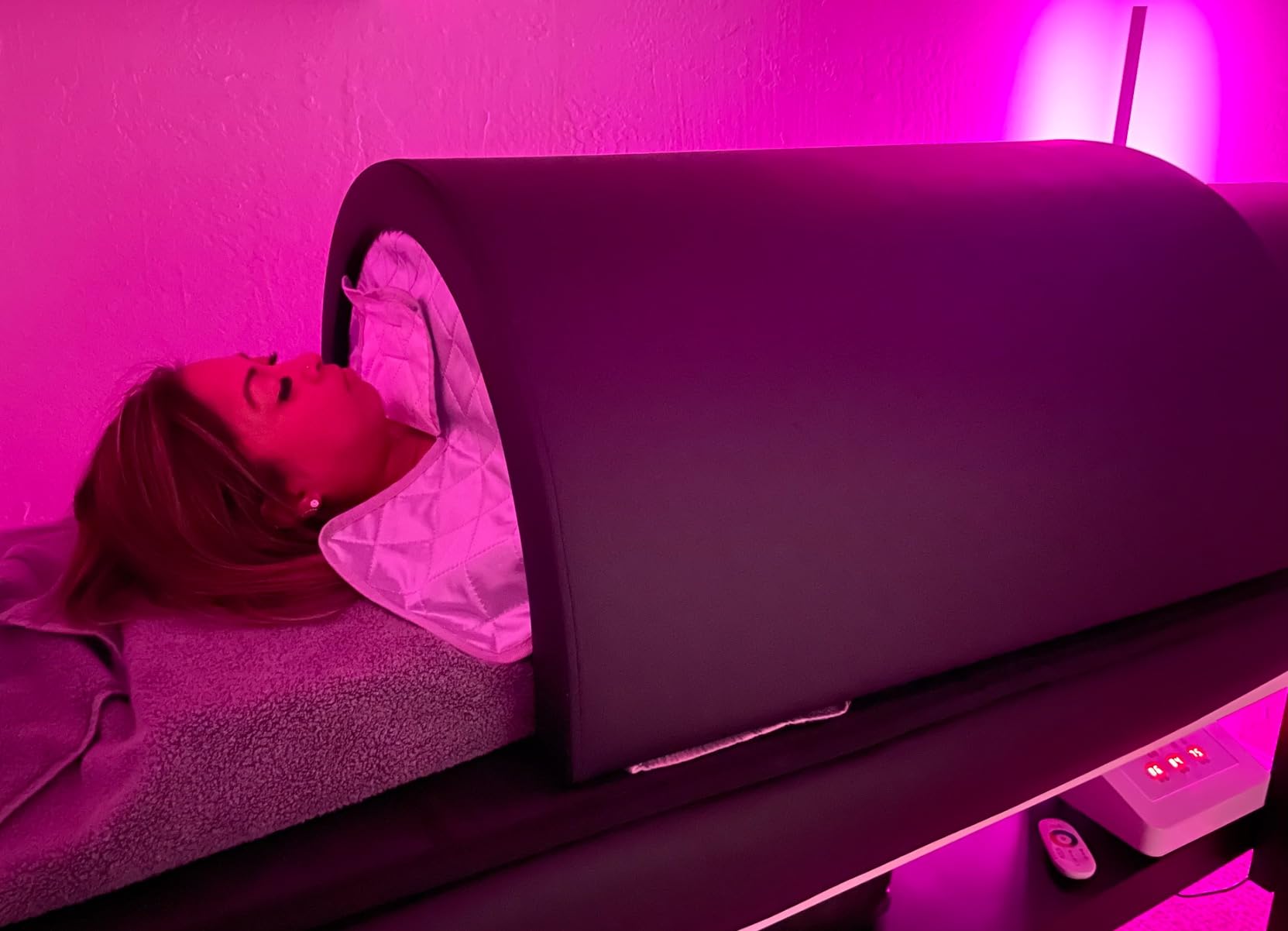
The 1200W heater runs on standard 110V, which matters in older treatment rooms where a second 240V circuit is a real cost. At 69.3 pounds it is not a one-person carry, but it is a two-person job and it moves with a furniture dolly rather than a rebuild.
Two complaints recur. Owners over six feet report the standard shell is cramped, so budget for the XL version if your clients skew tall. Separately, some users say the magnetic insulated cover stops holding after months of daily use, which is a replacement part rather than a failed unit.
Preheat Time and Booking Turnaround
At 5 to 10 minutes, this is the only dome here that can sit idle and still be usable inside a short booking window. You can start it at the top of a facial or massage, and have it at temperature when the client walks in. Every other dome in this roundup needed a longer warm-up, or a temperature ceiling low enough that the schedule mattered less.
Sizing for Tall Clients and Limited Mobility
The XL version covers users from 58 to 77 inches, and that is the version we would put in a room with a mixed clientele. The standard shell keeps the footprint smaller, which matters more in a treatment room than the two people who cannot fit. Note that the entry is floor-level in every version, so step-in height is a consideration for anyone with limited mobility.
2. Golden Wave Far Infrared Sauna Dome – The Best Value Treat Room Option
Golden Wave Far Infrared Sauna Dome, Professional Home Spa with Tourmaline and Germanium Stones, Single Person Use
77F-194F range
20-60 min timer
Tourmaline and germanium
Stones, lifetime warranty
Pros
- Shares the highest rating in this group at 4.8 across 11 reviews
- 77F to 194F range with a 20 to 60 minute timer
- Tourmaline and germanium stones release negative ions into the session
- Digital control panel
- ergonomic head pillow and insulated curtains included
- Lifetime warranty covers more ground than the one-year terms on most rivals
Cons
- Some owners report a plastic smell during the first few heat cycles
- Listed product dimensions of 12 x 12 x 12 inches do not match the actual unit
- One reviewer at 5 ft 2 in describes a tight entry and exit
The Golden Wave is the pick we would hand an operator who wants the 1Love-class ceiling without the 1Love-class spend. It shares a 4.8 average rating and hits the same 194 degree maximum, with a lifetime warranty that outlasts every other dome in this roundup.
It is billed as a professional home spa unit, and the feature set reads like one: full-coverage heating zones, a digital control panel, a head pillow and insulated curtains in the box. Owners highlight quick heating and a genuinely compact footprint, which is the trade a spa operator makes every time they give up floor space.
The stones are tourmaline and germanium, marketed for negative ion release. Whether or not you can measure the effect, the owners who like this dome tend to like the heat profile, and that is what fills a booking.
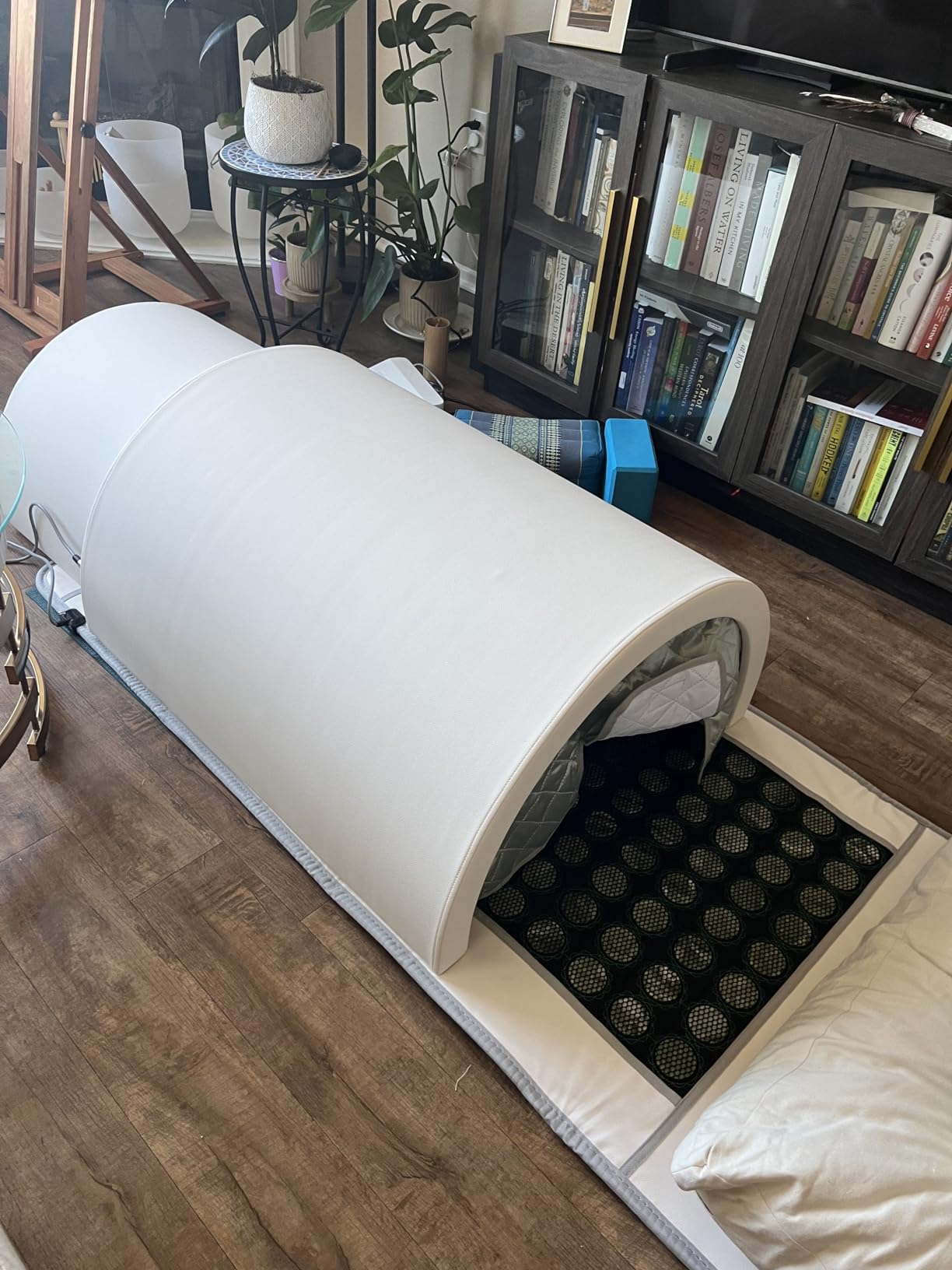
Two things to raise with the seller before you commit. Owners who bought new report a plastic smell that fades after several heat cycles, so plan for a burn-in period before you sell the session. And the listed dimensions of 12 by 12 by 12 inches are clearly a packaging error, so measure your floor space from the product photos rather than the spec page.
The other recurring note is fit for shorter users. One reviewer at 5 ft 2 in described shimmying in and out, which is the opposite problem from the taller users who struggle with the 1Love standard size. Measure your shortest regular client before ordering.
Temperature Ceiling Versus Comfort
A 194 degree ceiling on a far-infrared dome does not feel like a 194 degree sauna room. The carbon panels warm the body directly, so most operators land somewhere in the 140 to 170 range for a 30-minute session. The value here is that the top of the range is available when you want it, and the dial still goes down to 77 for warm-ups and cool-downs.
Warranty and Long-Term Owner Confidence
A lifetime warranty is unusual in this category, where most rivals offer one year. That matters most for a commercial room, where a failed heater means a cancelled booking rather than an inconvenience. Ask the manufacturer to confirm in writing whether that lifetime term survives business use, because residential and commercial terms are often separate and the answer varies by seller.
3. Tuning Dome Lasse Korean Capsule – Lightest Option for Mobile Sauna Services
Tuning Dome Made in Korea Sauna Dome Locking Inside no Swing Home Room Original Portable Foldable Patented Design Far Infrared Salon Use Carrying Bag Low Power Consumption Low EMF Lasse
Weighs 9 lb
Foldable with carrying bag
Low power draw
20 x 24.5 x 16.5 in
Pros
- Weighs 9 pounds
- the lightest unit in this roundup by a wide margin
- Folds flat and packs into the included carrying bag
- Low power consumption suits rental
- event and mobile setups
- Patented Korean locking-entry design keeps the pod stable while you get in
Cons
- Independent testing reported in reviews measured 50mG EMF
- far above the 3mG threshold
- ELF readings reported as high as 700 volt per meter
- Some owners run two units side by side for full body coverage
This is a different product from a different market, and it solves a different problem. At 9 pounds it is the only dome here you can genuinely carry into a client’s home, a hotel room, or a pop-up event, which is exactly what a mobile sauna service needs. The carrying bag is included and the frame folds flat.
The patented Korean design uses a locking inside entry rather than a swinging door, so the pod does not tip or roll while you climb in. Owners using it for neuropathy and general pain relief report real satisfaction with the heat, and the low power consumption makes it a sensible pick where a heavy heater load is not available.
That satisfaction comes with a serious caveat that we would not gloss over. One reviewer ran independent meter testing and measured 50 milligauss of EMF, against a widely used 3 milligauss safe threshold, plus ELF readings reported as high as 700 volts per meter. The listing describes it as low EMF, and that measurement contradicts the claim.
That reading came from a buyer, not from us, and it is a single data point. But in a category where buyers are already the most EMF-vigilant audience there is, and where published meter readings are the single most trusted signal, we would want our own meter test on this unit before putting a paying client inside it.
EMF Readings and the Low-EMF Claim
If your clients are the EMF-conscious group that buys infrared equipment, this is the one pick we would not put in a treatment room without verifying it yourself. A basic gauss meter is inexpensive, and a two-minute reading at the head position during a full heat cycle tells you more than any product page. The same test is worth running on whichever dome you do buy, whatever the claim says.
When Two Units Make Sense
Several owners report buying a second unit so one can heat while the other resets, which is a scheduling trick that pays off in any room running back-to-back bookings. Some also use two side by side for full body coverage. At this weight, that duplication is affordable in a way it never is with the 69-pound units above.
4. Clearlight The Curve Sauna Dome – Best Fit for Apartment-Style Treatment Rooms
Clearlight The Curve™ Sauna Dome with Amethyst Mat – Portable Far Infrared Home Sauna for Pain Relief & Muscle Recovery, Personal Lightweight Sauna for Relaxation & Wellness
Carbon fiber and ceramic heaters
73 x 35 x 20 in
Amethyst mat
2 domes
Pros
- Organic carbon fiber heaters with a patented ceramic compound
- Amethyst mat included for targeted therapy sessions
- 73 by 35 by 20 inch footprint suits narrow treatment rooms
- Two lightweight domes nest together when not in use
- States minimized EMF exposure as a design goal rather than a bare claim
Cons
- Only 5 reviews and a 3.2 average make this the least-proven pick here
- Costs more than most domes in the group without long-term feedback to offset it
- Almost half of the ratings are 2-star
The Curve is the brand name people search for when they look up sauna domes, and the product is genuinely well engineered on paper. The heater technology is organic carbon fiber with a patented ceramic compound, and the package pairs the domes with an amethyst mat, which is positioned as a targeted-frequency therapy addition to the session.
For a spa with a tight treatment room, the footprint is the argument. At 73 by 35 by 20 inches it reads longer and narrower than the round units, and two lightweight domes nest together when the room is not booked, which lets you run parallel sessions or a dome plus mat configuration.
The stated uses are pain relief, muscle recovery, circulation, sleep and stress relief, and the brand positions the product for small spaces, rental properties and apartments. That positioning matches how a lot of wellness operators actually work, in a converted room rather than a purpose-built facility.
Here is the problem. This listing has 5 reviews and a 3.2 average, with almost half the ratings at 2 stars. That is not enough evidence to sell a client on, and it is well below the confidence level of the two domes above it. In our experience, an unproven unit in a paid treatment room is a liability, because a guest who does not feel the benefit does not come back.
Footprint and Room Layout
This is where the Curve earns its badge. If your treatment room is narrow and you need to keep floor space clear for other modalities, the 73 by 35 by 20 inch profile stores down to almost nothing when the domes nest. The amethyst mat also gives you a second service to sell off the same footprint, which is the kind of flexibility a day spa can bill for.
What the Review Record Tells Us
Five reviews cannot tell you much, and what they do tell you is not encouraging. A 3.2 average with a large share of 2-star ratings is a signal to ask the manufacturer for their own service data before you commit. If you are testing the sauna category for the first time and want a premium brand name on the equipment, this is a defensible pilot purchase, not a fleet buy.
5. ZONEMEL 360 Degree Personal Sauna Dome – Lowest-Cost Way to Test Demand
ZONEMEL Personal Infrared Sauna Dome for Home Spa, 360 Degree Coverage Lying Down Hot Carbon Sauna, Portable Full Body Sauna with Pillows and Mat, Dry Heat
1300W carbon fiber
77F-131F
9 levels, 1-60 min
Nests for storage
Pros
- Lowest cost of the group and a practical way to test local demand
- 1300W carbon fiber heaters with 360 degree coverage
- Nine heat levels and a 1 to 60 minute timer
- Lower dome slides under the upper dome for half-size storage
- Pillows and mat included in the package
Cons
- One reviewer reported burns and disputed the far-infrared claim
- Not UL or ETL certified according to buyer reports
- Can take over an hour to produce visible sweat
There is one legitimate reason to buy the cheapest dome on this list: to find out whether sauna bookings convert in your market before you spend real money. If you run a gym or studio, the ZONEMEL is a cheap pilot unit. It has more reviews than several rivals and a 3.3 average that is honest about what it is.
On the specification side it is not bad. 1300 watts of carbon fiber with 360 degree coverage, nine heat levels, a 1 to 60 minute timer, and a temperature range of 77 to 131 degrees. The two-part design is the practical part for a treatment room, since the lower dome slides under the upper one and the whole footprint roughly halves.
Two cabin size options are offered, at roughly 31 by 31 by 16 inches and 31 by 28 by 14 inches, with a dome that adjusts to 67 by 28 by 14 inches. At 21.8 pounds it is the second-lightest unit here and moves around a room without a dolly.
Now the part that decides whether it belongs in a paid session. Buyers report burns, dispute the far-infrared claim outright, and note the absence of UL or ETL certification. The 131 degree ceiling is also low enough that more than one owner reports waiting over an hour to sweat, which is the opposite of the scheduling advantage a dome is supposed to deliver.
Certification and Client Safety
No UL or ETL listing is a real problem in a commercial room, because your liability posture is different from a homeowner’s. If you use this unit as a lead-in demo with your own staff while you research better options, the risk is contained. Putting a paying guest in an uncertified pod with reported burns is a different decision, and we would not make it.
Storage Design for Multi-Use Rooms
The nesting design is genuinely the best in this group for a room that does other work. When sauna bookings are not covering the room’s cost, sliding the lower dome under the upper one frees the floor for other equipment. For a studio testing demand on a part-time basis, that flexibility is worth more than a higher temperature ceiling.
6. TaTalife Two-Stage Far Infrared Dome Kit – Best Multi-Unit Package
TaTalife Portable Professional Far Infrared Sauna Dome,360 Degree Complete Coverage Personal Sauna Capsule,with Pillows, Two – Stage Home Sauna Spa
2 domes plus FIR mat
Two heating zones
77F-131F
9 levels, 20-60 min
Pros
- Two domes plus a mat support back-to-back or parallel client sessions
- Two independently controlled heating zones
- Everything stores inside the nested domes when the room is free
- Remote control
- electrical box
- pillow and two insulated curtains included
- Runs on 9 heat levels with a 20 to 60 minute timer
Cons
- Only 5 reviews
- so long-term reliability is unproven
- Remote control reliability issues reported by owners
- One owner needed more than an hour to start sweating
The TaTalife package is built around a scheduling idea rather than a single unit. You get two FIR domes, a FIR mat, a pillow, a remote control, an electrical box and two insulated curtains, which means a two-person sauna session or a rotation where one dome heats while the other resets.
The technical setup is sensible for that purpose. Two independently controlled heating zones, nine heat levels, a 20 to 60 minute timer, and a 77 to 131 degree range. Storage is handled by nesting the lower dome under the upper one and stowing the accessories inside, so the whole kit collapses to a single footprint when it is not in use.
At 23.9 pounds this is manageable for a two-person move, and the materials are described as high heat resistance with an environmental focus. Owners who like it tend to talk about the completeness of the kit rather than any single feature.
With 5 reviews and a 3.4 average, though, the confidence level is low. The specific complaints cluster around the remote control reliability and slow heat-up, and the same over-an-hour sweat problem reported on cheaper capsules shows up here too. The 131 degree ceiling is the core limitation.
Two Domes for Throughput
Buying two units to run one while the other cleans is a proven treatment room pattern, and this package gives you that without a second purchase. If your booking sheet is full and you need a reliable 30-minute turnaround, the double dome is a better fit than a single higher-end unit at the same total spend.
Temperature and Timer Limits
The 131 degree ceiling and the 20-minute minimum on the timer are worth checking against your service menu. A 20-minute minimum suits a focused express session, but if you plan to run 30 to 45 minute sessions you are working near the top of what the timer allows, with no room for a longer sweat cycle.
7. Relax Sauna Lie Down Far Infrared Sauna – Fastest Heat-Up With a Design Caveat
Relax Sauna Relax Far Infrared Sauna (Lie Down Version)
800W infrared generator
4-14 microns
30 second heat-up
65 x 26 x 19 in
Pros
- Heats in 30 seconds
- the fastest start time in this roundup
- 800W patented far infrared generator tuned to a 4-14 micron band
- Reflective tent and mat redirect rays for fuller body coverage
- Non-toxic materials throughout
- Weighs 33 pounds and folds down for storage
Cons
- Only heats the upward-facing side
- so legs can burn under the rays
- One owner limited sessions to about 10 minutes for that reason
- Just 2 reviews behind a 2.8 average
Thirty seconds. Nothing else in this roundup starts that fast, and for a walk-in express service where the client is ready before the equipment is, that speed has real appeal. The generator is an 800 watt patented far infrared unit tuned to a 4 to 14 micron band, which sits in the range the industry treats as efficiently absorbed.
The reflective tent and mat work together to redirect the rays back across the body, and the materials are described as non-toxic, which is a fair question to ask about any pod a client sweats inside. At 33 pounds and 65 by 26 by 19 inches it is a mid-weight unit with a one-year warranty.
Then there is the design flaw. The lie-down version works by heating the side facing upward, so the underside of the legs and the backs of the thighs sit on the cold floor while the rays concentrate on the top of the body. The owner who reviewed it reported burns on their legs and cut sessions to about 10 minutes.
Two reviews and a 2.8 average is not enough data to condemn the product, but the one detailed review describes a structural problem rather than a preference. We would not put a client in this one for a 30-minute session, and the honest reason is the geometry of the design, not the quality of the heater.
Who the Express Format Actually Suits
A 10-minute express session is a real service, and at 30 seconds to start this unit can run several in a row. If you sell sauna as a short add-on to a facial or a cryotherapy booking rather than a dedicated 30-minute treatment, the speed offsets the design limitation and it becomes a defensible pick.
Why We Would Not Book It for a Full Session
The single-sided heating means your client sweats on top and stays cool underneath, which is not how you want a paid 30-minute service to feel. Owners who wanted a proper lie-down infrared experience moved to a full-coverage dome. Treat this as a quick-add-on machine, not a primary heat therapy station.
How to Choose a Sauna Dome for a Spa Treatment Room
Most buyers compare these domes on wattage, and that is the wrong number. Wattage tells you how hard the heater pushes, not whether the pod is ready when a client arrives. Here is what we would check before a purchase order, in the order that matters for a booked room.
Preheat time against your booking length. This is the number that decides throughput. A dome that heats in 5 to 10 minutes can start during the previous appointment. A dome that needs an hour to produce visible sweat does not save you floor space, it just hides it in a corner while you wait on it. Owners on r/infraredsauna consistently quote the same contrast between roughly 10-minute domes and 30 to 45 minute full cabins, and it is the most-quoted advantage of this format in spa contexts.
Temperature ceiling versus comfort. Every dome here tops out between 131 and 194 degrees, and none of those figures feel like a Finnish sauna because far infrared warms the body directly. A higher ceiling gives you headroom to run a genuinely hot session, but most operators settle around 140 to 170. Buyers underestimate how much a low ceiling limits a 30-minute booking.
EMF, measured not marketed. Buyers in this category are unusually EMF-literate, and published milligauss readings are the trust signal that matters most. The word low is not a measurement. If a brand claims zero or minimized EMF, ask for the number and the method, then confirm it yourself with a gauss meter at head position during a full heat cycle. One of the domes in this roundup markets itself as low EMF while a buyer measurement reported 50 milligauss.
Full-spectrum versus far-infrared. Far-infrared uses longer wavelengths for a gentler, deeper-feeling warmth at lower air temperatures. Full-spectrum adds near and mid-infrared for a hotter, more intense surface sweat. Most spa clients are booking a gentle recovery session rather than a heat endurance event, which is why the far-infrared domes in this roundup suit treatment rooms better.
Wattage, circuit and floor plan. Most of these units run on standard 110V, including the 1200W and 1300W models, which means no electrical upgrade in an existing treatment room. Check the footprint against your floor plan, and confirm the step-in height works for clients with limited mobility. Tall clients need the longer XL shells.
Commercial warranty validity. This is the question we would ask first, and the one buyers most often skip. Residential warranties are frequently void in a business setting, and a heater that fails in month three of a booked room is a revenue problem, not a household one. Get the business-use answer in writing, in the seller’s name, before you install anything.
Cleaning and mat cover. A machine washable mat cover shortens turnaround between clients considerably. Fabrics that need hand cleaning will quietly destroy your booking schedule within a month of opening.
Sauna Dome vs Sauna Blanket vs Full Cabin
Are sauna domes worth it? For a spa, usually yes, and the reason is throughput rather than heat quality. A dome heats in minutes instead of half an hour, fits in a standard treatment room instead of needing a dedicated space, and rolls between rooms when it is not in use.
A sauna blanket wraps the body and covers more surface area, which many clients find more claustrophobic, and it leaves the head exposed. It is also far cheaper and stores flat. The trade is heat distribution: a dome surrounds you, a blanket drapes you.
A full cabin gives a shared, social experience and far higher heat, but it needs a 240V circuit, a larger room, and a preheat window that a treatment schedule cannot absorb. In a spa, that footprint and turnaround cost usually rules it out unless you have a dedicated sauna room that you charge premium membership for.
Our rule of thumb: dome for treatment rooms, blanket for rooms that need to stay flexible, cabin for a dedicated heat-therapy suite with its own membership model.
Sanitation and Client Turnaround for a Shared Dome
Hygiene between clients is the operational question we hear least answered, and in a shared dome it is the one that matters most. Nobody in our research had a public answer, which is why we built a simple protocol from how the equipment actually works.
Ventilate and dry first. After a session, open the zip and leave the dome open so trapped moisture and heat clear. A dome that is wiped and folded while damp is a mold risk, and a mold risk in a treatment room is a liability.
Wipe the interior shell with a hospital-grade wipe, paying attention to the mat and any fabric the client was lying on. The machine washable covers on the better units can go straight into a laundry cycle, which is the single biggest time saver in the whole protocol.
Do not share a towel or a head pillow cover between clients without swapping it. Every dome in this roundup includes some form of pillow or mat, and those are the surfaces with the most direct skin contact.
Finally, keep the wipe-down time inside your booking buffer. Owners who stack sessions back to back without a reset window end up cutting sanitation short, and that is where problems start. A 10-minute reset between clients is a reasonable design target, and a machine washable cover is what makes it achievable.
Frequently Asked Questions
Which sauna dome is the best?
For a spa treatment room, the 1Love Luxor Pro is the strongest all-round pick. It heats in a reported 5 to 10 minutes, reaches a 194 degree ceiling, offers three independently controlled heating zones, and has the deepest review base in the category at 4.8 across 67 reviews. The Golden Wave matches its 4.8 rating at a lower spend and adds a lifetime warranty.
Are sauna domes worth it?
For a spa, yes, mostly because of throughput. A dome heats in minutes instead of the 30 to 45 minutes a full cabin needs, fits inside a standard treatment room, and rolls between rooms. A sauna blanket is cheaper and stores flat but leaves the head exposed and covers less surface area. A full cabin delivers far more heat and a social experience, at the cost of floor space and a dedicated circuit.
How long does a sauna dome take to heat up?
It depends on the design, and the gap is wide. The 1Love Luxor Pro lists a 5 to 10 minute preheat, and owners confirm fast heating. The Relax Sauna claims 30 seconds. Cheaper 1300 watt capsules in this roundup took owners more than an hour to start sweating. For a 45-minute booking, anything above roughly 15 minutes needs to start during the previous appointment.
What is the 200 rule for saunas?
The 200 rule is a community guideline suggesting roughly 200 degrees Fahrenheit is the upper limit of the sauna experience, and that no one should exceed 200. It applies most directly to traditional steam saunas. Far-infrared sauna domes rarely exceed 194 degrees at the ceiling, and most clients settle well below that because the heat penetrates directly rather than heating the air.
How much does a commercial sauna cost?
Commercial infrared domes in this roundup sit at the low end of the market compared with full cabins, which commonly run into the thousands and need dedicated installation. The main cost for a spa is not the unit but the electrical work, floor space, and the cleaning and booking time around each session. Confirm whether the warranty covers business use before you buy, since residential terms are often void in commercial settings.
Do saunas help lower cortisol?
Sauna use is associated in published research with a range of cardiovascular and stress-response benefits, and heat therapy is widely used for recovery. However, most of the strong data comes from Finnish sauna cohort studies, not from small infrared domes, and much of the internet claim set around cortisol and detox outruns the evidence. Treat a dome as a heat therapy tool rather than a treatment with a guaranteed biological outcome.
The Best Sauna Domes for Spas in 2026
The 1Love Luxor Pro is our pick for the best sauna domes for spas in 2026, and the reason is scheduling. A 5 to 10 minute preheat with three independent zones and a 194 degree ceiling is the only combination here that fits a real booked treatment room, and 67 reviews at 4.8 is the most proven feedback base in the category. The Golden Wave is the value route with a matching rating and a lifetime warranty, and the TaTalife two-dome kit makes sense when you need a second unit for turnover.
Two things to settle before you order. Run a gauss meter on whatever you buy, because the low EMF claim is not always accurate, and get the business-use warranty confirmed in writing before you install it in a paid room. If you are still planning the rest of the room, start with our best Vichy showers for spas and best esthetician beds for spas guides to keep the heat-therapy and wet-therapy zones from competing for the same square footage.