
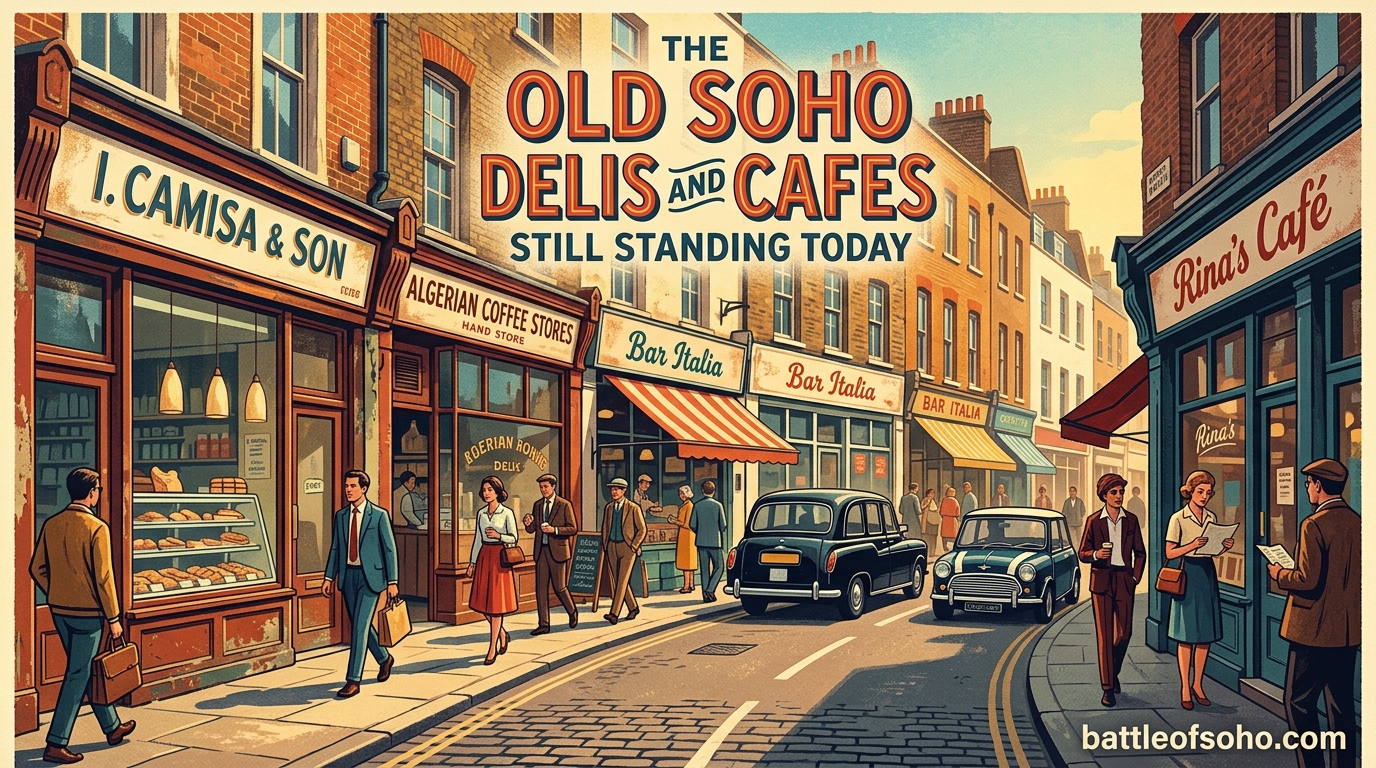
Soho has lost hundreds of beloved food establishments over the decades. Rents skyrocket, chains move in, and family-run shops shutter their doors for good. But a remarkable group of old Soho delis and cafes have refused to disappear. These are the historic venues that opened their doors fifty, seventy, even over a hundred years ago and are still serving customers today.
From the Italian immigrants who built a coffee culture on Frith Street to the French patissiers who turned Soho into a slice of Paris, these surviving businesses represent something rare in modern London. They are living history. When you walk through their doors, you are stepping into spaces that have barely changed in generations.
This guide covers the oldest Soho delis and cafes still standing today, with establishment dates, survival stories, and what makes each one worth visiting. Whether you are a Londoner hunting for an authentic lunch spot or a visitor chasing the city’s culinary heritage, these are the places that have earned their place in Soho’s story.
Table of Contents
The Old Soho Delis and Cafes Still Standing Today: Quick Overview
If you want the short version, here are the longest-surviving food establishments in Soho, ranked by how long they have been open:
1. Maison Bertaux (1871) – French patisserie, Greek Street
2. Algerian Coffee Stores (1887) – Coffee merchant, Old Compton Street
3. I Camisa and Sons (1929) – Italian deli, Old Compton Street
4. Lina Stores (1944) – Italian deli and cafe, Brewer Street
5. Bar Italia (1949) – Italian coffee bar, Frith Street
6. Bar Bruno – Classic greasy spoon cafe, Wardour Street
Each of these venues has weathered world wars, economic crashes, rent explosions, and a global pandemic. Their continued existence reflects the determination of the families and individuals who refused to let Soho’s food heritage die.
Maison Bertaux (1871) – The Oldest Patisserie in Soho
Maison Bertaux holds the crown as the oldest surviving patisserie in Soho, and possibly the oldest cake shop in central London. Founded in 1871 by a French couple who wanted to bring authentic French patisserie to London’s theatre district, this tiny shop on Greek Street has been baking eclairs, mille-feuille, and croissants for over 150 years.
The patisserie survived the Blitz, when bombs rained down on Soho and destroyed neighbouring buildings. It survived the post-war decline of the area, when crime and neglect drove many businesses away. And it has survived the modern era of soaring commercial rents that has claimed dozens of historic Soho venues.
What makes Maison Bertaux special is not just its age. The interior feels frozen in time. Narrow wooden stairs, vintage signage, mismatched furniture, and cake displays that look like they belong in a museum. The upstairs seating area is cramped and slightly chaotic, but that is precisely the appeal. You are experiencing a Soho that most people assume is gone.
The cakes are the main draw. Their fruit tarts, chocolate ganache slices, and almond croissants are made using recipes that have barely changed since the 19th century. Locals and tourists queue outside on weekends, and the staff maintain a brisk, no-nonsense attitude that feels authentically Soho.
Look closely at the walls and you will see decades of memorabilia, photos, and artwork. The shop became a gathering point for Soho’s bohemian crowd, attracting artists, writers, and musicians who treated it as a second home. That creative spirit still lingers in the air.
Algerian Coffee Stores (1887) – A Coffee Institution
Algerian Coffee Stores has been selling coffee on Old Compton Street since 1887, making it one of the oldest coffee merchants in London. While modern third-wave coffee shops get all the attention, this unassuming shop has been roasting and blending beans for over 135 years.
The shop was founded by an Algerian immigrant who saw an opportunity to bring North African coffee traditions to London. At a time when coffee in England meant instant granules or bitter diner brews, Algerian Coffee Stores was selling single-origin beans, custom blends, and freshly ground coffee by weight.
Walking in feels like entering a different century. The aroma hits you before you cross the threshold. Sacks of beans line the walls. Handwritten signs list prices and origins. The staff know their product inside out and will guide you toward the right blend based on how you brew at home.
You can buy beans from virtually every coffee-producing region in the world here. Their house blends are what most regulars come back for, particularly the Mocha Blend, which has been a customer favourite for decades. Prices remain remarkably reasonable compared to the specialty coffee shops that have sprouted up across Soho in recent years.
This is not a sit-down cafe. It is a shop first and foremost. But the experience of buying coffee here, from people who have been doing it for generations, connects you to a Soho that predates the area’s reputation as a nightlife hub. Algerian Coffee Stores is a working piece of Victorian London that still functions exactly as it was intended to.
I Camisa and Sons (1929) – Soho’s Italian Heritage
I Camisa and Sons is the oldest Italian deli still operating in Soho, established in 1929 on Old Compton Street. The Camisa family emigrated from Italy and built this deli into one of the most respected food shops in London. Nearly a century later, it remains a family-run business with deep roots in the local Italian community.
The deli served the wave of Italian immigrants who settled in Soho during the early 20th century. These families needed olive oil, cured meats, aged cheeses, and pasta that reminded them of home. Camisa became their supplier, their meeting point, and their connection to the culture they left behind.
Over the decades, the deli built relationships with producers across Italy that most modern importers can only dream of. Their Parma hams, pecorino cheeses, and antipasti selections are sourced through channels established generations ago. That network of trust is impossible to replicate.
What to look for when you visit? The olive selection alone is worth the trip. They stock varieties you will not find in supermarkets, along with cured meats sliced to order and fresh pasta made using traditional methods. The staff are generous with samples and recommendations, treating regulars and newcomers with equal warmth.
The deli faced significant challenges after Brexit, when new import rules disrupted supply chains for European food products. Importing Italian goods became slower, more expensive, and more complicated. But I Camisa and Sons adapted, drawing on decades of experience to navigate the changing landscape. Their survival is a quiet act of defiance against the forces that have claimed so many other family businesses in the area.
Lina Stores (1944) – The Green-Fronted Icon
If you have walked down Brewer Street, you have noticed Lina Stores. The distinctive green-painted storefront has been a Soho landmark since 1944, when an Italian woman named Lina opened a small shop selling homemade pasta and Italian ingredients to the local community.
Lina Stores predates the explosion of Italian food culture in London by several decades. In 1944, Britain was in the middle of rationing, and finding quality continental ingredients was nearly impossible. Lina’s shop filled that gap, importing what she could and making fresh pasta by hand using recipes from her home region.
The shop became so identified with its green facade that the colour itself became a brand. That distinctive shade of green has been repainted faithfully for eighty years, and regulars use it as a meeting point and navigation aid. It is one of the few commercial frontages in Soho that locals would recognise with their eyes closed.
Inside, the deli counter groans under the weight of Italian cheeses, cured meats, antipasti, and prepared dishes. The fresh pasta, made on-site, is what built the reputation. Tagliatelle, ravioli, gnocchi, and lasagne sheets are produced using the same techniques Lina herself used eight decades ago.
Lina Stores has expanded in recent years, opening a restaurant and additional locations. But the original Brewer Street shop remains the heart of the operation. The family behind it has maintained the quality and character that made it famous, even as the business has grown. For anyone interested in the old Soho delis and cafes still standing today, this is an essential stop.
Bar Italia (1949) – Soho’s Coffee Bar Pioneer
Bar Italia opened on Frith Street in 1949 and is widely credited as one of the first authentic Italian coffee bars in London. Founded by the Polledri family, who had already been in the Soho food scene for years, it arrived just before the espresso boom of the 1950s that would transform British coffee culture.
The timing was perfect. Post-war London was hungry for continental influence, and Italian-style coffee bars became social hubs for young people, artists, and musicians. Bar Italia was at the centre of that movement, serving espresso, cappuccino, and Italian pastries at a time when most Britons had never tasted properly brewed coffee.
Yes, Bar Italia is still open today, and it looks remarkably like it did in the 1950s. The chrome espresso machine dominates the counter. Black-and-white photographs line the walls. The pavement seating out front draws crowds year-round, and the service is fast, loud, and authentically Italian.
The coffee is consistently excellent. They roast their own beans and have never wavered from the traditional Italian espresso style. If you want a flat white with oat milk and latte art, this is not your spot. If you want a properly pulled espresso standing at the bar, exactly as you would in Rome or Milan, Bar Italia delivers every time.
The cafe has a particular cultural resonance in the neighbourhood. It is the kind of place where you might find Italian grandfathers arguing over newspapers at 7 AM, then Soho nightclub workers grabbing a 2 AM espresso twelve hours later. That round-the-clock energy is part of what makes it a genuine Soho institution rather than just a heritage venue.
Football fans should know that Bar Italia is also famous for its connection to Italian sport. Matches are shown on the screen behind the counter, and during the World Cup or European Championship, the pavement outside becomes an impromptu celebration zone for Italian supporters. It is one of those rare places where the atmosphere shifts with the sporting calendar, making each visit feel slightly different.
Bar Bruno – The Classic Greasy Spoon
Not every historic Soho establishment is Italian or French. Bar Bruno, on the corner of Wardour Street, represents the great British greasy spoon tradition that once dominated the area. While its exact founding date is less precisely documented than some venues, it has been serving fry-ups, mugs of tea, and bacon sandwiches to Soho workers for generations.
This is the type of cafe where construction workers, market traders, office staff, and night-shift crews all rub shoulders over the same menu. Formica tables. A counter piled with pastries. A grill that never stops. The smell of bacon grease and toast. Bar Bruno has survived because it serves a need that no artisan coffee shop or specialty deli can fill.
The full English breakfast is the obvious order. Eggs, bacon, sausage, beans, mushrooms, tomatoes, fried bread, and black pudding if you want it. Served on a hot plate with a mug of strong tea, it is exactly what a cold morning in Soho demands. Prices have gone up over the years, as they have everywhere, but Bar Bruno remains one of the more affordable sit-down options in the neighbourhood.
Reddit users and London food forums frequently mention Bar Bruno when someone asks about authentic old-school cafes left in Soho. The consensus is clear: it is one of the last places where you can get a proper, no-frills British cafe meal in a setting that feels untouched by the area’s gentrification.
The cafe also functions as a social space for the local working community. Regulars have their usual orders memorised by the staff. Conversations happen between strangers at neighbouring tables. It is the kind of spontaneous social interaction that chain cafes, with their app ordering and laptop culture, have largely eliminated.
Other Notable Surviving Soho Institutions
Beyond the headline venues, several other long-standing food and drink establishments in Soho deserve recognition. They may not date back as far as Maison Bertaux, but they have each earned their place in the neighbourhood’s story.
The French House on Dean Street has been a pub since 1914 and was the unofficial headquarters of Free French forces during World War II. While technically a pub rather than a cafe or deli, its contribution to Soho’s food and drink culture is undeniable. Charles de Gaulle supposedly drank here. Dylan Thomas, Francis Bacon, and Lucian Freud were regulars.
Yauatcha, while a more modern addition opened in 2004, occupies a historic Soho space and represents the newer wave of establishments that have become Soho institutions in their own right. It shows that Soho’s food culture is not frozen in time but continues to evolve while respecting its heritage.
Several smaller coffee shops and sandwich bars on side streets have been operating for decades without fanfare. These are the places that Soho office workers visit daily, the unglamorous backstops of the neighbourhood’s food economy. They rarely make tourist lists, but locals would feel their absence immediately.
The Preservation Challenges Facing Historic Soho Venues
The survival of these old Soho delis and cafes is not guaranteed. Every one of them faces threats that could close their doors for good. Understanding these challenges is essential for anyone who cares about London’s culinary heritage.
Rising commercial rents are the single biggest threat. Soho property values have climbed astronomically over the past two decades, and landlords can charge premium rates to chain restaurants and corporate tenants. A family-run deli generating modest profits simply cannot compete with a multinational willing to pay double the rent. Many long-standing venues have closed not because they were failing, but because their leases came up for renewal at rates that made continuation impossible.
Gentrification has changed the character of the neighbourhood itself. Soho in the 1950s was a working-class area with a thriving immigrant community and a slightly rough-around-the-edges atmosphere. Today it is prime real estate surrounded by luxury developments. The customer base has shifted, and some historic venues struggle to attract newer residents and workers who expect a different type of experience.
Brexit created massive disruption for venues that import European ingredients. I Camisa, Lina Stores, and other Italian establishments faced new customs procedures, delayed shipments, and increased costs for the products that define their menus. Some items became temporarily unavailable. The additional paperwork and expense hit small family businesses far harder than large importers.
The COVID-19 pandemic was another existential threat. Lockdowns forced cafes and delis to close their doors for months. Foot traffic from office workers, theatre-goers, and tourists disappeared overnight. Some venues survived by pivoting to delivery or takeaway models. Others burned through savings and relied on government support to stay afloat. The full impact of that period is still being felt.
Community response has been significant. Local organisations, customer campaigns, and heritage groups have rallied around threatened venues. Social media has given these businesses a platform to reach customers directly and build loyalty that transcends foot traffic. But community goodwill alone cannot offset structural economic pressures.
Why These Historic Venues Matter
The old Soho delis and cafes still standing today matter for reasons that go beyond nostalgia. They are living repositories of London’s cultural and culinary history, places where you can taste recipes that have been refined over generations and experience a version of the city that exists nowhere else.
These venues represent the immigrant communities that shaped Soho. The Italians who built the deli and coffee culture. The French who brought patisserie. The North Africans who introduced London to proper coffee. Without these businesses, Soho would be just another generic central London district with the same chains you find everywhere else.
They also represent resistance against the homogenisation of British high streets. Walk down any shopping street in the UK and you will see the same coffee chains, the same sandwich shops, the same fast-food outlets. The venues in this guide are different. They are unique to Soho. They cannot be replicated or franchised. When one of them closes, that piece of history is gone permanently.
For visitors, these establishments offer something increasingly rare: authenticity. The espresso at Bar Italia tastes the way it does because they have been making it the same way for 75 years. The cakes at Maison Bertaux come from recipes tested over a century and a half. That depth of experience cannot be manufactured by a new business, no matter how well-funded or well-marketed.
FAQs
What is the oldest cafe in Soho?
Maison Bertaux, established in 1871 on Greek Street, is the oldest surviving patisserie and cafe in Soho. It has been serving French cakes, pastries, and coffee for over 150 years and remains open today.
What is the oldest deli in Soho?
I Camisa and Sons, founded in 1929 on Old Compton Street, is the oldest Italian deli still operating in Soho. The family-run business has been selling cured meats, cheeses, and Italian specialties for nearly a century.
Is Bar Italia still open?
Yes, Bar Italia is still open and operating on Frith Street. Founded in 1949, it remains one of the most popular and recognizable coffee bars in Soho, serving espresso and Italian pastries seven days a week.
Which Soho cafes have been there since the 1950s?
Bar Italia, established in 1949, is the most prominent cafe from that era still operating today. Lina Stores, founded in 1944, was also well-established by the 1950s. Several other venues from the 1950s have closed over the decades.
Are there any original Soho cafes still open?
Yes, several original Soho establishments are still open, including Maison Bertaux (1871), Algerian Coffee Stores (1887), I Camisa and Sons (1929), Lina Stores (1944), and Bar Italia (1949). These venues maintain their original locations, recipes, and family-run character.
How old are the oldest Soho restaurants and cafes?
The oldest surviving food establishments in Soho date back to the 19th century. Maison Bertaux opened in 1871 and Algerian Coffee Stores in 1887, making them over 135 years old. Several others were established in the early to mid-20th century.
Visiting Soho’s Historic Delis and Cafes
The old Soho delis and cafes still standing today are not museum pieces. They are living businesses that depend on customers to survive. Every espresso bought at Bar Italia, every bag of coffee from Algerian Coffee Stores, every slice of cake at Maison Bertaux helps keep these institutions alive for the next generation.
If you are planning a visit, here are a few practical tips. Most of these venues are within a five-minute walk of each other, clustered around Old Compton Street, Frith Street, and Brewer Street. Tottenham Court Road and Leicester Square are the nearest Underground stations. Weekday mornings tend to be quieter than weekends, when queues can build quickly.
Cash is still accepted at most of these venues, though card payments are now standard. Be prepared for tight seating, especially at Maison Bertaux and Bar Italia. These spaces were built when Soho was a different kind of neighbourhood, and expansions are rarely an option.
Most importantly, take your time. These are not fast-food outlets designed for speed. They are places to sit, eat, drink, and absorb the atmosphere that only decades of continuous operation can create. That is precisely what makes them irreplaceable.
Soho’s food heritage is fragile. The venues in this guide have survived wars, recessions, pandemics, and the relentless pressure of modern London real estate. But their future depends on people continuing to walk through their doors. So next time you are in Soho, skip the chain. Find the green storefront. Order the espresso. Eat the cake that has been made the same way for 150 years. These places are still standing because people like you keep showing up.