
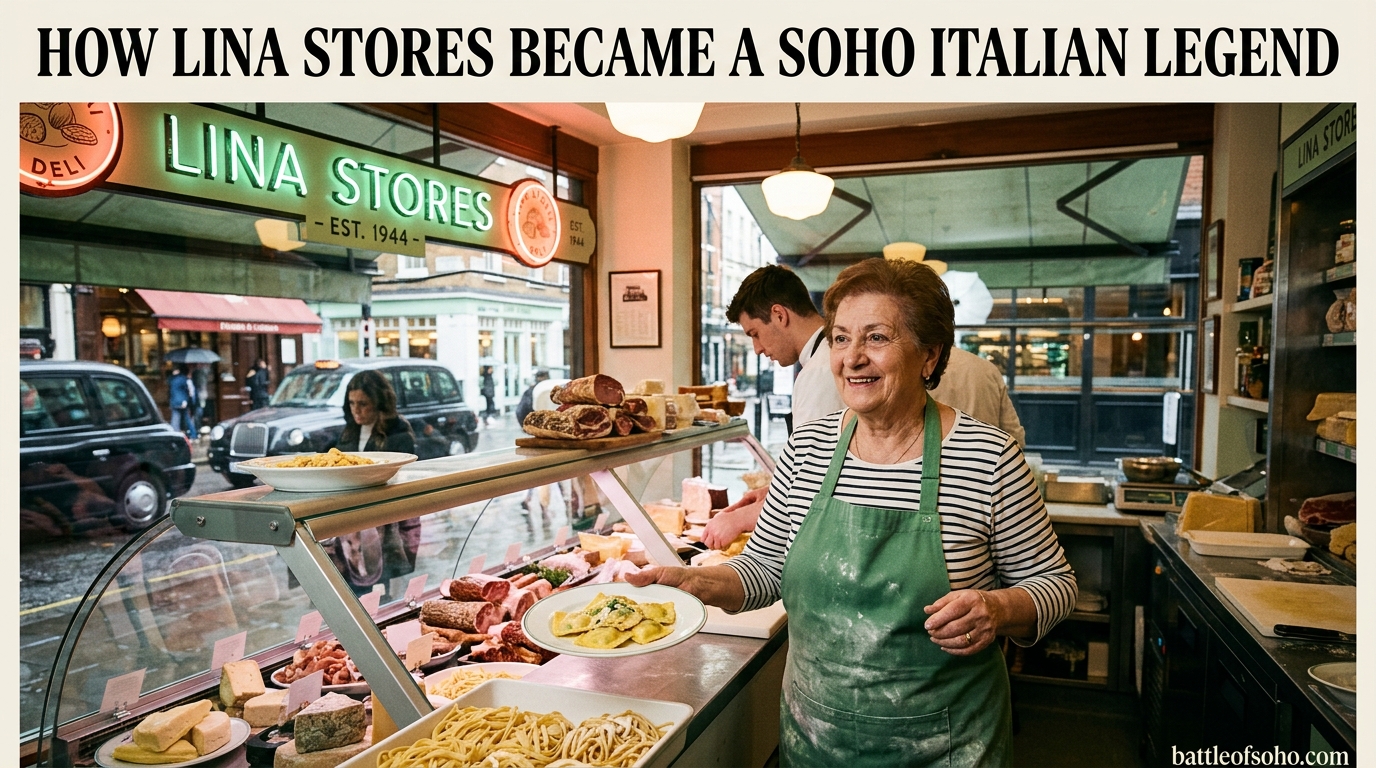
Walk down Brewer Street in London’s Soho any day of the week and you cannot miss it. That unmistakable pistachio-green storefront, the pyramids of Parmigiano Reggiano stacked behind the glass, the scent of fresh pasta hanging in the air. Lina Stores has been standing at number 18 since 1944, and in the eight decades since, it has become something far bigger than a delicatessen. It is a Soho Italian legend.
But how did a single deli run by an immigrant from a small town near Genoaa grow into one of the most beloved names in London food? That story involves a remarkable woman named Lina, a partnership forged in postwar Soho, handmade pasta that changed how Londoners ate, and a community of Italians who made this neighbourhood their own. Here is how Lina Stores became a Soho Italian legend.
We have traced the full arc of this story, from Lina Parisio’s arrival in London through to the modern restaurant group operating across the city and beyond. What emerges is not just a business history but a portrait of how food, identity, and place can intertwine to create something genuinely irreplaceable.
Table of Contents
How Lina Stores Became a Soho Italian Legend: The Founding Story
The story begins in Acqui Terme, a small town in Piedmont not far from Genoa. This is where Lina Parisio was born, and it is where her connection to Italian food culture first took root. The details of her early life paint a picture of resilience. She came to London as an orphan, carrying with her the food traditions of northern Italy and a determination to build something of her own.
In 1944, during the final stretch of the Second World War, Lina opened her delicatessen at 18 Brewer Street. This was not an obvious moment to launch a food business. London was scarred by bombing, rationing was in full force, and the idea of selling Italian olive oil and Parma ham to Londoners seemed, at best, ambitious. But Lina understood something that many did not. There was a community of Italians already living in Soho who were desperate for a taste of home.
Those early years were about survival as much as commerce. Olive oil was so scarce in wartime Britain that it was sometimes sold at the chemist rather than the grocery. Parmigiano Reggiano and Prosciutto di Parma were virtually impossible to find anywhere else in London. Lina Stores filled that gap, and in doing so, it became a lifeline for homesick Italians scattered across the city.
The founding vision was simple but powerful. Lina wanted to bring authentic Italian produce to a city that had almost no access to it. She imported artisanal products through a network that eventually grew into a wholesale operation called Continental Produce Importers. This allowed her to stock goods that no other shop in London carried. What started as a small deli quickly became a destination for anyone in Britain who understood real Italian food.
Lina and Emilio: A Partnership Built on Pasta
Lina did not build this legend alone. She met Enrico Emilio Crippa, an engineering fitter who had come to London through work connected to the Italian Hospital. Their meeting was the beginning of both a marriage and a business partnership that would define Lina Stores for decades.
Emilio brought a different set of skills to the operation. Where Lina was the formidable presence behind the counter, the woman regulars called “the smiling lady” of Soho, Emilio handled the logistics, the importing, and the mechanics of running a growing food business. Together they built Continental Produce Importers into a wholesale operation that supplied Italian restaurants and delis across the country.
Their partnership was rooted in a shared understanding that quality came before everything else. They imported olive oil, cured meats, cheeses, and pantry staples that simply could not be found elsewhere in postwar Britain. This was not about riding trends or chasing profit margins. It was about making sure that the Italian community in London could eat the food they grew up with, prepared with the ingredients they trusted.
One detail from this era captures the spirit of Lina and Emilio’s operation better than any balance sheet. In the early days, they used to deliver fresh pasta to customers around Soho by strapping boxes to the back of their dog. It is the kind of story that sounds almost too charming to be true, but it speaks to the scrappy, personal, deeply hands-on nature of what they built. This was a family business in the truest sense, powered by ingenuity and a refusal to compromise on the food they served.
Lina remained the face of the store for decades. Customers remember her standing behind the counter, recommending cheeses, cutting prosciutto to order, greeting regulars by name. She became a fixture of Soho life, and through her presence, the shop became more than a place to buy food. It became a gathering point for the Italian community and for the growing number of Londoners who were discovering what real Italian cooking tasted like.
18 Brewer Street: A Building With History
The physical home of Lina Stores has its own story worth telling. Number 18 Brewer Street was not always a deli. Before Lina took it over in 1944, the building had served as a saddlery, a dentist’s office, and a hairdresser’s shop. Each of those incarnations left their mark on the structure, and the building carries layers of Soho history within its walls.
There is a cultural footnote that adds weight to this address. The Irish writer Samuel Beckett, one of the most important literary figures of the twentieth century, had connections to this part of Soho during his time in London. The building at 18 Brewer Street sits within a streetscape that has hosted artists, writers, and bohemians for well over a century. Lina Stores did not just occupy a shop unit. It became part of a cultural geography that defines Soho’s identity.
Then there is the colour. That pistachio-green exterior is not just a design choice. It is a landmark. For decades, Londoners have used it as a meeting point, a navigational aid, a visual shorthand for Italian food in the West End. The green facade has been repainted and refreshed over the years, but the colour has never changed. It is as much a part of the brand as the name itself.
In a neighbourhood where businesses come and go with alarming speed, the fact that Lina Stores has occupied the same building for over 80 years is remarkable. Brewer Street has seen transformations, demolitions, and reinventions. But that green frontage has remained constant, a thread of continuity running through eight decades of London history.
Soho’s Italian Community: The World That Built Lina Stores
You cannot understand how Lina Stores became a Soho Italian legend without understanding the Italian community that surrounded it. Soho’s Italian presence stretches back to the late nineteenth and early twentieth centuries, when immigrants from northern Italy settled in the area around Clerkenwell and Soho. By the 1920s, there was a thriving Italian quarter with its own cafes, grocers, social clubs, and community infrastructure.
The Italian Hospital on Queen Square was a cornerstone of this community. It provided healthcare for Italian immigrants and served as a social hub where newcomers could find support and connections. Emilio Crippa’s path to London ran through this institution, and many of Lina Stores’ earliest customers were Italians connected to the hospital and the wider community network.
Italian delis were more than shops in this context. They were anchors. Places like Lina Stores and I Camisa and Son on Old Compton Street served as meeting points where Italians could speak their language, buy familiar products, and maintain a connection to their homeland. These shops were the social infrastructure of a community that was trying to put down roots in a city that did not always welcome them.
The contrast between Lina Stores and I Camisa and Son tells a revealing story about survival in modern Soho. Camisa, which had been serving the Italian community since 1929, closed its doors permanently during the COVID-19 pandemic. The closure was met with genuine grief from London’s Italian community. Lina Stores, facing the same pressures, adapted and survived. That difference in outcomes says much about how each business evolved and who was running them when the crisis hit.
Today, the Italian community in Soho is a fraction of what it once was. Property prices, changing demographics, and the transformation of Soho into an entertainment and hospitality district have dispersed the community that created these institutions. But the legacy remains, and Lina Stores stands as the most visible reminder of the Italian Soho that once was.
Fresh Handmade Pasta: The Heart of the Legend
If there is one thing that elevated Lina Stores from a good deli to a Soho Italian legend, it is the fresh handmade pasta. This is where the business found its true identity and what set it apart from every other Italian shop in London.
Lina Stores has been producing fresh pasta on site for most of its history. The signature shapes include agnolotti, the stuffed pasta from Piedmont that connects back to Lina’s own roots near Acqui Terme, as well as tagliatelle, ravioli, tortellini, and seasonal specials. The pasta is made by hand using techniques that have been passed down through generations of Italian cooks. This is not factory production. It is a craft.
In 2018, Lina Stores took a step that many had been waiting decades for. They opened a full restaurant on Greek Street, just around the corner from the original deli. The restaurant featured an open kitchen where customers could watch pasta being made in real time. Head chef Masha Rener, who came from La Chiusa, an organic farm and restaurant in Umbria, brought a philosophy that matched the deli’s heritage. She described fresh pasta making as a craft, not a process, and her menus reflected a commitment to seasonal, authentic Italian cooking.
The restaurant was a turning point. For 75 years, Lina Stores had been a place where you bought pasta to take home and cook yourself. Now you could sit down and eat it there, prepared by chefs who understood the traditions behind it. The Greek Street venue was followed by additional locations, each one extending the brand while trying to stay true to the handmade pasta heritage that made the original deli famous.
That pasta heritage matters because it represents something larger than the food itself. In postwar Britain, where Italian cuisine was poorly understood and often reduced to spaghetti bolognese and tinned tomatoes, Lina Stores was teaching Londoners what real Italian food looked like. Every plate of handmade tagliatelle, every carefully filled agnolotto, was an act of cultural education. That is how a deli becomes a legend.
Family Succession: Keeping the Legacy Alive
One of the most remarkable aspects of Lina Stores’ history is how it passed through multiple Italian families while maintaining its identity. Lina and Emilio ran the business together for decades, but eventually the time came to pass it on.
Alberto and Rita Seradi were the next custodians. They took over the deli and continued the traditions that Lina had established. Under their stewardship, the shop maintained its reputation for quality Italian produce and fresh pasta. The transition from one Italian family to another meant that the cultural DNA of the business stayed intact. This was not a corporate acquisition. It was a continuation of a community tradition.
After the Seradi era, the Filippi family took ownership. Again, the baton was passed within the Italian community, and again, the shop’s core identity was preserved. Each family that ran Lina Stores understood what it represented to the Italian community in London and to the growing number of British customers who had come to love the food.
This pattern of family succession is important because it explains how Lina Stores maintained its authenticity over such a long period. When ownership stays within a community that shares the same food culture, the same language, and the same values, the business does not drift. It stays rooted. That rooting is a big part of why Lina Stores survived when so many other Soho institutions did not.
Eventually, the ownership story took a different turn. But by the time the business left Italian family hands, it had accumulated 70-plus years of cultural capital. That capital proved strong enough to carry the brand into its next chapter.
Famous Faces and Cultural Impact
Lina Stores’ reputation spread far beyond the Italian community. Its location in the heart of Soho, within walking distance of Theatreland, meant that it attracted a clientele that ranged from West End actors to international celebrities.
The most famous endorsement came from Luciano Pavarotti. The legendary tenor visited Lina Stores and described it as “a little piece of Italy” in London. Coming from one of the most famous Italians of the twentieth century, that description carried enormous weight. It was not a paid endorsement or a marketing partnership. It was a genuine reaction from a man who recognised the authenticity of what Lina Stores represented.
Pavarotti was far from the only famous face to pass through those doors. Over the decades, West End performers, musicians, writers, and film directors who lived or worked in Soho became regulars. The proximity to the theatres made it a natural stopping point for pre-show meals and post-show suppers. For actors and creatives who spent their evenings in the West End, Lina Stores became part of the rhythm of their professional lives.
This celebrity connection reinforced the deli’s status as an institution. It was not just a shop. It was a place where culture happened, where the creative life of Soho intersected with the food traditions of Italy. That intersection is rare, and it helps explain why Lina Stores occupies such a special place in London’s cultural memory.
The Green Brothers Era: From Deli to Empire
The most significant transformation in Lina Stores’ recent history came when Edward and Max Green acquired the business. The Green brothers, who have been described as public-school entrepreneurs, saw potential in a single delicatessen that had been operating on Brewer Street for over seven decades. They brought a vision for growth that went far beyond what any previous owner had attempted.
Under the Greens’ ownership, Lina Stores expanded from one location to a small empire. New restaurants opened in South Kensington, Shoreditch, and King’s Cross. The brand went international with locations in Japan. More recently, Lina Stores expanded to Manchester, bringing the Soho Italian legend to audiences far beyond London.
The numbers tell the story of this transformation. Lina Stores reportedly grew to a turnover in the range of 24.5 million pounds with approximately 75 employees. This is a staggering trajectory for a business that began with Lina Parisio strapping pasta boxes to a dog’s back. The Greens preserved the visual identity, the pistachio-green aesthetic, the focus on fresh pasta, while scaling it into something that could compete in the modern restaurant market.
Not everyone has welcomed this transformation. Some long-time customers and observers have expressed concern that Lina Stores feels more like a chain than a family deli. Forum discussions among London food enthusiasts reveal mixed feelings. Some praise the consistent quality across locations. Others feel that something intangible has been lost in the transition from community institution to restaurant group.
The contrast with I Camisa and Son is instructive here. Camisa closed during COVID, unable to weather the combination of pandemic disruption and the broader pressures facing independent food businesses in central London. Lina Stores, with the financial backing and operational infrastructure of the Green brothers’ operation, was able to survive. Whether survival at the cost of some authenticity is a fair trade is a question that each customer answers for themselves.
The Soho Italian Legend Today: Legacy and Challenges
As of 2026, Lina Stores is over 80 years old. That fact alone is extraordinary in a city where restaurants and shops routinely open and close within a single year. But the anniversary comes at a complicated moment for the business and for Soho itself.
The challenges are real. Online reviews and forum discussions suggest that some customers feel the quality of food at the newer restaurant locations does not always match the standard set by the original deli. Complaints about food arriving lukewarm, tables packed too closely together, and a sense that the experience has become more commercial all surface regularly in customer feedback. These are not fatal problems, but they do reflect the tension between scaling a brand and maintaining the handmade, personal quality that made it famous.
Gentrification has reshaped Soho in ways that Lina Stores’ founders could never have imagined. The neighbourhood that once housed a close-knit Italian community is now dominated by bars, clubs, and corporate hospitality venues. Planning law changes, particularly the introduction of use class E, have made it easier for traditional retail and food businesses to be converted into other types of premises. This has contributed to the erosion of the independent food culture that once defined the area.
COVID-19 was a watershed moment. The pandemic hit central London harder than almost anywhere else, as office workers disappeared and tourism ground to a halt. Businesses that had operated for decades, like I Camisa and Son, did not survive. Lina Stores did, partly because of its expanded footprint across multiple neighbourhoods and partly because of the financial structure behind it. But the Soho that Lina Stores returns to each morning is not the same Soho where Lina Parisio opened her doors in 1944.
The question for the future is whether Lina Stores can continue to honour its heritage while operating at scale. The original deli on Brewer Street still stands, still painted that pistachio green, still selling fresh pasta and Italian produce. That continuity is the brand’s greatest asset. If the Green brothers and their successors can protect that core while growing the business around it, there is no reason the Soho Italian legend cannot endure for another 80 years.
FAQs
What is the story behind Lina Stores?
Lina Stores was founded in 1944 by Lina Parisio, an orphan from Acqui Terme near Genoa, who opened an Italian delicatessen at 18 Brewer Street in London’s Soho. Together with her husband Enrico Emilio Crippa, she built the business into a cornerstone of the Italian community in London, importing authentic Italian produce and making fresh handmade pasta on site.
When did Lina Stores open?
Lina Stores opened in 1944, during the final years of the Second World War, at 18 Brewer Street in Soho, London. It has been operating from the same location for over 80 years.
Who founded Lina Stores?
Lina Stores was founded by Lina Parisio, who was born in Acqui Terme in Piedmont, Italy. She later partnered with Enrico Emilio Crippa, whom she married, and together they ran the deli and a wholesale importing business called Continental Produce Importers.
Are there Lina Stores outside of London?
Yes. Under the ownership of Edward and Max Green, Lina Stores expanded beyond its original Soho location to include restaurants in South Kensington, Shoreditch, and King’s Cross in London, as well as locations in Manchester and internationally in Japan.
Is Lina Stores expensive?
Lina Stores sits in the mid-to-premium price range for Italian dining in London. While the deli counter offers products at various price points, the restaurants are positioned as quality-led dining experiences. Some customers on forums have noted that prices have increased as the brand has expanded.
Conclusion: A Legend That Endures
The story of how Lina Stores became a Soho Italian legend is really a story about what happens when one person’s love for their food culture meets a city hungry for something authentic. Lina Parisio arrived in London with nothing but her heritage and her determination. She left behind a business that has fed generations of Italians and Londoners, trained a city to appreciate real pasta, and outlasted almost every competitor in one of the world’s most demanding food markets.
The Lina Stores Soho Italian legend is not just about the past. It is a living institution that continues to evolve, to face new challenges, and to spark debate about what authenticity means in a city that changes faster than almost any other. Whether you visit the original deli on Brewer Street or one of the newer restaurants across London and beyond, you are tasting a piece of history that stretches back to wartime Soho and a woman from Acqui Terme who refused to let her food traditions die.
If you have never walked past that pistachio-green storefront, make time for it. Stand on Brewer Street, look at the same facade that has greeted customers since 1944, and step inside. You will understand immediately why this place became a legend.