
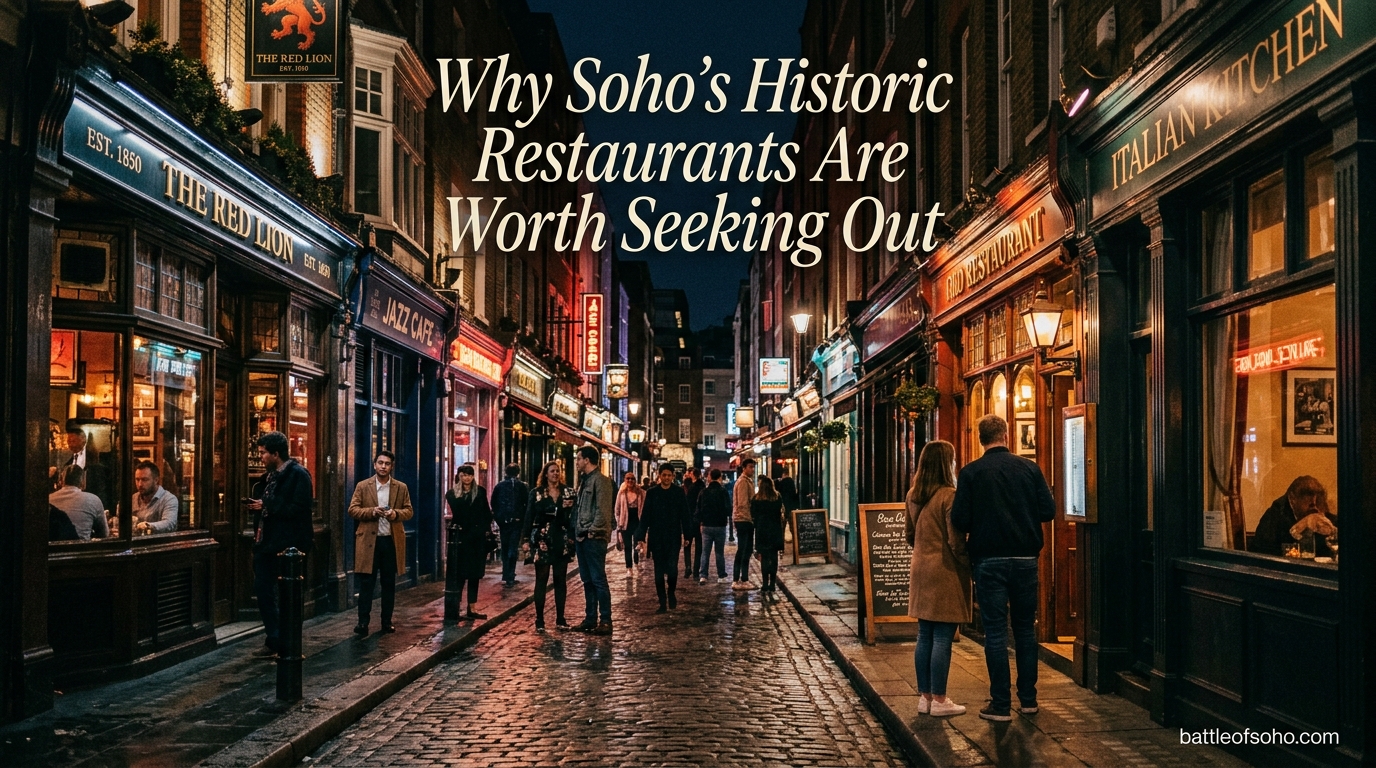
Walk down any street in Soho today and you will find the ghosts of centuries past sitting alongside the latest openings. This tiny square mile in the heart of London’s West End has been feeding people since before the United States existed as a nation. Understanding why Soho’s historic restaurants are worth seeking out means understanding something fundamental about London itself, a city that has always reinvented itself while stubbornly refusing to let go of the places that matter.
I have spent years eating my way through Soho, from four-hour lunches at places that look like they have not been redecorated since the Blitz, to standing-room-only coffee bars where the same families have been pulling espresso shots since the 1940s. What I have learned is that these are not just restaurants. They are living museums, community centres, and time capsules all rolled into one.
In this guide, I want to take you through why these places matter so much. We will cover the full history of Soho dining, from its origins as a royal hunting ground to the immigrant communities that shaped its food culture. I will profile the eight most important historic restaurants still standing, share a walking tour you can follow, and give you practical tips for actually getting a table at places where booking can feel like winning the lottery.
If you care about food, history, or simply want to experience the real London that exists beyond the tourist trail, Soho’s historic restaurants are worth seeking out in a way that nowhere else in the city can match.
Table of Contents
From Hunting Ground to Dining Destination: How Soho Was Born
Soho’s name itself comes from a hunting call. Back in the 1500s, this area was open farmland and fields used as a royal hunting ground by Henry VIII and his court. When hunters spotted their prey, they would shout “Soho!” as a rallying cry, the same way hunters in other parts of England shouted “Tally-ho!” when they spotted a fox. That cry became the name of the land.
The transformation from hunting ground to neighborhood began in the late 1600s. Landowners started laying out streets and building houses, and by the early 1700s Soho had become a densely populated residential area. The Georgian townhouses that went up during this period, many of which still stand today, would eventually become the physical homes of some of London’s most famous restaurants.
What made Soho different from other London neighborhoods was its openness to outsiders. From the very beginning, Soho attracted immigrants, artists, and people who did not quite fit in elsewhere. French Huguenots fleeing religious persecution arrived in the late 1600s and early 1700s, bringing their food culture with them. Italian immigrants followed in the 1800s, establishing the coffee houses and ice cream parlours that would become Soho institutions.
By the Victorian era, Soho had earned a reputation as both a slum and a cultural centre. A 1906 Metropolitan Police inspector famously called Greek Street “the worst street in the West End.” But that rough, mixed, unrespectable character was exactly what made Soho interesting. It was the place where writers, artists, political radicals, and bohemians gathered, and they all needed somewhere to eat and drink.
That combination of cheap rents, central location, and a population drawn from every corner of the world created the perfect conditions for a remarkable restaurant scene to develop. By the late 1800s, Soho had become the place to eat in London if you wanted something that was not plain British cooking. French, Italian, Greek, and Chinese restaurateurs all set up shop within a few streets of each other.
Understanding this history is essential to understanding why Soho’s historic restaurants are worth seeking out. These places did not just appear. They grew out of a specific neighborhood with a specific character, and many of them have been serving the same neighborhoods, the same dishes, and sometimes even the same families for well over a century.
A Timeline of Soho’s Restaurant History
One of the things that makes Soho’s dining heritage so remarkable is the sheer depth of time involved. Here is a timeline of the key moments that shaped Soho’s restaurant scene.
1536 onwards: Henry VIII uses the Soho area as a royal hunting ground. The hunting cry “Soho!” gives the area its name.
1670s-1690s: Landowners begin developing Soho into a residential neighborhood. Georgian townhouses are built, many of which later house restaurants.
1685 onwards: French Huguenot refugees arrive in Soho, establishing the French food culture that continues to this day.
1798: Rules opens, eventually becoming London’s oldest surviving restaurant. It serves traditional British game cookery in a setting barely changed in over two centuries.
1800s: Italian immigrants begin arriving in significant numbers. Coffee houses, ice cream shops, and Italian restaurants start appearing on Soho’s streets.
1871: Maison Bertaux opens, becoming London’s oldest patisserie. A French woman fleeing the Franco-Prussian War founds it, and it remains family-run to this day.
1891: The German-owned pub that would become The French House gets its first license. It becomes the epicentre of bohemian Soho, famous for serving beer in half-pints only.
1896: Georges Gaudin establishes L’Escargot in a 1741 Georgian townhouse on Greek Street. It becomes London’s oldest French restaurant.
1920s-1930s: Chinatown begins to take shape around Gerrard Street, adding Cantonese cuisine to Soho’s mix. Quo Vadis opens on Dean Street, in a building where Karl Marx once lived.
1949: Bar Italia opens on Frith Street, founded by the Polledri family. It quickly becomes the beating heart of Soho’s Italian community and a 24-hour fixture of neighborhood life.
1950s-1960s: Soho’s reputation as a centre of counterculture, nightlife, and gangland activity peaks. Restaurants, cafes, pubs, and private members clubs operate side by side in a neighborhood that never sleeps.
1980s-2000s: Rising rents and gentrification begin to threaten old Soho. Some historic venues close, including the legendary Gaggia restaurant on Dean Street that had served coffee since the 1960s.
2010s-present: A new wave of appreciation for old Soho emerges. The Devonshire opens and is celebrated for embodying “old Soho in spirit.” Campaigns to preserve remaining historic venues gain momentum.
The Immigrant Communities That Built Soho’s Dining Scene
You cannot talk about why Soho’s historic restaurants are worth seeking out without talking about immigration. Every wave of people who came to Soho brought their food with them, and over centuries those contributions layered on top of each other to create something genuinely unique in British dining.
The French were first. Huguenot refugees arriving in the late 1600s and early 1700s brought French cooking techniques, recipes, and a food culture that valued good ingredients and proper preparation. This French influence never left. L’Escargot has been serving classic French cuisine since 1896, and The French House has been pouring wine and pastis for bohemian Soho since the late 1800s.
The Italians arrived in the 1800s and transformed Soho’s cafe culture. Families like the Polledris at Bar Italia and the owners of Maison Bertaux built businesses that have now been running for multiple generations. These were not just restaurants. They were community hubs where Italian immigrants could hear their own language, eat food from home, and find a sense of belonging in a new country.
The Chinese community arrived in significant numbers after World War II, turning the area around Gerrard Street into London’s Chinatown. Chinese restaurants, grocery stores, and bakeries added an entirely new dimension to Soho’s food scene, one that continues to thrive and evolve today.
Greek, Spanish, Lebanese, and Jewish immigrants all contributed as well. The result was a neighborhood where you could eat food from a dozen different countries within a five-minute walk. This diversity is not a recent development. It has been building for over 300 years, and the historic restaurants that survive are living proof of every chapter of that story.
When you eat at one of Soho’s historic restaurants, you are not just having a meal. You are participating in a centuries-long story of migration, adaptation, and cultural exchange. That is what makes these places worth seeking out in a way that a new opening, however exciting, simply cannot match.
The Historic Restaurants Worth Seeking Out
Here are the eight most important historic restaurants and dining institutions in Soho that I believe are genuinely worth seeking out. Each one represents a different chapter in Soho’s food story.
Rules (Founded 1798)
Rules is not just the oldest restaurant in Soho. It is the oldest restaurant in London, and one of the oldest in the world still operating. Founded in 1798 by Thomas Rule as an oyster bar, it has been serving customers from the same Covent Garden location for over 225 years.
The restaurant specialises in traditional British cookery, particularly game. Rules has its own estate in the Pennines, so the grouse, pheasant, and venison on the menu often come directly from their own land. The interior is pure Victorian grandeur, all red velvet, dark wood, crystal chandeliers, and oil paintings covering every inch of wall space.
Charles Dickens was a regular. So were H.G. Wells, Laurence Olivier, and Clark Gable. The restaurant has appeared in literature and film more times than anyone has properly counted. Eating here feels like stepping into a Victorian novel, except the food is real and it is genuinely excellent.
What makes Rules worth seeking out is that it has survived every upheaval London has thrown at it. The Blitz, the Depression, two world wars, multiple recessions, and the complete transformation of British dining culture. Through all of it, Rules kept serving steak and kidney pudding and oysters and game, exactly the way it always has. That kind of endurance is not just impressive. It is genuinely moving.
L’Escargot (Building 1741, Restaurant 1896)
L’Escargot occupies a magnificent Georgian townhouse on Greek Street that was built in 1741, making the building itself older than the United States. The restaurant was established in 1896 by Georges Gaudin, and it holds the title of London’s oldest French restaurant.
The name comes from the snails that are the restaurant’s signature dish. The interior is divided across multiple floors, with the ground floor decorated with paintings by artists like Miró and Matisse (originals, not prints, in the old days). The dining rooms feel like a private club in the best possible way.
Regulars over the years have included everyone from Charles de Gaulle to Frank Sinatra. The restaurant has weathered changing fashions in dining by simply refusing to chase trends. The menu still features the same classic French dishes that would have been served a century ago, executed with the kind of care that can only come from generations of practice.
The building alone makes L’Escargot worth visiting. This is one of the finest surviving Georgian townhouses in Soho, and dining inside it connects you directly to the 1700s when Soho was still becoming the neighborhood we know today.
The French House (Founded 1891)
The French House on Dean Street is not a restaurant in the traditional sense, but it is impossible to write about Soho’s dining heritage without it. This pub has been the social centre of bohemian Soho since the late 1800s, and its influence on London’s cultural history is immeasurable.
The pub’s most famous rule is that it only serves beer in half-pints. This sounds odd until you understand the reasoning. The idea is to encourage conversation and pace rather than rapid consumption. It works. The French House has always been a place where people come to talk, argue, make deals, and make art, not to get drunk quickly.
The list of famous regulars reads like a who’s who of 20th century culture. Dylan Thomas, Brendan Behan, Lucian Freud, Francis Bacon, and Karl Marx (in the neighborhood, if not this specific pub) all drank here. General de Gaulle used the pub as a base during World War II and allegedly wrote “À tous les Français” on the wall, a rallying cry for Free France.
What makes The French House worth seeking out is its total refusal to change. There is still a no-screens policy, meaning no phones and no laptops. The atmosphere is exactly what it has been for decades. In a Soho that is increasingly dominated by chains and polished new openings, The French House remains gloriously, stubbornly itself.
Bar Italia (Founded 1949)
Bar Italia opened on Frith Street in 1949, founded by the Polledri family who had emigrated from Italy. Over 75 years later, it is still family-run and still one of the most beloved spots in all of Soho.
The bar operates 24 hours a day, which alone makes it a Soho institution. At any hour of the day or night, you can walk in and get a genuinely excellent espresso, a glass of wine, or a plate of simple Italian food. The pavement seating out front is prime people-watching territory, and on warm evenings it feels like a slice of Italian life dropped into the middle of London.
Bar Italia is also famous for its connection to television history. John Logie Baird gave the first public demonstration of television in the building above the bar in 1926. There is a plaque on the wall commemorating this, which most customers walk right past without noticing.
The coffee here is taken seriously in a way that most London coffee shops can only dream of. The espresso machine is constantly in use, the pastries are fresh, and the staff know their regulars by name. What makes Bar Italia worth seeking out is that rare combination of genuine history, genuine quality, and genuine community. Nothing about it is manufactured or nostalgic. It just is what it is, and it has been for nearly eight decades.
Maison Bertaux (Founded 1871)
Maison Bertaux is London’s oldest patisserie, founded in 1871 by a French woman who had fled the Franco-Prussian War. Tucked into Greek Street, it has been serving French pastries, cakes, and coffee for over 150 years.
The interior is tiny and slightly chaotic in the best way. There are only a handful of tables spread across two narrow floors, and every surface is covered with photos, postcards, and memorabilia accumulated over a century and a half of operation. Sitting upstairs feels like being in someone’s eccentric French grandmother’s apartment.
The pastries are the real reason to come. Maison Bertaux makes eclairs, mille-feuille, tarts, and cakes using recipes that have barely changed since the 19th century. The croissants in the morning are worth queuing for. The hot chocolate is thick enough to stand a spoon in.
What makes this place worth seeking out is its total commitment to doing things the old way. There is no website that tries to make it look cool. There is no rebranding. There are no fusion pastries. Maison Bertaux just keeps doing what it has done since 1871, and the result is one of the most authentic dining experiences you can have in London.
Quo Vadis (Founded 1926)
Quo Vadis sits on Dean Street in a building with an extraordinary history. Karl Marx lived here in the 1850s while writing Das Kapital, and the building has a blue plaque commemorating that fact. The restaurant itself was founded in 1926, making it nearly a century old.
The name Quo Vadis, Latin for “where are you going?”, has a wry appropriateness for a Soho restaurant. The establishment has reinvented itself several times over the decades while maintaining its core identity as a serious, old-school Soho dining room. The ground floor bar and dining room have a classic members club feel, all dark wood and leather.
The food has evolved more than at some other historic venues. Under various chefs over the years, Quo Vadis has maintained a reputation for excellent British cooking with classical French technique. The menu changes with the seasons, but the quality and the setting remain consistent.
What makes Quo Vadis worth seeking out is the layering of history. You are eating in a building where one of the most influential political thinkers in history lived and worked, in a restaurant that has its own century of stories. Few dining rooms in London can match that combination of intellectual heritage and culinary quality.
The Coach and Horses (Founded 1847)
The Coach and Horses on Greek Street is one of Soho’s most famous pubs and a Grade II listed building. Founded in 1847, it has been at the centre of Soho’s drinking and dining culture for nearly 180 years.
The pub’s modern identity was largely shaped by Norman Balon, who served as landlord for an astonishing 63 years from 1945 to 2008 and was known as “the rudest landlord in London.” Under Norman’s tenure, the Coach and Horses became the unofficial canteen for Private Eye magazine, with many of the satirical magazine’s editorial meetings held over pints at a corner table. The journalist Jeffrey Bernard was another famous regular, and his “Low Life” column in The Spectator was largely written from this pub.
The pub is famous for its Friday evening singalongs around the piano, a tradition that goes back decades. It is the kind of place where strangers become friends over the course of an evening, and where the music and conversation flow freely.
What makes the Coach and Horses worth seeking out is that it represents the unpolished, unpretentious side of old Soho. This is not a fine dining establishment. It is a pub that serves solid food, excellent beer, and an atmosphere that money cannot buy. In a neighborhood increasingly dominated by design-conscious new openings, the Coach and Horses remains defiantly itself.
The Devonshire (Modern Classic)
The Devonshire is the newest entry on this list, but I include it because it captures something essential about why old Soho matters. Opened in recent years, it was immediately embraced by Londoners precisely because it felt like old Soho in spirit, a place where the values of historic Soho dining have been recreated for a new generation.
The restaurant built its reputation on a simple but powerful formula. Guinness poured perfectly, steak frites done the classic way, and an atmosphere that feels like it has been there forever even though it has not. Word spread fast, and getting a table became notoriously difficult.
Booking strategy matters here. Tables are released on Thursdays at 10:30am for the following week, and they disappear within minutes. If you want to eat at The Devonshire, you need to be online at exactly the right moment. The effort is worth it.
What makes The Devonshire worth seeking out is what it represents. It proves that the appetite for the kind of dining experience Soho has always offered, straightforward, atmospheric, generous, and unpretentious, is alive and well. The historic restaurants are not just relics. They are the template for what people still want from a great meal out.
The Lethal Triangle: Soho’s Most Legendary Pub Crawl
There is a concept in Soho drinking culture known as “the lethal triangle.” It refers to three establishments that sit within stumbling distance of each other and collectively form the apex of old Soho’s social scene. The three corners of the triangle are The French House, the Coach and Horses, and the Colony Room Club.
The Colony Room was a private members club on Dean Street that operated from 1948 until it closed in 2008. It was famous for its bright green decor, its no-nonsense landlady Muriel Belcher, and its clientele of artists, writers, and celebrities who treated it as a second home. Francis Bacon was a devoted regular, as were Lucian Freud and many other figures from the postwar Soho art scene.
The idea of the lethal triangle is that a determined drinker could work their way around all three in an evening, and by the end would be in what might politely be called a challenging state. The concept captures something important about old Soho culture: the idea that eating and drinking were not just about sustenance but about community, conversation, and a shared way of life.
The Colony Room may be gone, but the concept of the lethal triangle still shapes how people understand Soho’s hospitality culture. The French House and the Coach and Horses carry on the tradition, and newer establishments like The Devonshire have picked up the mantle in their own way. Understanding this cultural concept is part of understanding why Soho’s historic restaurants are worth seeking out. They are not isolated businesses. They are interconnected nodes in a social network that has existed for generations.
What Makes Old Soho Restaurants Worth Seeking Out
So what exactly is it that makes these places so special? After years of eating in Soho, I have identified five things that set the historic restaurants apart from everywhere else.
1. Atmosphere that cannot be manufactured. You cannot fake 200 years of history. The worn wood, the faded photos, the slightly sticky floors, the bartenders who know every regular by name. These things only come with time, and they create an atmosphere that no amount of interior design spending can replicate. When you walk into The French House or the Coach and Horses, you feel the accumulated weight of every conversation, argument, deal, and romance that has happened in that room. That feeling is the product, not just the food.
2. Famous regulars and cultural connections. These are the places where Dickens ate, where Marx drank, where Bacon held court, where Bourdain came when he wanted to show viewers the real London. That history is not a marketing gimmick. It is a genuine part of what you experience when you visit. You are sitting in the same seat, looking at the same walls, eating food from the same recipes as some of the most interesting people who have ever lived in London.
3. Signature dishes with real history. The steak and kidney pudding at Rules. The snails at L’Escargot. The eclairs at Maison Bertaux. The espresso at Bar Italia. These are not just items on a menu. They are dishes that have been refined over generations, dishes that people have crossed London for over decades or centuries. When you order them, you are tasting something that has been perfected by time.
4. A refusal to modernize. In an era where restaurants chase trends, redesign their interiors every five years, and change menus to match whatever is on Instagram, Soho’s historic restaurants represent the opposite philosophy. They do what they do, and they keep doing it. The French House still serves only half-pints. Bar Italia still opens 24 hours. Maison Bertaux still uses recipes from the 1800s. This stubbornness is their greatest strength.
5. Community and loyalty. These are not just tourist attractions. They are real neighbourhood spots with real regulars. The same families have been coming for generations. The staff have often worked there for decades. When you eat at one of these places, you are joining a community, not just making a transaction. That sense of belonging, even as a first-time visitor, is something that chain restaurants and trendy new openings can never provide.
What Has Been Lost and What Survives
It is important to acknowledge that Soho’s historic restaurant scene is not what it once was. Decades of rising rents, redevelopment, and changing tastes have taken their toll, and some genuinely important places have been lost.
Gaggia on Dean Street is one of the most mourned losses. Opened in the 1960s, this Italian restaurant was a fixture of Soho life for decades, serving coffee and food to a who’s who of London’s creative community. Its closure removed a piece of living history from the neighborhood.
The Pillars of Hercules on Greek Street, which may date back as far as 1714, was another landmark. It was refurnished and rebranded as “Bar Hercules,” losing much of its original character in the process. For many Soho regulars, this was a cautionary tale about what happens when commercial pressure overrides respect for history.
The broader story is one of gentrification. Soho’s central location and cultural cachet make its real estate among the most valuable in London. Small, independent, family-run businesses operate on margins that cannot always absorb rent increases, and each closure removes another thread from the neighborhood’s fabric.
This is exactly why supporting the surviving historic restaurants matters so much. Every meal you eat at Rules, every pint at the Coach and Horses, every coffee at Bar Italia is a vote for the kind of London that values history over homogeneity. These places need customers to survive, and choosing to spend your money and time at them is a practical way to help preserve what makes Soho special.
The good news is that there is still a great deal worth fighting for. The eight restaurants profiled above are all still operating, and many of them are thriving. New appreciation for old Soho, driven partly by nostalgia and partly by a genuine recognition of quality, has brought new energy to the surviving institutions. The challenge is keeping that energy going.
A Walking Tour of Soho’s Historic Restaurants
One of the best ways to experience why Soho’s historic restaurants are worth seeking out is to do a walking tour. The neighborhood is compact enough that you can visit multiple historic venues in a single afternoon or evening. Here is a route I recommend.
Stop 1: Rules (35 Maiden Lane). Start at the oldest restaurant in London. Maiden Lane is just south of the main Soho strip, and Rules is a short walk from Covent Garden tube. Go for lunch if you can, order the game if it is in season, and take time to look at the art on the walls.
Stop 2: Bar Italia (22 Frith Street). Walk north into the heart of Soho. Stop at Bar Italia for an espresso and a pastry. If it is a nice day, stand at the pavement counter and watch Frith Street go by. This is prime people-watching territory.
Stop 3: Maison Bertaux (28 Greek Street). Walk one street over to Greek Street. Maison Bertaux is just around the corner. Have a cake and a coffee upstairs, surrounded by decades of accumulated memorabilia. Take your time.
Stop 4: L’Escargot (48 Greek Street). You are already on Greek Street, and L’Escargot is a few doors down. This is an excellent spot for a proper lunch or dinner. Order the snails, obviously, and take in the Georgian architecture.
Stop 5: The French House (49 Dean Street). Walk one street east to Dean Street. The French House is the perfect place for a half-pint and a conversation. Remember: no screens, no phones, just talk.
Stop 6: The Coach and Horses (29 Greek Street). Head back to Greek Street for a final pint at the Coach and Horses. If it is a Friday evening, you may catch the legendary singaround. This is the perfect way to end a tour of historic Soho.
This walking tour covers about half a mile of walking total and takes you through 200 years of Soho dining history. You can do it in a single afternoon, or spread it across multiple visits. Either way, by the end you will have a deep, visceral understanding of why these places matter.
Practical Tips for Visiting Soho’s Historic Restaurants
Knowing where to go is only half the battle. Here are some practical tips I have picked up over the years for getting the most out of your visits to Soho’s historic restaurants.
Booking strategies. Some of these places do not take reservations at all. Bar Italia, Maison Bertaux, and The French House operate on a walk-in basis. For places that do take bookings, timing is everything. The Devonshire releases tables on Thursdays at 10:30am for the following week, and they are gone within minutes. Rules and Quo Vadis take advance bookings, but weekend slots fill up weeks ahead. Book as early as you possibly can.
Best times to visit. Weekday lunches are generally easier to get into than weekend dinners, and the atmosphere at lunchtime is often more relaxed. Bar Italia is wonderful in the early morning when the neighborhood is still quiet. The Coach and Horses is best on a Friday evening for the singaround, but get there early to get a table.
Budget considerations. These restaurants range from genuinely affordable to quite expensive. Bar Italia and Maison Bertaux are budget-friendly. The French House is a standard pub price point. Rules, L’Escargot, and Quo Vadis are proper restaurant prices, so plan accordingly. The Devonshire sits in the middle. None of these places are cheap, but most offer good value for the quality and history you get.
What to order. Order the thing each place is famous for. The snails at L’Escargot. The game at Rules. The eclairs at Maison Bertaux. The espresso at Bar Italia. The Guinness at The Devonshire. These signature dishes are what these restaurants built their reputations on, and they remain the best things on the menu.
Respect the culture. The French House has a no-screens policy, and it is enforced. Other historic venues have their own norms. Be respectful of the culture that has made these places what they are. You are visiting their home, in a sense. Behave accordingly and you will be welcomed warmly.
FAQs
What are the oldest restaurants in Soho?
The oldest restaurants in Soho include Rules (founded 1798), L’Escargot (established 1896 in a building from 1741), The French House (licensed since 1891), Maison Bertaux (founded 1871), the Coach and Horses (founded 1847), and Bar Italia (founded 1949). Rules holds the title of the oldest restaurant not just in Soho but in all of London, having served customers from the same location for over 225 years.
Why is Soho famous for restaurants?
Soho is famous for restaurants because its history as a destination for immigrants, artists, and bohemians created a uniquely diverse and vibrant food culture over more than 300 years. French Huguenots, Italian families, Chinese communities, and many others brought their food traditions to Soho’s small geographic area. The neighborhood’s central London location, relatively affordable historic rents, and countercultural reputation made it a magnet for interesting restaurants and the creative communities that sustained them.
What is the oldest restaurant in London?
Rules, founded in 1798 on Maiden Lane in what is now the Soho and Covent Garden area, is the oldest restaurant in London. It has been serving traditional British cuisine, particularly game dishes, from the same location for over 225 years. Famous regulars have included Charles Dickens, H.G. Wells, Laurence Olivier, and Clark Gable.
What makes a restaurant historic?
A restaurant becomes historic through a combination of longevity, cultural significance, and continuity. Truly historic restaurants have operated for decades or centuries, maintained their original character and recipes, built relationships with generations of customers, and played a meaningful role in their neighborhood’s social and cultural life. In Soho, restaurants like Rules and The French House qualify as historic because they have been serving the same community, in the same buildings, with the same ethos for well over a century.
Are Soho’s historic restaurants still worth visiting?
Yes, Soho’s historic restaurants are absolutely still worth visiting. They offer an experience that newer restaurants cannot replicate: genuine atmosphere accumulated over centuries, signature dishes refined across generations, famous regulars whose history you can feel in the walls, and a sense of connection to London’s cultural past. While some venues have been lost to gentrification, the surviving historic restaurants remain among the best dining experiences in London.
Which historic Soho restaurants have celebrity connections?
Many historic Soho restaurants have deep celebrity connections. Rules counted Charles Dickens and Clark Gable as regulars. L’Escargot hosted Charles de Gaulle and Frank Sinatra. The French House was the drinking spot for Dylan Thomas, Lucian Freud, and Francis Bacon. The Coach and Horses was frequented by Jeffrey Bernard and the Private Eye editorial team. Bar Italia has been visited by everyone from Anthony Bourdain to Keith Richards. Quo Vadis occupies a building where Karl Marx once lived.
Conclusion: Why These Places Still Matter
Soho’s historic restaurants are worth seeking out because they are the last living connection to a London that is rapidly disappearing. When you eat at Rules, you are eating in the same room where Dickens ate. When you drink at The French House, you are drinking where Francis Bacon held court for decades. When you order coffee at Bar Italia, you are participating in a tradition that stretches back to 1949 and an immigrant family’s dream of building something lasting in a new country.
These places are not museums. They are working restaurants and pubs, serving genuinely excellent food and drink to customers every single day. They survive because they are good at what they do, not because they are preserved in amber. That combination of real quality and real history is something no new restaurant can manufacture, no matter how much money they spend on design and marketing.
My advice is simple. Go. Visit them. Spend an afternoon doing the walking tour I outlined above. Eat the snails at L’Escargot. Have a half-pint at The French House. Order a cake at Maison Bertaux. These places need customers to survive, and the best way to understand why Soho’s historic restaurants are worth seeking out is to experience them yourself. You will not regret it, and you will come away with a deeper appreciation for what makes this tiny corner of London so endlessly fascinating.