
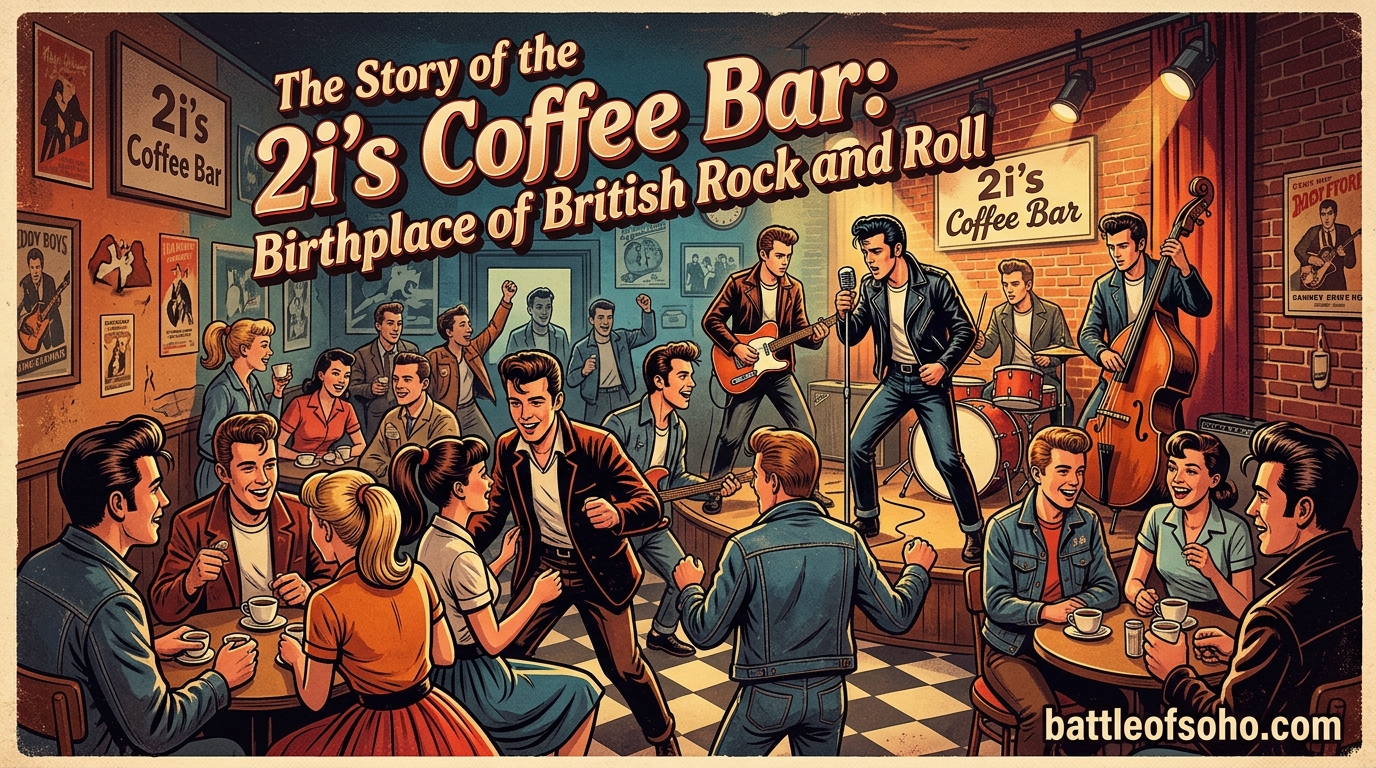
Walk down Old Compton Street in Soho today and you will find restaurants, bars, and the constant hum of London nightlife. But number 59 holds a secret that changed British music forever. This is the story of the 2i’s Coffee Bar, the birthplace of British rock and roll.
The 2i’s Coffee Bar was a coffeehouse at 59 Old Compton Street in Soho, London, that operated from 1956 to 1970. It served as the launching pad for some of the biggest names in British music history, including Tommy Steele, Cliff Richard, and Adam Faith. What started as a small basement venue with an 18-inch stage became the most important talent incubator in 1950s Britain.
For our team at Battle of Soho, exploring this story feels deeply personal. Soho has always been the beating heart of London’s cultural underground. The 2i’s Coffee Bar represents everything we celebrate about this neighbourhood: gritty, authentic, and impossible to replicate. Before the stadiums and the record deals, the future stars of British rock and roll stood on a tiny stage made of milk crates and played for shillings.
In this article, we trace the full history of the 2i’s Coffee Bar from its founding by two immigrant brothers to its closure and modern legacy. We cover the artists discovered there, the colourful characters who ran it, and why a small Soho basement deserves its title as the birthplace of British rock and roll.
Table of Contents
The Founding of the 2i’s Coffee Bar
The story of the 2i’s Coffee Bar begins with the post-war coffee bar boom that swept through London in the early 1950s. After years of wartime rationing and grey austerity, young people craved colour, energy, and somewhere to gather. Coffee bars answered that call with espresso machines, loud music, and late opening hours that traditional pubs could not match.
The Irani Brothers and the Coffee Bar Boom
In April 1956, two Iranian brothers opened the 2i’s Coffee Bar at 59 Old Compton Street in Soho. The name reportedly came from the two brothers and their wives, making “two eyes” or “2i’s.” The venue featured a Gaggia espresso machine, which was still a novelty in London at the time, serving strong Italian-style coffee to a young and hungry clientele.
The location was strategic. Old Compton Street sat at the centre of Soho’s entertainment district, surrounded by theatres, clubs, and music shops. The area attracted musicians, artists, writers, and teenagers looking for something new. The brothers tapped into a cultural moment when Britain was shaking off its post-war gloom and embracing American-influenced youth culture.
Coffee bars were different from pubs. They welcomed teenagers who were too young to drink alcohol. They stayed open later. And crucially, many of them started hosting live music. The 2i’s Coffee Bar would take this concept further than anyone could have imagined.
Enter Paul Lincoln – Dr Death
The transformation from ordinary coffee bar to legendary music venue happened when Paul Lincoln arrived. Lincoln, a charismatic Australian with a flair for showmanship, took over the management of live entertainment at the 2i’s. He earned the nickname “Dr Death” for his habit of wearing a top hat and performing dramatic stunts, including pretending to hang himself on stage as part of his own music act.
Lincoln recognised something that others missed. The basement of the 2i’s, with its low ceiling and cramped dimensions, could become an intimate performance space. He began organising regular live music nights, charging just 1 shilling for entry. The tiny room could hold roughly 20 people standing, packed shoulder to shoulder, creating an electric atmosphere that no large venue could replicate.
Under Lincoln’s guidance, the 2i’s Coffee Bar shifted from serving coffee to serving music. He brought in Ray Hunter as a partner, and together they built a venue that would attract talent spotters, record label executives, and BBC producers. The combination of Lincoln’s theatrical instincts and Hunter’s business sense turned a Soho basement into the most important address in British popular music.
The Basement Venue and Its Famous 18-Inch Stage
The physical space of the 2i’s Coffee Bar was almost absurdly small. Performers played on a stage just 18 inches high, constructed from wooden milk crates topped with a board. The basement room was narrow, dimly lit, and intensely hot when packed with bodies. There was no dressing room, no green room, and certainly no luxury.
And yet, that cramped basement became magical. The closeness between performer and audience created an immediacy that was unheard of in British entertainment at the time. Singers could see every face in the crowd. The audience could reach out and touch the stage. In a country where live music typically meant sitting politely in a theatre, the 2i’s offered something raw and thrilling.
The venue’s reputation spread quickly. Word of mouth turned the 2i’s Coffee Bar into the place where anyone who was anyone in British music wanted to play. What happened in that tiny basement between 1956 and 1960 would reshape the entire landscape of British popular culture.
The Music Scene at the 2i’s Coffee Bar
When the 2i’s Coffee Bar began hosting live music, the dominant sound in Britain was not rock and roll but skiffle. Understanding skiffle is essential to understanding how the 2i’s became the birthplace of British rock and roll. The venue’s musical journey mirrored the transformation of British youth culture itself.
The Skiffle Explosion
Skiffle was a uniquely British phenomenon. It blended American folk, blues, and jug band music with homemade instruments and DIY energy. Teenagers across the country formed skiffle groups using washboards, tea chest basses, and acoustic guitars. The movement was accessible, cheap, and infectious. You did not need formal training or expensive equipment to start playing.
Lonnie Donegan had ignited the skiffle craze in 1955 with his hit “Rock Island Line,” and by 1956, skiffle groups were springing up in every city, town, and village in Britain. Coffee bars became the natural home for this music. The 2i’s Coffee Bar, with its basement performance space and young clientele, was perfectly positioned to capitalise on the trend.
While London’s first skiffle bar was technically the Gyre and Gimble in Charing Cross, it was the 2i’s that took the concept to another level. The 2i’s became the skiffle capital of London, attracting the best performers and the biggest crowds. From skiffle, the venue would graduate to rock and roll, and in doing so, would change everything.
The Vipers Skiffle Group and the Residency System
The house band at the 2i’s Coffee Bar was The Vipers Skiffle Group, and their residency became the backbone of the venue’s musical identity. The group featured some remarkable talents, including Wally Whyton on vocals and guitar, Johnny Pilgrim on washboard, and Jean Van den Bosch on tea chest bass. They played multiple sets every night, entertaining the crowds between appearances by visiting performers.
The residency system was simple but brilliant. The Vipers provided continuity, drawing regulars back night after night. Guest performers, many of them unknown and desperate for a break, would get a slot on the same bill. This meant that every evening at the 2i’s offered a mix of familiar favourites and new discoveries. Talent spotters learned that if they wanted to find the next big thing, they needed to visit the 2i’s regularly.
The Vipers Skiffle Group became stars in their own right. They signed recording contracts, appeared on television, and toured nationally. But their spiritual home remained the 2i’s Coffee Bar. Their presence gave the venue credibility and consistency, making it the fixed point around which the entire British skiffle and early rock and roll scene revolved.
How Talent Spotters Transformed the Venue
The 2i’s Coffee Bar became a magnet for talent spotters, music promoters, and record label representatives. These were the men who could turn a basement performance into a national career. They sat in the audience night after night, watching unknown teenagers sing and play, searching for the spark that might translate into record sales and chart hits.
This created a powerful ecosystem. Young musicians flocked to the 2i’s because they knew important people were watching. The important people kept coming because they knew the best raw talent in Britain was performing there. The venue became a feedback loop of ambition and opportunity, driving the entire British music industry forward from a Soho basement.
The talent spotting culture at the 2i’s was competitive and sometimes ruthless. Promoters would try to sign performers before rivals could get to them. Stories spread of handshake deals made over coffee in the upstairs room. For many young artists, being noticed at the 2i’s was the difference between stardom and obscurity.
The BBC Six-Five Special Connection
The 2i’s Coffee Bar received a massive boost when the BBC launched the Six-Five Special in 1957. This was Britain’s first national youth music television programme, and it embraced the energy of the skiffle and rock and roll scene. The programme’s producers regularly featured performers who had been discovered at the 2i’s, giving the venue national exposure.
Jack Good, the producer of the Six-Five Special, was particularly connected to the 2i’s. He understood the raw appeal of the music and the venue, and he brought that energy to television screens across Britain. When viewers saw performers who had come from the 2i’s Coffee Bar, they wanted to know more about this legendary Soho basement.
The BBC connection legitimised what was happening at the 2i’s. Suddenly, it was not just a coffee bar where teenagers played music. It was a cultural institution, recognised by the national broadcaster as the epicentre of a musical revolution. Performers who appeared on the Six-Five Special after being discovered at the 2i’s became household names within weeks.
Famous Discoveries at the 2i’s
The roster of artists discovered at the 2i’s Coffee Bar reads like a who’s who of early British popular music. The venue launched more careers than any other single location in British music history. Each discovery story adds another layer to the legend of 59 Old Compton Street.
Tommy Steele – The First Star
The most famous discovery at the 2i’s Coffee Bar was Tommy Steele, and his story cemented the venue’s reputation as the birthplace of British rock and roll. In September 1956, Steele was a 19-year-old merchant seaman named Thomas Hicks who wandered into the 2i’s and asked if he could sing. He performed a few Elvis Presley numbers and immediately electrified the audience.
Talent manager Larry Parnes was in the audience that night, or so the story goes, and he recognised something special in the young singer. Within weeks, Steele had a management deal, a recording contract, and a chart-topping single. “Rock With the Caveman” reached number 13 in the UK charts in late 1956, making Steele Britain’s first homegrown rock and roll star.
Tommy Steele’s rise from the 2i’s basement to national fame happened with astonishing speed. He went from singing for shillings to starring in films within months. His success proved that the 2i’s Coffee Bar formula worked, and it sent a signal to every aspiring musician in Britain: go to Old Compton Street and get discovered.
Cliff Richard and the Drifters
Cliff Richard’s connection to the 2i’s Coffee Bar further cemented the venue’s status. Richard, then known as Harry Rodger Webb, performed at the 2i’s with his group the Drifters (later renamed the Shadows to avoid confusion with the American group). His performances caught the attention of producers and promoters who recognised his potential as Britain’s answer to Elvis Presley.
Richard’s 1958 debut single “Move It” is often cited as one of the most important records in British rock and roll history. The path from the 2i’s Coffee Bar basement to that recording studio was direct. The venue had given him a stage, an audience, and the exposure he needed to be noticed by the right people.
Cliff Richard would go on to become one of the most successful British recording artists of all time, with a career spanning more than six decades. His time at the 2i’s was brief but significant. It was the launching pad, the moment when a talented teenager became a professional performer with genuine commercial potential.
Adam Faith and Other Discoveries
Adam Faith was another major star who passed through the 2i’s Coffee Bar. Faith, born Terence Nelhams, performed at the venue before being spotted by television producers. His distinctive vocal style and charismatic stage presence set him apart from the crowd. He went on to have numerous chart hits and became a major television and film personality.
The list of other performers associated with the 2i’s reads like a roll call of late 1950s British pop. Terry Dene, Wee Willie Harris, and Tony Sheridan all performed at the venue. Some went on to lasting fame, while others enjoyed brief moments of stardom before fading from the spotlight. But for all of them, the 2i’s Coffee Bar was the starting point.
What made the 2i’s so productive was volume. Every night brought new performers alongside the regular acts. Over the course of 14 years, hundreds of musicians played that tiny stage. The venue functioned as a continuous audition, with talent spotters always in attendance, always looking for the next big thing.
The Promoters Who Made It Happen
The discoveries at the 2i’s Coffee Bar did not happen by accident. A network of powerful music promoters and talent managers made the venue their hunting ground. Larry Parnes, known for his stable of polished young male singers, was a regular presence. He had a gift for spotting raw talent and packaging it for mass market appeal.
Jack Good, the television producer behind the Six-Five Special and later Oh Boy!, understood that the energy of the 2i’s could be translated to screen. He featured 2i’s graduates on his programmes, creating a pipeline from the Soho basement to national television. Good’s productions were visually dynamic and exciting, mirroring the atmosphere of the coffee bar itself.
Don Arden, later known as one of the most feared managers in British rock, was another figure connected to the 2i’s orbit. Arden would go on to manage Black Sabbath and Electric Light Orchestra, but his education in the music business began in the world of 1950s Soho entertainment. The talent spotting culture of the 2i’s helped shape a generation of music industry power brokers.
Notable Personalities Who Worked and Played There
Beyond the famous performers, the 2i’s Coffee Bar was staffed and frequented by characters who would go on to shape British music in profound ways. Some of the most important figures in British rock and roll history passed through the venue as employees, regulars, or aspiring performers before they became famous.
From the Stage to the Staff
What made the 2i’s Coffee Bar unique was how many future industry figures worked there in humble capacities before achieving fame. The venue was a training ground not just for performers but for the entire ecosystem of British popular music. Songwriters, producers, managers, and promoters all spent time in that Soho basement, learning their craft.
Jet Harris, who would later become the bassist for the Shadows alongside Cliff Richard, was one of the regulars at the 2i’s. Bruce Welch, another future Shadow, was also a fixture. Both men absorbed the music and the atmosphere of the venue, developing their skills before finding mainstream success. The Shadows would become one of the most successful instrumental groups in British music history.
The informal, collaborative atmosphere of the 2i’s encouraged musicians to share ideas, form connections, and develop their sound. Many of the partnerships and creative relationships that defined early British rock and roll were forged in the cramped quarters of 59 Old Compton Street.
Peter Grant – From Bouncer to Led Zeppelin Manager
One of the most remarkable stories from the 2i’s Coffee Bar involves Peter Grant. Before he became the legendary manager of Led Zeppelin and one of the most powerful figures in rock music history, Grant worked as a bouncer at the 2i’s. His imposing physical presence made him well suited to keeping order in a venue packed with excitable teenagers.
Grant’s time at the 2i’s gave him an education in the music business from the ground up. He learned how venues operated, how performers were managed, and how deals were struck. This knowledge would serve him extraordinarily well in the decades that followed. As Led Zeppelin’s manager, Grant negotiated unprecedented deals and redefined the relationship between artists and the music industry.
The fact that a future Rock and Roll Hall of Famer once stood at the door of the 2i’s Coffee Bar checking IDs and breaking up fights says everything about the venue’s place in music history. The 2i’s was not just where stars were born. It was where the entire infrastructure of British rock was built, one person at a time.
Lionel Bart, Mickie Most, and the Songwriters
Lionel Bart, who would later write the musical “Oliver!” and compose numerous hit songs, was another figure connected to the 2i’s Coffee Bar scene. Bart was deeply embedded in the Soho music world of the late 1950s. His understanding of popular songcraft was honed in the same cultural environment that produced the 2i’s and its roster of stars.
Mickie Most, who would become one of the most successful record producers in British history, was also part of the 2i’s orbit. Most produced hits for the Animals, Herman’s Hermits, Lulu, and Donovan. His ear for commercial pop was shaped by the raw, immediate music he encountered in Soho coffee bars like the 2i’s.
These connections matter because they show that the 2i’s Coffee Bar was not an isolated phenomenon. It was the hub of a network that extended throughout British music for decades. The songs, the productions, the management deals, and the creative partnerships that defined British rock and roll all had roots that could be traced back to 59 Old Compton Street.
Legacy and Commemoration
The 2i’s Coffee Bar closed its doors in 1970, but its legacy has only grown in the decades since. The venue’s influence on British music is immeasurable, and London has not forgotten the tiny basement where it all began. The story of the 2i’s is preserved through historical markers, cultural references, and the ongoing fascination of music fans around the world.
The Closure and Aftermath
By the late 1960s, the musical landscape had shifted dramatically. The skiffle craze was long gone, and British rock had moved on to bigger venues and more elaborate productions. The Beatles, the Rolling Stones, and the Who played stadiums, not basements. Coffee bars had given way to clubs, and the 2i’s Coffee Bar found itself out of step with the times.
The venue closed in 1970, ending a 14-year run that had changed British music forever. The building at 59 Old Compton Street did not remain empty for long. Over the subsequent decades, it housed various restaurants and businesses, including the Dome Cafe and later a Vietnamese restaurant called House of Ho. Today, the address is home to Poppies Fish and Chips, an iconic Soho establishment in its own right.
The transformation of the physical space is bittersweet for music historians. Nothing original remains from the 2i’s era. The basement stage, the milk crates, the espresso machine, and the intimate atmosphere are all gone. But the building itself stands as a monument to what happened there, and the stories embedded in its walls continue to captivate anyone who learns them.
The Green Plaque of 2006
In 2006, English Heritage installed a green plaque at 59 Old Compton Street to commemorate the 2i’s Coffee Bar. The plaque reads simply but powerfully, identifying the location as the birthplace of British rock and roll. It stands as official recognition of the venue’s extraordinary contribution to British cultural life.
The green plaque ceremony drew attention from music historians, former performers, and fans of 1950s British music. It was a moment of validation for everyone who had ever played, worked, or spent an evening at the 2i’s. The plaque ensures that even as the building changes hands and purposes, its musical significance will never be forgotten.
For visitors to Soho today, the green plaque is a tangible connection to the past. It transforms an ordinary street corner into a pilgrimage site for music lovers. Fans travel from around the world to stand outside 59 Old Compton Street, look up at the plaque, and imagine what it was like when the birthplace of British rock and roll was in full swing.
What Remains at 59 Old Compton Street Today
Today, 59 Old Compton Street is occupied by Poppies Fish and Chips, a celebrated Soho restaurant that embraces the location’s history. Poppies acknowledges the building’s musical heritage, and many visitors come specifically because of the 2i’s connection. The restaurant serves classic British food in a retro setting that nods to the area’s mid-century past.
The fact that a fish and chip shop now occupies the birthplace of British rock and roll might seem incongruous at first. But in a way, it is perfectly appropriate. Both the 2i’s Coffee Bar and Poppies represent the unpretentious, democratic spirit of Soho. Both drew their energy from the streets and the people around them. And both remind us that great cultural movements often begin in the most ordinary of spaces.
Soho itself has changed enormously since the 1950s, but it remains a neighbourhood defined by its cultural density. The spirit of the 2i’s Coffee Bar lives on in the venues, clubs, and creative spaces that continue to make Soho one of the most vibrant areas in London. The baton has been passed, but the race began at 59 Old Compton Street.
FAQs
What was the 2i’s Coffee Bar?
The 2i’s Coffee Bar was a coffeehouse and live music venue at 59 Old Compton Street in Soho, London, that operated from 1956 to 1970. It featured a basement performance space with an 18-inch stage where skiffle and rock and roll acts performed, and it is widely recognised as the birthplace of British rock and roll.
Where was the 2i’s Coffee Bar located?
The 2i’s Coffee Bar was located at 59 Old Compton Street in the Soho district of London. The address is now occupied by Poppies Fish and Chips, and an English Heritage green plaque on the building commemorates the venue.
Who was discovered at the 2i’s Coffee Bar?
Tommy Steele was the most famous artist discovered at the 2i’s Coffee Bar, spotted performing there in 1956. Other notable performers and discoveries include Cliff Richard, Adam Faith, Terry Dene, Wee Willie Harris, and members of the Vipers Skiffle Group.
When did the 2i’s Coffee Bar open and close?
The 2i’s Coffee Bar opened in April 1956 and closed in 1970, operating for approximately 14 years. During its peak years between 1956 and 1960, it was the most important live music venue for emerging British rock and roll and skiffle artists.
Why was the 2i’s Coffee Bar called the birthplace of British rock and roll?
The 2i’s Coffee Bar earned the title birthplace of British rock and roll because it was the venue where the first generation of British rock and roll stars were discovered and launched. Tommy Steele became Britain’s first homegrown rock and roll star after being spotted there, and the venue’s basement stage hosted dozens of future hitmakers who shaped the entire British music scene.
What is at 59 Old Compton Street now?
The building at 59 Old Compton Street is now occupied by Poppies Fish and Chips, a popular Soho restaurant. An English Heritage green plaque installed in 2006 marks the location as the former site of the 2i’s Coffee Bar and the birthplace of British rock and roll.
Conclusion: Why the 2i’s Coffee Bar Still Matters
The 2i’s Coffee Bar lasted just 14 years and occupied a basement no bigger than a living room. Yet its impact on British music was seismic. Every artist who stood on that milk-crate stage and every talent spotter who sat in the audience contributed to a cultural shift that reverberates to this day.
The story of the 2i’s Coffee Bar, the birthplace of British rock and roll, is really a story about what makes Soho special. It is about a neighbourhood where ambition meets opportunity, where immigrant entrepreneurs and working-class teenagers can change the world from a basement on Old Compton Street. That spirit is what we celebrate at Battle of Soho, and it is why the legacy of the 2i’s will never fade.
The next time you walk past 59 Old Compton Street, pause for a moment. Look up at the green plaque. Listen for the ghost of a guitar echoing up from a basement that no longer exists. The 2i’s Coffee Bar may be gone, but the music it launched is still playing, somewhere, everywhere, all the time.