
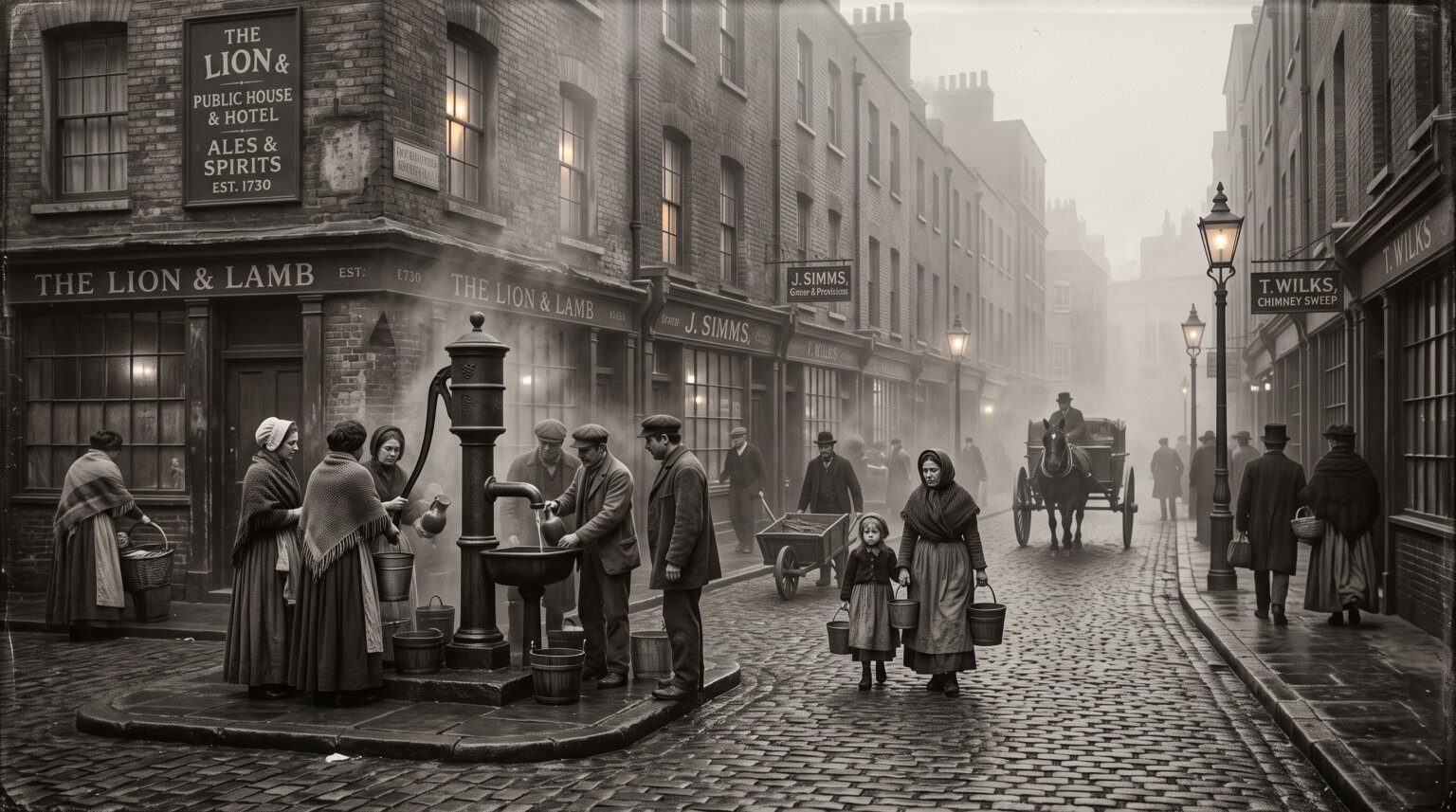
In the late summer of 1854, a quiet neighborhood in London became the epicenter of one of the deadliest disease outbreaks in the city’s history. The John Snow pump in Soho cholera outbreak killed over 600 people in a matter of days, and the investigation that followed changed medicine forever.
What made this outbreak different was not the death toll. It was the man who decided to question everything the medical establishment believed about how disease spread. Dr. John Snow did not accept the prevailing theory that cholera traveled through foul air. He went door to door, mapped every death, and followed the data to a single water pump on Broad Street.
In this guide, we will walk through exactly what happened during the 1854 Broad Street cholera outbreak, how Snow traced the source, what the evidence revealed, and why his work still matters 2026. Whether you are studying public health, data visualization, or medical history, this story shows how one investigator’s methodology founded an entire scientific discipline.
Table of Contents
The Soho Cholera Outbreak of 1854
Soho in the mid-nineteenth century was a densely populated working-class district. Streets were narrow, buildings were overcrowded, and sanitation infrastructure was practically nonexistent. Many homes shared communal water pumps, and human waste was dumped into cesspits that leaked into the surrounding soil and water supply.
On August 31, 1854, the first cases of cholera appeared in the neighborhood around Broad Street. Within hours, people began dying. The disease struck with terrifying speed. A healthy person could develop severe diarrhea, vomiting, and dehydration in the morning and be dead by nightfall.
The toll was staggering. In the first three days alone, 127 people died. By the end of ten days, approximately 500 residents had perished. The final death count reached 616 people, all within a few hundred yards of one another. Entire families were wiped out. Businesses shuttered. Those who could afford to flee the neighborhood did so immediately.
Cholera had visited London before. Major outbreaks in 1832 and 1849 had killed thousands across the city. But this outbreak was different in one critical way. It was intensely localized. The deaths clustered tightly around a single geographic point, and that pattern would prove to be the key to everything.
Who Was John Snow? The Doctor Who Defied Miasma Theory
John Snow was born in 1813 in York, England. He apprenticed as a surgeon-apothecary and eventually became a respected physician in London. He was also a pioneer in the field of anesthesia, personally administering chloroform to Queen Victoria during childbirth in 1853.
Snow’s medical experience gave him a unique perspective on how diseases affected the body. When cholera first swept through London in 1832, he treated victims firsthand. By the time the 1849 outbreak arrived, he had begun to form a theory that contradicted everything the medical establishment believed.
The dominant explanation for disease transmission in the nineteenth century was the miasma theory. Doctors believed that illnesses like cholera were spread by bad air, produced by decaying organic matter, sewage, and industrial pollution. The foul smells of London’s slums were thought to carry disease directly into the lungs of anyone who breathed them.
Snow was skeptical. He noticed that cholera primarily attacked the digestive system, not the respiratory system. The symptoms were vomiting and diarrhea, not coughing or sneezing. If cholera were spread through the air, he reasoned, the pattern would not be so tightly linked to the gut. He published a pamphlet in 1849 arguing that cholera was transmitted through contaminated water, but few people listened.
The miasma theory had powerful institutional support. Leading scientists, government officials, and medical journals all endorsed it. Snow’s waterborne theory was dismissed as fringe speculation. He needed stronger evidence, and the 1854 Soho outbreak would give him the perfect opportunity to gather it.
How John Snow Traced the Source of the Cholera Outbreak
When the Soho outbreak began, Snow was already working on a larger study of cholera in South London. He interrupted that work and rushed to Broad Street. What he did next became the template for every outbreak investigation that followed.
Snow’s approach was methodical and unprecedented. He did not theorize from his study. He went into the neighborhood and collected raw data.
Step 1: Door-to-Door Death Tracking
Snow obtained mortality records from the General Register Office, which tracked every death in London. But he did not stop at official numbers. He walked the streets of Soho and knocked on doors. He spoke with residents, asked who had died in each household, and recorded the exact address of every cholera victim.
Step 2: Building the Dot Map
Snow then plotted every death on a map of the neighborhood. Each cholera death was represented by a small mark, a bar or dot, at the address where the person had lived. When the map was complete, a clear visual pattern emerged. The dots formed a dense cluster radiating outward from one central point.
That point was the Broad Street water pump.
Step 3: Cluster Analysis
The mapping revealed that deaths were concentrated in homes closest to the Broad Street pump. The further a household was from the pump, the fewer cases appeared. Snow also noted that the cluster boundary roughly matched the area where residents would naturally walk to fetch water from that specific pump.
Step 4: Interviewing Residents
Snow interviewed surviving residents and families of victims. He asked where they got their drinking water. The vast majority confirmed they used the Broad Street pump. Some people who lived far from Broad Street but had passed through the neighborhood and drunk from the pump also fell ill. This geographic data was the first piece of compelling evidence that the pump was the source.
The Smoking Gun: Evidence That Proved Cholera Was Waterborne
The map was powerful, but Snow knew that a correlation alone would not convince skeptics. He needed to account for exceptions. Why did some people near the pump survive while others died? And why did some people far from the pump fall ill?
The exceptions turned out to be his strongest evidence.
The Brewery Workers Who Survived
Just a few steps from the Broad Street pump stood the Lion Brewery. The brewery employed dozens of workers who lived and worked in the heart of the outbreak zone. Yet not a single brewery worker died of cholera. Snow investigated and found that the brewery had its own private water well. Furthermore, the workers were given a daily allowance of beer, which they drank instead of pump water. They never touched the contaminated supply.
The Workhouse With Its Own Well
The St. James Workhouse was located even closer to the Broad Street pump than many of the homes where deaths occurred. Over 500 inmates lived there. Yet only five died of cholera. Snow discovered that the workhouse had its own private well and never drew water from the Broad Street pump. The inmates were protected by their independent water supply.
The Water Company Comparison
Even before the Soho outbreak, Snow had been building a broader case. In South London, two water companies supplied different neighborhoods. The Southwark and Vauxhall Company drew water from the polluted Thames, while the Lambeth Company drew from a cleaner upstream source.
Snow’s data showed a dramatic difference. Homes served by Southwark and Vauxhall had cholera death rates roughly ten times higher than homes served by Lambeth. Same neighborhoods, same air quality, same social conditions. The only variable was the water supply. This was the foundation of what is sometimes called Snow’s grand experiment.
The Contaminated Cesspit
After the outbreak subsided, Snow and Reverend Henry Whitehead, a local curate who conducted his own independent investigation, traced the contamination source. They discovered that a cesspit at 40 Broad Street had been leaking into the well that supplied the Broad Street pump. The cesspit had received waste from a household where an infant had died of cholera just days before the outbreak began. Sewage carrying Vibrio cholerae bacteria had seeped directly into the drinking water.
The Broad Street Pump Handle Removal
Snow presented his findings to the local Board of Guardians on September 7, 1854, just over a week into the outbreak. He showed them the map, the death cluster, and the exception cases. He argued that the Broad Street pump was the source and requested that the pump handle be removed to prevent further deaths.
The Board was skeptical. Snow’s waterborne theory challenged the accepted miasma doctrine. But the death toll was climbing, and they had no better solution. They agreed to remove the pump handle as a precaution.
The outbreak declined after the handle was removed. However, historians and epidemiologists have noted an important nuance. The outbreak was likely already waning by that point. Many residents had fled, and the contamination in the well may have been flushing out naturally. The pump handle removal may not have been the decisive factor in ending this particular outbreak.
What mattered more was the investigation itself. Snow had demonstrated a reproducible method for identifying the source of an outbreak using data collection, mapping, and logical analysis. That method was the real breakthrough.
What the John Snow Pump Reveals About a Deadly Outbreak
The John Snow pump in Soho cholera outbreak revealed several fundamental truths about disease and public health that transformed medicine.
First, it proved that cholera was a waterborne disease. The tight geographic clustering of deaths around a single pump, combined with the exception cases of the brewery and workhouse, left little room for alternative explanations. The miasma theory could not account for why people with clean air but contaminated water got sick while people with foul air but clean water stayed healthy.
Second, it established that diseases could be traced to specific environmental sources. Before Snow, disease was understood as a diffuse phenomenon caused by general conditions. After Snow, disease could be investigated as a detective problem with a specific source, pathway, and solution.
Third, it demonstrated the power of data visualization. Snow’s dot map was not just a record of deaths. It was an analytical tool that made invisible patterns visible. The map itself became evidence, allowing officials and the public to see the outbreak’s spatial logic at a glance.
Fourth, it showed that public health interventions could be guided by evidence rather than theory. The pump handle was removed because the data pointed to the pump, not because officials believed Snow’s theoretical framework. This principle, that action should follow evidence, remains the bedrock of public health response today.
Legacy: Founding Modern Epidemiology
John Snow died in 1858, just four years after the Broad Street outbreak. He never lived to see his waterborne theory fully accepted. It was not until the 1860s, when Louis Pasteur’s work on germ theory provided the biological mechanism Snow had hypothesized, that the medical establishment came around.
Today, John Snow is widely recognized as the father of modern epidemiology. The methods he developed during the Soho investigation are still taught in every public health program in the world. His approach of systematic data collection, geographic mapping, hypothesis testing, and evidence-based intervention forms the backbone of outbreak investigation.
The Broad Street pump itself is commemorated in modern Soho. The street was renamed Broadwick Street, and a replica pump with its handle removed stands as a memorial. A nearby pub, appropriately named the John Snow, serves as an informal gathering place for public health professionals and history enthusiasts. The original site of the pump is marked with a red granite curbstone and a plaque explaining what happened there.
Every year, public health students and professionals make pilgrimages to the site. It serves as a reminder that the foundations of their field were built not in a laboratory but on the streets of one of London’s poorest neighborhoods.
Modern Relevance: Cholera and Waterborne Disease Today
Cholera has not been eradicated. The World Health Organization estimates that between 1.3 million and 4 million cases occur globally each year, resulting in 21,000 to 143,000 deaths. The disease disproportionately affects regions with inadequate water treatment and sanitation infrastructure.
Recent years have seen major cholera outbreaks in Yemen, Haiti, and parts of Sub-Saharan Africa. In each case, the story echoes the Broad Street outbreak. Contaminated water supplies, overwhelmed sanitation systems, and vulnerable populations combine to create conditions where Vibrio cholerae thrives.
Modern epidemiology has tools Snow could never have imagined. Genomic sequencing now allows scientists to trace cholera strains back to their geographic origins using phylogenetic analysis. Researchers have identified the Bay of Bengal as the ancestral source population for most pandemic cholera strains. DNA sequencing of bacterial isolates from different outbreaks lets investigators map transmission pathways with extraordinary precision.
But the fundamental approach remains the same. Identify the source, trace the spread, remove the cause. Snow’s methodology, refined over 170 years, still guides how the world responds to waterborne disease outbreaks in 2026.
FAQs
How did John Snow discover cholera?
John Snow discovered that cholera was waterborne by mapping deaths during the 1854 Soho outbreak. He plotted every cholera victim’s address on a map and found a tight cluster around the Broad Street water pump. He confirmed his theory by identifying exceptions: brewery workers who drank beer and workhouse inmates with their own well did not fall ill. His data proved contaminated water, not bad air, spread the disease.
What caused the cholera outbreak in London?
The 1854 London cholera outbreak in Soho was caused by water from the Broad Street pump contaminated with Vibrio cholerae bacteria. A cesspit at 40 Broad Street, which had received waste from a household where an infant died of cholera, leaked into the well supplying the pump. Residents who drank from the pump ingested the bacteria and became infected.
What is the Broad Street pump cholera epidemic in London in 1854?
The Broad Street pump cholera epidemic was a severe outbreak of cholera in the Soho district of London that began on August 31, 1854. Approximately 500 people died in the first ten days, with a final death toll of 616. Dr. John Snow traced the outbreak to the Broad Street water pump, proving cholera was waterborne and founding modern epidemiology.
Why is John Snow called the father of public health?
John Snow is called the father of modern epidemiology and public health because he developed the systematic method of outbreak investigation that is still used today. He combined data collection, geographic mapping, hypothesis testing, and evidence-based intervention to identify disease sources. His work on the 1854 Soho cholera outbreak proved that contaminated water spreads disease and that public health measures can be guided by data.
How did John Snow trace the source of the cholera outbreak?
John Snow traced the source by obtaining death records, walking door to door to confirm cases, plotting each death on a street map of Soho, and identifying a geographic cluster centered on the Broad Street pump. He then interviewed residents about their water sources, noted that exceptions like brewery workers and workhouse inmates who used alternative water supplies survived, and presented his evidence to local officials.
Conclusion
The John Snow pump in Soho cholera outbreak remains one of the most important events in the history of medicine. A single contaminated water pump killed over 600 people in ten days. The investigation that followed proved that disease could be tracked to a specific source using data, mapped, and stopped through targeted intervention.
Snow’s work demolished the miasma theory and laid the groundwork for germ theory. It gave the world a repeatable methodology for outbreak investigation that has been refined over 2026 but never replaced. Every time public health officials trace a foodborne illness to a specific restaurant or a waterborne parasite to a particular treatment plant, they are following in Snow’s footsteps.
The story also carries a humbling lesson. Snow was right, but he was ignored for years because his ideas challenged the establishment. Scientific progress does not always come from the people in charge. Sometimes it comes from a doctor willing to walk the streets, knock on doors, and follow the data wherever it leads.
If you ever find yourself in Soho, take a walk to the corner of Broadwick and Lexington Streets. There you will find the replica pump with its handle removed, a quiet monument to the moment when medicine learned to listen to evidence. The John Snow pub is just around the corner. Raise a glass, preferably of something clean, to the man who showed the world that the key to stopping a deadly outbreak was already in the data.