
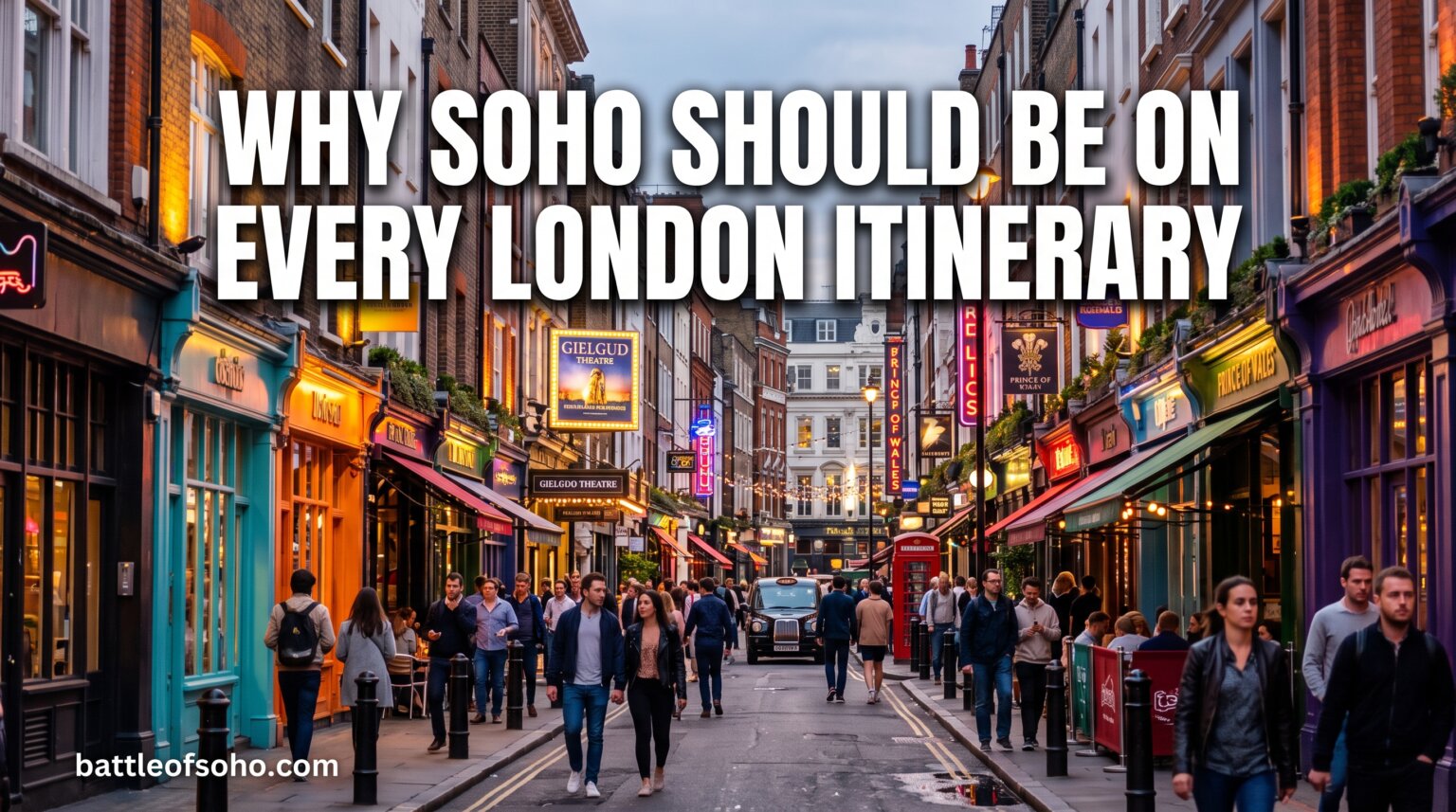
If you are building a London itinerary and wondering whether Soho deserves a full day of your time, the short answer is absolutely yes. Soho should be on every London itinerary because it packs world-class restaurants, West End theatres, legendary music venues, LGBTQ+ nightlife, and boutique shopping into a compact, walkable square mile right in the centre of the city.
I have spent years wandering these streets, hopping from coffee shops to cocktail bars, catching shows at the Prince Edward Theatre, and hunting down the best late-night noodles. Our team has compared notes, scoured forums, and mapped out what makes this neighbourhood tick so you can make the most of every hour you spend here.
Whether you are a first-time visitor trying to decide which areas to prioritise or a returning traveller looking for hidden corners you missed last time, this guide breaks down exactly why Soho should be on every London itinerary. We will cover the history, the food, the nightlife, the shopping, and a practical step-by-step plan you can follow on the ground.
Table of Contents
What Is Soho Known For?
Soho is known for being London’s most energetic entertainment district, a place where food, theatre, music, and nightlife collide in the best possible way. It sits in the West End, bordered roughly by Oxford Street to the north, Regent Street to the west, Shaftesbury Avenue to the south, and Charing Cross Road to the east.
The name “Soho” dates back to the 1600s. According to widely cited historical accounts, it originated as a hunting cry used during the area’s days as a Tudor hunting ground. The cry of “Soho!” was called out when hunters spotted game, much like “Tally-ho!” signalled a fox sighting. That hunting cry evolved into one of the most recognisable neighbourhood names in the world.
Today, Soho occupies roughly one square mile, but that square mile holds more restaurants, bars, theatres, music venues, and independent shops than most entire cities. It is the kind of place where you can start your morning with flat-white coffee, spend the afternoon browsing record stores on Berwick Street, catch a West End show in the evening, and end the night at a jazz club, all without walking more than ten minutes in any direction.
Soho’s History and Cultural Significance
You cannot understand why Soho should be on every London itinerary without understanding its history. This neighbourhood has been reinventing itself for centuries, and every era has left its mark on the streets.
From Hunting Grounds to Hippodrome
In the 1500s, the land we now call Soho was farmland and open fields used by Tudor monarchs for hunting expeditions. By the 1600s, development began as London expanded westward. The area became a fashionable residential district for aristocrats before gradually transforming into one of the city’s most diverse and bohemian neighbourhoods.
During the 18th and 19th centuries, Soho became home to waves of immigrants, particularly French Huguenots, who brought their craftsmanship and cuisine. The French influence is still visible today in some of the older architecture and in the area’s enduring appreciation for good food.
The Birthplace of British Rock
Here is where most travel guides fall short. Soho’s music heritage is one of the strongest reasons it belongs on your London itinerary, yet barely 1 in 4 competitors cover it in any depth.
The story starts at 2i’s Coffee Bar on Old Compton Street. In 1956, this tiny basement coffee house became the birthplace of British skiffle and rock and roll. Tommy Hicks (later Tommy Steele) was discovered here, and the venue is widely credited as the place where British rock music was born. If you are a music fan, standing outside this building is like visiting a shrine.
Then there is the Marquee Club, originally located at 90 Oxford Street before moving to Wardour Street. Between 1962 and 1988, this modest venue hosted the Rolling Stones’ first gig, early performances by David Bowie, The Who, Jimi Hendrix, and Led Zeppelin. The building may be gone, but the legacy is woven into Soho’s identity.
Denmark Street, also known as Tin Pan Alley, is another essential stop for music lovers. This short street was the centre of Britain’s music publishing industry for decades. The Sex Pistols lived above number 6. Elton John wrote songs here. David Bowie frequented the studios. Today, it still houses guitar shops and music businesses, making it a living piece of rock history.
Speaking of Bowie, Soho was deeply connected to his story. He lived, recorded, and performed in and around this neighbourhood throughout his career. The David Bowie walking tour that threads through Soho takes you past recording studios, performance venues, and locations that shaped one of the most influential artists of the 20th century.
The Swinging Sixties
In the 1960s, Soho became ground zero for the cultural revolution known as the Swinging Sixties. Carnaby Street became a global fashion destination. Designers like Mary Quant were redefining style. Musicians, artists, and filmmakers congregated in Soho’s clubs and coffee bars. The energy of that era still lingers in the neighbourhood’s DNA.
Soho’s LGBTQ+ Heritage
Old Compton Street is the beating heart of London’s LGBTQ+ community, and it has been for decades. Soho became a sanctuary for queer London at a time when homosexuality was criminalised. The bars, clubs, and cabaret venues here were among the few places where LGBTQ+ people could gather openly.
That legacy continues today. Old Compton Street and the surrounding blocks remain the centre of London’s Pride celebrations. Venues like the Admiral Duncan and Comptons of London are institutions. Even if you are just passing through, walking this street gives you a sense of how Soho has always been a place where people could be themselves when the rest of the world told them they could not.
This cultural depth is a huge part of why Soho should be on every London itinerary. You are not just visiting a neighbourhood. You are walking through centuries of cultural rebellion, artistic innovation, and social progress.
The Food Scene: Why Soho Restaurants Are Worth the Trip
If there is one reason that alone justifies putting Soho on every London itinerary, it is the food. No other square mile in London offers this much culinary diversity, from Michelin-starred fine dining to hole-in-the-wall dumpling shops.
Must-Try Restaurants in Soho
Dishoom on Kingly Street is practically mandatory. This Bombay-inspired cafe serves some of the best Indian food in London, and the bacon naan alone is worth the queue. Expect to wait during peak hours, but the line moves faster than you think.
Hawksmoor on Air Street is your go-to for a proper British steakhouse experience. The triple-cooked chips and the Sunday roast are legendary. This is where you go when you want to treat yourself after a day of walking.
Kingly Court is a three-story food court just off Carnaby Street that houses dozens of restaurants under one roof. You will find everything from Korean fried chicken to authentic Italian pasta to vegan comfort food. It is the perfect spot when your group cannot agree on what to eat.
For something more intimate, Bar Termini on Old Compton Street serves what many consider the best negronis in London alongside excellent small plates. The cocktails are around 7 to 10 pounds, which is surprisingly reasonable for central London.
Flat White on Berwick Street is where Soho’s coffee culture essentially started. This New Zealand-style cafe pioneered the flat white in London before every chain in the city copied it. The coffee is still among the best you will find anywhere.
What Does Eating in Soho Actually Cost?
One of the biggest pain points forum users raise is that Soho is expensive. It can be, but it does not have to be. Here is a rough budget breakdown based on current 2026 pricing:
- Casual lunch (street food, food court, casual cafe): 8 to 15 pounds per person
- Mid-range dinner (Dishoom, Wahaca, Franco Manca): 15 to 30 pounds per person
- Upscale dinner (Hawksmoor, Quo Vadis, Dean Street Townhouse): 40 to 80 pounds per person
- Michelin-starred experience (set lunch menu): 25 to 50 pounds per person
- Cocktails: 8 to 15 pounds each
- Pint of beer at a pub: 6 to 8 pounds
- Flat white or latte: 3.50 to 4.50 pounds
The trick is mixing price tiers. Start your day with a 4-pound coffee, grab a 10-pound lunch at Kingly Court, and save your budget for a proper dinner and drinks in the evening.
Timing Your Meals
Restaurants in Soho get incredibly busy on Thursday, Friday, and Saturday nights. If you want to eat somewhere specific, book ahead. Many restaurants on OpenTable and SevenRooms allow reservations up to 30 days in advance. Walk-ins are possible on weekdays and early evenings, but after 7pm on a weekend, you will be waiting.
Lunch service between 12pm and 2pm is also packed with office workers. Aim for 11:30am or 2:30pm if you want a calmer experience and a better chance of walking in without a booking.
Bars, Pubs, and Nightlife in Soho
Soho at night is a completely different animal from Soho during the day. The streets fill up, the neon signs glow brighter, and the energy shifts from busy to electric. This transformation is one of the strongest reasons why Soho should be on every London itinerary, especially if you enjoy going out.
Traditional Pubs Worth a Pint
The Coach and Horses on Greek Street is a Soho institution. It is one of the last genuinely old-school pubs in the neighbourhood, with a famously rude staff (in an affectionate, theatrical way) and a no-music policy. This is where you go for a proper pint, a pub lunch, and an atmosphere that has not changed in decades.
The French House on Dean Street is another legend. It served Free French forces during World War II and was a favourite of Charles de Gaulle. They only serve beer in half-pints (a French tradition), and the place has a wonderful, cramped, convivial energy. Dylan Thomas and Francis Bacon were regulars here.
Cocktail Bars and Late-Night Spots
Ronnie Scott’s on Frith Street is arguably the most famous jazz club in the world outside of New York. Opened in 1959, it has hosted everyone from Count Basie to Ella Fitzgerald to modern artists like Norah Jones. Tickets for evening shows typically run 30 to 60 pounds depending on the act. If you want a more affordable option, their late-night sessions (usually after 11pm) sometimes have lower cover charges.
The 100 Club on Oxford Street has been hosting live music since 1942 and is one of the oldest still-operating music venues in the world. It has hosted the Rolling Stones, the Sex Pistols, and pretty much every punk and indie band worth knowing. Check their calendar for upcoming shows.
For cocktails, Bar Termini and Swift on Old Compton Street are top picks. Experimental Cocktail Club on Chinatown’s edge (technically just outside Soho) is a speakeasy-style basement bar that feels like a secret worth knowing.
Clubbing and Cover Charges
Here is a tip straight from Reddit forums that will save you money. Cover charges at Soho nightclubs can be steep, sometimes 15 to 25 pounds on weekends. However, if you arrive before 9pm, many clubs waive or significantly reduce the entry fee. The same applies to some cocktail bars that switch from cafe mode to nightlife mode. Early arrival gets you cheaper entry and a seat.
Happy hour deals are another budget-saver. Several bars on Wardour Street and Old Compton Street run happy hours from 4pm to 7pm on weekdays, offering cocktails at 5 to 7 pounds instead of the usual 12 to 15. If you are planning a night out, start early and take advantage of these windows.
Shopping in Soho: From Carnaby Street to Hidden Boutiques
Soho shopping is not just about spending money. It is about experiencing the evolution of London style, from the 1960s fashion revolution to today’s independent maker scene.
Carnaby Street
No discussion of Soho shopping is complete without Carnaby Street. In the 1960s, this narrow pedestrian street was the epicentre of the Swinging London fashion movement. Boutiques like Biba and Mary Quant’s store drew celebrities, musicians, and fashion obsessives from around the world.
Today, Carnaby Street and the surrounding Carnaby area (including Kingly Court and Newburgh Street) house a mix of well-known brands and independent shops. It is pedestrianised, which makes browsing a pleasure rather than a battle with traffic. Look for the Carnaby Street arch as your entry point.
Liberty London
Just on the edge of Soho on Great Marlborough Street sits Liberty London, a Tudor-revival department store that looks like it was airlifted from the 1920s. The building itself, with its half-timbered facade, is worth seeing even if you never set foot inside. But do go inside. The timber-framed interior, the fabric hall, and the curated designer collections make Liberty one of the most beautiful shopping experiences in any city.
Berwick Street Market and Independent Shops
Berwick Street has been a market since the 1800s. Today, you will find fruit and vegetable stalls alongside vinyl record shops, comic book stores, and tailors. It is also where you will find some of the best independent shops in Soho, far from the chain stores of Oxford Street.
The strip of record shops on Berwick Street is a pilgrimage site for vinyl collectors. Sister Ray and Reckless Records both carry deep catalogues of new and used vinyl, and the staff actually know their music. If you are building a London itinerary and you love music, Berwick Street is non-negotiable.
Denmark Street: Tin Pan Alley
We touched on Denmark Street’s music history earlier, but it is also a shopping destination. The street is lined with guitar shops, including some that have been selling instruments for over 60 years. Whether you are a beginner looking for a travel ukulele or a serious guitarist hunting for a vintage Fender, this is where you come in London.
Theatres and West End Entertainment
Soho sits at the heart of London’s Theatreland, the West End. If you are wondering why Soho should be on every London itinerary and you have even a passing interest in live performance, this section is your answer.
West End Shows Near Soho
Several major theatres sit within or immediately adjacent to Soho. The Prince Edward Theatre on Old Compton Street has hosted long-running hits. The Prince of Wales Theatre on Coventry Street is another landmark venue. The Lyric Theatre and the Apollo Theatre on Shaftesbury Avenue are both a short walk from Soho’s centre.
Booking in advance is the smartest move, especially for popular shows. Official London Theatre and TKTS in Leicester Square both offer legitimate discounted tickets for same-day and upcoming performances. TKTS is the Society of London Theatre’s official booth, so you will not get scammed there.
Soho Theatre
Soho Theatre on Dean Street is something different from the big West End musicals. It is a fringe theatre and comedy venue that has launched the careers of countless comedians and playwrights. Tickets are affordable, usually 10 to 20 pounds, and the programming is always bold and contemporary. If you want to see the next big name in British comedy before they break through, this is where you find them.
Live Music Beyond the Big Names
Between Ronnie Scott’s, the 100 Club, and the various smaller venues scattered through Soho, you can find live music almost any night of the week. Check venue websites on the day you plan to visit. Many venues sell tickets at the door for weeknight shows, and you can often catch incredible sets by emerging artists for under 15 pounds.
One Day in Soho: A Step-by-Step Itinerary
If you only have one day to spend in Soho, here is how our team would structure it to hit all the highlights without feeling rushed. This is a chronological itinerary you can follow on the ground.
Morning (9am to 12pm): Coffee, Culture, and Quiet Streets
Start your day at Flat White on Berwick Street for the best coffee in the neighbourhood. The shop opens early and the morning light on Berwick Street is beautiful. Grab a pastry from one of the nearby bakeries.
Walk over to Soho Square for a few minutes of peace before the city wakes up fully. This small park in the centre of Soho is a hidden gem that many tourists walk right past. The benches under the trees are the perfect place to plan your day.
Head to the Photographers’ Gallery on Ramillies Street. It is the largest public gallery in London dedicated to photography, and it is free to enter for most exhibitions. Even if photography is not your primary interest, the curation is consistently thought-provoking.
Lunch (12pm to 2pm): Eat Your Way Through Soho
Make your way to Kingly Court for lunch. Three floors of food options mean everyone in your group will find something they love. If you want something more specific, Dishoom on Kingly Street is a 5-minute walk and serves phenomenal Indian food. Arrive before noon or after 2pm to avoid the longest queues.
After lunch, take a stroll through Chinatown, which borders Soho to the south. Even if you do not eat there, the gates, the lanterns, and the bustle make for great photos and a completely different atmosphere from Soho proper.
Afternoon (2pm to 6pm): Shopping and Exploration
Walk Carnaby Street and explore the side streets. Pop into Liberty London even if it is just to admire the building. Browse the record shops on Berwick Street. If you are a music fan, walk Denmark Street and visit the guitar shops.
For a cultural detour, consider visiting the House of St Barnabas, a members’ club with a beautiful garden and a social mission. Their afternoon tea is open to non-members and the garden is a stunning hidden oasis.
Evening (6pm to Late): Dinner, Theatre, and Nightlife
Have dinner at one of Soho’s standout restaurants. If you booked ahead, somewhere like Hawksmoor or Quo Vadis will give you a memorable meal. If you are going casual, the food at Barrafina (Spanish tapas) or Bao (Taiwanese) is exceptional.
Catch a West End show or a comedy set at Soho Theatre. If theatre is not your thing, grab cocktails at Bar Termini before they get crowded (arrive before 7pm).
End your night at Ronnie Scott’s for world-class jazz, or at the French House for a half-pint of history. If you are still going strong, Soho’s bars and clubs stay open until 2am or later on weekends.
Getting to and Around Soho
One of the reasons Soho works so well on a London itinerary is how easy it is to reach. You will rarely need a taxi or a long Tube ride to get here from central London attractions.
Nearest Tube Stations
Soho is served by four major Tube stations on its corners:
- Tottenham Court Road (Northern and Central lines): Best for arriving from the north or east. Sits at the top of Charing Cross Road, near the eastern edge of Soho.
- Oxford Circus (Bakerloo, Central, and Victoria lines): Best for arriving from the north or west. Steps from Carnaby Street and Regent Street shopping.
- Piccadilly Circus (Bakerloo and Piccadilly lines): Best for arriving from the south. Puts you near the theatres of Shaftesbury Avenue.
- Leicester Square (Northern and Piccadilly lines): Sits at the southeast corner, between Soho and Chinatown.
From any of these stations, you are never more than a 5-minute walk to the heart of Soho.
Walking Distances from Soho
Part of what makes Soho such a smart itinerary choice is its proximity to other major London attractions. Here are approximate walking times from central Soho:
- Covent Garden: 5 to 7 minutes
- Trafalgar Square: 10 minutes
- Buckingham Palace: 20 to 25 minutes
- The British Museum: 10 to 12 minutes
- Hyde Park: 20 minutes
- The Thames (Embankment): 10 to 12 minutes
You can genuinely spend an entire day in and around Soho without ever needing to take public transport.
Navigating with Luggage
If you are arriving with luggage, avoid the Tube during rush hours (7:30am to 9:30am and 5pm to 7pm). Stations like Oxford Circus get extremely crowded, and navigating with a suitcase is miserable. Consider taking a black cab or using a ride-share app if you have heavy bags. There are also luggage storage services like Stasher and Nannybag with locations around Soho for around 6 to 8 pounds per bag per day.
Practical Tips for Visiting Soho
Before you finalise your London itinerary and head to Soho, here are some practical considerations that will make your visit smoother.
Safety in Soho
Soho is generally safe, especially in the evenings when the streets are busy and well-lit. However, pickpocketing is a known issue around Piccadilly Circus, Leicester Square, and Covent Garden, all of which border Soho. Keep your phone and wallet in front pockets or a zipped bag. Be particularly aware in crowded bars and on busy pavements on weekend nights.
Solo travellers should feel comfortable in Soho at night. The streets are busy, there are always people around, and the area is well-policed. Use the same street smarts you would in any major city.
Best Time to Visit Soho
Soho is lively year-round, but the experience varies by season and day of the week.
Weekday afternoons (Monday through Thursday) are the best times for a relaxed visit. You can browse shops, eat at popular restaurants without a massive queue, and enjoy the atmosphere without shoulder-to-shoulder crowds.
Friday and Saturday nights are when Soho is at its most electric. If nightlife is your priority, this is when you want to be here. Just be prepared for crowds, higher energy, and the need to book restaurants and buy show tickets in advance.
Sunday is quieter than Saturday but still busy. Many restaurants and bars open later on Sundays, so plan accordingly. Some smaller independent shops may have reduced hours.
Budget Tips for Soho
Soho does not have to break the bank. Here are a few strategies we have picked up:
- Eat your big meal at lunch rather than dinner. Many restaurants offer set lunch menus at 30 to 50 percent less than dinner pricing.
- Hit happy hours between 4pm and 7pm on weekdays for half-price cocktails.
- Arrive at clubs before 9pm to avoid or reduce cover charges.
- Grab food from Chinatown bakeries for a 3 to 5-pound snack that fills you up.
- Look for free entry nights at smaller music venues on weeknights.
Payment and Practicalities
Most establishments in Soho accept contactless payments, Apple Pay, and Google Pay. You rarely need cash, though it is always smart to carry a small amount for tips or smaller independent vendors. Tipping in restaurants is typically 10 to 12.5 percent, and many places add a discretionary service charge automatically, so check your bill.
Free Wi-Fi is available in many cafes and pubs. If you are visiting from outside the UK, consider an eSIM or a local SIM card for data. Coverage in central London is excellent across all major networks.
Frequently Asked Questions
Why is SoHo London important?
Soho is important because it has been London’s cultural heartbeat for centuries. It started as a Tudor hunting ground, became a bohemian hub for immigrants and artists in the 18th and 19th centuries, served as the birthplace of British rock music in the 1950s, was ground zero for the Swinging Sixties fashion revolution, and remains the centre of London’s LGBTQ+ community. No other London neighbourhood has played so many cultural roles across so many eras.
Is SoHo a good place to stay when visiting London?
Soho is an excellent place to stay if you want to be in the centre of the action. You can walk to Covent Garden, Trafalgar Square, the British Museum, and multiple Tube stations within minutes. The trade-off is that hotels in Soho tend to be smaller and more expensive than in other areas, and the neighbourhood can be noisy at night. If you prioritise location and energy over space and quiet, Soho is one of the best bases in London.
Is SoHo in London still a red light district?
Soho’s days as a prominent red light district are largely in the past. While a few historic walk-up flats remain in certain side streets, the area has been heavily gentrified over the last two decades. Today, Soho is better known for its restaurants, theatres, cocktail bars, and LGBTQ+ nightlife than for adult entertainment. Visitors expecting a red light district will find a vibrant dining and entertainment neighbourhood instead.
Why does everyone go to SoHo?
People go to Soho because it offers the highest concentration of food, entertainment, shopping, and nightlife in London within a single walkable area. You can eat at world-class restaurants, watch a West End show, browse independent record shops, dance at a club, and drink at a historic pub, all within a few blocks. No other part of London packs this much variety into such a compact space.
Is Soho London safe for tourists?
Yes, Soho is generally safe for tourists. The streets are busy, well-lit, and heavily trafficked well into the night. The main safety concern is pickpocketing in crowded areas like Piccadilly Circus and Leicester Square. Keep valuables secure, be aware of your surroundings in packed bars and on busy pavements, and use common sense. Solo travellers and families can both enjoy Soho comfortably.
How many days do you need in Soho?
You can experience the highlights of Soho in a single full day if you plan well. A one-day itinerary gives you time for coffee, lunch, shopping, a museum visit, dinner, and a show or night out. If you want to explore more deeply, two days lets you visit additional restaurants, catch multiple shows, and explore nearby areas like Chinatown and Covent Garden at a more relaxed pace.
Final Thoughts
When you are building a London itinerary with limited time, every neighbourhood competes for your attention. But the combination of food, history, music, theatre, nightlife, and walkability that Soho offers in a single square mile is unmatched anywhere else in the city. That is exactly why Soho should be on every London itinerary, whether you have one day in the city or ten.
Walk Carnaby Street in the afternoon. Eat something incredible for dinner. Catch a show. End the night with a jazz set at Ronnie Scott’s. Soho will give you the London experience you came looking for, and probably a few stories you did not expect.