
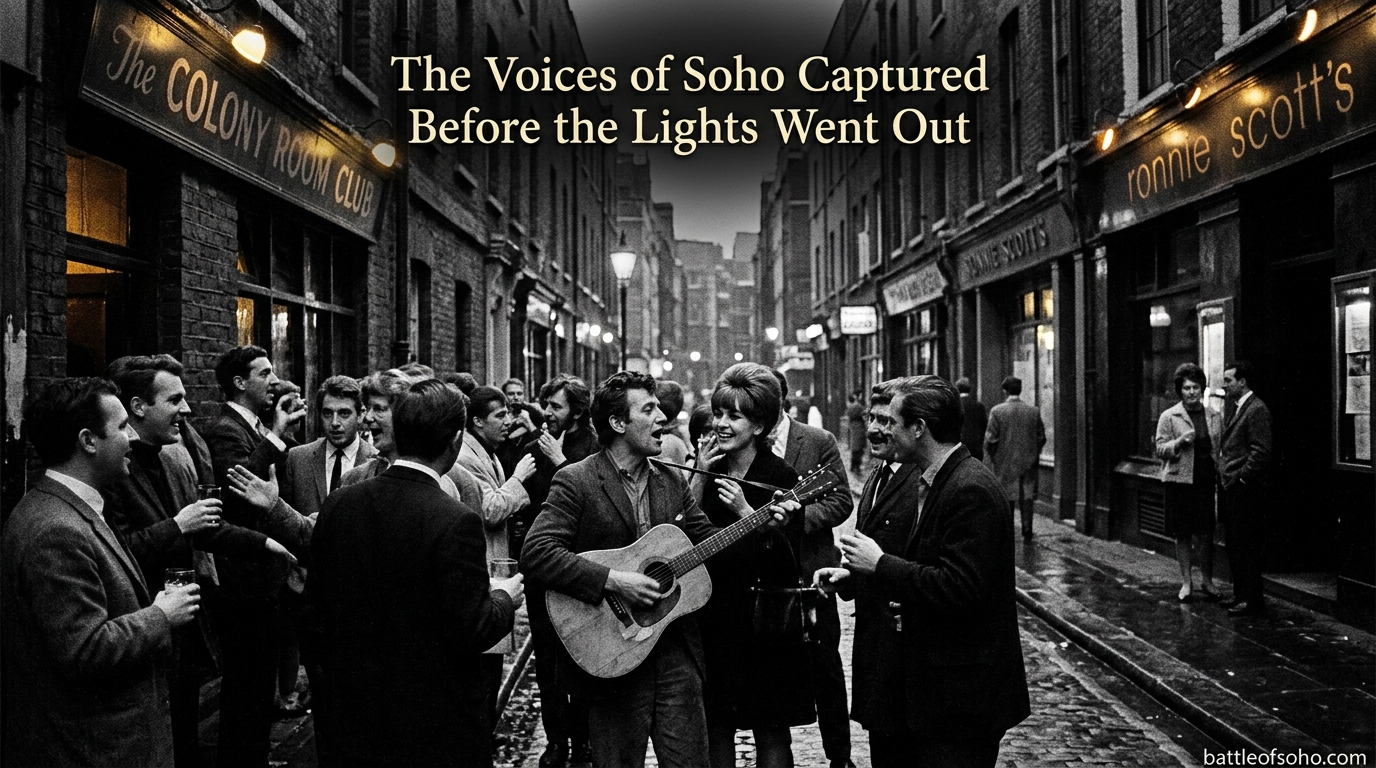
Somewhere in a backroom above a Greek Street café, a tape recorder was switched on. A market trader who had worked Berwick Street since 1948 leaned forward and began to talk. A club doorman from Walker’s Court cleared his throat and remembered the night the bands stopped playing. A restaurateur described the smell of the morning bread deliveries on Old Compton Street before the tourists arrived. These are the voices of Soho captured before the lights went out — recordings made in the gap between the old neighbourhood and the new one, when people who had lived and worked there for decades finally sat down to be heard.
This article traces those voices. It is about the oral history projects — most notably the Photographers’ Gallery’s “Soho Then” podcast and the broader archive of interviews with Soho residents and workers — that set out to record a London neighbourhood in the middle of profound change. It is also about what those voices describe: post-war bomb sites, all-night coffee bars, the counterculture of the 1960s, the LGBTQ+ bars of Old Compton Street, the market traders, the sex workers, the buskers, and the slow creep of gentrification that dimmed the lights one venue at a time.
Table of Contents
What the Voices of Soho Captured Before the Lights Went Out Really Means
The phrase points to a specific kind of history. Not the history of kings or planners, but the history held in the mouths of the people who actually lived there. Oral history is the practice of recording first-person testimony about everyday life, work, and place. In Soho’s case, it became urgent precisely because the place was visibly disappearing.
The most prominent example is the “Soho Then” project, produced in connection with the Photographers’ Gallery on Ramillies Street. The gallery sits at the edge of Soho itself, and over the course of the project it gathered residents, workers, landlords, club owners and long-time habitués into a recording booth to talk about the neighbourhood they knew. The resulting podcast episodes are short, intimate, and often bittersweet — each one a small portrait of a Soho that was already fading as the microphone rolled.
What makes these recordings different from a standard documentary is the texture. You hear the actual accents of post-war Soho. You hear the pauses when someone remembers a pub that no longer exists. You hear laughter about things that were not funny at the time. This is history in the first person, captured before the people who could tell it were gone.
Post-War Soho: The Wild West End
To understand why those voices mattered, you have to picture what Soho was in the 1950s. Post-war Soho was the new bohemian capital of London, as the London Museum’s research on the period puts it. With its cheap rents and worldly village character, people flocked to Soho for music, restaurants, coffee bars, nightclubs and drinking dens.
The war had left marks. In the mid-1950s, only a decade after the conflict ended, there were still bomb sites scattered through the district. Threadbare bookies operated out of back rooms. Pubs that had served as meeting points during the Blitz carried on serving the same clientele, now joined by a new wave of returning soldiers, displaced Europeans, artists and chancers. Cheap rents meant almost anyone could afford a room or a shopfront, and that mix produced a streetscape unlike anywhere else in the capital.
The oral history recordings bring this back with startling clarity. In one frequently cited thread of reminiscences about Soho in the 1950s and 60s, former residents describe a place of seedy pubs, characters on every corner, and a constant low hum of music from basement clubs. It was rough, certainly. But it was also communal in a way that is hard to recreate now — people knew each other, watched out for each other, and tolerated each other’s peculiarities because there was nowhere else for those peculiarities to go.
This is the Soho that the voices in the archive grew up in. When they talk about “their” Soho, this is what they mean: the post-war village inside the city, where the rent was low, the coffee was strong, and nobody asked too many questions.
Soho in the 1960s: Coffee Bars, Clubs and Counterculture
By the 1960s, Soho had become a whirlwind of counterculture, creativity, and a touch of notoriety. The small grid of streets between Oxford Street, Shaftesbury Avenue, Charing Cross Road and Regent Street pulsated with a life unlike any other part of London. The oral histories captured by the Soho Then project and similar archives return again and again to this decade as the high-water mark of the old neighbourhood.
Live music clubs and coffee bars were the engine of it. Places like the Green Bowler, the Nite Owl, the Chameleon and the Casino Ballroom became the spawning ground for British rock and roll, skiffle, jazz and early R&B. Young musicians who would later become famous played cramped sets to tiny crowds. Coffee bars — many of them run by Italian and French families who had settled in the area — stayed open late, served espresso (still a novelty in 1950s Britain), and gave teenagers a place to gather that was not the pub.
When you listen to the recordings from this period, certain details repeat. The smell of espresso machines. The blue cigarette haze in basement rooms. The sense that something could begin at any moment — a band, a fight, a romance, a business. Workers from the clubs describe carrying amplifiers down narrow stairs at two in the morning. Waitresses remember the regulars by name decades later. Owners talk about licensing hours, police raids, and the unwritten rules that kept the whole ecosystem turning over.
What the voices capture, more than anything, is atmosphere. The 1960s Soho that emerges from the recordings is not the cartoon version of Swinging London. It is a working neighbourhood, run by working people, where the work happened to be entertainment. That distinction matters, because it is exactly what got lost later.
Soho’s LGBTQ+ Voices and the Bars That Held Them
Some of the most important voices in the Soho archive belong to people who speak about the neighbourhood’s LGBTQ+ history. Soho has been a centre of queer life in London for centuries, and the bars and clubs of Old Compton Street and the surrounding streets have long served as meeting places, refuges, and sites of resistance.
Tracing the roots of Soho’s LGBTQ+ bars takes you back well before the 1950s. There is evidence of queer gathering places in the area from the 1600s onwards — molly houses in the eighteenth century, discreet bars in the Victorian and Edwardian eras, and then the more visible (if still persecuted) scene that developed through the twentieth century. By the post-war decades, Soho had become the most recognisable queer neighbourhood in London, even if the law had not yet caught up with the people who lived there.
The oral histories record what that felt like from the inside. Speakers describe the coded language used at the bar, the danger of police raids, the relief of finding a room full of people who understood. They talk about specific venues — some famous, some long demolished — and about the barmen, drag performers and door staff who held those spaces together. The 1967 partial decriminalisation of homosexuality in England and Wales is recalled not as a single moment of liberation but as a slow shift that changed how Soho’s queer venues could operate in public.
These testimonies matter because LGBTQ+ history is unusually fragile. Bars close, records are destroyed, people are careful about what they write down. The voices captured by the Soho Then project and related archives preserve a record that, in many cases, exists nowhere else.
The Residents and Workers Who Spoke Into the Microphone
The strength of the Soho oral history archive is that it did not only record the famous. It recorded the people who actually made the neighbourhood run. The Photographers’ Gallery project and similar collections deliberately sought out market traders from Berwick Street, chefs and waiters from the restaurants of Chinatown and Old Compton Street, landlords of Soho pubs, sex workers who operated from the flats and walk-ups of Walker’s Court, buskers who worked the corner of Charing Cross Road, and long-term residents who had lived in the same flat for forty years.
The market traders are some of the most vivid voices. Berwick Street Market has existed since the eighteenth century, and the traders who spoke into the microphone described a place that was raucous, competitive, and deeply social. They remembered the costermongers’ calls, the early-morning deliveries, the regulars who came every week for decades. Several of them talked about the slow replacement of independent stalls by chain outlets, and what that did to the texture of the street.
The sex workers’ testimonies are handled with particular care in the archive. Soho’s sex industry was for decades one of the things the neighbourhood was most known for, and the people who worked in it have rarely been asked to describe it in their own words. The recordings give them that space. They talk about the economics of the work, the relationships between workers and landlords, the constant negotiation with police and council, and their own feelings about an industry that was simultaneously stigmatised and central to Soho’s reputation.
Restaurateurs and publicans describe a different kind of community. Many of the family-run Italian, French, Chinese and Greek establishments that defined Soho’s food scene operated on tight margins and long friendships. The voices in the archive recall the networks of suppliers, the chefs who moved between kitchens, and the customers who became part of the furniture. When those businesses closed — and many did, as rents climbed — the loss was personal as well as commercial.
Together, these everyday voices form the real heart of the project. The point of capturing them was not nostalgia. It was the recognition that a neighbourhood is its people, and that when the people change, something has genuinely been lost.
When the Lights Started Going Out: Gentrification and Loss
So when did the lights start going out? The honest answer is gradually, over decades, with no single turning point. But the voices in the Soho archive point to a clear acceleration from the late 1990s onwards.
Rising rents were the engine. As central London property values climbed, the cheap rooms and shopfronts that had sustained Soho’s bohemian and working-class character became too valuable to leave in the hands of the people who had used them. Independent venues closed. The sex shops and walk-ups of Walker’s Court and surrounding streets were steadily reduced as Westminster Council applied licensing pressure and developers bought up freeholds. Long-running clubs and music venues shut their doors, replaced by bars, chain restaurants, and corporate offices.
The construction of Crossrail and the redevelopment around Tottenham Court Road and Dean Street removed whole swathes of the old streetscape. Properties that had housed small businesses for generations were demolished or gutted. The Photographers’ Gallery itself moved to new premises on Ramillies Street in 2012, in a building that sits within the very neighbourhood it was documenting — a reminder that even the institutions preserving Soho’s history were caught up in its physical transformation.
The oral histories capture the emotional texture of this change. Speakers describe walking down streets they no longer recognise. They talk about regulars who have moved out, been priced out, or died. They mourn specific venues by name. Several of them use exactly the kind of language the title of this article borrows from — the sense that the lights of old Soho were going out one by one, and that nobody had thought to record what had been lit until it was almost too late.
That urgency is what gave the recording projects their force. They were not just exercises in nostalgia. They were rescue operations, conducted in real time, against the steady erasure of a place and the people who had made it.
Is Soho Still Seedy? What the Voices Tell Us About the Neighbourhood Today
The short answer is: less than it was, but not entirely gone. The longer answer depends on who you ask, and the voices in the archive make clear that “seediness” was always a complicated word.
To the people who lived and worked in post-war Soho, the things outsiders called seedy — the sex shops, the late-night drinking, the rough pubs, the mixed crowds — were simply the neighbourhood. They were not ashamed of it. Several speakers in the archive push back directly against the idea that old Soho was a place to be embarrassed about. They describe it as tolerant, alive, and genuinely diverse in a way that the polished version of the area is not.
What remains of that Soho in 2026 is a fraction of what existed in the 1950s or 1960s. A handful of sex shops survive around Old Compton Street and Walker’s Court. Some of the old pubs are still trading, though their clientele has changed. Berwick Street Market still operates, but in a much-reduced form. The LGBTQ+ venues that remain are fewer than a decade ago, and several landmark clubs have shut their doors for good.
So is Soho still seedy? Compared to its post-war self, no. Compared to the rest of the West End, it still carries traces of the old character — late opening hours, a visible queer presence, a few survivors from the era of neon and walk-ups. But the version of Soho that the voices in the archive describe is gone, and the recordings exist precisely because the people making them understood that it was going.
What Is the History of Soho London? A Quick Timeline
For readers looking for the broad sweep, the history of Soho London can be sketched quickly. The area takes its name from a hunting cry — “Soho!” — supposedly used by hunters in the open fields that occupied the site in the medieval and Tudor periods. For centuries it was farmland and royal hunting ground on the edge of London.
In the late seventeenth century, the land was developed as London expanded westward. Soho Square was laid out in the 1670s and 1680s, and the surrounding streets filled with town houses for the aristocracy and the rising middle class. Greek Street, Frith Street and Old Compton Street all date from this period of expansion. By the eighteenth century, the area had begun its long drift away from respectability, as the wealthy moved further west to Mayfair and the old houses were subdivided and rented out.
The nineteenth century brought waves of immigrants — French Huguenots, Italian, Greek, Jewish and Chinese communities all settled in or near Soho — and with them the restaurants, markets and small businesses that gave the neighbourhood its cosmopolitan flavour. Soho became known for cheap food, political exiles, music halls, and a thriving underworld.
The twentieth century was when Soho became the Soho of legend. The post-war decades brought the bohemian 1950s, the countercultural 1960s, the music industry and advertising agencies of the 1970s and 1980s, and the rise of Old Compton Street as the centre of London’s LGBTQ+ scene. Through all of this, the underlying character — cheap, mixed, tolerant, noisy, working — held on, until the property pressures of the late twentieth and early twenty-first centuries began to prise it apart.
That is the history the oral archive sits on top of. Every voice in the recordings is, in its own way, a single thread in this much longer story.
Why These Voices of Soho Captured Before the Lights Went Out Still Matter in 2026
It would be easy to treat the Soho Then recordings and the broader oral history of the neighbourhood as a closed chapter — a record of a place that no longer exists, interesting mainly to historians and the nostalgic. That would be a mistake. The voices of Soho captured before the lights went out matter in 2026 for at least three reasons.
First, they are a record of a kind of city that is disappearing everywhere, not just in Soho. The pressures that closed the old venues — rising rents, redevelopment, licensing crackdowns, the replacement of independent businesses by chains — are the same pressures reshaping neighbourhoods across London and beyond. Listening to how Soho’s residents and workers described what was happening to them is a way of understanding a much wider story about who gets to live in central cities at all.
Second, the recordings preserve histories that exist nowhere else. Many of the speakers are now dead. Many of the venues they describe are demolished. Without the oral history work, the details of everyday life in post-war and mid-century Soho — the calls of the market traders, the routines of the club doormen, the slang of the walk-ups, the names of the regulars — would simply be gone. The archive is, in a literal sense, irreplaceable.
Third, and perhaps most simply, the voices are good to listen to. They are funny, sharp, sometimes angry, often tender. They remind you that history is made of people talking about their lives, and that the most valuable records we have of a place are often the ones where someone simply sat down and was asked to remember.
That is the case for the work, and it is the case for keeping the recordings available, listened to, and built upon. The lights that went out in Soho are not coming back. But the voices that were captured while some of them were still on deserve to keep being heard.
FAQs
Is Soho still seedy?
Soho is far less seedy than it was in its post-war heyday. A handful of sex shops and late-night venues survive around Old Compton Street and Walker’s Court, and the area still has a visible queer presence and late opening hours. But compared to the Soho described in oral history recordings from the 1950s and 1960s, the old character has been substantially reduced by rising rents, licensing changes and redevelopment.
Has Soho been gentrified?
Yes. From the late 1990s onwards, rising central London property values, Crossrail construction, and redevelopment around Dean Street and Tottenham Court Road pushed out many of the independent venues, family restaurants and walk-ups that defined old Soho. The oral history archive was created largely in response to this process, capturing residents’ and workers’ testimonies before further change erased them.
What was Soho like in the 1950s?
Post-war Soho in the 1950s was the bohemian capital of London. Cheap rents, a cosmopolitan mix of residents, and a lively street culture made it a centre for music, coffee bars, nightclubs, restaurants and drinking dens. There were still wartime bomb sites, seedy pubs and back-room bookies. The atmosphere was rough but communal, with tight-knit networks of residents, traders and venue owners.
What was Soho like in the 60s?
Soho in the 1960s was a centre of counterculture and live music. Coffee bars and clubs such as the Green Bowler, the Nite Owl, the Chameleon and the Casino Ballroom hosted early rock and roll, jazz, skiffle and Ru0026amp;B. The decade is widely regarded by oral history contributors as the high point of the old neighbourhood, before property pressures and redevelopment began to change the area’s character.
What is the history of Soho London?
Soho began as farmland and royal hunting ground on the edge of London, taking its name from a hunting cry. It was developed in the late seventeenth century with the laying out of Soho Square, became a cosmopolitan district of immigrants and small businesses in the nineteenth century, and rose to fame in the twentieth century as London’s bohemian and nightlife centre. The post-war decades brought the bohemian 1950s, the countercultural 1960s, and the rise of Old Compton Street as the heart of the city’s LGBTQ+ scene.
Conclusion
The voices of Soho captured before the lights went out are not a museum piece. They are a living record of a neighbourhood in the middle of change, made by the people who lived through that change and had the foresight to sit down in front of a microphone. The Photographers’ Gallery’s Soho Then project, alongside the broader archives of residents and workers, gives us something rare: history told in the accents of the people who actually made it.
What those voices describe is a Soho that is hard to picture now — the post-war bomb sites and cheap rents, the coffee bars and basement clubs of the 1960s, the LGBTQ+ bars of Old Compton Street, the Berwick Street traders, the Walker’s Court walk-ups, the family restaurants run on tight margins and long friendships. They also describe the slow process by which that Soho was priced out, redeveloped and licensed away. Listening to them is the closest most of us will get to walking those streets as they were.
If you want to hear the voices for yourself, start with the Soho Then podcast episodes hosted by the Photographers’ Gallery, and explore the oral history collections held by the London Museum and local archives. And if you find yourself in Soho in 2026, walk Berwick Street, Old Compton Street, Greek Street and Walker’s Court with one of those recordings in your ears. You will hear a neighbourhood talking back through time — the lights mostly gone, but the voices still there, still clear, still insisting on being remembered.