
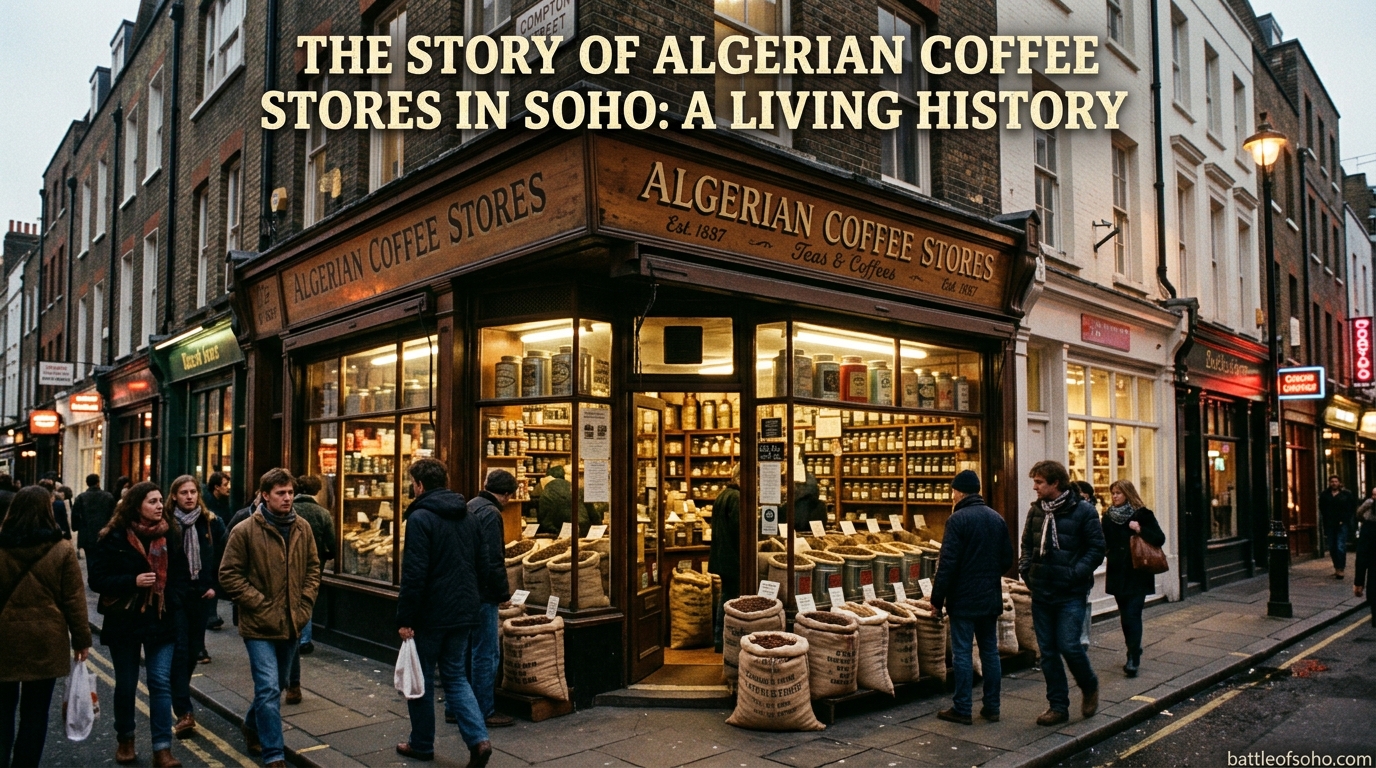
Walk down Old Compton Street in Soho on any given morning and you will pass coffee shops on every corner. Most of them belong to chains you can find in any city in the world. But at number 52, tucked between a theatre and a patisserie, sits a shop that has been selling coffee from the same premises since 1887. The story of the Algerian Coffee Stores in Soho is not just about coffee. It is about survival, family, and a stubborn refusal to become something other than what it has always been.
This small shop on Old Compton Street has lived through the reign of Queen Victoria, two World Wars, the Blitz, the swinging sixties, the AIDS crisis, the 1999 Soho nail bombing, two global pandemics, and the relentless gentrification that has transformed nearly every other business in the neighbourhood. It has been owned by an Algerian, a Belgian, an Englishman, and now an Italian family spanning three generations. And it still blends coffee by hand in a cellar underneath the shop floor.
In this article, I want to take you through the full history of this remarkable place. We will start with its mysterious Algerian founder, trace every ownership change, walk through the bomb damage of World War II, and explore what the shop looks and feels like today. Whether you are a coffee obsessive, a London history buff, or someone who just loves a good story about an independent business that refused to die, there is something here for you.
Table of Contents
The Founding in 1887: Mr Hassan and the Algerian Connection
The Algerian Coffee Stores was opened in 1887 by an Algerian gentleman known only as Mr Hassan. That is where the shop gets its name. Beyond this basic fact, remarkably little is known about the man who started it all. The shop’s own blog, written by the current family owners, admits: “Unfortunately, we know very little about him or the shop back then.”
What we do know is that 1887 was the year. Queen Victoria had been on the throne for fifty years. The Eiffel Tower had not yet been built. Electric lighting was still a novelty in London. Coffee was not the everyday beverage we know today in Britain. It was a specialty product, sold by weight from shops that looked more like apothecaries than cafes. Mr Hassan’s decision to open a coffee store in Soho was, in that context, a distinctly forward-thinking move.
The Algerian connection matters. Algeria has a deep coffee culture rooted in its history as a French territory, and North African coffee traditions stretch back centuries. Mr Hassan would have brought knowledge of coffee sourcing, roasting, and blending that was simply unavailable from most British merchants at the time. He chose Soho because it was already a neighbourhood of immigrants, traders, and small independent shops. It was the kind of place where a stranger with a specialized skill could set up a business and find customers.
There is one wrinkle in this story worth addressing. Wikipedia lists the founder as “M. Siari,” an Algerian national, rather than Mr Hassan. The official blog and CNN both name Mr Hassan. The most likely explanation is that either these are the same person known by different names in different records, or M. Siari was involved in the founding in a capacity that early records captured differently. The family’s own archival research, passed down through ownership changes, refers to Mr Hassan, and I will follow that account while noting the discrepancy for transparency.
What happened to Mr Hassan remains a mystery. At some point, the shop left his hands. The next documented owner does not appear until the 1920s, leaving a gap of several decades that the shop’s archives do not fully cover. What is certain is that the name stuck. More than 135 years later, it still says Algerian Coffee Stores above the door.
The Ownership Timeline: From Algeria to the Crocetta Family
One of the most remarkable things about the Algerian Coffee Stores is how many times it has changed hands, yet never changed character. Each new owner respected what the shop was and carried it forward. Here is the ownership timeline, broken down step by step.
1. Mr Hassan (1887 to circa 1920s): The Algerian founder established the shop, built the initial customer base, and created the coffee-by-weight model that would define the business for the next century plus.
2. Mr Boerman (1928 to 1946): A Belgian businessman purchased the shop in the late 1920s. Under his ownership, the shop expanded its coffee sourcing and began stocking a wider range of origins. The 1944 coffee stock sheet, preserved in the shop’s archives, shows beans arriving from India, Jamaica, Cameroon, Madagascar, Congo, and Brazil. Boerman also oversaw the shop through the darkest days of World War II.
3. Mr Jones (1946 to 1960s): An Englishman took over shortly after the war. He guided the shop through the post-war recovery years, when rationing was still in effect and Soho was rebuilding after heavy bomb damage. Little specific detail survives about his tenure, but the shop continued trading without interruption.
4. Paul Crocetta (1960s to 1980s): An Italian businessman, Paul Crocetta, acquired the shop and brought with him a deep understanding of Italian coffee culture. Under his ownership, the shop refined its blending techniques, expanded its tea selection, and built the mail-order business that would eventually ship coffee around the world. The Italian connection brought a new layer of expertise to an already established operation.
5. Marisa and Daniela Crocetta (1980s to present): Paul’s descendants now run the shop. Marisa Crocetta is the current face of the business, frequently interviewed by journalists and featured in the CNN travel piece about the shop. Her daughter Daniela represents the third generation of the family to manage the store. Together, they have maintained the shop’s character while building an international online presence that ships coffee worldwide.
Five owners across 137 years. Three nationalities represented before the Crocetta family. And the shop still looks, feels, and operates almost exactly as it did in the Victorian era.
Surviving The Blitz: Algerian Coffee Stores During World War II
Of all the chapters in the shop’s history, its survival through World War II is perhaps the most dramatic. Soho took heavy punishment during the Blitz. The area around Old Compton Street was struck repeatedly, and neighbouring buildings were destroyed or severely damaged.
Photographs from May 1941, preserved in the shop’s archives, show the devastation firsthand. The area around the shop was littered with debris. Windows along Old Compton Street were blown out. The Admiral Duncan pub, just a short walk away and trading since 1832, suffered damage during the bombing campaigns. Shops on either side of Algerian Coffee Stores were not so lucky.
Yet the coffee store survived. Its windows were boarded up during the worst of the raids, and evidence of shrapnel damage can still be found on the building’s facade if you know where to look. A dentist’s sign, visible on the first floor in wartime photographs, provides a timestamp for the era and confirms the building was standing and partially occupied even as bombs fell around it.
The shop stayed open. This is the part that staggers me. Through air raids, blackouts, and rationing, Algerian Coffee Stores continued to serve customers. Coffee was rationed like everything else, but the shop adapted, sourcing whatever beans were available and keeping its doors open. For Soho residents living through the terror of the Blitz, having a familiar shop still trading on their street must have been a small but real comfort.
Two children named Lucy and Tony were born on the top floor of the building, in 1917 and 1937 respectively. Tony was just a small child during the Blitz. The fact that a family was living above the shop throughout the bombing adds a deeply human dimension to the wartime story. It was not just a business surviving. It was a home.
When the war ended in 1945, the shop was still standing. The board came off the windows, the stock sheet was updated, and the next chapter began with Mr Jones taking ownership in 1946. London was rebuilding, and Old Compton Street was finding its way back to normalcy. The coffee store had made it through.
Step Inside: The Original Shop Features Still Here Today
If you visit Algerian Coffee Stores today, you are walking into a space that has barely changed in over a century. This is not a themed recreation. It is the real thing. Marisa Crocetta told CNN plainly: “No one wants us to glam it up.” That philosophy has preserved one of the most authentic Victorian-era shop interiors in London.
The first thing you notice is the wooden counter. It dates from the 19th century, original to the shop’s early decades. Behind it, floor-to-ceiling shelves are stocked with jars and bags of coffee and tea from around the world. The shelving itself is original, built to hold the shop’s stock in an era before modular shop fittings existed.
On the floor near the entrance, there is a glass paving hatch. This is not a decorative feature. It is a working delivery point. Raw coffee was historically delivered in 70-kilogram sacks and lowered through this hatch into the cellar below. The glass panels allowed light to filter down into the underground space. This hatch is still there today, a piece of functional Victorian industrial design that has simply never been removed.
Below the shop floor sits the cellar. This is where the blending happens. Coffee arrives in large sacks, is sorted by origin, and is blended by hand using methods that have not changed in over a hundred years. There is no automated production line. There is no industrial roasting facility. It is a person, a set of scales, and decades of accumulated knowledge about which beans work together.
Cast iron scales sit on the counter, the kind with sliding weights that click into place. They are not props. They are used. Coffee is weighed out for customers in front of them, wrapped in paper, and handed across that same wooden counter. In an age where most coffee comes in branded foil bags with marketing copy printed on the side, this feels almost radical.
The shop fascia outside, the painted sign above the door, retains the look of an earlier era. Time Out London described the shop as “unassumingly nestled in the heart of Soho.” That is exactly right. It does not announce itself. It simply is what it has always been, and in a neighbourhood that has reinvented itself a dozen times over, that continuity is its greatest asset.
What You Will Find Inside: 80 Coffees, 120 Teas, and More
The product range at Algerian Coffee Stores is staggering for a shop of its size. The current stock list includes over 80 different types of coffee beans sourced from origins around the world, and more than 120 varieties of loose leaf tea. For a shop that is essentially one room and a cellar, this is an extraordinary selection.
The coffee range spans single origin beans and house blends. You will find beans from traditional coffee-growing regions like Brazil, Colombia, and Ethiopia, sitting alongside more unusual origins. CNN noted beans from Hawaii, Vietnam, Malawi, and even Australia in the shop’s stock. The 1944 coffee stock sheet, still preserved in the archives, shows that even during wartime the shop was sourcing from India, Jamaica, Cameroon, Madagascar, and the Congo. The global reach of this tiny Soho shop has been a defining feature from the beginning.
The signature house blend is called Gourmet Noir. Multiple customers have written about this blend in the shop’s comment section, some describing decades of loyalty to it. One customer, who first tried it when she moved to London in 1989, still orders it regularly. House blends like this are where the shop’s blending expertise really shows. Each blend is created in the cellar, mixed by hand from component beans that are chosen for how they complement each other.
The tea selection is equally impressive. Over 120 loose leaf teas are stocked, ranging from traditional English Breakfast to rare single-estate varieties. In the shop’s earlier decades, it also sold wine and Port, shipped in tea chests. That part of the business has since been retired, but the tea side has only grown.
Beyond beans and leaves, the shop stocks coffee and tea equipment. This is where it gets interesting for brewing enthusiasts. A Reddit user on r/UKroasters highlighted that the shop carries items like the Vietnamese phin, a small metal filter used for traditional Vietnamese coffee. This is not the kind of product you find in most British coffee shops. It reflects the shop’s philosophy of stocking what is genuinely useful and interesting, regardless of whether it fits a narrow commercial profile.
Coffee is sold by weight, not in branded packaging. You ask for what you want, it gets weighed on the cast iron scales, and it goes into a paper bag. This is how coffee was sold in 1887, and it is how it is sold now. The shop also sells coffee machines, grinders, and confectionery, making it a one-stop shop for anyone who takes their coffee seriously.
You can also buy a ready-made cup. An espresso costs around the price of a high-street chain’s smallest drink, and a cappuccino is similarly affordable. Secret London highlighted this as one of the great surprises of the shop: quality coffee in central London for a fraction of what the chains charge. The shop is primarily a retail space with limited seating, so think of it more as a place to buy beans and grab a quick cup than a linger-all-afternoon cafe.
The Crocetta Family: Three Generations of Coffee Dedication
The Crocetta family’s connection to Algerian Coffee Stores began when Paul Crocetta, an Italian businessman, purchased the shop in the 1960s. Paul brought with him the Italian tradition of espresso culture and a deep understanding of coffee blending. Under his ownership, the shop refined its processes, built relationships with international suppliers, and laid the groundwork for the mail-order business that would later become a significant part of the operation.
The baton passed to Marisa Crocetta, Paul’s daughter, who now runs the shop day to day. Marisa is the public face of the business and has been interviewed by CNN, Time Out, Secret London, and numerous other publications. In her CNN interview, she spoke about the shop with a mix of pride and pragmatism. She does not see the shop as a museum piece or a tourist attraction. She sees it as a working business that happens to have a long history.
Daniela Crocetta, Marisa’s daughter, represents the third generation of the family to work in the shop. The transition from Paul to Marisa to Daniela has been seamless because each generation inherited not just the business but the philosophy: keep the shop as it is, source the best coffee you can find, blend it properly, and serve the people who walk through the door.
The family has also modernized in one specific way. The mail-order business, which began as handwritten letters and posted orders, has evolved into a full online operation. Customers around the world can now order coffee through the shop’s website and have it shipped internationally. Marisa described this in her CNN interview: “We send coffee all over the world, from the UK and all over the world.” The shop maintains a loyal international customer base that has been ordering from them for decades.
What the Crocetta family has resisted is the temptation to expand. There is one shop. There is no second location, no franchise, no branded merchandise line, no plans for a chain. In a city where every successful food business seems to spawn three more locations within a year, this restraint is almost unheard of. It is also, arguably, the reason the shop has survived. By staying small and focused, the family has kept quality high and overheads manageable.
Soho Itself: How the Neighborhood Changed Around the Shop
You cannot tell the story of the Algerian Coffee Stores without telling the story of Soho. The neighbourhood has been London’s most colourful district for centuries, and the shop has been a constant presence through all of its transformations.
Soho began developing in the late 1670s, when the area was gradually built up from open fields into a residential and commercial district. Old Compton Street, where the coffee store sits, has been a commercial street since the 18th century. The area attracted immigrants, artists, musicians, writers, and tradespeople. It became known for its bohemian character, its nightlife, and its independent businesses.
Neighbouring institutions tell their own stories. Maison Bertaux, a French patisserie founded in 1871, sits nearby and predates even the coffee store. The Admiral Duncan pub, trading since 1832 and just a short walk from the shop, has its own long and sometimes tragic history. Together, these businesses formed the backbone of an independent, family-run Old Compton Street that thrived for over a century.
The late 20th and early 21st centuries were not kind to that version of Soho. Gentrification swept through the area. Rents skyrocketed. Independent shops closed one by one. I Camisa, a beloved Italian deli that had been a Soho institution, shut its doors. Chain restaurants, cocktail bars charging premium prices, and corporate-owned venues replaced many of the family businesses that had given the neighbourhood its character.
The shop has also lived through moments of tragedy in the neighbourhood. The 1999 Admiral Duncan nail bombing, which killed three people and injured many more, happened just around the corner. The AIDS crisis devastated Soho’s community in the 1980s and 1990s. Through all of this, the coffee store stayed open, serving whoever walked through the door.
Yet Algerian Coffee Stores held on. Part of this is the family’s stubborn commitment to the shop. Part of it is the fact that they own the building, which removes the rent pressure that killed so many other Soho businesses. And part of it is the loyalty of customers who have been coming for decades and refuse to let the shop disappear. In a Soho that has been sanitized and corporatized in so many ways, the coffee store is a direct link to the neighbourhood’s older, grittier, more independent past.
The Coffee Blending Craft: Traditional Methods That Have Not Changed
One of the most underexplored aspects of the Algerian Coffee Stores story is the blending craft itself. This is not a shop that buys pre-roasted, pre-blended coffee from a supplier. It creates its own blends from raw ingredients, using methods that have been passed down through ownership changes for over a century.
The process starts in the cellar. Raw coffee arrives in 70-kilogram sacks, delivered through the glass paving hatch at the front of the shop. These sacks come from the same types of origins documented in the 1944 stock sheet: Brazil, India, Jamaica, Cameroon, Madagascar, Congo, and many more. Each origin has its own characteristics. Some are bright and acidic. Some are heavy and chocolatey. Some are floral. The art of blending is in knowing which of these complement each other.
The cellar is where the blending happens. It is not a high-tech facility. It is a low-ceilinged, traditional London shop cellar with sacks of coffee, measuring equipment, and the accumulated knowledge of the people who work there. Blends are mixed by hand, in batches, based on recipes that have been refined over decades. The Gourmet Noir blend, for instance, is a specific combination of beans that has been tuned over the years to produce a consistent, recognizable cup.
Cast iron scales are used to measure component beans for each blend. The same type of scales that were used in 1887. There is something deeply satisfying about this. In an era where coffee production has been industrialized to the point where a single factory can produce millions of identical pods, there is still a shop in Soho where a person weighs out beans by hand and mixes them in a cellar.
The blending matters because it is the core of what makes the shop unique. Anyone can buy single origin beans from a wholesaler. But a house blend is a signature. It is the product of decisions made over years about what tastes good together. When a customer has been ordering the same blend from Algerian Coffee Stores for thirty years, they are tasting the result of three decades of refinement. That kind of consistency does not come from a machine. It comes from people who care.
Generations of Customers: Why People Keep Coming Back
The most powerful evidence of what Algerian Coffee Stores means to people comes from the customers themselves. The shop’s official blog has a comments section filled with stories that span decades, and they paint a picture of a business that is woven into the fabric of people’s lives in a way that no chain coffee shop could ever replicate.
One customer wrote: “I have been buying my coffee from the Algerian Stores for years now and I always enjoy coming in to the store.” That comment, simple as it is, was from a customer who first visited in 1971. Over fifty years of loyalty to a single coffee shop.
Another shared a childhood memory that captures the personal dimension of the shop beautifully: “My mother used to bring me here every week to buy her mocha coffee beans. The servers all wore white coats and when I lost my front baby teeth they would sing to me about all I want are my two front teeth.” This is not a transaction. This is a relationship between a family and a shop that spans generations.
A customer who first came to London as a student in 1974 wrote: “I have happily been buying my coffee beans in your fabulous store since 1974 when I first came to London as a student.” Fifty years later, still buying from the same place. Another discovered the shop through a friend in 1989, tried the Gourmet Noir blend, and has been ordering it ever since.
One customer, an author, mentioned that the shop’s Algerian Special blend literally fuelled his writing: “I have been a customer since 1971. Most recent Algerian Special fuelled book: Bob Dylan’s Hibbing.” This touches on a less-documented aspect of the shop’s cultural footprint: its connection to London’s literary and creative community. Writers, artists, and musicians who have lived and worked in Soho over the decades have almost certainly passed through this shop.
On TripAdvisor, the shop holds a 4.8 out of 5 rating from over 191 reviews. Visitors consistently mention the atmosphere, the range, the prices, and the sense of stepping back in time. On Reddit, users in r/UKroasters praise the shop’s “cool history” and the unexpected breadth of its equipment range, from espresso machines to Vietnamese phin filters.
These stories matter because they demonstrate something that no marketing campaign can manufacture: genuine, multi-generational customer love. People do not just buy coffee from this shop. They bring their children. They remember the staff from decades ago. They write about it in book acknowledgments. That kind of loyalty is built one cup at a time, over years and decades, and it is the real reason the shop has survived.
Visiting Algerian Coffee Stores Today
If this article has convinced you to visit, here is what you need to know. The shop is located at 52 Old Compton Street, in the heart of Soho, London W1. It is a short walk from Tottenham Court Road Underground station, and easily reachable from Leicester Square and Piccadilly Circus as well.
When you arrive, expect a small, busy retail space rather than a sit-down cafe. There is limited seating, so most people come to buy beans and equipment to take away, or to grab a quick espresso or cappuccino at the counter. The coffee prices are notably lower than the chain shops nearby, which is one of the most consistent surprises for first-time visitors.
If you are not sure what to order, ask the staff. They know their stock inside out and can recommend a blend based on how you brew at home. If you like dark, rich coffee, the Gourmet Noir house blend is the one that comes up most often in customer testimonials. If you want to explore, browse the single origin shelves and pick something from a region you have never tried before.
If you cannot visit in person, the shop runs a full mail-order service through its website. Coffee is shipped internationally, and customers around the world have been ordering from the shop for decades. You can browse the full range of coffees, teas, and equipment online and have it delivered to your door.
The shop has survived COVID-19 pandemic disruptions and the economic pressures of recent years, and it remains open and trading. If you are planning a visit, check the shop’s website for current opening hours, as these can vary seasonally.
FAQs
What is the cultural significance of Algerian coffee?
Algerian coffee culture is rooted in North African and French colonial traditions, where coffee preparation and social drinking are deeply embedded in daily life. When Mr Hassan opened the Algerian Coffee Stores in 1887, he brought this tradition to London at a time when coffee was still a specialty product in Britain. The shop introduced coffee-by-weight retailing to Soho and helped establish the neighbourhood’s long-running coffee culture.
Where did Soho coffee start?
Coffee houses in Soho date back to the 17th and 18th centuries, when the area was developing as a commercial and social district. The Algerian Coffee Stores, founded in 1887 on Old Compton Street, is widely considered the oldest continuously operating coffee shop in London and played a foundational role in establishing Soho as a coffee destination.
What is the history of the old coffee house Soho?
Soho’s coffee house history stretches back to the 1600s, but the most significant surviving example is the Algerian Coffee Stores, opened in 1887. It was founded by an Algerian gentleman named Mr Hassan, sold to a Belgian named Mr Boerman in the 1920s, then to an Englishman named Mr Jones in 1946, and finally to the Crocetta family, who still own and run it today as a third-generation family business at 52 Old Compton Street.
Is Algerian Coffee Stores the oldest coffee shop in London?
Algerian Coffee Stores, founded in 1887, is widely cited as the oldest continuously operating coffee shop in London. While the Jamaica Wine House in the City of London has connections to coffee dating back to 1652, the Algerian Coffee Stores holds the distinction of being the longest-running dedicated coffee retail shop trading from its original premises without interruption.
Who founded Algerian Coffee Stores?
Algerian Coffee Stores was founded in 1887 by an Algerian gentleman known as Mr Hassan, which is where the shop gets its name. Wikipedia alternatively lists the founder as M. Siari, an Algerian national. The official shop records passed down through ownership changes refer to Mr Hassan.
Can you buy coffee online from Algerian Coffee Stores?
Yes. Algerian Coffee Stores operates a full mail-order service through its website, shipping coffee beans, loose leaf tea, and brewing equipment internationally. The shop has maintained a mail-order business for decades, evolving from handwritten posted orders to online ordering, and serves loyal customers around the world.
Conclusion: Why This Story Still Matters in 2026
The story of the Algerian Coffee Stores in Soho is, at its core, a story about persistence. One shop, one location, 137 years and counting. Five owners from four different countries. Two World Wars, two pandemics, and waves of gentrification that swept away nearly every other independent business on the street. And yet the doors at 52 Old Compton Street are still open, the cellar is still blending coffee by hand, and the cast iron scales are still clicking out weights on a Victorian-era counter.
In 2026, as Soho continues to change and as London’s independent businesses face pressures that would have been unimaginable in 1887, this shop stands as proof that not everything has to be new to be relevant. Some things just need to survive long enough to become irreplaceable. If you have never visited, or never ordered a bag of beans online, there has never been a better time to discover what generations of Londoners have known for over a century: this little shop on Old Compton Street is one of a kind.