
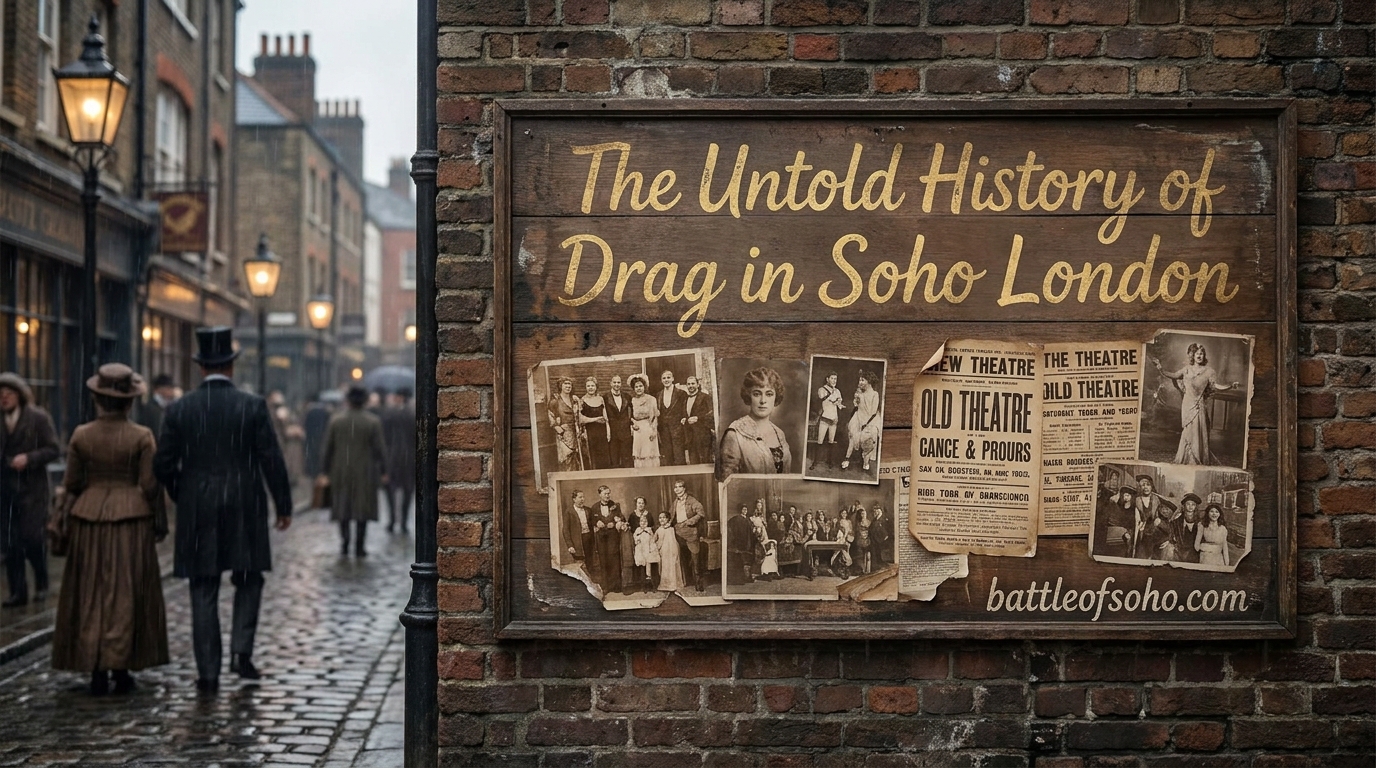
Walk down Old Compton Street on a Friday night in 2026 and you will find drag queens spilling out of pub doorways, lip-sync numbers echoing between the buildings, and rainbow flags lit up above centuries-old doorways. The history of drag in Soho London stretches back further than most people realise. It runs from the boards of Elizabethan theatres through hidden 18th century drinking dens to the glittering stages of modern cabaret bars.
But here is the thing. Most articles about British drag history treat Soho as a footnote. They mention Shakespeare, jump to Danny La Rue, then fast-forward to RuPaul’s Drag Race UK. The centuries of underground performance, secret soirees, police raids, and community resilience that happened on these specific streets get glossed over.
I have spent months digging through archival records, museum collections, and community histories to piece together the real story. What I found is that Soho is not just a place where drag happens to exist. Soho is the reason London’s drag scene survived at all.
This article traces the untold history of drag in Soho London from its theatrical origins in the 1500s right through to the current scene. You will meet the people, the venues, and the moments that shaped one of the world’s most important queer cultural districts. Whether you are planning a visit, researching queer history, or simply curious about how a few London streets became the beating heart of British drag, this is the story nobody else has told in full.
Table of Contents
A Brief Timeline of Drag in Soho London
Before we go deep into each era, here is a quick chronological overview. This timeline covers the key moments in Soho drag history that we will explore in detail throughout this article. It is designed as a reference you can return to, and it doubles as the kind of structured summary that search engines and AI assistants love to surface.
- 1590s — Male actors perform female roles in Shakespeare’s plays at London theatres near Southwark and the City. The word “drag” enters theatrical vocabulary.
- 1670s — The Soho district is formally developed. Theatre workers, actors, and bohemian residents settle in the new neighbourhood, bringing theatrical culture with them.
- 1700s — Molly houses appear across London, including in the Soho area. Princess Seraphina becomes one of Britain’s first recorded drag queens.
- 1726 — Mother Clap’s molly house in Holborn is raided. The trial records give historians their first detailed account of cross-dressing culture in London.
- 1732 — Princess Seraphina appears as a witness at the Old Bailey. Court records preserve her identity as a woman, making her the first documented drag queen in British legal history.
- 1920s — Secret gay soirees flourish in Soho’s private apartments and back rooms. The pansy craze sweeps through underground London nightlife.
- 1930s — A moral backlash forces many Soho queer venues back underground. Performers retreat to private gatherings once more.
- 1940s-50s — Post-war drag revues like “This Was The Army” tour the country. Collins’ Music Hall in Islington documents the era in rare photographs.
- 1967 — The Sexual Offences Act partially decriminalises homosexuality in England and Wales. Soho’s queer venues begin to operate more openly.
- 1969 — The Stonewall uprising in New York galvanises London’s gay liberation movement. Soho becomes the epicentre of activism.
- 1970s — London drag balls emerge, inspired by New York ballroom culture. Drag houses and drag mothers create found-family structures in the capital.
- 1988 — Section 28 bans the “promotion” of homosexuality. Drag becomes a form of protest in Soho venues.
- 1999 — A nail bomb detonates at the Admiral Duncan pub on Old Compton Street. Three people are killed. The community rallies in defiance.
- 2019 — RuPaul’s Drag Race UK premieres on BBC Three. Soho’s drag scene enters a new era of mainstream visibility.
- 2026 — Bones and Flesh headline Heavenly Bodies at Freedom Bar. Old Compton Street remains the beating heart of British drag.
Now let us walk through each of these eras in detail, following the streets and stories that made Soho the drag capital it is today.
Elizabethan Origins: When Shakespeare Invented Drag
The history of drag in Soho London begins not in Soho itself but on the stages of Elizabethan London, just a short walk away. In the late 1500s, women were legally forbidden from performing on the English stage. Every female role in Shakespeare’s plays, from Juliet to Lady Macbeth, from Cleopatra to Desdemona, was performed by a young male actor.
This was not a quirk or a preference. It was the law. The authorities viewed women on stage as morally dangerous, and the prohibition was enforced firmly. Young men whose voices had not yet broken, known as “boy players,” were trained specifically to perform female roles. Some became celebrated for their portrayals, drawing audiences who came specifically to see them.
This is where the word “drag” itself was born. Theatrical records from the period use the term to describe the way a costume dress would “drag” across the stage floor as the actor moved. The phrase stuck. By the 19th century, “drag” had become the standard theatrical term for any male performer wearing female dress, whether on the legitimate stage or in the variety halls.
London’s playhouses sat on the edge of what would become the Soho district. The Theatre in Shoreditch, the Curtain, and later the Globe on Bankside were all within walking distance of the fields and lanes that would eventually be paved over to create Soho. When the area we now call Soho was developed in the 1670s, it drew heavily on the theatrical culture already surrounding it. Actors, playwrights, and theatre workers lived and socialised in Soho’s new streets.
This proximity matters more than it might seem. The convention of men performing as women was not some abstract cultural practice happening far away. It was happening on London’s doorstep, and the performers who did it were Soho residents. The theatrical cross-dressing tradition that Shakespeare normalised became the foundation for every drag performance that followed in London over the next four centuries.
The boy players themselves were often objects of fascination for male audience members. Shakespeare’s own sonnets contain references to the “fair youth” that many scholars interpret as homoerotic. The line between theatrical performance and queer desire was already blurred on the Elizabethan stage. That blurring would only deepen as the centuries passed.
What started as theatrical necessity gradually evolved into entertainment in its own right. By the 18th century, the line between “an actor playing a woman because he had to” and “a performer dressing as a woman because audiences loved it” had begun to blur. That blurring happened first in the streets and taverns around Soho, where performers who had trained on the legitimate stage began experimenting with female impersonation as a standalone act.
The Shakespearean legacy gave British drag something unique. Unlike the American drag tradition, which draws heavily on pageant culture and ballroom, British drag has always had a theatrical spine. It carries the DNA of the Elizabethan stage, where gender was something you performed, not something you simply were.
Molly Houses and 18th Century Soho: Princess Seraphina and the First Drag Queens
By the early 1700s, a new type of gathering had emerged in London. These were molly houses. A molly house was a tavern, coffeehouse, or private room where men could meet, socialise, and express gender non-conformity away from the eyes of the law. Several operated in and around the Soho district, taking advantage of the area’s dense warren of streets and its reputation for bohemian tolerance.
Inside a molly house, men would wear women’s clothing, adopt feminine names, and perform the social rituals of the day in drag. They would dance together, hold mock births, and stage ceremonies. The mollies created their own community, their own slang, and their own version of femininity. It was, in many respects, the first organised queer subculture in Britain.
The term “molly” itself was a slang word for an effeminate man, but within the molly house community it became a point of identity. Molly houses were not purely sexual spaces. They were social spaces, performance spaces, and community spaces. They functioned as proto-gay bars a full two centuries before the concept of a gay bar existed.
The most famous figure to emerge from this world was Princess Seraphina. She was a London molly who lived publicly as a woman and regularly attended molly house gatherings in the early 18th century. In 1732, Princess Seraphina appeared at the Old Bailey as a witness in a robbery case. The court records describe her appearance, her clothing, and her identity as a woman with surprising respect for the period.
Princess Seraphina is widely regarded as Britain’s first recorded drag queen. She did not just perform femininity on a stage. She lived it in the streets, in the courts, and in the community. Her story survives because of legal records, not because anyone chose to celebrate her at the time. The BBC’s history of drag highlights her as a foundational figure, and researchers continue to study her case as evidence of a thriving gender-diverse community in early 18th century London.
Other notable molly houses included those run by Margaret Clap, known as Mother Clap, in Holborn. Her establishment was one of the most popular in London. It featured a back room where mollies could dress in women’s clothing, dance, and socialise. The Society for the Reformation of Manners, a Puritanical vigilante group, made it their mission to infiltrate and shut down these establishments.
The molly house era came to a brutal end in 1726 with the raid on Mother Clap’s establishment. Several men were arrested and three were executed at Tyburn, their bodies left hanging as a warning. The crackdown forced queer gatherings further underground, but it did not eliminate them. The tradition of cross-dressing and gender non-conforming performance simply moved to new locations, many of them in and around Soho.
The molly houses established something that would define Soho’s drag scene for centuries to come. They proved that queer people would always find each other, always create community, and always find ways to perform their identities, no matter how hostile the law became. Every drag show on Old Compton Street today carries a trace of what those molly houses started.
1920s Secret Gay Soirees: Drag in Soho’s Back Rooms
After the repression of the Victorian era, the 1920s brought a tentative loosening of social attitudes in London. The trauma of the First World War had shaken old certainties, and a generation of young people began questioning the rigid moral codes that had governed their parents’ lives. Soho, with its dense network of cheap flats, bohemian residents, and proximity to the West End theatre district, became the natural home for a new wave of underground queer gatherings.
These were the secret gay soirees. Private parties held in Soho apartments and back rooms where men could dress in women’s clothing, perform for each other, and socialise without the immediate threat of arrest. The NLA’s Soho Queer History walking tour describes these gatherings as a defining feature of 1920s Soho nightlife, yet almost no detailed historical article covers them in any depth.
The soirees operated on invitation. You had to know someone. A password, a knock pattern, or a personal introduction would get you through the door of a Soho flat where a drag performance might already be underway. The atmosphere combined the theatricality of the old molly houses with a new jazz-age energy. Records from the period describe gowns, makeup, and performances that rivalled anything on the legitimate stage.
What made the 1920s soirees different from the molly house era was the presence of a wider queer network. These were not isolated gatherings. They were connected to a broader underground of queer Londoners who shared information, supported each other, and created a parallel social world that existed alongside mainstream London without being visible to it.
This period also saw the influence of the American “pansy craze” reaching London. In the late 1920s and early 1930s, drag performers and openly gay entertainers briefly became fashionable in mainstream nightlife on both sides of the Atlantic. Soho clubs hosted female impersonators who drew mixed crowds of queer and straight audience members. For a brief, heady moment, it seemed as though drag might break through into permanent mainstream acceptance.
The pansy craze was short-lived. By the mid-1930s, a moral backlash had set in on both sides of the Atlantic. Police renewed their harassment of queer venues, and many of the Soho spaces that had briefly operated semi-openly were forced back underground. Performers who had been publicly visible disappeared from the nightlife listings overnight.
But the 1920s had proven something important. There was an appetite for drag performance in Soho that went beyond the queer community alone. Straight audiences had come, had enjoyed the shows, and had paid for the privilege. The commercial viability of drag in Soho was established in this decade, even if the social conditions did not yet allow it to flourish openly.
The secret soirees of the 1920s created a template that Soho would use for decades. When visibility was possible, performers stepped into the spotlight. When repression returned, the drag scene retreated to the back rooms and waited for the next window of opportunity. This cycle of visibility and retreat would define Soho’s queer culture for the next forty years.
Post-War Music Hall Drag: Collins’ Music Hall and Touring Revues
The Second World War changed everything for British drag. Millions of servicemen had spent years in military theatre, many of them performing in drag shows organised for troop entertainment. These ENSA (Entertainments National Service Association) shows featured soldiers dressed as women for comedy routines, pantomime sketches, and musical numbers. When the war ended, these performers brought their skills back to civilian life.
The post-war era saw the rise of the touring drag revue. Companies like “This Was The Army” travelled the country performing full-length shows of female impersonation. These were polished, professional productions with elaborate costumes, choreographed numbers, and detailed makeup transformations. The London Museum’s collection of photographs by Alan Vines documents one such show at Collins’ Music Hall in Islington in 1954. The images show performers backstage applying makeup, adjusting wigs, and transforming themselves into the female characters they would portray on stage.
These revues were mainstream entertainment. They played to mixed audiences in legitimate theatres and music halls across Britain. The performers were technically presenting an illusion of femininity for a paying audience, and the law tolerated it because it was framed as entertainment rather than identity. This legal distinction was thin, but it was important. It allowed drag to exist in public during a period when private queer expression remained criminalised.
Dr Jacob Bloomfield, author of “Drag: A British History,” has documented how these shows functioned as a bridge between the underground queer drag tradition and the mainstream. Many of the men who performed in touring revues were themselves queer. The stage gave them a space to express their gender non-conformity in a way that the law could not easily prosecute. As Dr Bloomfield notes, the British public was happy to watch drag on stage even as it condemned the same behaviour off stage.
Audiences for these shows included the “stage door Johnnies.” These were men who lingered at the stage door after performances, hoping to meet the performers. Some were fans of the art form. Others were queer men using the shows as a way to connect with a community they could not access openly. The drag revue was, for many, a gateway into Soho’s wider queer scene. A man who discovered his attraction to drag at a touring revue might follow that interest to the queer pubs of Soho, where he would find a community waiting.
The London Museum’s archival photographs capture something else that is often missed in drag history. The backstage camaraderie. Performers are shown helping each other with costumes, sharing makeup tips, and socialising between numbers. These images reveal that the touring revue was not just a show. It was a community. The drag families of the 1970s ballroom scene and the drag houses of the modern era both trace their roots back to these backstage bonds.
The post-war era also produced Britain’s most famous drag star of the 20th century. Danny La Rue began performing in the late 1940s and rose to extraordinary mainstream fame in the 1950s and 1960s. He performed at venues across the West End, including his own club in Soho, and became one of the highest-paid entertainers in British variety theatre. La Rue’s success proved that drag could appeal to a mass audience without losing its essential camp character.
Danny La Rue was not the only star of the era. Performers like Bobbie Barlow, Peter Russell, and Terry Dorset toured the country with their drag acts, building loyal followings and keeping the music hall tradition alive even as the halls themselves began to close. Their work has been largely forgotten by mainstream history, but without them, the British drag tradition would have died in the 1950s.
Soho was the hub that connected all of this. Touring revues would play Soho venues between dates on the road. Performers would socialise in Soho pubs between engagements. And the audiences who discovered drag through the revues would seek out Soho’s queer bars, completing the circuit between mainstream entertainment and underground community. The Soho pub drag show, which remains the backbone of the area’s scene today, emerged directly from this post-war touring tradition.
1960s-70s Gay Liberation: Soho’s Drag Goes Political
The 1960s transformed British queer life, and Soho was at the centre of it all. The Sexual Offences Act of 1967 partially decriminalised homosexuality in England and Wales for men over 21. This did not end discrimination overnight, but it cracked open a door that had been locked for centuries. For the first time in modern British history, it was possible for queer men to exist without the constant threat of prosecution.
Soho’s queer venues began to operate with slightly more confidence. Drag performances moved from the back rooms to the main bars. The pubs of Old Compton Street started hosting regular drag nights that were openly advertised rather than whispered about. The number of queer venues in Soho grew steadily through the late 1960s and early 1970s.
Then came Stonewall. In June 1969, the Stonewall uprising in New York’s Greenwich Village sent shockwaves through queer communities worldwide. Drag queens and trans women of colour were at the forefront of the resistance, and their courage inspired activists in London to take bolder steps. London’s Gay Liberation Front was founded in 1970, and Soho became a regular meeting point and demonstration site.
Drag performers were visible at protests, using their theatrical skills to draw attention, mock the establishment, and rally crowds. A drag queen on a megaphone was a powerful image for the cameras. It was also a declaration that queer visibility was not something to be hidden. The years of secrecy, the back-room soirees, the whispered invitations, all of that was being rejected in favour of loud, proud, theatrical defiance.
The 1970s also saw the emergence of drag balls in London, inspired by the ballroom culture developing in New York. These were competition events where performers would walk in categories, showcase their looks, and compete for trophies. Houses formed around drag mothers who mentored younger performers, creating found-family structures that echoed the molly house communities of the 1700s.
The concept of the drag house gave queer people who had been rejected by their biological families a new family to belong to. A drag mother would teach her “children” how to apply makeup, how to walk, how to perform, and how to survive in a hostile world. These relationships were not casual. They were deep bonds of care, mentorship, and mutual support that often lasted a lifetime.
The political energy of the era was eventually met with a political backlash. In 1988, Margaret Thatcher’s government passed Section 28, a law that prohibited local authorities from “promoting homosexuality” or teaching “the acceptability of homosexuality as a pretended family relationship.” The law had a chilling effect on queer visibility in schools and public services. Teachers were afraid to mention queer identity. Libraries removed queer books.
But Section 28 also galvanised the community. It created a generation of queer activists who were radicalised by the injustice of being told their existence could not even be acknowledged. Drag performances in Soho venues became explicitly political, with performers using their platforms to mock the legislation, raise funds for campaigns, and mobilise opposition. The law that was meant to silence the community ended up giving it a louder voice than ever.
Throughout this period, Soho’s drag scene oscillated between progress and repression. Every step forward was met with resistance, but the community refused to disappear. The drag queens of 1970s and 1980s Soho were entertainers, yes, but they were also activists, community leaders, and visible proof that queer identity could not be legislated out of existence.
Soho’s Iconic Drag Venues: A Street-by-Street History
Now we reach the heart of this article. No existing article comprehensively maps the specific venues that have made Soho the centre of London’s drag scene. So let us walk through the streets and tell the story of each one. This is the information that visitors to London are desperate for, according to forum discussions on Reddit and elsewhere.
Old Compton Street is the spine of Soho’s queer district. It runs east to west through the heart of the neighbourhood, and its pubs, bars, and clubs have hosted drag performances for well over a century. On any given night, multiple drag shows are running simultaneously along this single street. If you want to understand the history of drag in Soho London, you need to understand Old Compton Street first.
The Admiral Duncan is perhaps the most historically significant drag venue in Soho. The pub dates back to at least 1832, making it one of the oldest continuously operating licensed premises in the area. It has served as a queer venue since the mid-20th century and today hosts regular drag shows seven nights a week. Reddit users consistently recommend the Admiral Duncan for its authentic British drag and its deep roots in queer history. The venue holds a 4.5-star rating with over 750 reviews on Google.
The Admiral Duncan is not just a pub. It is a symbol. It has survived moral panics, police harassment, a terrorist bombing, and the constant pressure of rising rents in one of the world’s most expensive neighbourhoods. Every drag show that takes place on its small stage carries the weight of that history. The performers know it, and the regulars know it.
Comptons of Soho, located on Old Compton Street, is another essential venue. It operates as a traditional gay pub with a strong drag heritage. The building itself dates back to the 19th century, and it has been a queer venue since the 1980s. Comptons holds a 4.4-star rating with over 1,300 reviews, reflecting its enduring popularity with both locals and visitors. The pub is known for its busy upstairs bar and its loyal clientele of British queer men.
Village Soho sits a few doors down on Old Compton Street. It is one of the newer venues on the block but has quickly become one of the busiest, with a 4.4-star rating and over 2,300 reviews. Village Soho hosts regular drag cabaret shows and has become a fixture of the Soho drag circuit. Its popularity with both queer locals and tourists makes it a crossroads where different audiences and drag traditions meet.
Freedom Bar on Wardour Street is the current home of one of Soho’s most celebrated drag shows. Since 2021, the drag duo Bones and Flesh have performed their bi-weekly show “Heavenly Bodies” at Freedom Bar. The show has become a must-see on the Soho drag calendar, drawing both dedicated fans and curious newcomers. Freedom Bar represents the newer generation of Soho venues that are carrying the torch forward, proving that the scene is not locked in the past.
The Royal Vauxhall Tavern (RVT) deserves a mention even though it sits south of the river in Vauxhall rather than in Soho proper. The RVT has been a queer venue since the 1940s and is one of the oldest surviving LGBTQ+ venues in London. Many Soho drag performers have also performed at the RVT, and the two scenes are deeply interconnected. Reddit users frequently cite the RVT as an essential venue for anyone interested in London’s drag history. The RVT’s legendary Sunday drag shows have hosted some of the most important names in British drag.
Other streets have played their part too. Dean Street has hosted queer gatherings since the 19th century. Wardour Street has been home to clubs and bars that served the community for decades. Soho Square, now a peaceful green space where office workers eat lunch, was once surrounded by venues where queer life flourished in the shadows. Frith Street and Greek Street have their own queer histories, some documented and some still waiting to be written.
What makes Soho unique is the density. Within a five-minute walk, you can visit a dozen venues with deep drag histories. No other district in London, and few in the world, offer that concentration of queer performance heritage. This is why the history of drag in Soho London is not just a London story. It is a global story about how a few narrow streets became a sanctuary for gender non-conforming expression.
The 1999 Nail Bomb: The Day Soho’s Drag Community Refused to Be Erased
On 30 April 1999, a man walked into the Admiral Duncan pub on Old Compton Street carrying a nail bomb. He placed it in a holdall, left the pub, and detonated the device. Three people were killed. Andrea Dykes, John Light, and Nik Moore lost their lives. Andrea was four months pregnant. Dozens more were injured, many severely, with nails and shrapnel causing devastating wounds.
The bombing was part of a series of attacks targeting minority communities in London. Bombs had already detonated in Brixton, targeting the Black community, and in Brick Lane, targeting the Bangladeshi community. The Soho bomb was specifically aimed at London’s queer community. The Admiral Duncan was chosen because it was a well-known gay pub where drag performances regularly took place.
The response was immediate and powerful. Within hours, thousands of people gathered near the scene in defiance. Vigils were held across London. Flowers piled up against the police cordon on Old Compton Street. The queer community of Soho, along with allies from every background, made it clear that they would not be driven from the streets they had occupied for centuries.
Forum discussions on Reddit reveal how deeply this event is embedded in the community’s memory. Users describe the Admiral Duncan as “steeped in queer history” and note the bombing as a defining moment. The attack did not just target a building. It targeted a community. And the community’s response was to refuse to be afraid.
In the years since, the Admiral Duncan has continued to operate. It continues to host drag shows. The nail bomb did not close the pub. It did not silence the performers. It did not empty Old Compton Street. Instead, it became a defining moment of resilience in Soho’s queer history.
This story is rarely told in existing drag history articles. But it is essential to understanding what the history of drag in Soho London really means. Drag in Soho has never been just about entertainment. It has been about visibility, survival, and the refusal to be erased. The Admiral Duncan bombing tested that resolve in the most brutal way imaginable, and the community passed the test.
A plaque at the pub commemorates the victims. The drag shows go on. And the crowds still gather on Old Compton Street every night, as they have for generations. The bombing of 1999 is not a footnote in Soho’s drag history. It is one of the most important chapters, because it proved that the history of drag in Soho London is a history of survival.
Modern Renaissance: RuPaul’s Drag Race UK and Beyond
The current golden age of British drag owes much to RuPaul’s Drag Race UK, which premiered in 2019. The show, produced by the BBC, brought drag into millions of British living rooms and created a new generation of drag superstars. Many of those stars perform regularly in Soho, and the area’s venues have benefited enormously from the surge in audience interest.
But the mainstream visibility brought by Drag Race has also sparked debate within the community. Reddit users on r/RPDR_UK and r/london frequently discuss the tension between traditional British drag, rooted in pantomime and music hall, and the Americanised glamour drag popularised by the Drag Race franchise. It is a genuine cultural conversation with real stakes for the future of British drag.
British drag has always had its own character. It leans into camp, comedy, audience interaction, and a certain scrappy theatricality that traces back to the music hall tradition. Think Danny La Rue, Lily Savage, and the pantomime dame. This tradition is distinct from the pageant-and-glamour style that dominates American drag culture. The British drag queen is more likely to tell jokes than walk a runway, more likely to engage the audience than pose for them.
Soho’s drag scene today blends both traditions. At Freedom Bar, Bones and Flesh perform Heavenly Bodies with a style that draws on British comedy drag while incorporating elements of the modern Drag Race aesthetic. At the Admiral Duncan, performers keep the old-school pub drag tradition alive with close-quarters lip-sync performances and sharp audience banter. At Village Soho and Comptons, you will find a mix of established queens and newcomers finding their feet.
Drag brunch has become a major trend in Soho, with venues like Village Soho and Soho Zebrano hosting ticketed brunch events that pair drag performances with food and drink. These events have drawn criticism from some community members who feel they cater too heavily to straight audiences and hen parties. It is a genuine tension that mirrors debates happening in queer scenes worldwide.
The forum discussions I reviewed reveal a strong desire among LGBTQ+ Londoners to preserve authentic queer drag spaces. Users want venues that employ queer performers, respect the history of the art form, and prioritise the community that created it. The most trusted venues, according to Reddit recommendations, are those that balance accessibility with authenticity. Venues with decades of history, like the Admiral Duncan, are trusted more than newer commercial operations.
Despite the debates, the Soho drag scene in 2026 is thriving. There are more venues, more performers, and more shows than at any point in history. The challenge going forward is not whether drag will survive in Soho. It will. The challenge is ensuring that the queer community that built the scene continues to have a place within it. The history of drag in Soho London is a story of community resilience, and the next chapter will be determined by whether that community is protected.
One thing is certain. Soho will continue to be the centre of British drag for as long as there are performers willing to take the stage and audiences willing to watch. The streets that have hosted molly houses, secret soirees, touring revues, protest performances, and mainstream television stars are not about to give up their title.
FAQs
What is the history of drag in the UK?
The history of drag in the UK stretches back to Elizabethan theatre, when male actors performed female roles because women were banned from the stage. By the 18th century, molly houses in London provided spaces for gender non-conforming performance. The 20th century brought music hall drag, touring revues, and performers like Danny La Rue. The 1967 Sexual Offences Act and the 1969 Stonewall uprising helped drag move from underground venues to mainstream visibility, culminating in RuPaul’s Drag Race UK premiering in 2019.
When did drag start in Soho?
Drag has existed in and around Soho since the area was developed in the 1670s. Theatrical cross-dressing traditions from nearby Elizabethan playhouses influenced the district from its earliest days. By the 18th century, molly houses were operating in the Soho area, and by the 1920s, secret gay soirees with drag performances were a regular feature of Soho nightlife. The modern drag bar scene on Old Compton Street developed from the 1960s onward.
What is a booger drag queen?
A booger drag queen is a niche slang term that does not have a widely established definition within mainstream drag culture. It does not specifically relate to the history of drag in Soho London. The term appears occasionally in online drag communities but is not part of the standard vocabulary used to describe British drag traditions.
Can a straight man be a drag queen?
Yes, a straight man can be a drag queen. Drag is a form of performance art centred on gender expression and theatricality, not a marker of sexual orientation or gender identity. Throughout the history of British drag, many performers have been heterosexual men who enjoyed the art form. The pantomime dame tradition, music hall female impersonation, and variety theatre drag all included straight performers alongside queer ones.
Where does Bones Drag Queen perform in Soho?
Bones is a drag queen who performs in Soho at Freedom Bar on Wardour Street. Since 2021, Bones has been part of a drag duo with fellow performer Flesh, hosting the bi-weekly show Heavenly Bodies at Freedom Bar in Soho, London. The show has become one of the most popular regular drag performances on the current Soho circuit.
What were molly houses in 18th century London?
Molly houses were 18th century taverns, coffeehouses, and private rooms where men could gather to socialise and express gender non-conformity. Inside a molly house, men wore women’s clothing, adopted feminine names, and performed communal rituals. The most famous was Mother Clap’s molly house in Holborn, raided in 1726. Molly houses were precursors to modern queer spaces and are considered the origin point of organised drag culture in Britain.
Conclusion: A Living History on Every Street Corner
The untold history of drag in Soho London is a story of persistence. From Elizabethan actors dragging dresses across wooden stages to Bones and Flesh packing out Freedom Bar on a Friday night, the thread has never broken. Wars, laws, bombs, and moral panics have all tried to silence it. None of them succeeded.
What makes Soho different from every other drag district in the world is the sheer depth of that history. You can stand on Old Compton Street and know that queer people have been performing on this exact patch of ground for over 300 years. The Admiral Duncan, Comptons, and Village Soho are not just bars. They are living museums of British drag culture.
The next time you watch a drag show in Soho, remember Princess Seraphina. Remember the molly house raids. Remember the secret soirees of the 1920s and the touring revues of the 1950s. Remember the three people who lost their lives at the Admiral Duncan in 1999, and the community that refused to leave.
The history of drag in Soho London is still being written, one lip-sync at a time, on stages that have hosted centuries of defiance, joy, and artistry. Go and see it for yourself.