
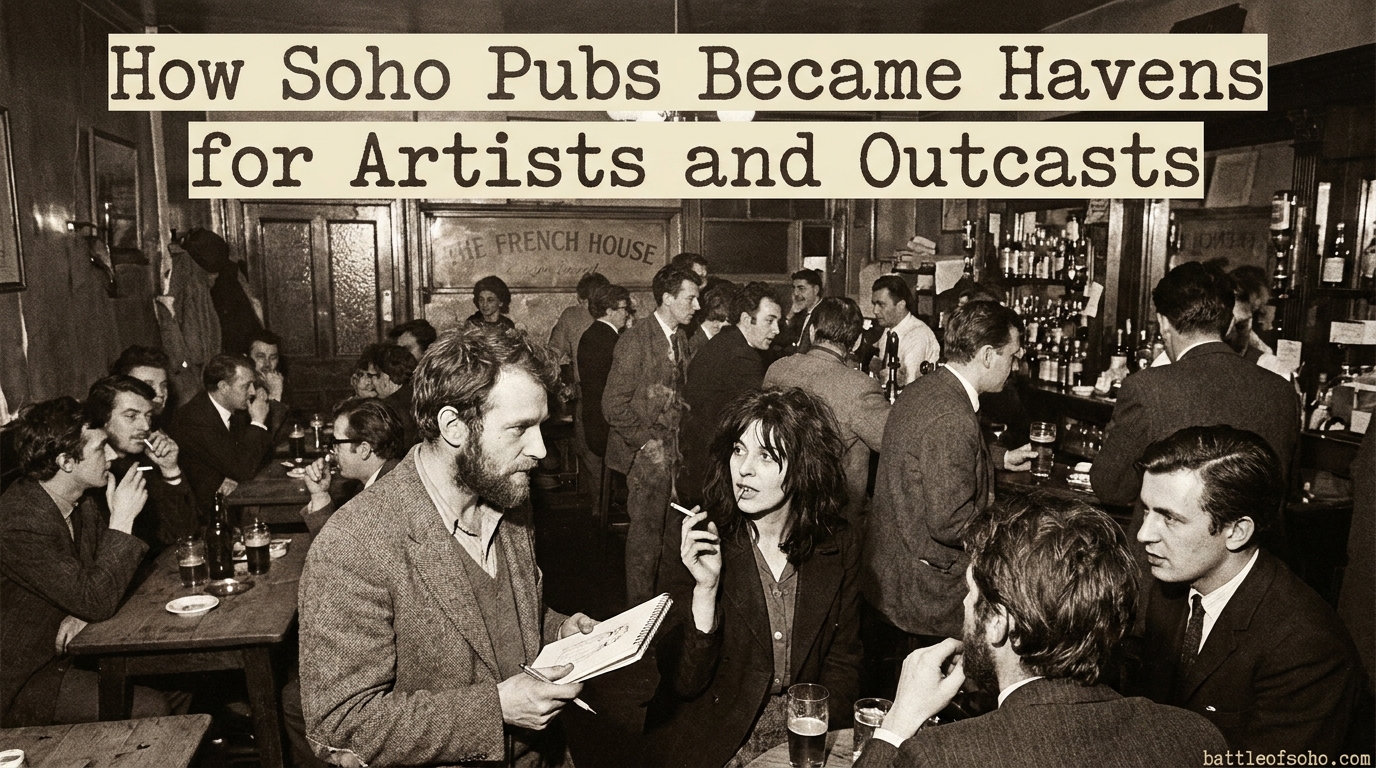
Walk down Dean Street on a Tuesday afternoon and you can still feel it. The narrow doorways, the faded pub signs, the sense that something important happened behind these walls. Understanding how Soho pubs became havens for artists and outcasts means looking at a perfect storm of post-war poverty, cheap rents, restrictive licensing laws, and a neighborhood that had always welcomed people who fit in nowhere else.
Soho London became famous because it offered something nowhere else in the city could: freedom. From the 1940s through the 1960s, this square mile of winding streets housed painters who would define twentieth-century British art, writers who shaped literature, queer people criminalized everywhere else, immigrants rebuilding lives, and working-class Londoners priced out of respectability. The pubs were their parliament, their studio, their refuge, and their home.
Our team spent months tracing the story through archives, oral histories, and the memories of people who were there. What emerges is not just a tale of famous drunks. It is a story about how physical spaces, specifically public houses, created one of the most important bohemian communities in modern history. The French House, the Colony Room Club, the Coach and Horses, and a dozen other drinking dens formed an interconnected ecosystem that nurtured creativity the way a greenhouse grows orchids.
This article traces how Soho pubs became havens for artists and outcasts from the rubble of the Second World War through to the gentrified present. We will walk you through the historical origins, the legendary venues, the iconic figures who made these places their own, and what remains of that world today.
Table of Contents
The Historical Origins: How Soho Pubs Became Havens for Artists and Outcasts
Soho was a refuge long before the artists arrived. Throughout the eighteenth and nineteenth centuries, this patch of central London absorbed French Huguenots, Italian immigrants, Jewish refugees, and anyone else who needed cheap rooms and anonymity. By the 1930s, Soho had a reputation as a place where anything went and nobody asked questions.
The Second World War changed everything. Bomb damage hollowed out large sections of the district. Property values collapsed. Landlords desperate for any income rented rooms for pennies to anyone willing to take them. Artists, who had always needed cheap space, flooded in. Rationing dominated British life well into the 1950s. Food was scarce, fuel was expensive, and post-war austerity made conventional domestic life grim. A pint in a warm pub became one of the few affordable luxuries left.
Licensing laws compounded the effect. Pubs in Britain were required to close in the afternoon, which created demand for private members clubs that could serve drinks when ordinary pubs could not. Soho filled with afternoon drinking clubs that operated in a legal grey area. These clubs became the natural gathering points for people who did not conform to regular hours, regular jobs, or regular lives.
The area also benefited from a kind of benign neglect. The Metropolitan Police had bigger problems than chasing painters and poets. Soho had a thriving sex industry, black market economy, and organized crime. In that context, a few artists drinking and arguing about color theory attracted zero official attention. The chaos provided cover. The cover provided freedom.
Cheap rents were the economic foundation of the whole scene. A painter could rent a studio above a pub or a garret on Frith Street for a few pounds a week. When Lucian Freud arrived in Soho in the early 1940s, he found a neighborhood where he could live, work, and drink for almost nothing. Francis Bacon followed the same logic. The neighborhood selected for people who valued time and creative freedom over comfort and security.
By the late 1940s, a critical mass had formed. Artists attracted other artists. Writers attracted editors. Musicians attracted promoters. Soho became what urbanists now call a creative cluster, a self-reinforcing ecosystem of talent, cheap space, and social infrastructure. The pubs were the connective tissue holding it all together.
The Key Pubs and Venues That Defined Bohemian Soho
If you wanted to understand the Soho art scene in the 1950s, you did not go to a gallery. You went to the pubs. Each venue had its own character, its own regulars, and its own role in the ecosystem. Together they formed what regulars called the Dean Street Shuffle, a pub circuit that connected the entire creative community.
The French House
The French House on Dean Street is the single most important pub in the history of British bohemia. Originally called the York Minster, it became known as the French House during the Second World War when it served as an informal headquarters for Charles de Gaulle and the Free French Forces. The name stuck.
Gaston Berlemont, the landlord through the mid-twentieth century, set the tone. He cultivated an atmosphere of tolerance, warmth, and absolute refusal to modernize. The pub famously served only half-pints, a tradition supposedly begun because artists kept buying rounds they could not afford. The half-pint rule forced pacing and kept the conversation flowing longer.
The French House operated as an informal salon. Francis Bacon held court there most afternoons. Lucian Freud was a fixture. Frank Auerbach, Michael Andrews, and the rest of the London School painters treated the back room as an extension of their studios. There were no screens, no machines, no music. Just conversation, cigarette smoke, and the constant arrival and departure of people who had nowhere else to be.
Lesley Lewis, who became landlady in the late 1980s and ran the pub for thirty-seven years, preserved that tradition. She understood that the French House was not a pub that happened to have artist regulars. It was an art institution that happened to serve beer. Under her watch, the pub maintained a staff artist program, hosted exhibitions, and continued the tradition of treating unknown painters with the same respect as famous ones.
The Colony Room Club
If the French House was the salon, the Colony Room Club was the electric shock. Founded in 1948 by Muriel Belcher at 41 Dean Street, it was a private members drinking club that opened at lunchtime and closed late. The entrance was an unmarked green door up a narrow staircase. Inside was a small room painted a violent green, presided over by Belcher, who ruled her club like a benevolent dictator.
Muriel Belcher was the secret ingredient. Sharp-tongued, deeply connected, and genuinely interested in creative people, she curated her membership list with care. Francis Bacon was her star attraction. She reportedly paid him to bring interesting people to the club, essentially making him a talent scout for bohemian Soho. Bacon spent more time at the Colony Room than in his own studio.
The Colony Room was notorious for its atmosphere. The drinking was legendary, the behavior was outrageous, and the gossip was merciless. But it was also one of the most permissive spaces in post-war London. Queer people, who faced criminal prosecution everywhere else, could be themselves behind that green door. Artists who were broke could drink on credit. Anyone who was interesting was welcome.
The club operated until 2008, a remarkable sixty-year run. Its closing marked the end of an era in Soho. No single venue has replaced it, and the loss is still felt by anyone who understands what that room meant to British cultural life.
The Coach and Horses
The Coach and Horses on Greek Street served as the journalistic anchor of bohemian Soho. While the French House drew painters and the Colony Room drew everyone, the Coach and Horses was the newspaper crowd. Jeffrey Bernard, the Spectator columnist, made it his office. The pub appeared in his famous “Low Life” column, which documented the chaos of Soho drinking culture for readers across Britain.
Norman Balon, who ran the Coach and Horses for decades, became a Soho institution himself. He claimed to be the rudest landlord in London, and the rudeness was part of the charm. The pub had no telephone, no music, and no patience for tourists. Regulars loved it precisely because it made no effort to be welcoming to outsiders.
The Gargoyle Club
The Gargoyle Club, which operated from 1925 to 1978 on Meard Street, was one of the earliest members clubs to attract the artistic elite. Founded by David Tennant, it featured a dance floor designed by Henri Matisse and a membership list that read like a who’s who of interwar and post-war British culture. Augustus John, who practically invented the image of the bohemian artist in Britain, was a founding regular.
By the 1950s, the Gargoyle had become part of the Soho pub circuit. It was more formal than the Colony Room and more glamorous than the French House. It attracted the overlap between the art world, high society, and the intelligence services, which were heavily represented in post-war Soho.
The Fitzroy Tavern
The Fitzroy Tavern on Charlotte Street was the working-class entry point to bohemian Soho. In the 1920s and 1930s, it hosted the Friday night gatherings that defined interwar literary bohemia. Nina Hamnett, the Welsh painter and bon vivant known as the Queen of Bohemia, held court there. Writers like Dylan Thomas and George Orwell drank alongside artists, barmaids, and anyone else who could afford a pint.
The Fitzroy represents an important truth about Soho: bohemian culture was never exclusively elite. The same cheap rents that attracted Francis Bacon attracted dockworkers, dancers, and dishwashers. The pubs were the great equalizer. Everyone drank in the same rooms.
The Devonshire
The Devonshire pub represents the modern chapter of Soho drinking culture. In recent years, it has become known as a refuge for characters, a place where the spirit of old Soho survives in diminished but recognizable form. Ollie Poberts, the publican, has cultivated a reputation for keeping the old ways alive: serious about beer, uninterested in trends, and welcoming to anyone with a story.
For people mourning the loss of authentic Soho, the Devonshire offers a thread of continuity. It is not the Colony Room, and it does not pretend to be. But it proves that the values of bohemian pub culture, tolerance, conversation, and character over comfort, can still survive if someone cares enough to maintain them.
Iconic Artists and Outcasts Who Made Soho Their Own
The pubs were the stage, but the people were the play. The story of how Soho pubs became havens for artists and outcasts is ultimately a story about individuals who chose freedom over convention and found each other in the same few rooms.
Francis Bacon: The Center of Gravity
Francis Bacon was the gravitational force around which post-war Soho art culture orbited. He lived, drank, and gambled in Soho from the 1940s until his death in 1992. His studio at 7 Reece Mews was minutes from his preferred drinking spots. He spent more waking hours in the Colony Room and the French House than anywhere else.
Bacon’s relationship with the pubs was not recreational. It was essential to his process. He painted from memory, from photographs, and from faces. The people he met in Soho pubs became his subjects, his muses, and his collaborators. Henrietta Moraes, who appeared in dozens of his paintings, was a Soho drinking companion. Peter Lacy, his great love and frequent model, was part of the same circuit.
Bacon also served as a connector. His presence at the Colony Room drew other artists, collectors, and critics. Muriel Belcher understood his value and catered to him accordingly. Without Bacon, the Soho pub scene would have been smaller, quieter, and far less documented.
Lucian Freud: The Observer
Lucian Freud arrived in Soho as a teenager in the early 1940s and never really left the orbit. More private than Bacon, Freud was nonetheless a fixture at the French House and the Gargoyle Club. His early work, precise and unsettling, drew directly on the Soho world. He painted friends, lovers, and drinking companions with an intensity that made the pub culture visible on canvas.
Freud represented a different strand of Soho bohemia. Where Bacon was theatrical and public, Freud was observational and guarded. Both men needed the pubs for the same reason: the human material. Soho provided an endless supply of faces, bodies, and stories that fed their work for decades.
Frank Auerbach and the London School
Frank Auerbach, Leon Kossoff, and Michael Andrews formed the next generation of Soho-connected painters. They studied under David Bomberg, drank in the same pubs as Bacon and Freud, and developed the thick, obsessive painting style that became known as the London School. Auerbach still works in the same Camden studio he has occupied since the 1950s, but his social and creative roots are in Soho.
These painters were less flamboyant than Bacon, but their commitment to the Soho ecosystem was just as deep. They relied on the pubs for community, criticism, and the kind of intense creative friction that comes from being surrounded by other serious artists.
The Women of Bohemian Soho
The standard narrative of Soho bohemia centers on male painters, but women were essential to the culture in ways that go far beyond posing for portraits. Nina Hamnett, the Queen of Bohemia, was a working artist who exhibited alongside the men and out-drank most of them. She held court at the Fitzroy Tavern for decades and embodied the bohemian ideal of total personal freedom.
Henrietta Moraes is often reduced to a muse, but she was a writer, a adventurer, and a central figure in the Soho social world. Her memoirs provide some of the best firsthand accounts of what the pubs were actually like. Molly Parkin, painter, journalist, and later Colony Room member, brought a different generation of creative women into the scene.
Muriel Belcher and Lesley Lewis deserve special attention as the women who actually ran the spaces. Belcher built the Colony Room from nothing into the most famous drinking club in London. Lewis protected the French House’s artistic mission for nearly four decades. Without these women as cultural custodians, the bohemian pub scene would have collapsed. The pubs survived because specific, tough, visionary women refused to let them change.
The Queer Community and Soho as Sanctuary
Soho pubs became havens for artists and outcasts partly because they served as sanctuaries for queer people at a time when homosexuality was criminalized in Britain. Until the Sexual Offences Act of 1967 partially decriminalized homosexuality, gay men and women faced arrest, imprisonment, and public ruin for expressing their identities. Soho, with its culture of tolerance and its network of private clubs, offered relative safety.
The Colony Room was explicitly welcoming. Muriel Belcher was bisexual, Francis Bacon was openly gay, and the membership included a large queer contingent. The French House and several other Soho venues operated on similar principles of discretion and acceptance. Behind unmarked doors and up narrow staircases, queer people could socialize, form relationships, and build community without fear.
This aspect of Soho’s history is essential to understanding why the pubs mattered. They were not just places to drink. They were the only places in London where certain people could exist as themselves. The bohemian culture of the pubs and the queer culture of Soho were inseparable. Both were built on the same foundation of tolerance, privacy, and mutual protection.
International Artists Drawn to Soho
Soho’s reputation spread internationally. F.N. Souza, the Indian painter who founded the Progressive Artists’ Group in Bombay, moved to London in 1949 and became part of the Soho scene. Victor Musgrave’s Gallery One, located on Litchfield Street, exhibited Souza’s work alongside international figures like Yves Klein. The gallery functioned as an extension of the pub culture, with openings that spilled into nearby drinking establishments.
The international dimension matters because it shows that Soho was not a closed British scene. It was connected to global art movements, global currents of political dissent, and global networks of displaced people. The same post-war chaos that made London cheap also made borders porous. Artists arrived from India, from Europe, from the Caribbean, and found in Soho a community that accepted them.
The Photographers Who Documented It All
Without photographers, our image of bohemian Soho would be far poorer. John Deakin, hired by Bacon to photograph his subjects, captured the faces of Soho with brutal honesty. His portraits of Moraes, Freud, and the other regulars are some of the most striking images of mid-century British life. John Claridge, who grew up in the East End and became a celebrated photographer, documented Soho faces for decades in his Soho Faces series.
These photographers did more than record. They participated. Deakin was a Colony Room regular whose own chaotic life was part of the story he was documenting. The line between artist, subject, and documentarian was always blurry in Soho. Everyone was in the same room, drinking the same drinks, living the same story.
Beyond Artists: The Broader Outcast Culture
The word outcasts in our title is deliberate. Soho pubs were not only for painters. They served sex workers who worked the surrounding streets, immigrants who had no other social spaces, working-class Londoners priced out of respectable society, political radicals, petty criminals, and anyone else who did not fit the post-war ideal of British normalcy.
This broader outcast culture is what made Soho pubs genuinely different from a private club for rich artists. The artists were not isolated in a ghetto of their own kind. They drank alongside everyone else who had been pushed to the margins. That mixing produced the creative friction, the cross-pollination of ideas, and the social richness that made Soho uniquely generative.
Cultural Significance: Why Soho Mattered Beyond London
To understand the cultural significance of Soho pub culture, it helps to place it alongside other bohemian districts. Greenwich Village in New York, Montmartre and the Left Bank in Paris, Schwabing in Munich, and comparable neighborhoods in cities around the world all followed a similar pattern. Cheap space attracts outsiders. Outsiders create culture. Culture raises the area’s profile. Rising profile drives up rents. Rents drive out the people who made it interesting.
Soho followed this cycle with unusual intensity because the conditions were extreme. Post-war London was genuinely poor. The licensing laws created a legal structure that funneled bohemian life into private clubs. The existing immigrant and working-class culture provided a tolerant base. And the concentration of talent, particularly Bacon and Freud, was unusually high.
Why did artists choose Greenwich Village in New York? For the same reasons they chose Soho. Cheap rents, existing diversity, tolerance of difference, and proximity to other creative people. The mechanics are universal. What made Soho distinctive was the pub. Greenwich Village had cafes and bars, but the British pub, with its specific culture of regulars, landlords, and long sessions, gave Soho a social infrastructure that other bohemian districts lacked.
The pub as institution deserves recognition as a creative technology. The stammtisch, the German concept of a regulars’ table reserved for the same group every day, existed in Soho in practice if not in name. The French House had its painter’s table. The Colony Room had its corner. The Coach and Horses had Jeffrey Bernard’s seat. These regular gatherings functioned as ongoing seminars, critique groups, networking events, and emotional support systems.
The role of the bartender or publican as cultural custodian cannot be overstated. Gaston Berlemont, Muriel Belcher, Norman Balon, and Lesley Lewis were not just serving drinks. They were curating communities, protecting traditions, and making editorial decisions about who belonged. The bohemian character of Soho survived as long as it did because specific individuals chose to maintain it against the pressures of commerce and conformity.
Legacy and Modern Relevance: What Remains of Bohemian Soho
Has Soho been gentrified? Unambiguously, yes. Property prices in Soho are now among the highest in London. The cheap rooms that once housed painters now house advertising executives. Many of the old pubs have been renovated, rebranded, or converted into restaurants. The sex shops of Walker’s Court have been reduced to a handful of tourist-oriented holdouts. The creative energy that defined Soho for half a century has largely migrated eastward to Hackney, Shoreditch, and Peckham.
Is Soho still seedy? Not in the way it once was. The genuine grime, danger, and lawlessness that gave old Soho its edge have been largely cleaned up. What remains is a carefully curated hint of seediness, a tourist-friendly version of the original. Long-time Londoners describe modern Soho as a theme park of its former self, polished and packaged for visitors who want a taste of bohemian danger without any actual risk.
Yet pockets of the old Soho survive. The French House still serves half-pints and still hosts artists. The Devonshire maintains the traditions of serious drinking and serious conversation. The Coach and Horses, despite changes, retains something of its old character. These survivors exist because individuals continue to fight for them, often at considerable financial cost.
Where do London artists live now that Soho has gentrified? According to artists themselves on forums and in interviews, the answer is Hackney, Shoreditch, Peckham, and other parts of east and southeast London. The pattern repeats: cheap rents attract artists, artists create culture, culture attracts development, development raises rents, rents drive artists out. The difference is that none of these new neighborhoods have developed the pub-based social infrastructure that made Soho unique.
The loss of that infrastructure matters. Artists can find cheap space anywhere. What they cannot easily recreate is the dense, daily, face-to-face social network that the Soho pubs provided. The Colony Room is gone. The Gargoyle Club is long gone. The informal circuits that connected painters, writers, photographers, and outcasts have fragmented into online networks that lack the friction and intimacy of a crowded bar at five in the afternoon.
Can you still experience old Soho today? Partially. A walking tour of the remaining historic pubs, the French House, the Coach and Horses, the Fitzroy Tavern, the Devonshire, gives a sense of the geography. But the people who made those places matter are largely gone. The buildings survive. The culture they housed has scattered.
FAQs
Is Soho still seedy?
Modern Soho is far less seedy than it was from the 1940s through the 1980s. Gentrification has cleaned up most of the sex industry, criminal activity, and genuine grit that once defined the area. What remains is a carefully curated, tourist-friendly version of its former edge rather than authentic bohemian seediness.
Has Soho been gentrified?
Yes, Soho has been extensively gentrified. Property prices are now among the highest in London, most working artists have been priced out, and many historic pubs have been renovated or rebranded. The creative community has largely migrated to east and southeast London neighborhoods like Hackney and Peckham.
Why is the Devonshire pub so famous?
The Devonshire is famous as one of the few remaining Soho pubs that preserves the spirit of old bohemian London. Under publican Ollie Poberts, it maintained a reputation for serious beer, serious conversation, and a welcoming attitude toward characters, making it a modern refuge for people who miss authentic Soho pub culture.
Why is Soho London so famous?
Soho is famous for its centuries-long role as London’s most tolerant, diverse, and bohemian neighborhood. It served as a refuge for immigrants, artists, queer people, and outcasts from the eighteenth century onward. Its pubs and clubs nurtured figures like Francis Bacon and Lucian Freud, making it a global symbol of creative counterculture.
What was the Colony Room Club?
The Colony Room Club was a private members drinking club at 41 Dean Street, founded by Muriel Belcher in 1948 and operated until 2008. Entered through an unmarked green door up a narrow staircase, it was the most famous bohemian gathering place in post-war London, with Francis Bacon as its star regular and a deeply permissive, queer-friendly atmosphere.
What role did pubs play in the Soho art scene?
Soho pubs functioned as informal studios, galleries, networking hubs, and emotional support systems for artists. Places like the French House and the Colony Room hosted daily gatherings where painters, writers, and photographers shared ideas, criticized each other’s work, and built the community that produced some of the most important British art of the twentieth century.
Conclusion
The story of how Soho pubs became havens for artists and outcasts is ultimately a story about space, tolerance, and the people willing to defend both. Post-war poverty and cheap rents opened the door. Licensing laws shaped the form. Visionary publicans like Muriel Belcher, Gaston Berlemont, and Lesley Lewis kept the culture alive for decades. Artists like Francis Bacon and Lucian Freud gave it weight and visibility.
Gentrification has closed much of that chapter. But the lessons remain. Creative communities need cheap space, social infrastructure, and tolerant custodians. The Soho pub model, daily gatherings in dedicated spaces run by people who understand the mission, is worth studying and worth defending wherever it still exists. If you want to understand how culture gets made, look at where people drink.
Next time you walk through Soho, stop at the French House. Order a half-pint. Look at the walls. Then ask yourself what your city is doing to protect the spaces where unlikely people gather to do unlikely things. That is where the future gets built, one conversation at a time.