
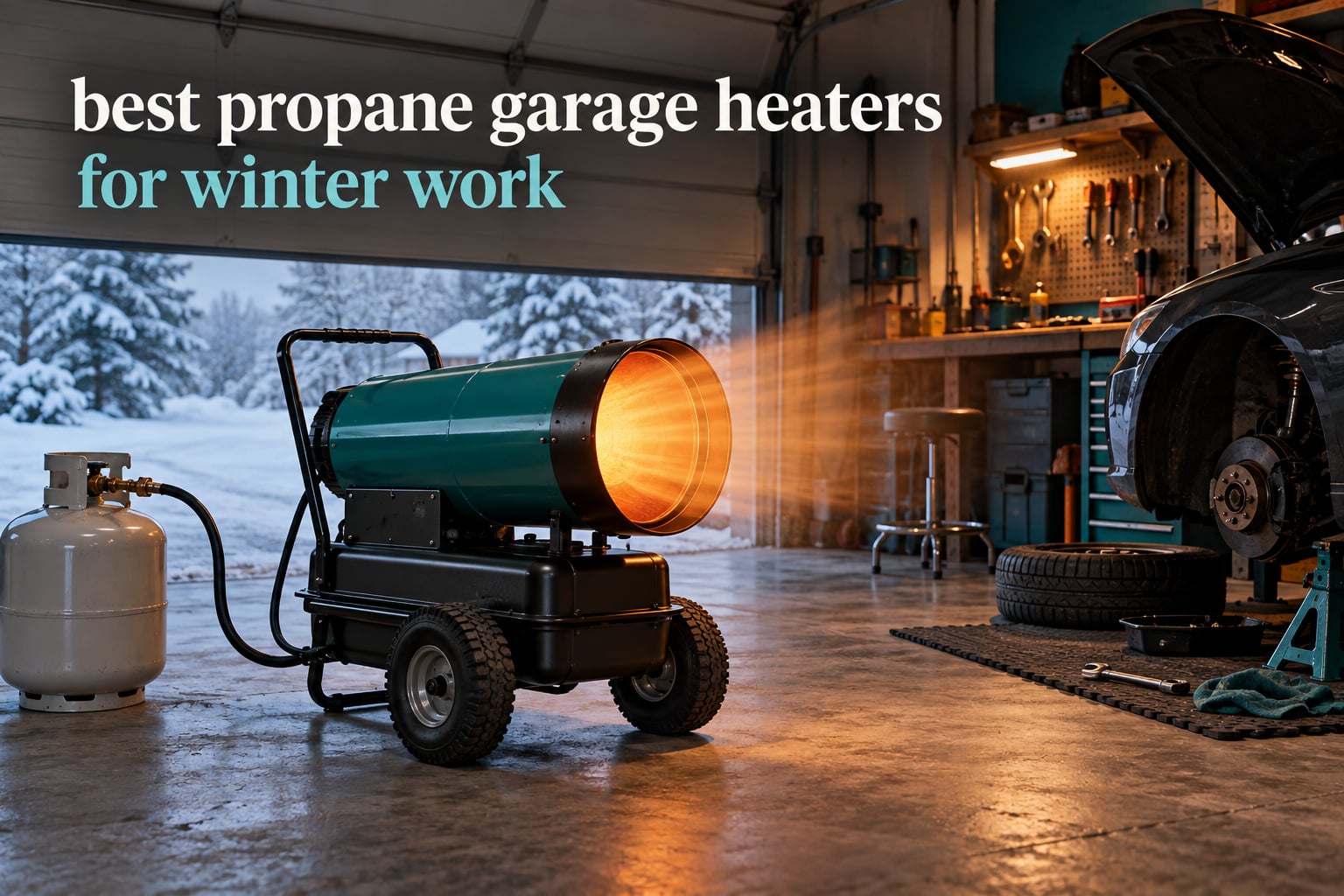
Short answer: the best propane garage heater for winter work is the GASLAND FH12FB, a 125,000 BTU forced air unit that covers up to 3,100 sq ft, comes with a 10 ft hose and regulator, and carries the largest review base in this roundup at more than 1,500 ratings. For quieter benches and offices, the Mr. Heater F271390 trades a little raw output for a noticeably softer burner note. Below, I break down ten propane garage heaters by BTU tier, heater type, safety shutoffs, and the accessories that actually arrive in the box.
Winter shop work gets slower the moment your hands go stiff. A garage sitting at 35F means lost dexterity, thicker gloves, and more time spent waiting for parts to warm up before they will seat. Propane is the fastest way to fix that when electricity cannot carry the load, and it is the only fuel that keeps working in a power outage.
That is the whole point of this guide. I compared ten propane garage heaters across the output range, from a 30,000 BTU unit that suits a single bay to 125,000 BTU machines built for a three-car shop, and I focused on the details that decide whether a heater survives a full season: variable output, flame-failure protection, whether the hose and regulator come in the box, and how loud the fan gets at full tilt.
If your garage is already reasonably insulated and you just need a quiet bench heater, our electric garage heater picks for workshops make more sense than combustion heat. If you are working outdoors or on a half-insulated structure, read on. We also cover infrared heaters for workshops in a separate breakdown, since radiant spot heat and forced air answer very different problems.
Everything below was refreshed for 2026, and the sizing math reflects real uninsulated-garage conditions rather than idealised lab figures.
Table of Contents
Top 3 Picks for Winter Garage Heating for October 2026

GASLAND 125,000 BTU Forced Air
- 75000-125000 BTU variable output
- Covers up to 3100 sq ft
- 10 ft hose and regulator included
- CSA certified with overheat protection

Mr. Heater 125,000 BTU Quiet Burner
- 125000 BTU forced air output
- Quiet Burner Technology
- Up to 3125 sq ft
- 10 ft hose and regulator included

Dyna-Glo 30,000-60,000 BTU
- Continuously variable 30000-60000 BTU
- Heats up to 1350 sq ft
- Adjustable heat angle
- 10 ft hose and regulator included
All Ten Propane Garage Heaters at a Glance in October 2026
| Product | Specifications | Action |
|---|---|---|
| GASLAND 125,000 BTU Forced Air Heater |
|
Check Latest Price |
| Mr. Heater 125,000 BTU Quiet Burner |
|
Check Latest Price |
 Mr. Heater 50,000 BTU Ceiling Unit Heater Mr. Heater 50,000 BTU Ceiling Unit Heater |
|
Check Latest Price |
| Dyna-Glo RMC-FA60DGD Forced Air Heater |
|
Check Latest Price |
 Remington 60,000 BTU Forced Air Heater Remington 60,000 BTU Forced Air Heater |
|
Check Latest Price |
 DEWALT 68,000 BTU Forced Air Heater DEWALT 68,000 BTU Forced Air Heater |
|
Check Latest Price |
 Flame King 60,000 BTU Stainless Heater Flame King 60,000 BTU Stainless Heater |
|
Check Latest Price |
 Dura Heat LPC80 Convection Heater Dura Heat LPC80 Convection Heater |
|
Check Latest Price |
 Mr. Heater 80,000 BTU Convection Heater Mr. Heater 80,000 BTU Convection Heater |
|
Check Latest Price |
 Habitio 125,000 BTU Torpedo Heater Habitio 125,000 BTU Torpedo Heater |
|
Check Latest Price |
One note before the individual reviews: nothing in this list is a substitute for insulation. A BTU number describes how fast heat leaves the burner, not how fast it leaves the building. If your garage has bare block walls and a thin steel door, expect the heater to run continuously to hold temperature, and expect to cycle a tank across a weekend of work.
1. GASLAND 125,000 BTU Forced Air Heater – Best Overall for Winter Work
GASLAND 125,000 BTU Propane Force Air Heater for Garage, Heat Up 3100 Sq.Ft
125,000 BTU max
Adjustable 75,000-125,000 BTU
3,100 sq ft
13 lb
115V fan
Pros
- Very high output for large garages and shops
- Variable heat output for temperature control
- 10 ft propane hose and regulator in the box
- CSA certified with electronic ignition and overheat protection
- Light at 13 pounds for its output class
Cons
- Requires ventilation for safe operation
- Single-speed fan with no built-in thermostat
- Power outlet needed for the fan and ignition
The GASLAND FH12FB is the heater I would put in a three-car garage tomorrow. It puts out 125,000 BTU at maximum and throttles down to 75,000 BTU, which is the single most useful feature on the whole list for winter work. Being able to drop the burner to a lower output when you are just doing paperwork means you are not paying to heat a space you have already warmed.
Owner feedback after a season of use is consistently positive on the core question: does it warm a big space quickly. Reviewers point to the 3,100 sq ft coverage claim as realistic for open-plan shops, and to how the included 10 ft hose and regulator mean setup takes minutes rather than a trip to the parts counter.
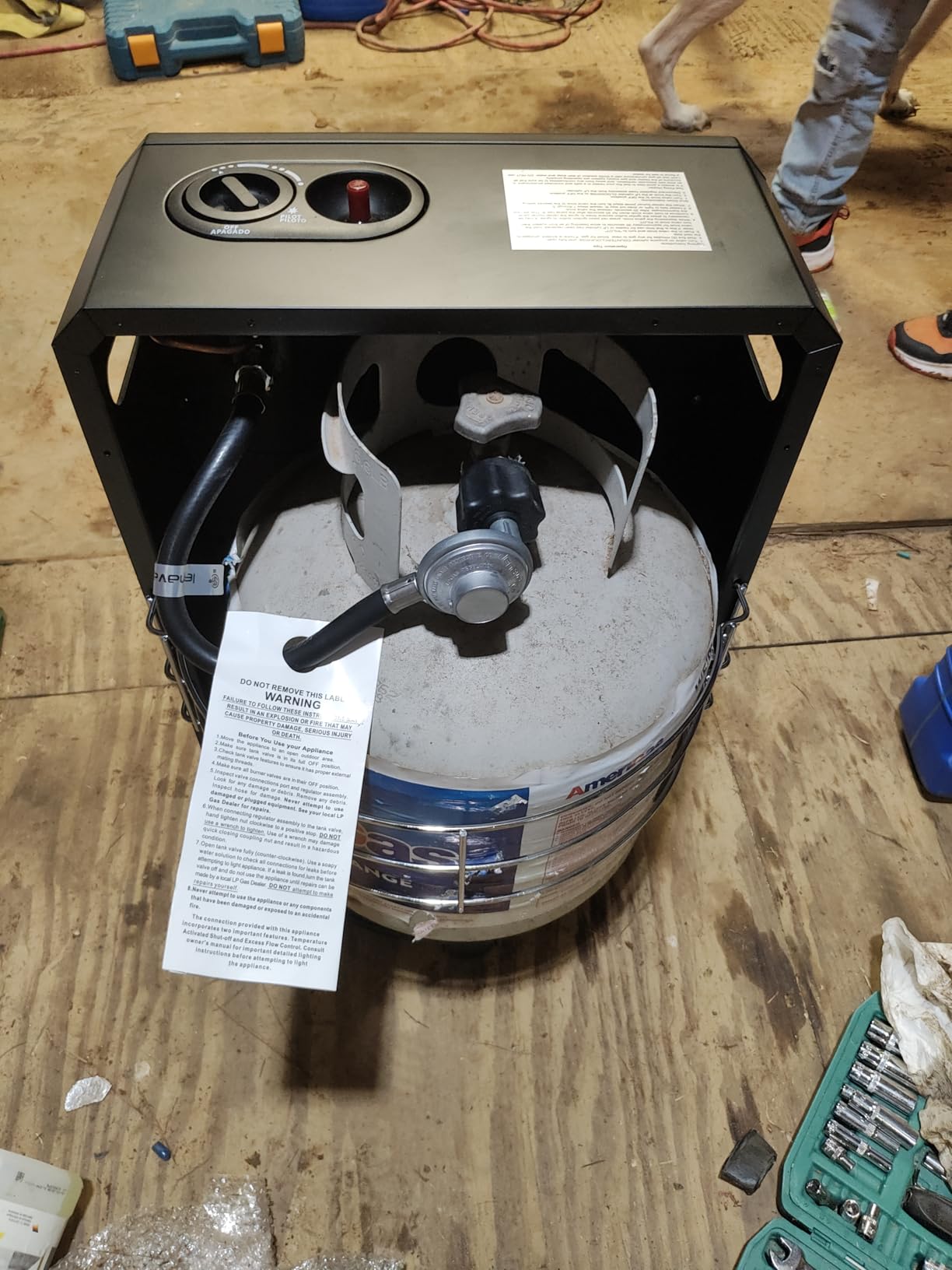
The specification sheet is honest about safety. This model is CSA certified, uses continuous electronic ignition, and carries both an overheat detection system and a thermo-electric safety valve. That combination covers the three failure modes that actually cause problems: a burner that overheats, a pilot that fails to light, and a valve that stays open when it should not.
The variable output dial and adjustable heat angle let you aim warmth at the work face rather than blanketing the far corner. In a 24×24 bay, that means you can point the duct at the engine bay you are working on instead of warming empty floor space all afternoon.
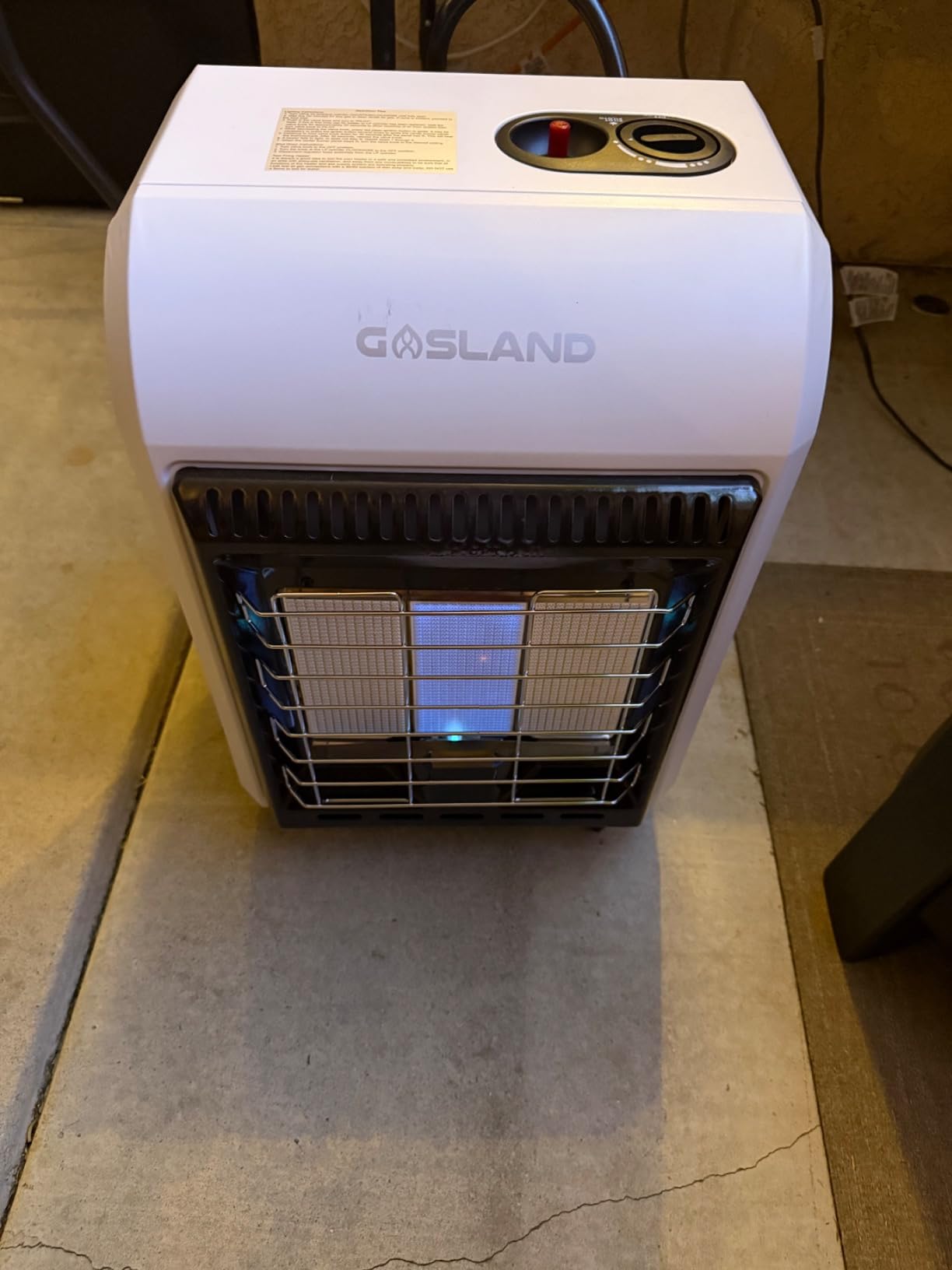
There are two limits worth planning around. The fan is single-speed with no thermostat, so temperature control is a manual on-off decision, and the unit needs a 115V outlet for the fan and ignition even though the fuel is propane. Owners also report propane odour in enclosed spaces, which is the normal signature of any combustion heater and a reminder to keep ventilation open.
Warranty coverage is one year against manufacturing defects, with lifetime customer support listed alongside it.
Who the GASLAND FH12FB suits
This is the pick for anyone with an uninsulated two-car or three-car garage, a shop bay, or a job site trailer that needs real heat rather than a warm spot. If you are working on vehicles or framing in gloves, you want the higher output tier, and this model delivers it while staying light enough to move with one hand.
It also suits anyone who does not own a DEWALT battery platform but wants the option. The tradeoff is that you give up true cordless operation and thermostat control.
Where the GASLAND falls short
If your garage is well insulated and 600 sq ft, this is more heater than you need, and a lower-output convection or forced air model will serve you with far less fuel burn. It is also not the right choice if you plan to run a long workday in a sealed room with no plan for fresh air.
Buyers who want scheduled heating should note there is no thermostat input here. You are turning a dial, not setting a schedule.
2. Mr. Heater 125,000 BTU Forced Air Propane Heater – Best for Quiet Work
Mr. Heater 125,000 BTU Quiet Burner Technology Forced Air Propane Heater
125,000 BTU forced air
Quiet Burner Technology
3,125 sq ft
17.3 lb
High-temp limit switch
Pros
- Fast even heat across garages up to 1600 sq ft
- Quiet Burner Technology cuts noise versus comparable torpedo heaters
- Hose and regulator included
- Starts reliably in very cold weather
- Easy to move for its output class
Cons
- Strong propane odour requires ventilation
- Only high and low settings with no modulating thermostat
- Igniter keeps sparking while the burner is lit
- Needs a power outlet for fan and ignition
Mr. Heater’s F271390 is the pick when noise is the thing that will drive you crazy. Its Quiet Burner Technology is rated by the manufacturer at 50 percent quieter than a standard propane heater, and owners consistently report that the difference is obvious in a quiet garage where you are trying to hear an impact wrench or think through a wiring diagram.
Owners report warming a 1,400 to 1,600 sq ft garage in roughly 5 to 20 minutes, including from single-digit outdoor temperatures, which is the fastest warm-up owners describe for a portable unit at this output level.
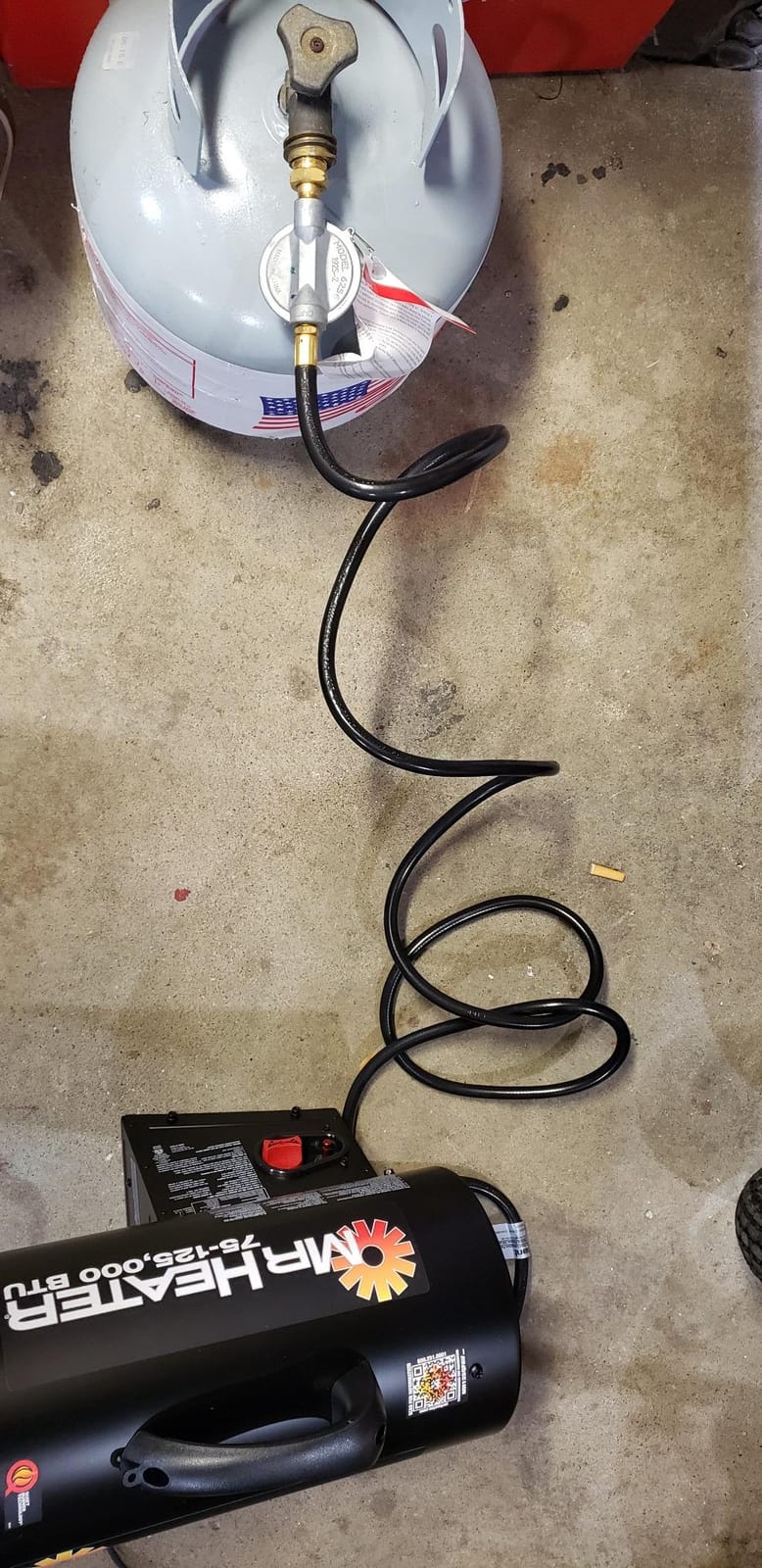
Physical design is a real strength here. The split barrel design opens up for maintenance without fully disassembling the heater, so cleaning the burner screen before winter is a five-minute job rather than a teardown. The high-temperature limit switch and heavy-duty handle round out a package that feels built for a work environment rather than a patio.
At 17.3 pounds and 21.5 inches deep, it is heavier than the GASLAND but still a one-person lift. The 10 ft hose and regulator are included, and a 120-inch cable gives you more reach than most competitors, which means fewer extension cords.
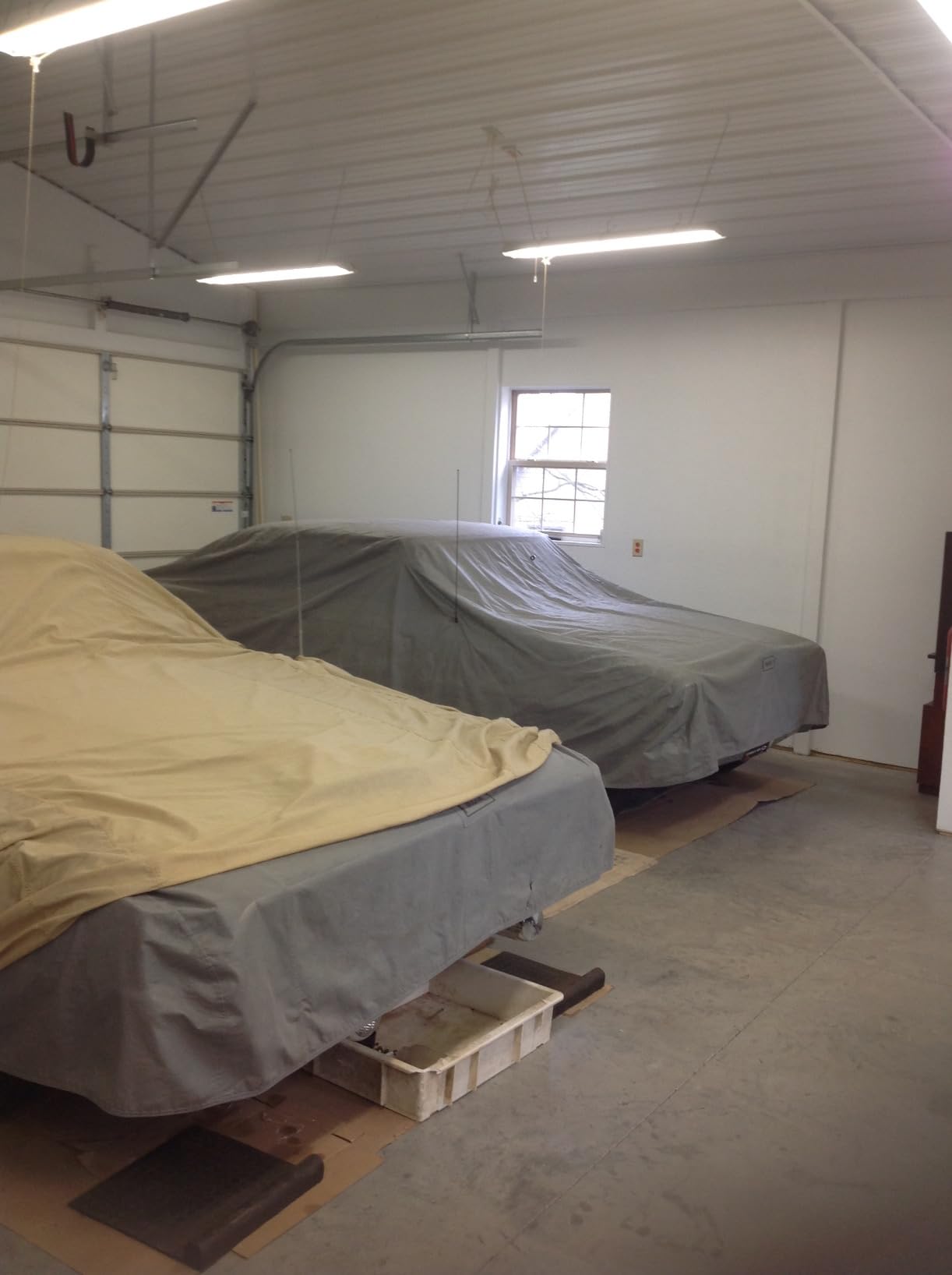
Control is the weak point. This is a two-position unit, high and low, with no modulating thermostat between them. In practice that means you run it low while you are working close by and high while you are warming the space at the start of a session, and you accept that as the trade for the quieter burner.
Reviewers also flag the igniter continuing to spark while the unit is lit. It is not a fault, but it is an audible and visible behaviour that annoys people who are not expecting it. The propane odour while running is another recurring note, and it disappears when the space is ventilated.
Why the Mr. Heater wins quiet garage picks
If you work alone in the garage for hours, a background combustion fan is genuinely fatiguing. This model reduces that load while keeping 125,000 BTU of headroom for cold starts, which makes it the balance pick between raw output and working comfort.
It is also a good match for a garage that gets used as an office or a detailing bay, where you want heat without constant fan noise.
Where the Mr. Heater falls short
Anyone who wants automatic temperature control will be disappointed, because there is no thermostat compatibility here. It is also rated for indoor and garage use in the listing but still produces combustion odour, so treat it as a ventilated-garage heater rather than a sealed-room heater.
If your space is small, 125,000 BTU is more than you need and the 50,000 BTU ceiling unit on this list is the more rational ceiling-mounted answer.
3. Mr. Heater 50,000 BTU Ceiling-Mount Unit Heater – Best Permanent Installation
Mr. Heater 50,000 BTU Forced-Air Unit Heater (Propane or Natural Gas)
50,000 BTU ceiling mount
1,667 sq ft coverage
60.3 lb
24V and Wi-Fi thermostats
Flame sensor shutoff
Pros
- Ceiling mount frees all floor and wall space
- Very quiet fan operation most owners do not notice
- Long service life across many seasons
- Works with 24V and Wi-Fi thermostats for scheduled heating
- Even heat across an insulated garage
Cons
- Professional gas line and vent installation adds significant cost
- Vent pipe brackets and thermostat sold separately
- Some units ship with loose fan set screws or bent blades
- Control board failures reported on a minority of units
This is the only fixed-installation heater in the roundup, and it works on a completely different premise from the torpedo units. You hang it from the ceiling, run a vent through the roof, and connect a gas line, and in return you get floor space back, thermostat control, and a fan so quiet that most owners stop noticing it.
At 50,000 BTU it covers up to 1,667 sq ft, roughly a three-car garage in a building with reasonable insulation. That rating sounds modest next to a 125,000 BTU portable, but the portable is fighting a leaking building while this one circulates air in a space that holds heat. Long-term owners report running these across many seasons.
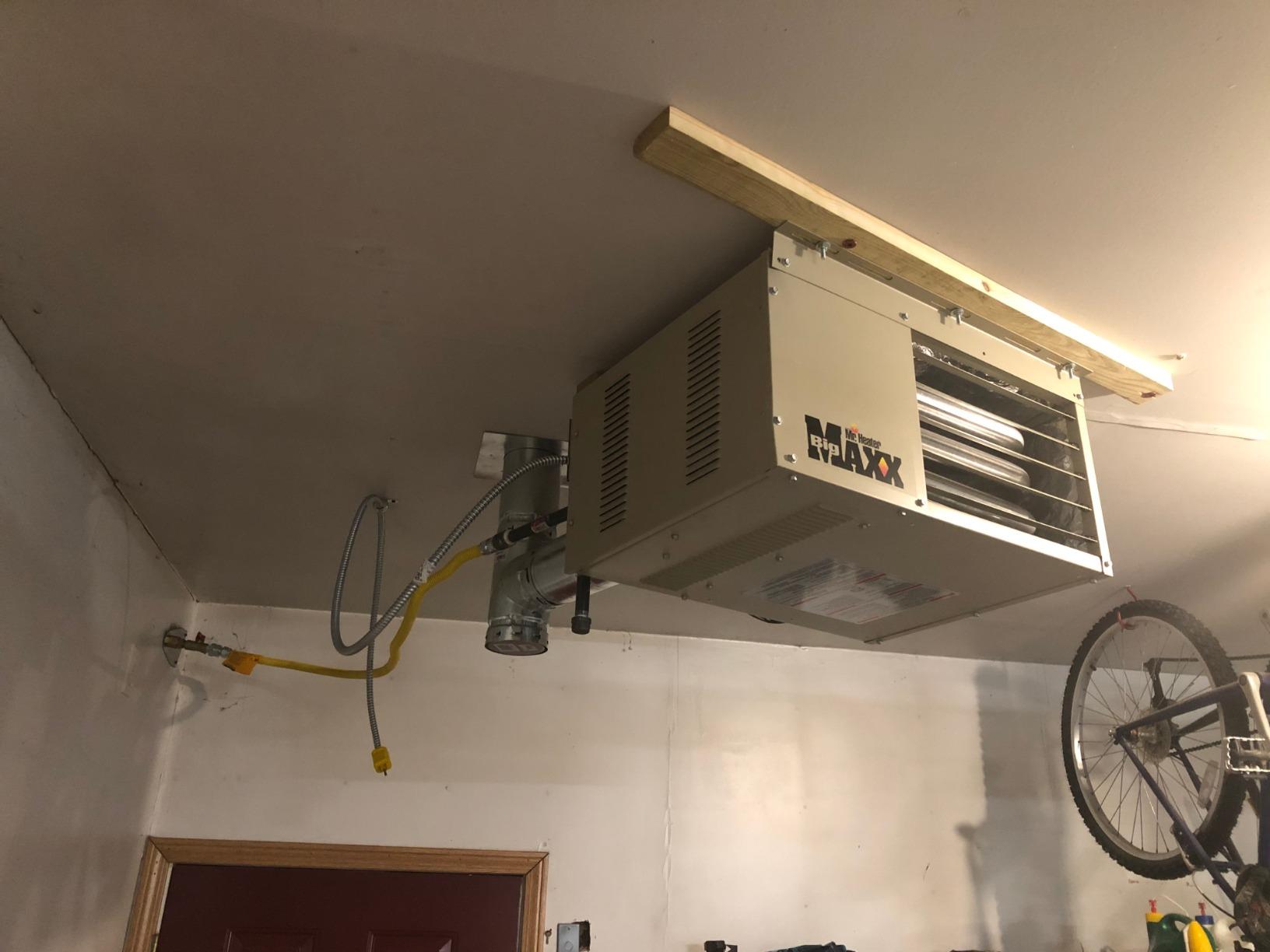
Thermostat compatibility is the deciding feature for anyone who wants scheduled heating. This unit works with standard 24V thermostats and with Wi-Fi-enabled models sold separately, so you can set the garage to warm up before you drive over rather than sitting in a cold building waiting for it. That single capability is worth more than raw BTU to many weekenders.
Safety is handled by a high-temperature safety shutoff switch plus a gas safety flame sensor. The low profile design needs a minimum 10 ft ceiling and 8 ft of clearance from the base of the heater to the floor, so measure before you commit.
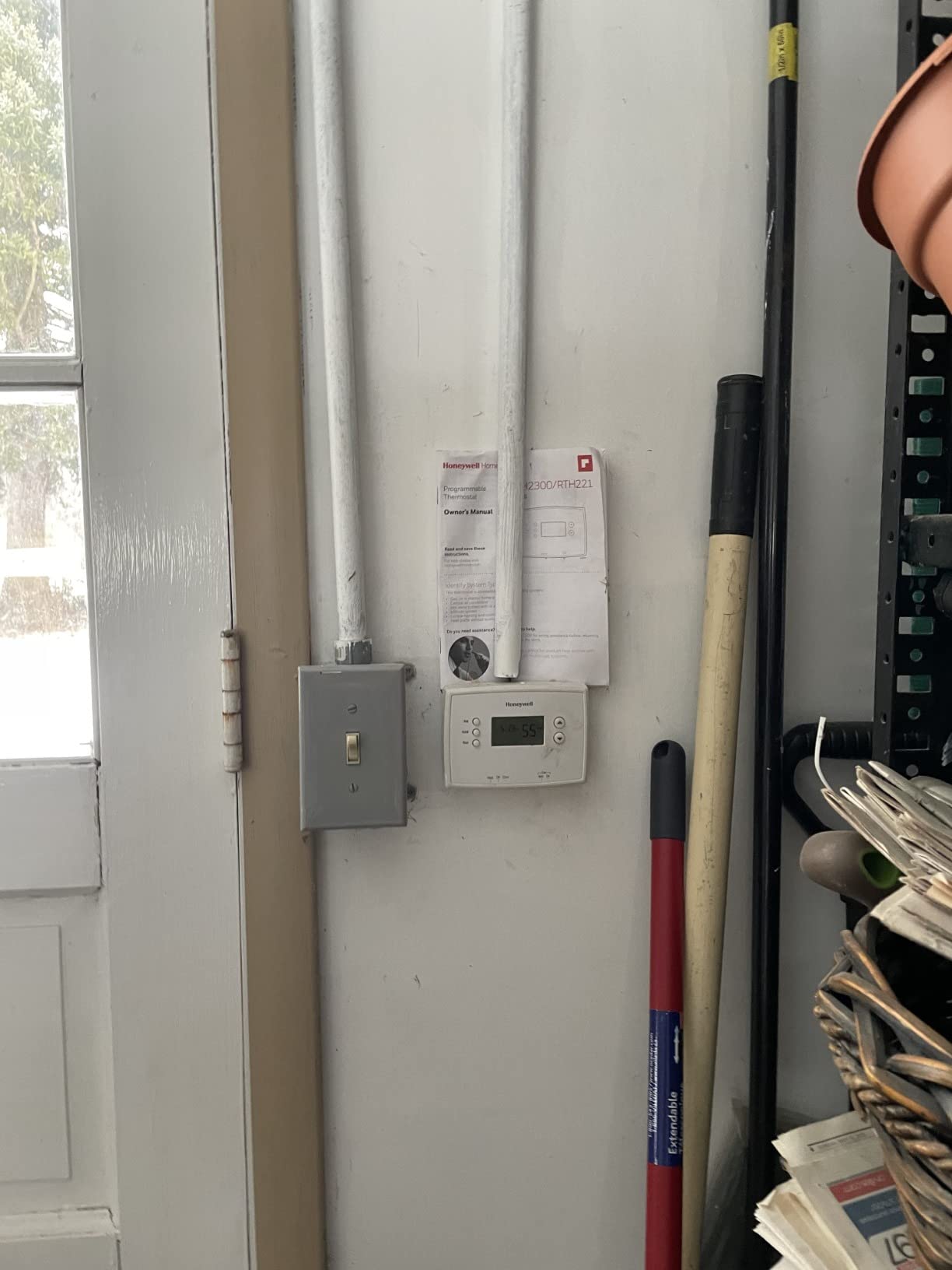
The honest drawback is installation. You need a professional gas line and vent run, and that labour can approach the cost of the heater itself. The vent pipe, mounting brackets, and thermostat are all sold separately, which inflates the true starting cost further. Two angle brackets for ceiling mount are included in the box.
A minority of owners report a loose fan set screw or bent fan blades causing noise, and a minority report control board failures with slow manufacturer support. Both are fixable or avoidable, but you should know they exist before you mount a unit at ceiling height. A natural gas to LP conversion kit is included if you run on propane.
When a ceiling-mounted unit heater is the right call
Choose this if your garage is insulated, you work in it every day, and you have a plan for a gas line and roof vent. The thermostat compatibility alone changes how you use the space, since you can schedule heat around your schedule rather than babysitting a dial.
It is also the sensible option for a barn or workshop with high ceilings and no floor space to spare, and for anyone who has grown tired of tripping over a portable heater cord.
Where the installation complexity bites
If your garage already has gas service and a vent stub, this is straightforward. If it does not, the full cost of a professional install plus a separately purchased vent pipe, brackets, and thermostat can exceed what a 125,000 BTU portable costs outright, and the portable can be running this afternoon.
It is also the wrong tool for an uninsulated garage, where heat leaves faster than 50,000 BTU can replace it.
4. Dyna-Glo RMC-FA60DGD 30,000-60,000 BTU Forced Air Heater – Best Value
Dyna-Glo Delux RMC-FA60DGD 30,000 – 60,000 BTU LP Forced Air Heater
30,000-60,000 BTU variable
1,350 sq ft coverage
13.8 lb
Adjustable heat angle
CSA certified
Pros
- Continuously variable output gives usable spot-heat control
- Heats a two or three car garage in 10-20 minutes
- Adjustable heat angle aims warmth at the work area
- Hose and regulator included and unit arrives assembled
- Good fuel economy across a season
Cons
- Thin sheet metal that flexes at the handle
- No on/off switch so the fan runs whenever it is plugged in
- Short power cord usually needs an extension
- Noticeably noisy fan especially on the low setting
- No thermostat control
The Dyna-Glo RMC-FA60DGD is the one I recommend to anyone who wants a garage heater without spending garage heater money. Its headline feature is continuously variable output from 30,000 to 60,000 BTU, and unlike a two-position switch that gives you cold or hot, this dial moves smoothly between them.
Owners report taking a two or three car garage from near freezing to workable temperature in 10 to 20 minutes, which is the range Dyna-Glo and Mr. Heater forced air units are widely reported to hit. The adjustable heat angle lets you aim the airflow where you are working rather than at the ceiling.
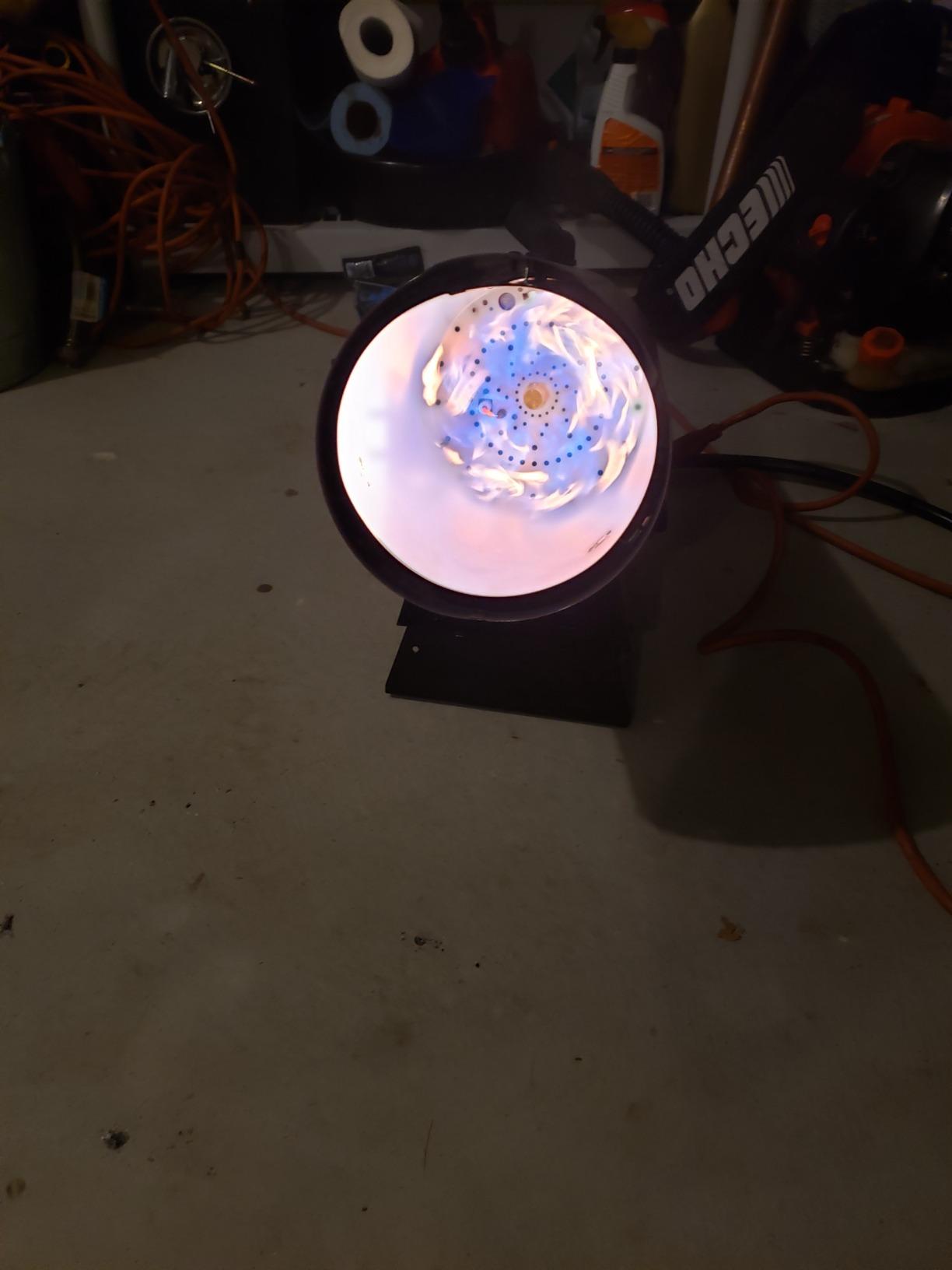
Everything you need to start is in the carton. The 10 ft hose and regulator are included, the unit arrives fully assembled, and it is CSA certified with continuous electronic ignition and overheat auto shutoff. Continuous electronic ignition matters more than it sounds, because it removes the delayed ignition risk that comes with a pilot-and-match design.
Fuel economy is a genuine strength. Owners report getting through a heating season on a single tank fill, which is a direct result of the variable output letting you run the burner below full fire when the space is already warm.
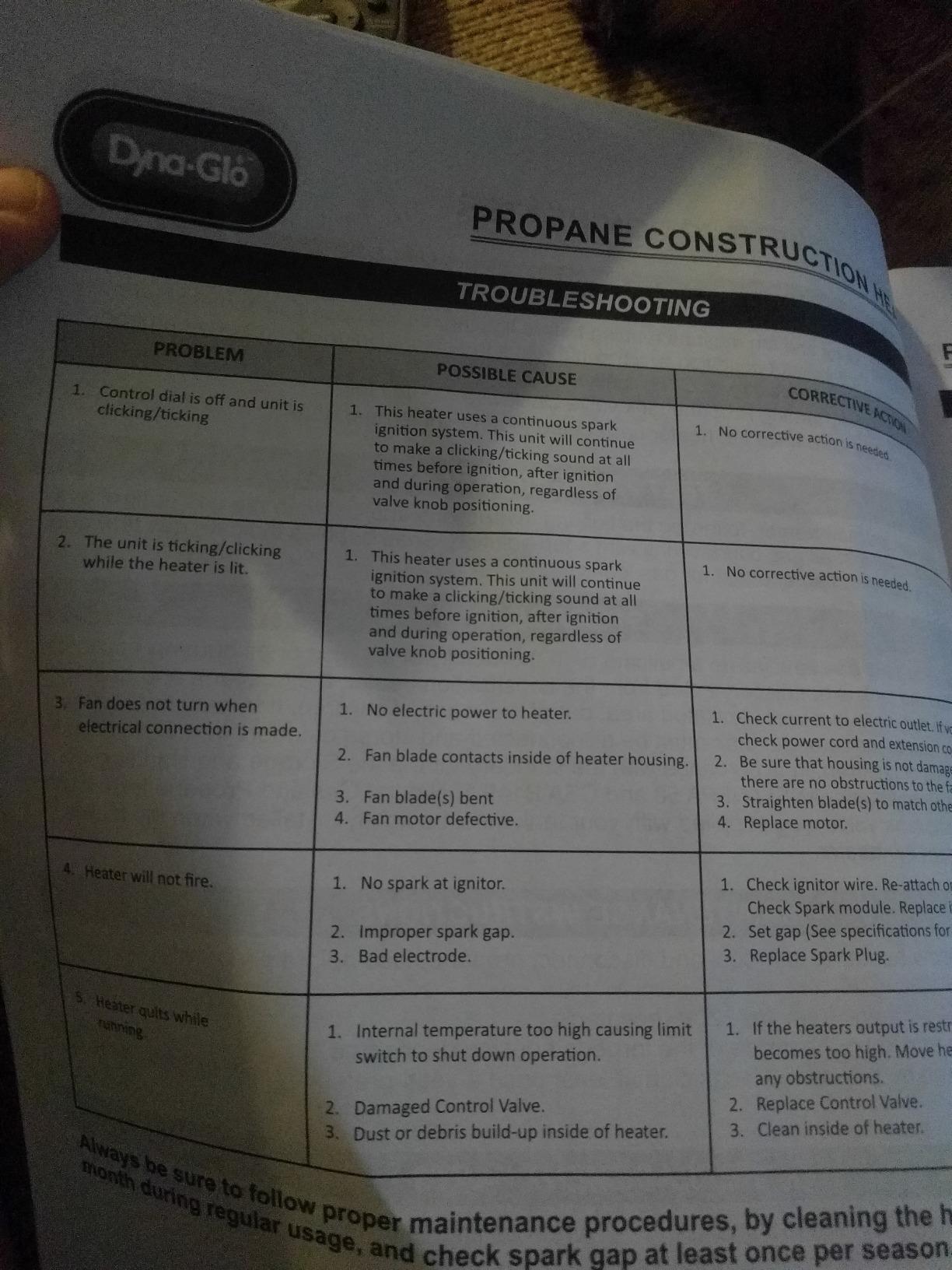
The build is where this heater earns its budget label. Owners describe the sheet metal as thin, and it flexes when you pick it up by the handle. It works, and it has kept working, but it does not feel like the same grade of hardware as the Mr. Heater or DEWALT units.
There is no on/off switch, so the fan runs any time the power cord is connected, and the cord is short enough that most setups need an extension. The fan is also the loudest complaint in the reviews, particularly on the low setting. With no thermostat, you manage temperature by turning the output down or unplugging the unit.
Where the Dyna-Glo earns its place
This is the heater for a single bay, a basement workshop, a two-car garage with a modest budget, or a shop that needs one more heat source for a bench. The variable output is the feature that most directly improves daily use, because you can dial heat to the job.
It is a good second heater too. Many owners buy one for the main bay and keep a smaller unit for a side workshop or a van.
Where it falls short
Do not expect it to be quiet, and do expect to run an extension cord. If your garage is fully uninsulated and larger than 1,350 sq ft, you will be perpetually on the low setting wishing the range went higher.
If you are bothered by build quality or want thermostat control, spend up and move to a higher tier rather than babying sheet metal through a decade of winters.
5. Remington 60,000 BTU Forced Air Heater – Best for a Two-Car Garage
Remington LP Forced Air Heater, Portable 60,000 BTU Space Heater for up to 1500 Square Feet – Liquid Propane Gas Powered, Tank Not Included
60,000 BTU forced air
1,500 sq ft coverage
11 lb
Variable settings
Thermocouple and flame-out cut-off
Pros
- Warms a two-car garage in about 10 minutes even with a window open
- Surprising output from a compact 11 lb body
- Clear setup instructions with hose and regulator included
- Continuous electronic ignition removes manual relighting
- Heat-sensitive sticker shows when the tube is safe to touch
Cons
- Very loud and unsuitable for quiet indoor spaces
- Power cord is extremely short
- Variable control is coarse because it heats so quickly
- A minority of units will not stay lit or arrive defective
The Remington REM-60V-GFA-O is the compact fast-warmer. It weighs 11 pounds, which makes it one of the easier units here to carry, and it delivers 60,000 BTU of forced air across up to 1,500 sq ft. Owners report a two-car garage going from cold to comfortable in about ten minutes, even with a window open for ventilation.
That combination of low weight and quick warm-up is why it earns repeat mentions from owners working in genuinely cold conditions. You can move it from the work bay to the far corner without recruiting a second person, which is not true of the 100,000 BTU-plus machines.
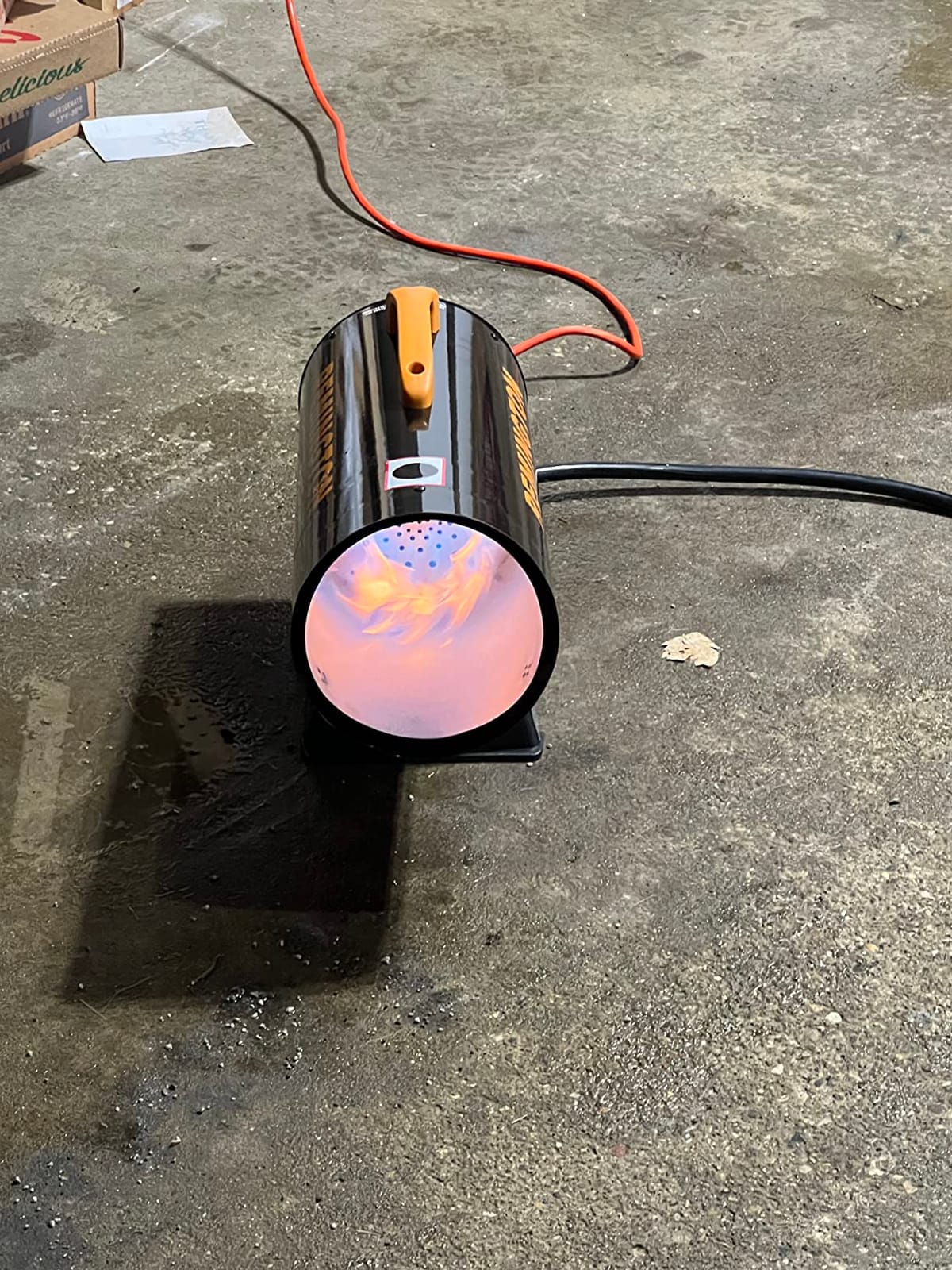
The safety package is thorough for a portable unit. It carries a thermocouple, a high-temperature limit shutoff, and a flame-out fuel cut-off, alongside continuous electronic ignition. Add variable heat settings and adjustable height, and you have a heater you can tune both in output and in position.
Heavy-duty steel construction at 11 pounds is a better combination than it sounds, and the heat-sensitive indicator sticker on the tube is a small touch that tells you when the part is cool enough to handle. The 10 ft cylinder hose and regulator are included. A 20 lb propane tank is not.
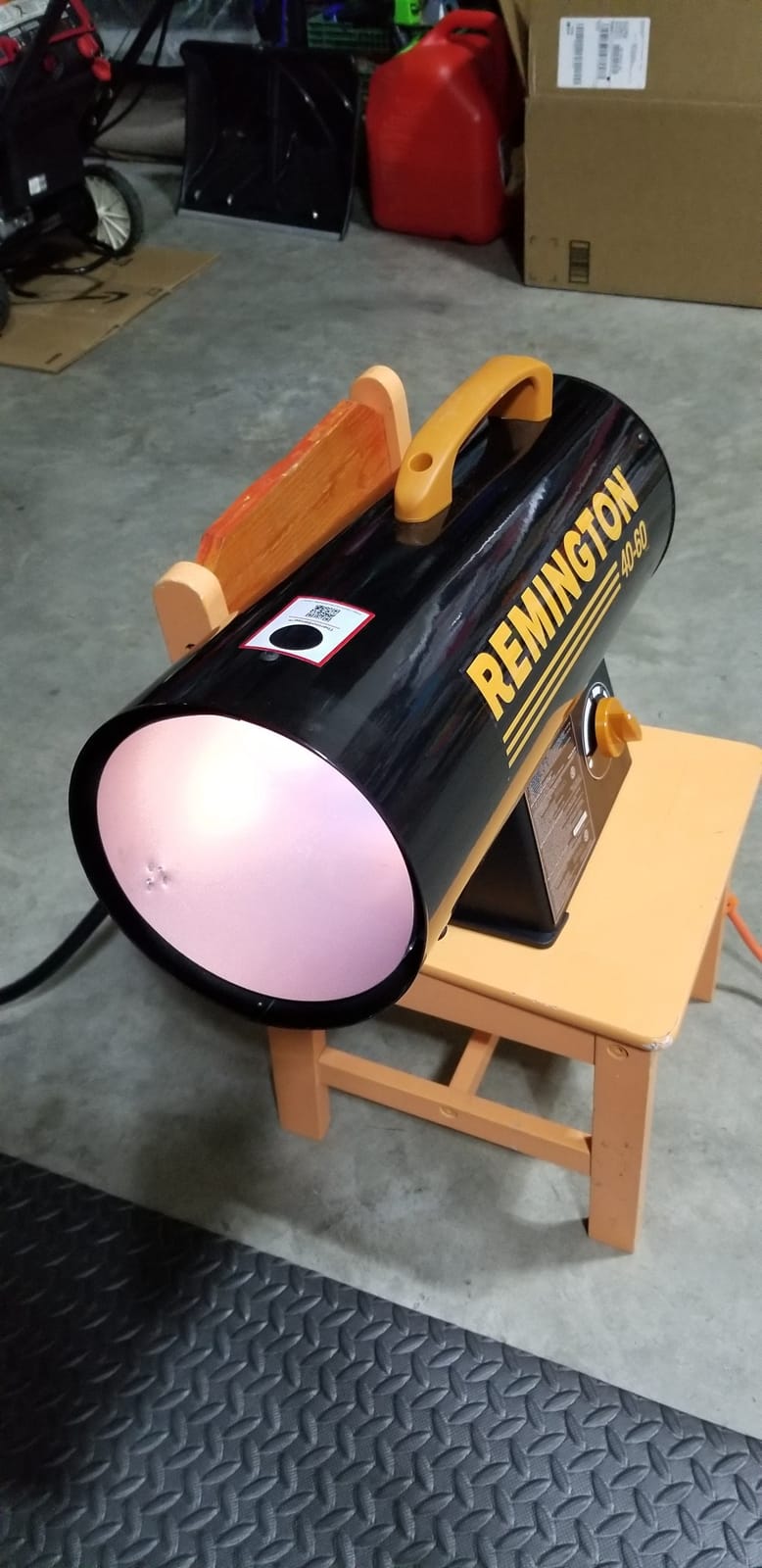
The noise is the honest drawback, and reviewers are blunt about it. This is not a heater for a garage you also use as a quiet office. The power cord is also extremely short, in some cases under a foot, so plan on an outdoor-rated extension from the start.
Variable control is coarse in practice, not because the mechanism is bad but because the heater warms the space so quickly that the adjustment feels irrelevant. A small number of units have been reported failing to stay lit or arriving damaged, so inspect the burner and check for leaks before you rely on it for a full weekend job.
Why the Remington works for daily winter use
For a two-car garage where you want heat now and want to be able to reposition the heater as you work, this is hard to beat. Eleven pounds means you will actually move it to follow the job instead of leaving it pointed at a wall.
The steel body also tolerates a shop floor better than the thin-gauge budget units, and the three-stage fuel cutoff is the sort of detail that matters if you fall asleep with it running overnight.
Where the Remington is the wrong tool
Skip it if you need quiet, if you are working in a small enclosed space where combustion noise bounces off hard surfaces, or if you want to avoid extension cords. The short cord is a daily annoyance, not a one-time setup detail.
For a spot-heating setup at a single bench, a radiant heater will do the job more cheaply than heating 1,500 sq ft of air you are not sitting in.
6. DEWALT 68,000 BTU Forced Air Propane Heater – Best Cordless Work
DEWALT 68,000 BTU Cordless Portable Forced Air Propane Heater
68,000 BTU forced air
1,700 sq ft coverage
13.2 lb
20V battery or 120V AC
Hose and regulator included
Pros
- Runs on DEWALT 20V batteries for genuinely cordless heat
- Quiet with little odour for a combustion unit
- 68000 BTU raises shop temperature quickly in cold weather
- Portable enough for job trailers and small shops
- Two-year limited parts warranty
Cons
- No built-in thermostat so temperature is manual
- Harder to start in extreme cold without warming it first
- Higher cost per BTU than basic propane heaters
- Battery runtime is limited on the high setting
The DEWALT DXH70CFAV solves a problem none of the other picks address: how do you get propane heat where there is no outlet. Its hybrid power system runs on a DEWALT 20V battery pack or standard 120V AC, so you can carry heat into a job trailer, a barn loft, or the far end of a shop with no power in the run.
At 68,000 BTU covering up to 1,700 sq ft, it sits in the middle of the range and handles a well-insulated two or three car garage comfortably. Owners praise how quietly it runs relative to typical combustion heaters, and how little odour it produces, which makes it one of the friendlier units to have in a space where you also sit and plan work.
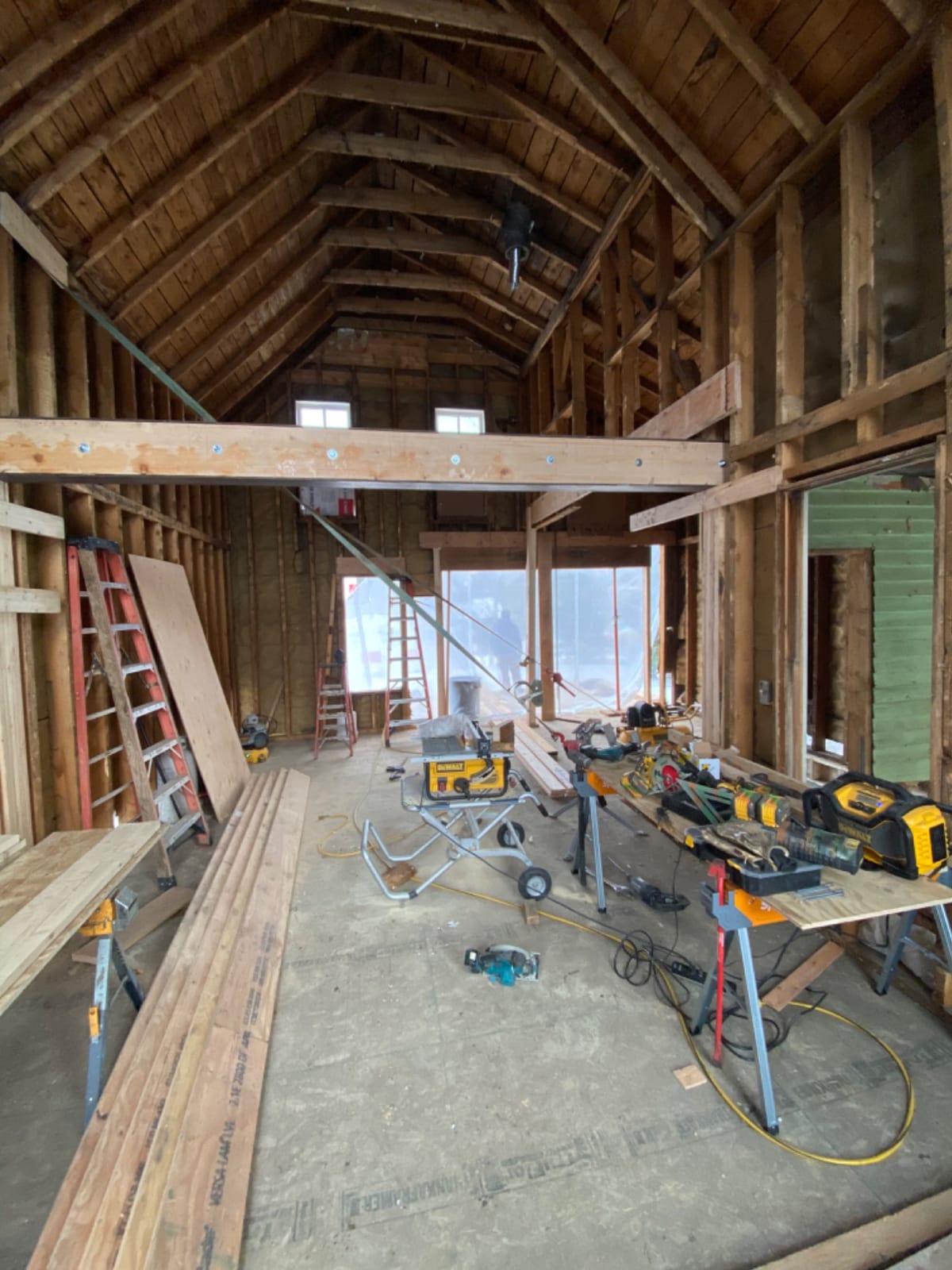
The rest of the package is well considered for a contractor. The hose and regulator assembly, handle, and owner’s manual are all included, the propane tank is not, and the two-year limited parts warranty is the longest stated term on this list. At 13.2 pounds it is one of the lighter units, which is consistent with a design meant to be carried between locations.
It also handles both indoor and outdoor rated use, which broadens the list of jobs it can cover. For someone already invested in DEWALT batteries, the platform fit is the entire value argument.
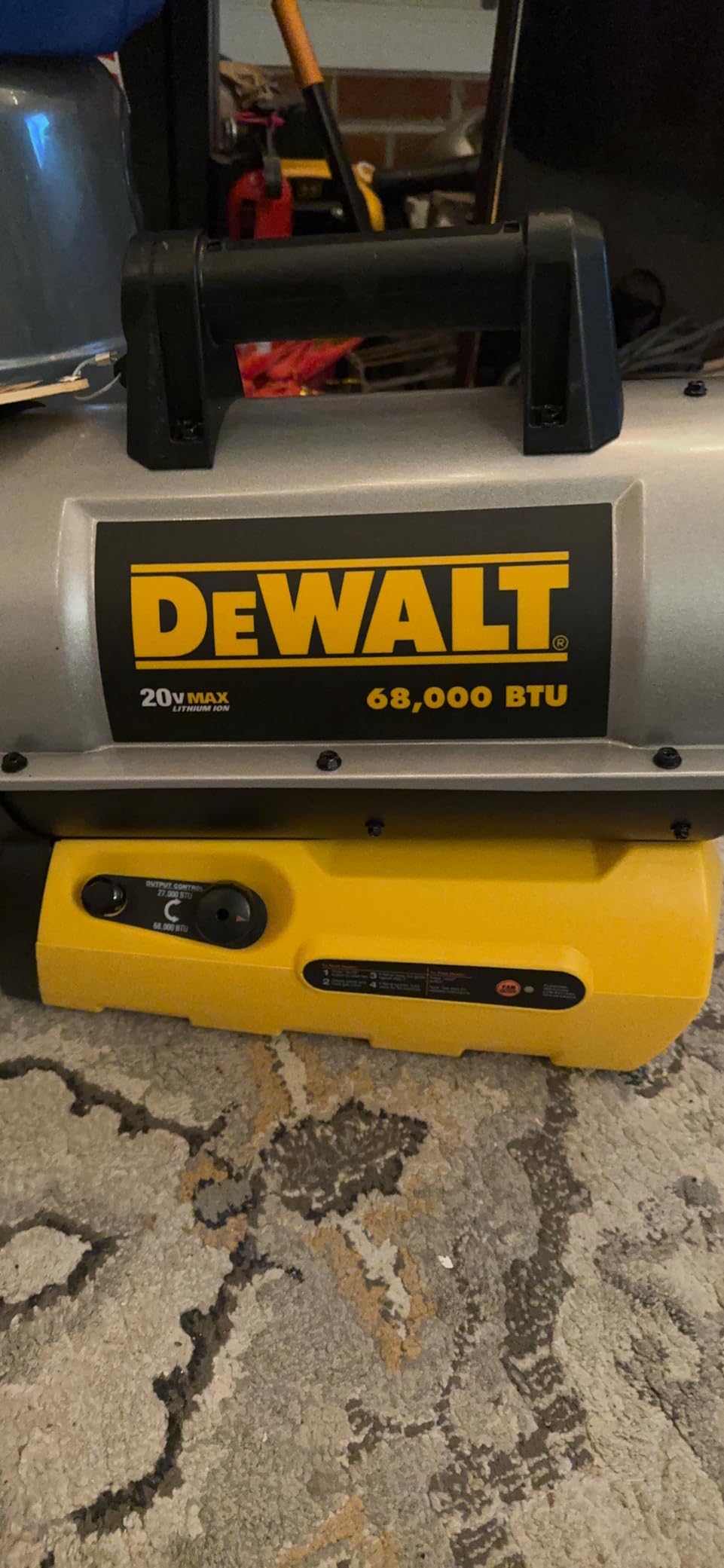
If you are not in the DEWALT battery ecosystem, that advantage largely disappears and you are left with a mid-output heater at a higher cost per BTU. There is no built-in thermostat, so temperature is a manual dial decision. Battery runtime on the high setting is the other limitation, since full output draws the pack down faster than you would like on a long job.
Cold-weather starting is a minor friction point. Owners report the unit being harder to ignite in extreme cold without warming it first, so on a freezing morning in an unheated garage, give it a minute before you judge it.
Where the DEWALT makes sense
Choose it for job trailers, remote ends of a property, construction sites without power, and any situation where a cord is a trip hazard or simply does not reach. If you already own DEWALT 20V packs, the running cost story is very attractive because you are not cycling extension cords.
It is also a good fit for a moderately insulated garage where 68,000 BTU is plenty and low odour matters because you spend hours in there.
Where it falls short
For a large uninsulated shop, 68,000 BTU is under-gunned, and you will be running it continuously. Without DEWALT batteries, the hybrid feature is marketing rather than utility.
And if you want scheduled heating, this is not the unit, because there is no thermostat to attach.
7. Flame King 60,000 BTU Stainless Steel Forced Air Heater – Best Stainless Build for Jobsites
Flame King 60,000 BTU Portable Propane Forced Air Heater Outdoor Great for Jobsite, Construction, Garage, Patio, Stainless Steel
60,000 BTU forced air
1,500 sq ft coverage
Up to 8 hrs per 20 lb bottle
Tilt shutoff
Tip-over shutoff
Pros
- Quiet operation compared with most portable propane heaters
- Stainless steel body with a compact footprint
- Easy to carry and quick to set up
- Roughly 8-9 hours of run time per 20 lb propane tank
- Brand replaced a failed ignitor unit even after warranty expiry
Cons
- Included hose and regulator may need an adapter for a standard 20 lb tank
- Piezo igniter can be finicky to light
- Lower output than higher-BTU models so larger spaces warm slowly
- Some units needed the gas control button held to keep running
The Flame King YSN-AD018 is the one to consider if your heater lives outdoors or on a damp job site. The stainless steel body resists the corrosion that eats painted steel when a unit sits in a wet garage all winter, and the compact footprint makes it easy to stow between uses.
Its stated run time is up to 8 hours on a single 20 lb propane bottle at 60,000 BTU, and owners report landing around 8 to 9 hours in practice. That figure makes it a good match for a full day of intermittent shop heat on a single tank, without swapping cylinders midday.
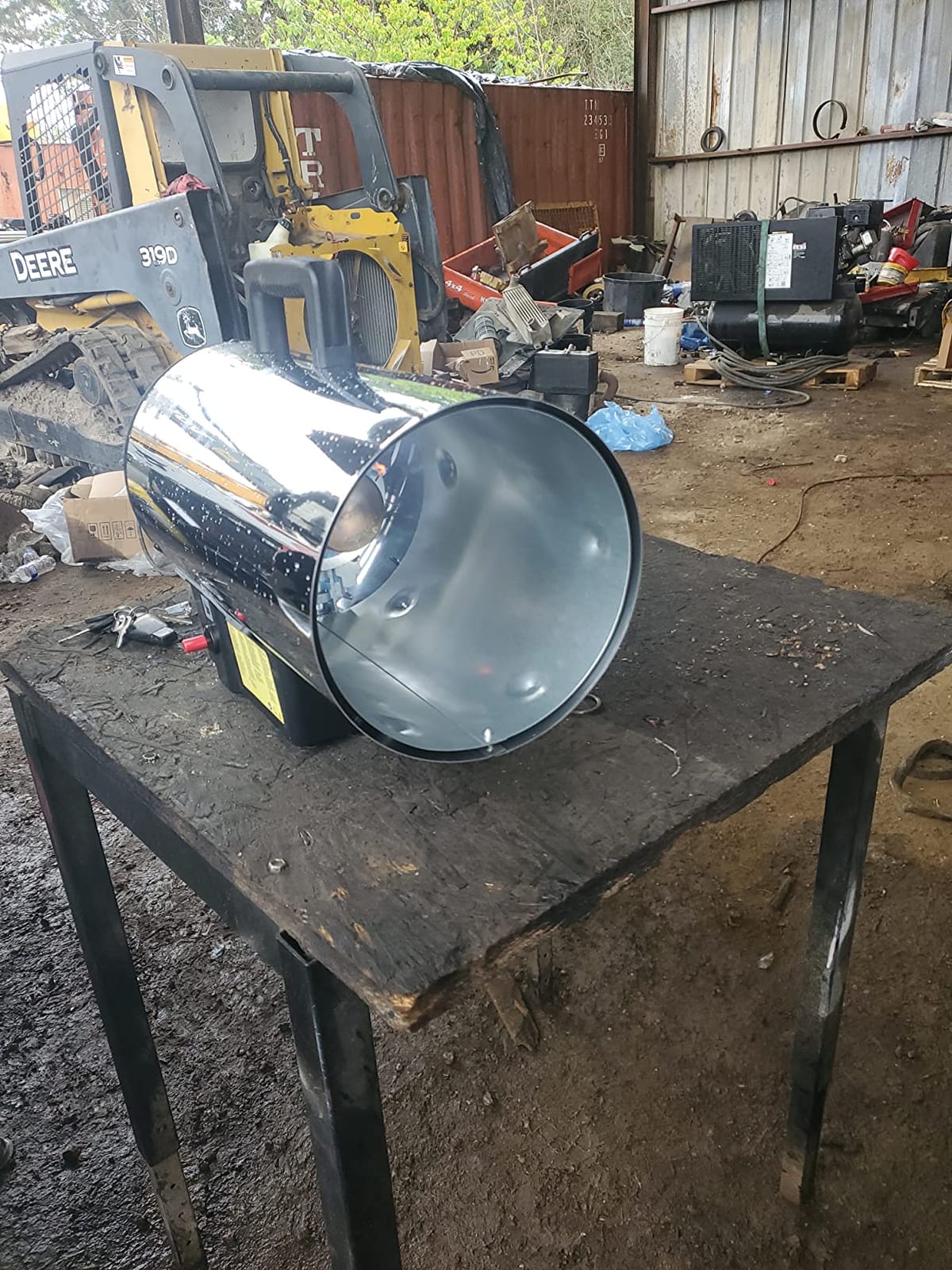
Safety features are unusually thorough for a portable unit. You get a built-in safety fuel shutoff, a fire detection system, and a safety tilt shutoff, plus CSA certification. The tilt shutoff in particular is worth having on a unit that gets moved around, since it kills fuel if the heater is tipped rather than letting the burner run with a flame pointed sideways.
Owners also highlight how quiet it is relative to most portable propane heaters, and the auto piezo ignition with a gas control button makes starting a one-hand operation once you know the sequence.
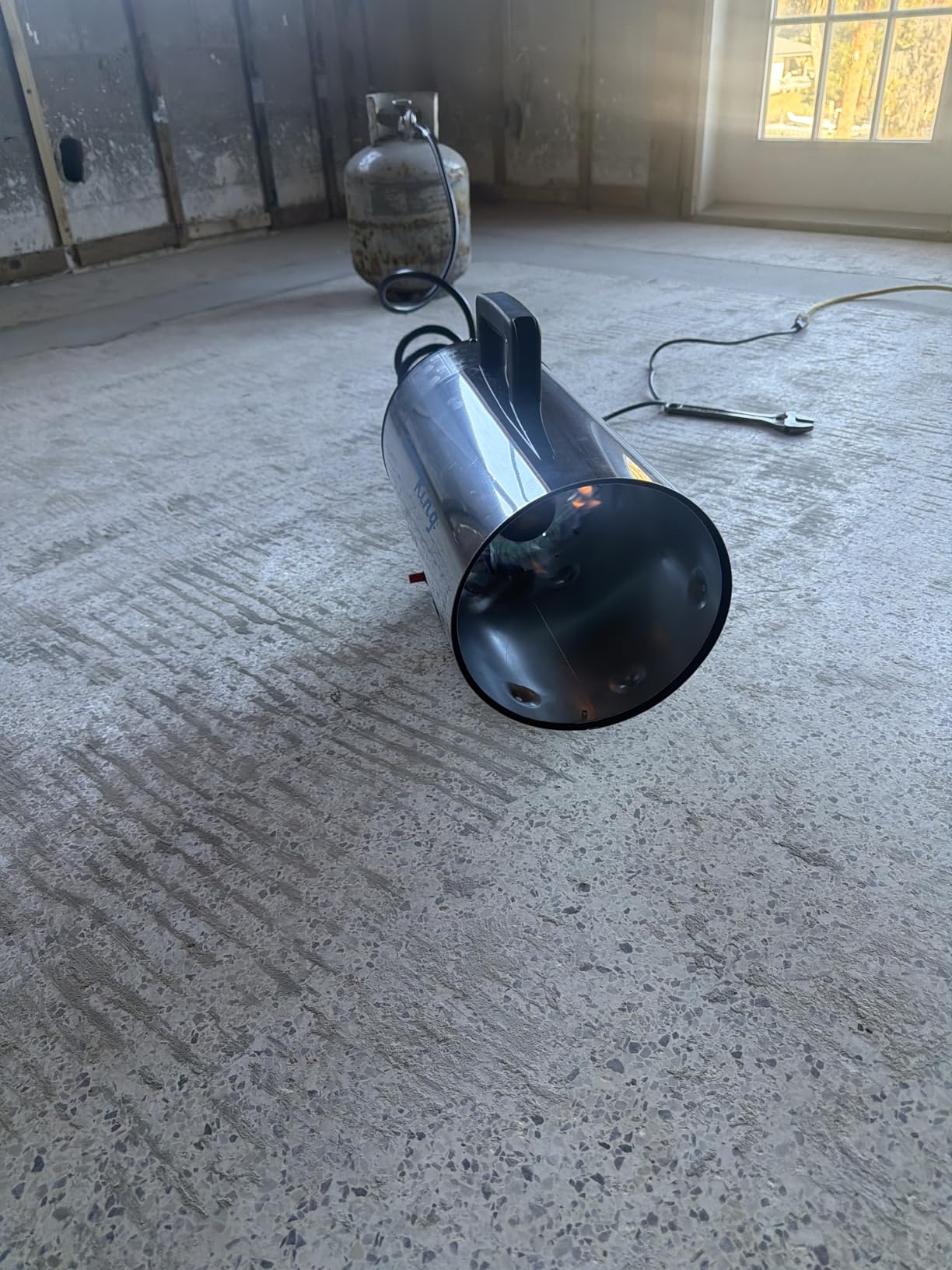
The two real problems are mechanical. First, the included hose and regulator assembly may not fit a standard 20 lb propane tank without an additional adapter, which is exactly the kind of surprise that ruins a cold first morning. Second, the piezo igniter can be finicky, and some owners had to hold the gas control button to keep the unit running, which is not an ideal behaviour to depend on in a cold shop.
At 60,000 BTU it also warms a large space more slowly than the 125,000 BTU models. That is fine for a one-car garage or a covered outdoor work area, and slow for anything bigger. Customer service is a genuine positive, with the manufacturer replacing a failed ignitor even after the warranty period had ended.
Who should pick the Flame King
It fits shops that are damp, dusty, or coastal, and anyone heating a covered patio, job site, or one-car garage on a single tank per day. The stainless housing and the tilt shutoff are the two reasons it earns a place on a shortlist that already has plenty of capable painted-steel heaters.
It is also a good travel heater for a van or trailer setup where corrosion is a constant threat.
Where the Flame King disappoints
Verify the tank fitting before you rely on it, and budget for an adapter if you own a standard cylinder. If finicky ignition in a cold garage is going to frustrate you, pick a continuous electronic ignition model instead.
And for a large uninsulated space, a 60,000 BTU output ceiling will leave you waiting.
8. Dura Heat LPC80 50,000-80,000 BTU Convection Heater – Best When You Have No Power
Dura Heat LPC80 50-80,000 BTU Propane (LP) Convection Heater , Gray
50,000-80,000 BTU variable
2,000 sq ft coverage
Piezo ignition
No electricity needed
Up to 17 hrs on a 40 lb cylinder
Pros
- No electricity required since the piezo igniter needs no outlet
- Up to 17 hours of run time on a 40 lb propane cylinder
- Collapsible design is easy to move between spaces
- Low setting gives ample heat for small and medium garages
- Works reliably right out of the box
Cons
- Convection heat warms the near area more than distant corners
- Consumes propane quickly on the higher settings
- Drops oxygen levels very close to the unit
- Not suited to spaces where children or pets roam
- Warranty covers manufacturing defects only
The Dura Heat LPC80 is the answer when there is no outlet and no plan to add one. Its piezo igniter requires no electricity at all, so the heater runs entirely on propane, which means it works in a detached shop, a barn, a garage that has lost power, or a job site with no generator.
Output ranges from 50,000 to 80,000 BTU with a 360 degree convection design and a built-in wind shield. Run time is the headline: up to 17 hours on a 40 lb propane cylinder, which is the longest figure quoted on a cylinder that size in this roundup and a real advantage for anyone who does not want to handle cylinders mid-session.
The 11 ft hose and regulator are included, the collapsible design makes it easy to move between a garage and a greenhouse or patio, and the auto safety shutoff is a sensible inclusion on a unit that runs unattended-length sessions. Owners like that it lights easily and works reliably straight from the box.
Variable output is genuinely useful here. On the low setting it gives ample heat for small and medium garages, so you are not forced to overheat a small space just because the dial has two positions.
Where the Dura Heat convection design fits
Pick it for a mid-size garage, a greenhouse, a covered patio, or a shop where the air is still and you want even, gentle warmth rather than a blast of hot air pointed across the floor. If you also use propane for other equipment in that space, a single cylinder working this hard for 17 hours is efficient fuel planning.
It is also the safest pick for a power outage, since nothing about it depends on the grid.
Where convection falls short of forced air
This is the key limitation and it is not a small one. Convection warms the air immediately around the unit far more effectively than it warms distant corners, so a large open garage will have a warm zone and a cold zone. Owners who moved up from a forced air unit notice the drop in throw immediately.
Reviewers also flag rapid propane consumption on the higher settings, and note that oxygen levels drop very close to the unit, so ventilation is not optional and it is not appropriate for spaces where children or pets roam freely. The warranty is one year, manufacturing defects only.
9. Mr. Heater 80,000 BTU Convection Heater – Best Long-Run Electricity-Free Heat
Mr. Heater 80,000 BTU Convection Heater Portable Propane
30,000-80,000 BTU variable
2,000 sq ft coverage
Piezo lighter
Standing pilot
Up to 14 hrs on a 100 lb tank
Pros
- Runs entirely without electricity using the built-in piezo lighter
- Variable 30000-80000 BTU output in an affordable package
- Standing pilot improves safety and reliability during operation
- Long run time when paired with a larger propane tank
- Arrives fully assembled and ready to use
Cons
- Convection warms the immediate area more than distant corners
- Requires ventilation and depletes oxygen close to the unit
- P.O.L. connection means smaller cylinders need an adapter
- Manual variable control with no thermostat
The Mr. Heater F270490 is a second electricity-free option, and it is the better one if you already run a larger tank. Output ranges from 30,000 to 80,000 BTU per hour, it heats up to 2,000 sq ft, and it operates for up to 14 hours on a 100 lb propane tank.
That 14 hour figure is what separates it from the Dura Heat on this list. If you have a 100 lb tank and a forklift or a strong back, this becomes a semi-permanent install that you leave running through a full work week without thinking about it. The variable range gives you fine control from a low simmer up to full output.
The standing pilot is the safety feature worth understanding. A pilot flame keeps the burner ready and gives the unit a continuous indication that gas is burning, which is why owners rate its reliability highly compared with units that rely on an intermittent electronic spark. There is no electricity requirement at all, since the built-in piezo lighter handles ignition.
It arrives fully assembled and ready to use, with a 10 ft hose, regulator, and P.O.L. tank connection included, and carries a one-year limited warranty.
When the 100 lb tank changes the economics
At 80,000 BTU you are not going to heat a large uninsulated garage with this. But in a reasonably insulated space, the ability to run 14 hours off a 100 lb cylinder changes how you think about refuelling. You fill once and forget it for most of a week.
It suits garages, greenhouses, and patios where there is no power and a larger tank is already in place.
Where the P.O.L. connection and convection design get in the way
The P.O.L. connection is the practical snag. Smaller standard propane cylinders need an adapter, so if you are working from 20 lb tanks you will be buying a fitting before the first light.
And the same convection limitation applies as with the Dura Heat: it warms the immediate area more than distant corners, it depletes oxygen close to the unit so ventilation is required, and the variable control is manual with no thermostat.
10. Habitio 125,000 BTU Forced Air Torpedo Heater – Best Tank Runtime
Habitio 125,000 BTU Forced Air Propane Heater, Portable Torpedo Heater for Jobsite, Garage, and Construction Sites, 10 ft Hose with Regulator Included, CSA Certified
75,000-125,000 BTU variable
3,125 sq ft coverage
28 hrs on low with a 100 lb tank
Pulse ignition
CSA certified
Pros
- 125000 BTU output covering up to 3125 sq ft for large spaces
- Very economical fuel use with up to 28 hours on low
- CSA certified with pulse ignition and power-outage auto shutdown
- Adjustable fan speed and height allow output tuning
- 10 ft hose and regulator included
Cons
- Noticeable operating noise which the manufacturer states is expected
- Requires a wrench to properly tighten the gas connection at setup
- Careful gas connection tightening is required before first use
- Far fewer customer reviews than established brands in this category
The Habitio BGA2302-125K-1 is the runtime champion in this group. It delivers 75,000 to 125,000 BTU across up to 3,125 sq ft, and the manufacturer rates it at up to 28 hours on low and 17 hours on high from a 100 lb propane tank. That low-setting figure is the reason to consider it, because most of your winter work happens in a space you have already warmed.
Adjustable fan speed and adjustable height are unusual at this output level and both are useful. Fan speed lets you trade noise for circulation, and height lets you direct the airflow across a workbench or up toward the ceiling of a tall shop.
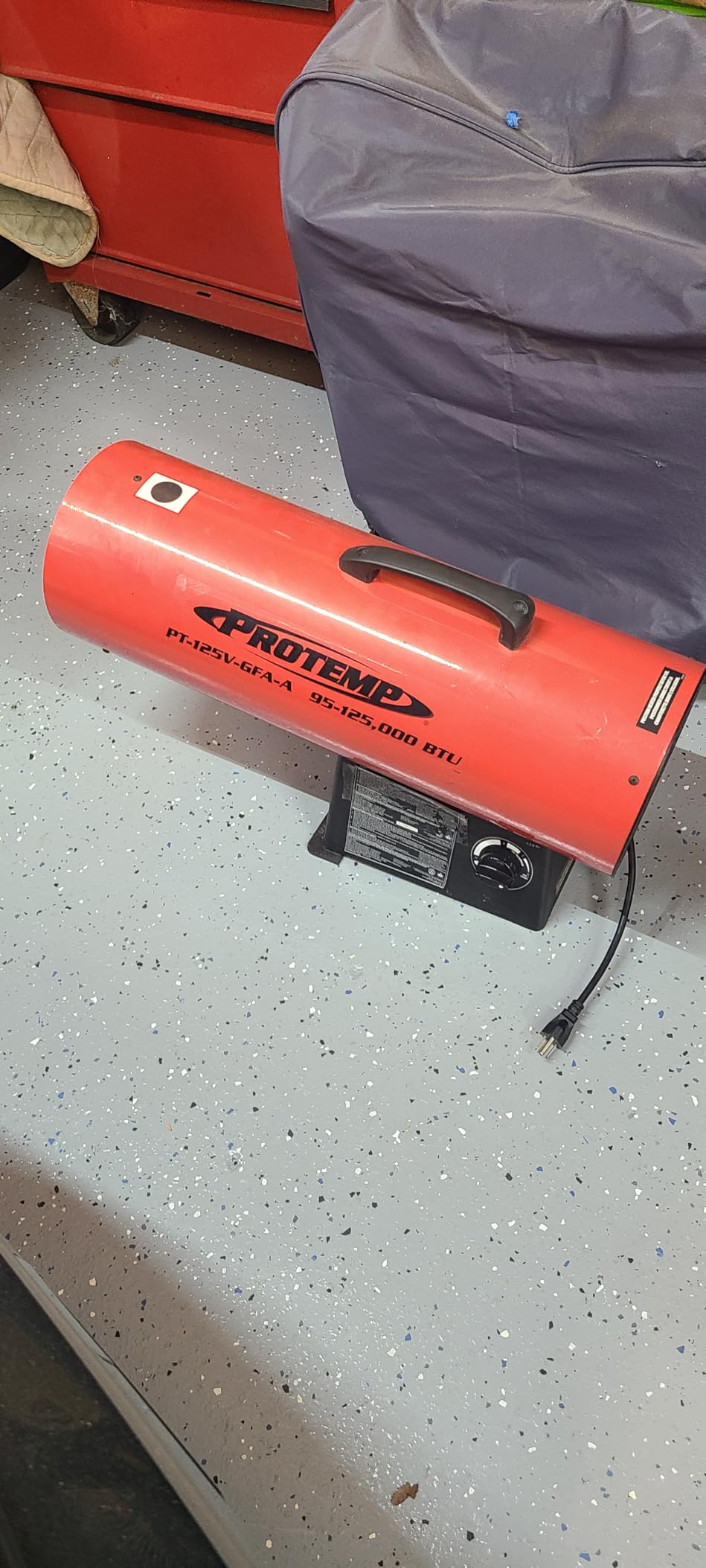
Safety features include pulse ignition, which the manufacturer describes as preventing flame-out and air leakage at start-up, plus overheat protection, automatic shutdown during a power outage, and CSA certification. The automatic outage shutdown is a nice touch for anyone running the heater in a shop where a tripped breaker is a realistic scenario.
Construction is described as corrosion and shock resistant, which is appropriate for a portable unit that lives in a garage rather than a storage closet. The 10 ft hose and regulator are included.
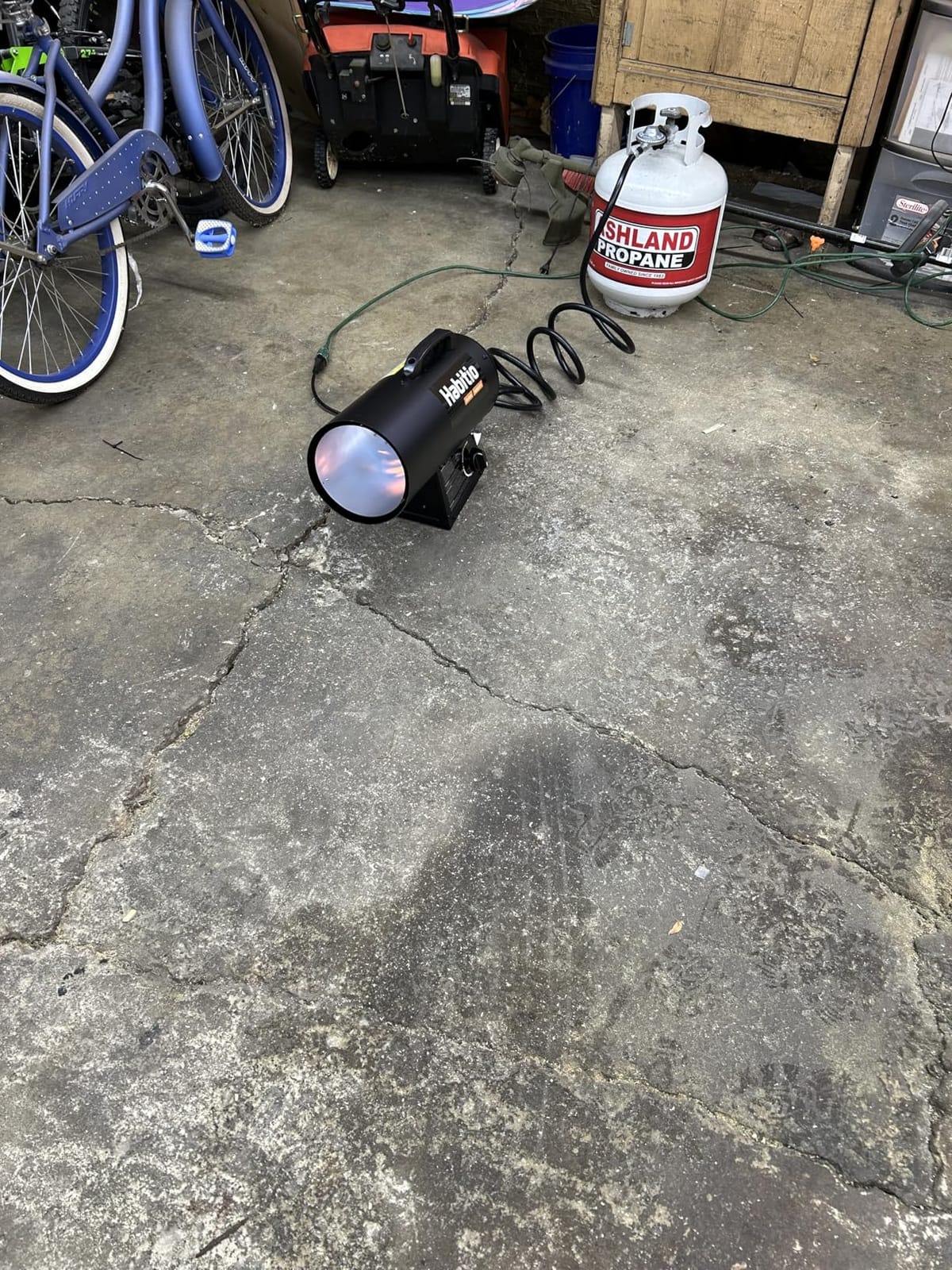
The two practical catches are documented in the product’s own bullet list and are worth repeating. The gas pipe connection must be tightened with a wrench after attaching, and the unit produces a noticeable operating noise that the manufacturer states is expected. Neither is a defect, but both are things you should know about before a long session.
The third factor is history. With a much smaller review base than the established brands, there is less long-term owner feedback available, and the first decade of a heater’s life is when manufacturing consistency tends to show. If you buy it, keep the receipt and register it, and check the burner and gas connection each season.
Who should pick the Habitio
It suits someone with a 100 lb tank who wants a large heater without running it at full fire most of the time. If your garage is a three-car space with high ceilings, the 3,125 sq ft coverage and adjustable height are the right tools for the job.
Adjustable fan speed also makes it a reasonable choice if a fixed-speed fan at 125,000 BTU would be irritating in a small space.
Where it falls short
If you have never run a propane heater, this is not the model to learn on, because the required wrench-tightening step at setup is the kind of detail that is easy to get wrong on a first attempt. The noise is also a real consideration for shared or quiet workspaces.
And given the shorter review history, it is a less proven bet than the GASLAND or Mr. Heater units at the same output tier.
How Many BTU Do You Need for Your Garage?
For a 24×24 garage, which is 576 sq ft, plan on 40 BTU per square foot as the floor for an insulated space and 60 BTU per square foot or more for an uninsulated one. That works out to roughly 23,000 to 30,000 BTU minimum for insulated, and 35,000 BTU upward as a practical starting point for a bare building. Most buyers end up choosing 60,000 to 125,000 BTU because undersizing is the single most common regret owners report.
Here is how the numbers translate into real spaces:
Single bay, roughly 200 to 240 sq ft: 30,000 to 50,000 BTU. A 20×20 shop with insulation does not need more than this.
Two-car garage, 400 to 576 sq ft (20×20 to 24×24): 40 BTU per square foot if insulated, 60 BTU per square foot if not. In practice that means a 60,000 BTU unit is the sweet spot and a 125,000 BTU unit gives you headroom for a cold start.
Three-car or large two-car, 600 to 900 sq ft: 60,000 BTU for insulated, 80,000 to 125,000 BTU for uninsulated.
Shop bay, 1,000 sq ft and up: 100,000 to 125,000 BTU, or two smaller heaters pointed at two work areas rather than one unit trying to heat the entire volume.
Two variables sit on top of that arithmetic. Ceiling height matters, because warm air that has to travel 14 ft to reach the floor loses more than air in a 9 ft ceiling, which is one argument for a lower ceiling-mounted unit in a finished garage. And insulation dominates everything: heat loss through bare block and a steel door can exceed what a 125,000 BTU burner produces on a windy day.
If your garage is uninsulated and you are still deciding, check our best garage heaters for winter breakdown, which compares propane against electric and infrared options for the same spaces.
Forced Air vs Radiant vs Convection: Which Style Do You Need?
Forced air wins for heating a whole garage, radiant wins for heating a person, and convection sits in between with the longest run times. That single sentence resolves most of the confusion in this category, because the BTU rating only means something once you know which of the three you are buying.
Forced air uses a combustion fan to push heated air across the space, and it mixes the air properly. This is why the Dyna-Glo, Remington, GASLAND, DEWALT, and Flame King units can take a two-car garage from freezing to workable in ten to twenty minutes. It is also why they are the noisiest option, because a fan running at high speed makes itself heard.
Radiant heaters send infrared heat toward surfaces and objects in a line of sight. Owners consistently favour them for warming one person at a bench, because you get heat on your hands and torso rather than on the air you are breathing. The limitation owners report is a working radius of roughly three feet, with the rest of the garage staying cold.
Convection heaters warm the surrounding air without a high-speed fan, using a natural circulation pattern. They are quieter, they run longer per tank, and they do not throw heat across a large space. The Dura Heat and the Mr. Heater 80,000 BTU are the two examples here, and both are best suited to still, mid-size spaces.
A practical combination many owners settle on is a radiant unit for the bench and a forced air unit for the room. If you want a dedicated look at the radiant side, we have covered the best infrared workshop heaters separately.
Vented, Ventless, and Indoor-Rated: What Garage Use Actually Allows
Most propane garage heaters in this roundup are combustion units that are outdoor-rated or garage-rated and must be used with ventilation. Only fixed-installation indoor-rated unit heaters like the Mr. Heater 50,000 BTU ceiling model are designed to sit inside a sealed space with a proper vent and gas line, and even that one requires a code-compliant vent.
This distinction is the most important safety point in the category, and it is the one most often blurred in product listings. A radiant or convection heater may say indoor use on its spec sheet because it is safe in a ventilated room, not because it is safe in a closed garage with no fresh air.
Combustion heaters consume oxygen as they burn. That is what an oxygen depletion sensor exists to detect, and why a sensor on a gas-fired garage heater is treated as a deal-breaker safety feature by experienced owners rather than a nice-to-have. None of the portable torpedo units in this roundup list an ODS as a headline feature, which is one more reason to keep the door cracked and follow the clearance distances in the manual.
Before you light any of these units, the CPSC and NFPA 58 guidance both point the same direction: combustion heaters need ventilation, and a carbon monoxide detector is not a substitute for it. Our greenhouse heater picks for winter cover the ventilation-first approach in a different structure.
Safety, Ventilation and Carbon Monoxide
Propane garage heaters are safe when you respect the physics of combustion. That means four rules: fresh air in, a carbon monoxide detector inside, correct clearance from combustibles, and a working flame-failure system.
Ventilation. Open the garage door a few inches or run a fan. This is standard practice in owner reports and it is what the CPSC and NFPA 58 guidance amount to in practical terms. Combustion heaters produce both combustion gases and moisture, and the moisture is what causes the sweating and rusting people associate with running a heater in a cold building.
Carbon monoxide detectors. Install one inside the garage on the wall near the door and, ideally, a second near the sleeping area of the house. A detector does not make a poorly ventilated space safe, but it is the last line of defence when something goes wrong with a burner or a flue.
Clearance. Keep the unit away from vehicles, cardboard, wood shelving, and any surface that can heat. Ceiling-mounted models have their own clearance requirements, and the Mr. Heater 50,000 BTU needs a minimum 10 ft ceiling with 8 ft of clearance beneath it.
Shutoffs. The safety systems on these heaters fall into three groups, and you want as many as your budget allows. Overheat auto shutoff stops the burner if the unit overheats. Flame-failure or flame-out fuel cut-off closes the gas valve if the flame goes out. Tip-over and tilt shutoff kill fuel if the heater is knocked or tipped, which matters most for the portable units that get moved around. The Remington pairs a thermocouple with high-temperature and flame-out cut-offs, and the Flame King adds a tilt shutoff with a fire detection system, while the GASLAND combines overheat detection with a thermo-electric safety valve.
If a heater will not stay lit or smells strongly of propane, turn the tank valve off, ventilate, and check the connection with soapy water before you do anything else. Bubbles at the joint mean a leak, and no heater is worth a fire.
How Much Propane Each Heater Burns
Propane carries 21,600 BTU per pound, which lets you convert any BTU rating into real fuel use. Divide the burner output by 21,600 to get pounds per hour, then divide 20 lb by that figure to get hours per standard cylinder.
Here is the working math for the output tiers in this roundup:
30,000 BTU: about 1.4 lb per hour, roughly 14 hours on a 20 lb cylinder. This is the low setting on the Dyna-Glo.
50,000 BTU: about 2.3 lb per hour, roughly 8 to 9 hours per 20 lb cylinder. The ceiling-mounted Mr. Heater and the low setting on the Dura Heat.
60,000 BTU: about 2.8 lb per hour, roughly 7 hours per 20 lb cylinder. The Remington, Flame King, and DEWALT units at output.
80,000 BTU: about 3.7 lb per hour, roughly 5 hours per 20 lb cylinder. The Dura Heat and Mr. Heater convection units at maximum.
125,000 BTU: about 5.8 lb per hour, a little over 3 hours per 20 lb cylinder. The GASLAND, Mr. Heater, and Habitio units at full fire.
That last line is why high-output owners keep a 100 lb tank or swap cylinders mid-session. It also explains why the variable output dial is such a valuable feature: a heater running at 30,000 to 60,000 BTU instead of 125,000 roughly halves your fuel burn for the same comfort once the space is warm.
For perspective on long sessions, the Habitio is rated at up to 28 hours on its low setting from a 100 lb tank, the Mr. Heater convection unit at up to 14 hours from a 100 lb tank, and the Dura Heat at up to 17 hours from a 40 lb cylinder. Those are the figures that make an electricity-free heater attractive for a full week of shop heat.
Undersizing shows up here as well as in comfort. A 60,000 BTU heater in a large uninsulated garage runs at full fire continuously, which means roughly 2.8 lb per hour with no option to throttle back, and you will burn through cylinders much faster than the label suggests.
Connecting a Heater to a Propane Tank and Pre-Winter Checks
Every portable unit here ships with a hose and regulator, so setup is straightforward. The sequence matters more than the parts.
1. Check the hose and regulator for cracks, bulges, or corrosion before connecting anything.
2. Turn the tank valve fully off, then attach the regulator to the cylinder and hand-tighten the cylinder nut.
3. Attach the regulator outlet to the heater inlet and tighten with a wrench. The Habitio’s instructions specifically call for wrench tightening on the gas pipe connection.
4. Open the tank valve slowly and listen for any hiss at the connection.
5. Leak test every joint with soapy water. Bubbles mean a leak that must be fixed before you light anything.
6. Connect the power cord or battery for the fan and ignition, unless your model is piezo or battery-free, as the Dura Heat and Mr. Heater convection unit are.
7. Place the heater with its stated clearance from walls, vehicles, and stored materials, with the exhaust pointed outside or with the garage door cracked open.
8. Light it per the manual and confirm you have airflow before you close the door.
Before the first cold week of the season, run a short maintenance pass. Clean the burner screen and nozzle so restricted airflow does not force the overheat shutoff into firing. Inspect the hose for hardening or cracking, especially if it was stored coiled. Check that the regulator still feels right, and confirm the carbon monoxide detector in the garage is working.
Store the heater somewhere dry and keep the cylinder upright and outdoors or in a ventilated shed. A propane tank stored in a heated attached space is a known safety problem, and heat accelerates the pressure relief process without telling you anything useful until it matters.
Frequently Asked Questions
How many BTU do I need to heat a 24×24 garage?
A 24×24 garage is 576 sq ft. Plan on 40 BTU per square foot for an insulated space, which is about 23,000 BTU, and 60 BTU per square foot for an uninsulated one, which is about 35,000 BTU. In practice most owners of uninsulated two-car garages choose a 60,000 to 125,000 BTU heater so they can warm the space quickly on a cold start and then throttle back.
Do propane garage heaters need electricity?
Most do, because the combustion fan and electronic ignition need power. A 115V or 120V outlet is required for models like the GASLAND, Remington, Flame King, and the Mr. Heater torpedo unit. The DEWALT DXH70CFAV runs on a 20V battery or AC power. The Dura Heat LPC80 and Mr. Heater 80,000 BTU convection units use piezo ignition and need no electricity at all.
How long does a 20 lb propane tank last in a garage heater?
A 60,000 BTU heater burns about 2.8 lb per hour, so a 20 lb cylinder runs roughly 7 hours at full output. A 30,000 BTU setting stretches that to around 14 hours, while a 125,000 BTU heater burns about 5.8 lb per hour and empties a 20 lb tank in a little over 3 hours. Variable output is the single biggest factor in how far a tank stretches.
Are propane heaters safe to use in a garage?
They are safe when you follow the rules. Propane garage heaters consume oxygen as they burn, so they need ventilation, and a carbon monoxide detector inside the garage is a necessary second layer. Keep the unit at its stated clearance from vehicles and stored material, and only use ventless indoor-rated models in a fully enclosed space. For a fixed install, NFPA 58 and CPSC guidance covers venting and placement.
What is the most efficient propane heater for a garage?
Efficiency comes from matching output to space and using variable heat rather than from a single brand. A heater with a wide BTU range, like the Dyna-Glo at 30,000 to 60,000 BTU or the GASLAND at 75,000 to 125,000 BTU, lets you run a low fire once the space is warm and cuts fuel burn sharply. The electricity-free convection units also stretch a tank furthest, with the Dura Heat rated at up to 17 hours on a 40 lb cylinder.
Should I choose a radiant or forced air propane heater for a garage?
Choose forced air if you want the whole garage workable, because a combustion fan mixes the air and can warm a two-car space in ten to twenty minutes. Choose radiant if you are warming one person at a bench, since it delivers heat directly to you but only works within a short radius. Convection sits between the two, running quieter and longer per tank but warming the area near the unit far more than distant corners.
Final Verdict
For most people searching for propane garage heaters for winter work in 2026, the GASLAND FH12FB is the one to buy. Its 75,000 to 125,000 BTU range covers an uninsulated three-car garage, the variable output and adjustable heat angle let you aim heat where you are working, and the included 10 ft hose and regulator mean it is running the day it arrives.
Buy the Mr. Heater F271390 instead if fan noise ruins your concentration, the Dyna-Glo RMC-FA60DGD if you want the widest useful output range for a mid-size garage, and the DEWALT DXH70CFAV if you need heat where there is no outlet.
Whichever one you choose, remember the rule that matters more than the BTU rating: ventilate the space, keep a carbon monoxide detector in the garage, and check the gas connection with soapy water before the first light of the season.