
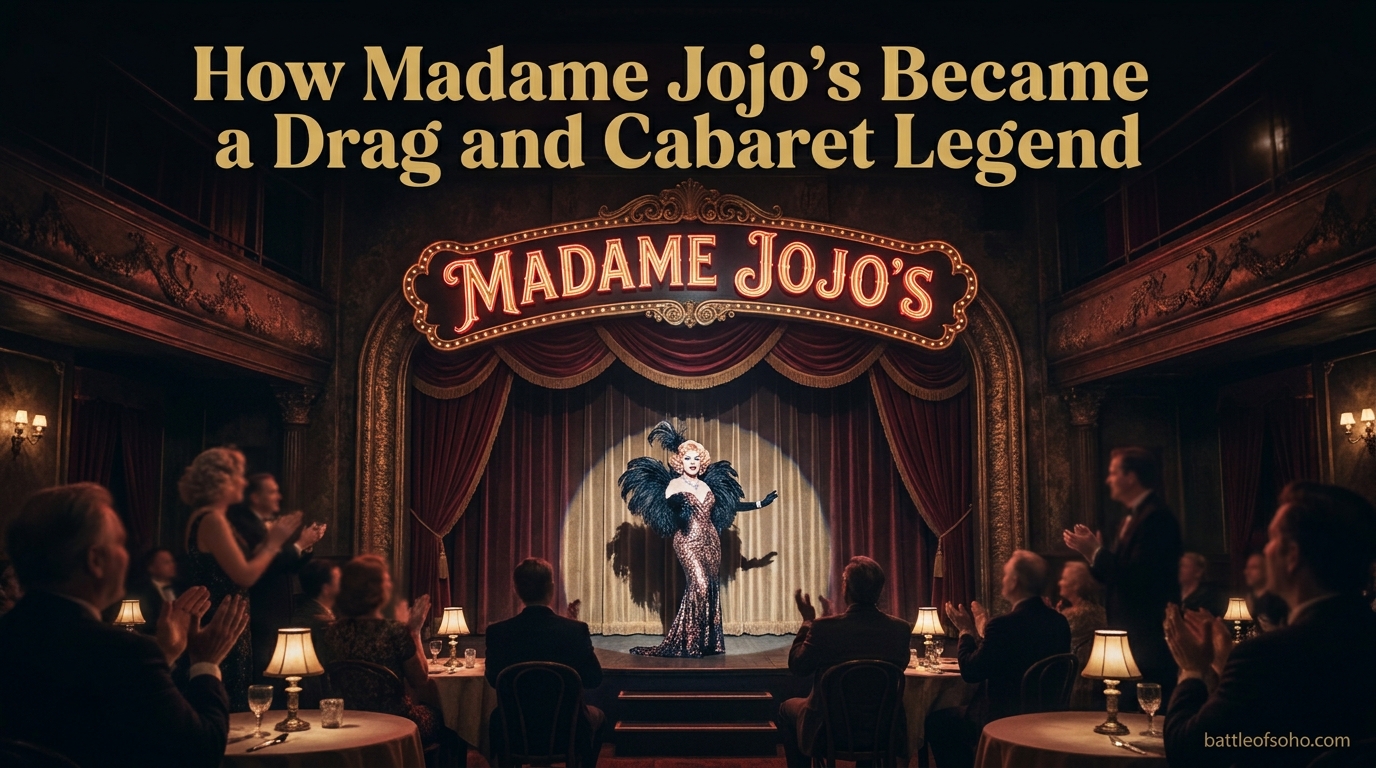
Madame Jojo’s was a legendary Soho nightclub and cabaret venue on Brewer Street in London’s West End, operating from 1986 until its forced closure in 2014. Known for drag shows, burlesque performances, and live music, it became one of the most culturally significant late-night venues in British history.
For nearly three decades, this single venue shaped drag culture, launched music careers, and served as a sanctuary for London’s LGBTQ+ community. It hosted everyone from Princess Diana to underground indie bands, all under the same glittering chandeliers on Brewer Street.
In this article, we trace the full story of how Madame Jojo’s became a drag and cabaret legend, from its founding by Soho mogul Paul Raymond to the bitter fight over its closure and the ongoing battle for its future. We cover the performers, the music, the controversies, and the legacy that still echoes through London nightlife in 2026.
Table of Contents
How Madame Jojo’s Became a Drag and Cabaret Legend: The Full Story
Few venues in London have a story as layered as Madame Jojo’s. What began as a cabaret and drag room in the mid-1980s evolved into a cultural institution that touched multiple generations of performers, musicians, and club-goers.
The club’s journey spans three distinct eras. The first was the golden age of drag cabaret, headlined by The Barbettes and a compere known as Madame Jojo herself. The second saw the rise of White Heat, a club night that became the beating heart of London’s indie and nu-rave scene. The third was the bitter end, when a violent incident in 2014 gave Westminster Council the reason it needed to pull the venue’s license.
Understanding how Madame Jojo’s became a legend means understanding all three eras and the people who made them possible. Let’s start at the very beginning, with the man who built the venue and the drag queen who gave it its name.
The Foundations: Paul Raymond and Brewer Street
Madame Jojo’s owed its existence to Paul Raymond, often called the “King of Soho.” Raymond was a publisher and club owner who controlled vast swaths of Soho’s real estate through his company, Soho Estates. He built his fortune on adult entertainment venues, starting with the Raymond Revuebar in 1958.
The building at 8-9 Brewer Street had a long history before Madame Jojo’s arrived. It previously operated as the Fox Casino, a gambling and entertainment venue that fit neatly into Raymond’s portfolio of Soho nightlife properties. When Raymond decided to transform the space in the mid-1980s, he saw an opportunity to create something that mixed glamour with the slightly sleazy charm that defined Soho in that era.
The venue opened as Madame Jojo’s in 1986. Raymond’s vision was a cabaret room that could showcase drag acts, burlesque performers, and variety entertainment in a setting that felt opulent but accessible. The interior was designed to feel like stepping into a fantasy. Red velvet, gold trim, chandeliers, and theatrical staging turned a plain Brewer Street building into something magical.
Soho in the 1980s was the perfect home for this kind of venture. The area was known for its sex shops, strip clubs, and late-night venues. It was gritty, creative, and unapologetically itself. Madame Jojo’s fit right into that ecosystem while also offering something different. It was a place where drag artistry took center stage rather than lingering in the margins.
Raymond’s backing gave the venue financial stability that many independent clubs lacked. His ownership also meant Madame Jojo’s was connected to the broader Soho Estates network, which would become relevant decades later when the question of the venue’s future became tied to property development plans.
Who Was Madame Jojo? The Drag Performer Behind the Name
Here is something most articles about this venue get wrong: Madame Jojo was not just a fictional name. She was a real drag performer, and she was the heart and soul of the club during its early years.
Madame Jojo served as the club’s resident compere and hostess. She was known for her sharp wit, commanding stage presence, and an ability to work a crowd that bordered on legendary. Patrons who frequented the venue in its early days remember her as strict but fair, a performer who demanded excellence from everyone who shared her stage.
She was not the kind of drag queen who relied on lip-syncing alone. Madame Jojo was a live singer and performer who engaged directly with the audience. Her performances blended comedy, music, and a theatricality that set the tone for everything the venue would become. She created the template for what a night at Madame Jojo’s was supposed to feel like.
Forum discussions among former patrons paint a vivid picture. Many recall her as the gatekeeper of quality at the venue. If you were a drag performer and Madame Jojo approved of your act, you knew you had arrived. If she did not, you heard about it, often from the stage in front of a packed house.
This personal touch mattered. It gave the venue a personality that went beyond its decor or programming. Madame Jojo was not just a name on a sign. She was a living, breathing presence who shaped the club’s identity from the inside out. When people talk about the soul of Madame Jojo’s, they are often talking about her.
Unfortunately, detailed biographical information about the performer behind Madame Jojo remains scarce in published sources. This is one of the biggest content gaps we found while researching this article. The drag queen who gave the venue its name deserves far more recognition than she has received.
The Barbettes: Drag Royalty of Soho
If Madame Jojo was the soul of the venue, The Barbettes were its crown jewels. The Barbettes were a troupe of drag performers who served as the signature act at Madame Jojo’s during its cabaret heyday.
The group performed elaborate production numbers that combined lip-syncing, choreography, and spectacular costumes. Their feathered outfits became iconic, with performers dressed in towering headdresses and cascading plumage that filled the stage. These were not amateur drag acts. The Barbettes delivered polished, professional shows that rivaled anything on the West End.
The Barbettes became celebrities in their own right within London’s nightlife scene. People came to Madame Jojo’s specifically to see them. Their presence helped establish the venue as a destination for high-quality drag entertainment, not just a curiosity or a novelty act.
The troupe’s significance extends beyond entertainment value. In an era when drag was far less mainstream than it is today, The Barbettes brought drag performance to wide audiences in a central London location. They helped normalize drag as legitimate theatrical entertainment at a time when it was often marginalized or treated as a joke.
Former patrons recall The Barbettes with genuine reverence. In Facebook groups dedicated to Soho memories, people describe the troupe’s performances as transformative experiences. The combination of music, visual spectacle, and raw charisma created nights that people remembered for decades.
The Barbettes also helped create the template for what would become the modern drag show format. Production numbers, costume changes, audience interaction, and comedic timing between acts all became standard elements of drag performances that followed. In that sense, the influence of The Barbettes extends far beyond the walls of Madame Jojo’s.
The Golden Era of Cabaret and Burlesque
The period from the late 1980s through the early 2000s represented the golden era of cabaret and burlesque at Madame Jojo’s. During this time, the venue established itself as the premier destination for variety entertainment in London’s West End.
Burlesque was a major part of the programming. As the burlesque revival gained momentum in the late 1990s and early 2000s, Madame Jojo’s became one of the key venues driving that movement in London. Performers who went on to international fame in burlesque often cite appearances at Madame Jojo’s as milestones in their careers.
The venue also hosted regular Drag King nights, providing a platform for female-to-male drag performers at a time when such events were extremely rare. These nights were groundbreaking in their visibility and helped expand the conversation around gender performance in London’s nightlife scene.
What made this era special was the variety. A single night at Madame Jojo’s might feature a burlesque dancer, a drag queen doing a comedy routine, a singer performing standards, and an avant-garde performance artist. Few venues in London offered that kind of programming diversity, and fewer still did it with such consistent quality.
The venue’s role within the LGBTQ+ community during this period cannot be overstated. Madame Jojo’s provided a safe space for queer performers and patrons at a time when such spaces were under constant threat. The venue was unapologetically inclusive, and that inclusivity extended to people of all genders, sexualities, and backgrounds.
This commitment to the community was not just incidental. It was built into the fabric of the venue. Performers recall Madame Jojo’s as a place where they could be themselves without fear, where experimentation was encouraged, and where the audience would follow them wherever their art took them.
The World Burlesque Games were hosted at the venue, further cementing its reputation as a global hub for the art form. Competitors and audiences traveled from around the world to participate, making Brewer Street a temporary center of the international burlesque community.
White Heat: When Madame Jojo’s Changed Music Forever
In the 2000s, something remarkable happened at Madame Jojo’s. A club night called White Heat transformed the venue from a cabaret institution into a launchpad for some of the most important music of the decade.
White Heat was founded as an indie and alternative club night, but it quickly became something much bigger. The night was known for breaking new bands before they hit the mainstream. Acts that went on to define the era, including The xx, Lorde, Jamie T, and countless others, played early or secret shows at the venue.
The atmosphere at White Heat was electric. It captured the spirit of what later became known as “indie sleaze” and the “nu-rave” movement. The crowd was young, fashionable, and passionate about discovering music. The room’s relatively small capacity meant that seeing a band at White Heat felt intimate and special in a way that larger venues could never replicate.
For the music press and industry tastemakers, White Heat became required attendance. A recommendation or a buzzing set at Madame Jojo’s could propel a band from obscurity to record deals and festival headlines. The club night essentially functioned as a talent pipeline for the British music industry.
What made White Heat particularly significant was how it coexisted with the venue’s cabaret programming. Madame Jojo’s was one of the few places where you could see a world-class drag show on one night and a future stadium-filling band on the next, all in the same room with the same chandeliers overhead.
The White Heat era also brought a new demographic to the venue. While the cabaret nights attracted loyal regulars and tourists seeking old-school Soho glamour, White Heat drew fashion-conscious music fans and industry insiders. This cross-pollination of audiences was part of what made Madame Jojo’s so culturally rich.
When the venue closed in 2014, the loss of White Heat was mourned as a separate tragedy. Music journalists wrote eulogies for the night, describing it as the most important indie club of its era. The closure meant that London lost not just a cabaret venue but a critical platform for emerging music.
The Atmosphere and Decor: Stepping Into Another World
Part of what made Madame Jojo’s legendary was the physical experience of being there. The moment you walked through the door on Brewer Street, you left ordinary London behind.
The interior was designed for maximum theatrical impact. Red velvet walls, gilded mirrors, crystal chandeliers, and a stage that commanded attention created an environment that felt simultaneously glamorous and slightly dangerous. It was the kind of decor that made you sit up straighter and speak more quietly, at least until the show started.
The layout of the venue contributed to its unique feel. The main room was intimate enough that every seat felt close to the action, but large enough to hold a proper crowd. There was a sense of being in a secret world, hidden behind an unassuming storefront on one of Soho’s busiest streets.
Celebrity visitors were a regular occurrence. Princess Diana reportedly visited the venue, as did Joan Collins and numerous other high-profile figures. The appeal was simple: Madame Jojo’s offered entertainment you could not find anywhere else in London, delivered in a setting that felt exclusive without being pretentious.
The venue also had a life on screen. Stanley Kubrick used Madame Jojo’s as a filming location for scenes in “Eyes Wide Shut,” the 1999 film starring Tom Cruise and Nicole Kidman. The production took over the venue for an extended period, and Kubrick’s team dressed the interior to match the film’s mysterious, ritualistic atmosphere. Fans of the film still discuss the Soho filming locations in online forums, keeping that connection alive.
Regular patrons describe the atmosphere as a unique blend of sleaze and glamour. It was not a polished, corporate venue. It had rough edges, personality, and a sense of danger that made every night feel like an adventure. That quality is something many people feel has been lost from modern London nightlife.
The staff and regular performers contributed to this atmosphere as much as the decor did. Door staff, bartenders, and performers all treated the venue as their domain, creating a sense of community and belonging that kept people coming back year after year.
The Closure: License Revocation in 2014
The end came suddenly. In November 2014, Westminster City Council revoked Madame Jojo’s license to operate, forcing the venue to close its doors.
The immediate cause was a violent incident outside the venue. A doorman was attacked, and the council determined that the venue’s management had failed to maintain adequate safety standards. The incident gave the council the legal basis it needed to act.
However, many supporters of the venue saw the closure as part of a larger pattern. Soho was undergoing rapid gentrification, and independent nightlife venues were being squeezed out by rising rents and tightening regulations. The argument was that Westminster Council had been looking for an excuse to shut down late-night venues and the incident at Madame Jojo’s provided one.
The Guardian’s coverage of the closure framed it within this broader context of cultural loss. Supporters argued that the council’s decision was disproportionate and that the real motivation was a desire to sanitize Soho for property developers and corporate tenants.
The closure sent shockwaves through London’s nightlife and creative communities. For the LGBTQ+ community, the loss was particularly painful. Madame Jojo’s had been a safe space for decades, and its closure meant one fewer place where queer people could gather without judgment.
The timing was also significant. The closure came amid a broader wave of venue closures across London, with fabric, The Astoria, and other iconic venues facing similar battles. Madame Jojo’s became a symbol of everything that was being lost in the rush to redevelop and gentrify the city’s nightlife districts.
Westminster Council defended its decision as a matter of public safety, citing the severity of the incident and the venue’s failure to address security concerns. But for many, the explanation rang hollow given the venue’s long history and cultural significance.
The emotional impact of the closure cannot be overstated. Social media filled with tributes and memories. People who had met their partners at the venue, discovered their favorite bands there, or performed on its stage for the first time all shared their stories. It felt like the end of an era for London itself, not just for a single nightclub.
Save Soho: The Fight to Preserve a Cultural Landmark
The closure of Madame Jojo’s helped galvanize a broader movement to protect Soho’s cultural heritage. The “Save Soho” campaign emerged as a coordinated effort to prevent further loss of independent venues in the area.
The campaign drew support from high-profile figures in the entertainment industry. Musicians, actors, writers, and performers who had connections to Soho’s nightlife scene lent their voices to the cause. The argument was straightforward: Soho’s unique character was built on its venues, and losing them meant losing the thing that made the area special.
Soho Estates, the property company that owned the Madame Jojo’s building, found itself at the center of the debate. The company had inherited Paul Raymond’s extensive Soho property portfolio and faced pressure from both developers and preservationists. The question of what would happen to the Madame Jojo’s space became a flashpoint in the broader conversation about Soho’s future.
The Save Soho campaign argued that venues like Madame Jojo’s were not just businesses. They were cultural infrastructure that could not be replaced by chain restaurants or luxury apartments. Once they were gone, the creative ecosystem they supported would collapse.
This argument resonated with the public. Petitions gathered thousands of signatures, and media coverage kept the issue in the public eye. While the campaign could not reverse the closure of Madame Jojo’s, it did raise awareness about the fragility of London’s nightlife heritage.
The fight also highlighted tensions between different visions for Soho’s future. On one side were those who saw the area as a creative and entertainment district that needed protection. On the other were property developers and council officials who saw economic potential in redevelopment. Madame Jojo’s became the most visible battleground in this ongoing conflict.
Reopening Attempts and the 2024-2025 Controversy
The story of Madame Jojo’s did not end with its closure. Multiple attempts have been made to bring the venue back, and the building has remained at the center of controversy.
In 2023, reports emerged that the iconic cabaret club was set to reopen its doors. Plans were discussed for restoring the venue to its former glory, with hopes that it could once again host drag shows, burlesque, and live music. The news was met with excitement from fans of the original venue and from London’s nightlife community more broadly.
However, the reopening plans took an unexpected turn. In 2024, an application was submitted for a sexual entertainment venue license at the Brewer Street site. The proposal was for a strip club called Penthouse, which would operate in the space formerly occupied by Madame Jojo’s.
This application sparked immediate controversy. Supporters of the original venue were dismayed that the space might be converted into a strip club rather than restored as the cabaret and drag venue they remembered. Community groups and LGBTQ+ advocates expressed concern that the shift would erase the cultural significance of the location.
The 2024-2025 license application process became a flashpoint for debate about what Soho’s nightlife should look like. Those in favor argued that sexual entertainment venues had always been part of Soho’s identity and that the area should not be sanitized. Those opposed argued that replacing a beloved drag and cabaret venue with a strip club represented exactly the kind of cultural loss the Save Soho campaign had warned about.
As of 2026, the question of what will ultimately happen to the Madame Jojo’s space remains unresolved. The building sits at the intersection of competing visions for Soho’s future, and every decision about its use carries enormous symbolic weight.
For those who remember the original venue, the fight is about more than one building. It is about whether London will preserve the spaces that made it a global capital of alternative culture, or whether those spaces will be steadily replaced by more profitable but less meaningful enterprises.
Madame Jojo’s Legacy: Why It Still Matters in 2026
Even though Madame Jojo’s has been closed for over a decade, its influence continues to shape drag culture, music, and nightlife in London and beyond.
The drag performers who graced its stage helped build the foundation for the mainstream visibility drag enjoys today. Shows like RuPaul’s Drag Race, which now command global audiences, owe a debt to venues like Madame Jojo’s that provided platforms for drag artistry when it was far less accepted. The production values, the audience engagement techniques, and the sheer theatricality that defined performances at Madame Jojo’s set standards that continue to influence drag shows worldwide.
White Heat’s impact on music is equally enduring. The bands that played the venue went on to shape the sound of a generation, and the club night’s model of discovery-based programming has influenced how the music industry thinks about emerging talent. The intimate, reputation-building shows that White Heat pioneered remain a key part of how new artists build careers.
The venue’s role in the LGBTQ+ community left a lasting mark as well. Madame Jojo’s demonstrated that inclusive, queer-friendly venues could be commercially successful and culturally significant. That model has inspired countless venues that have opened in the years since, even as the loss of the original continues to be felt.
The closure also served as a wake-up call for London’s nightlife community. It highlighted the vulnerability of independent venues and the importance of fighting for their preservation. The conversations that started around Madame Jojo’s closure have informed campaigns to protect other venues in the years since.
In 2026, as London continues to grapple with the tensions between development and preservation, Madame Jojo’s stands as a reminder of what is at stake. It was more than a nightclub. It was a cultural institution that shaped generations of artists, performers, and audiences. Its absence is a loss that the city has never fully replaced.
FAQs
Was Madame Jojo’s a nightclub or a bar?
Madame Jojo’s was a nightclub and cabaret venue, not just a bar. It featured a full stage for performances, a late-night license, and ticketed shows. Patrons came specifically for the entertainment, which included drag acts, burlesque, live music, and club nights like White Heat. It operated as a performance venue first and a drinking establishment second.
What was the atmosphere like at Madame Jojo’s?
The atmosphere at Madame Jojo’s was a distinctive blend of glamour and grit. The interior featured red velvet walls, gilded mirrors, and crystal chandeliers that created a theatrical, opulent feel. At the same time, the venue had an edge of Soho sleaze that made every night feel slightly dangerous and exciting. Performers and regulars created a strong sense of community, making newcomers feel like they had been let in on a secret.
Why did Madame Jojo’s close in 2014?
Madame Jojo’s closed in November 2014 after Westminster City Council revoked its license following a violent incident involving a doorman outside the venue. The council ruled that management had failed to maintain adequate safety standards. However, many supporters believed the closure was driven by a broader agenda of gentrification and a desire to replace independent nightlife venues with more commercially conventional businesses.
Will Madame Jojo’s ever reopen?
As of 2026, the future of the Madame Jojo’s site remains uncertain. There were plans to reopen the venue as a cabaret club in 2023, but a controversial 2024 application for a sexual entertainment venue license under the name Penthouse sparked significant community opposition. No decision has fully resolved the question of what will occupy the historic Brewer Street space.
Who was the real Madame Jojo?
Madame Jojo was an actual drag performer who served as the venue’s resident compere and hostess during its early years. She was known for her sharp wit, commanding stage presence, and high standards for the acts she introduced. She helped define the tone and personality of the venue, making it more than just a name on a sign.
What was White Heat at Madame Jojo’s?
White Heat was an indie and alternative club night that ran at Madame Jojo’s and became one of the most influential music nights in London during the 2000s. It was known for breaking new bands before they hit the mainstream, with acts like The xx, Lorde, and Jamie T playing early or secret shows there. It captured the spirit of the indie sleaze and nu-rave movements and became a key platform for emerging talent.
Conclusion: A Legend That Refuses to Fade
Madame Jojo’s earned its legendary status through decades of unforgettable performances, groundbreaking music, and unwavering commitment to the communities it served. From Paul Raymond’s founding vision in 1986 to the rise of The Barbettes, the explosion of White Heat, and the bitter fight over its closure, the venue’s story is the story of Soho itself.
Understanding how Madame Jojo’s became a drag and cabaret legend means recognizing that its power came from the people inside it. The drag performers, the musicians, the staff, and the regulars all contributed to something that no developer or council could replicate. That is why the loss still stings, and why the fight over its future continues.
The building on Brewer Street may still be in limbo, but the legacy of Madame Jojo’s lives on in every drag show that pushes boundaries, every indie band that plays a small room, and every venue that dares to be inclusive and bold. That legacy is permanent, and no license revocation can take it away.