
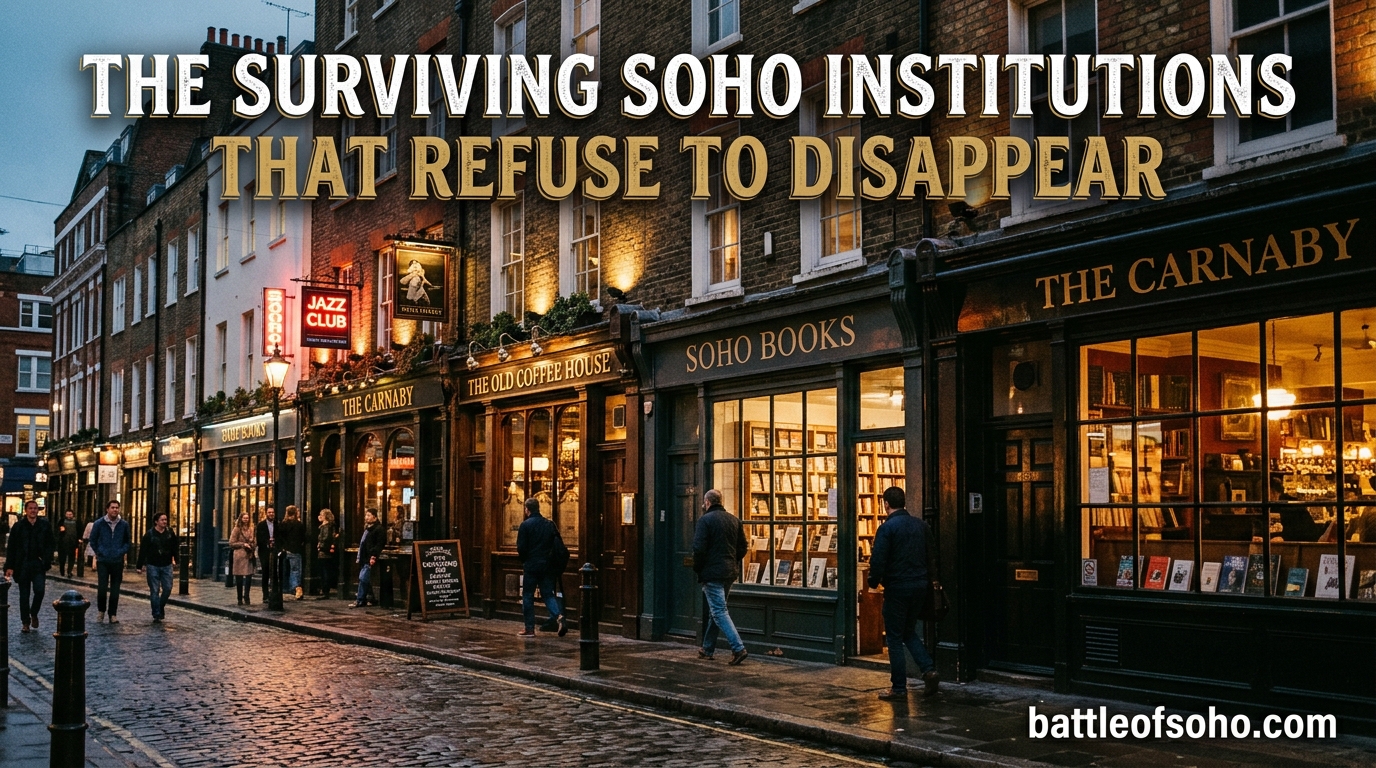
Walk through Soho on a Tuesday afternoon and you will hear two versions of London at once. One is the clatter of delivery bikes, the hum of luxury flats being fitted out, and the ping of contactless payments in gleaming new cocktail bars. The other is the creak of an old pub door, the smell of ale-soaked floorboards, and the low murmur of a crowd that has been gathering in the same spot for a century or more. These are the surviving Soho institutions, and against considerable odds, they are still open.
Our team has spent months researching the historic pubs, clubs, markets, and cultural venues that define Soho’s identity. We wanted to understand not just which places remain, but why some of them managed to resist the waves of redevelopment, rising commercial rents, and demographic change that have transformed so much of central London. What we found is a story of stubbornness, community loyalty, and a willingness to adapt without losing the plot.
This guide covers the surviving Soho institutions that refuse to disappear, from legendary public houses that served Charles Dickens and Karl Marx to street markets that have fed the neighbourhood since the 18th century. We will look at what makes each place special, how it managed to survive, and what pressures nearly ended it. Whether you are planning a pub crawl, researching London history, or simply curious about what is still standing in one of the world’s most contested postcodes, this is your field guide to the places that refused to go quietly.
Table of Contents
What Qualifies as a Surviving Soho Institution
Not every old business in Soho counts as an institution. The label carries weight, and locals tend to apply it with a mixture of affection and protectiveness. A surviving Soho institution is a business, venue, or landmark that has operated continuously in the neighbourhood for several decades, maintained its original character, and become woven into the social fabric of the area.
Most of the places in this guide have been trading for at least 50 years, and several have histories stretching back to the 18th and 19th centuries. They have survived world wars, licensing reforms, the AIDS crisis, the smoking ban, Crossrail construction, and multiple property booms. They have watched neighbouring businesses open and close in cycles while holding their ground.
What truly sets them apart is character. These are not preserved museum pieces behind glass. They are living, breathing establishments where people still gather, argue, drink, eat, and trade. The surviving Soho institutions that refuse to disappear have done so by remaining useful, not just historically interesting. That balance between heritage and function is exactly what makes them so hard to replace.
The Coach and Horses: Soho’s Loudest Survivor
If one pub encapsulates the spirit of a surviving Soho institution, it is the Coach and Horses on Greek Street. Founded in the 1850s, this legendary establishment has been serving pints and provoking conversations for over 170 years. It survived the Blitz, the decline of Soho’s bohemian era, and the creeping sanitisation that has reshaped so much of the West End.
What makes the Coach and Horses remarkable is not just its age but its refusal to conform. For decades it operated as a vegetarian pub, long before that was a marketing strategy. It was the favoured watering hole of journalist Jeffrey Bernard, whose chaotic life and column for The Spectator became known as the “Low Life” dispatches. The pub was even the subject of a West End play, fittingly titled “Jeffrey Bernard Is Unwell.”
Inside, the decor has barely changed. The wood panelling, the old-style bar fittings, and the portrait gallery of former regulars create an atmosphere that no refurbished cocktail bar could replicate. Staff are known for their forthright manner, and the pub has cultivated a reputation as a place where pretension goes to die. On any given evening you will find journalists, actors, office workers, and tourists sharing the same cramped, characterful space.
The Coach and Horses faced real pressure during the 2010s as Greek Street rents climbed and nearby independent venues closed. The pub’s survival came down to a combination of loyal custom, strong management, and a building that proved difficult to redevelop. It remains one of the most authentic traditional pubs Soho has to offer, and a living rebuke to anyone who thought the neighbourhood’s spirit could simply be designed out of existence.
The French House: Where De Gaulle and Dylan Thomas Drank
At 49 Dean Street stands perhaps the most culturally significant surviving Soho institution of them all. The French House, known formally as The York Minster, has been serving the community since the mid-19th century and earned its nickname from the influx of French exiles who made it their home during and after the Second World War. Charles de Gaulle reportedly drank here while writing his famous “A tous les Francais” appeal in 1940.
The pub’s reputation as a gathering place for writers, artists, and intellectuals is well earned. Dylan Thomas is said to have left the manuscript of Under Milk Volcano there (and possibly never retrieved it). Brendan Behan, John Mortimer, and Tom Driberg were all regulars. The walls carry photographs of famous patrons, though the pub has never leaned into celebrity in a way that would compromise its character.
One of the most distinctive traditions at the French House is the serving of beer in half-pint glasses only. The story goes that during the war, glass was scarce and the pub adopted the smaller measure to conserve supply. The tradition stuck, and to this day you cannot order a full pint. It is the kind of quirk that defines a genuine institution: a rule that makes no commercial sense but tells you everything about the place’s identity.
The French House survived the aggressive property speculation of the 2000s and 2010s partly because of its Grade II listed status and partly because its cultural significance made redevelopment politically unappealing. It is now run with a clear commitment to preserving its unique atmosphere while keeping the doors open and the regulars coming back. For anyone tracing Soho London history, this pub is an essential stop.
The Old Coffee House: Beak Street’s Hidden Treasure
Tucked away on Beak Street, the Old Coffee House is the kind of pub you walk past three times before you notice it. There is no flashy signage, no crowd of people taking photographs outside, and no velvet rope. There is just a traditional pub front, a warm interior, and a history that goes back to the days when Soho was better known for its coffee houses than its cocktail bars.
The name tells a story in itself. Coffee houses were central to Soho’s social and intellectual life in the 18th and 19th centuries, serving as meeting places for merchants, artists, and political radicals. The Old Coffee House carries that legacy forward, though these days the drinks of choice tend to be cask ale and craft beer rather than the bitter, gritty coffee of the Victorian era.
Inside, the pub retains a genuinely old-school feel. The bar is compact, the seating is snug, and the walls carry the kind of accumulated character that no design studio could manufacture. It is the sort of place where regulars nod at each other, where the bar staff remember your order, and where the conversation feels more important than the decor. On Reddit threads about old Soho establishments, this pub comes up repeatedly as a place that has stayed true to itself.
What kept the Old Coffee House alive while so many nearby venues disappeared? Part of the answer is its location, slightly off the main tourist drag, which insulated it from some of the worst pressures of the Soho property market. Part of it is the Sam Smith’s ownership, a brewery known for resisting modernisation. Together, those factors have produced one of the most authentic surviving Soho institutions still operating today.
The John Snow: A Pub with a Public Health Legacy
On the corner of Broadwick Street, formerly Broad Street, sits a pub named after one of the most important figures in the history of public health. The John Snow commemorates the physician who, in 1854, traced a deadly cholera outbreak to a contaminated water pump just yards from this spot. By removing the pump handle, Snow effectively ended the outbreak and helped prove that cholera was waterborne.
The pub itself predates Snow’s investigation, having served the Soho community for generations. It survived the redevelopment of Broadwick Street, the construction of nearby tube infrastructure, and the steady encroachment of corporate chains on independent venues. Today it stands as both a working pub and an unofficial monument to a pivotal moment in medical history.
Inside, the John Snow is unapologetically traditional. There is real ale on tap, a menu of straightforward pub food, and a layout that encourages conversation over spectacle. It attracts a mix of office workers, history enthusiasts, and locals who have been coming for years. The walls carry information about Snow’s work, and a replica of the original pump stands a short walk away on Broadwick Street.
As one of the surviving Soho institutions that refuses to disappear, the John Snow demonstrates how a pub can be both a community space and a keeper of local memory. It is not the flashiest venue in the neighbourhood, but it is one of the most meaningful. For visitors interested in Soho cultural heritage, the combination of medical history and genuine pub atmosphere makes it a standout.
The Star and Garter: Trans Resilience on Poland Street
Soho’s identity has always been shaped by its LGBTQ+ community, and few surviving Soho institutions represent that heritage more powerfully than the Star and Garter on Poland Street. While the building has gone through several incarnations, it has served as a gathering place for queer Londoners for decades, and its current identity as a trans-focused venue makes it a vital cultural space in a neighbourhood where LGBTQ+ venues have been disappearing at an alarming rate.
The story of LGBTQ+ venues in Soho is one of pride and loss. At the turn of the millennium, the area was home to dozens of gay bars, clubs, and saunas. Rising rents, redevelopment, and shifting social patterns have erased many of them. Venues like the Black Cap, Madame Jojo’s, and the Joiners Arms are now part of Soho’s lost heritage, mourned by former regulars and documented in community campaigns.
The Star and Garter’s survival is partly a story of community determination. When its future looked uncertain, supporters mobilised to keep the doors open, arguing that losing another queer venue would further erode Soho’s distinctive character. The pub’s current operation as a trans-inclusive space fills a gap that other venues have left behind, and it draws people from across London and beyond.
This is not just a pub. It is a statement that Soho’s role as a refuge for marginalised communities is not a thing of the past. The surviving Soho institutions that refuse to disappear include places where people fought to keep the lights on, and the Star and Garter is one of the clearest examples of that fight. For anyone wanting to understand Soho beyond its pubs and restaurants, this venue matters.
Berwick Street Market: Serving Soho Since the 18th Century
Not all surviving Soho institutions are pubs. Berwick Street Market has been feeding the neighbourhood since at least the 1770s, making it one of the oldest continuously operating street markets in London. What began as an informal gathering of traders selling produce and household goods evolved into a formalised market that became a defining feature of Soho’s working-class life.
At its peak, Berwick Street was a bustling thoroughfare of costermongers, fishmongers, and cloth merchants. The market supplied the restaurants, clubs, and boarding houses of Soho with fresh ingredients, and it provided affordable food for the thousands of people who lived and worked in the area. The street was also home to the historic Berwick Street record shops, which played a role in Soho’s music heritage during the vinyl era.
The market has contracted significantly from its heyday. The construction of Crossrail, the opening of large supermarkets nearby, and the broader shift in Soho’s economy have all taken their toll. Stall numbers have fallen, and the market no longer stretches the full length of the street as it once did. But it has not disappeared. Traders still set up six days a week, selling fruit, vegetables, fabrics, and street food to a loyal customer base.
Berwick Street Market survives because it still does something that chains and delivery apps cannot fully replicate. It provides face-to-face commerce, competitive prices, and a sense of place that a Tesco Express simply cannot match. As one of the surviving Soho institutions that refuses to disappear, it represents a different kind of heritage: not a building frozen in time, but a living commercial tradition that adapts while holding its ground.
The 2 Brewers Club: A Working Men’s Club Still Standing
Tucked away on Kingly Street, the 2 Brewers is one of the last surviving working men’s club-style venues in central Soho. These clubs were once a defining feature of London’s social landscape, providing affordable entertainment, community, and a space for working people to gather away from the formal pub trade. Most have vanished, victims of redevelopment, declining membership, and changing leisure habits.
The 2 Brewers has lasted by evolving. While it retains something of the community club spirit, it has adapted its programming to serve Soho’s current audience. It functions as a cabaret venue, a social space, and a gathering point for the LGBTQ+ community, hosting drag shows, karaoke nights, and community events that draw people from across the city. The building itself carries decades of accumulated character, with a layout that still feels more like a social club than a commercial bar.
What makes the 2 Brewers one of the surviving Soho institutions that refuse to disappear is its refusal to be boxed into a single category. It is not quite a pub, not quite a club, and not quite a theatre. It is a flexible community space that has survived by being useful to different groups of people at different times. That adaptability, combined with a clear sense of identity, has kept it going while flashier venues have come and gone.
For visitors and locals alike, the 2 Brewers offers a glimpse of a Soho that predates the era of branded cocktail lounges and Instagram-ready interiors. It is proof that community-oriented venues can survive in one of the most expensive postcodes in the world, provided they are willing to fight for their space and remain genuinely responsive to the people who use them.
Why Some Soho Institutions Survived While Others Disappeared
Anyone who has spent time in Soho over the past few decades has watched beloved venues close. Madame Jojo’s, the Astoria, the 12 Bar Cafe, the Borderline, the Punk Club, and countless independent shops and restaurants have all vanished from the map. So why did some survive while others fell? The answer is not simple, but a few patterns emerge when you look closely.
Heritage protection plays a significant role. Several of the surviving Soho institutions occupy Grade II listed buildings, which makes it harder for developers to demolish or radically alter them. The French House, the Coach and Horses, and others benefit from architectural protections that give them a degree of insulation against the most aggressive redevelopment plans. Heritage listing is not a guarantee of survival, but it raises the bar for anyone who wants to remove a venue.
Ownership structure matters enormously. Pubs and venues owned by independent operators with long leases, or by breweries like Sam Smith’s that resist modernisation, tend to survive longer than those operating on short leases from commercial landlords. When a venue is backed by someone committed to its character rather than purely its commercial yield, it has a fighting chance. The loss of so many Soho venues in the 2010s was directly tied to lease expiries and landlord decisions to pursue more profitable tenants.
Community support is perhaps the most intangible but important factor. Venues that built deep loyalty among specific communities, whether LGBTQ+ groups, music fans, literary circles, or long-term residents, were more likely to survive threats of closure because those communities fought for them. Campaigns to save venues, petitions, media coverage, and the sheer economic weight of loyal regulars have all played a role in keeping doors open. The surviving Soho institutions that refuse to disappear are, in many cases, the ones that people simply refused to let go.
Finally, there is an element of luck and timing. Some venues happened to be in buildings that were awkward to redevelop. Others caught a wave of nostalgia just when public opinion was turning against the homogenisation of Soho. Some survived because a wealthy benefactor stepped in. The combination of structural, economic, and human factors means that survival is never guaranteed, and every year a surviving institution remains open is a quiet victory.
The Economic Pressures: Crossrail, Rents, and Gentrification Survival
You cannot talk about surviving Soho institutions without talking about the forces that nearly destroyed them. Soho gentrification survival is not a gentle story. It is a decades-long struggle against some of the most intense property pressures in the world, played out in a square mile of extraordinarily valuable real estate.
The construction of Crossrail, now operating as the Elizabeth Line, was a seismic event for Soho. Works on the Tottenham Court Road and Bond Street stations disrupted businesses for years, blocked footfall, and created a cloud of dust and noise that drove customers away. Several long-standing businesses cited Crossrail disruption as a direct cause of their closure. Those that survived did so by absorbing losses, renegotiating with landlords, or simply waiting out the construction and hoping the customers would return.
Commercial rents in Soho have risen to levels that would have been unimaginable a generation ago. A small pub or shop that paid a few thousand pounds per month in the 1990s might face demands for five or ten times that amount when its lease comes up for renewal. Independent venues operating on thin margins simply cannot absorb those increases. The ones that survive often do so through a combination of long leases negotiated years ago, ownership of their freehold, or landlord relationships that have not yet been tested by the open market.
Property speculation has compounded the problem. Soho has been targeted by investors who see the potential for luxury flats, boutique hotels, and high-end retail in a central London location. Buildings that once housed independent businesses are bought, stripped, and converted into something far more profitable. The loss of venues like Madame Jojo’s, which was damaged in a fire and then shut down by its landlord, illustrates how quickly a cultural landmark can disappear when property economics align against it.
Has Soho been gentrified? Unquestionably. The neighbourhood that once housed strip clubs, greasy spoons, cheap recording studios, and radical bookshops now sits alongside multi-million-pound apartments and high-concept restaurants. But gentrification in Soho has not been total. The surviving institutions profiled in this guide prove that the neighbourhood’s older identity has not been fully erased, even if it is fighting for every square foot.
How to Experience Soho’s Heritage Today
If you want to see the surviving Soho institutions for yourself, the best approach is to slow down and look beyond the obvious tourist spots. The venues in this guide are all within a short walk of each other, and a thoughtful pub crawl through the neighbourhood will give you a vivid sense of what Soho has managed to hold on to.
Start at the French House on Dean Street for a half-pint and a dose of literary history. Walk east to Beak Street and find the Old Coffee House, where the pace is slower and the atmosphere is pure old London. Head south to Broadwick Street for the John Snow, where you can pay your respects to the cholera pump replica before stepping inside for a real ale. Loop back through Greek Street to the Coach and Horses for the most raucous, alive pub experience in the area.
For something beyond pubs, visit Berwick Street Market during trading hours to see one of London’s oldest street markets still in action. The stalls may be fewer than they once were, but the spirit of open-air commerce is intact. If you are interested in Soho’s LGBTQ+ heritage, the Star and Garter and the 2 Brewers both offer a window into the community spaces that have been central to the neighbourhood’s identity for decades.
The most important thing is to spend money in these places. Surviving Soho institutions survive because people use them. Every pint, every meal, every market purchase is a small act of preservation. The economic reality is stark: if locals and visitors stop coming, the rents become impossible to justify, and another piece of Soho disappears. The best way to support the neighbourhood’s heritage is to participate in it.
FAQs
What is the most historic pub in London?
London has several pubs dating back to the 16th and 17th centuries, including the Spaniards Inn in Hampstead (claiming connections to Dickens and Keats) and the Prospect of Whitby in Wapping. In Soho specifically, the French House and the Coach and Horses are among the most historically significant, with origins in the 19th century and deep connections to writers, artists, and political figures. While not the absolute oldest in London, they are among the most culturally important surviving institutions in the West End.
Is Soho still seedy?
Soho is far less seedy than it was in its mid-20th century heyday, when strip clubs, sex shops, and unlicensed venues dominated parts of the neighbourhood. Gentrification, licensing reforms, and property redevelopment have significantly reduced the adult entertainment trade. However, Soho has not been fully sanitised. Independent venues, queer spaces, late-night bars, and a bohemian residue still give the area an edge that distinguishes it from more corporate parts of central London.
Has Soho been gentrified?
Yes, extensively. Over the past three decades Soho has experienced significant gentrification, with luxury flats, high-end restaurants, and corporate chains replacing many independent venues and adult entertainment businesses. Rising commercial rents, Crossrail construction, and property speculation have forced out numerous long-standing establishments. However, gentrification has not been total: historic pubs, Berwick Street Market, and several LGBTQ+ venues continue to operate, making Soho gentrification survival an ongoing rather than finished story.
What is the most gentrified area in London?
Several London areas are frequently cited as heavily gentrified, including Shoreditch, Brixton, Hackney, Peckham, and Notting Hill. Soho is unusual because its gentrification has occurred in the heart of the West End, under intense property pressure, and in a neighbourhood with a distinctive bohemian and adult entertainment identity. While it may not top every gentrification ranking, the speed and cultural significance of change in Soho make it one of the most closely watched cases in London.
What happened to Soho’s adult entertainment venues?
Most of Soho’s adult entertainment venues have closed over the past two decades due to licensing changes, property redevelopment, and shifting cultural attitudes. Venues like Madame Jojo’s, the Raymond Revuebar, and numerous sex shops on Old Compton Street and Walker’s Court have shut down or been converted into mainstream bars and restaurants. A small number of adult businesses remain, but the density that once defined Soho’s reputation in this sector is largely gone.
Where can I find authentic old pubs in Soho?
Some of the most authentic old pubs still operating in Soho include the French House on Dean Street, the Coach and Horses on Greek Street, the Old Coffee House on Beak Street, the John Snow on Broadwick Street, and the Star and Garter on Poland Street. These venues retain traditional interiors, serve real ale, and have decades or centuries of history behind them. They tend to be quieter than the tourist-heavy pubs on Soho’s main streets and are favoured by locals and regulars.
Conclusion: The Fight to Keep Soho’s Doors Open
The surviving Soho institutions that refuse to disappear are more than old buildings with interesting backstories. They are the living proof that a neighbourhood’s character can be defended, even in a city that often seems determined to pave over its own history. Every pub, market, and venue in this guide has a different survival story, but they share a common thread: someone decided they mattered enough to fight for.
That fight is not over. Rents continue to climb, leases continue to expire, and the economic logic of central London property continues to favour the highest bidder over the longest tenant. The institutions profiled here could vanish in a bad year, and new ones are not appearing to replace the ones already lost. Soho’s heritage is not self-sustaining. It requires customers, advocates, and occasionally, people willing to stand in the way of a bulldozer.
If these places matter to you, the most useful thing you can do is visit them. Buy a half-pint at the French House. Browse the stalls at Berwick Street Market. Spend an evening at the Star and Garter. The surviving Soho institutions that refuse to disappear do so because people walk through their doors. As long as that continues, there is reason to believe that some version of old Soho will endure alongside whatever the neighbourhood becomes next.