
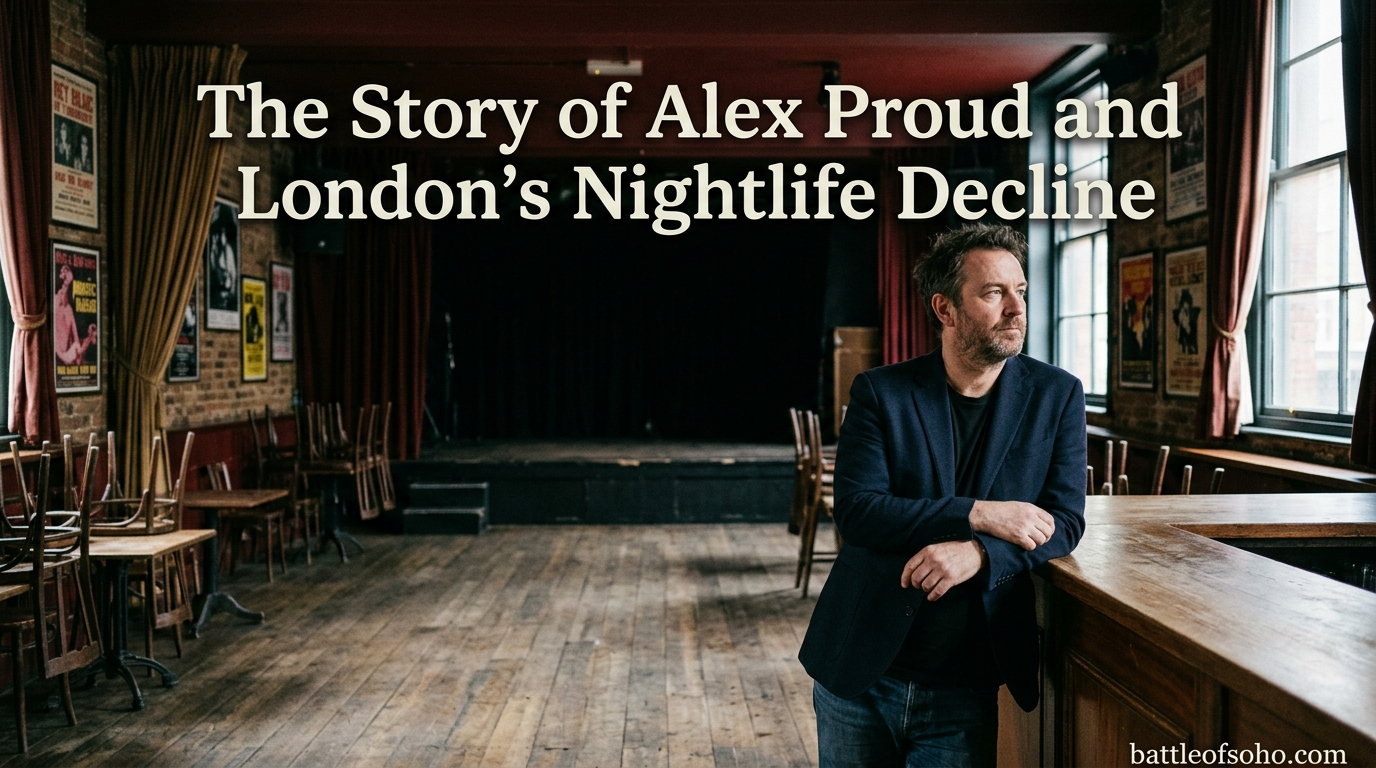
London’s nightlife has been dying a slow, expensive death for over a decade. Few figures sit at the centre of that story quite like Alex Proud. He built an empire of cabaret venues, photography galleries, and nightclubs that defined a particular era of the capital’s after-dark culture. Then that empire crumbled, leaving behind unpaid performers, collapsed companies, and serious questions about public money.
The story of Alex Proud and London’s nightlife decline is not just about one businessman. It is about what happens when a city’s creative soul is squeezed by gentrification, rising costs, and licensing crackdowns. It is about the Battle of Soho, the death of Camden’s indie spirit, and the performers left picking up the pieces.
In this article, we trace that story from its brightest moments to its messiest endings. We look at who Alex Proud is, how the Proud Group rose to prominence, and what its fall tells us about the wider collapse of London’s club scene.
Table of Contents
Who Is Alex Proud?
Alexander Proud is a British entrepreneur born in Hove, England, on 14 September 1969. He was educated at Tonbridge School, one of Britain’s most prestigious independent schools, before going on to study at the University of York. His background was comfortably middle-class, a detail that would later feature in discussions about his business persona.
Proud began his career in the art world rather than in nightlife. He worked in photography, building connections with photographers and collectors. This foundation in visual culture would become central to the Proud Group brand, which blended gallery exhibitions with entertainment venues.
In 1998, Proud opened his first photography gallery in London. The concept was simple but distinctive: combine high-quality photography exhibitions with a bar and social atmosphere. It tapped into a growing appetite for cultural experiences that blurred the line between art appreciation and socialising. The gallery attracted celebrities, media attention, and a certain kind of London cool that was hard to manufacture.
Proud also built a media profile beyond his venues. He appeared as an expert on Channel 4’s “Four Rooms,” a television show where dealers compete to buy antiques and collectibles from members of the public. He wrote columns for publications including the Telegraph. He presented himself as a cultured businessman with an eye for photography and a finger on the pulse of London’s creative scene.
But behind the media appearances and the celebrity-studded openings, a different story was unfolding. The Proud Group was expanding rapidly, taking on leases, staff, and overheads that would eventually become unsustainable. To understand how things went wrong, we need to look at how the empire was built.
The Rise of Proud Group: Building a Nightlife Empire
The Proud Group grew from a single photography gallery into a multi-venue entertainment business spanning London and Brighton. At its peak, the group operated some of the most recognisable nightlife spaces in the capital.
Proud Camden: The Crown Jewel
Proud Camden became the flagship venue of the entire operation. Located in the Stables Market in Camden, it occupied a space that felt authentically gritty. Exposed brick, industrial lighting, and a layout that combined gallery walls with dance floors made it feel like somewhere that mattered. For 17 years, Proud Camden hosted live music, club nights, exhibitions, and celebrity-filled parties.
The venue was perfectly positioned to capitalise on what cultural commentators later called the “indie sleaze” era. This was the period roughly spanning the mid-2000s to early 2010s, when indie music, fashion photography, and a certain brand of louche glamour dominated London’s cultural landscape. Bands played sets. Photographers exhibited work. People danced until the early hours. Proud Camden was at the heart of it.
For many Londoners who came of age during that era, Proud Camden was a defining venue. It felt like a place where art and nightlife genuinely intersected, not just as a marketing gimmick but as a real cultural proposition. The gallery pedigree gave it credibility. The location in Camden gave it edge. The programming gave it energy.
Proud Embankment and Beyond
As the Camden venue thrived, Proud expanded. Proud Embankment opened as a large-scale cabaret and nightlife venue near the Thames, aimed at a more upscale crowd. It offered dinner shows, drag performances, and corporate entertainment packages. The ambition was clear: Proud wanted to move beyond the indie crowd and capture a broader, wealthier market.
The group also expanded to Brighton with Haus of Cabaret, bringing the cabaret-dining concept to the south coast. Each new venue followed a similar formula: striking interior design, photography or art elements, and a mix of live entertainment and club programming. On paper, it looked like a winning model.
But expansion brought problems. More venues meant more rent, more staff, more licensing requirements, and more exposure to the economic pressures that were already starting to squeeze London’s nightlife sector. The costs of running large entertainment spaces in prime London locations were climbing steadily. Business rates were rising. Licensing fees were increasing. Insurance costs were going up across the industry.
The Proud Group was also operating in a market that was beginning to shift beneath its feet. The indie sleaze era was fading. Consumer habits were changing. The 2008 financial crash had altered spending patterns, and the recovery was uneven. Venues that had thrived on a specific cultural moment were finding it harder to attract the same crowds.
In 2017, after 17 years, Proud Camden closed its doors. The closure was framed as a business decision, but it sent shockwaves through London’s nightlife community. If a venue that successful could not survive, what did that say about the state of the industry?
London’s Nightlife Decline: A City Loses Its Spark
The closure of Proud Camden was not an isolated event. It was part of a pattern that has seen London lose a significant portion of its nightlife venues over the past fifteen years. The story of Alex Proud and London’s nightlife decline is, in many ways, the story of an entire sector in crisis.
According to data from the Mayor of London’s own nightlife task force, the capital has lost nearly half its grassroots music venues since 2007. Nightclubs have been closing at an alarming rate. The number of licensed premises in London fell by thousands between 2010 and 2026. These are not just statistics. Each closure represents a cultural space, a community hub, and a gathering point that cannot easily be replaced.
The Fabric Shutdown and What It Symbolised
The 2016 temporary closure of Fabric, one of London’s most famous nightclubs, became a flashpoint in the debate about nightlife decline. Islington Council revoked the club’s license following two drug-related deaths, and the venue was forced to shut its doors. The outcry was enormous. Thousands of people signed petitions. Artists and DJs spoke out. The campaign to save Fabric became a symbol of the broader fight to preserve London’s nightlife culture.
Fabric eventually reopened under strict new licensing conditions, but the episode highlighted a troubling dynamic. Nightclubs were being held to standards that other entertainment venues were not. The burden of responsibility for individual behaviour was being placed on venue owners and operators. Licensing enforcement was becoming more aggressive, and the cost of compliance was rising.
Gentrification and the Battle for Soho
Soho has always been the spiritual home of London’s nightlife. For decades, it was the place where club culture, cabaret, live music, and a certain brand of bohemian glamour coexisted. But Soho has been under sustained pressure from gentrification, redevelopment, and rising commercial rents.
The “Battle of Soho” — a term used by campaigners, and the inspiration behind this very publication — refers to the ongoing fight to preserve Soho’s character against the forces of corporate homogenisation. Independent venues have been replaced by chain restaurants. Historic buildings have been demolished or converted. The creative communities that gave Soho its identity have been priced out.
This is not a London-only phenomenon. Cities across the UK have seen their nightlife districts hollowed out by the same forces. But Soho’s case is particularly stark because of its cultural significance. When Soho loses its nightlife, London loses something that cannot be rebuilt elsewhere.
The COVID-19 Accelerant
If the decline was already underway, the COVID-19 pandemic poured petrol on the fire. Lockdowns forced every nightlife venue in the country to close for months on end. When restrictions lifted, many never reopened. The Night Time Industries Association reported that hundreds of UK nightclubs closed permanently during and after the pandemic. Consumer habits had shifted. People who once went out three nights a week were now staying in, ordering takeaways, and streaming entertainment at home.
The cost-of-living crisis that followed made things worse. With energy bills soaring, inflation eating into disposable income, and wages stagnating, a night out became a luxury fewer people could afford. Pubs, clubs, and bars all felt the squeeze. The venues most vulnerable were those with high overheads and large premises — exactly the kind of venues the Proud Group operated.
Financial Controversies: Debts, Closures, and Public Money
This is where the story of Alex Proud and London’s nightlife decline takes a darker turn. In early 2026, an investigation by London Centric revealed a series of financial controversies that cast the Proud empire in a very different light.
According to the investigation, Proud Group venues received approximately £885,000 in emergency arts funding from Arts Council England during the COVID-19 pandemic. The money was intended to support cultural organisations through the crisis. However, the same period saw Proud purchasing a vintage Lamborghini — a detail he reportedly did not disclose when applying for public funding.
The contrast between public money received and private luxury purchases sparked outrage. Performers who had worked at Proud venues came forward to say they were owed thousands in unpaid wages. Some described being left out of pocket when venues closed suddenly, with no warning and no recourse.
A Pattern of Liquidations
The Arts Council controversy was not an isolated incident. Forum discussions on Reddit’s r/brighton and r/london communities highlighted what appears to be a recurring pattern in Proud’s business operations. According to users who researched the companies, the cumulative debts from liquidated Proud-associated companies amount to nearly £2 million.
The pattern described by these users involves opening venues under a specific company name, operating until debts accumulate, and then placing that company into liquidation. The venues may then reopen under a different company name, sometimes at the same or similar locations. This is a practice that exists across the hospitality industry, but the scale and repetition alleged in Proud’s case drew particular attention.
Customers of Haus of Cabaret in Brighton reported discovering the venue had closed only when they called to rearrange bookings they had already paid for. One Reddit user described the experience: they had a pre-booked and paid evening arranged, called up to reschedule, and were told on the phone that the venue had shut down. No refund process was communicated. No notification had been sent.
These stories paint a picture of a business model that prioritised expansion over sustainability, and growth over the welfare of the people who actually made the venues function — the performers, the bar staff, the technicians, and the artists.
The Human Cost: Performers and Staff Left Behind
The financial figures and corporate structures can feel abstract. But the real impact of the Proud Group’s decline fell on individuals. Performers who relied on cabaret and drag work at Proud venues found themselves suddenly without income and without the money they were already owed.
Cabaret performers are often self-employed freelancers. They do not have the safety net of salaried employment. When a venue closes without paying them, there is rarely a straightforward path to recovery. Some performers reported being owed hundreds or thousands of pounds for completed work. Chasing debts through the small claims court is time-consuming, expensive, and often futile if the company in question has already entered liquidation.
The emotional toll is harder to quantify but equally significant. Performers spoke about the sense of betrayal. They had invested time, creativity, and loyalty into venues that they believed supported their art. When those venues collapsed, they were left feeling like disposable assets rather than valued collaborators.
The staff experience mirrored the performer experience. Bar workers, door staff, and technical crew described arriving for shifts to find venues shuttered. Some learned about closures through social media rather than from their employers. The lack of communication compounded the financial damage with a profound sense of disrespect.
This human dimension is something that most coverage of Alex Proud and London’s nightlife decline has overlooked. The story is often told in terms of business strategy, cultural trends, and financial figures. But behind every collapsed company is a group of people who lost income, opportunities, and faith in the industry.
Why Are UK Nightclubs Closing? The Bigger Picture
The Proud Group’s troubles cannot be separated from the broader crisis facing UK nightlife. To understand why so many venues are closing, we need to look at the structural factors affecting the entire industry.
Rising commercial rents are perhaps the single biggest factor. Property values in London have soared over the past two decades, and commercial landlords have raised rents accordingly. Venues that were affordable in the early 2000s now face rents that are simply unsustainable for entertainment businesses with thin margins.
Licensing and regulatory pressure has also intensified. Councils have become more aggressive in enforcing noise regulations, drink-spiking prevention measures, and age verification requirements. Each of these is individually reasonable, but collectively they create a compliance burden that small and medium venues struggle to meet. The cost of licensing legal support alone can run into tens of thousands of pounds per year.
Changing consumer behaviour has fundamentally altered the market. Younger generations are drinking less than their predecessors. The rise of dating apps reduced one of the traditional drivers of nightclub attendance. Streaming services, gaming, and social media provide entertainment that competes directly with going out. The pandemic accelerated these trends, breaking habits that may never fully return.
Gentrification has pushed nightlife out of the areas where it traditionally thrived. When residential developments are built near existing venues, new residents often complain about noise. This leads to licensing reviews, restrictions on operating hours, and ultimately closures. The irony is bitter: the cultural vibrancy that makes an area attractive to developers is destroyed by the development that follows.
The cost-of-living crisis has reduced disposable income across the board. When people are choosing between heating and eating, a night out is one of the first expenses to go. Venues that survived the pandemic are now facing a customer base with less money to spend, while their own costs — energy, supplies, wages — continue to rise.
The Battle of Soho Connection
This publication takes its name from a specific cultural moment. The Battle of Soho was about more than one neighbourhood. It was about the right of a city to maintain spaces for creativity, community, and cultural expression. It was about resisting the forces that turn vibrant, characterful districts into interchangeable corporate landscapes.
Alex Proud’s story intersects with the Battle of Soho narrative in complex ways. On one hand, Proud built venues that contributed to the cultural ecosystem the Battle of Soho was fought to protect. Cabaret, live music, and artistic exhibition are exactly the kinds of activities that give neighbourhoods their soul. Proud Camden, for all its later troubles, was genuinely important to a generation of Londoners.
On the other hand, the manner of the Proud Group’s decline — the unpaid wages, the public funding controversies, the pattern of corporate liquidation — represents a failure of exactly the kind of cultural stewardship that nightlife needs. When venue operators treat performers and staff as disposable, they undermine the entire ecosystem. When public money is accepted without transparent accountability, they erode public trust in arts funding.
The lesson of the Battle of Soho is that nightlife venues are not just businesses. They are cultural institutions that serve a social function. When they are well-run and responsibly managed, they enrich an entire city. When they are run purely for extraction, they damage the culture they claim to support.
FAQs
Who is Alex Proud?
Alex Proud is a British entrepreneur born in Hove in 1969, educated at Tonbridge School and the University of York. He founded the Proud Group in 1998, starting with a photography gallery that expanded into a network of nightclubs, cabaret venues, and galleries including Proud Camden and Proud Embankment. He also appeared on Channel 4’s Four Rooms as an antiques expert.
Why did London nightclubs close?
London nightclubs have closed due to a combination of rising commercial rents, aggressive licensing enforcement, gentrification pushing venues out of central areas, changing consumer habits with younger generations drinking less, and the economic impact of the COVID-19 pandemic followed by the cost-of-living crisis. London has lost nearly half its grassroots music venues since 2007.
What happened to Proud Camden?
Proud Camden closed in 2017 after 17 years of operation. The closure was attributed to rising costs and changing market conditions in Camden. The venue had been a fixture of London’s nightlife scene, combining photography exhibitions with live music and club nights during the peak of the indie sleaze era.
Why are UK nightclubs closing?
UK nightclubs are closing due to rising rents, increased licensing and regulatory costs, changing consumer behaviour with less alcohol consumption among young people, the lasting impact of COVID-19 lockdowns on going-out habits, and the cost-of-living crisis reducing disposable income for entertainment spending.
What is the Battle of Soho about?
The Battle of Soho refers to the ongoing cultural and political fight to preserve Soho’s historic character as London’s nightlife and entertainment heartland against pressures from gentrification, corporate redevelopment, and rising commercial rents that threaten to displace the independent venues and creative communities that define the area.
Did Alex Proud receive Arts Council funding?
According to a 2026 investigation by London Centric, Proud Group venues received approximately £885,000 in emergency arts funding from Arts Council England during the COVID-19 pandemic. The investigation raised questions about the funding in light of a vintage Lamborghini purchase during the same period and outstanding debts owed to performers.
Conclusion: What the Proud Story Tells Us
The story of Alex Proud and London’s nightlife decline is ultimately a story about what happens when culture and commerce collide without sufficient accountability. Proud built venues that mattered to people. He also presided over a business empire that left debts, unpaid workers, and unanswered questions in its wake.
London’s nightlife decline is real and ongoing. Venues are closing at an unsustainable rate, and the cultural fabric of the city is fraying. The Battle of Soho continues. Whether anyone will build something to replace what has been lost — and whether they will run it more responsibly — remains the open question.