
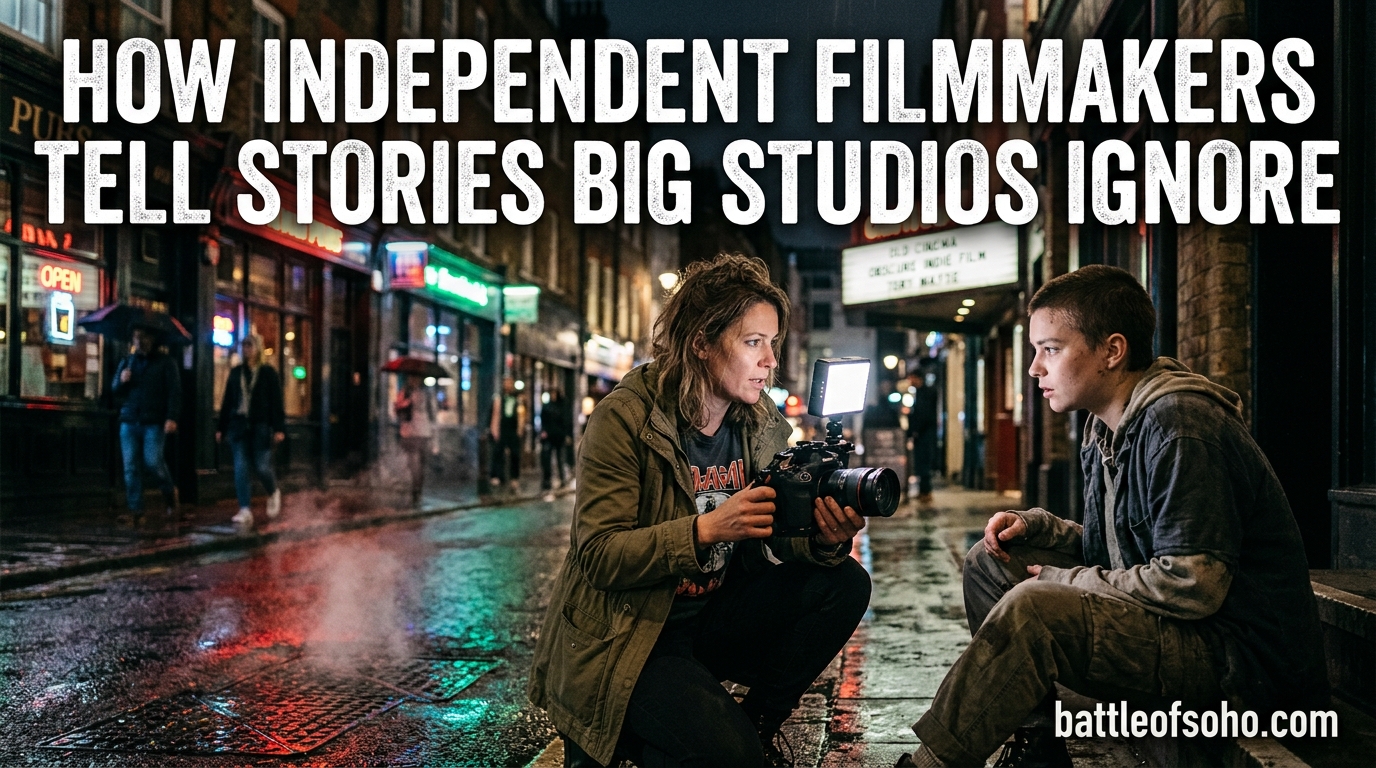
Independent filmmakers tell stories big studios ignore by working outside the studio system, where they retain full creative control and can pursue character-driven narratives, unconventional formats, and underrepresented perspectives that major studios consider too risky, too niche, or too difficult to market to mainstream audiences. These filmmakers secure their own funding through grants, crowdfunding, and personal investment, assemble small agile crews, and distribute their work through film festivals, streaming platforms, and direct community engagement rather than relying on studio infrastructure.
Understanding how independent filmmakers tell stories big studios ignore means looking at the specific techniques, constraints, and philosophies that shape their work. It means examining real films that proved studios wrong, the creative methods that emerged from limited resources, and the distribution models that bypass traditional gatekeepers entirely.
In this article, we break down what makes independent storytelling different from studio filmmaking, the specific narrative techniques indie directors use that Hollywood avoids, and how these approaches have shaped the broader film industry in 2026. Whether you are an aspiring filmmaker, a cinema student, or simply curious about why your most thought-provoking film experiences rarely come with a studio logo, this guide covers the full picture.
We have analyzed industry data, filmmaker interviews, festival trends, and community discussions from places like r/Filmmakers and r/Cinephiles to build a resource that goes beyond surface-level comparisons. The goal is to show you not just what indie filmmakers do differently, but exactly how they do it and why it matters.
Table of Contents
What Makes Independent Storytelling Different
The fundamental difference between independent and studio filmmaking comes down to who holds the decision-making power. In the studio system, executives, marketing teams, and focus groups influence everything from casting to ending choices. In independent filmmaking, the writer-director retains creative authority and answers to no corporate gatekeeper.
Independent filmmakers tell stories that big studios ignore because they operate under a different set of priorities. Studios need films that appeal to the widest possible audience to justify budgets that regularly exceed $100 million. Indie filmmakers can target a micro-audience of even a few thousand passionate viewers and still consider their film a success.
This changes everything about the stories that get told. Studios gravitate toward familiar franchises, proven formulas, and tested genres because the financial stakes demand predictability. Independent cinema thrives on the opposite: originality, specificity, and the willingness to alienate some viewers in order to deeply connect with others.
As one Reddit user on r/Cinephiles put it, smaller studios and indie films “keep taking risks, trying new ideas, and telling stories that don’t feel focus-tested to death.” That observation captures the core distinction. Studio films are designed by committee to offend no one. Indie films are designed by a single vision to resonate intensely with someone.
It is worth noting that not every independent film is a masterpiece, and not every studio film lacks artistic merit. The distinction is structural, not qualitative. The independent model simply removes the layers of corporate oversight that tend to sand down edges and homogenize creative choices.
Creative Freedom: The Indie Advantage
Creative control is the single most cited reason filmmakers choose the independent path. When a director works with a major studio, the final cut often belongs to the studio, not the filmmaker. Notes from producers, marketing executives, and test screening audiences can reshape a film’s tone, pacing, and even its ending.
Independent filmmakers avoid this by securing funding from sources that do not demand creative input. Grants from organizations like the Sundance Institute, the Independent Film Project, and regional arts councils come with money but no script notes. Crowdfunding through platforms like Kickstarter and Seed and Spark means the audience funding the film wants the filmmaker’s vision, not a diluted version of it.
This creative freedom manifests in several ways. Indie directors can cast unknown actors who fit a role perfectly rather than bankable stars who fit a marketing campaign. They can shoot in real locations instead of controlled soundstages. They can write endings that are ambiguous, unsettling, or unresolved without a studio executive demanding something more “audience-friendly.”
The decision to go independent, as filmmakers on r/Filmmakers consistently note, is about “preserving artistic voice” rather than simply avoiding bureaucracy. It is a commitment to telling the story the way it needs to be told, even if that means fewer resources, longer timelines, and smaller audiences.
This freedom also extends to subject matter. Independent films regularly tackle themes that studios avoid: poverty without redemption, addiction without recovery arcs, relationships without resolution, and characters whose experiences fall outside the demographics that studios consider “universal.” These stories exist because someone with creative control decided they mattered enough to make.
Budget Constraints as Creative Catalysts
One of the most persistent myths in filmmaking is that bigger budgets produce better films. The reality of independent cinema suggests the opposite: limited resources often produce the most creative solutions. When you cannot throw money at a problem, you have to invent your way around it.
Low-budget filmmaking forces innovation in every department. A filmmaker who cannot afford elaborate sets shoots in real locations that bring their own visual texture and authenticity. A director who cannot afford a large crew learns to work with a skeleton team, which often means faster decisions and more intimate performances from actors.
Consider the production history of films like “Tangerine,” shot entirely on iPhone 5s devices, or “Paranormal Activity,” made for roughly $15,000 and eventually grossing nearly $200 million worldwide. These films did not succeed despite their limitations. They succeeded because their filmmakers turned those limitations into defining aesthetic choices.
Budget constraints also shape narrative structure. When you cannot afford a 60-day shooting schedule, you learn to tell your story in fewer locations with tighter timelines. This produces scripts that are leaner, more focused, and more character-driven than the sprawling narratives that studio budgets allow.
The micro-budget approach has become so effective that it has spawned its own aesthetic. Audiences now recognize and appreciate the raw, intimate quality of films made with minimal resources. What started as a necessity has become a deliberate creative choice for filmmakers who want their work to feel grounded and authentic.
Specific Storytelling Techniques Big Studios Won’t Try
This is where most articles about independent filmmaking go wrong. They tell you that indie films are different without explaining how. Here are the specific storytelling techniques that independent filmmakers use regularly and that major studios almost never attempt.
1. Non-Linear Narrative Structures
Indie filmmakers frequently abandon chronological storytelling. Films like “Memento,” “Pulp Fiction,” and “Mulholland Drive” proved that audiences can follow fragmented timelines when the emotional logic holds together. Studios typically resist this approach because test audiences often report confusion, and confusion shows up poorly in preview screenings.
Independent filmmakers trust their audience to piece things together. They understand that non-linear structures can mirror a character’s psychological state, create thematic resonance, or simply make a familiar story feel new again. The result is a viewing experience that demands engagement rather than passive consumption.
2. Long Takes and Uninterrupted Shots
While studios rely on coverage and editing to control pacing, indie filmmakers often use extended takes to build tension and immerse viewers in a moment. A single shot lasting several minutes forces the audience to sit with discomfort, observe detail, and experience time as the characters do.
Films like “Children of Men” and “1917” brought this technique into mainstream awareness, but it originated and thrives in independent cinema where long takes serve both artistic and budgetary purposes. Fewer cuts mean fewer setup hours and less editing time.
3. Diegetic Sound and Minimal Scoring
Studio films are typically wall-to-wall with orchestral scores that tell audiences exactly what to feel. Independent filmmakers often strip music away entirely, relying on diegetic sound: the noise that exists within the world of the film. Footsteps, breathing, traffic, wind, and ambient room tone become the soundtrack.
This technique creates an uncomfortable intimacy. Without musical cues telling you when to feel sad or scared, you have to interpret the scene yourself. Films like “The Witch” and “Gummo” use this approach to create atmospheres that conventional scoring could never achieve.
4. Minimal Dialogue and Visual Storytelling
Studios assume audiences need constant exposition. Independent filmmakers frequently trust images to carry meaning, reducing dialogue to its most essential function. A look, a gesture, a held shot of an empty room can communicate more than pages of script.
Films like “Drive,” “The Turin Horse,” and much of Kelly Reichardt’s work demonstrate how silence and visual composition can tell complete stories. This technique requires confidence in the audience and in the visual medium itself, something studio executives are rarely willing to gamble on.
5. Ambient Storytelling and Lived-In Worlds
Instead of building sets from scratch, indie filmmakers often shoot in real homes, real neighborhoods, and real workplaces. The imperfections become part of the story. A peeling wall, a cluttered desk, a flickering fluorescent light all communicate something about the characters who inhabit that space.
This ambient storytelling extends to casting. Using non-professional actors, or actors who share the lived experience of their characters, adds a layer of authenticity that trained performances sometimes flatten. Sean Baker’s films, from “Tangerine” to “The Florida Project,” are masterclasses in this approach.
6. Found Footage and Experimental Formats
The found footage format emerged from independent cinema as both a budget solution and a storytelling device. “The Blair Witch Project” proved that suggestion and atmosphere could be more terrifying than anything a studio effects budget could create. The format works because it forces the audience to fill in the gaps with their own imagination.
Beyond found footage, indie filmmakers experiment with formats like screen-life films (told entirely through computer screens), mockumentary structures, and hybrid documentary-fiction approaches. Studios rarely touch these formats because they are difficult to market and resist easy categorization.
7. Ensemble Casting Without a Clear Protagonist
Studio films almost always center on a single protagonist with a clear arc. Independent films frequently distribute narrative weight across ensembles, sometimes refusing to identify a main character at all. This mirrors real life, where no single person is the protagonist of a community’s story.
Films like “Short Term 12,” “The Last Black Man in San Francisco,” and many of Robert Altman’s works use ensemble structures to explore systems and communities rather than individual heroes. This approach feels authentic to audiences who rarely see their own communal experiences reflected in Hollywood’s hero narratives.
8. Improvisation and Script Flexibility
Independent filmmakers often build room for improvisation into their productions. Rather than treating the script as sacred text, they allow actors to find moments spontaneously on set. This produces dialogue and interactions that feel lived-in rather than written.
Filmmakers like Richard Linklater, Joe Swanberg, and the entire mumblecore movement built their careers on this approach. Studios generally cannot accommodate improvisation because insurance, scheduling, and producer expectations demand adherence to a locked script.
Real Examples: Indie Films That Changed the Conversation
Talking about techniques in the abstract only goes so far. Let us look at specific independent films that told stories studios either rejected or never would have considered, and examine why those stories mattered.
Moonlight (2016)
“Moonlight” was passed over by every major studio before being produced independently through A24 with a budget of around $1.5 million. The film tells the story of a young Black man grappling with his identity and sexuality across three life stages, a narrative that no studio considered commercially viable.
It won the Academy Award for Best Picture. More importantly, it proved that deeply specific, character-driven stories about underrepresented experiences could achieve both critical and commercial success. The film’s three-act structure, nonlinear time jumps, and meditative pacing are all techniques that studio development executives would have flagged as problems.
Hereditary (2018)
Ari Aster’s debut feature was produced independently through A24 and deals with grief, family trauma, and inherited mental illness through a horror framework. The film avoids nearly every convention of studio horror: no jump scares telegraphed by musical stings, no sympathetic comic relief, no reassuring final girl.
Studios had repeatedly rejected similar scripts because they were “too dark” and “too slow.” The film grossed over $80 million on an $8 million budget and is now widely considered one of the defining horror films of its decade.
The Witch (2015)
Robert Eggers’ period horror film was made for under $5 million and shot with natural light, period-accurate dialogue, and a deliberate pace that most studios would consider glacial. The film trusts its audience to sit with dread rather than delivering regular scares.
Every major studio passed. A24 produced it independently, and it became one of the most talked-about horror films of the decade, launching Eggers’ career and proving that audiences would embrace slow-burn, atmospheric horror that refused to pander.
Tangerine (2015)
Sean Baker shot “Tangerine” entirely on iPhone 5s smartphones with anamorphic lens adapters. The film follows two transgender sex workers in Los Angeles on Christmas Eve. No studio would have greenlit this story with these actors on this budget.
The film premiered at Sundance, received widespread critical acclaim, and demonstrated that technical limitations could become defining aesthetic choices. It also brought authentic transgender representation to screen years before studios began addressing that gap.
Obvious Child (2014)
Gillian Robespierre’s romantic comedy centers on a woman who has an abortion after a one-night stand and does not treat that decision as a tragedy or a moral crisis. Every studio rejected the script. It was produced independently and became a critical hit that challenged what romantic comedies were allowed to depict.
The film proved that audiences would embrace stories about women’s real experiences, even when those experiences made studio executives uncomfortable. Its success helped open the door for a wave of female-driven indie comedies that refused to sanitize reproductive choices.
Indie vs Studio Storytelling: A Side-by-Side Comparison
To make the differences concrete, here is a comparison across eight key dimensions of filmmaking. This is the kind of breakdown that most articles skip, and it is exactly what helps you understand how independent filmmakers tell stories big studios ignore.
Decision-Making: Indie filmmakers answer to themselves and their investors. Studio filmmakers answer to executives, marketing teams, and focus groups who can override creative decisions.
Budget Approach: Indie filmmakers treat limitations as creative constraints that shape the story. Studio filmmakers treat budget as a tool for solving problems through scale and spectacle.
Casting: Indie filmmakers cast for authenticity and fit. Studio filmmakers cast for marketability and international appeal.
Narrative Structure: Indie filmmakers experiment with non-linear timelines, ensemble casts, and ambiguous endings. Studio filmmakers follow established three-act structures with clear resolution.
Sound and Music: Indie filmmakers use diegetic sound and minimal scoring to create intimacy. Studio filmmakers use continuous orchestral scores to guide audience emotion.
Subject Matter: Indie filmmakers pursue underrepresented stories and controversial themes. Studio filmmakers pursue broadly appealing, franchise-friendly content.
Audience Target: Indie filmmakers target micro-audiences who deeply connect with the material. Studio filmmakers target the widest possible demographic to maximize returns.
Success Metrics: Indie filmmakers measure success through critical acclaim, festival reception, and cultural impact. Studio filmmakers measure success primarily through box office revenue and opening weekend performance.
How Independent Filmmakers Find Their Audience
Without studio marketing budgets that can exceed the cost of the film itself, independent filmmakers have to build audiences through different channels. The distribution landscape has transformed dramatically in 2026, giving indie filmmakers more direct paths to viewers than ever before.
Film festivals remain the primary launchpad. Sundance, Toronto, Cannes, SXSW, and Tribeca serve as marketplaces where independent films find distributors, generate critical buzz, and build the word-of-mouth that no advertising budget can buy. A strong festival premiere can transform an unknown film into a must-see event.
Streaming platforms have changed the game entirely. Netflix, Amazon Prime, Hulu, and Mubi actively acquire independent films, giving them global distribution that was previously impossible without a studio deal. A24, Neon, and IFC Films have built distribution models that bridge the gap between festival premieres and streaming availability.
Self-distribution has become a viable path. Platforms like Vimeo On Demand, Gumroad, and even direct-to-fan models through websites and email lists let filmmakers keep a larger share of revenue while building direct relationships with their audience. This is what the micro-audience strategy looks like in practice: a filmmaker identifies a specific community, creates content for them, and distributes it directly.
Community building has emerged as the most sustainable long-term strategy. Filmmakers who share their process, engage with audiences on social media, and build email newsletters create followings that support multiple projects over time. As community discussions on platforms like r/Filmmakers and Stage 32 consistently emphasize, indie filmmaking is “truly a community effort” that requires support from other creators and engaged audiences.
How Indie Approaches Are Influencing Hollywood
The relationship between independent and studio filmmaking is not one-directional. Indie techniques, talent, and storytelling models consistently flow upward into Hollywood, reshaping mainstream cinema in the process.
Directors who built their reputations in independent film regularly get recruited by studios. Christopher Nolan, Greta Gerwig, Ryan Coogler, Barry Jenkins, and Jordan Peele all transitioned from indie origins to major studio productions, bringing their independent sensibilities with them. The result has been some of the most acclaimed studio films of recent years.
Studios have also adopted indie storytelling techniques. The success of films like “Get Out” and “Everything Everywhere All at Once” showed studios that audiences would embrace genre-bending, socially conscious, and formally experimental storytelling. A24’s entire brand identity has influenced how studios market and position their more adventurous projects.
The streaming era has accelerated this influence. Platforms like Netflix and Amazon function simultaneously as indie distributors and studio-scale producers. They fund independent films that traditional studios would reject while also producing content that borrows heavily from indie aesthetics and narrative approaches.
The Challenges Independent Filmmakers Face
The independent path is not romantic when you are living it. The challenges are significant, and understanding them is part of understanding how these stories get told at all.
Funding remains the most persistent obstacle. Independent filmmakers piece together budgets from grants, crowdfunding campaigns, personal savings, and private investors. Each funding source comes with its own timeline, requirements, and uncertainties. A film can take years to finance, and many projects never reach their funding goals.
Marketplace saturation makes discoverability a major problem. Thousands of independent films are made each year, and only a fraction secure meaningful distribution. Standing out requires not just a great film but also strategic festival positioning, effective marketing, and often sheer luck.
Marketing is particularly difficult without studio resources. Indie filmmakers on r/Filmmakers frequently discuss the challenge of wearing multiple hats: director, producer, marketer, distributor, social media manager. Weak marketing strategies and ineffective trailers can doom an otherwise excellent film to obscurity.
Festival momentum is fragile. A strong premiere generates buzz, but that buzz has a short half-life. Without immediate distribution and sustained marketing, post-festival momentum dies quickly and the film fades from conversation before most potential viewers even hear about it.
The financial uncertainty is relentless. Most independent filmmakers cannot live on filmmaking alone. They work day jobs, take on commercial work, teach, or piece together freelance income between projects. This makes sustained creative output difficult and contributes to the high attrition rate in independent careers.
The psychological toll is real and rarely discussed. Choosing the independent path means accepting that your work may never reach a wide audience, that your financial situation will always be precarious, and that you will constantly have to justify your choices to people who measure success in box office numbers. Community discussions emphasize that this emotional weight is one of the hardest truths about independent filmmaking.
Advice for Aspiring Independent Filmmakers
If you are considering the independent path, the most important thing to understand is that creative freedom comes with total responsibility. You are not just making a film. You are building a business, a brand, and a community around your work.
Start small and specific. The most successful independent films begin with a story that only that filmmaker can tell, aimed at an audience that no one else is serving. Specificity is your advantage over studios who must generalize to survive.
Build your community before you need it. Engage with other filmmakers, share your process, attend festivals as an audience member, and create genuine relationships. The filmmakers who succeed long-term are the ones who invest in their networks early and consistently.
Learn every aspect of the process. Understanding distribution, marketing, and audience building is just as important as mastering craft. The independent filmmaker who only wants to direct will struggle. The one who understands the full ecosystem will adapt and persist.
Frequently Asked Questions
What is the 60/30/10 rule in filmmaking?
The 60/30/10 rule in filmmaking is a budget allocation guideline suggesting that 60% of a film’s budget should go to above-the-line costs (cast, director, writers, producers), 30% to below-the-line production costs (crew, equipment, locations), and 10% to post-production. Independent filmmakers often invert this ratio, spending far less on above-the-line talent and more on production and post-production to maximize on-screen quality with limited resources.
Why do most indie filmmakers fail?
Most indie filmmakers fail due to a combination of insufficient funding, poor marketing strategy, lack of distribution access, and marketplace saturation. Many independent films are made without a clear audience strategy or distribution plan, assuming that a good film will naturally find viewers. Additional factors include weak networking, inability to build community support, over-reliance on distributors who may not effectively promote the film, and the financial pressure of sustaining a career between projects.
What is the 2.5 rule for movies?
The 2.5 rule for movies is an industry guideline suggesting that a film needs to gross approximately 2.5 times its production budget at the box office to break even. This accounts for marketing costs, theater revenue splits, and distribution fees. For independent filmmakers working with smaller budgets, this rule underscores the importance of keeping costs low enough that modest box office or streaming revenue can still generate a return.
What is the 30/30 rule in film?
The 30/30 rule in film refers to the guideline that a scene should be shot with at least 30 seconds of footage and that editors should maintain at least 30 frames of overlap when cutting between shots to ensure smooth transitions. In a distribution context, some filmmakers use the term to describe spending 30% of total effort on production and 30% on marketing and audience building, emphasizing that distribution deserves as much attention as filmmaking itself.
Conclusion
Understanding how independent filmmakers tell stories big studios ignore means recognizing that the differences are structural, philosophical, and deeply practical. Independent filmmakers retain creative control, target specific audiences rather than mass markets, and use budget limitations as catalysts for innovation rather than obstacles to overcome.
The techniques they use, from non-linear narratives and diegetic sound to ensemble casting and improvisation, are not accidents. They are deliberate choices made by filmmakers who trust their audiences and believe that cinema should challenge rather than simply entertain.
The films that prove this model works, from “Moonlight” to “Hereditary” to “Tangerine,” were all rejected or ignored by the studio system before finding their audiences through independent channels. Their success demonstrates that stories big studios ignore are often the stories that matter most.
If you are an aspiring filmmaker, the independent path offers something the studio system cannot: the freedom to tell your story your way. It demands everything you have, but it gives back something no budget can buy. The next step is yours: find the story only you can tell, identify the community that needs to hear it, and start building the network that will help you bring it to life in 2026 and beyond.