
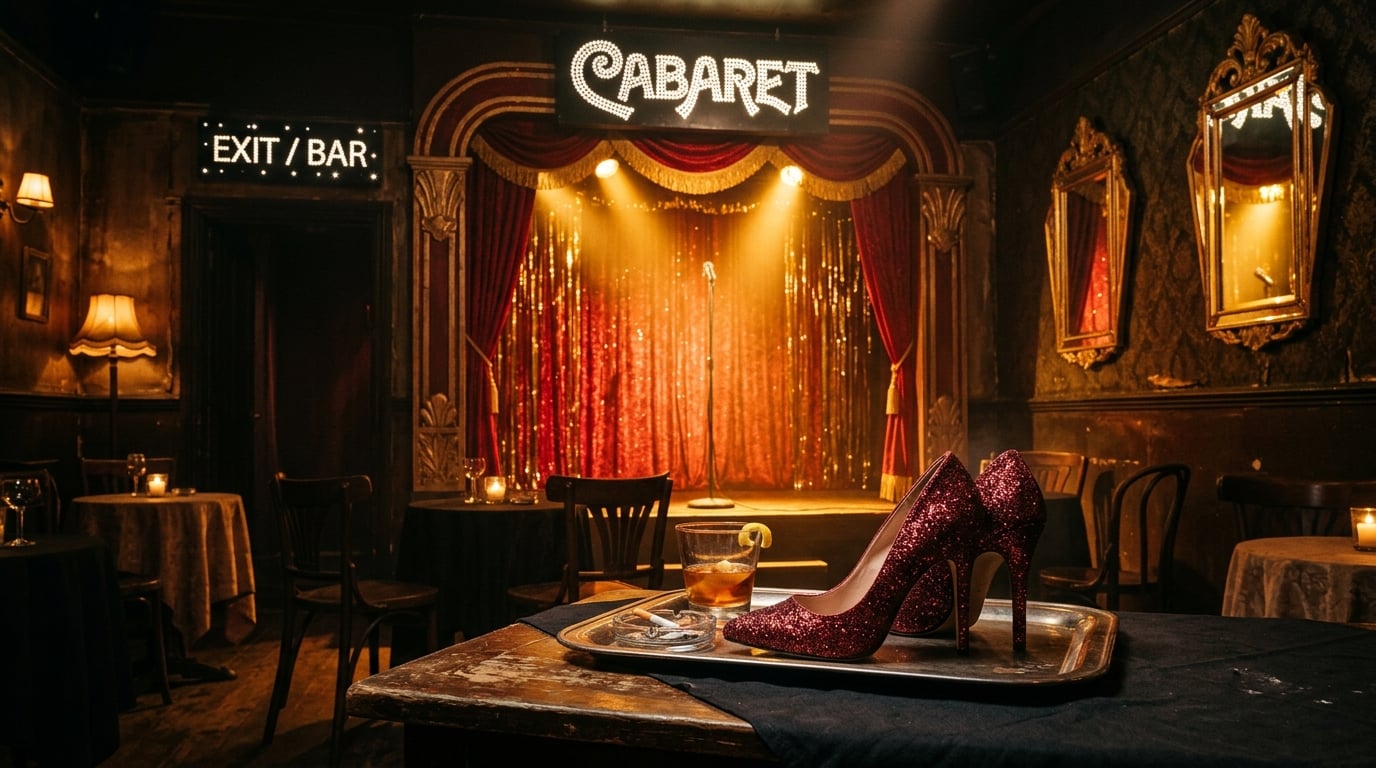
If you walked down Brewer Street in Soho during the late 1980s, you might have noticed a modest doorway beneath a white rhinestone sign reading “Madame Jojo’s.” Behind those doors sat one of the most extraordinary nightlife venues London has ever known. And at the heart of that venue were the Barbettes, the drag stars of Old Soho who served drinks in six-inch heels, slid down a handrail with trays balanced overhead, and performed cabaret six nights a week to packed crowds.
The Barbettes drag stars Old Soho remembers so fondly were a troupe of drag cabaret performers who worked as glamorous waiting staff at Madame Jojo’s nightclub. They wore leotards, elaborate makeup, and towering stilettos while entertaining guests with lip-sync numbers, comedy routines, and theatrical flair. They became local celebrities and symbols of a Soho that has since largely disappeared.
Madame Jojo’s closed its doors in November 2014 after Westminster Council revoked its license following a violent incident involving a bouncer. The venue sat empty for years, though Soho Estates eventually received approval for a strip club license at the site in December 2024. The Madame Jojo’s that the Barbettes called home, however, is gone.
In this article, I want to tell the full story of the Barbettes for the first time. Existing coverage treats them as a footnote to Madame Jojo’s history. They deserve their own story, and that is what follows.
Table of Contents
The Barbette Name: From Cocteau to Soho
The name “Barbettes” did not come from nowhere. It carries a direct line back to one of the most influential drag performers of the twentieth century and the avant-garde art world of 1920s and 1930s Europe.
The original Barbette was Vander Clyde Broadway, an American aerialist and female impersonator born in 1897 in Texas. Broadway adopted the stage name “Barbette” and became an international sensation performing a spectacular trapeze act in full drag. She would appear on stage in elaborate gowns and makeup, execute breathtaking aerial feats, and then remove her wig at the end to reveal she was actually a man. The act was a sensation across Europe and the United States.
The French poet and filmmaker Jean Cocteau was so captivated by Barbette’s performance that he wrote a celebrated essay about her in 1926 for the French journal Nouvelles Litteraires. Cocteau later cast Barbette in his surrealistic film The Blood of a Poet (1930), which became a landmark of avant-garde cinema. Barbette appeared as an angel in the film, and the connection between Cocteau, the film, and the art of drag was cemented in cultural history.
Decades later, when Madame Jojo’s was establishing its drag cabaret format in the 1980s, the name “Barbettes” was chosen as a direct tribute. It referenced Cocteau’s film and the pioneering spirit of the original Barbette. The drag performers who worked at the club would carry that name as a badge of honor, linking themselves to a tradition of theatrical gender performance that stretched back over half a century.
What makes the name particularly fitting is that the original Barbette was not just a drag performer but also an athlete and entertainer who combined glamour with physical skill. The Barbettes of Madame Jojo’s would do the same thing in their own way, balancing drinks trays while navigating a two-level venue in stilettos. The spirit of the name lived on in every performance.
Madame Jojo’s: The Stage Where It All Happened
You cannot tell the story of the Barbettes without telling the story of Madame Jojo’s. The venue was their home, their platform, and their world.
Madame Jojo’s was located at 8-10 Brewer Street in the heart of Soho, London. The building had a long history as an entertainment venue, having previously operated under names including the Flamingo Club and the Revuebar during the 1960s and 1970s. But its transformation into Madame Jojo’s came under the ownership of Paul Raymond, the man often called the “King of Soho.”
Paul Raymond was a property magnate and publisher who had made his fortune in the adult entertainment industry. By the 1980s, he owned vast swaths of Soho real estate and was one of the most powerful figures in the area. Raymond had a policy of buying properties and largely leaving them alone, which paradoxically preserved much of Soho’s historic character even as he profited from it. His Revuebar, which opened in 1958, had already established Brewer Street as a destination for adult entertainment and cabaret.
Madame Jojo’s itself opened in the mid-1980s, with the exact year commonly cited as 1986. The venue was designed to feel like stepping into another world. From the unremarkable street entrance, patrons pushed through double doors and found themselves in a space dripping with old-school glamour. Art Deco mirrors lined the walls. Red velvet curtains framed the stage. The lighting was low and warm, casting everything in a golden, theatrical glow.
The venue was split across two levels, a design feature that would become central to the Barbettes’ most famous trick. A handrail connected the upper and lower levels, and part of the Barbettes’ performance involved sliding down that handrail while balancing drinks trays above their heads. It was the kind of spectacle that could only exist in a space purpose-built for theatrical cabaret.
The club also operated with a late license, allowing it to stay open well past standard closing times. This made it a magnet for night owls, performers finishing shifts at other venues, and anyone who wanted to keep Soho’s party going into the small hours. The combination of late hours, theatrical performances, and the Barbettes’ unique brand of drag cabaret created an atmosphere that people traveled across London, and sometimes across the world, to experience.
Madame Jojo’s strict no-photography policy also contributed to its mystique. In an era before camera phones, this meant that the Barbettes’ performances existed primarily in the memories of those who saw them. Stories about the club spread by word of mouth, which only amplified the venue’s legendary status.
The Birth of the Barbettes
The Barbettes were born out of a simple but brilliant concept: what if the waiting staff were the show?
When Madame Jojo’s launched its cabaret format, the idea was to create an immersive entertainment experience where the boundary between performer and server dissolved. The compere character of “Madame Jojo” presided over proceedings, a larger-than-life drag persona who introduced acts, told jokes, and kept the energy high throughout the night. Around this central figure, the Barbettes served as both the venue’s waiting staff and its resident performing troupe.
This was not entirely unprecedented in Soho’s history. The area had a long tradition of gender-bending entertainment, from the music hall days through to the drag balls of the mid-twentieth century. But what made the Barbettes different was the integration of service and performance into a single, seamless role. A patron might have their drink served by a performer in full cabaret makeup and costume, watch that same performer take the stage for a lip-sync number twenty minutes later, and then have another drink served by them after the set was done.
The concept was the brainchild of the creative team behind Madame Jojo’s, working under Paul Raymond’s ownership. They drew on Soho’s existing cabaret traditions but elevated them with higher production values, more elaborate costumes, and a level of theatrical commitment that set the Barbettes apart from anything else happening in London nightlife at the time.
From the beginning, the Barbettes were positioned as stars rather than background decoration. They had dedicated performance spots in the nightly show. They were featured in the club’s promotional materials. And they developed loyal followings among regular patrons who would come specifically to see their favorite Barbette perform.
The early years of the Barbettes coincided with a broader cultural moment in London. The 1980s saw the rise of the New Romantic movement, with its embrace of gender fluidity and theatrical fashion. Clubs like Blitz and Taboo were drawing crowds with their emphasis on dressing up and performing identity. The Barbettes existed in the same cultural ecosystem, but they brought something that those other venues lacked: a dedicated cabaret stage, a regular performing troupe, and the institutional backing of one of Soho’s most powerful operators.
Who Were the Barbettes? Appearance, Uniform, and Role
The Barbettes were impossible to miss. Their look was designed to stop conversations and turn heads the moment they entered a room.
The Barbette uniform centered on the leotard. Each performer wore a tightly fitted, often sequined or glittering leotard that emphasized the theatrical, exaggerated femininity of the drag aesthetic. The leotards were paired with elaborate makeup featuring bold colors, heavy eyeliner, dramatic lashes, and contouring that could be seen from the back of the room. Wigs were towering, immaculately styled, and often changed between sets to match different numbers.
And then there were the heels. Six-inch stilettos were the standard, non-negotiable footwear for every Barbette. These were not stage props worn only during performances. The Barbettes wore them for their entire shifts, navigating the two-level venue, carrying drinks trays, and performing their cabaret numbers, all while balanced on spike heels that would challenge most people just to walk in.
The Barbettes served multiple roles simultaneously. They were the venue’s primary waiting staff, taking orders and delivering drinks to tables across both levels of the club. They were performers, with dedicated spots in the nightly cabaret show featuring lip-sync performances, comedy routines, and theatrical sketches. And they were atmosphere, living embodiments of the Madame Jojo’s brand who maintained the venue’s sense of glamour and transgression simply by being present.
The most famous element of the Barbette performance was the handrail slide. The venue’s two-level layout meant that performers needed to move between floors throughout the night. Rather than simply walking down the stairs, the Barbettes would slide down the handrail while balancing drinks trays above their heads. It was a feat that required extraordinary balance, core strength, and nerves of steel, especially in six-inch heels.
The slide became one of the most iconic images associated with Madame Jojo’s. Patrons would wait for it, cameras at the ready, though the no-photography policy meant few images ever escaped the venue. It was the kind of performance that had to be experienced live, which only added to its legend.
Six nights a week, the Barbettes performed their cabaret show. The routines varied, but typically included lip-sync numbers to popular songs, comedy bits that played with gender expectations, and interactive segments that brought audience members into the act. Christmas shows were particularly elaborate, with special routines, decorated costumes, and an anything-goes party atmosphere that regulars still talk about decades later.
Becoming a Barbette: The Audition Process
You did not simply apply to be a Barbette and get the job. The audition process was notoriously strict, and for good reason.
The physical requirements alone were demanding. The Barbettes were expected to be tall, partly for visual impact and partly because the height was needed to carry off the six-inch heel look without appearing disproportionate. Prospective Barbettes needed to demonstrate that they could not only walk in stilettos but also work an entire shift in them, carrying trays, navigating stairs, and performing on stage.
The audition typically involved several stages. First, candidates would be assessed on their appearance and presentation, including their ability to create a convincing and compelling drag look. This meant demonstrating skill with makeup, wig styling, and costume selection. The Madame Jojo’s aesthetic was specific: glamorous, theatrical, and bold. A subtle or understated look would not make the cut.
Second, candidates had to demonstrate performance ability. This included lip-syncing, stage presence, comic timing, and the ability to command an audience’s attention. The Barbettes were not just decorative; they were entertainers who needed to hold a room. A Barbette who could not perform was of no use to the show, regardless of how good they looked.
Third, and perhaps most importantly, candidates needed to show they could handle the practical demands of the job. This meant balancing drinks trays, moving efficiently through a crowded venue, and performing the signature handrail slide. The slide was not optional. Every Barbette was expected to master it, and falling off with a tray full of drinks was not an option the management would tolerate for long.
The strictness of the audition process meant that becoming a Barbette was a genuine achievement. Those who made it through knew they had been selected from a pool of candidates and had proven themselves capable of meeting the venue’s demanding standards. This created a strong sense of pride and identity among the Barbettes, who saw themselves as an elite troupe rather than just a collection of individual performers.
Life as a Barbette: Behind the Velvet Curtains
Being a Barbette was not a part-time gig or a hobby. It was a demanding, full-time commitment that consumed the lives of those who took it on.
A typical evening at Madame Jojo’s began hours before the doors opened. The Barbettes would arrive early to begin the elaborate preparation process. Makeup alone could take an hour or more, involving layers of foundation, contouring, eye work, and lip color designed to be visible under stage lighting and durable enough to survive a full night of performing. Wigs needed to be styled, pinned, and secured so they would survive the handrail slide. Costumes had to be checked, pressed, and in some cases changed between numbers.
The physical demands of the job were intense. Working a full shift in six-inch heels took a toll on feet, ankles, and backs. Balancing drinks trays while navigating a crowded, dimly lit venue required concentration and spatial awareness. And performing cabaret numbers after hours of waiting tables required the kind of stamina that only dedicated performers could sustain night after night.
Despite the challenges, the Barbettes described their time at Madame Jojo’s as an extraordinary experience. The camaraderie among the troupe was a defining feature of daily life. The performers spent hours together preparing, performing, and decompressing after shifts. They supported each other through costume malfunctions, difficult customers, and the physical demands of the job. Many formed friendships that lasted long after the club closed.
The celebrity encounters were another perk that made life as a Barbette unlike any other job. Madame Jojo’s attracted a diverse and often famous clientele, particularly in its later years when club nights like White Heat brought in a new generation of London’s creative elite. The Barbettes served drinks to musicians, actors, artists, and aristocrats, often without knowing who they were until afterward. The no-photography policy meant that celebrities could let their guard down, and the Barbettes were sworn to discretion about what they saw.
Christmas at Madame Jojo’s was legendary. The Barbettes would put on specially elaborated shows with festive routines, decorated costumes, and an atmosphere of controlled chaos that regulars planned their entire holiday season around. The Christmas performances were the Barbettes’ chance to push the boundaries of their act even further than usual, with sketches and numbers that would never have passed in a more conventional venue.
The late license meant that shifts often ran well past 3 AM. After the last patron left and the doors were closed, the Barbettes would help clean up, count tips, and unwind. The post-shift conversations, shared over a drink in the empty venue, were when the real bonds were formed. It was in those quiet hours that the Barbettes became a family rather than just a troupe.
Notable Barbette Performers
The Barbettes were not anonymous. Individual performers developed reputations, followings, and careers that extended beyond Madame Jojo’s walls.
Stella Artois is perhaps the most well-documented Barbette, thanks in large part to her extensive interviews with Time Out for their oral history of Madame Jojo’s. Stella was a veteran of the troupe who embodied everything the Barbettes represented: glamour, wit, physical courage, and an absolute commitment to the art of drag performance. Her accounts of daily life at Madame Jojo’s, from the handrail slide to the Christmas shows, have become the primary source material for anyone trying to understand what the Barbettes were really like. Stella’s stories are filled with humor and warmth, but also with a clear-eyed honesty about the demands and challenges of the job.
Ruby Venezuela was another standout Barbette, known for a commanding stage presence and a look that patrons remembered long after their visit. Ruby was part of the troupe that Entertainment Weekly documented, appearing alongside Venus Mantrap and Miss Terry Flair in coverage that captured the Barbettes at the height of their fame. Ruby’s performances were characterized by a physical, aggressive style of drag that some described as “male, hard,” a contrast to softer, more traditionally feminine approaches.
Venus Mantrap was described as an imposing figure whose drag aesthetic leaned into a bold, confrontational energy. Venus was part of a generation of Barbettes who pushed the boundaries of what drag performance could be, incorporating elements of punk, performance art, and avant-garde theater into their cabaret numbers. The Entertainment Weekly footage of Venus and the Barbettes remains one of the few video records of the troupe in action.
Miss Terry Flair brought a different energy to the troupe, with a name that was itself a masterpiece of drag wordplay. Miss Terry Flair was known for comedic timing and an ability to work a crowd, skills that were essential for the interactive elements of the Madame Jojo’s cabaret format.
Terri Fox and Scott St Martyn were also key figures in the Barbette story. Both performers contributed to the oral history of the venue, sharing memories that have helped preserve the Barbettes’ legacy. Terri Fox was known for a polished, professional approach to drag cabaret that set a standard for newer members of the troupe. Scott St Martyn brought a theatrical sensibility that connected the Barbettes’ performances to the broader traditions of British drag and music hall entertainment.
What united all these performers was a commitment to the Barbette ideal: drag as spectacle, service, and art combined into a single, unforgettable experience. Each brought their own personality and style to the role, but together they created something that was greater than the sum of its parts.
The Barbettes’ Legacy: What Came After
The story of the Barbettes does not have a happy ending, at least not in the conventional sense. But their legacy endures.
Madame Jojo’s closed on November 24, 2014, after Westminster Council revoked its license. The immediate cause was a violent incident in which a bouncer assaulted a customer, but the closure was widely seen as part of a broader pattern of Soho gentrification that had been squeezing out the area’s historic nightlife venues for years. The Guardian reported the closure with a tone of mourning, describing a venue that had been a cross-cultural meeting point for London’s fringe culture, cabaret scene, and LGBTQ+ community.
The reaction to the closure was immediate and passionate. Marcus Harris, of the production company Finger in the Pie, told the Guardian that Madame Jojo’s was “one of the most important venues in London.” Alexander Parsonage, artistic director of the theatre company Flux, framed the closure as part of a cultural clash between Soho’s historic identity as a haven for alternative culture and the forces of corporate redevelopment. The Crossrail project, which was reshaping large parts of central London, was cited as a contributing factor to the changing character of the area.
For the Barbettes, the closure meant the end of a way of life. There was no other venue in London that offered anything like the Madame Jojo’s format, where drag performers could serve as both waiting staff and cabaret stars in a purpose-built theatrical space. The troupe dispersed, with individual performers moving on to other venues, other careers, or in some cases leaving the performance world entirely.
There have been attempts to keep the spirit of Madame Jojo’s alive. In December 2024, Soho Estates, the property company that now controls much of Paul Raymond’s former empire, received approval for a strip club license at the Brewer Street site. This was met with mixed reactions from those who remembered what the venue had been. A strip club is not a drag cabaret, and the Barbettes’ particular brand of performance art does not fit neatly into the categories that contemporary licensing frameworks recognize.
But the Barbettes’ influence extends far beyond the question of whether Madame Jojo’s itself can be revived. The concept of drag performers as immersive entertainers, serving and performing simultaneously, has influenced a generation of drag artists who came of age after the club’s closure. Elements of the Barbette aesthetic and performance style can be seen in drag brunches, immersive cabaret experiences, and the broader professionalization of drag as an entertainment form that has occurred in the UK over the past decade.
The Barbettes also hold a significant place in the LGBTQ+ history of London. They were not just entertainers; they were visible, public figures who performed gender nonconformity in the heart of one of the world’s most high-profile entertainment districts. At a time when LGBTQ+ rights were still being contested and Section 28 was still on the books, the Barbettes were unapologetically themselves, night after night, in front of audiences from every walk of life. That kind of visibility mattered, and it continues to matter.
The Barbettes vs Modern Drag: How the Art Form Evolved
The world of drag has changed dramatically since the Barbettes ruled Brewer Street. But the comparison reveals both how far the art form has come and how much it owes to pioneers like the Madame Jojo’s troupe.
The most obvious change is the influence of RuPaul’s Drag Race, which launched its UK version in 2019 and transformed drag from a niche, primarily live-performance art into a mainstream entertainment phenomenon. Modern drag queens in the UK have career paths, media profiles, and earning potential that the Barbettes could never have imagined. They perform in dedicated drag venues, at festivals, on television, and on international tours.
But the professionalization of drag has also changed the nature of the performance itself. The Barbettes were immersive entertainers who existed in the same space as their audience. They served you a drink, chatted with you, and then performed for you, all within the same evening. Modern drag is often more staged and separated, with performers appearing on a platform or stage and the audience watching from a distance. The intimacy and interactivity that defined the Barbette experience is harder to find in the era of large-scale drag shows.
The Barbette aesthetic was also distinct from contemporary drag looks. The leotards, the heavy theatrical makeup designed for stage visibility, and the emphasis on physical performance over fashion-forward styling all reflected a specific era and tradition. Modern drag, influenced by Drag Race, tends to prioritize fashion, makeup artistry, and social media-ready looks over the kind of working-performance aesthetic that the Barbettes embodied.
What has not changed is the core of what made the Barbettes special: the commitment, the courage, and the willingness to be fully, unapologetically visible. The Barbettes walked into a room in six-inch heels and commanded attention not because they were famous or because they had a television contract, but because they were extraordinary at what they did. That same spirit lives on in every drag performer who takes a stage today, whether in a Soho venue, a Pride festival, or a small bar in a town that has never seen drag before.
The Barbettes were pioneers. They helped establish drag cabaret as a viable, respected form of entertainment in London at a time when LGBTQ+ culture was still fighting for basic recognition. The performers who followed them, including the generation that rose to prominence through Drag Race UK and the broader drag boom of the 2010s and 2020s, are walking a path that the Barbettes helped clear.
FAQs
Is Madame Jojo’s still open?
No. Madame Jojo’s closed on November 24, 2014, after Westminster Council revoked its license following a violent incident involving a bouncer. The venue sat empty for years. In December 2024, Soho Estates received approval for a strip club license at the Brewer Street site, but the Madame Jojo’s that hosted the Barbettes is gone.
Who were the Barbettes at Madame Jojo’s?
The Barbettes were a troupe of drag cabaret performers who worked as glamorous waiting staff at Madame Jojo’s nightclub in Soho. They wore leotards, elaborate makeup, and six-inch stilettos while serving drinks and performing cabaret numbers six nights a week. Notable Barbettes included Stella Artois, Ruby Venezuela, Venus Mantrap, and Miss Terry Flair.
Why were they called the Barbettes?
The name was inspired by Jean Cocteau’s 1930 film The Blood of a Poet, which featured the pioneering American aerialist and female impersonator Vander Clyde Broadway, known professionally as Barbette. The name was chosen as a tribute to this tradition of theatrical gender performance.
How did someone become a Barbette?
The audition process was famously strict. Candidates had to meet height requirements, demonstrate the ability to work an entire shift in six-inch heels, show proficiency in drag makeup and styling, perform cabaret numbers including lip-syncing and comedy, and master the signature handrail slide with a drinks tray balanced overhead.
Are drag queens usually straight men?
No. Drag queens come from across the gender and sexuality spectrum. While historically some straight men have performed in drag, particularly in pantomime and theatrical traditions, the majority of drag queens identify as gay or queer men, transgender women, non-binary, or gender nonconforming. The Barbettes themselves represented a range of identities and backgrounds.
Who is the highest paid drag queen?
RuPaul is widely regarded as the highest paid drag queen in the world, with an estimated net worth in the tens of millions of dollars, built through the Drag Race television franchise, music, acting, and production. This is a far cry from the era of the Barbettes, when drag performance was a primarily live, venue-based art form with modest earning potential.
The Lasting Sparkle of the Barbettes
The Barbettes drag stars Old Soho gave the world were more than just performers. They were pioneers of a form of entertainment that combined service, spectacle, and artistry in a way that has never been quite replicated. They worked grueling shifts in six-inch heels, slid down handrails with drinks trays balanced overhead, performed cabaret numbers to packed houses, and became the beating heart of one of London’s most legendary nightclubs.
Their story is a window into a Soho that is rapidly disappearing. The neon signs, the late licenses, the no-photography policies, and the drag cabaret troupes have been replaced by chain restaurants, luxury apartments, and corporate entertainment venues. But the spirit of the Barbettes lives on in every drag performer who takes a stage, in every immersive cabaret experience that blurs the line between performer and audience, and in every person who has the courage to be unapologetically, spectacularly themselves.
Madame Jojo’s may be gone, but the Barbettes are not forgotten. Their names, their stories, and their performances deserve to be remembered. And now, for the first time, they have a story that is their own.