
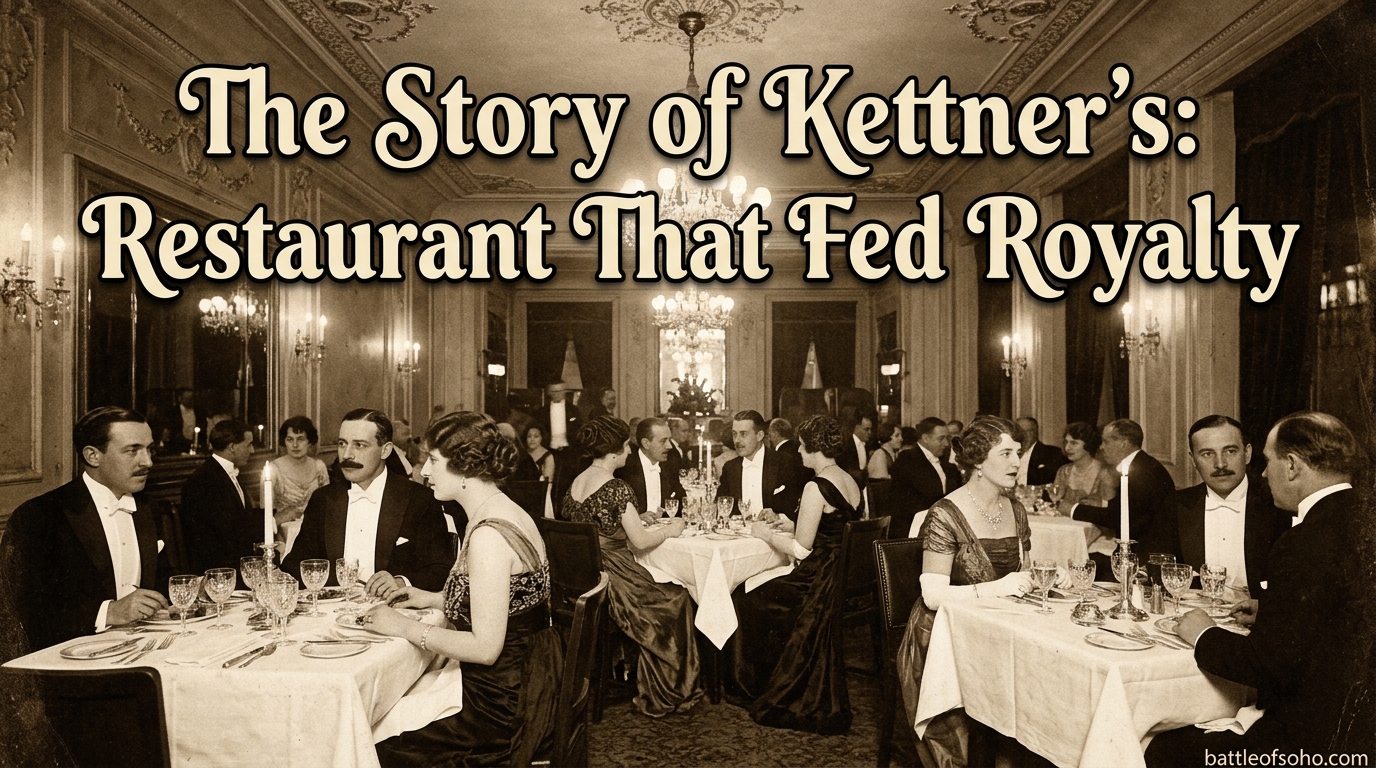
Some restaurants serve dinner. Kettner’s served history. When you walk past the Georgian townhouse on Romilly Street in Soho today, you are standing in front of one of London’s oldest surviving dining rooms, a place where kings dined, playwrights plotted, and a secret tunnel reportedly connected the kitchen to a theatre stage door. The story of Kettner’s restaurant history spans more than 150 years, from a French chef’s bold gamble in 1867 to a modern boutique hotel and champagne bar that still draws crowds in 2026.
This is the full story. The real one. Not just the legend of a chef who served an emperor, but the complicated, fascinating, sometimes disputed tale of how one Soho restaurant survived monarchs, world wars, corporate buyouts, and a full closure to become what it is today.
Table of Contents
The Founding: Auguste Kettner and the Napoleon III Myth
Kettner’s restaurant history begins in 1867, when Auguste Kettner, an Alsatian-born chef, opened what would become one of the first French restaurants in London. He set up shop at 29 Romilly Street in the heart of Soho, a neighbourhood already buzzing with theatres, music halls, and immigrants bringing new flavours to the city.
Most accounts, including Wikipedia and several major publications, state that Auguste Kettner served as chef to Napoleon III before coming to London. The story goes that he fled France after the fall of the Second French Empire in 1870 and brought his imperial culinary skills to Soho. It is a compelling origin story.
But here is where things get interesting. Research published on Harringay Online reveals that the Napoleonic Institute has stated Kettner was never on Napoleon III’s official payroll. The connection appears to be an embellishment, one that grew more dramatic with each retelling over the decades. Some historians suggest Kettner may have worked in the imperial kitchens in a junior capacity, but there is no documented evidence he served as the emperor’s personal chef.
What is not in dispute is that Auguste Kettner was a genuine talent. His French cooking arrived in London at exactly the right moment. Victorian England was developing an appetite for continental cuisine, and Kettner’s became the place to experience authentic French food without crossing the Channel.
Barbe Maria Theresa: The Woman Who Ran Kettner’s
Auguste Kettner did not build the restaurant alone. His wife, Barbe Maria Theresa Kettner, was a formidable businesswoman who helped run the establishment during its formative years. In an era when female restaurant ownership in Victorian London was virtually unheard of, Barbe managed operations, handled finances, and kept the business thriving.
Her story is almost entirely absent from mainstream accounts of Kettner’s. Yet her influence was significant enough that her tomb in Brompton Cemetery holds Grade II listed status, recognised by Historic England as part of the city’s heritage. The Harringay connection to her story runs deeper than most realise, as we will see.
Royal Patronage: Edward VII and Lillie Langtry
If Auguste Kettner’s food established the restaurant, royal patronage made it legendary. The most famous royal connection belongs to King Edward VII, who visited Kettner’s regularly during the 1890s when he was still the Prince of Wales.
Edward VII was not coming for the ambiance alone. He was reportedly meeting his mistress, the actress Lillie Langtry, in Kettner’s private dining rooms. The restaurant’s ornate upstairs rooms offered the discretion that a future king needed for romantic rendezvous away from the public eye.
The Secret Tunnel to the Palace Theatre
This is where the story takes a turn into something out of a spy novel. Multiple sources, including Wikipedia, History Hit, and Eater London, all reference a secret tunnel connecting Kettner’s to the Palace Theatre nearby on Cambridge Circus.
According to the legend, the tunnel allowed the Prince of Wales to travel between the theatre and the restaurant undetected. He could watch Lillie Langtry perform on stage, then slip through the tunnel to join her for dinner at Kettner’s without being spotted by the press or public. Whether the tunnel was built for this purpose or simply served as a convenient service passage has never been definitively settled.
Historians continue to debate the tunnel’s existence. No structural survey has ever publicly confirmed it, but the story has been repeated so consistently across independent sources that it has become an inseparable part of Kettner’s identity. It gives the restaurant an air of intrigue that few London dining rooms can match.
The 1879 Times Letter That Changed Everything
Before the royal visits, before the famous patrons, Kettner’s needed a breakthrough. It came in 1879, when a letter appeared in The Times praising the restaurant’s French cuisine. The letter singled out Kettner’s as proof that London could rival Paris for fine dining.
In an age before restaurant reviews, social media, or food blogs, a positive mention in The Times was the most powerful publicity a business could receive. The letter brought a flood of new customers. Diners who had never heard of Romilly Street suddenly wanted to experience the French restaurant that had impressed the readership of Britain’s most influential newspaper.
This moment marked the turning point from a promising new restaurant to a London institution. The publicity attracted the attention of the aristocracy, the literary world, and eventually the royal family itself.
Famous Patrons: From Oscar Wilde to Winston Churchill
Once Kettner’s became established, its guest list read like a who’s who of British cultural and political life. Oscar Wilde was a regular, drawn to the restaurant’s French cuisine and its atmosphere of bohemian elegance. He reportedly used Kettner’s as a meeting place and found inspiration in its private dining rooms.
Winston Churchill dined there. Agatha Christie visited. Bing Crosby stopped in. Margaret Thatcher was among the later patrons. Each generation of Britain’s elite found its way to the same Soho townhouse.
The restaurant developed a reputation not just for its food but for what it represented: discretion, glamour, and a certain kind of affordable luxury. You could dine alongside the powerful without needing to be powerful yourself.
The Bananarama and Robert De Niro Encounter
One of the most frequently recounted modern anecdotes about Kettner’s involves an unlikely meeting. According to Eater London, the 1980s pop group Bananarama ran into Robert De Niro at the restaurant. The story captures the strange magic of Kettner’s during its Pizza Express era, a time when the restaurant was accessible enough for pop stars to dine casually yet glamorous enough to attract Hollywood royalty on the same evening.
The Harringay Connection: Giovanni Sangiorgi
Here is a chapter of Kettner’s restaurant history that almost no major publication has told. Research from the Harringay Online community forum reveals that during its Victorian heyday, Kettner’s was actually run from Harringay, a neighbourhood in north London.
The connection runs through Giovanni Sangiorgi, a figure whose involvement with the restaurant is documented in local historical records. Sangiorgi’s residence in Harringay served as something of an operations base for the restaurant’s business dealings during its peak years. This detail connects Kettner’s not just to Soho but to a broader network of London’s Italian and French immigrant communities.
This angle matters for anyone interested in the full picture of how Victorian London’s restaurant industry actually functioned. The story of Kettner’s is not just a Soho story. It is a London story, with threads running from the West End to Haringey and beyond. It also ties into the legacy of Barbe Maria Theresa Kettner, whose business acumen kept the operation running across multiple locations.
The Pizza Express Years: 1980 to 2008
In 1980, Kettner’s entered a new chapter when Pizza Express acquired the restaurant. The pizza chain kept the historic premises on Romilly Street but introduced its own menu alongside the French classics. For nearly three decades, Kettner’s operated as an upscale Pizza Express location.
This period is often dismissed as a decline, but that view misses something important. In the 1980s and 1990s, Kettner’s was a major lunchtime destination for London’s media industry. Journalists, editors, and television producers gathered there regularly. You could eat pizza in genuinely historic surroundings, or drink champagne at the bar surrounded by the same walls that once hosted royalty.
The food critic Jay Rayner, writing in The Guardian, offered a blunt assessment of this era. He described the Pizza Express years as “the killing of Kettner’s,” arguing that the chain’s presence diminished what made the restaurant special. Others remember it more fondly as a time when the building was at least open and serving customers, even if the menu had changed.
Pizza Express eventually sold Kettner’s, and the restaurant underwent a refurbishment in 2008. But the revival was short-lived. By 2016, after 149 years of continuous operation, Kettner’s closed its doors.
The Soho House Revival: Kettner’s Townhouse Today
The closure could have been the end. Instead, Nick Jones, founder of the Soho House group, purchased the building and undertook a major renovation. In 2018, Kettner’s reopened as Kettner’s Townhouse, a French brasserie and 33-room boutique hotel.
The renovation preserved many original features. The mosaic floors, the oak-panelled rooms, the grand staircase, and the building’s Grade II listed architecture all remain. Soho House added its own design touches, described by Eater London as “boudoir” styling, a nod to the restaurant’s history of romantic assignations and private dining.
Nick Jones himself captured the spirit of the place in an interview with the Evening Standard. He described Kettner’s Townhouse as the kind of place “you’ll take people you want to sleep with rather than people you work with.” It was a provocative statement, but it connected directly to the restaurant’s heritage as a venue for romance, secrecy, and social ambition.
Today, the restaurant operates as a French bistro with a champagne bar, open to the public for breakfast, lunch, and dinner. The hotel rooms above offer overnight stays in the heart of Soho. The building has survived its transformations while retaining the character that made it special in the first place.
FAQs
What is the story behind Kettners?
Kettner’s was founded in 1867 by Auguste Kettner, an Alsatian chef rumoured to have served Napoleon III. It became one of London’s first French restaurants and gained fame through royal patronage, particularly from King Edward VII, who reportedly used a secret tunnel connecting the restaurant to the Palace Theatre to meet his mistress Lillie Langtry. The restaurant has survived multiple ownership changes and now operates as Kettner’s Townhouse under the Soho House group.
Who owns Kettners?
Kettner’s is currently owned by the Soho House group, founded by Nick Jones. Soho House purchased the building after its 2016 closure and reopened it in 2018 as Kettner’s Townhouse, combining a French brasserie and champagne bar with a 33-room boutique hotel.
Can anyone go to Kettners?
Yes, Kettner’s Townhouse restaurant and champagne bar are open to the public. Unlike most Soho House venues which require membership, the Kettner’s dining room operates as a regular restaurant where anyone can book a table for breakfast, lunch, or dinner. The hotel rooms above are also available for public booking.
What is special about Kettners?
Kettner’s is one of London’s oldest restaurants, founded in 1867. It is special for its royal connections (King Edward VII dined there), its secret tunnel to the Palace Theatre, its Grade II listed Georgian townhouse architecture, and its remarkable guest list including Oscar Wilde, Winston Churchill, Agatha Christie, and Bing Crosby. It has survived multiple eras from Victorian dining room to Pizza Express to luxury hotel.
Conclusion
Kettner’s restaurant history is a story of survival. From Auguste Kettner’s 1867 founding to the Soho House revival of 2026, this single Soho townhouse has hosted kings, fed literary legends, survived a Pizza Express takeover, and returned as one of London’s most characterful dining destinations. The myths may be embellished, the tunnel may never be confirmed, and the Napoleon III connection may be more fiction than fact. But the building itself, with its mosaic floors and oak-panelled rooms, remains a living piece of London’s social and culinary history.
That is what makes Kettner’s special. It is not just an old restaurant. It is a place where the layers of London’s past are still visible, one dining room at a time.