
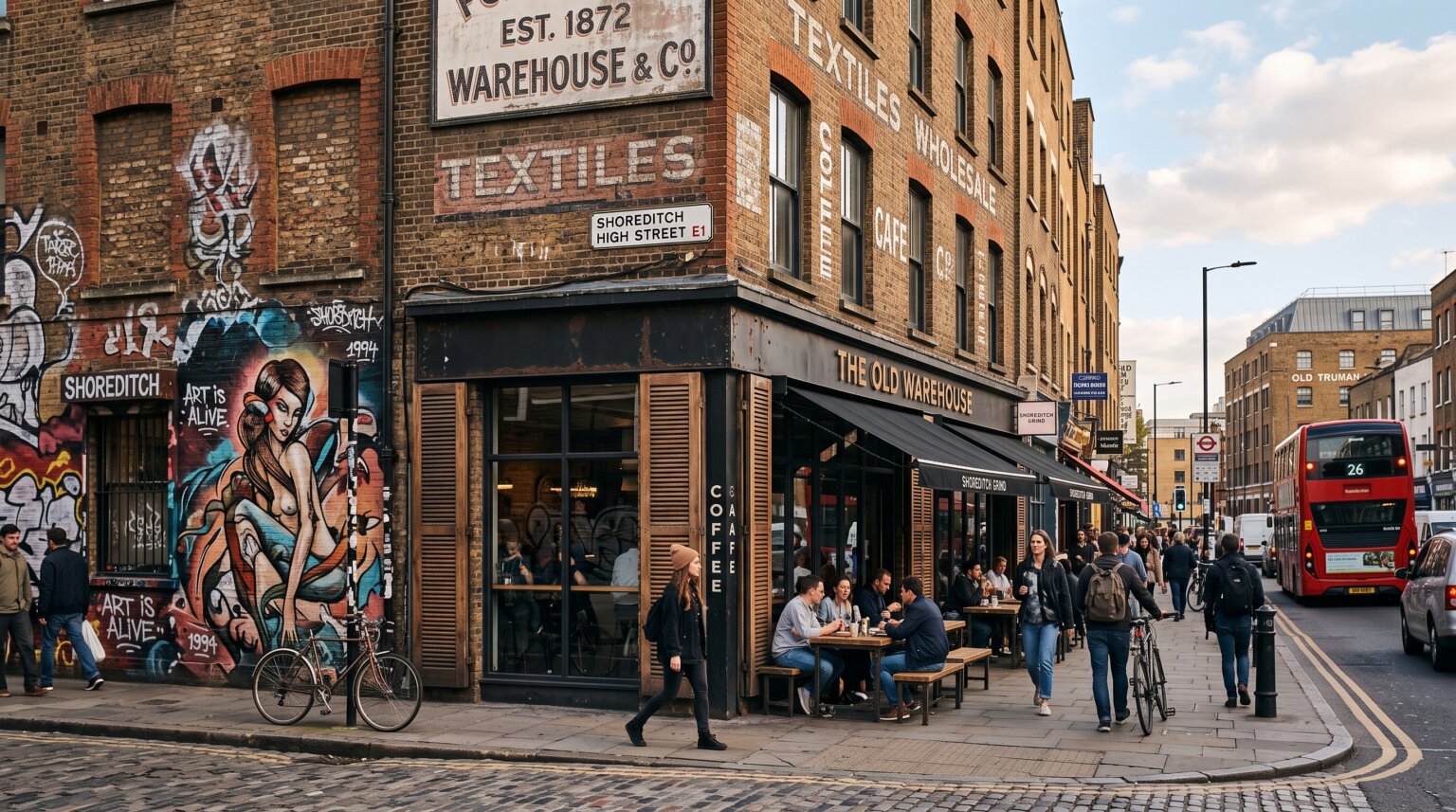
Few places in London have reinvented themselves as dramatically as Shoreditch. Walk down Shoreditch High Street today and you will find artisan coffee shops, vintage clothing stores, and walls covered in world-class street art. But beneath the craft cocktails and pop-up markets lies centuries of grit, industry, and survival that most visitors never see.
The story of Shoreditch from working class to hipster hub is one of the most remarkable urban transformations in modern London history. Since around 1996, Shoreditch has become a popular and fashionable part of London, particularly associated with the creative industries. Before that, it spent centuries as a tough, working-class neighborhood shaped by textile mills, wartime bombing, and economic decline.
Understanding Shoreditch history means understanding London itself. This neighborhood has been an Elizabethan entertainment district, an industrial powerhouse, a slum, a wartime target, an artist colony, and now a global symbol of hipster culture. Each layer built on the last, creating a place where 400-year-old theatre history sits next to a flat white served in a converted warehouse.
In this guide, we trace the complete Shoreditch transformation from its theatrical beginnings in the 1500s to its current status as one of the most talked-about neighborhoods in the world. Whether you are planning a visit, researching gentrification, or just curious about how a struggling East London district became the capital of cool, this is the full story.
Table of Contents
Elizabethan Beginnings: Shoreditch’s Theatrical Roots
Shoreditch’s cultural story starts long before the hipsters arrived. In fact, it begins with the birth of English theatre itself. Long before the Globe Theatre made Southwark famous, Shoreditch was the place where professional theatre in England first took root.
In 1576, James Burbage built The Theatre in Shoreditch. This was the first permanent playhouse ever constructed in England for the sole purpose of staging plays. William Shakespeare himself performed there as a young man with the Lord Chamberlain’s Men. The company used The Theatre as their primary venue before the famous Globe was even a concept.
The Curtain Theatre followed shortly after, opening in 1577 just down the road. Shakespeare’s Henry V was first performed at the Curtain, and the theatre served as a major venue for his early works. Shoreditch was effectively the Broadway of Elizabethan England, drawing crowds from across London to watch the latest productions.
This theatrical heritage matters more than most people realize. It established Shoreditch as an entertainment destination from its earliest days. The area attracted actors, writers, and creative types drawn to the energy of the stage. That same creative magnetism would return 400 years later when artists flooded into Shoreditch’s empty warehouses in the 1990s.
Archaeologists uncovered the remains of The Theatre in 2008 during excavations for a new development on Curtain Road. The discovery confirmed what historians had long suspected: Shoreditch was not just a backdrop for English theatre. It was the birthplace.
By the early 1600s, the theatres had moved south to Southwark, and Shoreditch entered a new phase. But the DNA of creativity and performance had been embedded in the area. It would take another 300 years for that creative spirit to resurface in the form of artists, musicians, and designers who would once again make Shoreditch famous.
The Industrial Powerhouse: 17th to 19th Century
After the theatres departed, Shoreditch reinvented itself as one of London’s most productive industrial neighborhoods. From the 1600s through the 1800s, the area became a powerhouse of manufacturing, particularly known for two industries: textiles and furniture.
The textile trade dominated Shoreditch life. Huguenot refugees fleeing persecution in France settled in East London in the late 1600s and brought their silk-weaving expertise with them. Shoreditch and neighboring Spitalfields became the center of London’s silk and textile production. Weavers’ looms clattered from attic windows across the district.
Furniture making was the other pillar of Shoreditch’s industrial identity. By the 18th and 19th centuries, the area was packed with cabinet makers, woodworkers, and upholsterers. The famous Shoreditch furniture trade supplied homes across Britain. The craft tradition ran deep, with skills passed down through generations of working families.
This industrial boom brought people. Lots of them. Shoreditch became one of the most densely populated areas in London. Workers and their families packed into cramped tenements and back-to-back housing. The streets were crowded, noisy, and often unsanitary. But the community was strong and self-reliant.
Charles Dickens knew this Shoreditch well. He referenced the area in several works, capturing the grinding poverty and fierce community spirit that defined working-class East London. The neighborhood Dickens described was tough but alive with human energy and enterprise.
By the late 19th century, however, Shoreditch’s industrial dominance was already fading. Competition from larger factories, changing trade routes, and outdated production methods eroded the local economy. The textile trade declined, furniture workshops closed, and unemployment rose. Shoreditch was entering a long, difficult period that would define its identity for the first half of the 20th century.
The working-class character forged during this industrial era became the foundation of Shoreditch’s identity. These were families who had lived in the area for generations, who worked with their hands, and who took pride in their trades. That heritage would be tested severely in the decades to come.
Working-Class Shoreditch: Decline and Survival
The 20th century was brutal for Shoreditch. What had been a struggling but proud working-class neighborhood descended into deep poverty, crime, and physical destruction. The industrial jobs that had sustained the area for centuries were disappearing, and nothing came to replace them.
Poverty in early 20th century Shoreditch was severe by any standard. Overcrowded housing, unemployment, and poor public health defined daily life for most residents. The area became synonymous with the social problems of London’s East End. Government reports and social reformers documented the conditions extensively, often using Shoreditch as a case study in urban deprivation.
Into this vacuum of opportunity stepped organized crime. The Kray twins, Ronnie and Reggie, built their criminal empire in East London during the 1950s and 1960s. Their influence extended across the East End, including Shoreditch and neighboring Bethnal Green. The Krays ran protection rackets, gambling dens, and nightclubs, and their presence cast a long shadow over the area’s reputation.
For many outsiders, Shoreditch and the surrounding East End became known primarily for crime and danger during this period. That reputation, while not the whole story, made the area unattractive to investors, developers, and newcomers. Property values stayed low. Buildings deteriorated. The cycle of decline deepened.
Then came the Second World War. The Blitz devastated East London more than almost any other part of the city. Shoreditch’s proximity to the docks and industrial areas made it a prime target for German bombing. Entire streets were flattened. Factories, homes, and historic buildings were destroyed. The physical scars of the Blitz would remain visible in Shoreditch for decades in the form of bombsites and empty lots.
Post-war Shoreditch was a shadow of its former self. Bomb damage, industrial collapse, and population outflow left behind empty buildings and abandoned warehouses. The local authority struggled to provide basic services. Many who could afford to leave did so, moving to newer housing estates further from central London.
Among those who stayed and those who arrived was a growing Bengali and Bangladeshi community. Immigrants from Bangladesh, particularly from the Sylhet region, began settling in and around Brick Lane and Shoreditch from the 1950s onward. They opened restaurants, worked in local factories, and established a vibrant community that became an integral part of the area’s identity. This community would later find itself on the front lines of Shoreditch’s gentrification battle.
By the 1980s, Shoreditch was at its lowest point. Property was cheap because nobody wanted it. Warehouses stood empty. The streets were quiet after dark. Nobody would have predicted that within a decade, this neglected corner of East London would become the most fashionable address in the city.
The 1990s: How Shoreditch Became Cool
The transformation of Shoreditch began in the early 1990s and accelerated rapidly after 1996. This is when the story of Shoreditch from working class to hipster hub truly takes off, driven by a simple economic reality: artists needed cheap space, and Shoreditch had it in abundance.
Since around 1996, Shoreditch has become a popular and fashionable part of London, particularly associated with the creative industries. That single year is widely cited as the turning point. But the roots of the transformation go back to the late 1980s, when a small number of artists and musicians began trickling into the area looking for affordable studio space.
London’s art scene in the late 1980s and early 1990s was dominated by the Young British Artists, or YBAs. Figures like Tracey Emin, Damien Hirst, and Sarah Lucas were producing provocative work that challenged the art establishment. They needed large, cheap spaces to create and exhibit. Shoreditch’s empty warehouses, with their industrial scale and rock-bottom rents, were perfect.
The White Cube gallery, founded by Jay Jopling, opened in nearby Hoxton Square in 2000 and cemented the area’s status as a contemporary art destination. But even before that, artists had been organizing their own exhibitions in Shoreditch warehouses. These were raw, informal shows that attracted collectors, critics, and curious visitors to a neighborhood that most Londoners had never visited.
The warehouse rave scene played a massive role too. In the early 1990s, underground parties spread across East London’s abandoned industrial spaces. Shoreditch warehouses hosted all-night raves that drew thousands. The energy was raw and the atmosphere was electric. These events introduced a generation of young Londoners to the creative potential of the area.
Banksy arrived in Shoreditch in the late 1990s. His stenciled works began appearing on walls across the neighborhood, commenting on urban decay, consumerism, and authority. Other street artists followed. Within a few years, Shoreditch had one of the highest concentrations of street art anywhere in the world. The walls themselves became a gallery without walls, free and open to everyone.
Fashion designers, photographers, and musicians came next. They were drawn by the same combination that attracted the painters: cheap rent, large spaces, and a growing creative community. Cafes and bars opened to serve this new population. Vintage clothing stores and independent boutiques followed. A self-reinforcing cycle had begun.
Reddit users and longtime residents often point to the early 1990s as the moment everything changed. People who lived in Shoreditch during that period describe a neighborhood in flux: old working-class families living alongside young artists who had moved in for the cheap housing. The atmosphere was creative, slightly chaotic, and undeniably exciting.
The critical factor was affordability. These early settlers were not wealthy. They were students, recent graduates, and struggling artists who needed cheap rent. Shoreditch offered what nowhere else in central London could: large spaces at prices that creative people could actually afford. That economic reality seeded everything that followed.
The Hipster Revolution and Silicon Roundabout
By the early 2000s, Shoreditch had crossed a threshold. It was no longer just a neighborhood where artists happened to live. It had become a full-blown cultural phenomenon. The word hipster, which had not yet become a cliché, seemed to have been invented for the people who now populated Shoreditch’s cafes and bars.
The hipster culture of Shoreditch was defined by a particular aesthetic and set of values. Think single-origin coffee served in converted warehouses. Think vintage clothing stores curated with the precision of a museum. Think cocktail bars hidden behind unmarked doors, street food markets operating out of shipping containers, and beard oil sold in apothecary-style bottles. This was the world of artisanal everything.
Then came the tech companies. In the late 2000s, technology startups began clustering around Old Street roundabout, a major junction at the western edge of Shoreditch. The area earned the nickname Silicon Roundabout. Companies like Last.fm, Songkick, and Mind Candy set up offices. Google opened a campus in the area. venture capital followed.
Silicon Roundabout changed the economics of Shoreditch overnight. Tech workers with high salaries moved in. Rents surged. The creative industries that had seeded the transformation found themselves priced out of the very neighborhood they had built. cafes that once served struggling artists now served venture capital pitch meetings.
The phenomenon became so distinctive that it earned its own name: Shoredification. The term describes the specific pattern of gentrification that transformed Shoreditch: artists arrive first, seeking cheap space; cafes and bars follow to serve them; media coverage attracts wider attention; tech companies and corporate money move in; property prices explode; the original creative community is pushed out.
This pattern has since been replicated, or attempted, in neighborhoods around the world. Shoreditch became the template for hipster-led urban regeneration. Cities from Berlin to Brooklyn watched what happened in East London and saw both the possibilities and the dangers of creative-led development.
By the mid-2010s, global brands had arrived. High-end fashion boutiques opened where furniture workshops once stood. Corporate advertising agencies replaced artist collectives. The area around Shoreditch High Street became one of the most sought-after commercial addresses in London. The transformation from working-class district to creative hub to corporate destination was nearly complete.
Street Art and Cultural Preservation
If there is one element that keeps Shoreditch’s original identity alive, it is street art. The murals, stencils, and paste-ups that cover the neighborhood’s walls serve as a living archive of its cultural transformation. They are also one of the main reasons visitors come to the area today.
Banksy’s early works in Shoreditch are now among the most famous pieces of street art in the world. But he was far from alone. Artists like ROA, whose large-scale animal murals appear on walls across the neighborhood, and Invader, whose mosaic tile pieces draw on video game imagery, have contributed to making Shoreditch an open-air gallery of international significance.
What makes Shoreditch street art different from a traditional gallery is its impermanence. Pieces are painted over, tagged, or replaced. Buildings are demolished or renovated. The art is constantly changing. This means that every visit reveals something new. It also means that the creative energy of the area is always visible, always evolving.
Street art tours have become a major industry in Shoreditch. Guides lead groups through back streets and alleyways, explaining the stories behind specific pieces and the artists who created them. For many visitors, these tours are their first introduction to Shoreditch history. The art becomes a gateway to understanding the neighborhood’s deeper past.
There is an argument that street art serves as a form of cultural preservation. When original working-class communities are displaced and historic buildings are replaced with glass offices, the murals on the walls remind passersby that this neighborhood has a history. They signal that Shoreditch was not always a corporate playground. It was a place where people created, struggled, and survived.
Gentrification and Cultural Cleansing: The Dark Side
The story of Shoreditch’s transformation is not entirely one of success and renewal. For many people, especially long-term residents, the gentrification of the area has been a story of loss, displacement, and what critics call cultural cleansing. Understanding this side of the story is essential to understanding Shoreditch history in full.
Property prices in Shoreditch have skyrocketed since the 1990s. A warehouse that rented for a few hundred pounds a month in the early 1990s might now cost thousands. Property purchases that were once within reach of working-class families are now priced for corporate investors and wealthy professionals. The area has become one of the most expensive neighborhoods in East London.
Rising rents have pushed out the very people who made Shoreditch interesting in the first place. Artists who moved to the area in the 1990s because it was affordable have been forced to leave. Independent venues have closed. In 2015, the Red Gallery, one of the last independent art spaces in the area, was forced to close. The Last Days of Shoreditch pop-up market shut down around the same time. Each closure removed a piece of the creative ecosystem that had defined the neighborhood.
The Bengali community, which has been a core part of the area’s identity since the 1950s, has been particularly affected. Brick Lane, once the heart of London’s Bangladeshi community, has seen traditional curry houses replaced with cocktail bars and chain restaurants. Property developers have targeted the area aggressively, and many long-term residents feel that their community is being erased in the name of regeneration.
Ernesto Leal, a gallery owner quoted in The Guardian’s landmark 2018 investigation, described the situation as cultural cleansing. He argued that the unique creative character of Shoreditch was being systematically destroyed by corporate money and developer greed. His words captured a frustration shared by many in the community who felt that the neighborhood they had built was being taken from them.
The debate over gentrification in Shoreditch is complex. Supporters point to improved infrastructure, lower crime rates, and new investment that have come with the transformation. Critics counter that these benefits have come at the cost of community displacement and cultural homogenization. The truth probably lies somewhere in between, but the loss felt by displaced communities is real and deserves acknowledgment.
What happened in Shoreditch has become a cautionary tale for other neighborhoods. When people talk about Shoredification in places like Peckham, Brixton, or Tottenham, they are referencing the Shoreditch model and its consequences. The hope is that future urban transformations can learn from what went wrong here and preserve community alongside development.
Modern Shoreditch: What the Area Looks Like Today
Shoreditch in 2026 is a neighborhood of layers. The working-class history, the artistic revolution, the tech boom, and the corporate arrival are all visible if you know where to look. It remains one of the most visited and talked-about areas in London.
BOXPARK Shoreditch, built from shipping containers, was one of the first pop-up mall concepts in the world. Spitalfields Market, on the edge of Shoreditch, remains one of London’s oldest and most popular markets. Shoreditch House, a private members’ club in a former tea warehouse, symbolizes the area’s premium status. These destinations draw millions of visitors each year.
The food scene is extraordinary. From street food at Dinerama to fine dining in converted warehouses, Shoreditch offers one of the most diverse culinary landscapes in London. The cocktail bar culture rivals anywhere in the world. Independent coffee roasters compete with international chains, and many locals would argue the independents still win.
Nightlife in Shoreditch is still vibrant, though it has shifted from the underground warehouse raves of the 1990s to more established venues. Pattern, XOYO, and Village Underground host international DJs and live acts. The energy that first drew artists to the area in the 1990s has not entirely disappeared, even if the setting has become more polished.
Is Shoreditch still trendy? That depends on who you ask. Many observers argue that the truly cutting-edge creative types have already moved on to areas like Tottenham, Walthamstow, or Deptford, where rents are cheaper and the energy feels rawer. Shoreditch, in this view, has become too expensive and too established to maintain its edge. Others insist that the concentration of creative businesses, street art, and cultural venues still makes it one of the most interesting neighborhoods in London.
What is undeniable is that Shoreditch has cemented its place in London’s cultural geography. It may no longer be the scrappy underground hub it was in 1996, but it has become something else: a globally recognized brand of urban cool that continues to attract visitors, businesses, and attention from around the world.
The Story of Shoreditch From Working Class to Hipster Hub: Conclusion
The story of Shoreditch from working class to hipster hub spans centuries. From Elizabethan theatres to Victorian textile mills, from Blitz-era bombsites to 1990s warehouse raves, from Banksy stencils to Silicon Roundabout startups, this neighborhood has lived more lives than most cities. Each era left its mark on the streets, the buildings, and the people who call Shoreditch home.
Shoreditch history teaches us that neighborhoods are never static. They evolve, decline, and reinvent themselves in response to economic forces, cultural movements, and the people who choose to live in them. The Shoreditch transformation shows how creative energy can breathe life into a neglected area. It also shows how quickly that same energy can be co-opted, commercialized, and priced out of existence.
The next chapter of Shoreditch is still being written. Property prices continue to rise. New developments reshape the skyline. But the street art on the walls, the Bengali restaurants on Brick Lane, and the echoes of Shakespeare’s first performances remind us that this neighborhood has survived dramatic change before. Whatever comes next, Shoreditch will keep telling its story.
FAQs
When did Shoreditch become cool?
Shoreditch became cool around 1996, when artists and creative professionals began moving into the area’s empty warehouses seeking affordable studio space. This marked the turning point when the neighborhood shifted from a declining working-class district to a fashionable hub associated with the creative industries.
Is Shoreditch a hipster area?
Yes, Shoreditch is widely considered the original hipster hub of London. Since the late 1990s, it has been associated with artisan coffee shops, vintage clothing stores, street art, independent galleries, and a distinctive creative culture that defined the hipster movement in the UK.
Has Shoreditch been gentrified?
Yes, Shoreditch has undergone one of the most dramatic gentrification processes in London. Since the 1990s, property prices have soared, original working-class residents and artists have been displaced, and corporate brands have replaced many independent venues. The process is often cited as a textbook example of creative-led gentrification, sometimes called Shoredification.
What was Shoreditch like in the past?
Before its transformation, Shoreditch was a predominantly working-class area with deep roots in textile manufacturing and furniture making. In the 20th century, it suffered from industrial decline, poverty, and heavy damage during the WWII Blitz. By the 1980s, it was one of the most neglected parts of East London, with empty warehouses and low property values.
What is Shoreditch famous for?
Shoreditch is famous for its street art, including early works by Banksy, its role as London’s original hipster neighborhood, the Silicon Roundabout tech hub, Elizabethan theatre history as the site of England’s first purpose-built playhouse in 1576, and its vibrant food, nightlife, and creative industries scene.
Is Shoreditch still trendy?
Shoreditch remains one of London’s most popular and culturally significant neighborhoods, though many argue its cutting-edge creative edge has shifted to cheaper areas like Tottenham and Deptford. It still attracts millions of visitors annually for its street art, markets, food scene, and nightlife, and remains a major hub for tech startups and creative businesses.