
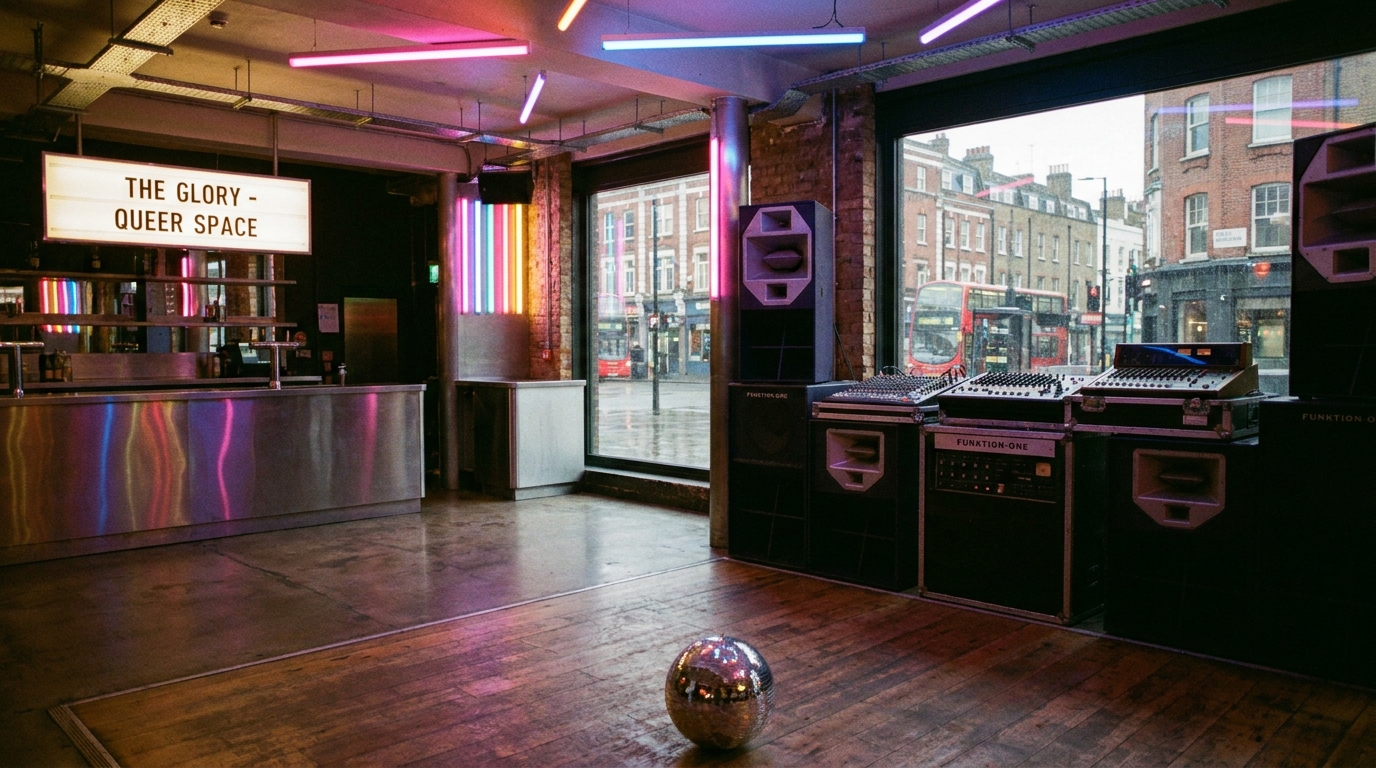
For decades, if you wanted queer nightlife in London, you went to Soho. Old Compton Street was the beating heart of LGBTQ+ life, a few blocks where you could walk from bar to bar and feel like you belonged. That world has shifted dramatically.
Between 2006 and 2017, London lost more than half of its LGBTQ+ venues. The number dropped from roughly 125 to just 53, according to research from UCL. Soho was hit hard, but the closures spread across the entire city. What happened next is a story of displacement, reinvention, and community resilience.
Queer nightlife did not die. It moved. It spread south to Vauxhall, east to Dalston and Hackney Wick, and south again to Peckham. New forms of queer space-making emerged, from pop-up parties to outdoor gatherings like the Queer Picnic. The queer nightlife London offers in 2026 looks nothing like it did twenty years ago, and in many ways, that is the point.
In this guide, we trace how queer nightlife spread beyond Soho across London. We cover the historical role of Soho, the forces that drove the decline, the neighborhoods that picked up the mantle, and the grassroots movements reshaping what queer community space can be.
Whether you are new to London or have watched the scene change over decades, understanding this shift matters. Queer spaces are cultural infrastructure, and the story of where they went tells us a great deal about the city itself.
Table of Contents
Soho’s Reign as London’s Gayborhood
Soho earned its status as London’s gayborhood through decades of accumulation. It was not designated or planned. It grew organically from a mix of bohemian culture, cheap postwar rents, and a concentration of bars and clubs that catered to LGBTQ+ clientele when doing so was risky and often illegal.
How Soho Became the Center of Queer London
Back in the 1950s and 1960s, Soho was already known as a neighborhood of outsiders. Artists, sex workers, immigrants, and creatives filled its narrow streets. Queer people found a home there because no one else wanted the space, and the existing culture of tolerance, born of necessity, created a foothold.
By the 1970s and 1980s, bars and clubs began clustering around Old Compton Street. Venues like The Admiral Duncan, Comptons, and G-A-Y became landmarks. The area drew LGBTQ+ people from across the UK and around the world. If you were queer in Britain, Soho was where you went to feel normal.
The concentration created a critical mass. One bar attracted another. A club next to a cafe next to a bookshop created an ecosystem. People could spend an entire evening moving between venues without ever leaving a few square blocks. That density was Soho’s greatest strength.
The Golden Era of Old Compton Street
The 1990s and early 2000s represented peak Soho. Old Compton Street was lined with gay bars that spilled onto the pavement on summer evenings. Tourists took photos. Hen parties mixed with drag queens. It felt like a celebration that never quite ended.
This era also saw the commercialization of queer culture in Soho. Property values rose as the area became trendy. Mainstream businesses moved in. The very visibility that made Soho a safe haven also made it a target for development and profit.
Many long-time community members started noticing that the crowd was changing. The bars that had served working-class queer people, queer people of color, and older LGBTQ+ patrons began giving way to venues aimed at a younger, wealthier, and often whiter clientele.
Cracks in the Foundation: Early Signs of Decline
The decline did not happen overnight. It started with individual venue closures that each felt like a loss but seemed manageable in isolation. A pub here, a club there. Each closure was explained away as a business decision or a retirement.
But the pattern became clear by the mid-2000s. Rents in Soho were climbing faster than venue revenue. Landlords saw more value in converting queer spaces into chain restaurants, luxury flats, or mainstream bars. The ecosystem that depended on density started to thin out.
Research from UCL’s Urban Lab tracked this decline methodically. Their work showed that the loss of LGBTQ+ venues was not random. It correlated directly with areas of rapid gentrification and redevelopment, and Soho sat squarely in the crosshairs.
The Decline: Why Queer Venues Started Disappearing
The loss of queer venues in London is one of the most documented cultural shifts in the city’s recent history. It is not a mystery. The causes are well-understood, and they point to systemic forces rather than individual failures.
The Numbers: 125 to 53 Venues
The UCL Urban Lab study, led by Ben Campkin and Laura Marshall, counted 125 LGBTQ+ nightlife venues in London in 2006. By 2017, that number had fallen to 53. That is a 58 percent loss in just over a decade.
To put that in perspective, London was losing roughly one queer venue every two months for eleven years. Each closure represented not just a business shutting down, but a community touchpoint disappearing. For many LGBTQ+ people, these venues were where they made friends, found partners, and built chosen families.
The rate of closure was not even across all groups. Venues serving queer women, queer people of color, and older LGBTQ+ people closed at disproportionately high rates. The venues that survived tended to be larger, more commercially oriented, and located in areas with higher foot traffic from tourists.
Gentrification and Rising Rents
Gentrification is the single biggest driver of queer venue closures in London. As neighborhoods get “discovered” and property values rise, the businesses that gave those neighborhoods their character get priced out. Queer venues, which often operated on thin margins in cheap spaces, were particularly vulnerable.
A bar that paid 20,000 pounds per year in rent could suddenly face a renewal at 60,000 or 80,000. Few queer venues had the revenue to absorb that kind of increase. The math simply did not work, and landlords knew they could charge more from a chain pub or a cocktail bar catering to a mainstream crowd.
This created a cruel irony. Queer communities made neighborhoods cool. Cool neighborhoods attracted investment. Investment raised rents. Higher rents pushed queer communities out. The same cycle played out in Soho, then Vauxhall, then pockets of East London.
Neoliberal Urban Planning and Redevelopment
London’s planning policies over the past two decades favored market-led redevelopment over cultural preservation. The concept of “permitted development rights” allowed property owners to convert spaces with minimal oversight. Queer venues, which often occupied older buildings, were frequent targets.
The research from UCL and the University of Roehampton documented how planning decisions systematically overlooked the cultural value of queer spaces. Venues were treated as ordinary commercial properties rather than community infrastructure. When a developer wanted to demolish a queer bar to build flats, the planning system rarely stood in the way.
Neoliberal regeneration prioritized tax revenue, housing units, and corporate investment. Social sustainability, the idea that communities need cultural spaces to thrive, was treated as an afterthought. Queer nightlife London had built over decades was collateral damage in a broader redevelopment agenda.
COVID-19: An Accelerant on an Existing Fire
The pandemic hit queer venues hard, but it did not create the crisis. It accelerated a decline that was already well underway. Lockdowns, capacity restrictions, and economic uncertainty pushed many venues that were barely surviving over the edge.
According to community reporting and Reddit discussions from r/londonlgbt, at least eight of London’s biggest queer parties and collectives united during and after the pandemic to sound the alarm. Groups like INFERNO, Queer House Party, and Riposte called for urgent action to save remaining venues.
The pandemic also shifted behavior. Some people who might have gone out to a bar every weekend got used to staying home. Others discovered online queer communities and virtual events. The return to in-person nightlife has been uneven, and some venues that closed during COVID have not reopened.
How Queer Nightlife Spread Beyond Soho Across London
The spread of queer nightlife beyond Soho was driven by a combination of push and pull factors. Venues and organizers were pushed out of central London by rising costs and redevelopment. They were pulled toward peripheral neighborhoods by cheaper rents, available industrial spaces, and communities hungry for something different.
The Push: Displacement from Central London
As Soho became more expensive and less welcoming to grassroots queer culture, organizers and venue operators looked elsewhere. The same forces that closed venues in Soho made it nearly impossible to open new ones there. Licensing requirements, rent deposits, and competition from mainstream businesses created barriers.
Queer promoters who could not afford Soho rents started looking at areas where industrial units sat empty and licensing was more flexible. The logic was simple. If you cannot afford a bar on Old Compton Street, you find a warehouse in an industrial estate and throw a party there.
This displacement was not always voluntary. Many queer organizers felt pushed out of central London entirely. Reddit users from r/londonlgbt describe a sense of loss about Soho, coupled with an acknowledgment that the scene they loved had already changed before it physically relocated.
The Pull: Cheaper Rents and Unused Industrial Spaces
The neighborhoods that absorbed queer nightlife shared certain characteristics. They had cheaper commercial rents, underused industrial or warehouse space, and existing communities of artists and creatives who understood underground culture.
Vauxhall offered railway arches and industrial buildings that could be converted into clubs. Dalston and Hackney had warehouses and former retail spaces. Peckham had a growing creative scene and disused commercial properties. Each area offered something Soho could not, room to experiment.
This pull factor created opportunities for queer nightlife to reinvent itself. Instead of replicating the Soho bar model, organizers created something new. Warehouse parties, pop-up events, and multi-room extravaganzas became the norm. The experience of going out queer in London changed.
From Permanent Venues to Ephemeral Spaces
One of the most significant shifts in how queer nightlife spread beyond Soho was the move from permanent venues to ephemeral spaces. An ephemeral space is a venue that exists temporarily, for a single night, a weekend, or a season, and then disappears.
This model has advantages. It is cheaper than maintaining a permanent venue. It can move to avoid rising rents. It can create a sense of urgency and excitement that a standing bar cannot match. But it also has costs. There is no permanent address, no physical anchor, no place to point to and say “this is ours.”
Researchers studying transgressive queer space-making in London have noted that ephemeral spaces represent both a survival strategy and a loss. They keep queer culture alive, but they do so in a form that is harder to sustain, harder to protect, and harder to pass down to the next generation.
Neighborhood-by-Neighborhood: Where Queer Nightlife Lives Now
If you want to understand how queer nightlife spread beyond Soho, you need to look at the specific neighborhoods that became new centers. Each area developed its own character, its own scene, and its own relationship to the broader London queer community.
Vauxhall: The Industrial Party District
Vauxhall, in Lambeth south of the river, became the most established alternative to Soho for queer nightlife. The area’s railway arches and industrial buildings provided the perfect infrastructure for large-scale clubbing. Venues like Fire, Lightbox, and Royal Vauxhall Tavern created a critical mass.
The Royal Vauxhall Tavern, or RVT as it is known, deserves special mention. It is one of the oldest surviving queer venues in London, dating back to the 1940s. While it predates the recent spread of queer nightlife, it became an anchor that attracted other venues and events to the area.
Vauxhall developed a reputation for the harder, sweatier end of queer nightlife. Late-night clubbing, dark rooms, and underground sounds defined the scene. It attracted a different crowd from Soho, one that was more interested in music and dancing than cocktails and pavement seating.
However, Vauxhall has not been immune to the same pressures that hit Soho. Redevelopment around the Vauxhall Nine Elms Battersea Opportunity Area has raised concerns about the future of the industrial spaces that queer nightlife depends on. The cycle threatens to repeat itself.
Dalston and Hackney: East London’s Queer Frontier
East London became the other major destination for queer nightlife dispersing from Soho. Dalston, in particular, developed a thriving queer scene built around smaller venues, bars, and pop-up events. The area attracted a younger, more diverse crowd that was less interested in traditional gay bars and more interested in experimental and inclusive spaces.
Venues in Dalston tended to be smaller and more intimate than the clubs of Vauxhall. They operated on different economic models, often blending queer events with broader cultural programming. A cafe might host a queer reading group by day and a dance party by night.
Hackney more broadly, including areas like London Fields and Bethnal Green, developed a network of queer-friendly spaces that did not necessarily market themselves as gay venues. This integration reflected a generational shift. Younger queer people increasingly wanted spaces that were queer-positive without being exclusively queer, spaces where they could bring straight friends without it feeling like a compromise.
Reddit users frequently mention Dalston and Hackney when asked where LGBTQ+ people hang out in London now. The area comes up again and again in curated lists of queer-friendly venues, and the community has actively built resources to help people navigate the scene.
Peckham: The New Queer Creative Hub
Peckham emerged more recently as a queer nightlife destination. The area’s growing reputation as a creative hub attracted queer artists, musicians, and event organizers who were priced out of other parts of London. Multi-use spaces like the Bussey Building became home to queer parties and cultural events.
What makes Peckham distinct is its intersection with broader creative and cultural communities. Queer nightlife in Peckham does not exist in isolation. It is woven into the fabric of the local creative economy, which includes art galleries, music venues, food markets, and performance spaces.
This integration has benefits and risks. On the plus side, it creates a diverse and dynamic scene that draws from multiple communities. On the risk side, Peckham is itself gentrifying rapidly, and the same displacement dynamic that affected Soho and Vauxhall could play out here. Queer organizers in Peckham are acutely aware of this tension.
Hackney Wick and Bethnal Green: DIY and Underground
For those seeking the most underground end of queer nightlife London has to offer, Hackney Wick and parts of Bethnal Green have become key destinations. These areas host warehouse parties and DIY events that operate outside the traditional venue model entirely.
Hackney Wick, with its concentration of artist studios and former industrial buildings, has been a natural home for ephemeral queer spaces. Parties happen in spaces that are not licensed as venues, that may not exist in the same form next month, and that rely on word-of-mouth and community networks rather than advertising.
This end of the scene is the most fragile but also the most experimental. It is where new sounds, new aesthetics, and new forms of queer community are often tested before filtering into more established venues. The loss of these spaces would mean losing the research and development wing of London’s queer nightlife.
Community Activism and Grassroots Responses
The spread of queer nightlife beyond Soho is not just a story about geography and economics. It is also a story about community action. When venues closed and systems failed to protect queer spaces, people organized.
The Queer Picnic Movement
The Queer Picnic is one of the most successful examples of alternative queer space-making in London. It is exactly what it sounds like, a community-organized picnic in a public park that creates queer space without needing a venue, a lease, or a license.
The beauty of the Queer Picnic model is its accessibility. There is no door fee, no dress code, and no gatekeeping. Anyone can show up. It reclaims public space as queer space, even temporarily, and it does so in a way that is visible and unapologetic.
Researchers studying transgressive queer space-making have highlighted the Queer Picnic as an example of how queer communities are adapting to the loss of permanent venues. It is not a replacement for a bar or a club, but it serves a different function. It builds community in daylight, in public, and on terms that the community controls.
Femmes of Color Open Brunch
The Femmes of Color Open Brunch addresses one of the most important gaps in London’s queer nightlife, the lack of spaces specifically for queer people of color, and particularly queer women and femmes of color. Forum discussions and community reporting consistently highlight exclusion from mainstream LGBTQ+ venues as a major pain point.
Reddit users describe feeling unwelcome at predominantly white gay bars, citing racism at the door, fetishization on the dancefloor, and a general sense that these spaces were not built with them in mind. The Femmes of Color Open Brunch creates an alternative, a space where queer people of color are not the exception but the center.
This event, and others like it, represents a critical evolution in how queer nightlife operates in London. The spread beyond Soho is not just about geography. It is about who gets to be included, whose needs get centered, and what kind of community queer spaces actually build.
Coalitions to Save LGBTQ+ Venues
When the scale of venue closures became impossible to ignore, coalitions formed to fight back. Organizations like the Friends of the Joiners Arms, which campaigned to save a beloved queer pub in Hackney, pushed for policy changes that would protect LGBTQ+ cultural infrastructure.
Their advocacy led to real results. In 2017, the Mayor of London published a Cultural Infrastructure Plan that, for the first time, acknowledged LGBTQ+ venues as cultural assets deserving of protection. The plan recommended that local councils consider the impact on LGBTQ+ communities when making planning decisions.
This was a significant shift. For years, queer venues had been treated as ordinary commercial properties with no special cultural value. Recognizing them as cultural infrastructure opened the door to new forms of protection, though implementation has been inconsistent across boroughs.
More recently, coalitions of queer party promoters and venue operators have banded together to share resources, cross-promote events, and advocate collectively. The pandemic strengthened these networks, as organizers realized that cooperation was more effective than competition in a shrinking market.
The New LGBTQ+ Community Center
One of the most tangible outcomes of community activism is the effort to establish a permanent LGBTQ+ community center in London. Unlike a bar or a club, a community center serves multiple functions. It can host meetings, provide social services, offer performance space, and serve as a daytime gathering point.
London went decades without a dedicated LGBTQ+ community center, a gap that community members frequently noted. Other major cities, including Manchester and Brighton, had community spaces that London lacked. The campaign to create one drew on the same energy that fueled venue preservation efforts.
The push for a community center reflects a broader understanding that queer nightlife alone is not enough. People need spaces that function beyond the hours of 10pm to 4am, spaces that serve older LGBTQ+ people, queer families, and those who do not drink or do not club. The center represents a vision of queer community infrastructure that goes beyond nightlife.
What Comes Next for Queer Nightlife London
The story of how queer nightlife spread beyond Soho is still being written. The forces that drove the dispersal, gentrification, rising rents, redevelopment, and commercialization, have not gone away. Neighborhoods that welcomed queer nightlife a decade ago are now facing the same pressures that hollowed out Soho.
But the community has learned from experience. Organizers are more strategic about space, more collaborative in their approach, and more explicit about the need to protect queer cultural infrastructure. The conversation has shifted from “where is the gay area” to “how do we build sustainable queer community across the whole city.”
The spread of queer nightlife beyond Soho has also diversified the scene in important ways. Queer people of color, queer women, trans people, and others who felt excluded from the Soho model have built spaces that center their experiences. The result is a queer nightlife landscape that is messier, more fragmented, and arguably more alive than the one it replaced.
FAQs
What is the most queer city in the UK?
London remains the UK’s most prominent city for LGBTQ+ life in terms of sheer numbers of venues, events, and community organizations. However, Brighton is often considered the most queer-friendly city per capita, with a long-established LGBTQ+ community and a higher density of queer spaces relative to its population size.
Is Soho in London still a red light district?
Soho’s days as a red light district are largely behind it. While the area retains some adult shops and historic associations with sex work, decades of gentrification, redevelopment, and rising property values have transformed Soho into a mainstream commercial and entertainment district. The queer bars that remain are surrounded by chain restaurants, luxury flats, and corporate offices.
Where do the gays hang out in London?
Queer nightlife in London is now spread across multiple neighborhoods. Vauxhall remains the hub for large-scale clubbing, particularly in railway arch venues. Dalston and Hackney host smaller bars, pop-up events, and inclusive spaces. Peckham has grown as a creative queer hub with multi-use venues. Hackney Wick and Bethnal Green host underground warehouse parties. Soho still has queer bars but no longer dominates the scene.
What percentage of London is LGBT?
The UK Office for National Statistics estimated that approximately 3.1 percent of the UK population aged 16 and over identified as lesbian, gay, or bisexual in recent surveys, with London consistently showing the highest rates of any region. Figures for transgender and non-binary identification add to this total. Actual numbers are likely higher, as many people do not disclose their identity in official surveys.
Why did queer venues close in London?
Queer venues in London closed primarily due to gentrification and rising commercial rents, neoliberal urban planning that treated queer spaces as ordinary properties rather than cultural infrastructure, and permitted development rights that allowed property owners to convert or demolish venues with minimal oversight. The COVID-19 pandemic accelerated closures that were already underway. Between 2006 and 2017, London lost 58 percent of its LGBTQ+ nightlife venues.
What is an ephemeral queer space?
An ephemeral queer space is a temporary or pop-up venue that exists for a single night, weekend, or season rather than as a permanent location. Examples include warehouse parties, outdoor gatherings like the Queer Picnic, and roaming pop-up events. These spaces allow queer communities to create gathering points without the financial burden of maintaining a permanent venue, but they lack the stability and visibility of traditional bars and clubs.
Conclusion: The Decentralized Future of London’s Queer Scene
Understanding how queer nightlife spread beyond Soho across London means accepting that there is no single gayborhood anymore. The scene is decentralized, diverse, and constantly evolving. That is both a challenge and a strength.
Soho still matters. It holds history, and the venues that remain carry cultural weight. But it is no longer the only place to find queer community in London, and treating it as such means missing most of what the city has to offer in 2026.
The future of queer nightlife London depends on whether the community and the city can learn from the past. Gentrification continues. Rents continue to rise. But awareness is higher, activism is stronger, and the models for creating queer space are more varied than ever.
If you want to support queer nightlife in London, the most important thing you can do is show up. Go to the pop-up. Attend the picnic. Visit the venue in the neighborhood you have never been to. Queer spaces survive because communities choose to sustain them, wherever they happen to be.