
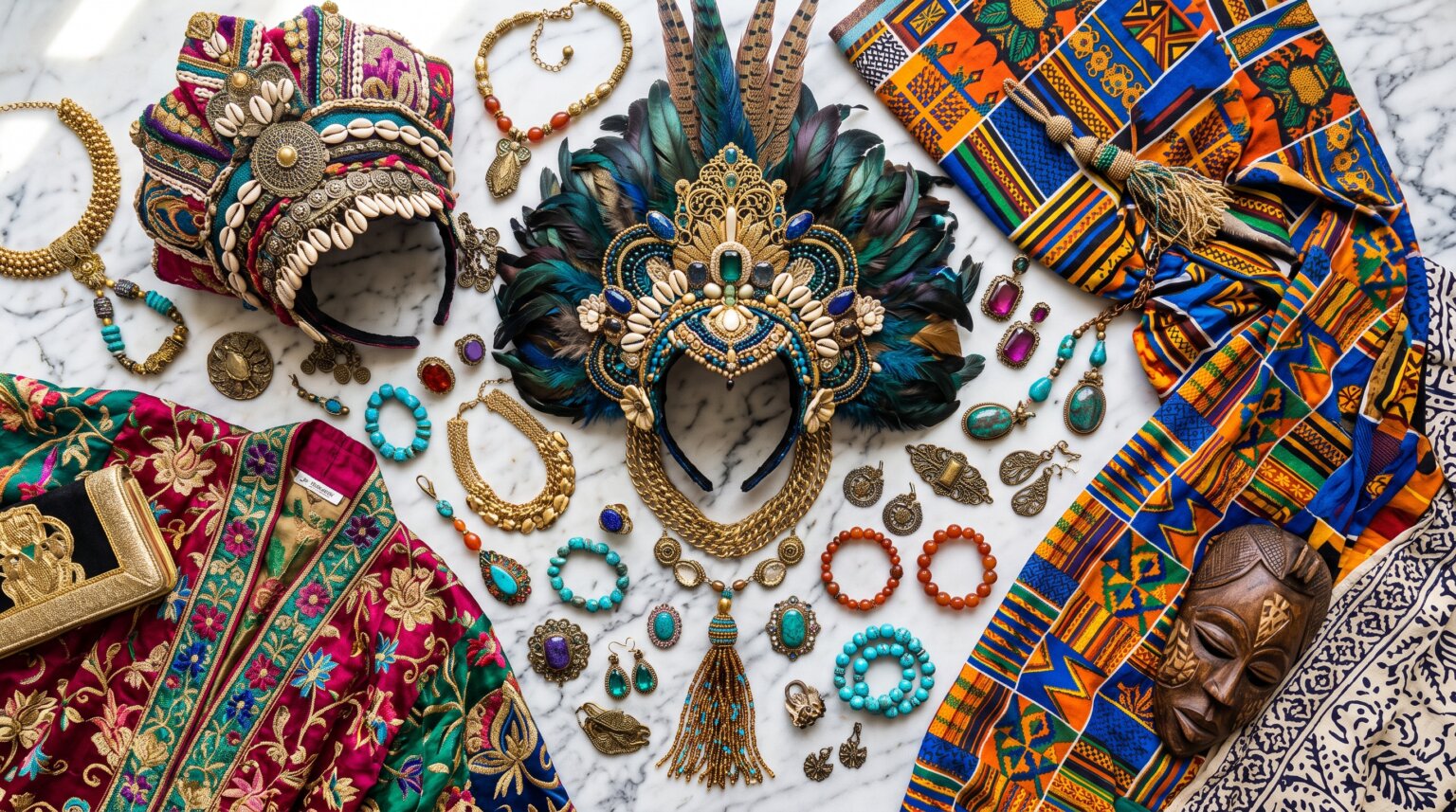
Daniel Lismore (born 24 December 1984) is a British fabric sculptor, designer, and campaigner described by Vogue as “England’s Most Eccentric Dresser.” Standing 6-foot-4 with waist-length raven hair, Lismore has spent decades turning himself into what he calls a living artwork, wearing elaborate sculptural ensembles assembled from thousands of objects gathered across the globe.
He is best known for his flamboyant dress sense, which serves simultaneously as fashion, performance art, and personal statement. His wardrobe includes over 3,000 pieces, many constructed using nothing more than safety pins. He never sews a single stitch.
In this guide, we explore who Daniel Lismore is, how he builds his sculptures, where he came from, and why Vogue crowned him the most eccentric dresser in all of England. Whether you discovered him through his TED talk, his V&A showcase, or a scroll through fashion photography, this is the full story of a man who made himself the canvas.
Table of Contents
Who Is Daniel Lismore?
Daniel Lismore is a fabric sculptor and fashion artist who transforms everyday and extraordinary materials into wearable art. Rather than designing clothes for other people, Lismore designs for himself, treating his own body as the gallery and the sculpture at once.
His work defies easy categorization. He is part designer, part performance artist, part campaigner, and part living exhibition. The fashion establishment has struggled to place him neatly because he does not follow seasonal collections or industry conventions. Instead, he creates spontaneously, responding to materials, moods, and moments.
Vogue Magazine gave him the title “England’s Most Eccentric Dresser,” and the label has followed him throughout his career. Lismore embraces it fully, seeing eccentricity not as an insult but as a badge of honor that signals authenticity over conformity.
His pieces have appeared in exhibitions at the Victoria and Albert Museum, SCAD Atlanta, and his hometown of Coventry. He has designed costumes for the English National Opera, delivered a TED talk watched by hundreds of thousands, and been named to the Out 100 List in 2017. Yet he remains deeply personal about his process, often describing his work in spiritual rather than technical terms.
At his core, Daniel Lismore is a man who decided that life itself could be art. Every outfit is an intentional creation, every public appearance a performance, and every day an opportunity to express something that words alone cannot capture.
Early Life and Background
Daniel Lismore was born on 24 December 1984 in Staffordshire and grew up in the Coventry area of the West Midlands. From an early age, he showed an interest in dressing up, costume, and theatrical self-presentation that set him apart from his peers.
His childhood in Coventry shaped much of his later identity. The city has a rich history of art and industry, and Lismore has spoken about returning there for exhibitions as a deeply meaningful experience. His connection to his hometown remains strong despite his global career.
As a young man, Lismore moved to London, where he immersed himself in the city’s vibrant nightlife and club culture. The underground scene of the early 2000s provided a space where outrageous self-expression was not just accepted but celebrated. This environment gave him the freedom to experiment with increasingly elaborate looks.
Before fully committing to his fabric sculpture career, Lismore worked in modeling and spent time in the music and nightlife industries. These experiences taught him about visual presentation, photography, and the power of a striking image. They also introduced him to the creative networks that would later support his transition into full-time art.
He has described his early years as a period of searching, trying on different identities and styles until he found the approach that felt true to who he was. That approach, treating each outfit as a sculpture and each day as a performance, became the foundation of everything that followed.
Daniel Lismore’s Fashion Philosophy and Creative Process
The most remarkable thing about Daniel Lismore’s creative process is what he does not do. He never sews. His go-to tool is the humble safety pin, and with it, he constructs elaborate sculptural garments that can weigh dozens of pounds and incorporate hundreds of individual elements.
Lismore describes himself as a fabric sculptor rather than a fashion designer. The distinction matters because his approach is fundamentally three-dimensional. He builds garments the way a sculptor builds form, layering materials, draping fabrics, and pinning elements together until the composition feels complete.
His materials come from everywhere. Vintage fabrics, antique jewelry, found objects, textiles from markets across Asia and Africa, pieces gifted by friends, and items sourced from flea markets all find their way into his wardrobe. Each piece carries a story, and Lismore often knows exactly where every element originated.
In interviews, he has been remarkably open about his methods. Speaking with 10 Magazine, he explained: “I decided to live my life as art. I spend hours, sometimes months making things. I never sew my creations. My go-to tool is the safety pin.” This confession reveals something important about his philosophy. The safety pin is improvisational, temporary, and endlessly adaptable, qualities that mirror his approach to identity itself.
The creative process can take hours or months depending on the piece. Some ensembles come together in a single afternoon of inspired pinning and draping. Others evolve slowly over years as he accumulates materials and waits for the right moment to bring them together.
What makes his work particularly striking is the sheer scale. Standing at 6-foot-4, already tall by any standard, Lismore’s sculptural additions can add another foot or more to his height. Headpieces tower, trains sweep the floor, and layers build outward in every direction. The visual effect is overwhelming in person and unforgettable in photographs.
His philosophy extends beyond construction techniques to a broader worldview. He believes that everyone has the capacity for creative self-expression, and that social conventions around dress are artificial constraints that can and should be challenged. This message of authenticity runs through every interview, exhibition, and public appearance he makes.
Be Yourself: The Exhibition That Changed Everything
The “Be Yourself” exhibition marked a turning point in Daniel Lismore’s career, transforming him from a cult figure in fashion circles to a recognized artist on the international stage. The exhibition debuted at SCAD Atlanta in 2016 and showcased selections from his staggering 3,000-piece wardrobe.
Vogue covered the exhibition extensively, noting that standing 6-foot-4 with waist-length raven hair, Lismore was already impossible to ignore in person. The exhibition gave audiences the chance to see his work up close, examine the construction details, and appreciate the range of his creative output over many years.
The exhibition was not a static display. Lismore designed it as an immersive experience, with mannequins wearing his sculptural ensembles arranged in theatrical tableaux. Visitors could walk among the pieces and see how fabrics, objects, and forms came together to create wearable art that defied conventional fashion display.
In 2021, the Victoria and Albert Museum in London hosted Lismore as part of its prestigious Fashion in Motion series. The V&A program, which has featured some of the world’s most influential designers, put Lismore’s work in the Raphael Gallery for a series of live catwalk presentations. This was a significant institutional validation from one of the world’s leading museums of art and design.
The exhibition also traveled to his hometown of Coventry, where it took on special significance. Returning to the city where he grew up, Lismore presented his work to the community that shaped him. The Culture Space Coventry venue hosted the show, giving local audiences a chance to see what the boy from their city had become.
Each iteration of “Be Yourself” carried the same fundamental message embedded in its title. Lismore’s work is not just about spectacle. It is a manifesto for authentic self-expression, a visual argument that everyone should feel free to present themselves to the world exactly as they are, however unconventional that might be.
Career Highlights: Opera, TED Talks, and Fashion Collaborations
Daniel Lismore’s career extends far beyond personal wardrobe sculpture. He has brought his distinctive aesthetic to opera, film, public speaking, and high-fashion collaborations, demonstrating a versatility that surprises people who initially see him only as an eccentric dresser.
The English National Opera commissioned Lismore to design costumes, bringing his sculptural sensibility to the operatic stage. Opera costume design demands dramatic visual impact visible from the back row of a theater, and Lismore’s larger-than-life aesthetic translated naturally to the art form. His work brought a fresh contemporary energy to classical productions.
His TED talk brought his philosophy to a global audience. Speaking about living life as art, Lismore shared his belief that self-expression through dress is a form of personal freedom available to everyone. The talk resonated far beyond fashion circles, reaching viewers interested in creativity, identity, and living authentically.
In the fashion world, Lismore has collaborated with numerous designers and brands. His work with SORAPOL, the London-based jewelry and fashion house known for its bold sculptural pieces, produced some of his most memorable looks. The collaboration made sense because both Lismore and SORAPOL share an approach to fashion that prioritizes visual impact over practicality.
In 2017, Lismore was selected for the Out 100 List, an annual recognition of influential LGBTQ+ individuals published by Out Magazine. The honor acknowledged not just his aesthetic contributions but his role as a visible, unapologetically authentic figure in British public life.
He has also appeared in numerous fashion publications beyond Vogue, including 10 Magazine and various international titles. Fashion photographers seek him out because his look guarantees a striking image, and his willingness to push boundaries aligns with the creative ambitions of editorial shoots.
Performance art remains central to his practice. Every public appearance is, in a sense, a performance, whether he is walking through London, attending a gallery opening, or speaking on stage. Lismore does not distinguish between his art and his life because the two are permanently intertwined.
Living Life as Art: The Philosophy Behind the Persona
The phrase “living life as art” is not a marketing slogan for Daniel Lismore. It is the organizing principle of his entire existence, the decision from which every other choice flows. In an interview with Suzanne Dang, he stated it plainly: “I am an artist. I live my life as an artwork.”
This philosophy means that getting dressed each morning is a creative act. It means that walking down the street is a performance. It means that the boundary between the person and the art dissolves completely, leaving only the living artwork itself.
The commitment required is immense. Lismore’s ensembles can take hours to construct and wear. Some pieces are heavy, physically demanding, and impossible to sit down in comfortably. Maintaining this level of visual presentation every single day requires a dedication that goes far beyond ordinary fashion enthusiasm.
Yet Lismore frames this not as sacrifice but as liberation. By rejecting the idea that clothing must be practical, comfortable, or socially acceptable, he frees himself to explore identity in ways that most people never attempt. His message to others is that this same freedom is available to anyone willing to claim it.
His philosophy has particular resonance for people who feel constrained by social norms around gender, appearance, and self-presentation. By living so visibly outside conventional boundaries, Lismore models a form of courage that inspires others to experiment with their own self-expression, even in smaller ways.
Community impact is also part of his philosophy. When he returned to Coventry for his exhibition, he spoke about the importance of bringing art back to the places that shaped artists. He sees himself not as an isolated figure but as part of a broader conversation about creativity, identity, and the courage to be different.
Daniel Lismore’s Impact on Fashion and Culture
Daniel Lismore occupies a unique position in British fashion. He is not a conventional designer, not a traditional model, and not a typical performance artist. This ambiguity has allowed him to influence multiple worlds simultaneously, bringing ideas from one sphere into another in ways that provoke new thinking.
Within avant-garde fashion, Lismore represents an extreme position that challenges even the boundaries of experimental design. His total commitment to living sculpture pushes the conversation about what fashion can be further than most designers are willing to go. He demonstrates that clothing can be fine art, not just applied art or commercial product.
His presence on social media has amplified his reach beyond the art world. Photographs of his elaborate ensembles circulate widely online, introducing his work to audiences who might never visit a gallery or attend a fashion show. Each image becomes a standalone artwork, shareable and instantly striking.
In the broader context of British eccentric dressers, Lismore continues a tradition that includes figures like Isabella Blow, Stephen Jones, and Leigh Bowery. What sets him apart is his consistency and his explicit framing of dress as sculpture rather than fashion. He is not styling outfits. He is building art objects that happen to be wearable.
His influence extends to younger creatives who see in his example the possibility of building a career around radical self-expression. By proving that an unconventional approach can lead to museum exhibitions, opera commissions, and international recognition, Lismore has expanded what emerging artists believe is possible.
FAQs
Who is Daniel Lismore?
Daniel Lismore is a British fabric sculptor, designer, and campaigner born on 24 December 1984. Vogue Magazine described him as England’s Most Eccentric Dresser. He is known for living his life as a living artwork, wearing elaborate sculptural ensembles constructed from thousands of objects gathered worldwide.
How does Daniel Lismore create his sculptures?
Daniel Lismore creates his wearable sculptures using safety pins as his primary tool and never sews his creations. He gathers fabrics, vintage objects, antiques, and materials from markets around the world, then layers and pins them together into elaborate three-dimensional garments. Some pieces take hours to construct while others evolve over months.
Is Daniel Lismore a performance artist?
Yes, Daniel Lismore functions as a performance artist. He describes himself as someone who lives his life as an artwork, meaning every public appearance becomes a performance. He has also designed costumes for the English National Opera and presented his work through the Vu0026amp;A Fashion in Motion live catwalk series.
What is Daniel Lismore’s background?
Daniel Lismore was born in Staffordshire and grew up in Coventry in the West Midlands. He later moved to London where he became involved in nightlife, club culture, and modeling before developing his signature approach to fabric sculpture and living his life as art.
What does Daniel Lismore do?
Daniel Lismore is a fabric sculptor and fashion artist who creates wearable art from his 3,000-piece wardrobe of materials sourced globally. He exhibits his work internationally, designs opera costumes, speaks publicly about authentic self-expression, and campaigns for individuality through his Be Yourself exhibitions.
Conclusion: The Living Artwork of Daniel Lismore
Understanding who Daniel Lismore is, England’s most eccentric dresser, means accepting that some people refuse to separate art from life. He builds sculptures you can wear, delivers performances just by walking outside, and turns every day into an act of creative defiance against conformity.
From his beginnings in Coventry to the Raphael Gallery at the V&A, from safety pins to the English National Opera, Lismore has built a career on the radical idea that authenticity matters more than convention. His 3,000-piece wardrobe is not a collection. It is a body of work, accumulated and assembled over a lifetime of treating self-expression as the highest form of art.
Whether you encounter him through his TED talk, his Be Yourself exhibitions, or a striking photograph online, the message is the same. Be yourself, whatever that looks like, however eccentric it may seem. For Daniel Lismore, that message is not just words. It is the way he lives every single day.