
Walk down Old Compton Street in Soho today and you will find fish and chips shops, cocktail bars, and crowds of tourists. But if you stop at number 59 and look up, you will see a green plaque marking one of the most important addresses in music history. This was the 2i’s Coffee Bar, the tiny basement venue widely regarded as the birthplace of British rock and roll.
The 2i’s Coffee Bar was a cramped cellar coffeehouse that opened on April 22, 1956, at 59 Old Compton Street in Soho, London. It could hold roughly 20 people standing. Its stage measured about 18 inches high, built from milk crates. Yet from this unassuming basement emerged Tommy Steele, Cliff Richard, Adam Faith, and dozens of other artists who defined British popular music for generations.
How did a coffee bar no bigger than a living room launch an entire musical movement? The answer involves post-war youth culture, a DIY music craze called skiffle, two wrestling promoters with an eye for talent, and a basement that became the most important address in British music history.
Table of Contents
How a Tiny Soho Coffee Bar Launched British Rock and Roll
To understand how the 2i’s Coffee Bar launched British rock and roll, you have to understand the world that created it. Britain in the early 1950s was exhausted. The Second World War had ended in 1945, but rationing continued until 1954. Cities were still rebuilding from the Blitz. Entertainment options for young working-class people were limited to cinemas, dance halls, and pubs.
Then something unprecedented happened. The concept of the “teenager” emerged. For the first time in British history, young people had disposable income, leisure time, and a desire for their own culture separate from their parents. They did not want to sit in pubs listening to their fathers’ generation. They wanted something new.
Soho became the natural gathering point. Long the bohemian heart of London, Soho had been home to artists, writers, immigrants, and night owls for centuries. By the mid-1950s, it was also becoming the centre of a new kind of social space: the Italian-style coffee bar.
The coffee bar revolution started with the Gaggia espresso machine. When Italian immigrants brought these machines to London, they transformed the social landscape. Unlike pubs, coffee bars did not need alcohol licenses. They could stay open late. They welcomed teenagers. And crucially, many of them had basements or back rooms where live music could happen without disturbing the neighbours.
Soho was suddenly filled with coffee bars. The Cat’s Whisker, the Macabre, the Mocamba, and dozens of others dotted the narrow streets. But one tiny basement venue at 59 Old Compton Street would outshine them all.
The Founding: How Two Wrestling Promoters Created History
The building at 59 Old Compton Street had a colourful history before it became the 2i’s. It was originally a restaurant run by the Irani brothers, a family of Parsee immigrants who operated several eating houses in Soho. The Iranis leased the basement to various tenants over the years.
In early 1956, two professional wrestling promoters named Paul Lincoln and Ray Hunter took over the lease. Lincoln wrestled professionally under the name “Dr. Death” and was a well-known figure on the British wrestling circuit. Hunter was his business partner. Together, they decided to convert the basement into a coffee bar.
The name “2i’s” has been the subject of some debate among historians. The most widely accepted explanation is that it stood for “two Irani’s,” a nod to the building’s original owners. Another theory suggests it referred to the two founders, Lincoln and Hunter. Regardless of its origin, the name stuck and became legendary.
The 2i’s Coffee Bar opened its doors on April 22, 1956. Lincoln and Hunter fitted the basement with an espresso machine, a counter serving coffee and soft drinks, and a tiny raised stage at one end. They installed a jukebox loaded with American rock and roll records. The menu was simple: coffee, Coca-Cola, orange juice, and sandwiches.
What happened next surprised everyone, including the owners themselves.
Inside the 2i’s: What It Was Actually Like
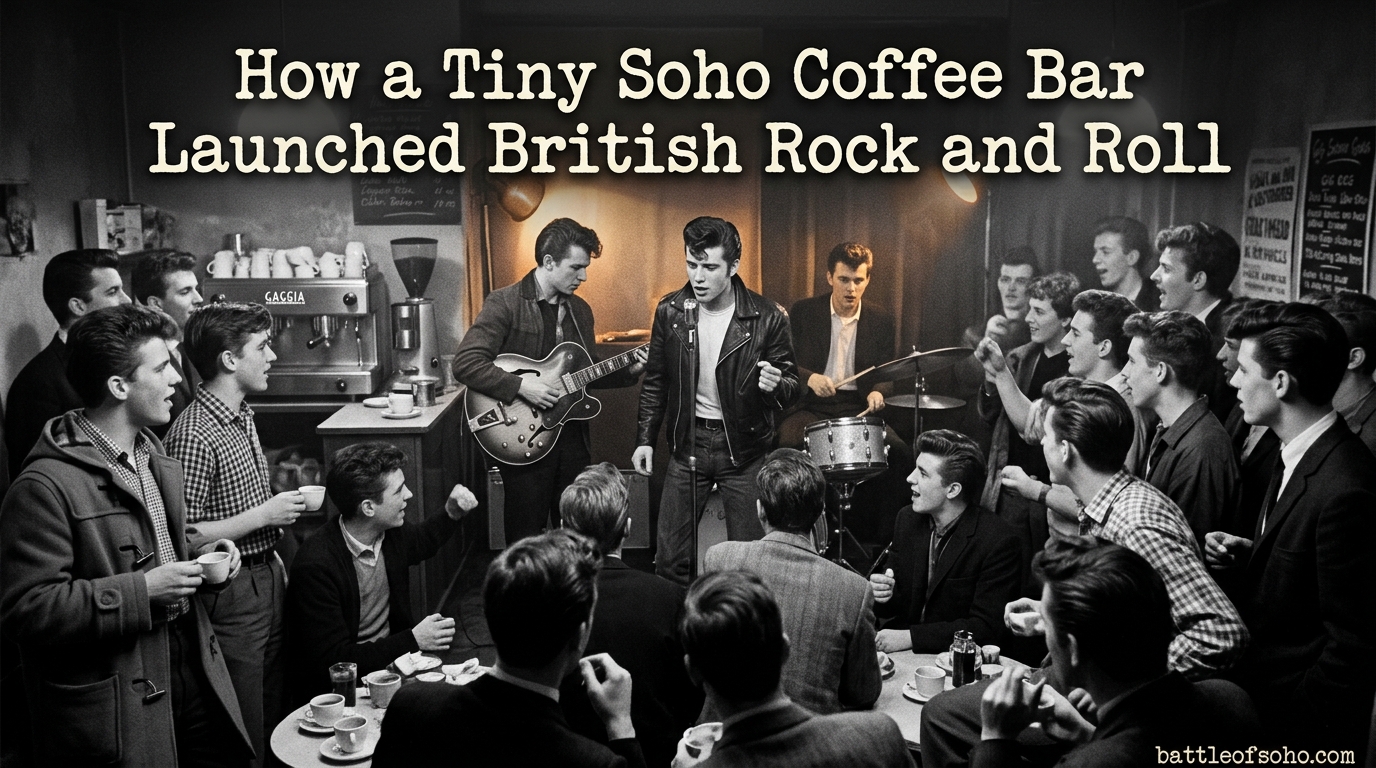
Imagine walking down a narrow staircase into a cellar beneath Old Compton Street. The air is thick with cigarette smoke and the hiss of the espresso machine. The ceiling is low enough that tall people have to duck. The entire room is perhaps 20 feet long and 15 feet wide, with standing room for about 20 people packed shoulder to shoulder.
At one end of the room sits an 18-inch stage cobbled together from milk crates and wooden planks. There is a single microphone. The sound system is rudimentary at best. The walls are bare brick, damp in winter. A neon sign glows behind the counter. Sandwiches sit in a small display case. An orange juice dispenser hums in the corner.
This was the 2i’s Coffee Bar. It was not glamorous. It was not comfortable. But for the teenagers who crowded into that basement night after night, it was the most exciting place in Britain.
A typical evening at the 2i’s started around seven o’clock. Teenagers would queue down the stairs and into the street. The crowd was a mix of working-class kids from across London, art students, Teddy Boys in their drape jackets and brothel creepers, and the occasional curious adult who had heard something was happening in Soho. They drank coffee because they were too young for pubs. They listened to the jukebox playing Elvis Presley, Little Richard, and Bill Haley. And they watched live music performed inches from their faces.
The intimacy was the point. At the 2i’s, you could reach out and touch the performers. The band was not on a distant stage under spotlights. They were standing right in front of you, close enough to see the sweat on their foreheads. When Tommy Steele or the Vipers Skiffle Group played, the sound bounced off the brick walls and filled every corner of that tiny cellar. It was raw, immediate, and electrifying.
No competitor writing about the 2i’s has fully captured what it felt like to be in that room. The closest comparison might be the Cavern Club in Liverpool, which was similarly cramped and intense. But the Cavern opened in 1957, a year after the 2i’s, and was partly inspired by what was happening in Soho.
The Skiffle Revolution That Fueled the 2i’s
The music that first filled the 2i’s was not rock and roll. It was something called skiffle, and understanding skiffle is essential to understanding how a coffee bar launched British rock and roll.
Skiffle was a DIY music craze that swept Britain in the mid-1950s. It was played on homemade and improvised instruments: acoustic guitars, washboards played with thimbles, tea chest basses made from a wooden tea crate, a broom handle, and a piece of string. The sound was raw, rhythmic, and enormously infectious. It drew from American folk, blues, and jug band traditions.
The skiffle explosion was triggered by one man and one record. In 1956, Lonnie Donegan released “Rock Island Line,” a driving, energetic track that became a sensation. It sold over a million copies and inspired thousands of teenagers to form their own skiffle groups. John Lennon formed The Quarrymen after hearing Donegan. The skiffle craze put guitars into the hands of a generation of British teenagers who would go on to form rock bands.
The 2i’s Coffee Bar became the epicentre of live skiffle in London. The Vipers Skiffle Group, featuring Wally Whyton, became the resident band. They played night after night to packed crowds in the basement. Other skiffle groups flocked to the 2i’s because it was one of the few venues in London where young, unknown musicians could get a gig. You did not need an agent or industry connections. You just needed to show up, plug in your guitar, and play.
This openness was revolutionary. Traditional music venues in 1950s Britain catered to dance bands, jazz orchestras, and established performers. They did not book teenagers with homemade instruments. The 2i’s broke that barrier. And as skiffle evolved into rock and roll, the 2i’s evolved with it.
The Stars: Who Was Discovered at the 2i’s Coffee Bar
This is where the story of the 2i’s Coffee Bar moves from interesting to extraordinary. The tiny basement at 59 Old Compton Street became the most effective talent discovery machine in British music history. Dozens of major artists either got their start at the 2i’s or were discovered there by industry figures who haunted the venue looking for the next big thing.
The most famous discovery was Tommy Steele. Born Thomas Hicks in Bermondsey, South London, Steele was a 19-year-old merchant seaman when he started singing at the 2i’s in 1956. His big break came when John Kennedy, a freelance talent scout, saw him performing in the basement and was blown away. Kennedy became Steele’s manager and within months, Steele had a recording contract, a chart-topping single with “Rock With The Cavemen,” and a film deal. Tommy Steele became Britain’s first homegrown rock and roll star.
Cliff Richard’s connection to the 2i’s is equally significant. Richard performed at the venue early in his career, and it was in the Soho coffee bar scene that his career took shape. His 1958 single “Move It,” often cited as the first authentic British rock and roll record, grew directly from the musical culture the 2i’s had created. Richard would go on to become one of the biggest-selling artists in British history.
Adam Faith was another 2i’s discovery. Faith was singing at the coffee bar when he was spotted and signed to a recording contract. His smooth vocals and boyish looks made him a teen idol, and he scored a string of hits in the early 1960s.
The list goes on. Joe Brown, one of Britain’s most respected guitarists, played at the 2i’s. Marty Wilde, another major star of the late 1950s, performed there. Wee Willie Harris, known as the “Wild Man of British Rock and Roll,” was a 2i’s regular whose frenetic performances became legendary. Bruce Welch and Hank Marvin, who would form The Shadows and back Cliff Richard on his biggest hits, were 2i’s regulars.
The impresario Larry Parnes turned the 2i’s into his personal talent pipeline. Parnes was famous for discovering young men in the Soho coffee bars, giving them stage names, and turning them into polished pop stars. He transformed Reg Patterson into Marty Wilde, Ronald Wycherley into Billy Fury, and managed several other 2i’s-era performers. Parnes understood that the 2i’s was the best place in Britain to find raw talent.
Other notable performers who graced the milk-crate stage included Ritchie Blackmore, who would later found Deep Purple, and Gary Glitter, who performed at the venue in the early 1960s. The Allisons, who would go on to represent the UK at Eurovision in 1961, sang at the 2i’s in August 1959. The sheer density of future stars who passed through that basement is staggering.
The Staff Who Became Legends
The performers were not the only people at the 2i’s who went on to greatness. The coffee bar’s staff included several individuals who would become enormously influential in the music industry.
Peter Grant worked at the 2i’s before becoming one of the most powerful managers in rock history. Grant managed Led Zeppelin and is widely regarded as one of the first managers to demand fair treatment and proper compensation for artists. His time at the 2i’s, where he saw how young musicians were treated by the industry, shaped his later approach to artist management.
Mickie Most was another 2i’s alumnus who became a production powerhouse. After his time in the Soho coffee bar scene, Most went on to produce hit records for Donovan, The Animals, Lulu, and Jeff Beck. He had an extraordinary ear for commercial pop and rock, and his production work defined the sound of British music in the 1960s.
Lionel Bart, who would later compose the musical Oliver! and write the James Bond theme “From Russia with Love,” was a regular presence in the 2i’s scene. Bart was deeply embedded in the Soho cultural world and drew on its energy and characters in his songwriting.
Even Marc Bolan, who would later found T. Rex and become one of the pioneers of glam rock, had connections to the 2i’s world through the Soho music scene that the coffee bar had created.
Talent Scouts and the A&R Machine
The 2i’s Coffee Bar did not just produce stars by accident. It operated as a crucial node in the British music industry’s talent discovery system, and understanding how that system worked reveals why a coffee bar in a Soho basement mattered so much.
A&R stands for “Artists and Repertoire.” A&R men were talent scouts employed by record labels like EMI, Decca, and Pye to find new performers and guide their artistic development. In the 1950s, before social media, before television talent shows, and before the internet, A&R men had to physically go where young musicians were performing. And in late-1950s Britain, that meant the Soho coffee bars.
The 2i’s was the epicentre. Night after night, A&R representatives from major labels would squeeze into the basement, drink coffee, and watch the acts. If someone caught their ear, they would approach them after the set, offer them a recording test, and potentially sign them to a contract. The path from the 2i’s milk-crate stage to a recording studio at Abbey Road was surprisingly short.
Freelance talent scouts like John Kennedy, who discovered Tommy Steele, worked the room regularly. Producer Jack Good, who created the BBC television show Six-Five Special, used the 2i’s as a recruiting ground for on-screen talent. The show, which launched in 1957, was Britain’s first teenage music television programme and featured many artists who had come through the Soho coffee bar circuit.
This system created a feedback loop. The 2i’s attracted talented young performers because it had a reputation for discovery. A&R men went to the 2i’s because that is where the best new talent was. The more stars discovered at the 2i’s, the more it attracted both performers and scouts. The coffee bar became a self-reinforcing engine of talent discovery.
The Beatles Connection: How the 2i’s Inspired Liverpool
The influence of the 2i’s Coffee Bar extended far beyond Soho. Its model of a basement coffee bar hosting live music for teenagers was replicated across Britain, and one particular imitation changed the course of music history.
In Liverpool, a woman named Mona Best decided to open her own coffee club in the basement of her family home at 8 Haymans Green. She had been inspired by the Soho coffee bar scene, and specifically by the kind of venue the 2i’s represented: an intimate, teenager-friendly space where live bands could play. She called it the Casbah Coffee Club.
The Casbah opened in August 1959, and a young Liverpool band called The Quarrymen, featuring a singer-guitarist named John Lennon, played the opening night. The Quarrymen would eventually evolve into The Beatles. The Casbah became their early residency, the place where they developed their sound and their following before heading to Hamburg.
The connection is direct and powerful. The 2i’s Coffee Bar in Soho pioneered the concept of the basement coffee bar as a music venue. Mona Best took that concept to Liverpool. The Casbah gave The Beatles their start. Without the 2i’s, the entire British music landscape might have looked different.
George Martin, the producer who would sign The Beatles to Parlophone and shape their sound at Abbey Road, was also part of the broader Soho music world that the 2i’s had helped create. As head of A&R at Parlophone, Martin worked in the same ecosystem of London labels, producers, and talent scouts that the 2i’s had fed for years. The through-line from a Soho basement to the biggest band in history is remarkably short.
The Hamburg connection adds another layer. The Beatles travelled to Hamburg to play the Kaiserkeller and other clubs on the Reeperbahn. The British musicians who blazed that trail, including performers who had come through the 2i’s scene, helped establish the Liverpool-to-Hamburg circuit that would prove so important to The Beatles’ development.
What Remains: The Legacy of the 2i’s Today
The 2i’s Coffee Bar did not last forever. The skiffle and rock and roll boom that had made it famous began to fade in the early 1960s as the music industry professionalised. Larger venues, proper concert halls, and the rise of beat clubs like the Marquee and the Crawdaddy drew audiences away from coffee bars. The 2i’s closed its doors in 1970.
A second branch of the 2i’s had opened at 44 Gerrard Street in Chinatown, but it closed even sooner. The original site at 59 Old Compton Street went through various incarnations over the decades. For years, it seemed like the birthplace of British rock and roll might be forgotten entirely.
That changed in September 2006, when Westminster City Council unveiled a green plaque at 59 Old Compton Street commemorating the 2i’s Coffee Bar as the birthplace of British rock and roll. The plaque was the result of years of campaigning by music historians and fans who recognised the venue’s importance. Several original performers and staff attended the ceremony.
Today, 59 Old Compton Street is occupied by Poppies Fish and Chips, a classic Soho institution. But the 2i’s has not been entirely erased. The green plaque is prominently displayed. Inside, the restaurant has preserved some of the original memorabilia, including the neon sign from the 2i’s era and photographs from the basement’s musical heyday. The physical basement where Tommy Steele and Cliff Richard once performed still exists beneath the building.
Music heritage tours regularly stop at the site. Gary Kemp of Spandau Ballet has been an active promoter of 2i’s history on social media. Billy Bragg’s 2017 book “Roots, Radicals and Rockers” brought scholarly attention to the skiffle movement that the 2i’s championed. The venue’s legacy is kept alive by a dedicated community of music historians, fans, and heritage organisations.
FAQs
What was the 2i’s Coffee Bar?
The 2i’s Coffee Bar was a tiny basement coffeehouse at 59 Old Compton Street in Soho, London, that opened on April 22, 1956, and became known as the birthplace of British rock and roll. It could hold about 20 people and featured an 18-inch stage built from milk crates.
Who was discovered at the 2i’s Coffee Bar?
Tommy Steele was the most famous discovery, becoming Britain’s first homegrown rock and roll star after being spotted at the 2i’s in 1956. Other notable performers and discoveries include Cliff Richard, Adam Faith, Marty Wilde, Billy Fury, Joe Brown, Wee Willie Harris, Ritchie Blackmore, and members of The Shadows.
When did the 2i’s Coffee Bar open and close?
The 2i’s Coffee Bar opened on April 22, 1956, and closed in 1970. It operated for approximately 14 years, with its most active and influential period running from 1956 to about 1962.
Where was the 2i’s Coffee Bar located?
The 2i’s Coffee Bar was located at 59 Old Compton Street in the Soho district of London. The venue occupied a basement cellar beneath what is now Poppies Fish and Chips, near Leicester Square.
Is the 2i’s Coffee Bar still open?
No, the 2i’s Coffee Bar closed in 1970. The site at 59 Old Compton Street is now occupied by Poppies Fish and Chips, but a green plaque from Westminster City Council commemorates the location, and some original memorabilia including the neon sign has been preserved inside.
Why was the 2i’s Coffee Bar called the birthplace of British rock and roll?
The 2i’s earned the title because it was the venue where Britain’s first homegrown rock and roll stars were discovered and launched. Tommy Steele, widely considered the first British rock and roll star, was discovered there in 1956. The venue’s role in launching the careers of dozens of major artists and pioneering the basement coffee bar music format cemented its status.
What is the connection between the 2i’s Coffee Bar and the Beatles?
The 2i’s pioneered the basement coffee bar as a live music venue, a concept that inspired Mona Best to open the Casbah Coffee Club in Liverpool in 1959. The Casbah was where The Quarrymen, who became The Beatles, played their early residency. Producer George Martin also worked in the same London music industry ecosystem that the 2i’s had helped build.
What replaced the 2i’s Coffee Bar?
The site at 59 Old Compton Street is now occupied by Poppies Fish and Chips, a well-known Soho restaurant. The establishment has preserved some 2i’s memorabilia, including the neon sign and historical photographs, and a green plaque on the exterior marks the building’s musical significance.
The Little Basement That Could
The story of how a tiny Soho coffee bar launched British rock and roll is really a story about what happens when you give talented people a place to perform. The 2i’s Coffee Bar was not fancy. It was a damp cellar with a milk-crate stage, a single microphone, and an espresso machine. But it was there, in that cramped basement at 59 Old Compton Street, that Britain found its own voice in rock and roll.
Every British artist who picked up a guitar after 1956 owes something to the 2i’s. The stars discovered there, from Tommy Steele to Cliff Richard, proved that Britain could produce its own rock and roll, not just import it from America. The coffee bar model the 2i’s pioneered spread to Liverpool, where it gave the Beatles their start. The staff who worked there went on to manage Led Zeppelin, produce The Animals, and compose Oliver!.
The next time you hear a British rock record, think about that little basement in Soho. The 2i’s Coffee Bar closed its doors in 1970, but its echo can still be heard in every chord. If you are in London, walk down Old Compton Street, find number 59, and look for the green plaque. Stand where history was made, in a room so small that 20 people changed the world.