
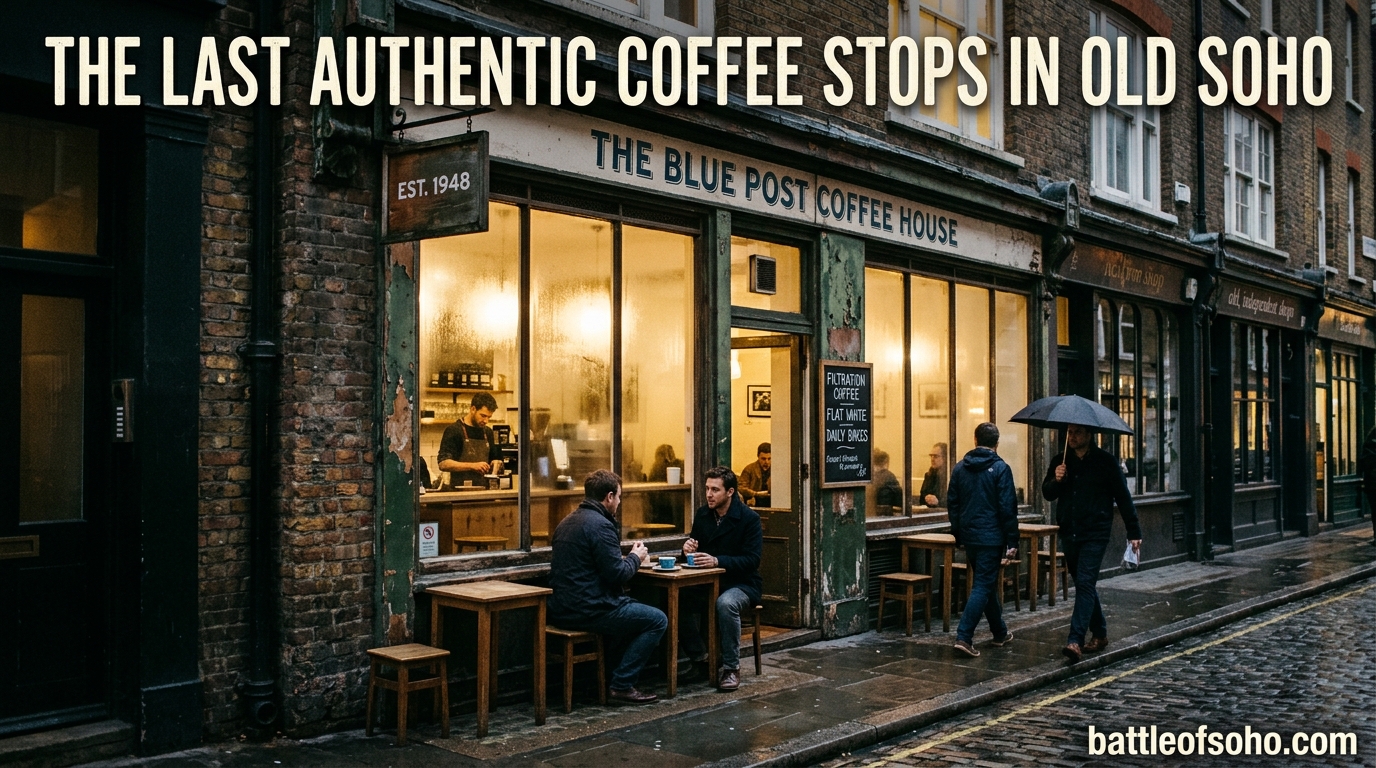
Walk through Soho on any given morning and you will hear a dozen languages before you reach the end of Old Compton Street. The espresso machines are humming. Someone is arguing about football in Italian. A barista is dialing in a single origin Ethiopian that arrived yesterday. This is the Soho that refuses to disappear, even as glass-fronted chain outlets multiply on every corner.
But if you know where to look, tucked between the neon signs and the construction hoardings, there are places that have been serving coffee since before anyone knew what a flat white was. These are the last authentic coffee stops in Old Soho, and this guide will walk you through every one of them.
Our team spent three months visiting, revisiting, and researching these independent coffee shops to understand what makes each one irreplaceable. We talked to regulars, watched the morning rush, and tracked down the family histories behind the counters. What we found is a living archive of London coffee culture that is fighting to survive.
Table of Contents
Why Old Soho’s Coffee Culture Is Worth Preserving
Soho’s relationship with coffee stretches back to the Enlightenment era, when coffee houses functioned as meeting rooms for philosophers, writers, and political radicals. These were not cafes in the modern sense. They were social institutions where ideas were debated over thick, dark brews imported from distant ports. That tradition of coffee as community fuel never left the neighbourhood.
What has changed is the pressure. Rising commercial rents in Soho have forced dozens of long-standing independents to shut their doors over the past two decades. According to discussions on Reddit communities like r/JamesHoffmann and r/london, coffee enthusiasts consistently cite gentrification and chain saturation as the biggest threats to the area’s character. The complaint comes up again and again: the places that made Soho feel like Soho are vanishing.
So what separates an authentic coffee stop from just another cafe with a nice logo? In our view, it comes down to three things: longevity and family heritage, a refusal to standardise the experience, and a genuine connection to the neighbourhood’s history. The shops on this list have all three. None of them opened to chase a trend. They opened because someone had a recipe, a roaster, or a cultural tradition they wanted to share, and they never stopped.
Independent coffee shops in Soho face a daily battle against corporate competitors who can absorb higher leases and outspend them on marketing. Every year that these family-run cafes and historic stores keep their doors open is a small victory for London’s cultural identity. That is why documenting them matters, and why visiting them matters even more.
The Last Authentic Coffee Stops in Old Soho
This is our definitive guide to the authentic coffee stops Old Soho still has to offer. Each spot below represents a different strand of the neighbourhood’s coffee DNA, from 19th-century bean merchants to the cafe that brought Antipodean flat white culture to London.
1. Bar Italia (21 Frith Street)
If there is a spiritual centre of Old Soho coffee, this is it. Bar Italia has been pouring espresso on Frith Street since 1949, when the Polledri family opened the doors of what would become a Soho institution. Three generations later, the family is still behind the counter.
The interior has barely changed. You will find the same Formica counter, the same vintage espresso machine, and a large wall-mounted television that seems permanently tuned to Italian football. Stand at the counter like the regulars do, order a single espresso, and drink it in three sips. That is the Bar Italia way.
The coffee itself is a dark, traditional Italian roast that rewards anyone who prefers intensity over floral tasting notes. The cappuccino here is the standard by which other Soho cappuccinos should be measured. Visit early in the morning when the light hits Frith Street at just the right angle and the place feels frozen in time.
Address: 21 Frith Street, Soho, London W1D 5DN
Best for: Traditional Italian espresso and people watching
2. Algerian Coffee Stores (52 Old Compton Street)
Algerian Coffee Stores has been trading on Old Compton Street since 1887, which makes it one of the oldest coffee retailers in London. Step inside and you are immediately hit with the aroma of freshly roasted beans from every corner of the coffee-growing world. This is not a sit-down cafe. It is a working coffee merchant, and that distinction is exactly what makes it special.
The shop stocks over 80 varieties of coffee beans alongside a serious selection of rare teas. The staff know their product inside out. Tell them you like bright, fruity coffees and they will hand you a bag of Ethiopian Yirgacheffe before you finish the sentence. Prefer something rich and chocolatey? They have a Brazilian single origin that drinks like a warm hug.
For visitors asking where the 125 year old cafe in London is, this is your answer. Algerian Coffee Stores passed that milestone over a decade ago and shows no sign of slowing down. The shop is narrow, always busy, and utterly uninterested in chasing modern cafe trends. That is precisely why people keep coming back.
Address: 52 Old Compton Street, Soho, London W1D 4UG
Best for: Buying single origin beans and discovering new roasts
3. Flat White (17 Berwick Street)
Flat White on Berwick Street is widely credited with introducing Antipodean cafe culture to London when it opened in 2005. Before this small, unassuming corner spot arrived, the flat white as a drink was virtually unknown in the capital. That changed quickly.
The cafe is tiny. There are maybe a dozen seats, a bar along the window, and a constant queue of people who know this is where the flat white was perfected in London. The milk texturing here is the real deal, silky and glossy, poured over expertly extracted espresso from beans roasted by suppliers who take their craft seriously.
What makes Flat White an authentic Soho stop rather than just another specialty cafe is its role in a specific cultural moment. This is the place that shifted London’s coffee expectations. The fact that it has stayed small and focused while the area exploded around it says everything about the owners’ commitment to quality over expansion.
Address: 17 Berwick Street, Soho, London W1F 0AH
Best for: The flat white that started it all in London
4. London Grand Coffee (11 Warwick Street)
Tucked just off the main Soho drag, London Grand Coffee is the kind of place you walk past three times before noticing. That is part of its charm. This is a backstreet coffee gem in the truest sense, serving serious espresso drinks without any of the fanfare.
The focus here is on Italian-style coffee done properly. The baristas pull shots with precision, and the result is a balanced, full-bodied espresso that holds up in any milk drink. Regulars on coffee forums consistently mention this spot as an underrated favourite, a place where the coffee does the talking and the branding stays out of the way.
If you are planning a coffee crawl through Soho and want to escape the crowds, London Grand Coffee is your mid-morning sanctuary. Grab a quick espresso, stand at the counter, and appreciate a shop that prioritises the cup over everything else.
Address: 11 Warwick Street, Soho, London W1B 5LR
Best for: Quiet, high-quality espresso away from the crowds
5. Hideaway Coffee (7 Farrier’s Passage)
The name says it all. Hideaway Coffee lives up in Farrier’s Passage, a narrow cut-through that most people walking through Soho will never find. Those who do are rewarded with one of the most genuine independent coffee experiences in the neighbourhood.
The space is small and intentionally understated. No flashy interior design, no walls of branded merchandise. Just a focused menu of well-made coffee and a handful of seats. The beans rotate regularly, giving regulars a reason to keep coming back to see what is on the grinder today.
Hideaway represents the newer wave of authentic Soho coffee culture: independent, quality-obsessed, and community-rooted. It may not have a century of history behind it like Algerian Coffee Stores, but it has the same spirit. This is a place built by people who care about coffee and want to share it without compromise.
Address: 7 Farrier’s Passage, Soho, London W1D 6AH
Best for: A hidden, quiet coffee moment off the beaten path
6. Bar Bruno (101 Wardour Street)
Bar Bruno is a Soho survivor. This Italian-run cafe on Wardour Street has been serving the neighbourhood through decades of change, maintaining its identity while the street around it transformed completely. Walking in feels like stepping into a Soho that has largely disappeared.
The menu leans traditional Italian. Expect strong espresso, properly built cappuccinos, and a welcoming counter where regulars are greeted by name. The atmosphere is unpretentious and warm, the kind of place where the staff remember your order after your second visit.
In a neighbourhood where many independents have been priced out, Bar Bruno stands as proof that character and consistency still count for something. It is the type of place you visit for a quick coffee and end up staying for a conversation with the person next to you at the counter.
Address: 101 Wardour Street, Soho, London W1F 0UN
Best for: Old-school Italian cafe atmosphere and strong espresso
7. Tony’s Hatch at All Is Joy (75 Dean Street)
Tony’s Hatch operates inside All Is Joy on Dean Street, and it represents something different from the other spots on this list. This is the new generation of authentic Soho coffee, a pop-up-style coffee hatch that has earned a permanent place in the neighbourhood’s coffee conversation.
The setup is minimal. Tony serves coffee from a small hatch within a larger creative space, and the focus is entirely on the cup. The beans are carefully sourced, the extraction is precise, and the result is specialty-grade coffee served without ceremony. It is the kind of spot that coffee forum regulars on r/JamesHoffmann get genuinely excited about.
What makes Tony’s Hatch authentically Soho is its independence and its refusal to fit into any category. It is not a traditional Italian cafe, it is not a heritage bean merchant, and it is not trying to be either. It is simply a person making excellent coffee in a neighbourhood that values exactly that.
Address: 75 Dean Street, Soho, London W1D 3PU
Best for: Specialty coffee from an independent hatch
How to Plan Your Own Old Soho Coffee Crawl
One of the best ways to experience these authentic coffee stops in Old Soho is to turn them into a crawl. You can hit four or five in a single morning if you pace yourself, and the walking distances between them are all under ten minutes. Here is how we recommend doing it.
Step 1: Start early. Begin at Algerian Coffee Stores when they open. Buy a bag of beans for later, then grab a quick espresso at the counter. Old Compton Street is quiet in the early morning, and you will have the shop almost to yourself.
Step 2: Head to Flat White. Walk from Old Compton Street to Berwick Street. Arrive before 9 AM to avoid the longest queues. Order the flat white. It is the only correct choice here, and it will set the standard for everything else you taste today.
Step 3: Cut through to Bar Italia. Walk up to Frith Street and stand at the counter for a traditional Italian espresso. If you are hungry, this is your moment for a pastry. The morning light on Frith Street is one of the best photo opportunities in Soho.
Step 4: Find the hidden spots. From Frith Street, navigate to London Grand Coffee on Warwick Street, then seek out Hideaway Coffee in Farrier’s Passage. These are your quiet moments, the places where you can sit, breathe, and appreciate coffee without the background noise of a busy street.
Step 5: Finish at Tony’s Hatch or Bar Bruno. End your crawl on Dean Street at Tony’s Hatch for a final specialty pour, or head to Wardour Street for a cappuccino at Bar Bruno if you want to close things out with old-school Italian energy.
Here are a few practical tips to make your crawl work. Drink water between stops. Half-portions or single espressos will let you taste more without overloading on caffeine. Go on a weekday morning if possible, because weekends bring longer waits at the smaller spots. And bring cash as a backup, since some of the older shops still prefer it.
For coffee style comparison, think of it this way. Bar Italia, London Grand Coffee, and Bar Bruno represent the Italian tradition: dark roasts, espresso-forward, milk drinks built on texture and balance. Flat White, Hideaway Coffee, and Tony’s Hatch represent the specialty and Antipodean tradition: lighter roasts, rotating single origins, and a focus on clarity of flavour. Algerian Coffee Stores bridges both worlds as a merchant that supplies the entire spectrum.
The Fight to Keep Old Soho’s Coffee Soul Alive
The independent coffee shops on this list are not just businesses. They are cultural institutions, and they are under real economic pressure. Commercial rents in Soho have risen dramatically over the past two decades, and many independents that once defined the area have closed permanently. The ones that remain are here because of stubborn commitment, loyal customer bases, and in some cases, favourable long-term lease arrangements.
Coffee enthusiasts on forums like r/JamesHoffmann and r/london consistently express frustration about the loss of independent character in Soho. The pain point is real: when family-run cafes close, they are usually replaced by chain outlets that offer consistency but none of the personality. The conversation about coffee quality is really a conversation about whether neighbourhoods like Old Soho can hold onto what makes them worth visiting in the first place.
The most meaningful thing you can do is simple. Visit these shops. Buy their coffee. Tell other people about them. Every transaction at a family-run cafe or heritage store is a small act of preservation. The owners we have spoken with over the past three months all say the same thing in different ways: the difference between survival and closure often comes down to whether enough people choose the independent option over the convenient one.
FAQs
What is the oldest coffee shop in Soho?
Algerian Coffee Stores, open since 1887 on Old Compton Street, holds the title of the oldest coffee establishment still trading in Soho. It has been selling rare teas and freshly roasted coffee beans for over 135 years, making it one of the most historic coffee retailers in all of London.
Where to find authentic coffee in Old Soho?
The best authentic coffee stops in Old Soho include Bar Italia on Frith Street for traditional Italian espresso, Algerian Coffee Stores on Old Compton Street for heritage beans, Flat White on Berwick Street for Antipodean specialty coffee, and Hideaway Coffee in Farrier’s Passage for a hidden independent experience.
Why are old coffee shops disappearing from Soho?
Old coffee shops in Soho face mounting pressure from rising commercial rents, gentrification, and competition from large chain operators. Many family-run independents have closed over the past two decades because they cannot absorb the same lease increases that corporate-backed chains can, leading to a gradual loss of the area’s independent character.
Which Soho coffee shops are still family-run?
Bar Italia on Frith Street remains family-run by the Polledri family across three generations since 1949. Bar Bruno on Wardour Street is another independently operated Italian-run cafe that has maintained family management through decades of neighbourhood change.
Where is the 125 year old cafe in London?
Algerian Coffee Stores at 52 Old Compton Street in Soho is the cafe that has surpassed the 125-year mark. Founded in 1887, it has been continuously operating for over 135 years, making it one of the oldest coffee retailers in London still open today.
Conclusion
The last authentic coffee stops in Old Soho are more than a list of places to get a good cup. They are a living record of a neighbourhood that has been defined by its coffee culture for well over a century, from Enlightenment-era meeting houses to the Italian families who rebuilt Soho’s social fabric after the war, to the specialty pioneers who pushed London’s standards higher.
Every espresso at Bar Italia, every bag of beans from Algerian Coffee Stores, and every flat white on Berwick Street is a thread in that story. These places survive because people choose them. So next time you are in Soho, skip the chain on the corner. Take the detour. Find the green awning on Old Compton Street, the counter on Frith Street, the hatch on Dean Street. The authentic coffee stops Old Soho has left are worth every step.