
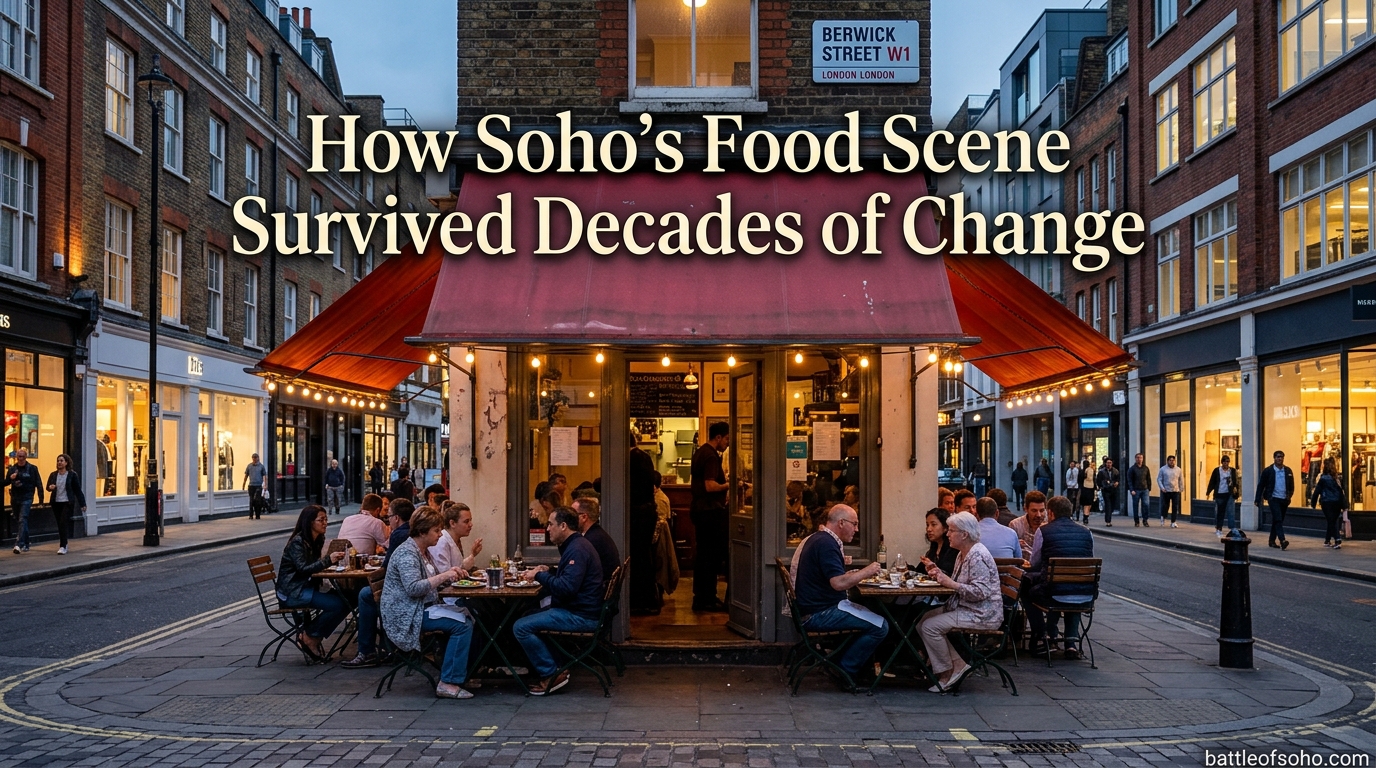
Walk through Soho today and you will find sleek bistros, upscale izakayas, and designer coffee shops lining every block. But the Soho food scene did not start this way. It began as a ragged cluster of artist-run kitchens inside abandoned industrial lofts, fueled by creativity rather than capital.
Understanding how Soho’s dining landscape transformed over five decades tells a bigger story about urban reinvention. The neighborhood went from a forgotten manufacturing zone to one of the most expensive culinary real estate in New York City. Restaurants that opened their doors in the 1970s had to survive economic crashes, waves of gentrification, and a global pandemic.
In this guide, we trace how Soho’s food scene survived decades of change. We look at the pioneer restaurants, the economic pressures that reshaped them, and what the neighborhood looks like today.
Table of Contents
How Soho’s Food Scene Survived Decades of Change: The Early Years
Soho’s food scene began as a survival mechanism. In the 1960s, the area south of Houston Street was a wasteland of empty cast-iron factories and warehouses. The city had rezoned parts of the neighborhood, and manufacturers were leaving in droves. Artists moved in illegally, drawn by massive loft spaces and dirt-cheap rents.
There were almost no restaurants. The only options were a handful of greasy diners and luncheonettes that served factory workers. Artists cooked in their lofts, shared meals communally, and hosted potluck dinner parties. This DIY food culture became the foundation of what would grow into a recognizable dining scene.
The bohemian lifestyle attracted creative people from across the city. Filmmakers, painters, sculptors, and writers all needed places to eat. Demand grew for something more permanent than a shared kitchen. The first wave of artist-operated eateries emerged from this exact need. These were not profit-driven businesses. They were gathering spaces designed to feed a community.
What made the early Soho food scene unique was its lack of pretension. The artists who opened these spots had no formal culinary training. They served simple, hearty fare at prices their neighbors could afford. The food was secondary to the atmosphere, the conversation, and the sense of belonging.
This community-first approach became the blueprint for everything that followed. Even as Soho transformed into a luxury destination, traces of that communal spirit survived in the restaurants that lasted.
The Birth of the Artist-Run Restaurant: FOOD (1971)
FOOD was the restaurant that changed everything. Opened in 1971 at 127 Prince Street, it was co-founded by artist Carol Goodden and Gordon Matta-Clark, one of the most influential figures in conceptual art. Tina Girouard and Suzanne Harris were also closely involved in running the space.
The concept was radical for its time. FOOD was part restaurant, part art project, part social experiment. The founders rotated cooking duties among a group of artists. Each night brought a different cook and a different menu. Some evenings featured themed meals tied to art openings or performances happening nearby.
FOOD introduced things that seem ordinary now but were genuinely shocking in 1971. They served Perrier water when most New Yorkers had never heard of bottled sparkling water. They elevated a simple bowl of soup into a wholesome, satisfying meal at a time when soup was considered a side dish. They offered exotic cheeses and fresh ingredients that you could not find at the local luncheonette.
The restaurant operated as a cooperative. Artists who worked shifts earned a share of the profits. Regulars knew the staff by name. The communal table in the center of the room encouraged strangers to talk to each other. Forum users who remember the era describe FOOD as less of a business and more of a neighborhood living room.
FOOD closed in the late 1980s, unable to sustain itself against rising costs and changing demographics. But its influence rippled through the entire Soho food scene. It proved that a restaurant could be a cultural institution, not just a place to eat. Every artist-run kitchen that followed owed something to what FOOD built on Prince Street.
Notable Restaurants That Defined Soho’s Early Food Scene
Fanelli’s: The Constant
Fanelli’s has been serving customers since 1922, making it one of the oldest continuously operating restaurants in the neighborhood. Originally a speakeasy during Prohibition, it transitioned into a legitimate bar and restaurant that became a fixture for locals and visitors alike.
What makes Fanelli’s remarkable is its consistency. People who grew up in Soho remember it as a comfort place. The food was reliable, the service was steady, and the atmosphere never tried too hard. While other restaurants reinvented themselves every few years, Fanelli’s stayed the same. That stability became its greatest asset during decades of rapid change.
Fanelli’s also serves as a living archive of Soho history. The walls are covered with old photographs and memorabilia. Sitting at the bar feels like stepping back into a neighborhood that no longer exists outside those four walls.
Broome Street Bar: The Bohemian Hangout
Opened in 1972, Broome Street Bar became the epicenter of the young art crowd. Located in a former textile factory, it attracted painters, musicians, and writers who lived in the surrounding lofts. The bar served simple food and cold beer, and the conversation was always the main attraction.
Long-time residents recall a time when Broome Street Bar felt like a private club for the neighborhood. Everyone knew everyone. The bar functioned as an informal community center where deals were made, collaborations were born, and friendships were forged over late-night drinks.
As gentrification accelerated, the bar’s clientele shifted. Today it serves mostly tourists and visitors rather than the resident artist community. But it survived, which is more than most of its peers can say.
Shalom Japan: Kosher Meets Japanese
Shalom Japan was one of the most unusual restaurants in early Soho. Operating in the early 1980s, it combined kosher Jewish cuisine with Japanese dishes. The concept sounds improbable, but it developed a loyal following. People remember it with deep nostalgia.
The restaurant featured floor shows and a lively atmosphere that made every meal feel like an event. It represented the kind of creative risk-taking that defined the Soho food scene at its peak. Nobody was copying trends. They were inventing new categories entirely.
O.G. Dining Rooms: Community First
O.G. Dining Rooms operated in the 1970s as another artist-backed venture. Like FOOD, it prioritized community gathering over profit. Weekly dinner gatherings brought neighbors together around shared tables. The food was affordable and the portions were generous.
O.G. Dining Rooms did not achieve the same lasting fame as FOOD, but it filled the same role for a different cluster of residents. It was the kind of place where you showed up not knowing what was on the menu, and you left feeling like you had been part of something special.
A Timeline of Soho’s Food Scene Evolution
Here is how the Soho food scene evolved across five decades of transformation:
1960s: Artists begin moving into abandoned Soho lofts illegally. No real restaurants exist beyond factory diners and luncheonettes. Communal cooking and potluck dinners become the norm.
1971: Carol Goodden and Gordon Matta-Clark open FOOD at 127 Prince Street, establishing the first major artist-run restaurant and pioneering communal dining.
1972: Broome Street Bar opens in a former textile factory, becoming a gathering place for the neighborhood’s growing artist population.
1970s: O.G. Dining Rooms and other cooperative eateries emerge, expanding the artist-run dining model across multiple blocks.
1980s: Shalom Japan opens, reflecting a new wave of creative culinary experimentation. Upscale retailers begin moving into Soho, signaling the start of gentrification pressures.
1990s: Property values climb sharply. Several artist-run restaurants close as leases expire and commercial rents skyrocket. Fanelli’s and Broome Street Bar survive by owning their spaces or negotiating long-term deals.
2000s: Celebrity chefs and restaurant groups enter Soho. The neighborhood begins attracting high-end dining concepts designed for affluent residents and tourists rather than working artists.
2010s: International cuisine floods into Soho. Japanese, Italian, and Southeast Asian restaurants dominate new openings. Average check sizes rise well beyond what the original artist community could have afforded.
2020-2021: COVID-19 devastates Soho’s restaurant industry. Indoor dining bans, capacity restrictions, and a collapse in foot traffic force many establishments to close permanently. Survivors pivot to takeout, outdoor dining, and delivery.
2026 and beyond: Soho’s dining scene rebuilds with a mix of legacy survivors and new concepts. Outdoor dining sheds remain a feature. The neighborhood retains its culinary cachet but grapples with questions about authenticity and accessibility.
Gentrification and Rising Rents: How Restaurants Adapted
Gentrification is the force that defined Soho’s food scene more than any other. What began as an artist haven built on cheap rent could not survive once those rents disappeared. Commercial property values in Soho increased by several hundred percent between the 1980s and 2026.
Restaurants responded in different ways. Some closed quietly when their leases expired. Others fought through legal battles to stay. A few, like Fanelli’s, survived because they owned their buildings outright rather than renting. Ownership became the single biggest predictor of whether a restaurant could weather the storm.
The restaurants that adapted often changed their concept. Simple, affordable menus gave way to higher-priced offerings aimed at the new affluent residents. A bowl of soup that cost three dollars in 1975 became a twenty-dollar appetizer by the 2000s. The food got better in many cases. The community feeling did not.
New arrivals treated gentrification as an opportunity rather than a threat. Celebrity chefs and restaurant groups saw the rising property values as proof of demand. They opened high-end concepts designed to attract shoppers, tourists, and finance professionals. The old artist community was priced out of its own neighborhood.
But gentrification did not erase everything. The restaurants that survived managed to preserve a connection to Soho’s bohemian past. They kept their old decor, maintained their original recipes, and served as living reminders of what the neighborhood used to be. That tension between old and new is what makes Soho’s food scene compelling even today.
Modern Soho: What the Dining Scene Looks Like Today
The Soho food scene in 2026 is a mix of survivors, newcomers, and everything in between. The neighborhood now hosts some of the most sought-after restaurant reservations in New York City. Wait times can stretch for weeks at the most popular spots.
International influence has reshaped the culinary landscape dramatically. Japanese omakase counters, modern Italian trattorias, Korean fine dining, and Southeast Asian fusion restaurants now line streets that once housed artist lofts. This diversity is one of the few things the modern scene shares with its bohemian predecessor. Both eras valued creativity and experimentation, even if the price points could not be more different.
COVID-19 hit Soho harder than almost any other neighborhood in New York. The area’s reliance on office workers, shoppers, and tourists meant that when foot traffic vanished, restaurants had almost no local customer base to fall back on. An estimated third of independent restaurants in downtown Manhattan closed permanently during the pandemic. Soho lost beloved institutions that had survived for decades.
The recovery has been uneven. Outdoor dining structures, originally built as emergency measures, became permanent fixtures that changed the feel of the streets. Some restaurants thrived with the additional seating. Others found the infrastructure costs unsustainable.
For visitors looking for authentic Soho experiences today, the advice from long-time residents is consistent. Skip the places with lines around the block. Look for the restaurants that have been there for decades. Fanelli’s is still serving the same reliable food it has served since the 1920s. The bones of old Soho are still there if you know where to look.
FAQs
What is Soho most famous for?
Soho is most famous for its cast-iron architecture, boutique shopping, and a food scene that evolved from 1970s artist-run restaurants to high-end international dining. It transformed from an abandoned industrial zone into one of NYC’s most desirable neighborhoods.
When did SoHo become seedy?
SoHo was at its seediest from the 1950s through the 1960s, when it was known as Hell’s Hundred Acres. The area was filled with empty factories, sweatshops, and occasional fires. Artists began moving in during the late 1960s, drawn by cheap loft space.
What are some hidden gem restaurants in Soho?
Beyond the famous spots, hidden gems in Soho include long-standing places like Fanelli’s (operating since 1922) and smaller international spots tucked on side streets. Look for restaurants on Sullivan, Thompson, and Spring Streets away from the main shopping corridors for more authentic, less tourist-heavy dining.
How has Soho’s food scene evolved over the decades?
Soho’s food scene evolved from communal artist kitchens in the 1960s, to pioneering artist-run restaurants like FOOD in 1971, through gentrification pressures in the 1990s, to today’s mix of high-end international dining and surviving legacy establishments.
What happened to FOOD restaurant in Soho?
FOOD restaurant, founded by Carol Goodden and Gordon Matta-Clark in 1971, closed in the late 1980s due to rising costs and changing demographics. It operated at 127 Prince Street and is remembered as the first major artist-run restaurant that pioneered communal dining in Soho.
Which old Soho restaurants are still open?
Fanelli’s (since 1922) and Broome Street Bar (since 1972) are among the longest-running survivors of old Soho. Both adapted to changing times while preserving elements of their original character, making them living connections to the neighborhood’s bohemian past.
Conclusion
The story of how Soho’s food scene survived decades of change is really a story about adaptation. Restaurants that started as communal kitchens for struggling artists gave way to high-end destinations serving a very different clientele. The economic pressures were enormous. Many did not make it.
But the ones that survived carried something forward. Fanelli’s still pours drinks at the same bar. Broome Street Bar still occupies the same former textile factory. The spirit of experimentation that Gordon Matta-Clark and Carol Goodden sparked at FOOD in 1971 lives on in every ambitious new kitchen that opens in the neighborhood.
If you want to experience the full arc of Soho’s food scene, start with the survivors. Then explore the new wave. The contrast between old and new is what makes this neighborhood unlike anywhere else in the city.