
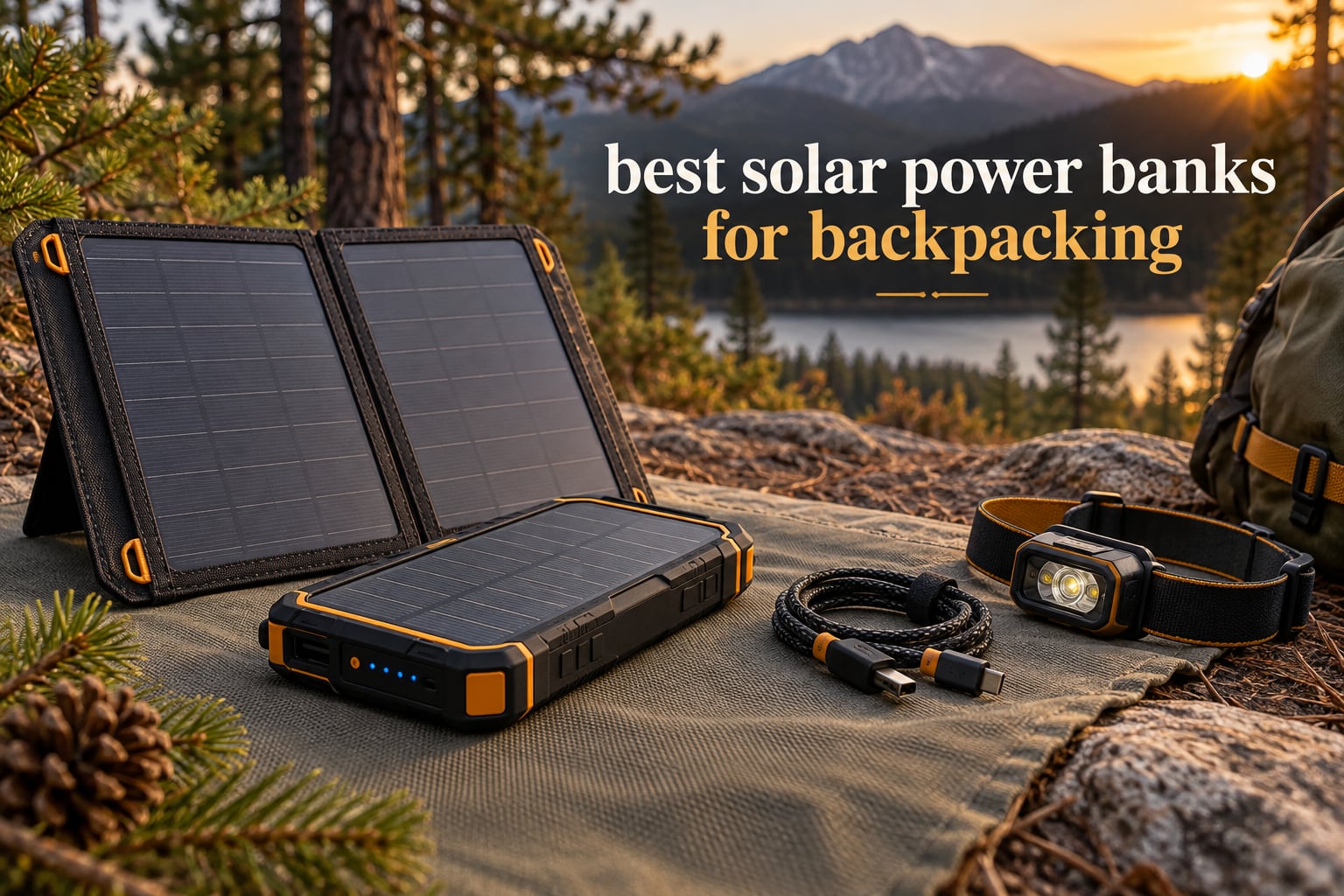
Most people shopping for the best solar power banks for backpacking are actually comparing two different things: a battery with a small solar panel glued to it, and a genuine folding solar panel. Only one of those belongs in a pack that weighs under 20 pounds, and the shopping results make that distinction harder than it should be.
Short answer on whether they are worth it: yes, as emergency top-up, no, as your primary charging plan. The battery half of every unit here works well. The solar half realistically adds a trickle of charge when you stop in direct sun, nowhere near enough to refill a phone from empty, and less than nothing when the panel is strapped to a moving pack.
We compared 12 solar power banks for backpacking, weighing the published specifications against what owners actually report after a season of trips. Our picks lean light, because every gram in a solar power bank backpacking kit is a gram you gave up somewhere else. If you are still building out the rest of your kit, start with our water filter roundup and our portable power bank guide before adding solar hardware.
Table of Contents
Top 3 Solar Power Bank Picks for Backpacking in October 2026
The BLAVOR 10000mAh takes the top slot because it does the one job a backpacking solar unit should do well. It stays under 10 ounces, charges quickly over USB-C, and shrugs off rain, and its 4.2 rating across more than 47,000 reviews tells us it does not fall apart in a pack.
The Durecopow 20000mAh is the value pick for anyone who hates packing cables. Four leads are built into the body, so you can stop carrying a three-cable tangle in your side pocket.
The BLAVOR 20000mAh is the feature pick, with 20W USB-C, a dedicated wireless pad for Apple Watch and the same four-cable layout, at the cost of weight.
Solar Power Banks for Backpacking at a Glance in October 2026
1. BLAVOR 10000mAh Solar Power Bank – Best Overall Pick at a Hiking Weight
BLAVOR Solar Power Bank 10,000mAh Portable Wireless Charger for Cell Phones
10000mAh
9.3 oz
20W USB-C
Qi wireless
IPX5
Pros
- Only 9.3 oz for a working power bank
- 20W USB-C refills a phone fast
- Qi pad plus three ports for three devices
- IPX5 water dust and shockproof
- Dual flashlights and compass carabiner in the box
Cons
- Smallest capacity in the group at 10000mAh
- Solar panel is a top-up rather than a recharge path
- Rated for 3.6 phone charges only
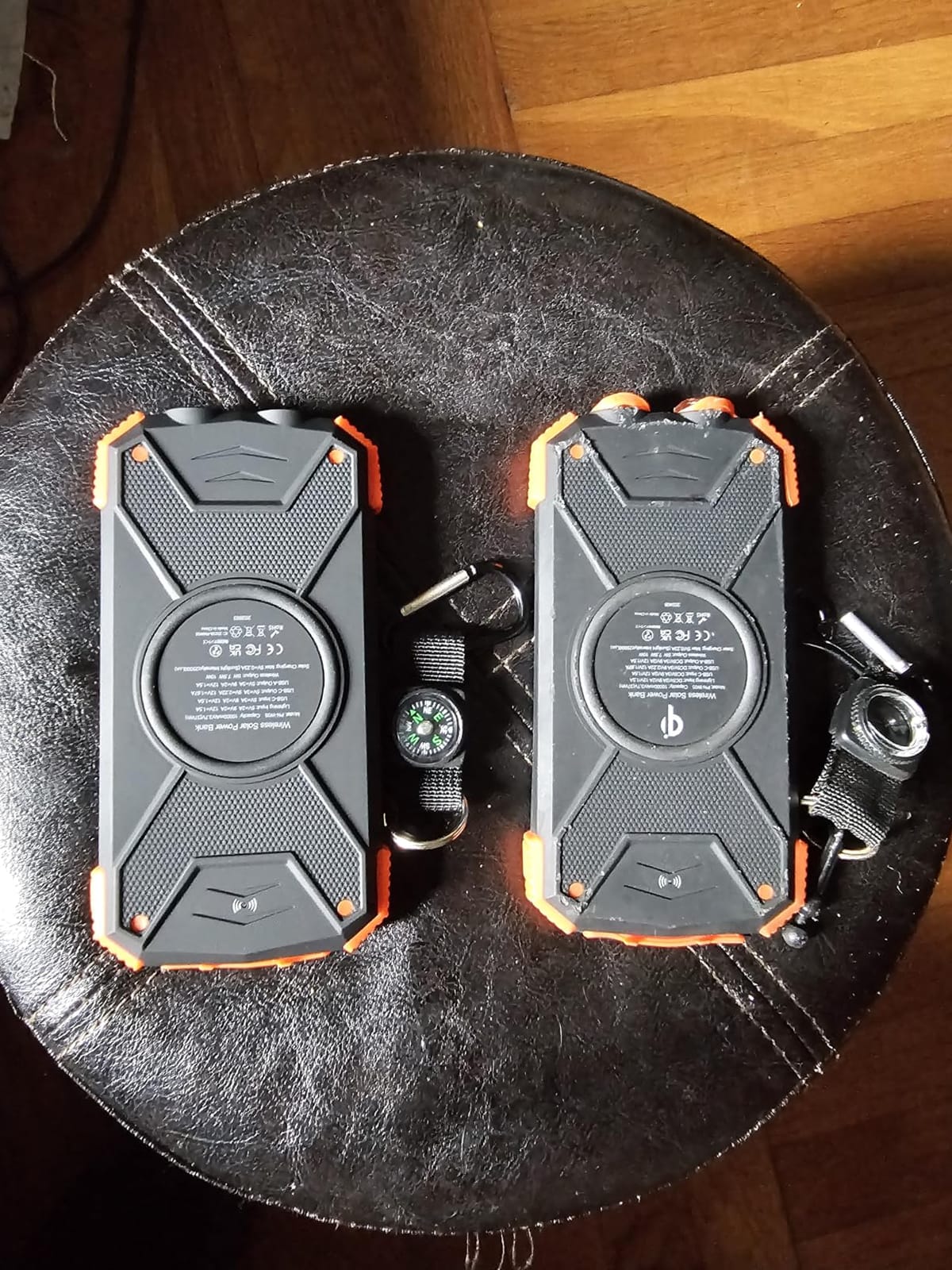
This is the unit I keep coming back to after looking at all 12. At 9.3 ounces it is the one product here where the panel does not add obvious bulk, and the shell is rated IPX5 for water, dust and shock, which is what a ridge line in April actually delivers.
The 20W USB-C output is the part that surprised me. Reviewers report an iPhone 15 moving from flat to roughly 65 percent in 30 minutes, which means a genuine top-up over a lunch break rather than an all-afternoon trickle.
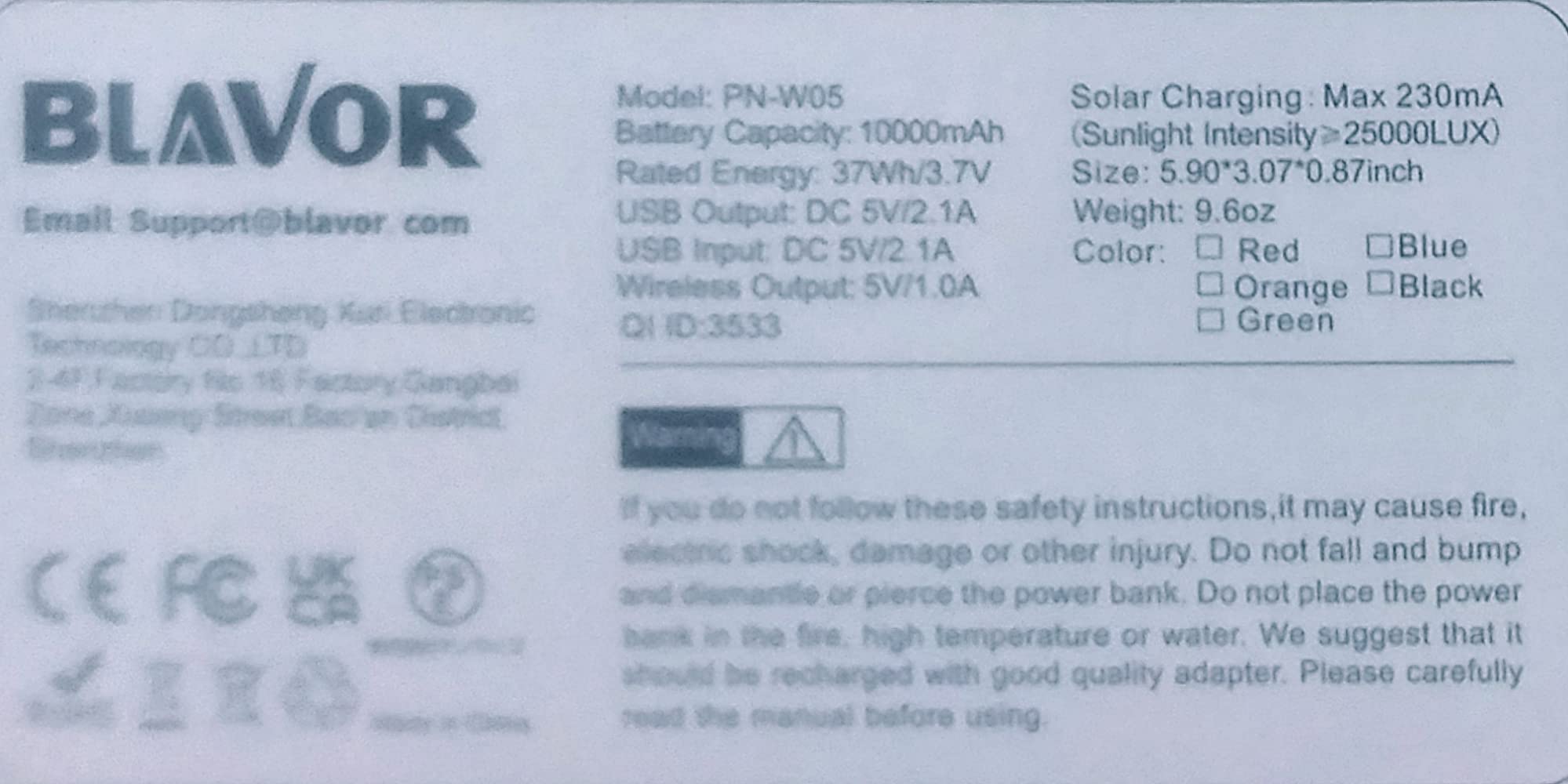
Three ports plus a Qi pad means you can run a phone, a GPS watch and a headlamp at the same time without swapping cables. The compass carabiner clips to a hip belt so the bank is not loose in the bottom of the pack, and the dual flashlights are the ones you will actually reach for at 11pm when the headlamp dies.
Ten thousand mAh is the honest limitation. After conversion loss you get roughly three and a half phone charges, so this is a two or three night bag that tops up a phone rather than a week-long expedition bank.
When this bank earns its place in your pack
It suits fastpackers and two to three day trips where every gram counts and you only need a phone to survive to the next water source. The wireless pad is a genuine bonus if your watch tracks your route, because a flat smartwatch at turn 8 is a real wayfinding problem.
It also works well as the bank in a two-piece system, carried empty and filled on a larger panel at camp.
When to leave it at home
Skip it if you are carrying a satellite messenger, a camera with two batteries or a tablet. None of those fit inside a 10,000mAh budget, and you would be topping up the wrong device all week.
Buyers also point out that the solar panel itself adds almost nothing on a moving pack, so treat it as a roadside backup rather than a power source you plan around.
2. Durecopow 20000mAh Solar Power Bank – Best Value for Cable Clutter
Durecopow Solar Charger Power Bank 20,000mAh, Portable Charger, 4 Cables 3 Ports Fast Charging External Battery Pack with USB C for Cell Phones, Solar Panel Charger with Dual Flashlight for Camping
20000mAh
250 g
4 built-in cables
3 ports
Water-resistant
Pros
- Four built-in cables cut the cord tangle
- 20000mAh gives real multi-day capacity
- Dual flashlight with steady SOS and strobe modes
- Silicone-cornered ABS body resists drops and dust
Cons
- About 250 g for twice the charge of our top pick
- Small share of 1-star ratings over time
- Solar panel is a trickle top-up
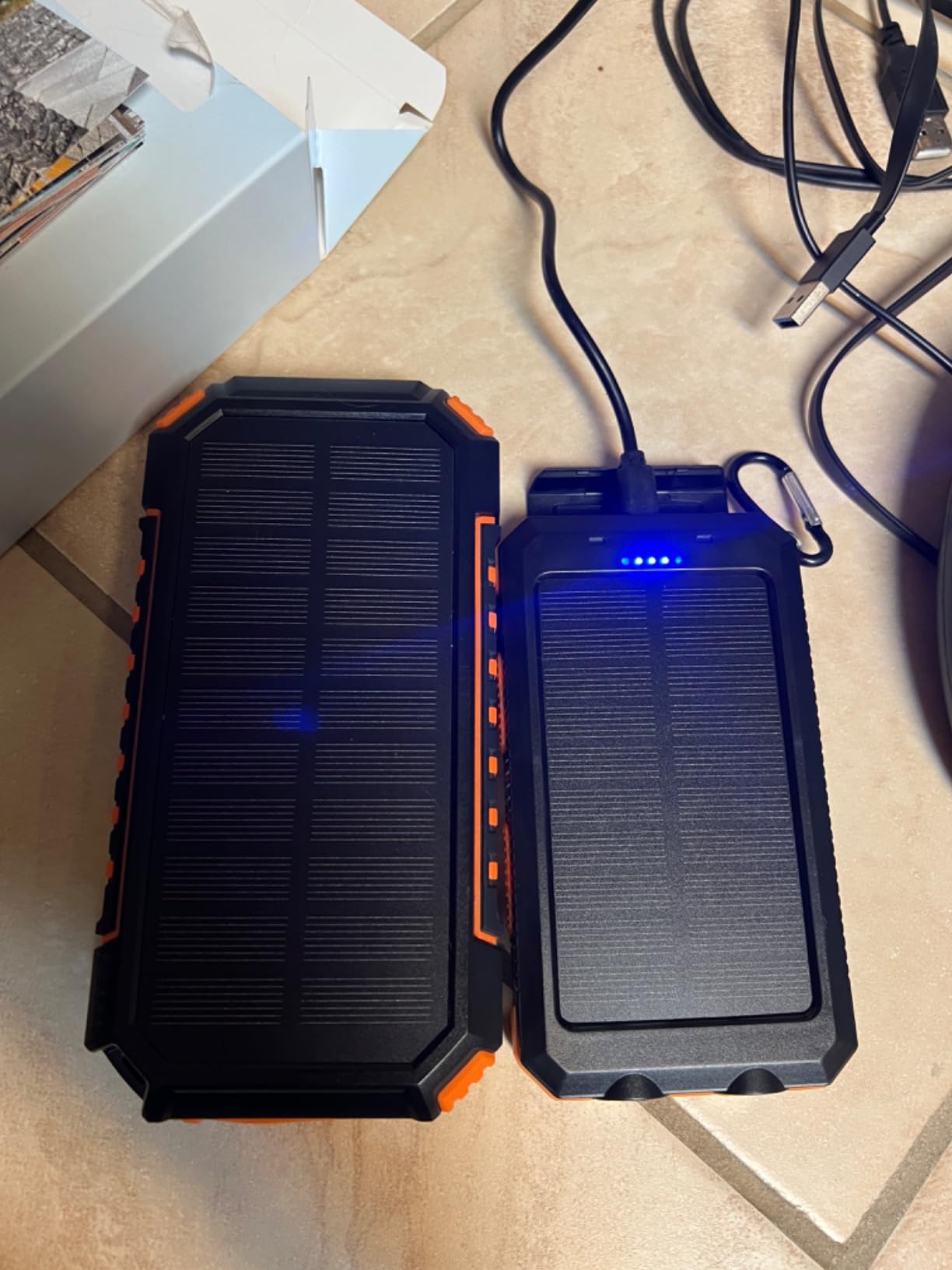
Twice the capacity of our top pick at almost the same carry weight, and the reason we like it is not the battery at all. Four cables are built into the casing, covering Type-C, Lightning and Micro USB, so the three-cord nest in your side pocket simply disappears.
Across three ports the bank handles up to six devices, which matters more than it sounds when you are co-ordinating a two-person trip and one of you has a phone that refuses standard cables.
The dual LED flashlight offers steady, SOS and strobe modes, and several owners mention using the strobe as a camp marker when a group splits up on a fork. The drop-proof, dust-proof, water-resistant body with silicone corners is the build you want when the unit lives in a rain-triggered pack.
The catch is weight per capacity. At 250 g this unit carries twice the charge of our top pick, which is the trade you are making, not a free upgrade. A small share of reviews also describe long-term durability as average, so treat the shell as a trail tool rather than a permanent fixture.
Why hikers pick it
Reviewers repeatedly say the feature density is hard to beat for the money, and the built-in leads are the part that gets mentioned first. Carrying fewer cables saves both weight and the daily frustration of a dead connector in wet weather.
It is a strong car-camping and hut-to-hut choice, where 250 g is a rounding error and cable convenience rules.
Where it disappoints
Ultralight hikers will feel the 250 g immediately, against 9.3 ounces for our top pick. Anyone expecting the panel to recharge it will be disappointed, because the solar side is a trickle.
The flashlight is bright but not a substitute for a headlamp, and the recessed ports are worth checking before you rely on them in mud.
3. SOARAISE 48000mAh Solar Power Bank – Best for Basecamp and Groups

SOARAISE Solar Power Bank 48000mAh Wireless Portable Charger with 4 Cables
48000mAh
4 solar panels
4 cables plus Qi
3A USB-C
Pros
- Four solar panels spread across the face
- Four cables plus a wireless pad support 7 devices
- 5V 3A USB-C refills a phone quickly
- Measured usable output around 60 Wh
Cons
- Roughly one pound
- awkward on a long carry
- Stated capacity sits far above measured real output
- Solar extends range rather than refilling
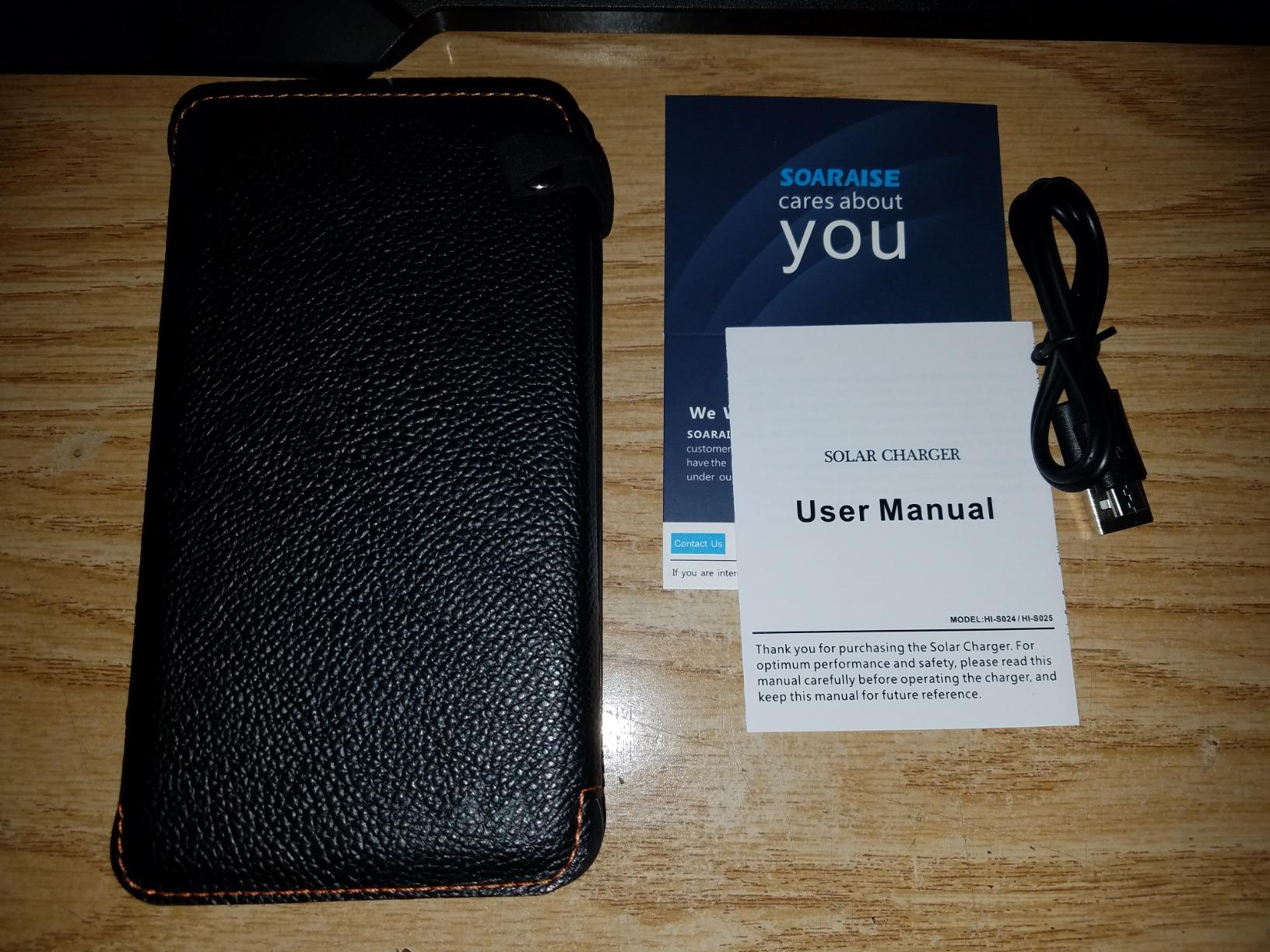
SOARAISE is the unit to look at when the gear stays in one place for a few days. Four panels spread across the face give it far more solar surface than the single-strip designs, and at basecamp, where a rig can sit in full sun through lunch, that is where the solar side starts doing real work.
Independent testing puts usable output near 60 watt-hours, which works out to just under four phone charges. That gap between the 48,000mAh label and the delivered energy is exactly the inflation pattern we described earlier, so plan from the measured figure rather than the printed one.
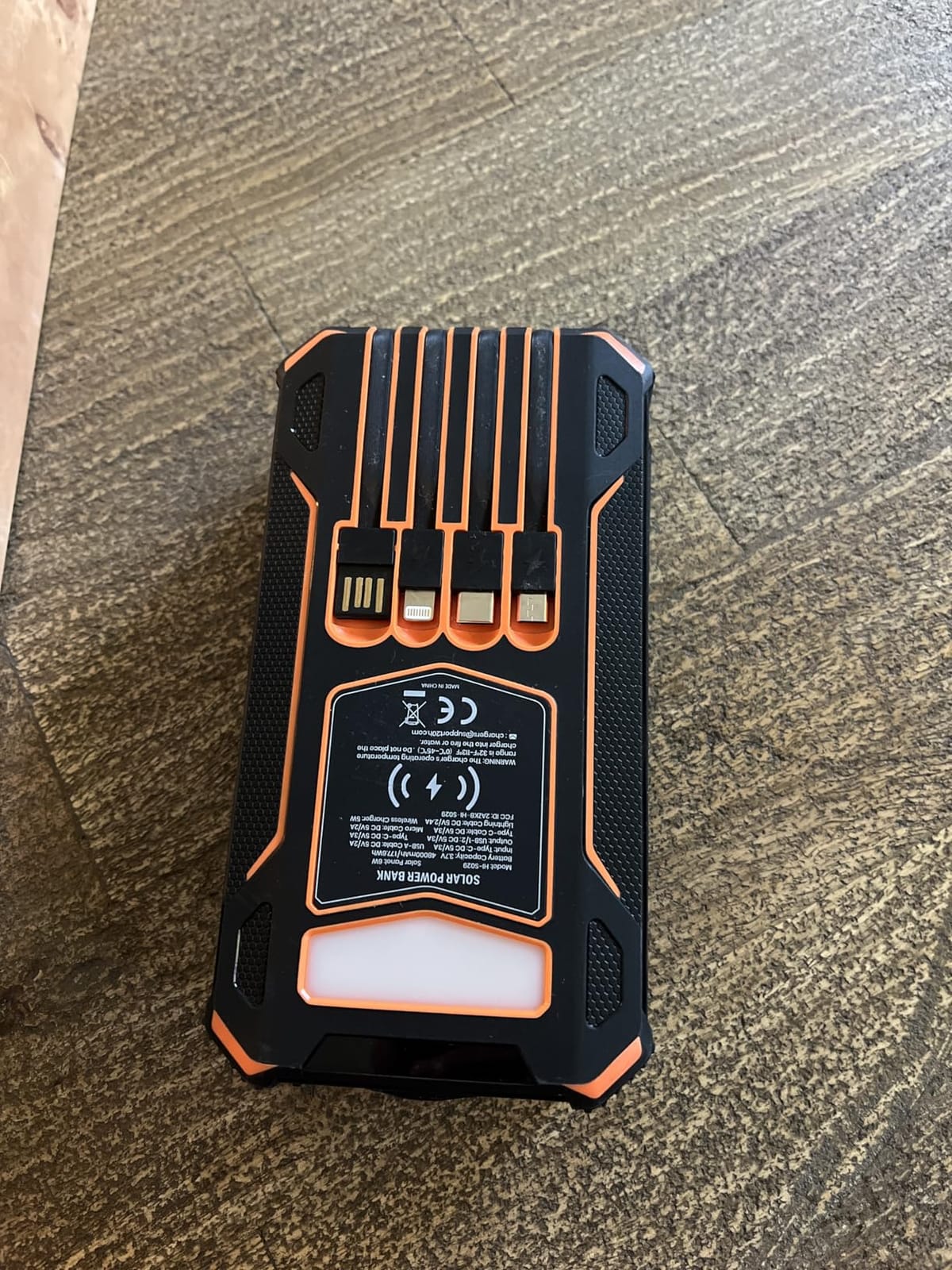
Four built-in cables plus a wireless pad support up to seven devices, and the 3A USB-C output moves an iPhone from 15 to 60 percent in half an hour. Reviewers like that it works with both Android and Apple kit, which removes the usual group-trip cable argument.
The honest downside is the pound of weight and a body that is 6.4 by 3.4 inches. This is a car trunk or a camp-table object, not something you want 300 trail miles from the road.
Where it wins
Basecamp, car camping, boat trips and desert or high-desert routes where the panel can be unfolded and left in the sun for hours. Multi-day hut trips where you re-supply power every second evening also suit it.
Groups benefit most, because one unit can cover two or three phones plus a satellite messenger rather than one person at a time.
Where it does not fit
It is the wrong shape for fastpacking, where weight per charge is the deciding number and this unit is among the least efficient here. The stated capacity also overstates what you will get, which matters if you are sizing it as your only reserve.
Long-term owners also report the panels top up only a small amount, so do not plan a full recharge around them.
4. BLAVOR 20000mAh 20W Power Bank – Most Versatile with Watch Charging
BLAVOR Solar Power Bank 20000mAh, Wireless Charger for Phones & Apple Watch
20000mAh
20W USB-C
Qi for phone and watch
4 cables
Pros
- 20W USB-C fills an iPhone in about 50 minutes
- Dedicated Apple Watch charging pad
- 4 cables and 3 ports drive 6 devices
- Owner testing verified the stated capacity
Cons
- Heavy at 0.78 kg for 20000mAh
- Built-in leads are short
- Watch charging has no clear indicator and is inconsistent
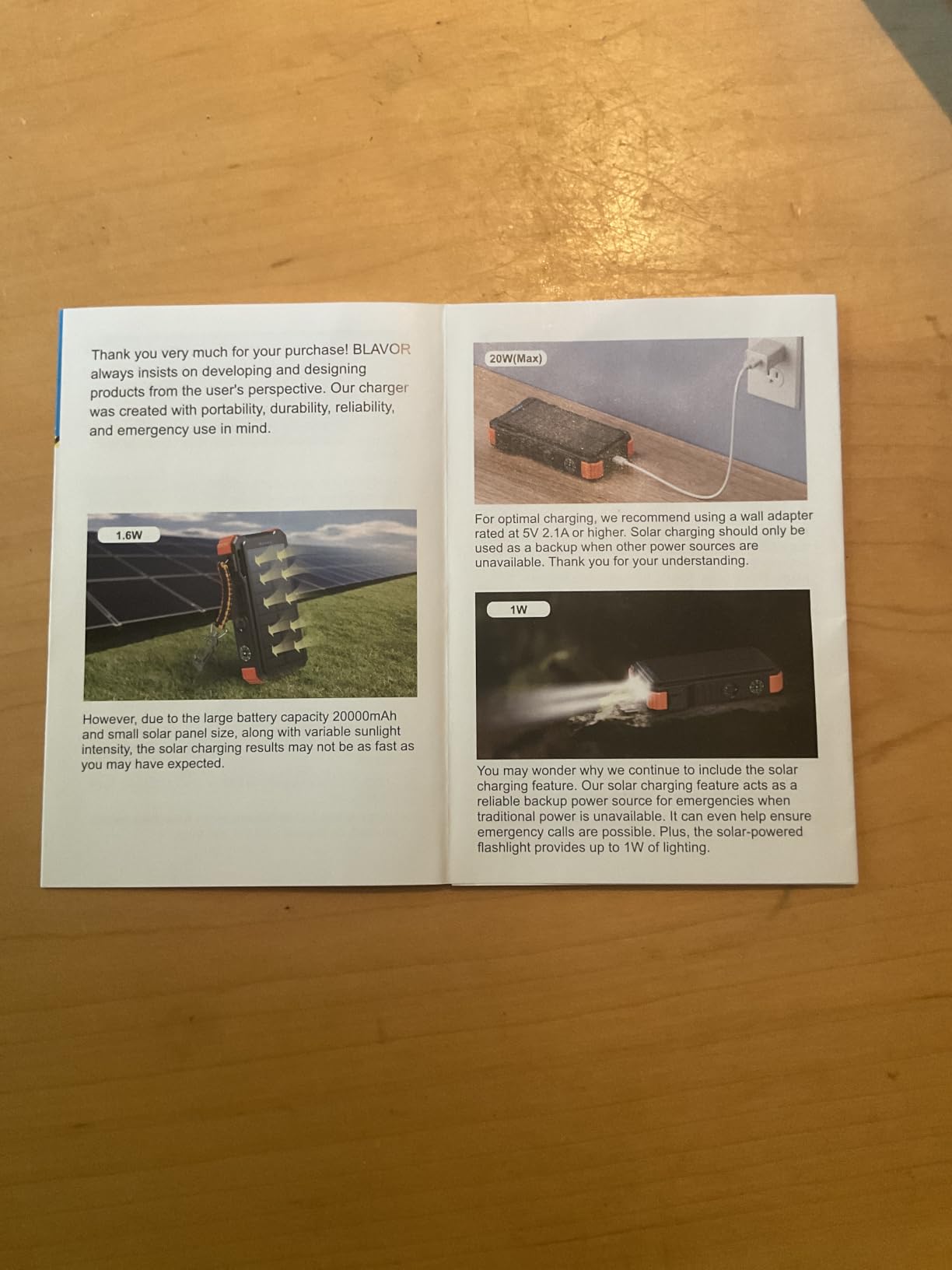
This is the unit we kept coming back to after our top pick, and the 4.3 rating across more than 5,000 reviews backs that up. Twenty watts of USB-C output is close to what a wall adapter gives you, which means a genuine half-hour top-up rather than an all-morning crawl.
The dedicated wireless pad for Apple Watch is a detail most hiking-specific lists ignore, and it is a real one. A watch that dies at midday takes your offline maps, temperature data and step count with it, and carrying a watch-specific cable is a weight most people forget to budget.
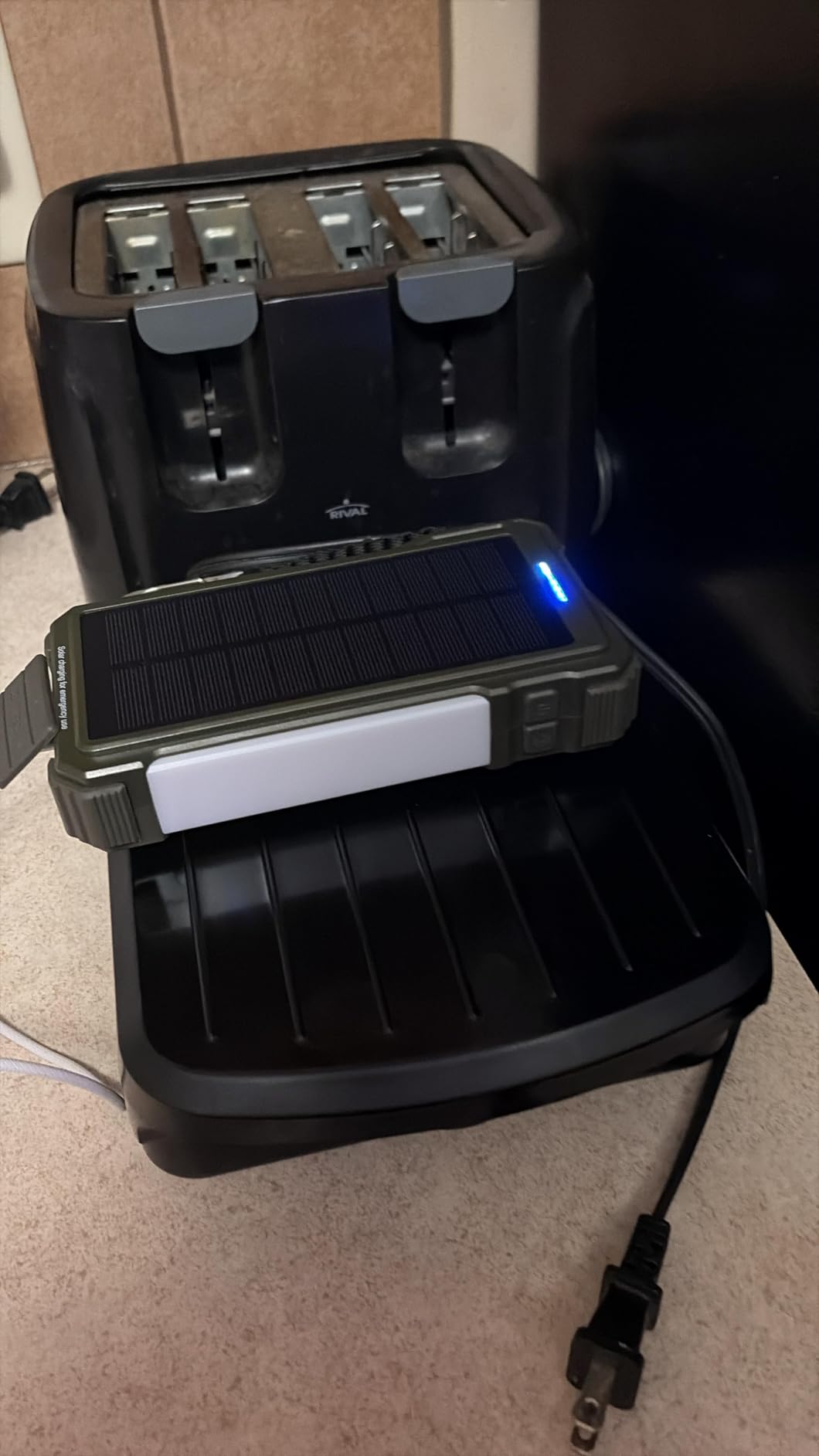
Four built-in cables and three ports handle up to six devices, and owners who tested the cell report the stated capacity held up after cycling, which is not something we can say for every large bank here. The compass, thermometer, three-level camping light and carabiner round out an unusually complete package.
The weight is the story. At 0.78 kg this is one of the heaviest units in the comparison, and owners describe it as a brick. The short built-in leads also mean you often hold the bank in one hand with the phone in the other.
Best reasons to carry it
Anyone whose phone and watch are both route tools, and anyone who values charging speed more than absolute lightness. Group trips benefit, since one unit can serve several people over a shared lunch stop.
It is also a good choice for anyone who has been burned by inflated capacity claims, because the owners who measured this one found the number honest.
Reasons to look elsewhere
Fastpackers will resent 0.78 kg, and a serious ultralight kit should not include it. Wireless phone charging needs careful alignment when the phone is in a case, and the watch indicator is inconsistent, so you cannot always confirm a charge started.
If your main worry is weight, our top pick stores about half as much charge in roughly a third of the mass.
5. Mregb 42800mAh Solar Power Bank – Best High-Capacity Rugged Unit

Mregb Solar Charger Power Bank 42800mAh, Portable Charger, Solar Power Bank,External Battery Pack 5V3.1A Qc 3.0 Fast Charger Built-in Super Bright Flashlight (Orange)
42800mAh
QC3.0 USB-C
IP67
3 devices
Pros
- 42800mAh in a compact footprint
- USB-C works as both input and output
- IP67 waterproof drop-proof and dust-proof shell
- Flashlight rated for up to 100 hours
Cons
- Brand states solar is emergency-only
- No built-in cables so you carry your own
- Only two USB-A outputs alongside the USB-C
Mregb is honest in a way most brands in this category are not. The listing states plainly that the solar charging is very slow and intended for emergencies, which is exactly the expectation you should carry into a trail, and buyers report treating it as a wall-charged pack with a solar safety net.
Forty-two thousand eight hundred mAh in a compact footprint is the headline number here, and QC 3.0 at 5V and 3.1A over a USB-C port that serves as both input and output keeps charging reasonably quick for a bank this size.
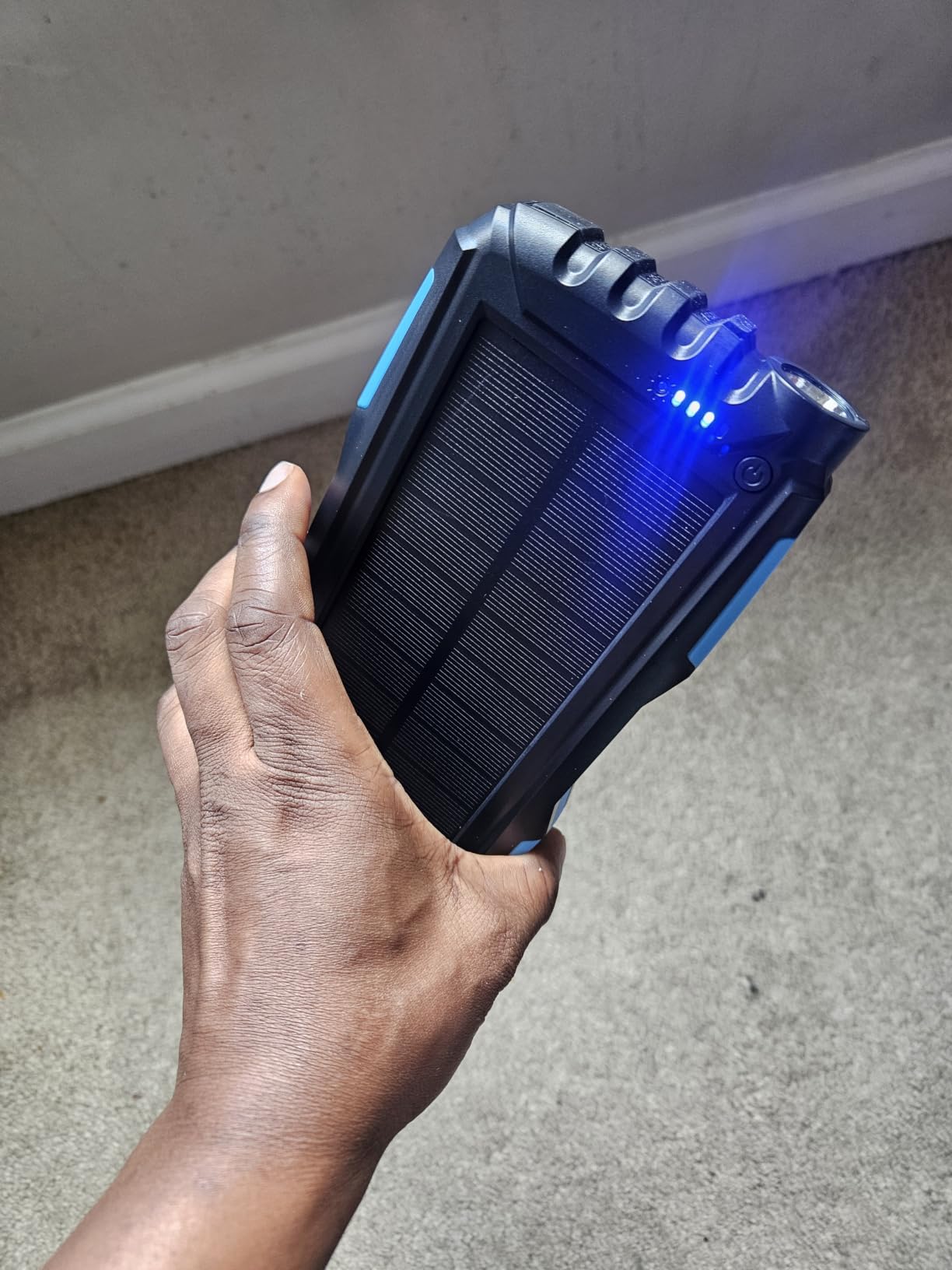
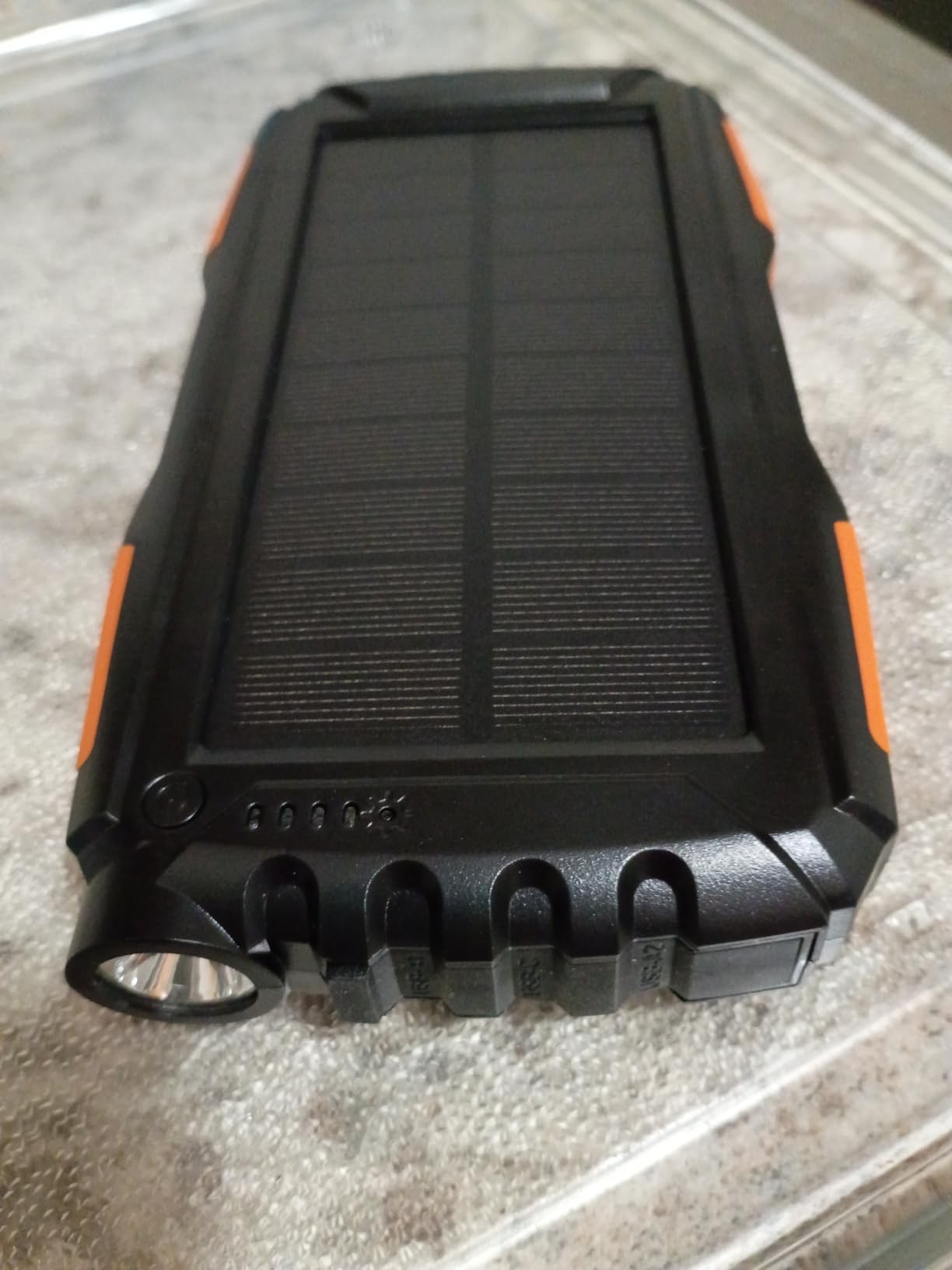
The IP67 rating is the strongest sealing claim in the group, better than the IPX5 and IP65 shells most competitors use, and it is backed by a drop-proof, dust-proof ABS body. The flashlight is rated for up to 100 hours, which makes it a genuine emergency lamp and not a novelty.
Three devices can charge at once, but you are carrying your own cables, so add a short USB-C and a Lightning lead to your gear list.
When its capacity earns the weight
Longer trips where you carry one bank for two people, or missions where a dead phone is a safety problem rather than an inconvenience. A satellite messenger that draws power slowly overnight suits a large bank well.
It also holds up in wet, sandy or high-dust environments better than anything else here on paper.
What you give up
No built-in cables means more small items in your pack, and the emergency-only panel means it will not rescue you after three cloudy days. At 42,800mAh the weight per charge is poor for anyone counting grams.
Only two USB-A outputs limits group use if everyone is on older cables.
6. FEELLE 50000mAh Solar Power Bank – Best for True Off-Grid Trips

FEELLE Solar Power Bank 50000mAh Magnetic Portable Charger with Hand Crank
50000mAh
15W magnetic
Hand crank
3 ports
0.5 kg
Pros
- Largest stated capacity here at 50000mAh
- 15W magnetic wireless snaps the phone into alignment
- Hand crank is a real last-resort source
- 4 cables and 3 ports drive 6 devices
Cons
- Heavy at about 1.1 lb and over 7 inches long
- Magnetic charging weakens through thick cases
- Bulk and weight are the price for the capacity
The hand crank is the headline feature and the one we would not rely on, but everything else here is built for a trip where you genuinely expect to be off the grid for days. Fifty thousand mAh is the largest stated capacity we found, and the 4.3 rating is tied for highest alongside the BLAVOR 20,000mAh.
Magnetic wireless charging at 15W solves the alignment problem that makes conventional pads frustrating. The phone snaps into position and starts, instead of you tilting it in the sun waiting for a charge icon.
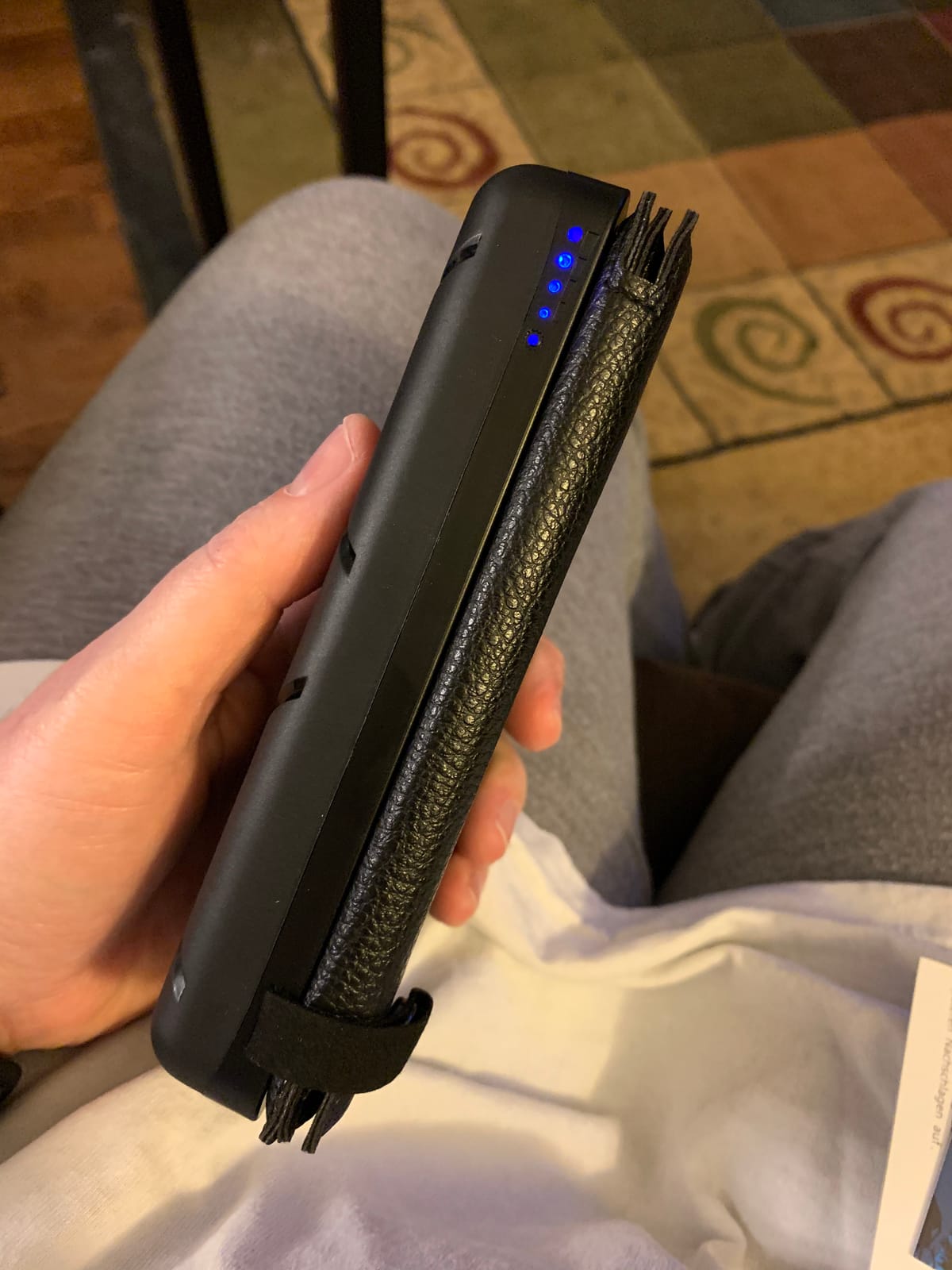
Four built-in cables and three ports support six devices, and the compass, three-mode flashlight and backpack hook make it a plausible vehicle for a car emergency kit. The silicone bumpers take the drop that ends lesser housings.
At half a kilo and over 7 inches long, this is the largest footprint in the comparison. Magnetic charging also drops off through thick cases, and 3mm or less is the manufacturer recommendation, so a rugged case costs you the feature.
Where it makes sense
Desert routes, boat trips and overlanding where you drive six hours a day and every minute of charge is parked-sun charge. Multi-day foot trips where you are not counting pack weight also suit it.
If you fly to a trailhead, a 50,000mAh bank sits close to the 100Wh airline ceiling, so check before you pack it.
Where it is the wrong call
Any pack where 1.1 lb is unacceptable, and any phone in a case thicker than 3mm if you plan to rely on the magnetic pad. The crank is a genuine emergency measure, not a way to run a satellite messenger.
7. Luvknit 20000mAh 15W Solar Power Bank – Ultralight Pick That Flies

Solar Power Bank 20000mAh with USB-C, Portable Charger for Travel Camping
20000mAh
8.32 oz
15W USB-C
IP65
Under 100Wh
Pros
- Light weight for a 20000mAh bank at 8.32 oz
- Under 100Wh so it clears the airline carry-on limit
- 15W USB-C refills a phone fast
- IP65 water-resistant drop-proof ABS plus PC shell
Cons
- No built-in cables so you carry your own
- 20000mAh yields about two phone charges
- Manufacturer states solar is an emergency trickle
Two things make this the one we recommend for anyone flying to a trailhead. At 8.32 ounces it is the lightest 20,000mAh unit we found, and it stays under the 100 watt-hour ceiling that governs lithium batteries in carry-on luggage.
Fifteen watts of USB-C takes an iPhone from 15 to 65 percent in about half an hour, and the IP65 shell handles rain and dust without the weight of a rubberised brick.
The three-mode flashlight covers strong, strobe and SOS, which is enough to find a dropped key at dusk or signal a group. Buyers describe it as the simplest way to add backup power to a pack without a second battery.
There are no built-in cables, so you carry your own, and 20,000mAh works out to roughly two phone charges after conversion loss. The manufacturer is candid that solar charging is a slow emergency trickle only.
Best fit for travel-light hikers
Two or three day trips with a mixed Android and Apple kit, and any route where you take a flight or a long bus ride to the trailhead. The under-100Wh figure removes the airline question entirely.
Reviewers also point to a 24-month warranty and a 30-day refund window, which is more cover than most of this category offers.
Limitations worth knowing
It must be wall-charged before you leave, and the solar panel will not rescue a dead bank mid-trip. Carrying your own cables adds back some of the weight you saved.
Two phone charges is not enough for a week unless you are disciplined about airplane mode.
8. MINRISE 40000mAh 20W PD Solar Power Bank – Best for 20W PD and Port Variety
MINRISE Solar Power Bank 40000mAh, Portable Charger PD 20W Fast Charging
40000mAh
20W PD
10 ports
1.8W panel
1.1 lb
Pros
- 20W PD fills an iPhone in 30 minutes
- 4 cables plus 5 outputs and 4 inputs
- Two flashlights reaching 165 feet for up to 25 hours
- Covered ports and silicone anti-fall corners
Cons
- Heavy at 1.1 lb and among the bulkiest here
- 1.8W solar panel is an emergency backup only
- 12 percent 1-star share points to some early failures
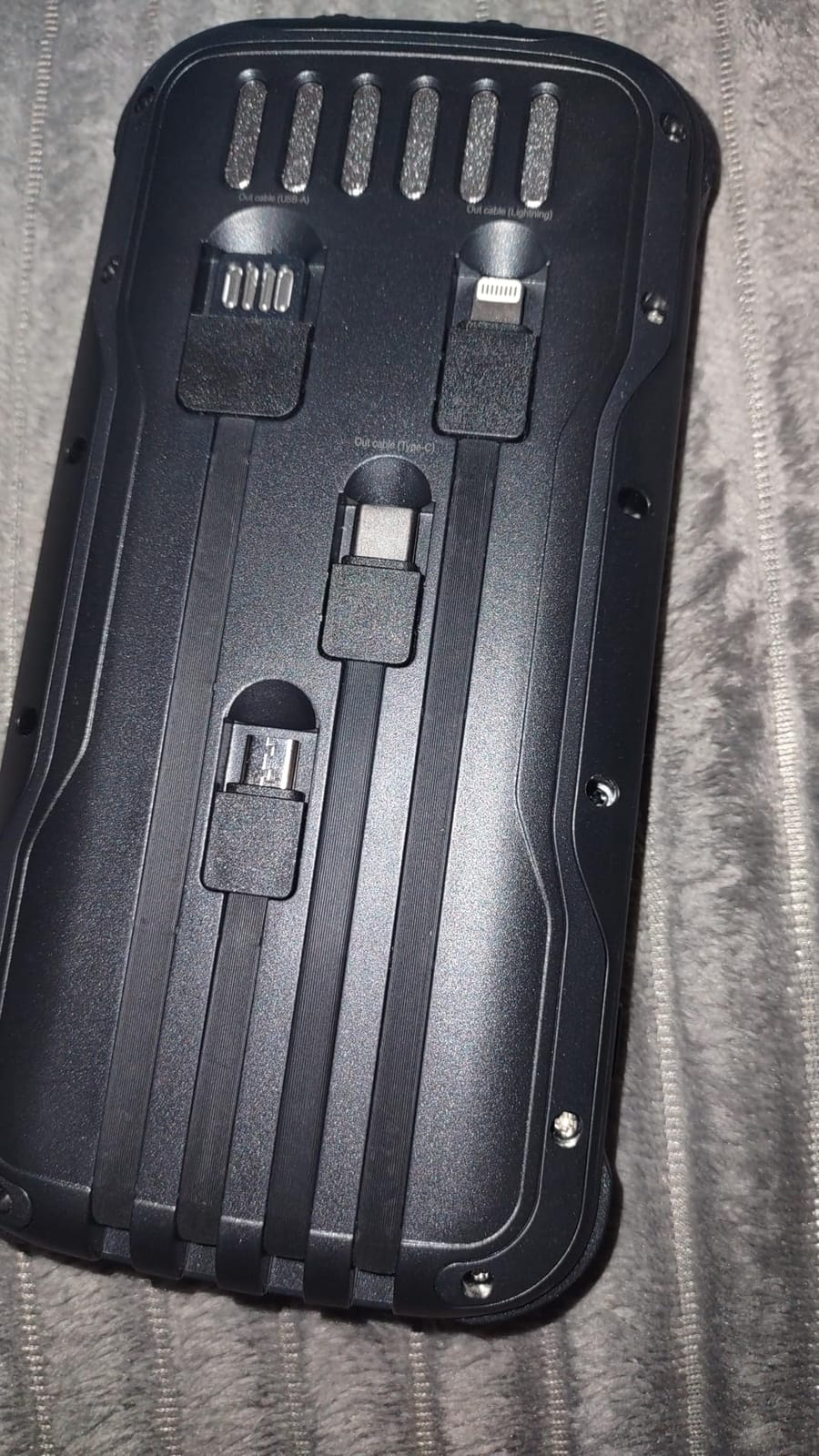
Ten ports is not a marketing number here, it is a genuine reason to like this bank. Four built-in cables, five outputs and four inputs cover nearly every cable combination a group of hikers could produce, which removes the cable problem that stalls more trips than any battery shortfall.
Twenty watts of PD is fast enough that a lunch stop genuinely recharges a phone, and the dual flashlights reach 165 feet for up to 25 hours, so they double as a camp light.
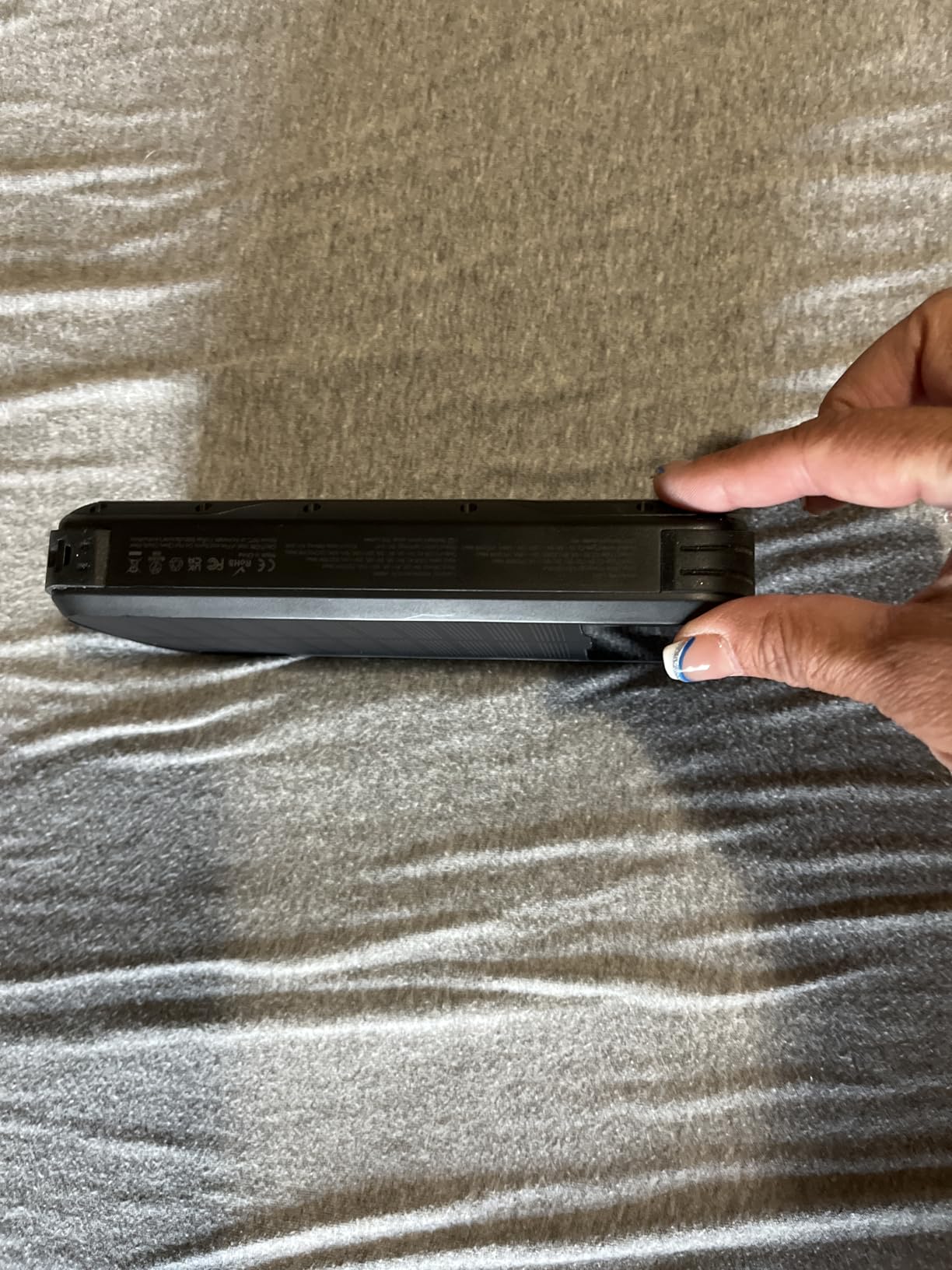
The body uses anti-fall silicone corners and covered charging ports, both of which matter when the bank is dragged across a wet rock shelf. Compatibility across iPhone, Samsung, Pixel and other Androids is confirmed by owners.
At 1.1 lb it is one of the bulkiest units we looked at, and the 1.8W panel is small enough that its contribution is close to symbolic. A 12 percent share of 1-star reviews suggests some early failure reports, so test all ports before the trip.
Who should carry it
Two-person trips and families, where one shared bank serving several devices beats two small ones. It is also a good fit for anyone whose phone is their map, so a fast refill is more useful than a large reserve.
Reviewers call it good value for a high-capacity pack with 20W PD and plenty of connection options.
Where weight rules it out
Fastpacking and long trails where 1.1 lb is the heaviest thing you own. The 1.8W solar panel will not meaningfully extend a trip, so do not choose it for the panel.
The 1.1 lb also makes it a poor choice for anyone carrying a camera, because the pair adds up fast.
9. Nuynix 49800mAh Solar Power Bank – Big Number, Variable Reliability

Nuynix 49800mAh Solar Power Bank with 15W Fast Charging & USB Charging
49800mAh
15W USB-C
3 ports
2.5 phone charges
Pros
- Very large stated capacity for the money
- 15W USB-C alongside multiple USB ports
- Charges three devices at once
- Water and dust-resistant housing with a carabiner
Cons
- Several reviews report early battery and port failure
- Long wall-charge times reported
- Solar is very slow and some say it cannot refill the pack
- No wall charger included
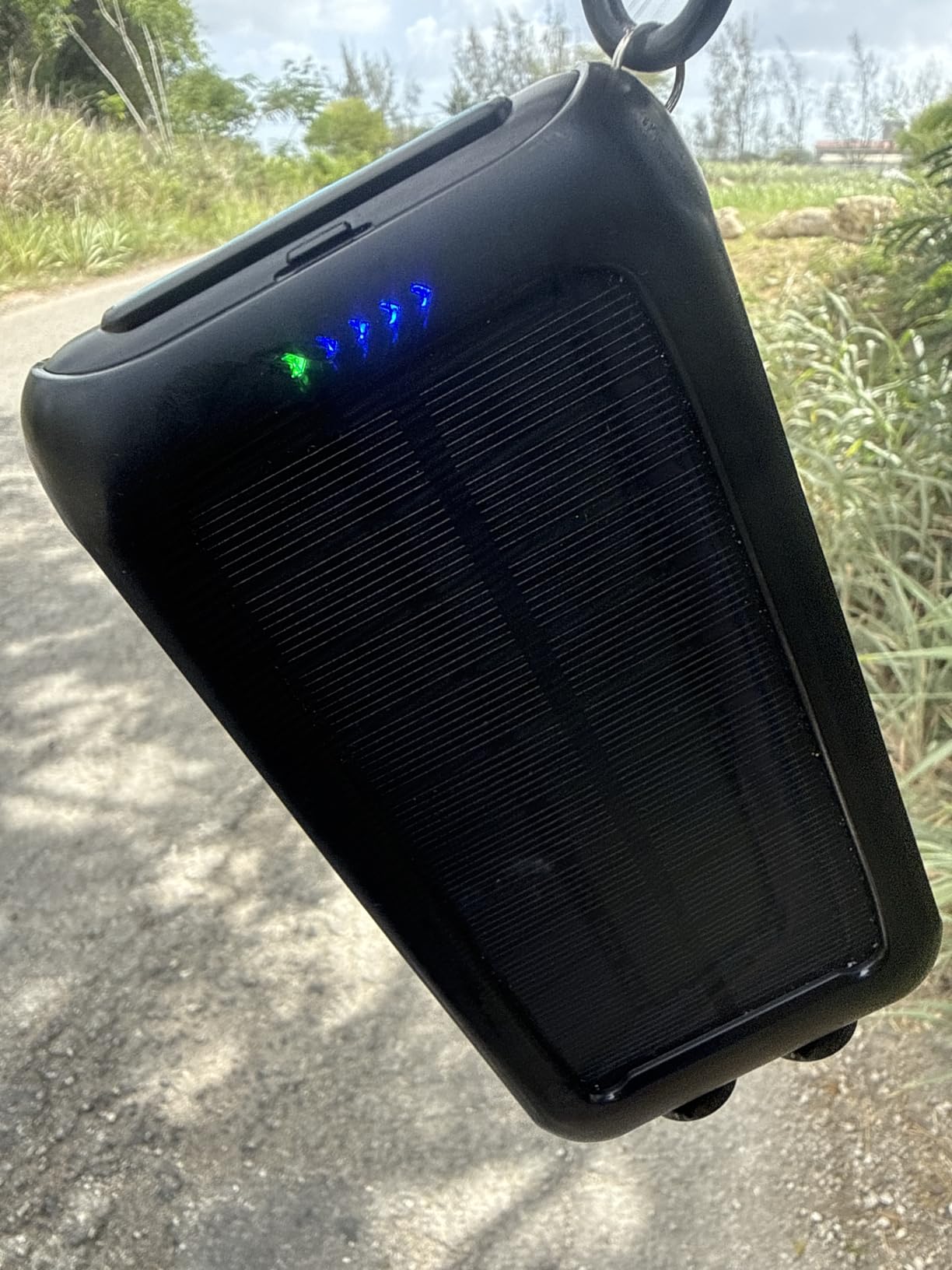
One of the biggest batteries in the group at 49,800mAh, and the first impression owners report is a strong one. The 15W USB-C output and three ports handle a phone, a headlamp and a GPS unit at the same time.
Here is the problem: a meaningful minority of owners report the unit dying within a few months and refusing to recharge, and the practical output is closer to 2.5 full phone charges. The label is not the number you will experience.
Long wall-charge times are also reported, which matters because this bank has to be full before you walk out the door. No wall charger is included, so you need to plan to borrow or buy one for the pre-trip top-up.
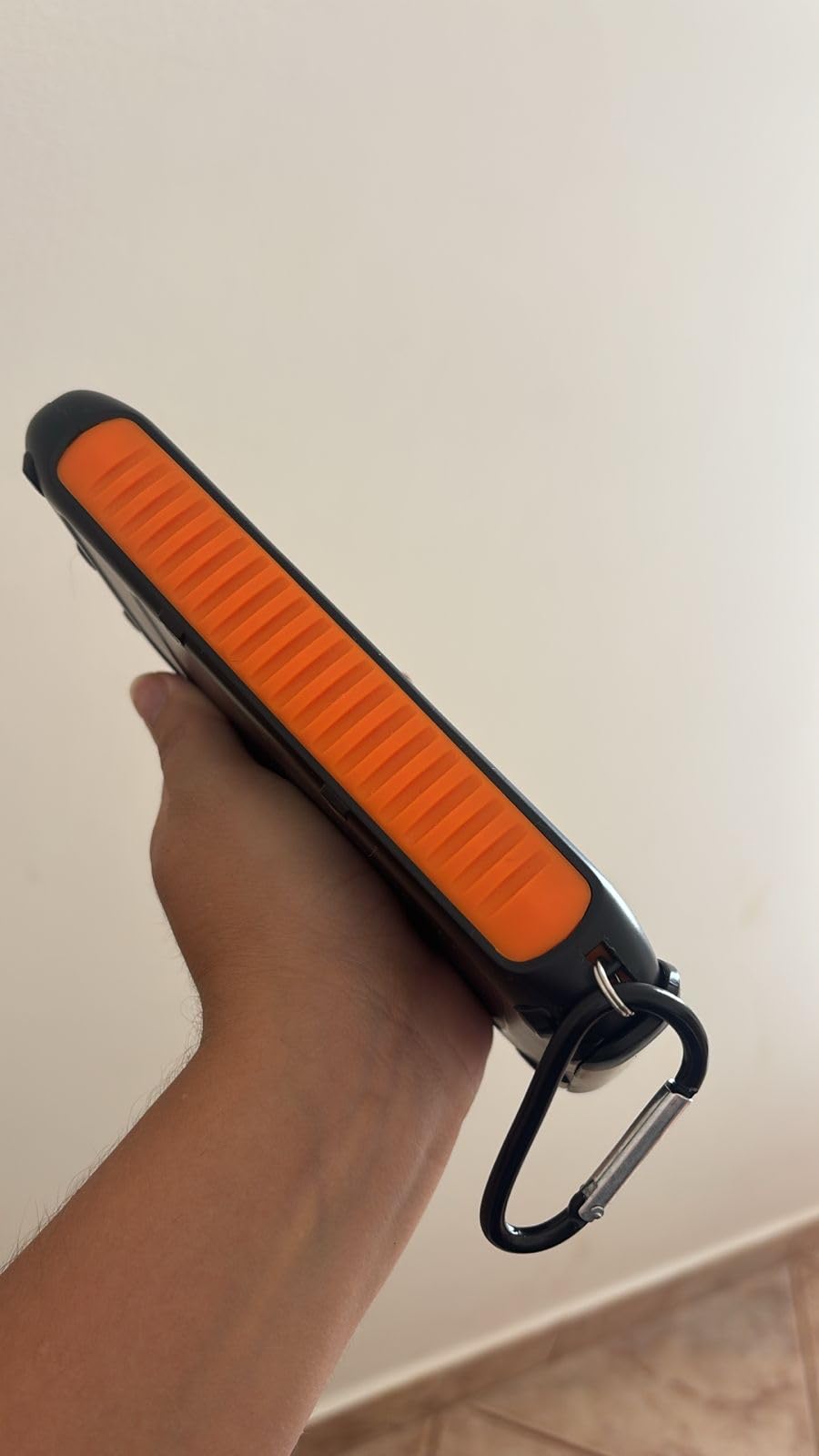
Build quality on the housing is fine, with a water and dust-resistant shell, a bright LED flashlight and a carabiner for clipping to a pack strap.
The case for it
It makes sense as a high-output bank for a group or for a trip where you cannot resupply, and the flashlight and carabiner are useful additions. If you only ever need a top-up, the extra capacity is harmless as long as you accept the weight.
The case against it
Reliability reports are the deciding factor. A bank that dies in a remote valley is worse than a smaller one that works, and the slow solar recovery means the panel will not rescue it.
Long charge times and the missing wall charger are real practical drawbacks for anyone leaving from home the same morning.
10. Luvknit 20000mAh 3-Cable Power Bank – Best for Group Camps and Budget Kit
Solar Power Bank 20000mAh, Portable Charger with Built-in 3 Cables (USB-C/Lightning/Micro-USB), 15W Fast Charge, Battery Pack for iPhone Samsung Android, Solar for Emergency Only, Perfect for Camping
20000mAh
3 built-in cables
15W
6 ports
Qi pad
Pros
- Three built-in cables plus a wireless pad
- Charges 5 to 6 devices for group trips
- 15W output takes a phone to 50 percent in about an hour
- 20000mAh gives 2 to 3 phone charges
Cons
- Arrives in sleep mode and needs 6 to 8 hours of wall charging first
- Solar is emergency top-up only
- Splash resistant rather than fully waterproof
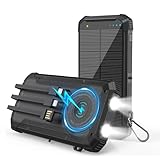
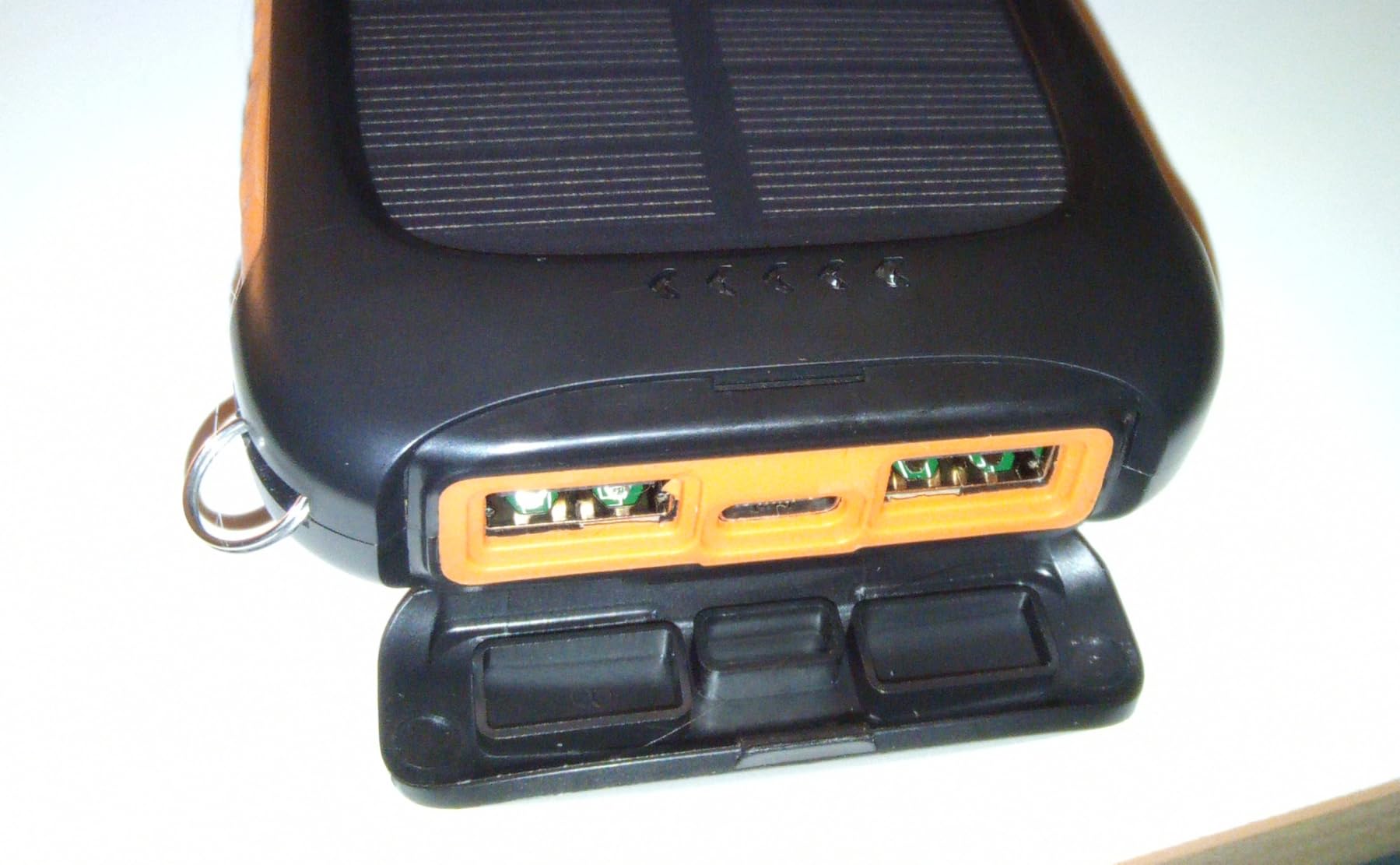
Same 20,000mAh core as our ultralight pick, but with three built-in cables and a wireless pad instead of bare ports, and the trade-off is the sleep mode. Reviewers are clear that it needs six to eight hours on a wall charger before first use, which means the night before your trip.
Six ports and a 15W output keep a group of two to three going, and a phone to 50 percent in about an hour is fine when the sun is out and the bank is full.
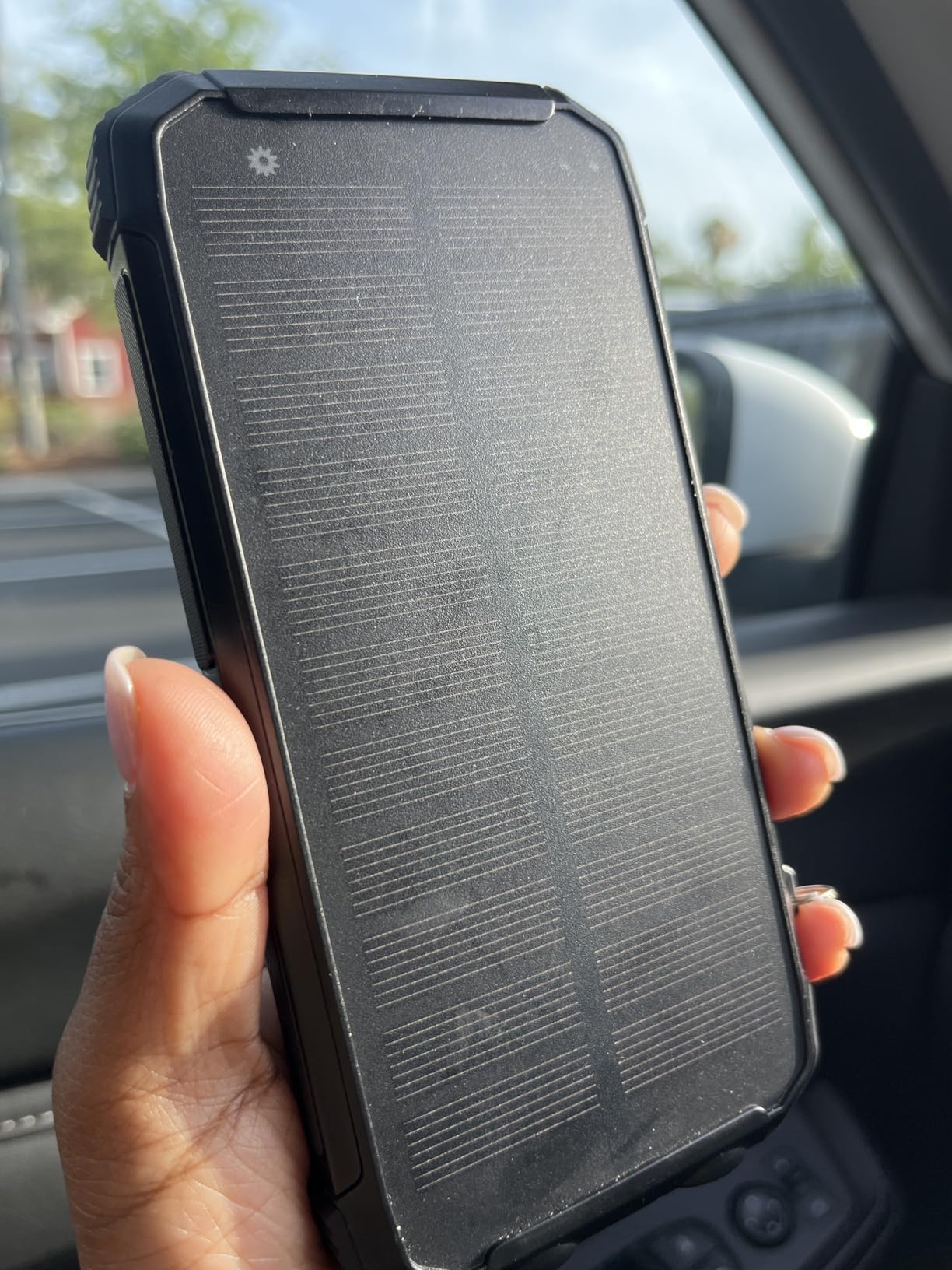
The 3-mode flashlight covers strong, strobe and SOS, and the multi-protection chip handles the usual overcharge and short-circuit cases. Carrying it for the cables alone would be defensible.
It is splash resistant rather than fully waterproof, and the solar panel is explicitly an emergency feature. This unit also has the lowest average rating in the group, with a 14 percent share of 1-star reviews.
Where it earns its place
Car camping and festival trips, where the built-in cables matter more than the last 100 g. Groups benefit most, since one pack can serve five or six devices without anyone sharing a lead.
It is a reasonable pick if you want the cable convenience without the weight of the larger multi-device banks.
Where to pass
It is not a wet-weather bank. If your routes involve sustained rain or river crossings, spend the extra and get an IP65 or IP67 shell instead.
The sleep-mode behaviour also means it is useless as an emergency grab-and-go battery unless it is already at full charge.
11. Hiluckey Solar Power Bank with 4 Solar Panels – Best for Panel-Based Recovery
Hiluckey Solar Charger Power Bank – Fast Charging Portable Phone Charger with 4 Solar Panels – USB C PD External Battery Pack with 3 USB Outputs for Cellphone Tablet (Dark Black)
4 foldable panels
6W solar
15W PD
0.56 kg
Pros
- Four foldable panels reach up to 6W in direct sun
- Folds flat and clips to a backpack
- 15W USB-C PD takes a phone to 65 percent in 30 minutes
- Full recharge in 5 hours over USB-C
Cons
- Capacity is not published by the manufacturer
- 6W of solar is maintenance-level output only
- At 0.56 kg it is heavy for its size
This unit is built around a genuine fold-out panel array rather than a single strip. Four foldable panels produce up to 6W in direct sunlight, and the fold-flat design clips to a pack without adding much bulk.
Because it takes full power over USB-C in five hours, it is the pick for anyone who wants solar capability without carrying a large battery. The 15W PD output and three USB ports handle your devices at camp.
Two things to accept before you buy. The manufacturer does not publish the capacity, only a claim of 8 iPhone charges, and at 0.56 kg the weight is high for the class. Reviewers treat the solar side as maintenance rather than primary power, which is the honest way to use it.
When the array justifies itself
Longer trips in consistently sunny, open terrain, where you have predictable midday sun and can leave the panels unfolded for hours. It also works well as a panel-only rig paired with a separate small bank you fill at lunch.
The dust and drop-resistant construction suits dry, dusty trails where a soft panel would not last.
When it is the wrong buy
Wooded routes, cloudy regions and shoulder seasons, where 6W will not keep pace with your usage. The unpublished capacity also makes it hard to size against a trip, so buy it for the panel rather than the battery.
At 0.56 kg it will disappoint anyone who picked this list expecting something under 10 ounces.
12. BLAVOR 20000mAh with Hand Crank – Best for Long Off-Grid Trips
BLAVOR Solar Power Bank with Hand Crank and Built-in 4 Cables 20000mAh
20000mAh
15W wireless
4 cables
3 ports
1.3 lb
Pros
- Hand crank gives real power when every other source fails
- 4 cables and 3 ports charge up to 7 devices
- 15W wireless refuels a phone 50 percent in 30 minutes
- 20000mAh gives about 4 phone charges
Cons
- 1.3 lb is a lot of pack for 20000mAh
- Short built-in cables require holding the bank
- Solar panel is supplementary only
The heaviest pick we reviewed, at 1.3 pounds, and the one we include because on a genuine off-grid trip the hand crank is the only feature that never fails. When the bank is flat, the sun is gone and the trip is another day from anywhere, a crank that produces real current beats every other option.
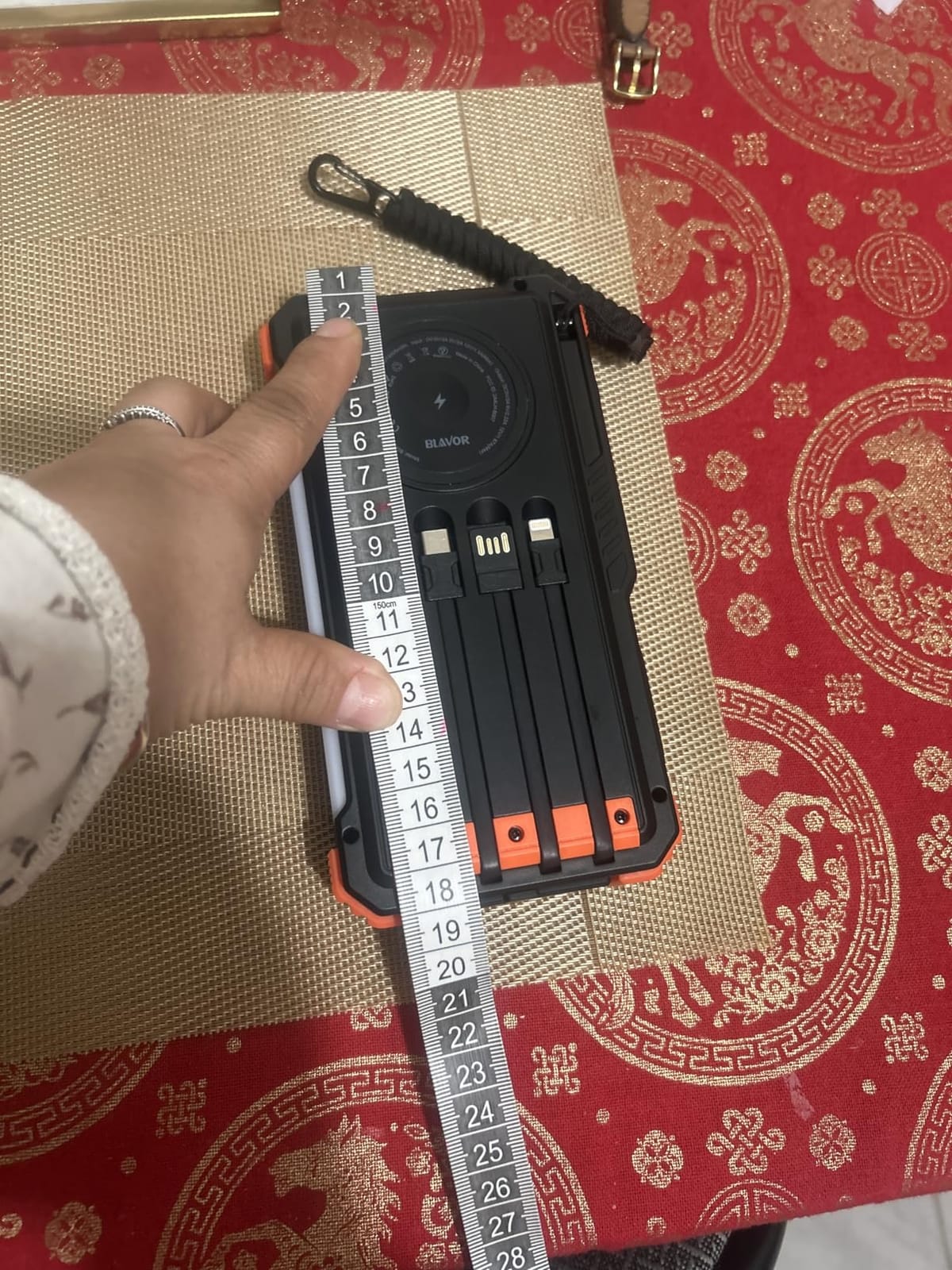
Beyond the crank it is a well-equipped bank: 15W wireless fast charging, four built-in cables, three ports and support for up to seven devices, plus a flashlight, camping lantern, compass, thermometer, carabiner and rope.
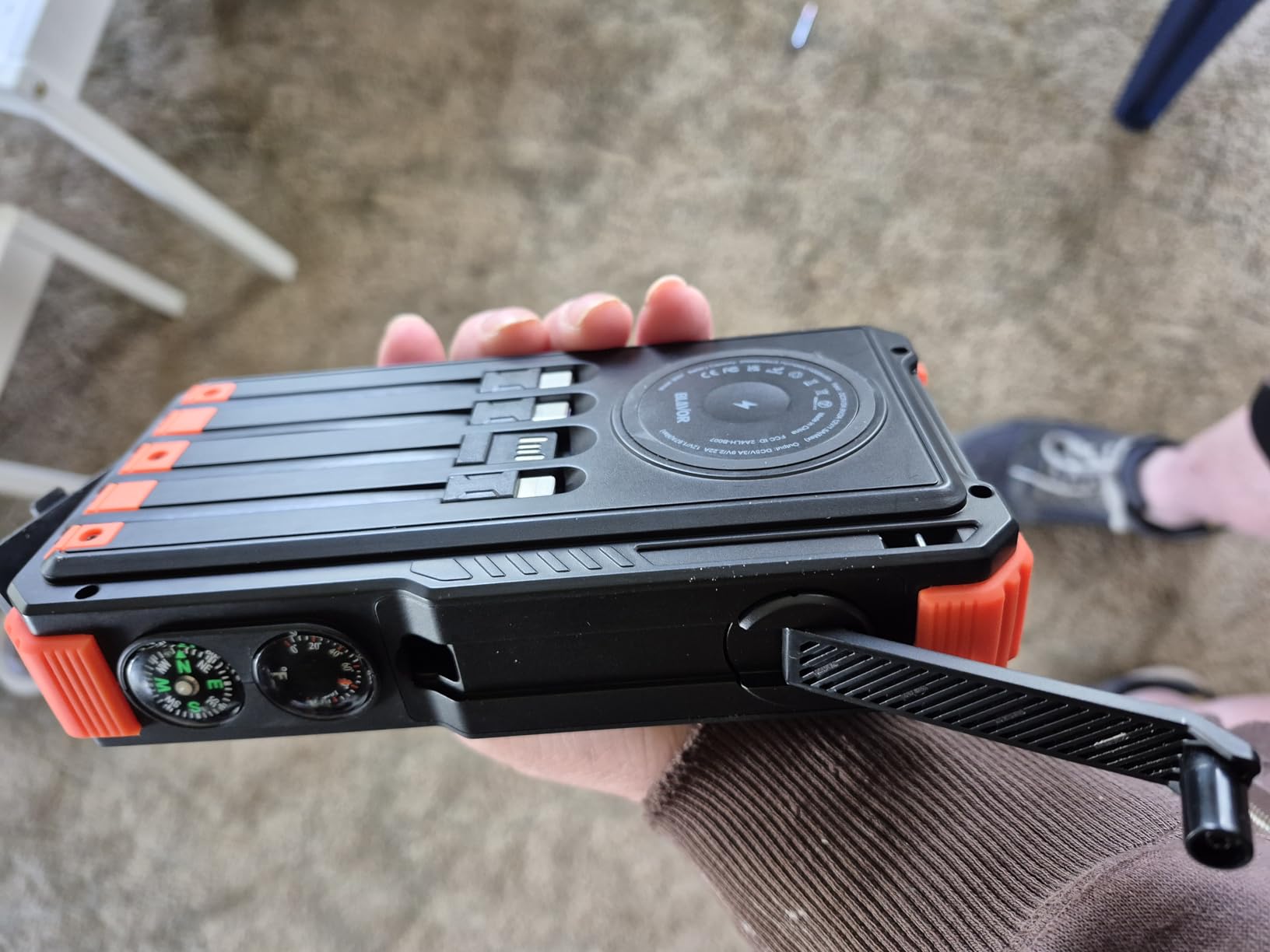
Reviewers report 20,000mAh giving roughly four iPhone 17 charges or about 3.6 Galaxy S24 Ultra charges, which is one of the better honest capacity-to-size results in the group.
The short built-in leads still mean holding the bank in your hand while the phone charges, and the solar panel remains supplementary. Nothing here is subtle about the bulk.
Who should accept the weight
Anyone heading somewhere with no resupply and no reliable sun, where a mechanical backup is worth 500 g. Vehicle-based trips and sail or canoe journeys, where weight matters less than independence, suit it well.
It also makes a capable go-bag battery for storm season, when the grid is your normal charging source.
Reasons to skip it
On foot, 1.3 lb is a lot of food to trade, and the lighter 20,000mAh options do the same job for a third of the mass. The short leads and supplementary panel are the other drawbacks.
If you are not going far from resupply, spend the weight on water or insulation instead.
How to Choose a Solar Power Bank for Backpacking
Decide whether you actually want solar. A folding solar panel plus a separate bank is a different purchase from an integrated unit, and for most three-day trips the honest calculation favours two plain banks. Backpackers on r/bicycletouring make the argument bluntly: a solar panel often weighs more than the extra battery holding the charge you would harvest from it across three days. Solar earns its place when you expect long stretches of no resupply, overcast weather risk or a hut trip with no power.
Set a weight budget before you shop. Decide how many grams the whole power system gets, not just the bank.
Do the total system weight, not just the bank weight. Panel plus bank plus cables is what goes in the pack, and across these picks a complete three-day setup lands between roughly 240 g and 600 g depending on capacity. A bank that looked reasonable on its own can eat a fifth of a day’s food budget once cables are counted.
Size capacity from real device draw, not label capacity. Budget roughly 3,000 to 5,000 mAh per phone charge, then apply 60 to 75 percent for conversion loss. That puts a two or three day trip at 10,000 to 20,000mAh and a four to seven day trip at 20,000 to 30,000mAh. Add capacity for a satellite messenger, which draws power steadily and is a common reason hikers run short.
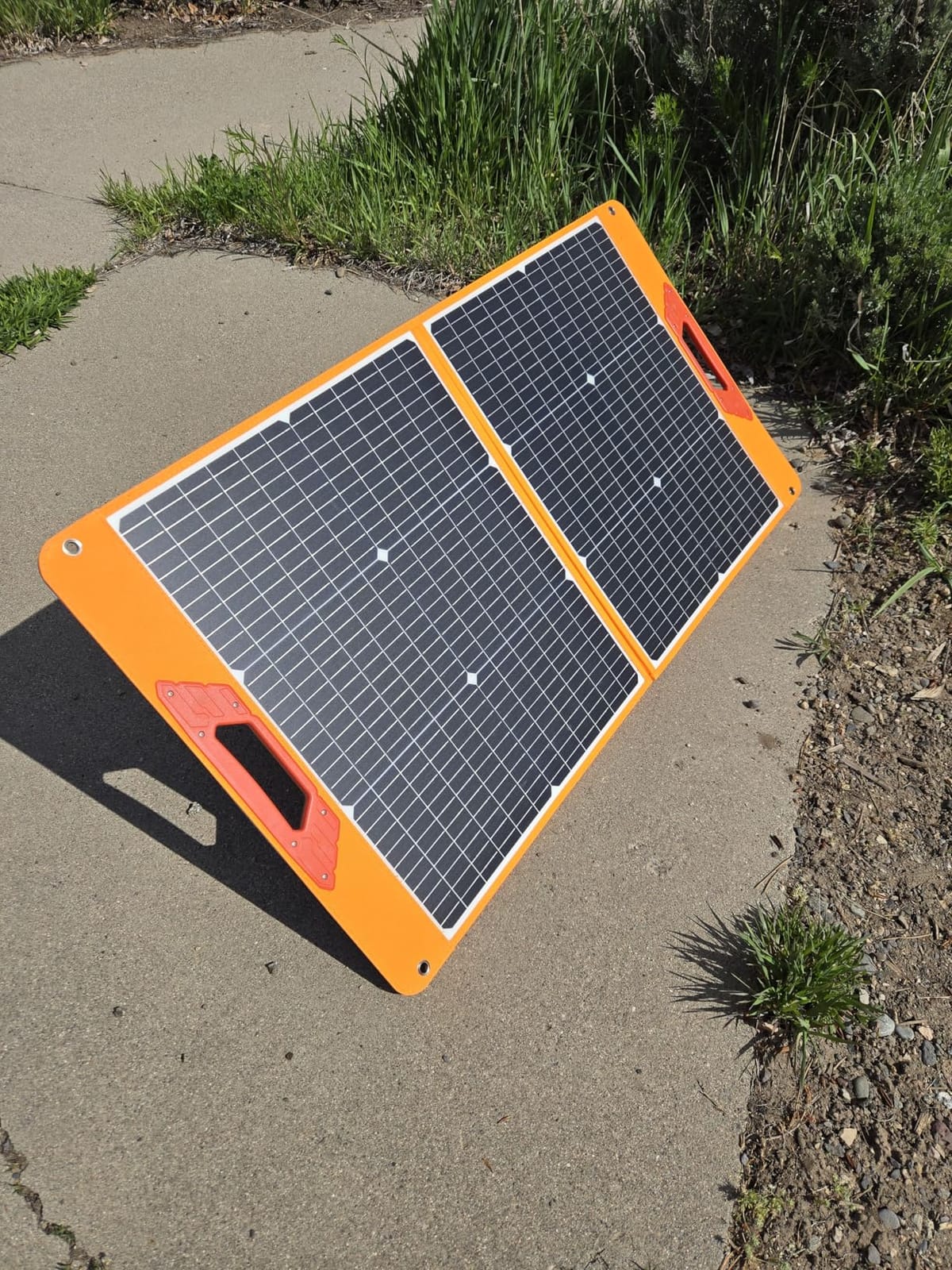
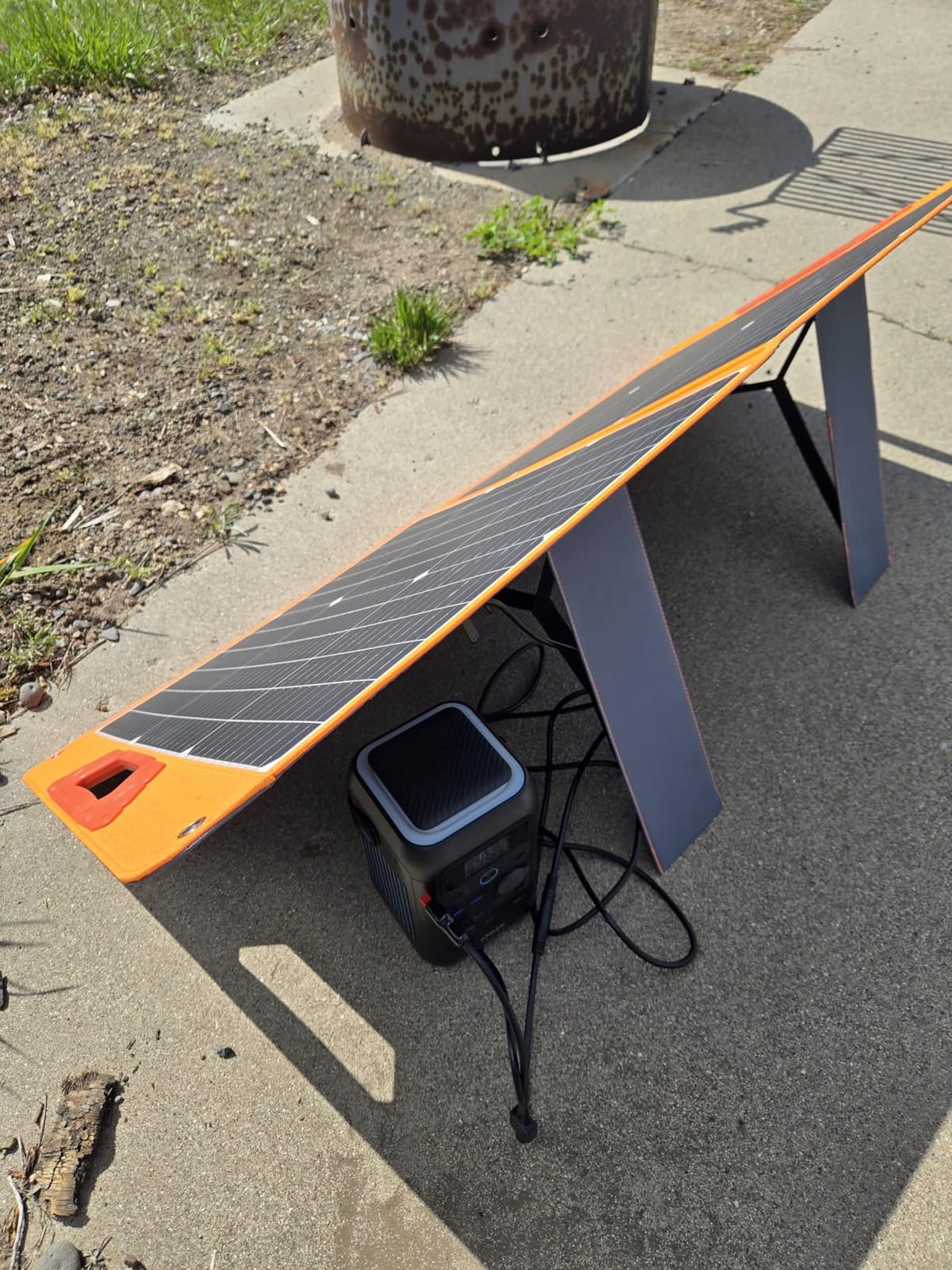
Treat panel wattage as a maintenance number. Under 2W is a paper panel. Around 5W to 6W maintains a bank through a sunny afternoon. Above 20W you are into folding panel territory, and only then does solar meaningfully extend a trip. None of the integrated units in this list reach that, which is exactly why we do not recommend buying one for the solar alone.
Check the IP rating against your weather. IPX5 handles rain and splashes, IP65 adds dust protection, IP67 survives immersion for short periods. For exposed alpine, river and monsoon routes, anything below IP65 is a gamble.
Prioritise USB-C PD output. Fifteen watts is the practical floor for a usable lunch-break top-up, and 20W is noticeably better. Verify the port is a full input and output port, since some units accept USB-C but only output over USB-A.
Deploy the panel properly at camp. Unhook it from the pack, unroll it flat, angle it toward the sun, and connect it to the bank rather than the phone. Charge the bank first, then plug your devices into the bank. Give it a full hour and check the indicator before drawing power, because the safety circuitry can delay the start of charging by 10 to 15 minutes on cheaper units.
If you fly to the trailhead, check the watt-hour figure. Lithium batteries up to 100Wh are allowed in carry-on luggage and never in checked bags, and anything between 101 and 160Wh needs airline approval. Keep terminals covered. The 20,000mAh Luvknit in this list is published under the 100Wh ceiling, which makes it the simplest one to fly with.
One more thing worth knowing. If your main concern is power in a place with a wall socket, a plain non-solar power bank will beat every unit on this list. Our portable power bank comparison covers the non-solar case, and if you are pairing a bank with a home array, our power optimizer guide covers the fixed-installation side.
Frequently Asked Questions
Are solar power banks worth it for backpacking?
They are worth it as emergency top-up and as peace of mind, not as a primary charger. The battery half works well and the solar half adds a trickle in direct sun while you are stopped. For most trips a large non-solar bank is the better buy.
What size power bank is best for backpacking?
For one to three days, 10,000 to 20,000mAh is enough. For four to seven days, 20,000 to 30,000mAh is more realistic. Budget 3,000 to 5,000mAh per phone charge and expect only 60 to 75 percent of the label figure after conversion loss.
Do any solar power banks actually work?
The battery half of every unit we reviewed works. The solar half genuinely recharges, but slowly, in direct sunlight, while stationary, and typically at a fraction of what the label suggests. A panel on a moving pack produces almost nothing.
Why is my solar power bank not charging in the sun?
Most often the panel is shaded, angled away from direct light, or the pack has shifted so the surface is no longer facing the sun. Cheap units also add a 10 to 15 minute safety delay before the cells accept charge, and some charge controllers cut panel input entirely.
Can you take a solar power bank in carry-on luggage?
Yes, in carry-on only and never in checked luggage. Lithium batteries up to 100Wh are permitted, units between 101 and 160Wh need airline approval, and anything above that is prohibited. Keep the terminals covered or taped.
Should I buy a solar panel or a solar power bank for backpacking?
For most trips, buy a power bank and a separate folding panel only if you will have long stretches without resupply. An integrated power bank is simpler but its built-in panel is a trickle. A panel plus bank rig weighs more but recovers faster when the sun is strong.
The Best Solar Power Bank for Backpacking in 2026
For most hikers, the best solar power banks for backpacking are the small, light ones. The BLAVOR 10000mAh at 9.3 ounces is our pick for two and three day trips, because weight is the constraint nobody negotiates and its 20W USB-C and Qi pad handle a phone, a watch and a GPS unit without a cable bag.
Carry more weight and the Durecopow 20000mAh wins on built-in cables, or the BLAVOR 20000mAh if you want fast charging and a watch pad. Basecamp and vehicle trips change the answer entirely, and the SOARAISE 48000mAh covers a group from one case.
Whichever you choose, top it up at home the night before, deploy the panel flat and stationary at lunch, and plan from the measured capacity rather than the label. That habit alone will do more for your trip than any panel wattage number on a spec sheet.