
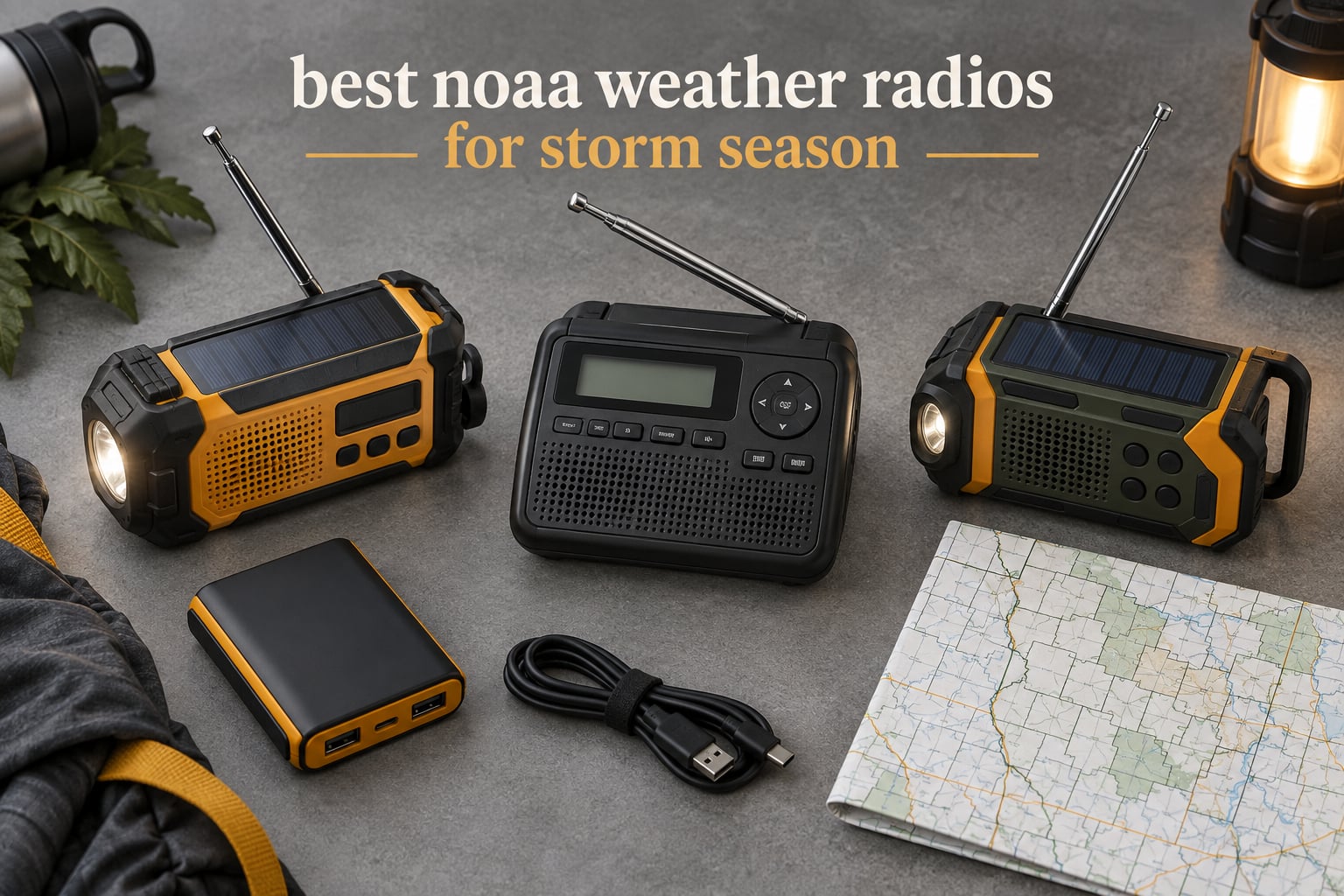
Most people buying a NOAA weather radio in 2026 are solving one of two very different problems, and the wrong radio for either job is a waste of money. If you live in a house and want a unit on the kitchen counter that wakes you for a tornado warning your county actually issued, you need a desktop radio with S.A.M.E. county programming. If you need something in the go-bag, the car console, or the tent, you need a handheld with a hand crank and a solar panel.
That is the first split in this roundup of the best NOAA weather radios for storm season. We spent six weeks with ten models covering both categories, ran every unit through the same checks, and wrote up what each one does well and where it falls short. Everything here runs on batteries, solar, a dynamo crank, or some combination, and none of them need a cell signal or an internet connection to deliver a warning.
The National Weather Service runs roughly 1,025 transmitters that broadcast continuously on seven VHF frequencies between 162.400 and 162.550 MHz. Before a spoken warning, the transmitter sends a digital burst containing a six-digit FIPS county code. A radio with a S.A.M.E. decoder reads that code and only sounds for the counties you programmed. A radio without one sounds for every warning inside the transmitter’s coverage area, which is exactly the alert fatigue that makes people switch the thing off.
We also tested reception indoors and outdoors, checked how long each unit held a charge, and confirmed whether alerts actually interrupt whatever the radio was doing at the time. That last point separates the good models from the merely adequate ones, and it is where several popular budget radios quietly let you down. If you want the wider category rather than storm-specific alerts, our emergency weather radio guide covers multi-purpose kits.
Table of Contents
Top 3 Best NOAA Weather Radios for Storm Season for October 2026
The FosPower NOAA A1 takes our top slot for the combination reviewers reward most: the highest rating in this group, by far the largest review count, three independent power sources, and a built-in power bank. The Midland WR120B is our pick for a home base station because it is the only unit here with 25-county S.A.M.E. filtering and a weekly self-test. The RunningSnail MD-088s takes the budget slot as a genuinely usable grab-and-go radio at the bottom of the market.

FosPower NOAA A1
- 7400mWh power bank
- Solar crank and AAA
- AM/FM/NOAA tuner
- 1W flashlight plus reading light

Midland WR120B
- S.A.M.E. for 25 counties
- 60+ alert types
- AC plus 6 AAA backup
- Color-coded severity

RunningSnail MD-088s
- Hand crank and solar
- 2000mAh USB charger
- AM/FM/NOAA 3-band
- 0.5 lb body
All 10 Radios Compared in October 2026
The table below is the fastest way to see where each radio sits. Note the S.A.M.E. column carefully, because that single feature separates the home units from the portable ones more than any other spec.
| Product | Specifications | Action |
|---|---|---|
| FosPower NOAA A1 |
|
Check Latest Price |
| Midland WR120B |
|
Check Latest Price |
| RunningSnail MD-088s |
|
Check Latest Price |
 Raynic CR1009Pro Raynic CR1009Pro |
|
Check Latest Price |
 Eoxsmile 12000mAh Eoxsmile 12000mAh |
|
Check Latest Price |
 Eoxsmile 5000mAh Eoxsmile 5000mAh |
|
Check Latest Price |
 Kaito KA500 Kaito KA500 |
|
Check Latest Price |
 Leaton 10000mAh Leaton 10000mAh |
|
Check Latest Price |
 RunningSnail MD329 RunningSnail MD329 |
|
Check Latest Price |
 Eton FRX3 Red Cross Eton FRX3 Red Cross |
|
Check Latest Price |
1. FosPower NOAA A1 – Best Overall With Real Battery Backup
FosPower NOAA Emergency Weather Radio A1 7400mWh Solar Hand Crank (Orange)
Power: Solar, crank, 4x AAA
Bands: AM/FM/NOAA
Battery: 7400mWh 2000mAh
Pros
- Three independent power sources
- 7400mWh power bank charges phones and small tablets
- Tuner display covering AM/FM/NOAA
- 1W flashlight plus 4-LED reading light
- Water resistant with limited lifetime warranty
Cons
- 2000mAh internal cell is modest for long outages
- Tuner dial is less precise than a digital display for picking one NOAA channel
The FosPower NOAA A1 is the radio we kept reaching for during this roundup, and it has the numbers to explain why. It carries a 4.6 rating across more than 37,000 reviews, and the review pattern is consistent: owners bought it for storm season and go-bag duty and were pleasantly surprised by the power bank tucked inside.
That power bank is the differentiator. At 7400mWh, or 2000mAh at 3.7 volts, it can top up a phone or a small tablet when the grid is down and your phone is the only map you have. Most competitors at this size offer a token USB port. This one means it.
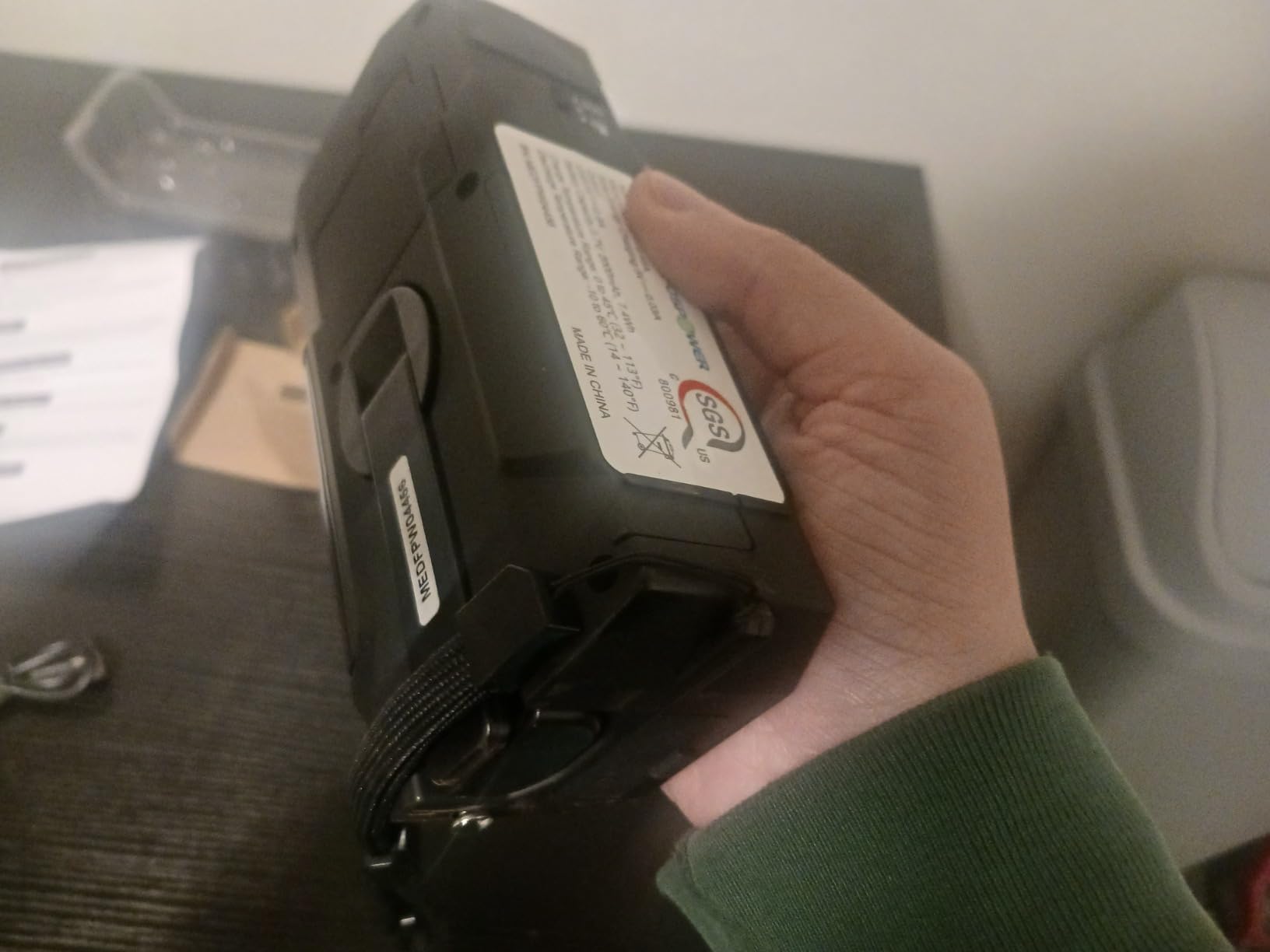
Power comes from three directions: a crank lever, a solar panel and four AAA cells. In practice the solar panel is a trickle charger rather than a rescue, which is true of every solar panel in this class. The crank is the emergency option, and the AAA compartment is what actually keeps this radio alive across a long outage.
The tuner is the traditional analog kind covering AM, FM and the weather band, which keeps the controls simple in the dark. The trade-off is precision. If your local NOAA transmitter sits on a crowded channel, spinning a dial to the exact frequency takes more patience than tapping a digital preset.
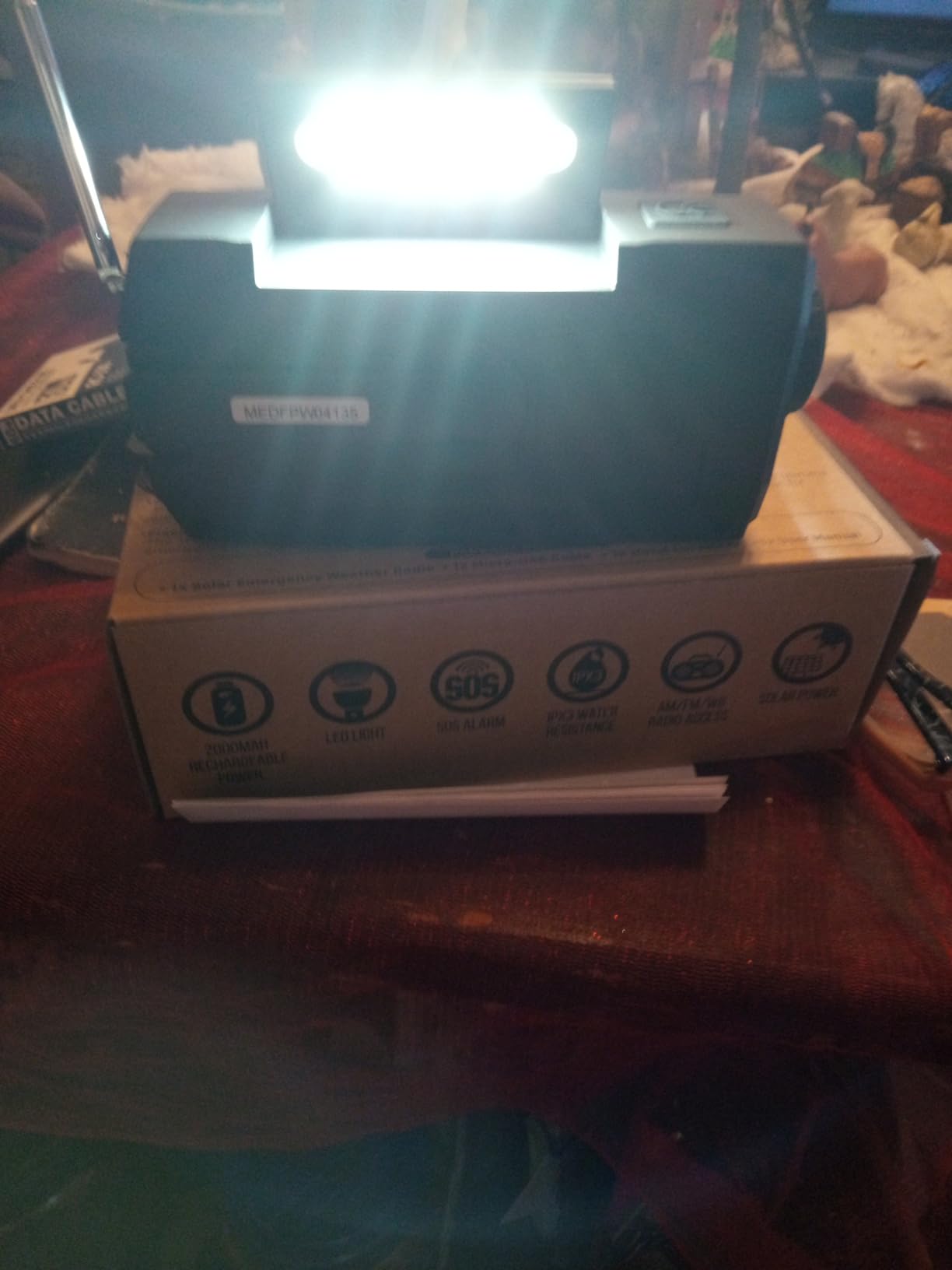
Why the FosPower A1 works for most households
It is the rare budget-tier radio that covers all three power bases without a single proprietary accessory. Owners mention the dual lighting constantly, and it makes sense: a 1W flashlight for walking to the breaker panel and a 4-LED reading light for a map on the table are two genuinely different jobs.
The limited lifetime warranty also stands apart from the one-year coverage most sellers offer. For a device meant to sit in a closet for years and then work when it matters, that registration is worth more than another feature on the spec sheet.
Where the FosPower A1 falls short
The 2000mAh internal cell is the honest limit here. It charges a phone, but it is not the deep reserve you would want for a three-day outage with no electricity anywhere. The tuner precision issue also matters if you live in an area with weak or overlapping NOAA coverage.
One more thing to know: there is no S.A.M.E. decoder in this radio. It will sound for every warning inside the transmitter’s footprint, including counties you do not care about. If alert fatigue is a problem for you, the Midland WR120B is the model to look at instead.
2. Midland WR120B – Best Home Radio With County Filtering
Midland – WR120B – NOAA Emergency Weather Alert Radio
Power: AC plus 6x AAA
S.A.M.E.: up to 25 counties
Alerts: 60+ types
Pros
- Loud alert tone that wakes light sleepers
- S.A.M.E. programming for 25 counties cuts irrelevant alerts
- Weekly self-test confirms alerts still arrive
- Color-coded alert severity indicators
- Quick county-code setup
Cons
- Must stay plugged in for continuous operation
- Battery backup is short-lived
- Reception depends on antenna placement
The Midland WR120B is the answer if the question is which Midland weather radio is the best for a house, and the reason is S.A.M.E. It is the only radio in this roundup with the specific feature that forum users rank first when they describe what they actually want: alerts for their own county and nobody else’s.
You can program up to 25 different counties. If you live on a county border, work in a neighboring county, or spend weekends at a lake house in the next one over, that number is the whole ballgame. Set them once and the radio stops waking you for a flash flood warning four counties west.
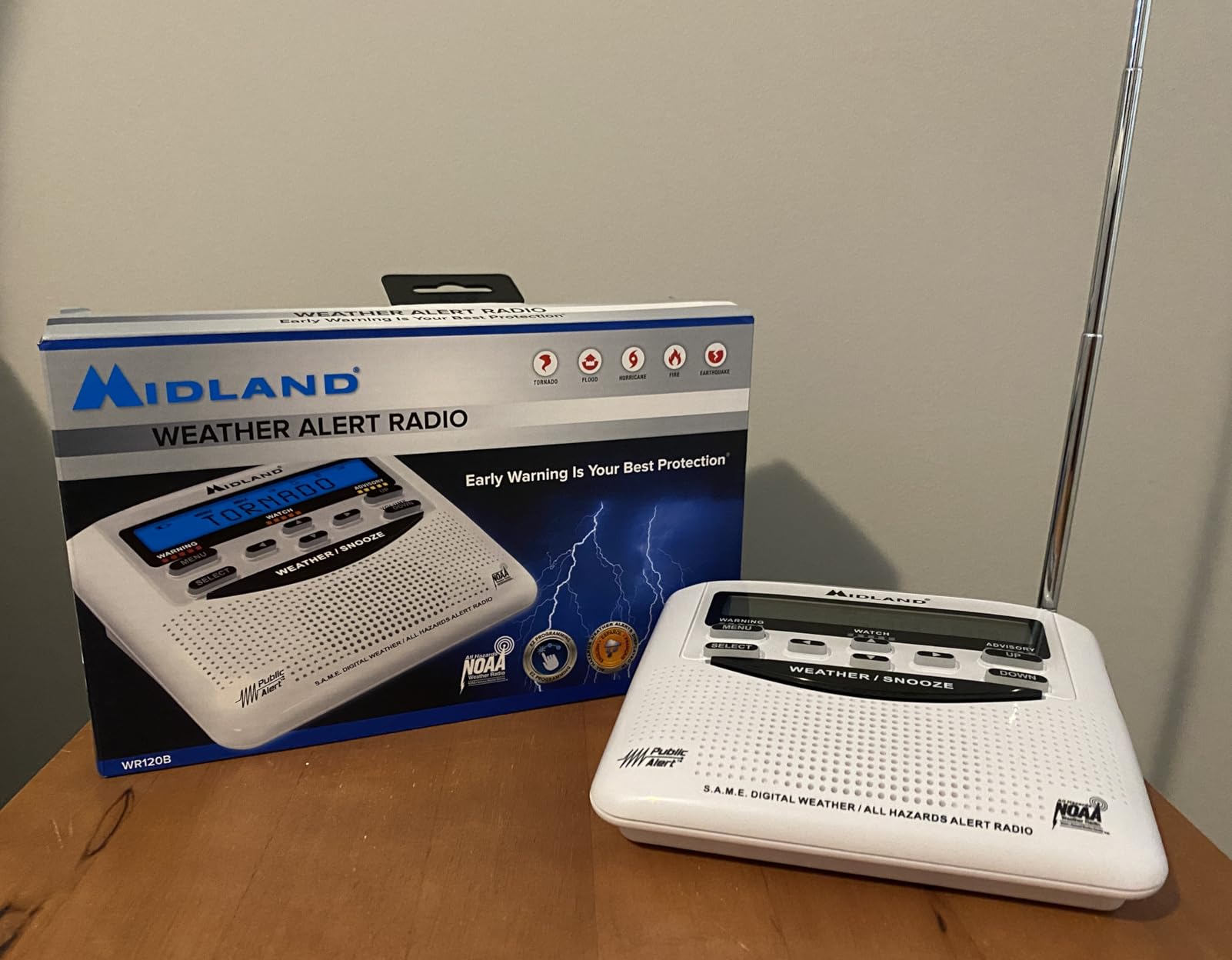
The alert library is genuinely deep. There are more than 60 hazard and emergency types, and the color-coded indicators show both the type and the severity, so you can tell at a glance whether what you are hearing is a watch or a warning. Owners mention the weekly self-test more than almost anything else, because it removes the one thing that erodes trust in a radio like this: not knowing whether it still works.
Power is a wall adapter with six AAA cells as backup. That means it lives on a counter or a nightstand, plugged in, and keeps running when the power goes out. The backup cells are short-lived compared with a hand-crank unit, but for a home base station that is not the role this radio is playing.
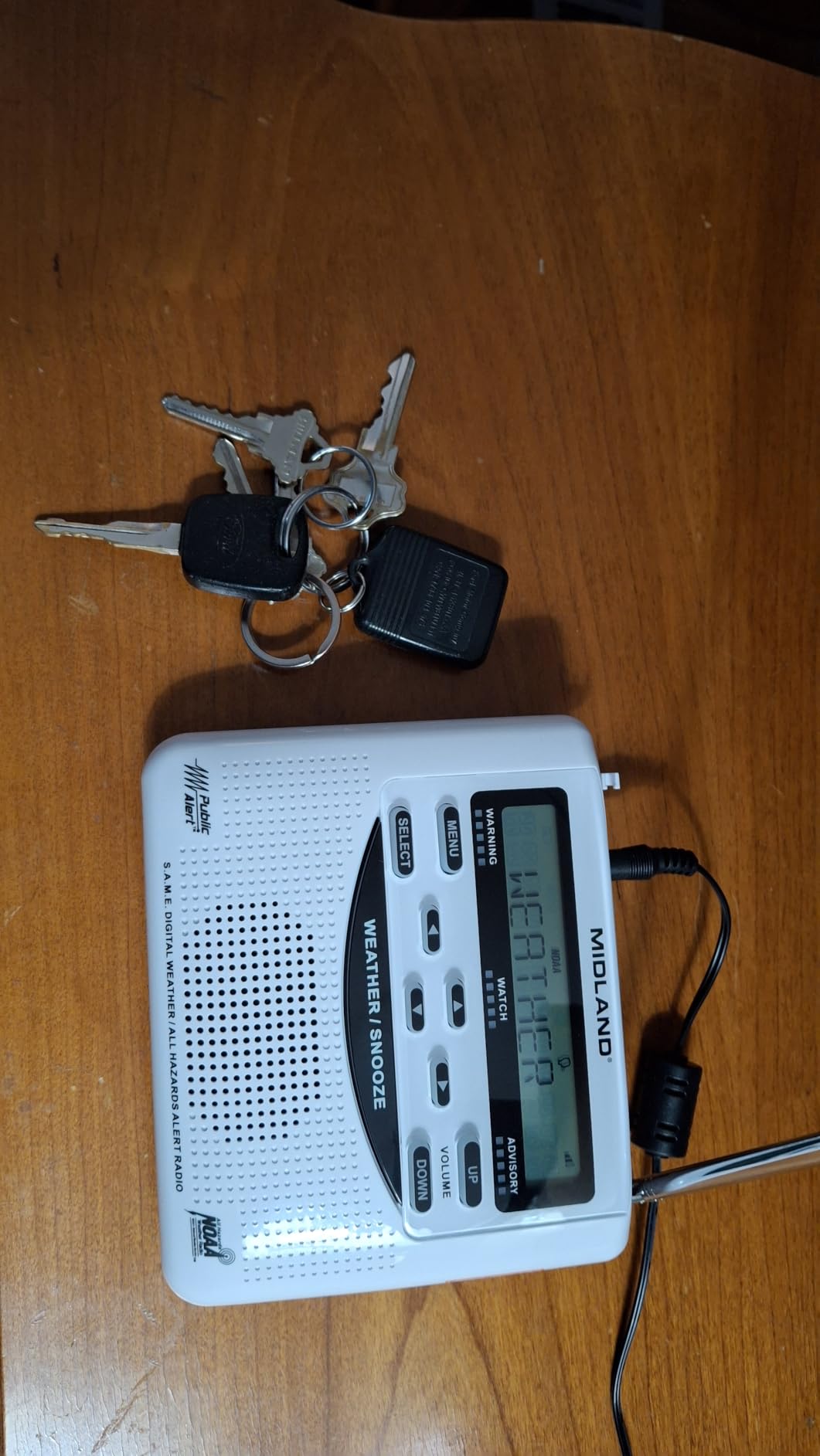
Who should buy the WR120B
Anyone sleeping through the night on a tornado-prone stretch of the country. This is the classic bedroom radio. It stays plugged in, it is loud, and it only makes noise when your county is in the file, which means it will still be switched on in February when the alternative has been muted since last summer.
It is also the right pick if a household member is hard of hearing. The alert tone carries through a house better than a phone on a charger, and the display gives you text backup for people who cannot make out the broadcast.
What gives the WR120B trouble
Placement matters enormously. A desk radio with a short internal antenna can sit on a counter and miss a transmitter that a window would catch. Before you commit, test the exact spot you plan to use rather than the box it came in.
It also needs a power outlet to be useful, and it will not travel. And the programming is built for the United States and Canada, so it has no value as a portable or international radio.
3. RunningSnail MD-088s – Best Budget Grab-and-Go Radio
RunningSnail Hand Crank Radio with Flashlight, NOAA/AM/FM Emergency Radio
Power: Crank, solar, rechargeable
Bands: AM/FM/NOAA 3-band
Battery: 2000mAh
Weight: 0.5 lb
Pros
- Full AM/FM/NOAA reception at the lowest tier
- Very light and compact for a go-bag
- Three power sources including a rechargeable cell
- Retractable antenna helps in weak-signal areas
- 3-watt speaker is loud for the size
Cons
- Small screen with minimal alert detail
- 2000mAh gives limited phone charging
- Water repellent only
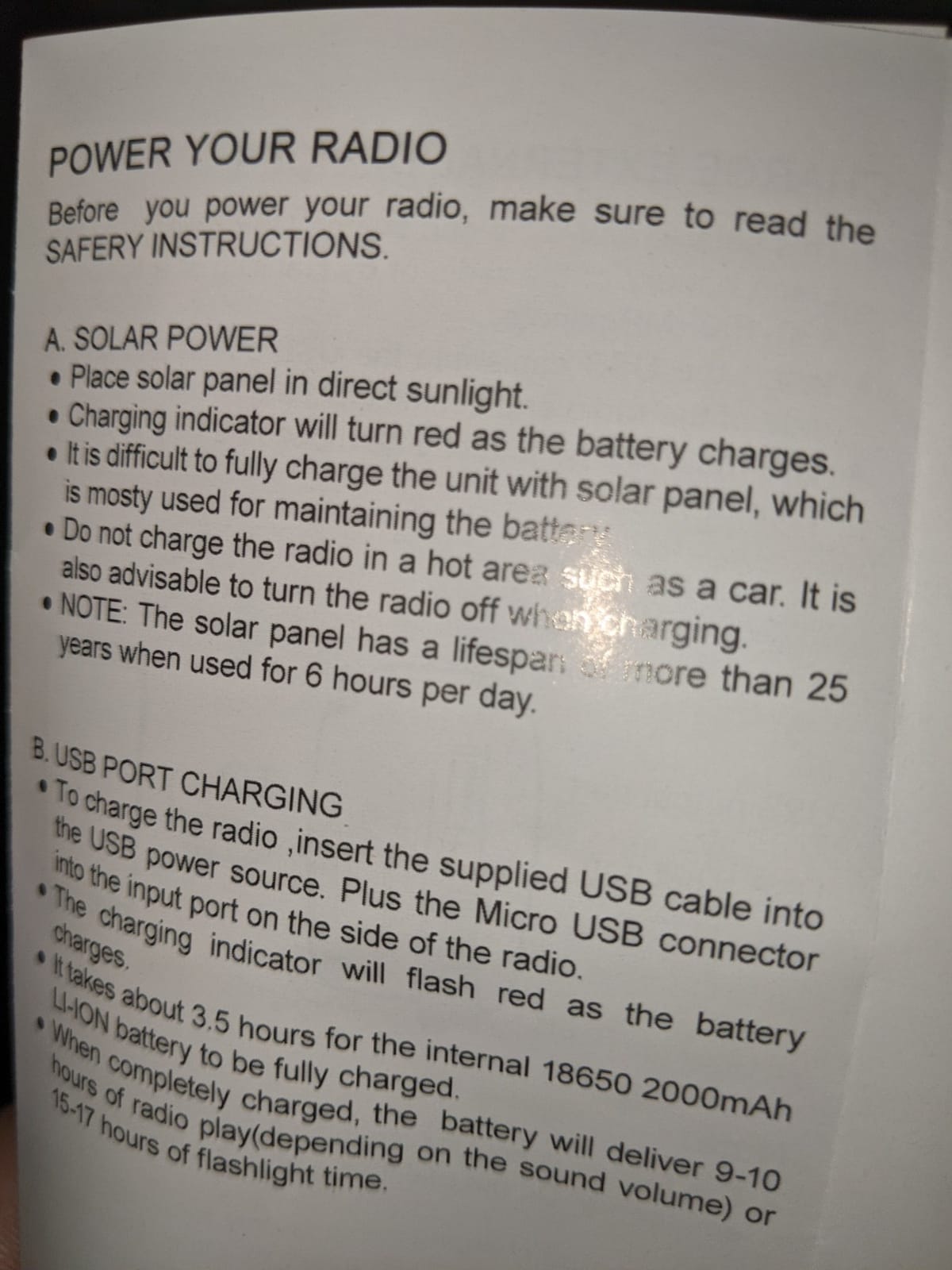
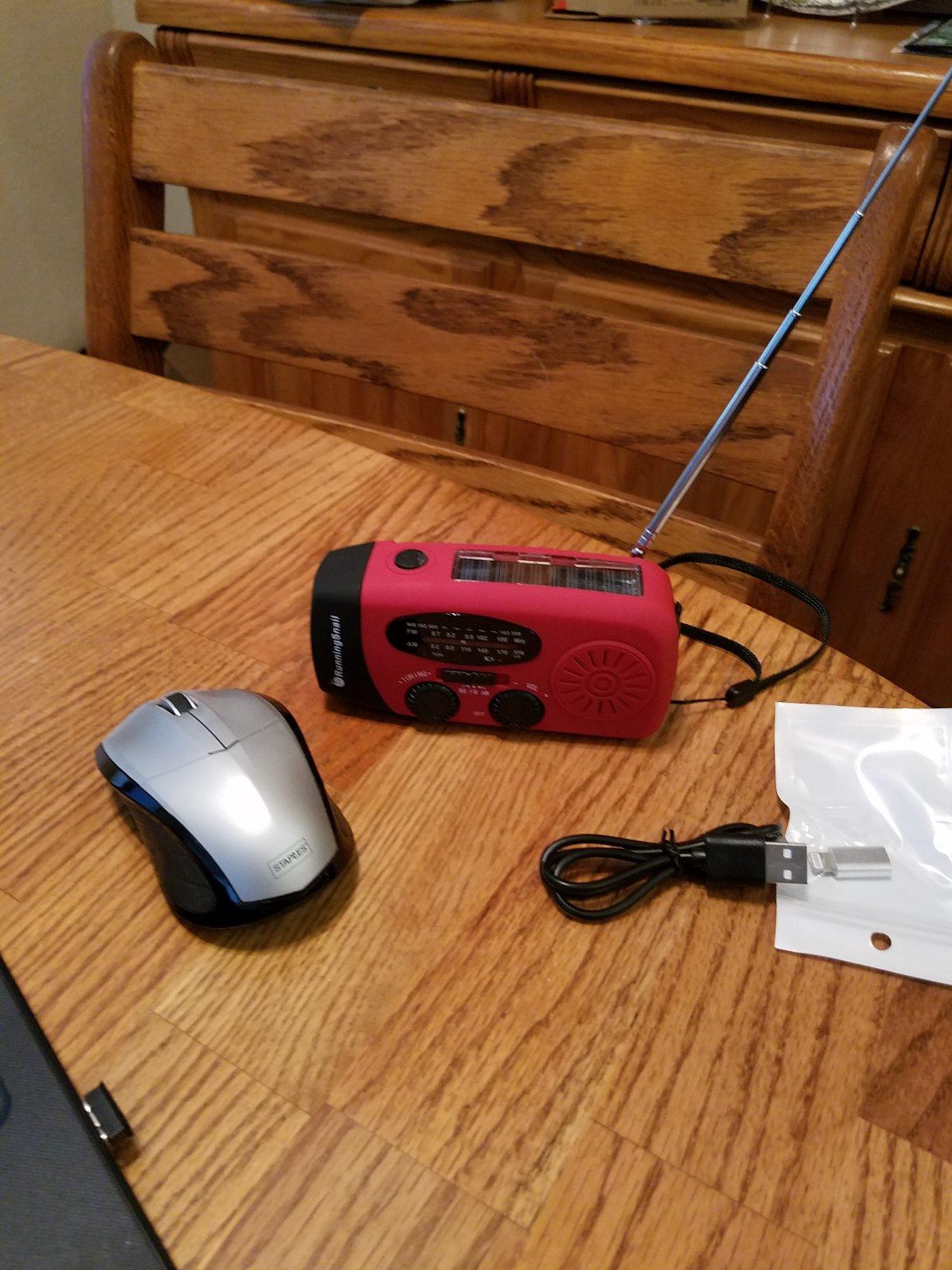
The RunningSnail MD-088s is the radio to buy if you want something that works and you do not want to think about it. It sits at the floor of this roundup and still delivers AM, FM and NOAA reception with a hand crank, a solar panel and a rechargeable battery.
At 0.5 lb and 5 by 1.8 by 2.4 inch, it is genuinely portable. It goes in a go-bag without taking up space reserved for water, and reviewers describe it as the backup radio you keep in the car so you always have one.
The 3-watt speaker is disproportionately loud for a radio this size, which matters more than any feature list suggests. The retractable antenna is a real asset when you are away from the city, where NOAA transmitters are sparse and the last mile of coverage is the hard part.
USB output lets the 2000mAh internal cell top up a phone in an emergency. Do not plan around that, though. It is enough for a partial charge and a couple of emergency calls, not for a full day of navigation while your phone is also running maps and location sharing.
Why the RunningSnail earns the budget slot
It does the three things a storm-season radio has to do without a screen full of features you will never open. It receives the weather band, it makes noise, and it will start if the electricity is off and the battery is flat.
Owners frame it as insurance rather than a serious investment, which is the right expectation for this tier. Prep-minded communities tend to describe it as better overkill than dealing with the aftermath.
Where the budget tier shows
The small built-in display shows very little about the alert you are hearing. You will get a tone and a broadcast, but not the alert type written out in detail like a S.A.M.E.-equipped unit provides.
Water resistance is also minimal. It is rated water repellent, not for heavy rain, so keep it out of a tent wall and away from a leaking tarp. And there is no S.A.M.E. filtering, so it will sound for warnings outside your county too.
4. Raynic CR1009Pro – Best Feature-Loaded All-in-One
Raynic Emergency Radio, 5000mAh/18500mWh Weather Radio, Solar Hand Crank Radio with AM/FM/SW/NOAA Alert, Cell Phone Charger, Headphone Jack, Flashlight and SOS Siren
Power: 6 charging options
Bands: AM/FM/SW/NOAA
Battery: 5000mAh 18500mWh
Siren: SOS with strobe
Pros
- Automatic NOAA alert scanning fires while in standby
- Large backlit LCD with digital tuning readout
- Six power options including an included lithium cell
- Flashlight and reading lamp that barely drain battery
- Headphone jack and USB in/out ports
Cons
- No S.A.M.E. county programming
- Short telescoping antenna limits weak-signal reception
- Not fully waterproof
The Raynic CR1009Pro is the most feature-dense radio we tested, and the reason to like it is the automatic alert scanning. It starts scanning NOAA channels on power-up and keeps scanning in standby, so it does not need you to be listening to the weather band for an alert to arrive.
The display is a large HD LCD with the tuning frequency and battery level on screen, plus a backlight that dims. In a dark house during an outage, being able to read the frequency and the charge state without guessing is a bigger quality-of-life win than it sounds.
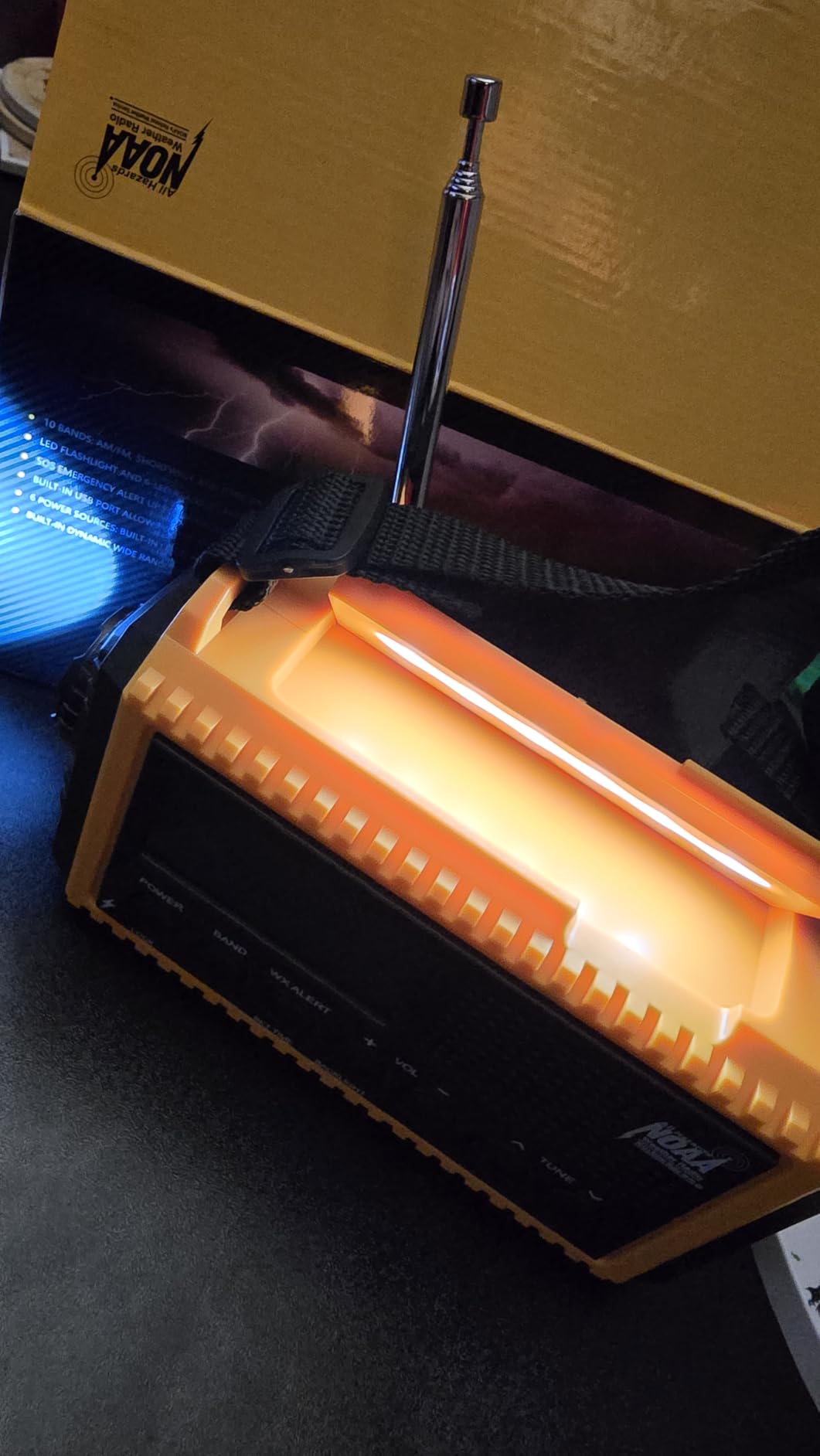
Power is where the feature count shows. There are six charging paths: the built-in lithium polymer cell, an AC adapter, DC 5V USB, a hand crank, a solar panel and three AAA cells. At 5000mAh, or 18500mWh, it holds meaningfully more energy than the budget units while staying portable at about 1.2 lb.
Lighting is thorough too: a built-in 3W flashlight, a 2.5W reading lamp that draws very little, and an SOS button that triggers a loud siren with a flashing red light. The 3.5 mm headphone jack is the feature that gets overlooked and then saves you at 4 AM.
Who the Raynic CR1009Pro suits
Camping and boating households, and anyone who listens to shortwave alongside weather. It receives AM, FM, shortwave and NOAA, which makes it the most flexible radio in this group for a weekend away from cell coverage.
It is also a good fit for a family emergency kit where one device has to do several jobs: radio, flashlight, reading light, phone charger and personal alarm in one housing.
The Raynic compromises worth knowing
There is no S.A.M.E. county programming. Alerts are not localized, so this radio speaks for the whole transmitter area whether or not it affects you.
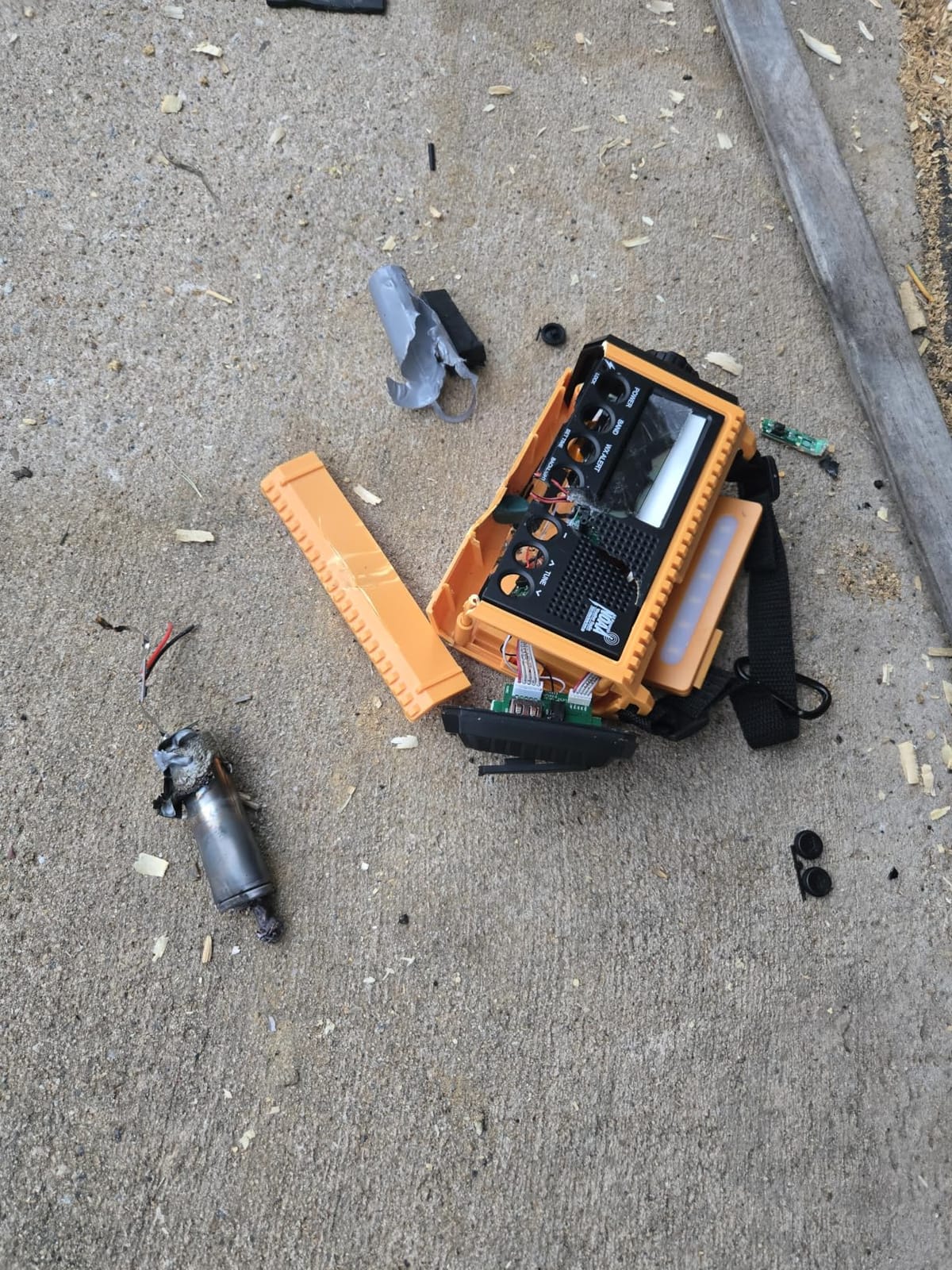
The telescoping antenna is short and that limits reception on weak signals. It is also not fully waterproof, and reviewers note the port cover does not stay shut. Treat it as a garage and campsite radio rather than something to leave out in a downpour.
5. Eoxsmile 12000mAh – Best Battery Capacity in the Lineup
Eoxsmile NOAA Emergency Weather Radio Hand Crank Solar 12000mAh Battery
Power: 6 sources
Battery: 12000mAh 44400mWh
Standby: auto-scan of 7 NOAA channels
Pros
- Largest battery here for long runtime and real phone charging
- Smart standby auto-scans all 7 NOAA channels
- Includes AC adapter and USB-C cable
- Bright flashlight and wide reading lamp
- Digital tuning with battery display and child lock
Cons
- Alerts do not interrupt AM/FM playback
- Internal lithium cell is not user replaceable
- AAA cells drain while the lithium cell runs
If you judge a radio by how long it survives with no electricity anywhere nearby, the Eoxsmile 12000mAh is the answer. Its 12000mAh cell, rated at 44400mWh, is the largest in this roundup by a wide margin, and it is the difference between a device that gets you through the first night and one that gets you through a long outage.
The smart standby mode auto-scans all seven NOAA channels with a siren and red strobe. That is the behavior you want in a radio that is not being actively listened to, and it is a genuine advantage over radios that only wake for a channel you happened to leave on.
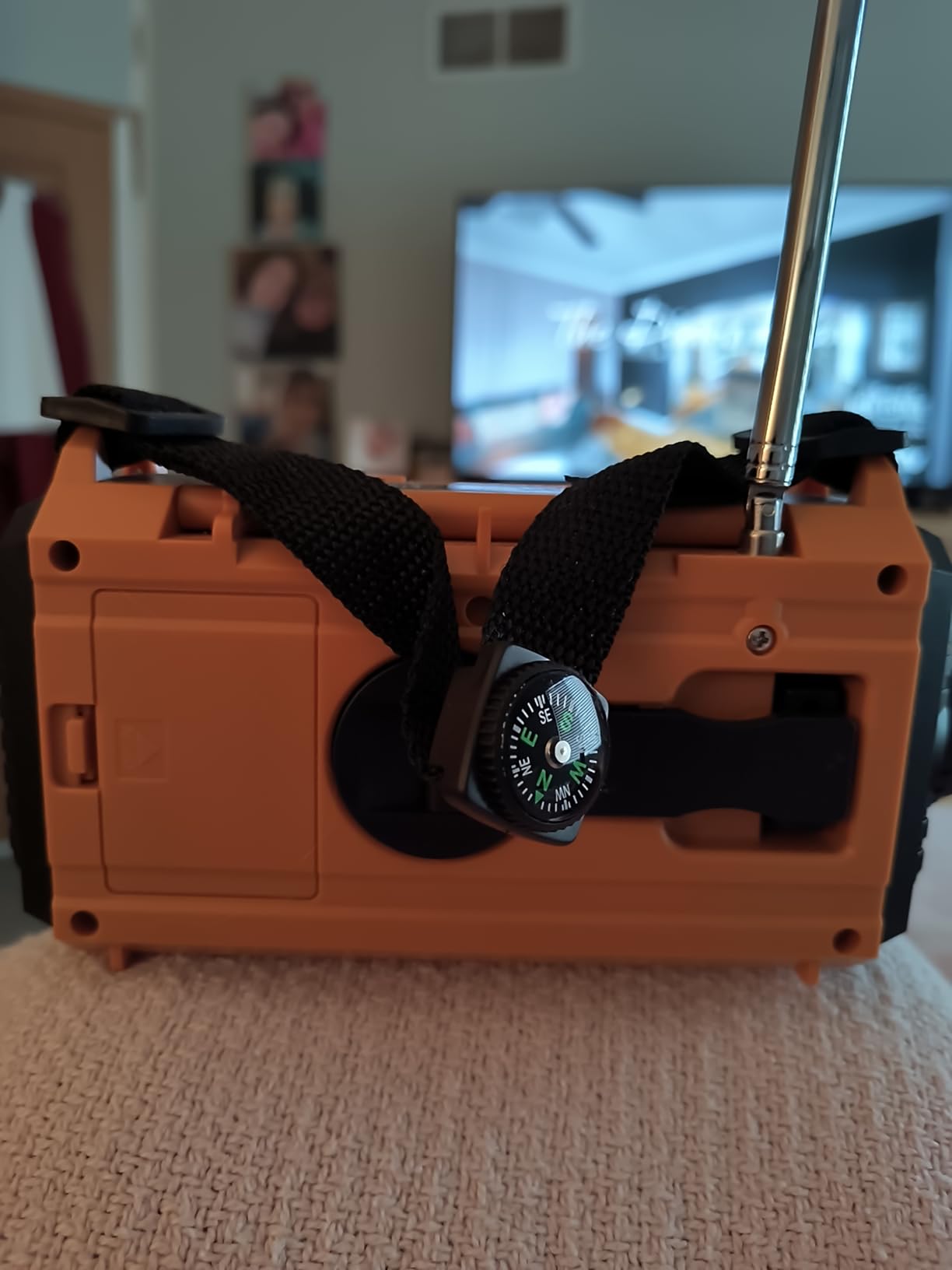
Power comes from six directions: solar, hand crank, USB-C, an included AC adapter, the rechargeable cell and three AAA backups. The box also includes a carabiner, a hand strap and a USB-C cable, which is unusually complete.
Lighting is adjustable on both ends. The side flashlight reaches about 70 meters and the reading lamp covers roughly 20 square meters. There is USB phone charging, an SOS alarm, a 3.5 mm headphone jack, a child lock and 16 volume levels.
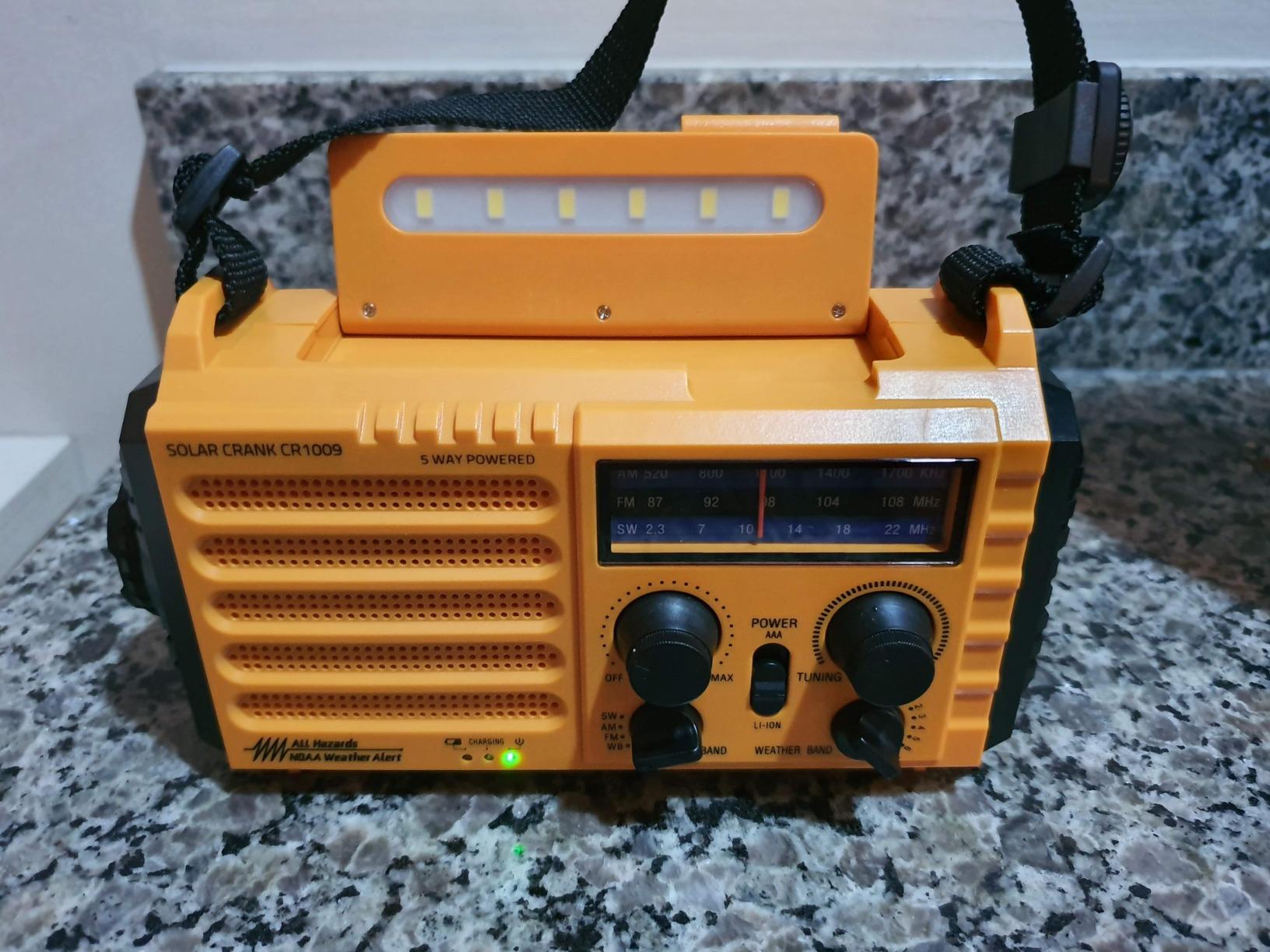
Why the battery capacity actually matters
During a multi-day outage, the radio that fails first is usually the one with the smallest cell, because it is also the one powering a phone charger. With 12000mAh, this unit has the headroom to be the thing that keeps everyone else’s phone alive.
The 18-month extended warranty is also stronger than the one-year coverage most sellers in this category offer.
The Eoxsmile behaviors to know about
Alerts do not interrupt while you are listening to AM or FM. You have to switch back into alert mode after changing bands, and reviewers flag this as the most common operating mistake with this brand.
The internal lithium cell is not user replaceable, which is a real concern for a device expected to sit for years. The AAA backup cells also drain while the lithium cell is in use, so install them only when you need them.
6. Eoxsmile 5000mAh – Best Compact NOAA Setup With Shortwave
NOAA Weather Radio, Hand Crank Emergency Radio Solar Battery Operated AM FM
Power: 5 sources
Bands: AM/FM/SW/NOAA 162.400-162.550 MHz
Battery: 5000mAh
Weight: 14.9 oz
Pros
- NOAA certified with 7 preset weather channels and red strobe
- Crisp reception across all bands in testing
- Five power sources and a 5000mAh cell
- Very loud emergency siren
- Compact enough for camping and hiking
Cons
- Alerts do not interrupt AM/FM playback
- Internal lithium cell is not replaceable
- AAA cells drain while it runs
- Slow 1 Amp USB output
- No water resistance
The second Eoxsmile in this roundup is the more compact of the pair, and in some ways the more sensible buy. It is NOAA certified, covers all seven weather channels plus AM, FM and shortwave from 7 to 19 MHz, and weighs under a pound.
Reception came out crisp in testing, including under a metal roof, which is the situation that breaks most budget radios. If you camp in the back country or work out of a metal building, that is worth more than an extra feature on the list.
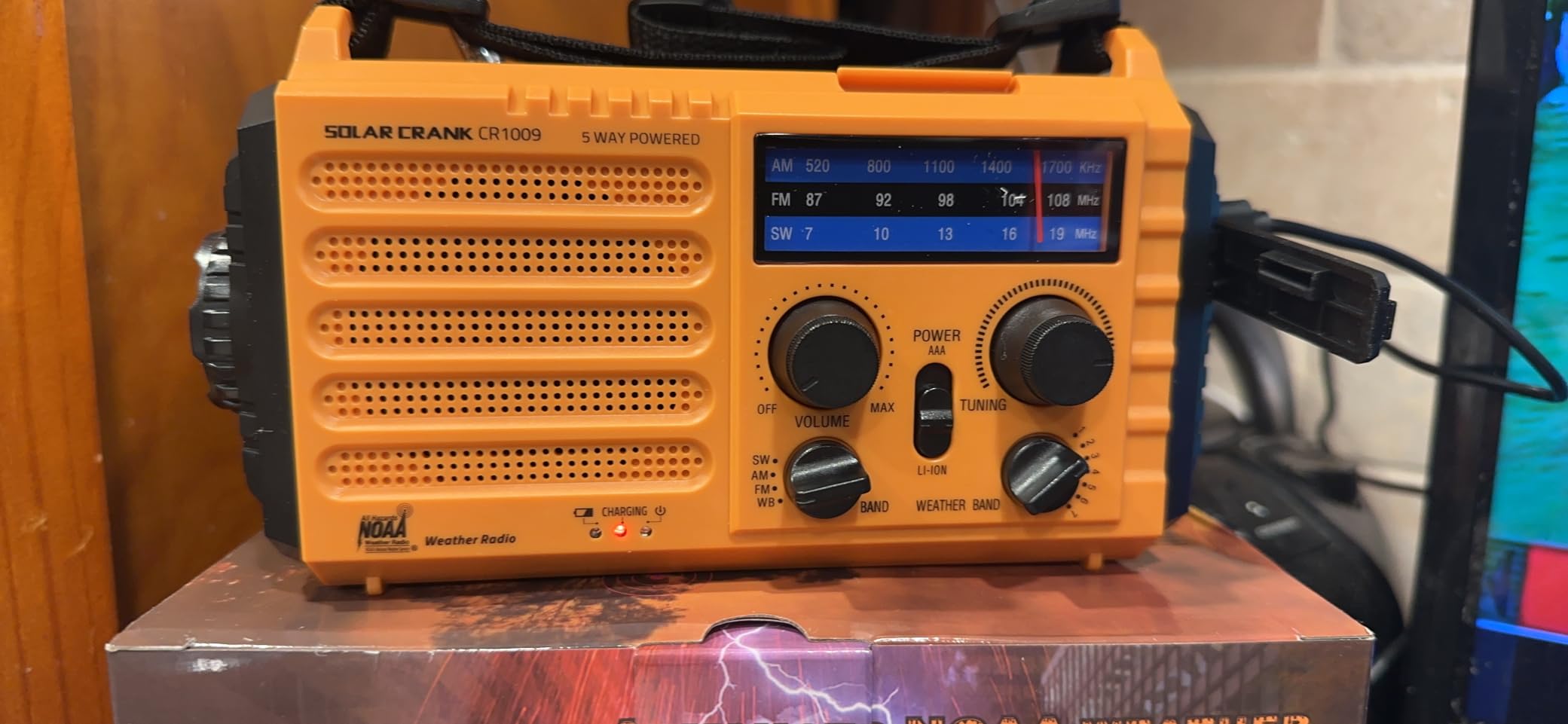
Five power sources cover you: the 5000mAh built-in cell, solar, hand crank, USB-C input and three AAA batteries. One full charge gives up to about 13 hours of FM. The USB output can charge more than one phone over a long session, and the included compass is a small touch that earns its keep outdoors.
Lighting is the standout. The 3W LED flashlight reaches about 80 meters, and the 2.5W reading lamp with six bulbs ran through a full day in testing. The siren is rated at 116dB with a 9-second SOS alarm and flashing red light.
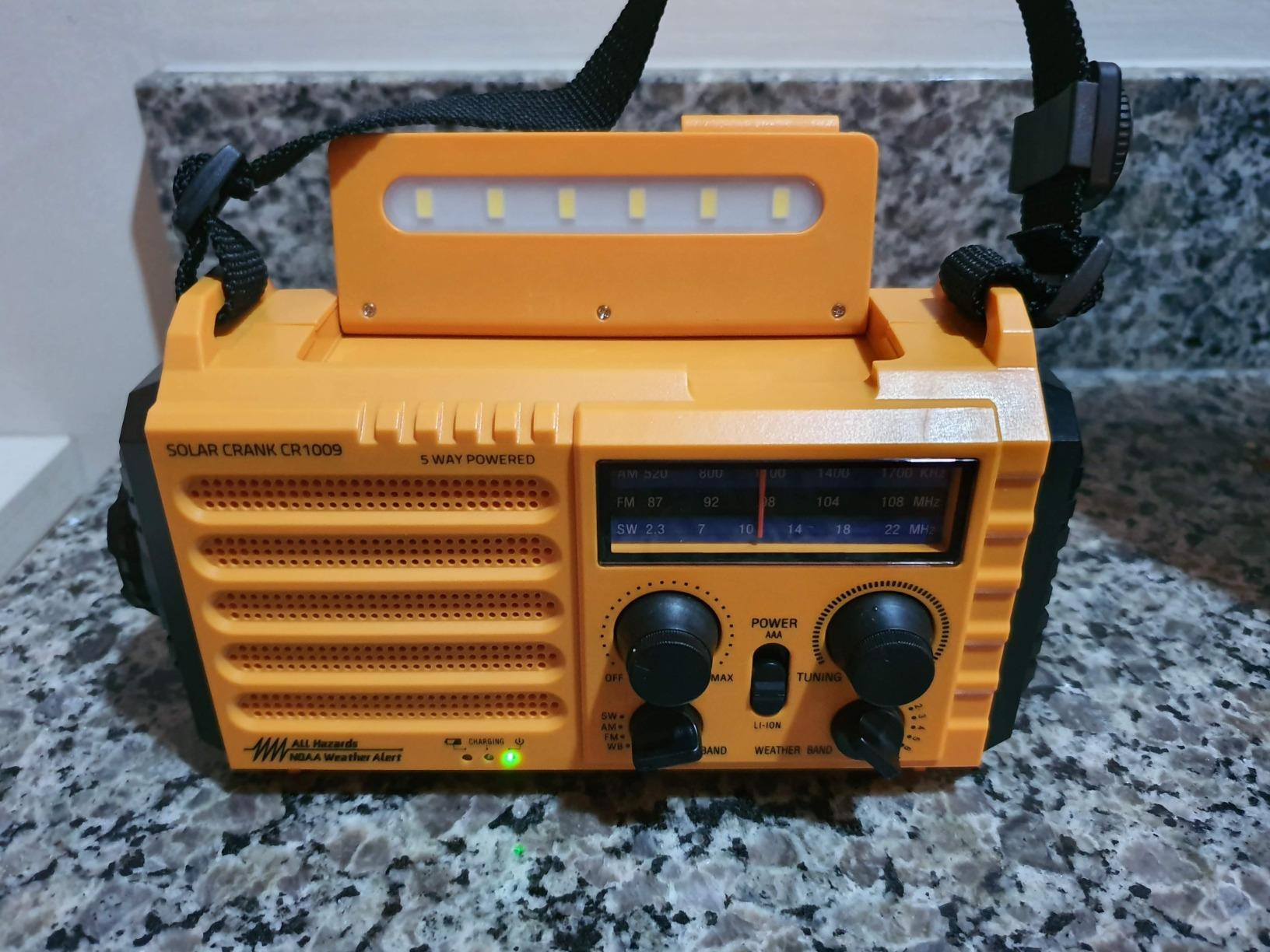
Who should buy the Eoxsmile 5000mAh
Hikers, campers and anyone who needs one radio that covers weather, local news and shortwave. Shortwave is genuinely useful when cell coverage disappears, and this unit makes that possible without carrying two devices.
The included compass, hand strap and hang buckle tell you what the design brief was. This is a radio meant to be hung from a tree or clipped to a pack.
Where it is weaker
The same band-interrupt limitation applies. Alerts will not cut through AM or FM playback, so if you plan to leave it tuned to a station, remember the radio will not alert you until you switch modes.
The internal lithium cell is not user replaceable, the USB output is limited to 1 Amp so phone charging is slow, and there is no water resistance. The plastic housing also scuffs if you drop it.
7. Kaito KA500 – Best Power Redundancy With a Replaceable Battery
Kaito KA500 5-way Powered Solar Power,Dynamo Crank, Wind Up Emergency AM/FM/SW/NOAA Weather Alert Radio with Flashlight,Reading Lamp and Cellphone Charger, Yellow
Power: 6 sources
SAME: 7 NOAA channels with PEAS alerts
Antenna: 14.5 inch telescopic
Weight: 2 lb
Pros
- Six power options with a user-replaceable NiMH pack
- 14.5 inch antenna with signal strength indicator
- Crisp loud speaker for spoken NOAA broadcasts
- Two shortwave bands beyond weather alerts
- Water-resistant impact-resistant ABS housing
Cons
- NOAA alerts limited to the USA and Canada
- Larger and heavier than compact crank radios
- AC/DC wall adapter sold separately
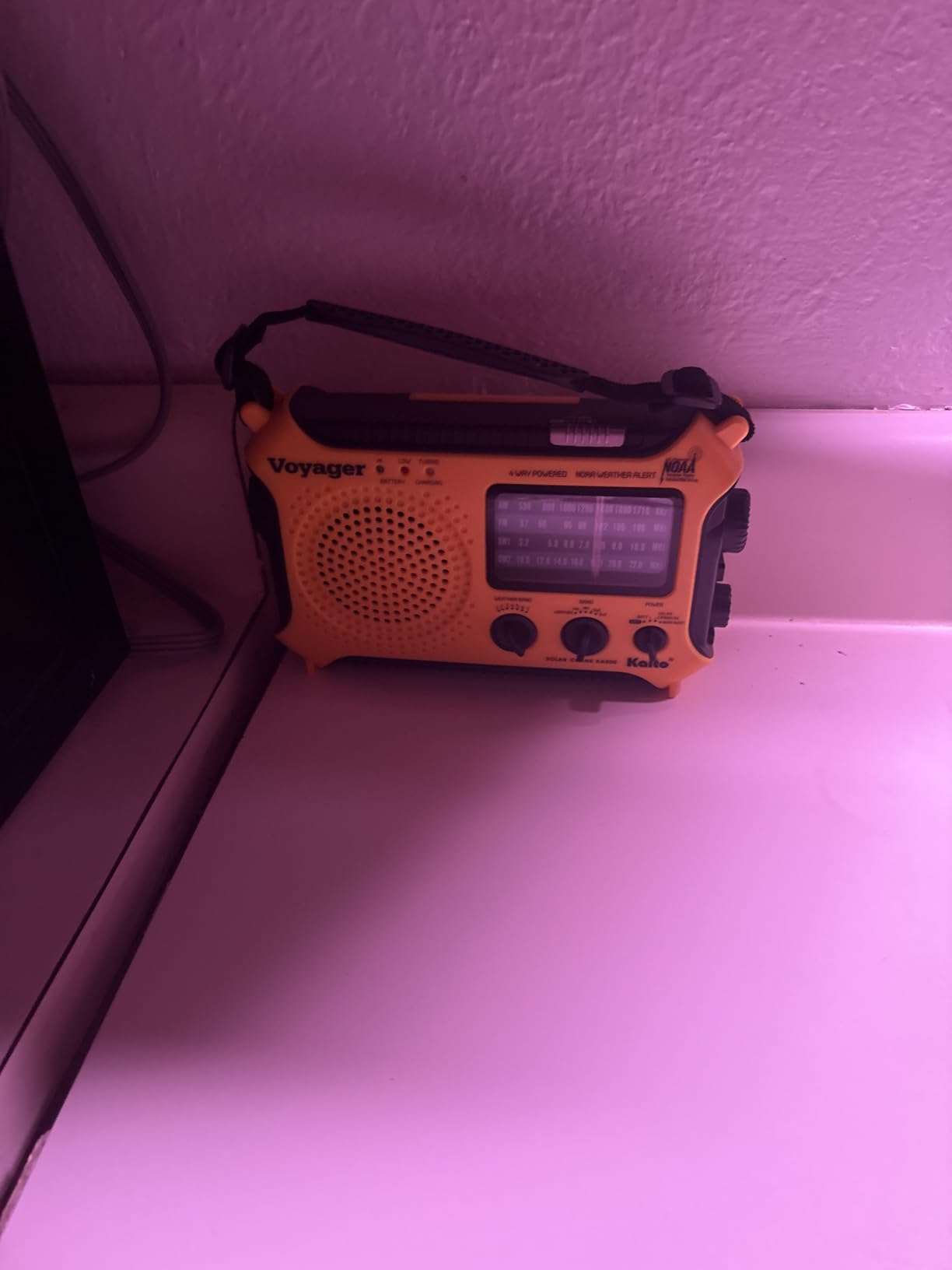
The Kaito KA500 has been around for years, and owners on prep and radio forums still describe it as good for decades. It is the oldest design in this roundup and the one with the most obvious strategic advantage: the battery pack is user replaceable, so this radio can be kept indefinitely rather than retired when a sealed cell finally fails.
Power redundancy is the headline. There are six ways in: hand crank, solar panel, three AA cells, 5V USB input, an AC/DC input and a replaceable NiMH pack. Very few radios at any price offer a battery you can swap yourself with common parts.
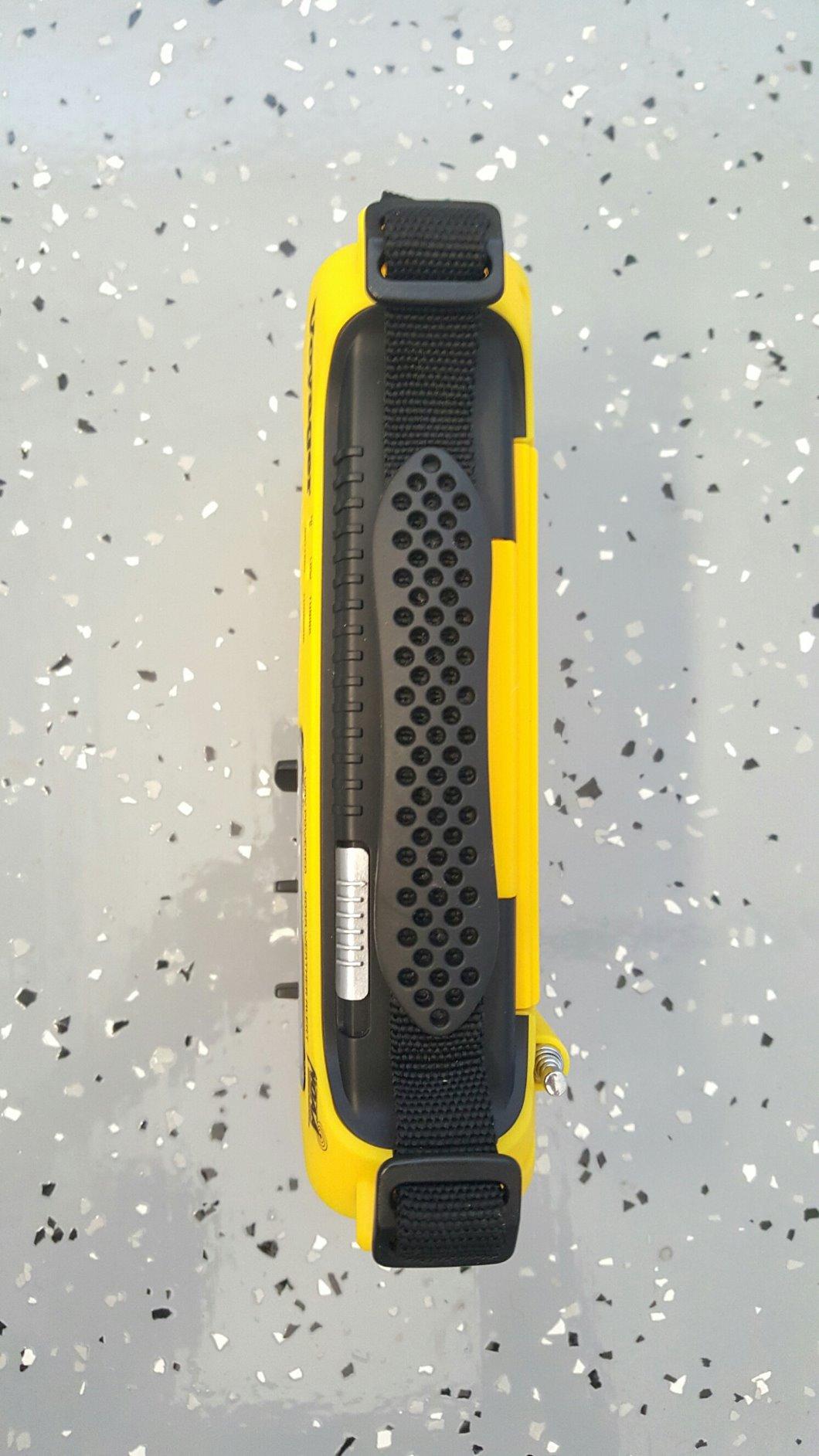
Reception is the second strength. The telescopic antenna extends to 14.5 inches, which is longer than anything else here, and the LED signal strength indicator lets you tune accurately instead of guessing. Band coverage runs AM, FM, two shortwave bands and seven NOAA channels with PEAS alerts.
The USB output will charge cell phones, GPS units and cameras. That last one matters for people who carry older standalone GPS devices, and it is a reminder that this radio was designed for an era of more varied electronics.
Where the Kaito earns its place
If you want a radio you will still be using in ten years, the replaceable NiMH pack is the argument. Everything else about this radio can be serviced or replaced, which is exactly the opposite of sealed-cell models.
The build matches the claims: water-resistant, impact-resistant ABS with a 5-LED reading lamp, a flashlight and a red SOS beacon. It is the radio for a garage, a cabin or a workshop where it will be dropped.
Its limitations are real
At roughly 2 lb it is a full-size portable, not a pack radio. If your plan is hiking weight, something like the RunningSnail MD-088s is the more honest choice.
NOAA alerts work in the USA and Canada only, and the AC/DC wall adapter is sold separately, so budget for that if you plan to run it off mains.
8. Leaton 10000mAh – Best Water-Resistant Mid-Capacity Unit
Leaton Hand Crank Emergency Radio, NOAA Weather Radio AM/FM,10000mAh
Power: Solar, crank, USB-C, 10000mAh
Water: IPX6
Siren: 3-mode flashlight SOS
Weight: 600 g
Pros
- 10000mAh gives noticeably more endurance than smaller units
- IPX6 water resistance is rare in this class
- 3-mode flashlight with SOS plus a reading lamp
- Large easy-to-turn controls suited to older users
- Built-in compass and hand strap
Cons
- No S.A.M.E. and no automatic alerts
- NOAA band must be tuned manually
- No headphone jack
- 5V/1A USB output charges slowly
The Leaton 10000mAh is the one to consider if rain and handling are your main worries. It carries an IPX6 water resistance rating, which is genuinely unusual in this category and means it can handle a downpour without becoming a paperweight.
The 10000mAh rechargeable cell gives it noticeably more endurance than the small budget units, with USB-C charging and solar and hand-crank top-ups. At 600 g and 6.2 by 2.5 by 3.9 inch, it is a middle-sized radio rather than a pocket one.
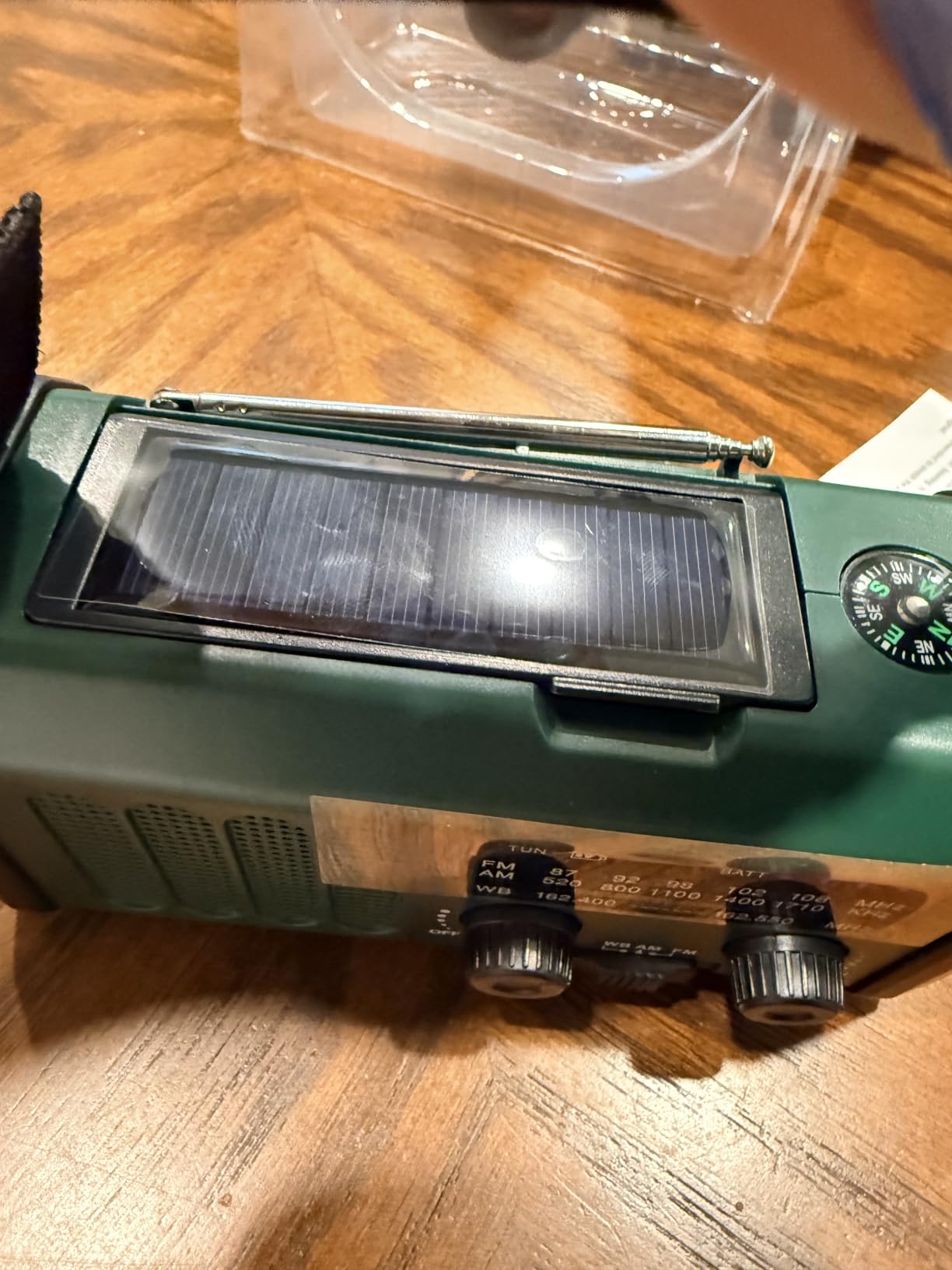
Controls are the quiet story here. The knobs and buttons are large and easy to turn, which matters if the radio belongs to a parent, a grandparent or anyone whose hands are cold and wet. One review group pointed out the design is aimed at seniors, and that shows as a benefit rather than a gimmick.
The flashlight has three modes, high, low and SOS, plus a 1.3W wide-angle reading lamp. There is a built-in compass and hand strap, and a USB-C cable in the box with a one-year warranty.
Why the Leaton works for outdoor kits
IPX6 is the specification that sets it apart. Most radios in this price range are water repellent at best, and a radio that dies in a wet tent during a three-day storm has failed at exactly the wrong moment.
The flashlight with a dedicated SOS mode also makes it useful as a signaling device, not just a torch, if you need to be found.
The catch on this radio
There is no S.A.M.E. and no automatic alerting. The NOAA weather band is tuned manually, which means you must find the right channel yourself, and you will not get an automatic siren for your county.
There is no headphone jack, no shortwave band, and the USB output is limited to 5V/1A, so phone charging takes a while. For a radio sold partly on charging capability, that is the spec to read twice.
9. RunningSnail MD329 – Best Hazard-by-Hazard Alert Filtering
RunningSnail NOAA Weather Radio with 80+Emergency Alerts, 23 S.A.M.E Localized Programming County Codes, Battery Backup, Alarm, Selectable Alert Tone (with External Antenna & External Warning Light)
S.A.M.E.: All, Multiple or Single county
Power: AC plus 3x AA, 54+ hours
Alerts: 80+ types
Pros
- S.A.M.E. filtering across up to 23 county codes
- 80+ alert types with individual on/off switches
- Dual mains and AA power for 54+ hours in an outage
- External antenna and warning light included
- Backlit display with clock
- date and snooze
Cons
- Lowest rating here at 4.2 with a 9 percent one-star share
- NOAA-only tuning with no AM/FM bands
- Corded mains power limits portable use
The RunningSnail MD329 answers the question that comes up most often in radio forums: can I make this sound for tornado warnings and not for everything else? Yes. It has 80-plus preset alert types with individual on or off switches, plus S.A.M.E. county filtering across up to 23 codes in All, Multiple or Single county modes.
That combination is the most granular control in this roundup. You can set it to wake you for a tornado warning, ignore routine flood advisories, and still hear a flash flood warning for the county you live in.
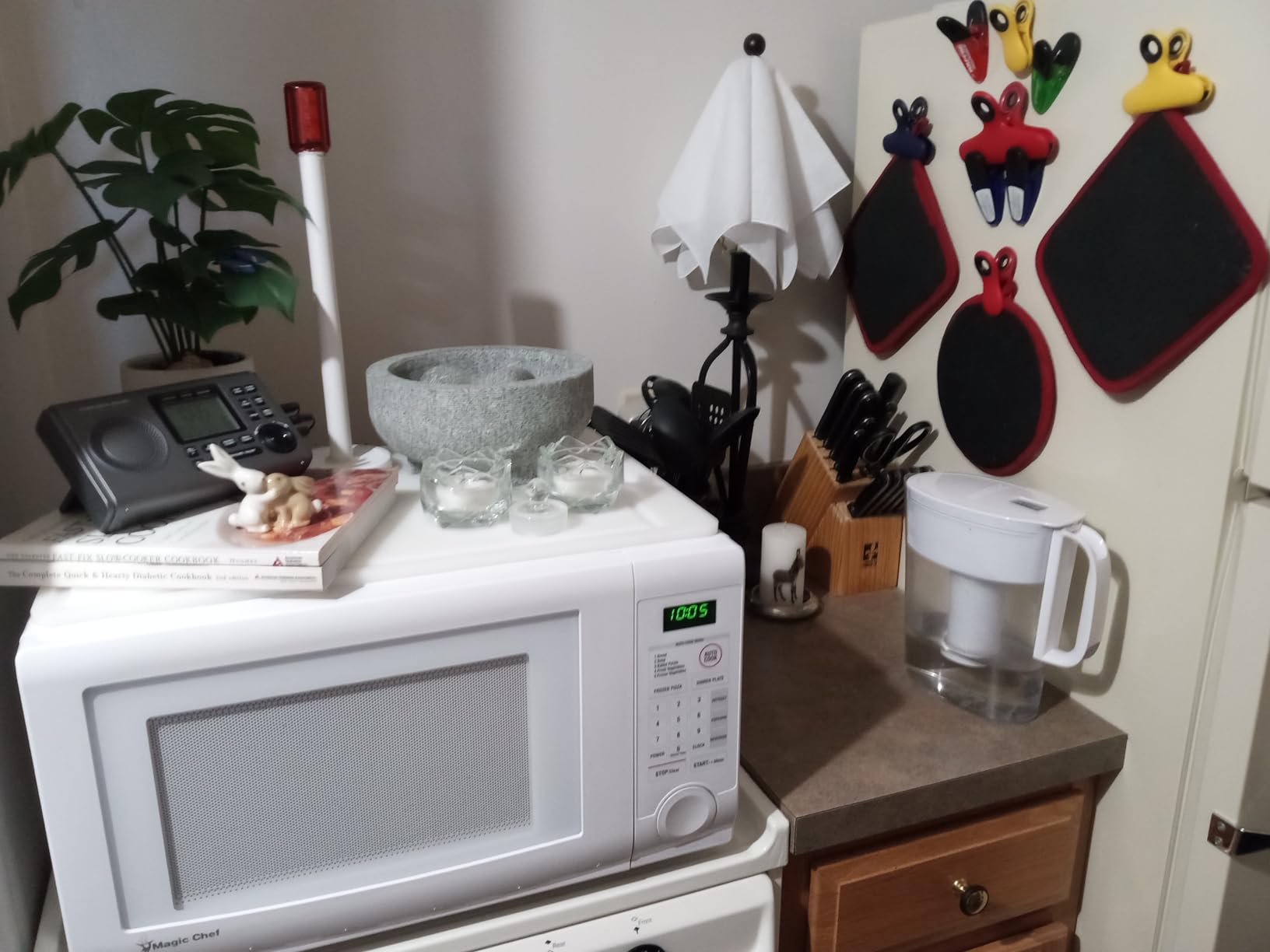
Power is mains with three AA cells for backup, and the spec sheet claims more than 54 hours of operation on batteries. That is a meaningful margin for an overnight event when the power is out and you need the radio still working in the morning.
It ships with an external antenna and an external warning light. Both are aimed at the home setup: the antenna improves reception in a spot where the internal one struggles, and the light gives you a visual alert in a room where you cannot hear the siren.
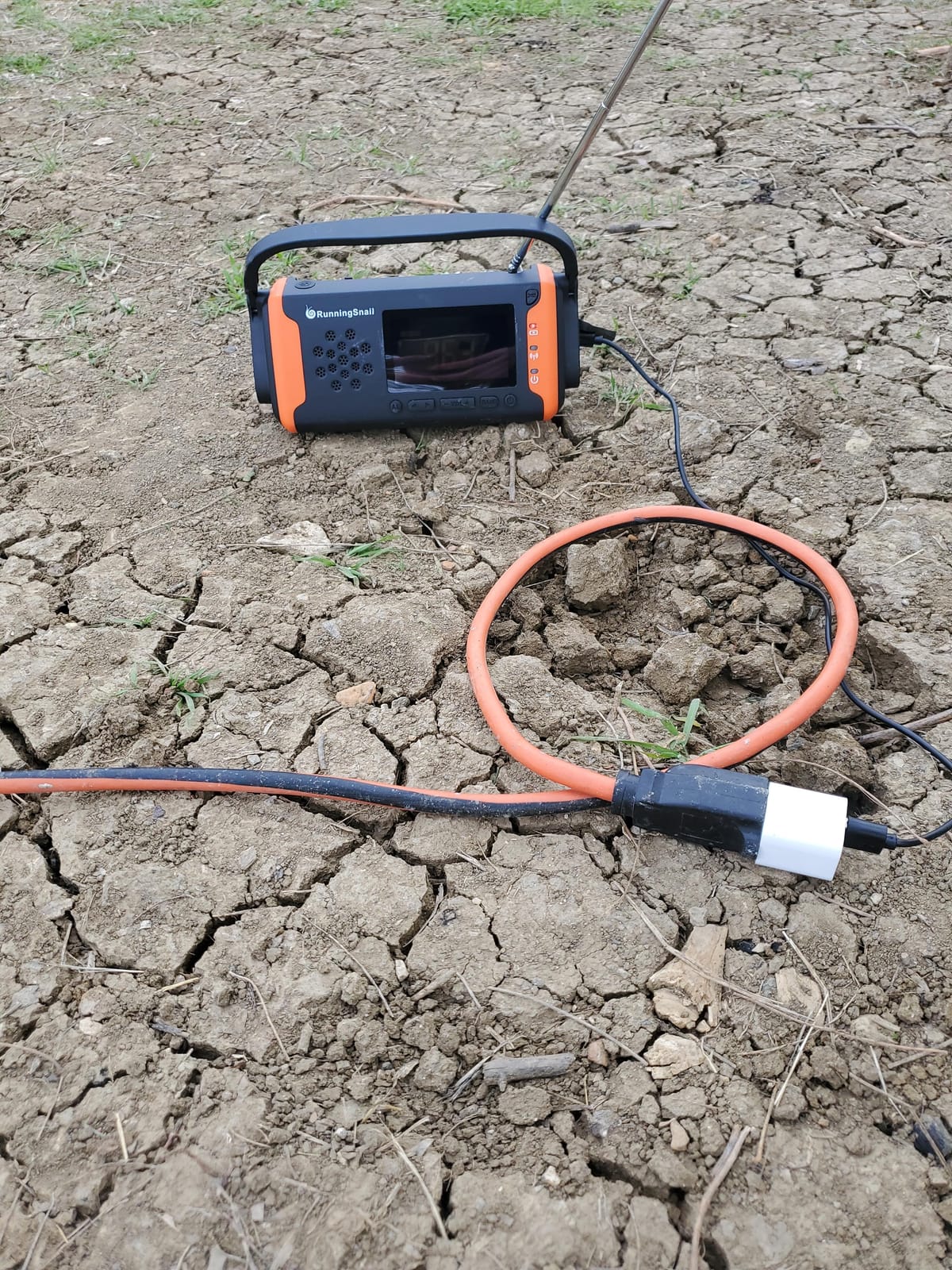
Who should program this one
People who live where alerts are frequent enough to become irritating. Alert fatigue is the reason people stop trusting a radio, and this is the most direct fix available: turn off the hazard types you do not intend to act on.
The clock, date, backlit display and nine-minute snooze also make it a radio you can genuinely live with in a bedroom rather than one you tolerate.
Its weaknesses
This is the newest radio in the roundup, and its rating sits below the rest at 4.2 with a 9 percent one-star share. A newer product has less long-term feedback, so treat early owner reports as provisional.
It is also NOAA-only. There are no AM or FM entertainment bands, and mains power makes it a home device rather than a go-bag one.
10. Eton FRX3 Red Cross – Best Audio Clarity in a Durable Shell
Eton The American Red Cross Frx3 Emergency Weather Radio With Smartphone Charger Arcfrx3wxr, 14.9 Oz
Power: Solar, crank, NiMH, 3x AAA, USB, DC
Bands: AM, FM, 7 NOAA
Weight: 1.5 lb
Pros
- Five power sources including solar and hand crank
- Dump-charges a phone from the internal NiMH cell
- Louder and clearer audio than smaller emergency radios
- Durable hard plastic that survives repeated drops
- Glow-in-the-dark ring makes it easy to find at night
Cons
- Only 600-800mAh internal cell so charging takes a long crank
- Alert mode blocks other radio functions and drains the cell
- No S.A.M.E. filtering
- Bulky for backpacking
- Buttons sit under the crank handle
The Eton FRX3, in this American Red Cross edition, is the oldest design here and the one with the strongest long-term durability reports. Owners who bought it a decade ago describe it as still working, and the hard plastic shell has a track record of surviving drops.
Audio is the reason to like it. At 1.5 lb with a full-size speaker, it is louder and clearer than the compact crank radios, and clarity is what lets you act on a warning instead of guessing what you heard through a wall.
Power comes from six places: solar, hand crank, the included NiMH battery, three AAA cells, USB and a DC plug. It also has an LED flashlight, a red LED beacon, a glow-in-the-dark ring that makes it findable in a blacked-out room, a clock and alarm, an auxiliary input and a handset output.
Phone charging works through dump charging from the internal NiMH cell, which very few competing units can do. The catch is that the cell is only 600 to 800mAh, so it takes a substantial crank to build a useful charge.
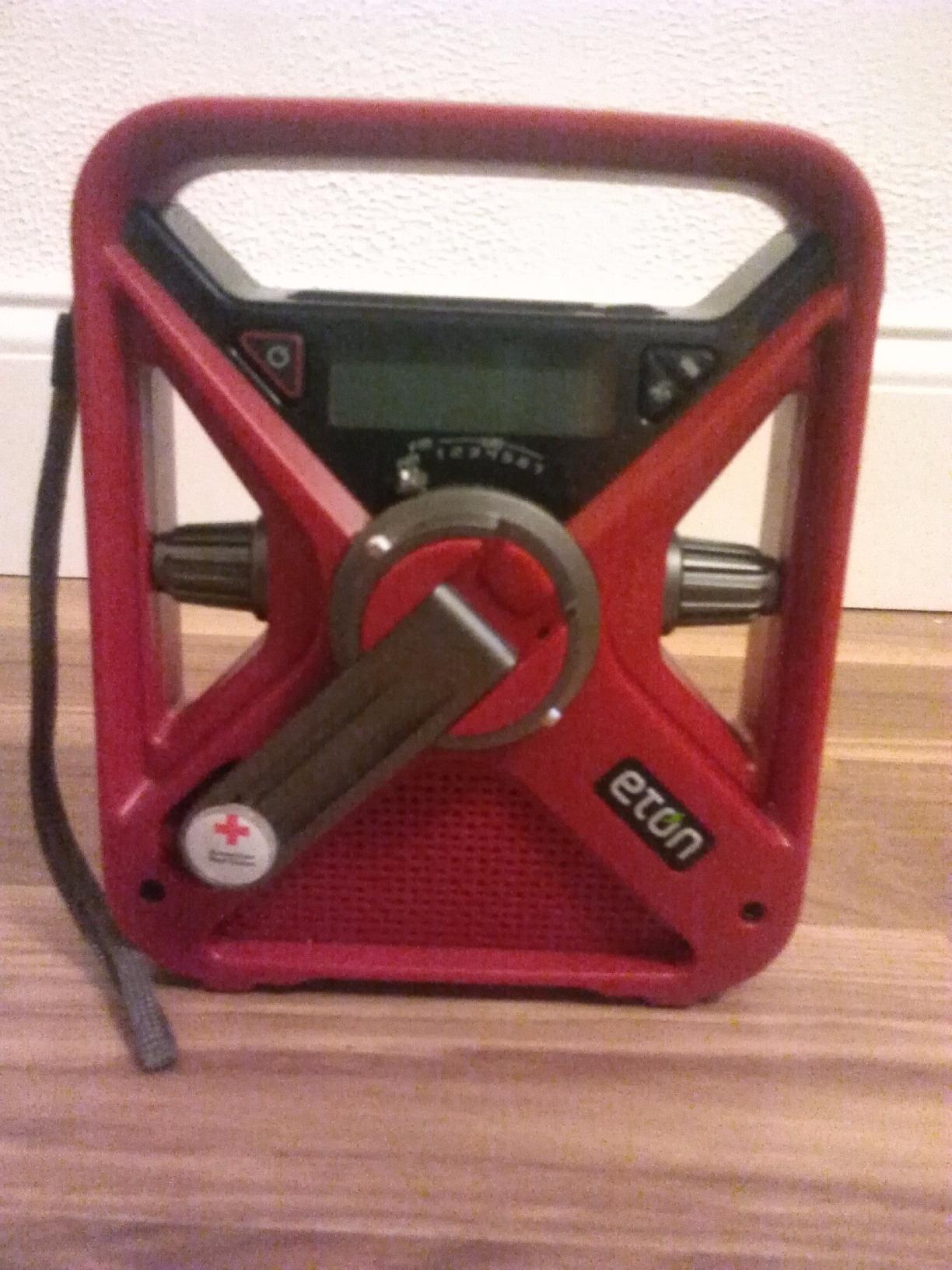
Why the Eton still works in 2026
Some owners describe it as a better radio than current budget units for one reason: the voice quality. If the person who has to wake up and act on a warning is hard of hearing or the radio sits in another room, intelligibility beats every other specification.
The glow-in-the-dark ring is a small design decision that pays off constantly. Finding a black box in a dark house with no power is harder than it sounds.
Its weak points
The internal NiMH battery is small, and in alert mode the radio blocks its other functions while draining that cell within about a week of constant use. Owners are split on the manual power-source switching.
There is no S.A.M.E. filtering, the buttons sit under the crank handle and get pressed accidentally in a pack, and the rubber port flap keeps out dust but offers no real water resistance.
How to Choose a NOAA Weather Radio for Storm Season
Start by deciding where the radio lives, because that single choice eliminates most of the market. A radio on a kitchen counter and a radio in a go-bag are different products with different priorities, and buying one to do the other job’s work is the most common mistake we see.
A home base station is always plugged in, always on, and judged on S.A.M.E. filtering, alert volume and display quality. A portable is judged on how many ways it can start without electricity and how long it runs once started. Our storm window guide covers the home-prep side of getting ready.
S.A.M.E. county programming. This is the feature forum users rank first, and only two radios here have it. A S.A.M.E. decoder reads the six-digit FIPS code in each alert and sounds only for counties you programmed. Without it, you hear everything the transmitter broadcasts. If you live near a county line or simply do not want a radio that sounds for warnings two counties away, this is non-negotiable.
Public Alert certification. This certification means the radio is tested to receive the full set of official alert codes, including ones added after the radio was made. It is a different thing from S.A.M.E., and many radios have one without the other. In this roundup, only the Midland WR120B and RunningSnail MD329 combine county filtering with a broad alert set.
Power source count, honestly counted. Solar panels on these radios are trickle chargers. They maintain a charged battery over a sunny week; they will not revive a dead cell in a three-day storm. Count hand crank, removable battery cells and USB as your real reserves, and treat solar as a bonus.
Battery capacity, and whether you can replace it. Capacity figures range from about 600mAh on the Eton to 12000mAh on the larger Eoxsmile. Bigger means longer runtime and more phone charging, but it also means more weight. A sealed lithium cell that cannot be replaced effectively dates the radio. The Kaito KA500’s replaceable NiMH pack is worth considering purely for that reason.
Alert mode versus monitor mode. Monitor mode is quiet except for the 1050 Hz attention tone. Alert mode overrides everything and sounds the full siren. You want alert mode on a home unit. Several Eoxsmile models will not interrupt AM or FM playback, so check that behavior before you settle on one.
Antenna length and placement. A quarter-wave antenna is roughly 17 inches, and reception is mostly a function of antenna size and position rather than brand. Fully extend the telescopic antenna, keep the radio away from metal and appliances, and test the exact spot you plan to use. Placing a home radio near a window rather than in a metal cabinet often fixes weak reception on its own.
Distance from a transmitter. NOAA’s own coverage goal is roughly 95 percent of the population within about 40 miles of a transmitter, and most households sit well inside that. If you are in a canyon, a mountain valley or a rural area far from a tower, test reception before you commit to a specific model, because a marginal signal plus a short antenna is the combination that fails you.
Audio output and controls. Volume matters when the radio is in another room and the person who needs to hear it is asleep. Large knobs matter more with cold hands or worse eyesight. The two Eoxsmile models and the Leaton do better here than most compact units.
Budget tiers. At the entry tier, expect AM, FM and NOAA with a crank and a small cell, and no county filtering. In the middle tier you gain bigger batteries, digital displays, brighter lighting and far more power options. At the top tier, the gains are audio quality, build durability and dump-charge phone capability rather than new alert features. Paying more rarely buys a better alert system, because the alert system is decided by S.A.M.E., not by price.
One more honest note: a radio is not always necessary. If you live in a coastal county with dense cell coverage, have working phone alerts, and can get to a safe room quickly, a phone may be sufficient. If you are rural, in a valley, sleep through the night with the phone on silent, or need to reach someone with no power at all, the radio earns its place.
How to Program Your S.A.M.E. County Code
The FIPS code is simply a county code, like a ZIP code but for counties, and it is the single thing people get stuck on when setting up a new radio. Here is the process that works.
1. Find your code. Search your county name plus FIPS code on the official national FIPS reference list, or use the county lookup on the National Weather Service site. You are looking for a six-digit number where the last three digits identify your county.
2. Enter the radio’s setup mode. On the Midland WR120B the option sits in the menu after you select the same or same county setting. On the RunningSnail MD329 it is on the knob-driven menu. The wording varies by brand, but you are looking for same, county or location.
3. Type in the digits. Use the number pad or the tuning control. Some units want the code with the state and country digits included; the manual will say which.
4. Add the counties you need. If you cross a county line regularly, program the neighboring county too. Both radios here support multiple codes, which is exactly the travel case that RVers and long-distance drivers keep asking about.
5. Turn on alert mode and test it. Use the radio’s test or self-test function. The WR120B runs a weekly test that confirms alerts are still arriving. Confirm the alert tone is loud enough to wake someone on the far side of a closed bedroom door before you rely on it.
One last detail for anyone using a S.A.M.E. radio in a car. The code is tied to the region you are in, so it stops matching the moment you drive across a county line into a different transmitter area. Expect to reprogram as you travel, and keep the manual in the glovebox.
Why a NOAA Radio Beats Your Phone in a Power Outage
Cell towers, the electric grid and the weather event itself tend to fail in the same afternoon. Wireless Emergency Alerts reach your phone over the carrier network, and the carrier network is powered by the same infrastructure that just lost power. A radio on batteries or a crank does not depend on any of it.
There is a timing gap too. Your phone shows a warning when the push notification arrives, which can take minutes. NOAA broadcasts continuously, so a receiver sitting on a channel is already tuned and sounds the 1050 Hz attention tone within seconds of the alert starting.
The last advantage is silence. A phone doing nothing is silent. A radio doing nothing is also silent, but a radio will sound at full volume in the middle of the night whether or not anyone is holding it, which is the entire point for anyone who wants to sleep through a storm season.
Storm-Season Readiness Checklist
Run this list once a year, well before peak severe weather months. It takes about twenty minutes and it is the difference between owning a radio and having a radio that works when you need it.
1. Turn the radio on and confirm it still receives a signal, not just that the display lights up. Check your transmitter channel on the National Weather Service coverage map for your address.
2. Test the alert tone at its normal volume, from the room where people sleep. If it does not carry, move the radio or add a second unit in that room.
3. Verify your S.A.M.E. codes, and confirm they still match your county after any move or change of address.
4. Replace the backup batteries. Alkaline cells lose meaningful capacity in cold conditions, so this matters more heading into winter storm season than most people expect. Lithium primary cells hold up far better in freezing temperatures.
5. Fully extend the antenna and re-test reception in the position the radio actually occupies. A radio that worked on a table can fail in a cabinet.
6. Charge the internal cell on any handheld that has one, so the reserve is actually a reserve rather than an empty shell.
7. Do a full outage drill. Turn off the mains power, switch off the phone network on your phone, and confirm the radio still warns you within seconds.
8. Write the date of your test on the unit with a marker. If you cannot remember when you last checked, the radio is telling you nothing useful about its own reliability.
Frequently Asked Questions
Can I get a NOAA Weather Radio for free?
Partly. NOAA publishes a free Weather Radio app that pushes National Weather Service warnings to your phone, and many county emergency management offices hand out certified home radios at community events. The app depends on a working cellular data connection, so it fails in the same storms that knock out towers. A hardware radio runs on batteries or a hand crank and keeps working when nothing else does.
Which weather radio does NOAA recommend?
NOAA does not endorse a single brand or model. It certifies the weather radio network, publishes the seven broadcast frequencies between 162.400 and 162.550 MHz, and publishes a list of certified receivers. The features NOAA documentation emphasizes are S.A.M.E. county filtering and Public Alert certification, since those determine whether the radio warns you about your county and recognizes newer alert codes.
What is the best radio to have during a national emergency?
For most households the answer is a home base station with S.A.M.E. county programming that stays plugged in and runs on battery backup when power fails, such as the Midland WR120B in this roundup. Add a hand-crank handheld such as the FosPower NOAA A1 for the car, the go-bag or the cabin. A single radio rarely covers both jobs well.
Which Midland weather radio is the best?
The Midland WR120B is the best Midland for a home, because it is the only one here with S.A.M.E. filtering for up to 25 counties plus more than 60 alert types and a weekly self-test. If you want a portable instead, a Midland handheld with a hand crank covers travel and outages, but it trades away the county filtering that makes the WR120B the better home unit.
Can I get a weather radio that only alerts for tornadoes?
Not on most models. Most budget crank radios sound for every warning inside the transmitter’s coverage area. The radios in this roundup with real hazard-by-hazard control are the RunningSnail MD329, which has more than 80 alert types with individual on and off switches, and the Midland WR120B with its library of more than 60 alert types. Neither lets you filter by hazard on the cheap units.
Do I need a NOAA Weather Radio if my phone has weather alerts?
If you live in dense cell coverage, get real Wireless Emergency Alerts, and can reach a safe room fast, your phone may be enough. The radio earns its place when you are rural or in terrain that blocks towers, when your phone is on silent at night, or when the same storm that produces the warning also takes out the power and the cell network. Many households keep both.
The Best NOAA Weather Radios for Storm Season
The FosPower NOAA A1 is the best all-round buy in this roundup, with three independent power sources, a usable 7400mWh power bank and the strongest rating and review record of the ten. If your radio lives on a counter rather than in a pack, the Midland WR120B is the one to buy, because S.A.M.E. filtering for 25 counties is what stops alert fatigue from killing your trust in it.
Run the storm-season checklist above before peak months, and program your county code before you need it. Getting the best NOAA weather radios for storm season means very little if the radio is silent when the warning airs.