
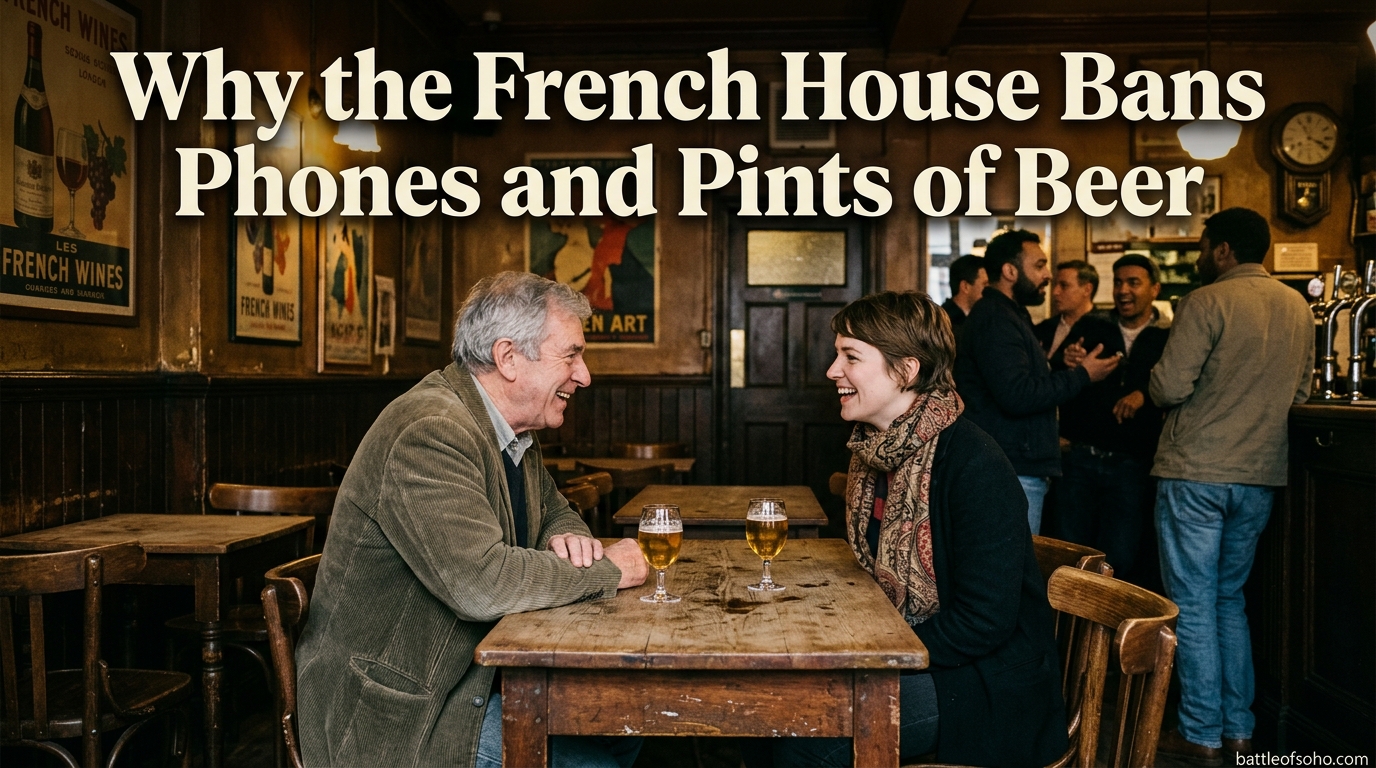
Walk into The French House on Dean Street in Soho, and you will immediately notice something different. There are no glowing phone screens, no background music, no television flickering in the corner. And when you order a beer, you will get it in a half-pint glass. These two rules, banning mobile phones and refusing to serve pints, have made this pub one of the most talked-about drinking spots in London for over a century.
Understanding why the French House bans phones and pints of beer means understanding the soul of old Soho itself. This is a pub that has resisted every cultural shift thrown at it, from the Blitz to the smartphone era, to remain exactly what it has always been: a place for conversation, connection, and a properly poured half.
Our team spent time researching the full history behind both of these famous rules. What we found is that the phone ban and the pint ban are not arbitrary quirks at all. They are two sides of the same philosophy, one that has kept this corner of Soho fiercely human in an increasingly digital world. If you are interested in exploring more of Soho’s rich history, our guide to the best Soho history walking tours covers many of the landmarks discussed in this article.
Table of Contents
The Two Rules at a Glance
The French House operates under a simple but strict code. Beer is served only in half-pint glasses, and has been for more than 100 years. Mobile phones are politely but firmly banned inside the pub, along with music, television, and slot machines.
The pub’s own signage lays it out in a chalk drawing behind the bar: “No machines, no music, no television, and no mobile phones.” That single sentence captures the entire ethos of the place. It is not about being difficult for the sake of it. It is about protecting something rare. For more on Soho’s iconic pubs, see our article on the best historic pubs in Soho.
Both rules trace back to the same core belief that a pub should be a space where people actually talk to each other. The half-pint tradition forces you to slow down, visit the bar more often, and interact with the staff and the people around you. The phone ban removes the single biggest barrier to genuine conversation in the modern age. Together, they create an atmosphere that regulars describe as almost magical.
The Half-Pint Rule: A Century-Old Tradition
The story of why the French House only serves half pints dates back to the 1920s, and it involves French sailors, broken glass, and a publican who had seen enough. According to the most widely told version of the origin story, French sailors visiting the nearby docks would come into the pub and order full pints of beer.
The problem was that these sailors were apparently enthusiastic drinkers who had a habit of smashing their pint glasses on the floor when they finished. Whether this was a cultural tradition, a sign of celebration, or simply the result of one too many rounds, the constant breakage became expensive and dangerous. The pub’s management at the time decided the simplest solution was to stop serving full pints altogether.
By switching to half-pint glasses, the pub solved the breakage problem overnight. A half-pint glass is cheaper to replace, less likely to cause injury when broken, and forces a slower, more measured pace of drinking. What started as a practical decision to protect the glassware became a defining characteristic of the pub.
Over the decades, the story has been told and retold. Some versions emphasize the destruction of the glasses. Others suggest that the half-pint rule was equally about encouraging conversation and sociability rather than rapid consumption. The Londonist noted that when they asked the pub directly about the origin, staff “remained tight-lipped,” which only adds to the legend.
What is certain is that the rule has now been in place for over a century. If you order a lager, ale, or any draft beer at the French House, you will receive it in a half-pint glass. The price reflects the smaller serving, with half pints typically costing around £3. For those who want a larger format, the pub does offer a half-gallon option, but even that is served in a communal jug designed for sharing rather than individual pint consumption.
The rule has become so iconic that it has spawned its own annual tradition, which we cover in detail later. But the everyday reality is simple: you order a half, you drink it, and then you go back to the bar for another. That process of repeatedly returning to the bar is part of the design. It puts you in contact with the bartenders, with other customers, and with the rhythm of the room.
Current landlady Lesley Lewis has maintained the half-pint tradition without exception. Regulars say the staff know their orders by heart, so the repeat trips to the bar become part of the social experience rather than a chore. One regular, described in press reports as a former actress, even has her own reserved glass behind the bar.
The No-Phones Policy: A Haven for Conversationalists
If the half-pint rule is about pace, the phone ban is about presence. The French House describes itself as a “haven for conversationalists,” and the no-phones policy is the backbone of that identity. Walk in, take a seat, and try to check your notifications, and a member of staff will politely ask you to put your phone away.
The rule is not posted on a stern sign with a red line through a smartphone. Instead, it is part of that chalk drawing behind the bar, listed alongside “no machines, no music, no television.” The phrasing matters. The ban is not anti-technology in a reactionary sense. It is pro-conversation.
The Financial Times highlighted the French House in a piece about whether phones should be allowed in restaurants, noting that the pub has “long maintained a policy of no phones, music or televisions to safeguard its reputation as a haven for conversationalists.” In an age where the average person checks their phone 96 times a day, that policy feels almost radical.
What makes the phone ban work is the consistency of enforcement. Staff do not shout or scold. They simply, firmly, and with typical French House courtesy, remind you that the pub is a phone-free zone. Most visitors comply immediately, and many describe the experience as refreshing. One MyLondon reviewer wrote that the rules are “at first an annoyance, then they really work.”
The ban takes on particular significance in the era of influencer culture and social media. London is full of pubs designed to be Instagrammed, with aesthetic lighting, curated cocktail menus, and selfie-friendly backdrops. The French House is the opposite. It is a pub designed to be experienced, not documented. You cannot film your drink for TikTok. You cannot photograph your food for a review. You can only sit, drink, and talk. For a look at how Soho’s nightlife has evolved alongside this ethos, check out our history of Soho nightlife.
This philosophy extends beyond phones. The absence of music means you can actually hear the person next to you. The absence of television means no one is staring at a screen in the corner. The absence of slot machines means no electronic beeping disrupts the flow of conversation. Every element of the ban serves the same purpose: removing distractions so that the only thing left is human interaction.
In 2026, as device-free dining and digital detox concepts gain traction across London, the French House looks less like a quirky holdout and more like a pioneer. Pubs and restaurants across the city are experimenting with phone baskets, screen-free zones, and digital detox nights. The French House has been doing it for decades.
WWII and the Free French Connection
The French House earned its name through one of the most dramatic chapters in London’s wartime history. During World War II, the pub served as an unofficial headquarters for the Free French movement, the resistance organization led by General Charles de Gaulle from exile in London.
De Gaulle himself was a regular at the pub, which was then known by its previous name. According to historical accounts, de Gaulle frequented the establishment during the war years, and the pub became a gathering point for Free French Forces personnel stationed in the capital. The most famous connection is to the Appeal of 18 June 1940, de Gaulle’s historic BBC broadcast calling on the French people to resist the German occupation.
The pub’s wartime significance cemented its French identity permanently. Before the war, it had been run by the Belgian Berlemont family, who had taken over during World War I. The Free French connection gave it an authenticity and emotional resonance that went beyond its name on the door.
One charming historical detail involves claret deliveries. The pub was originally called the York Minster, named after the famous cathedral. Claret wine deliveries intended for York Minster cathedral would sometimes arrive at the pub by mistake, which became a running joke. When the real York Minster suffered a major fire in 1984, the pub decided it was time to change its name to avoid further confusion and officially became The French House.
From German Beer Hall to French Institution: The Pub’s Origins
The story of the French House begins in 1891, when a German man named Christian Schmitt opened a pub at 49 Dean Street in Soho. At that time, the area was a dense mix of immigrants, artists, and working-class Londoners. Schmitt ran the pub with his wife, Bertha Schmitt, and it quickly became a neighborhood fixture.
The original pub was called the York Minster, and it served a largely German and Central European clientele in its early years. When World War I broke out, anti-German sentiment in London made it difficult for a German-named establishment to operate. Christian Schmitt sold the pub, and the bill of sale from that transaction is still posted on the wall inside the pub today, a tangible piece of history you can read over a half pint.
The Belgian Berlemont family took over the pub during this period. Victor Berlemont ran the establishment and gave it the French-Belgian character that would define it for the next several decades. His son, Gaston Berlemont, was literally born in the pub in 1914 and went on to become one of the most beloved publicans in Soho’s history. Gaston ran the pub for decades and was responsible for cultivating its reputation as a gathering place for artists, writers, and free thinkers.
Under Gaston’s leadership, the pub became known as Maison Berlemont to its regulars, even though the official sign still read York Minster until 1984. The name change to The French House finally made official what had been true for decades: this was a French institution in the heart of Soho. If you want to learn more about Soho’s cultural history, our complete guide to Soho’s cultural heritage covers the area’s transformation from the 19th century onward.
The Legends Who Drank Here: Famous Patrons
The French House’s guest list reads like a who’s who of 20th-century art and literature. Dylan Thomas was one of the most famous regulars, and local legend claims he drank his last pint at the French House before his death in 1953. Thomas was reportedly working on the manuscript for “Under Milk Wood” during his time frequenting the pub.
The painter Francis Bacon was another devoted regular. Bacon, who lived and worked nearby in Soho, treated the French House as an extension of his studio social life. Lucian Freud, another giant of British painting, was also known to drink here. The pub was part of the ecosystem of Soho’s postwar art scene, along with private members’ clubs like the Colony Room just around the corner.
Brendan Behan, the Irish poet and playwright, was a frequent visitor during his London spells. Salvador Dali reportedly darkened the door on at least one occasion. Other notable patrons included Malcolm Lowry, author of “Under the Volcano,” the painter Augustus John, and actors like Tom Baker and John Mortimer.
What drew all these creative figures to the same small pub on Dean Street was precisely the atmosphere that the two rules create. Writers and artists wanted a place where they could talk without distraction, drink at a civilized pace, and be surrounded by interesting people doing the same thing. The French House provided that, and in doing so, became woven into the cultural fabric of bohemian Soho.
The tradition continues in 2026. Photographer John Claridge documented the pub’s regulars in his “Soho Faces” project between 2004 and 2017, capturing the diverse and eccentric characters who still call the French House their local. The pub remains a living connection to Soho’s artistic heritage.
Pints Day: The One Exception to the Rule
Every rule needs an exception, and the French House’s half-pint rule has the best one in London. Once a year, on April 1, the pub breaks out full pint glasses for Pints Day, its annual charity event that has become a Soho institution in its own right.
Pints Day began around the year 2000 as a way to raise money for the Soho Parish School, a local primary school. The format is simple but brilliant. The pub serves full pints of beer for one day only, and each pint is poured by a celebrity guest bartender. The first pint of the day is auctioned off for charity, with some pints selling for well over £100.
The Madness frontman Suggs has poured the first pint at Pints Day for more than 23 years running. Other celebrity pourers over the years have included actors like Ken Stott, whose first pint went for £240 at auction, Lucy Benjamin, Nick Grimshaw, chef Angela Hartnett, and Ed Tudor-Pole. The event draws crowds from across London and turns the normally tranquil pub into a festive, joyous celebration.
Pints Day is also connected to another beloved Soho tradition. Each July, the Soho Waiters Race, a charity event where local restaurant and bar staff race through the streets carrying trays of drinks, starts from outside the French House. The pub’s role as the starting point underscores its status as the spiritual home of Soho’s hospitality community.
The antique pint glasses used on Pints Day are reportedly a treasured part of the pub’s collection, brought out only for this one occasion. After April 1, they go back into storage and the half-pint rule resumes as if nothing happened. It is a perfect example of how the French House respects its own traditions while using them to give back to the community. Readers interested in Soho events and seasonal traditions will find our annual Soho events guide a helpful companion piece.
Visiting the French House Today
If you want to experience the French House for yourself, you will find it at 49 Dean Street, Soho, London. The pub is open Monday through Saturday, with reduced hours on Sunday. There is no reservation system for the bar area, so arriving early is wise, especially on weekday evenings when after-work crowds fill the limited standing room.
Half pints are the standard order, and prices are reasonable for central London at around £3 per half. The pub also serves Ricard, the French aniseed aperitif, and reportedly sells more Ricard than any other establishment in Britain. Wine is available by the glass, and the bar stocks a focused selection of spirits and soft drinks.
Upstairs, there is a proper dining room that has earned an AA Rosette for its French cuisine. The restaurant was originally opened in 1992 by Fergus and Margot Henderson, the pioneering chefs behind St. John restaurant, before Neil Borthwick and Anna Hansen took over the kitchen. The food is classic French bistro fare, and the dining room has been ranked among the UK’s top 100 restaurants.
The most important thing to know before you visit: leave your phone in your pocket. Better yet, leave it at home. The staff will remind you if you forget, but why not arrive prepared? The whole point of the French House is to disconnect from the screen and reconnect with the room. That is what the half-pint rule and the phone ban are really about.
FAQs
Why does the French House only serve half pints?
The French House only serves half pints because of a tradition dating back to the 1920s, when French sailors visiting the pub would allegedly smash their full pint glasses on the floor. The pub switched to half-pint glasses to reduce breakage, and the rule has been in place for over 100 years.
Why did the French House ban mobile phones?
The French House bans mobile phones to preserve its identity as a haven for conversation. The pub’s policy of no machines, no music, no television, and no mobile phones is designed to remove all distractions and encourage genuine face-to-face interaction between customers.
Can you ever get a pint at the French House?
Yes, but only on one day of the year. On April 1, the French House holds Pints Day, an annual charity event for the Soho Parish School where full pints are served by celebrity guest bartenders. The rest of the year, only half pints are available.
Is the French House actually French?
Despite its name, the French House was originally founded in 1891 by a German man named Christian Schmitt. A Belgian family, the Berlemonts, took over during World War I and gave the pub its French-Belgian character. During World War II, it became a gathering place for Charles de Gaulle and the Free French Forces, cementing its French identity.
What famous people drank at the French House Soho?
The French House has been frequented by Dylan Thomas, Francis Bacon, Lucian Freud, Brendan Behan, Salvador Dali, Malcolm Lowry, Augustus John, Tom Baker, and John Mortimer, among many other writers, artists, and cultural figures throughout its 130-plus year history.
What are the rules of the French House pub in Soho?
The French House has four main rules: no machines, no music, no television, and no mobile phones. Additionally, beer is only served in half-pint glasses. These rules are enforced politely by staff and have been in place for decades to preserve the pub’s unique atmosphere.
Conclusion: Two Rules, One Philosophy
The reason why the French House bans phones and pints of beer comes down to a single, unwavering belief: a pub should be a place for people. The half-pint rule slows you down and brings you back to the bar. The phone ban removes the screen between you and the world around you. Together, they create something that almost no other pub in London can offer: pure, undistracted human connection.
In a city that changes constantly, the French House stands as a monument to old Soho. It is a place where Dylan Thomas once drank, where de Gaulle planned resistance, and where, in 2026, you can still walk in, order a half, and have the best conversation of your week. The rules are not the point. The atmosphere they create is.