
Norman Balon, the self-styled “rudest landlord in Britain,” ran the Coach and Horses on Greek Street in Soho for 63 years. When he died on June 4, 2026 at the age of 99, London lost one of its last true originals — a man who insulted prime ministers, cut off drunks with theatrical relish, and turned a pub into a legend.
For anyone who cares about the soul of Soho, the story of Norman Balon London’s rudest landlord is really the story of a vanishing London. He was a publican who became a cultural icon through sheer force of personality, a gruff exterior, and a sharp tongue that spared absolutely no one.
This article traces his remarkable life — from a working-class boy in Stepney to the most famous pub landlord in Britain. We’ll explore the pub he made famous, the writers who immortalized him, and what his passing means for a neighbourhood that has changed beyond recognition.
Table of Contents
Who Was Norman Balon?
Norman Balon was born on April 3, 1927 in London’s East End. His family was Jewish, part of the tight-knit working-class communities that populated Stepney and Whitechapel in the interwar years. His early life was shaped by the hardships of growing up during the Depression and the Blitz.
Balon came to the pub trade almost by accident. After attending a central London technical college, he began helping his father, who had taken over the Coach and Horses lease in the early 1940s. When his father stepped back, Norman took the reins — and never let go for over six decades.
He often said his mother was the real character of the family. She had a peculiar habit of hiding forks around the pub — no one ever quite knew why. It was this kind of household eccentricity that shaped Balon’s own theatrical approach to running a bar.
What set Balon apart from the start was that he was teetotal. The man who poured pints for some of Britain’s most notorious drinkers never touched alcohol himself. He watched the chaos from behind the bar with the clear eyes of a sober observer — and judged everyone accordingly.
The Coach and Horses: A Soho Institution
The Coach and Horses sits at 29 Greek Street, in the heart of Soho. It has existed as a pub since at least the 1850s, surviving world wars, slum clearances, and waves of gentrification that swallowed nearly every other historic boozer in the area.
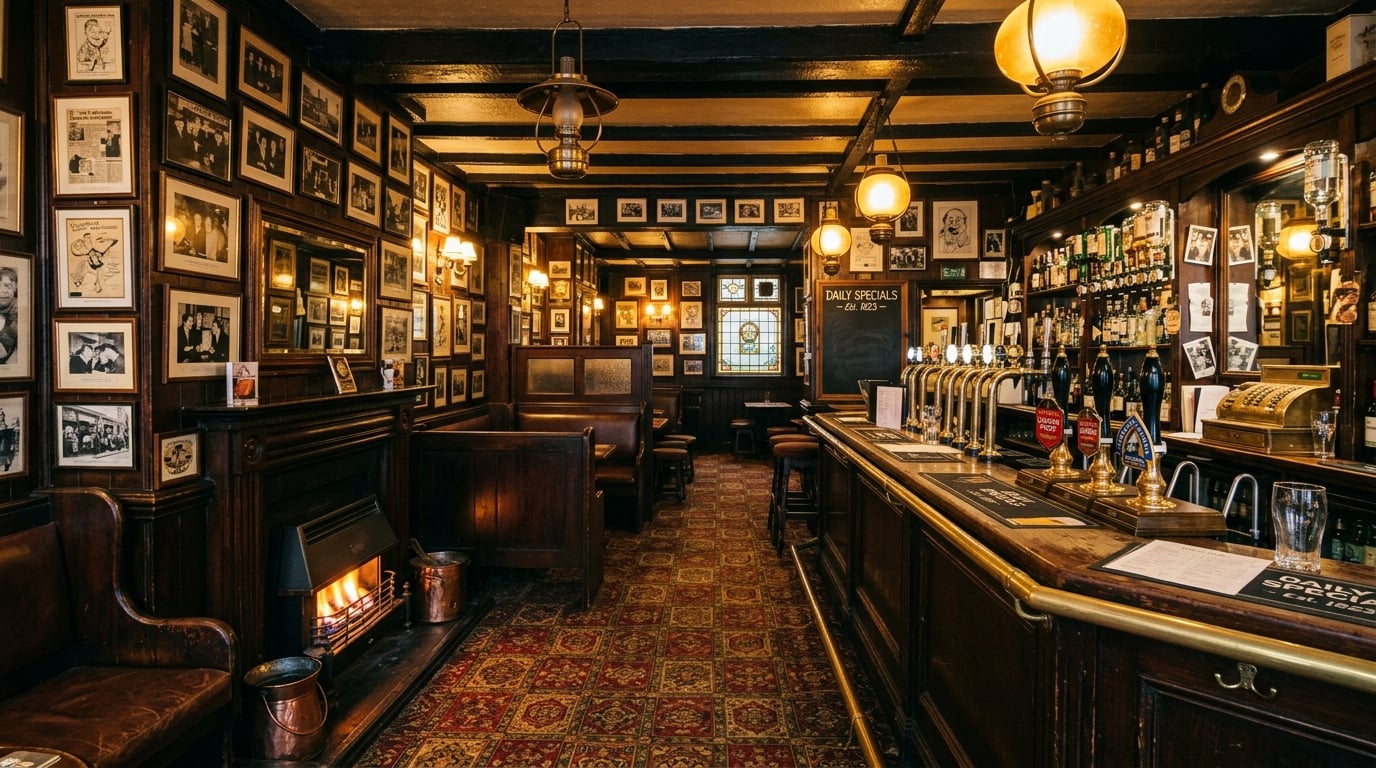
Under Balon’s management, the pub developed a physical character as distinctive as its landlord. The interior was famously old-fashioned — patterned carpets worn thin by decades of foot traffic, a gas fire that seemed to work on its own schedule, and a long bar where customers were served on Balon’s terms or not at all.
The pub operated on what regulars called a “one-way system.” You didn’t queue at the bar like a normal pub. You waited until Balon deigned to notice you, placed your order in a specific manner, and received your drink with whatever commentary he felt like delivering. Getting served was a performance, not a transaction.
It was the Platonic ideal of a London boozer — at least according to those who loved it. The walls were covered in old photographs, cartoons from Private Eye, and yellowed newspaper clippings that told the story of a London that no longer existed outside those doors.
Balon served what he wanted to serve. Fine ales and wines were available, but don’t bother asking for a cocktail. One customer reportedly asked for a snakebite — a mix of lager and cider — and was told in no uncertain terms to leave and not come back. The pub was a museum of old drinking culture, and Balon was its uncompromising curator.
How Norman Balon Became London’s Rudest Landlord
The legend of Norman Balon London’s rudest landlord was not an accident. Balon cultivated his rudeness with the precision of a stage performer. He described himself in his autobiography as a man who simply told customers the truth — and most customers, in his estimation, didn’t deserve pleasant conversation.
His insults were legendary. He categorized customers with the eye of a casting director. “Has-beens” were former celebrities who still expected star treatment. “Booze cruisers” were people who came in solely to get drunk — Balon’s least favourite type, and the ones he was quickest to throw out. “Platonics” were people who ordered soft drinks or spent too long nursing a single pint without buying another.
One of his most famous encounters was with Neil Kinnock, then Leader of the Opposition. Kinnock walked into the Coach and Horses expecting the usual political deference. Balon looked him up and down and delivered a withering assessment that left the politician speechless. The story became part of the pub’s mythology.
Tom Baker, the legendary Doctor Who actor, was another who got the treatment. Baker, a known drinker and raconteur, apparently met his match in Balon’s withering dismissal. The fourth Doctor could defeat Daleks but couldn’t get a civil word out of the man behind the bar.
But here’s the thing that many people missed: Balon’s rudeness was often an act of care. He would refuse to serve people who had already had too much — not out of legal obligation, but genuine concern. He banned customers who were rude to bar staff. He threw out anyone who caused trouble. His insults were a shield, and behind that shield was a man who genuinely looked after his regulars.
That’s what made him more than a gimmick. The rudeness was real, but so was the loyalty. People came back to the Coach and Horses decade after decade because Balon created a space that felt safe — even if getting through the door meant surviving a verbal assault.
The Jeffrey Bernard Connection
You cannot tell the story of Norman Balon without telling the story of Jeffrey Bernard. Bernard was a journalist, alcoholic, and one of the most brilliant columnists in British newspapers. His “Low Life” column in The Spectator turned the Coach and Horses into literary territory.
Bernard was a permanent fixture at the Coach and Horses. He drank there daily, held court at his usual spot, and turned the pub into his office, his living room, and occasionally his bedroom when he couldn’t make it home. Balon tolerated him — barely — because Bernard brought something invaluable: stories.
The relationship between landlord and regular was complex. Bernard would occasionally be barred — sometimes for days, sometimes for weeks. He’d commit some offence, Balon would throw him out, and the whole thing would become material for the next column. It was a symbiotic partnership that neither man would have survived without.
This connection reached its greatest cultural moment when Keith Waterhouse turned Bernard’s life into a West End play called “Jeffrey Bernard Is Unwell.” The title was the code phrase The Spectator used when Bernard was too drunk to file his column — a frequent occurrence. The play premiered in 1989 and became a hit, starring Robert Powell and later Peter O’Toole.
Although the play focused on Bernard, Balon loomed large in its world. The Coach and Horses was practically a character in its own right. Audiences who had never set foot in Soho suddenly knew about the rude landlord and the brilliant drunk who wrote about him. It turned a local legend into a national one.
Private Eye and The Regulars
The Coach and Horses wasn’t just Jeffrey Bernard’s pub. It was also the unofficial staff canteen for Private Eye, Britain’s most famous satirical magazine. The editorial offices were nearby, and the magazine’s staff — including Richard Ingrams, Ian Hislop, and Christopher Booker — were among Balon’s most loyal regulars.
This connection gave Balon a second life in popular culture. The cartoonist Michael Heath created “The Regulars,” a cartoon strip for Private Eye that was set in a thinly veiled version of the Coach and Horses. The characters were based on real pub-goers, and the grumpy landlord figure at the centre of every strip was unmistakably Balon.
Being immortalized in Private Eye cartoons was no small thing. The magazine had — and still has — a devoted readership of hundreds of thousands of people. Every fortnight, readers across Britain chuckled at the latest antics of the fictional regulars and their long-suffering, bad-tempered landlord.
Beyond Private Eye, the pub attracted an extraordinary range of famous clientele. Writers like Jeffrey Bernard and Francis Bacon’s crowd were regulars. Actors, journalists, politicians, and Soho characters of every description passed through those doors. Some were welcomed. Many were insulted. All were remembered.
Balon claimed his pub had “a great diversity of customers” — and he meant it as a point of pride. Where else in London could you find a Cabinet minister, a failed artist, a Fleet Street editor, and a Soho sex worker all drinking at the same bar? Only at the Coach and Horses, and only under Balon’s chaotic supervision.
The Battle for Soho’s Soul
By the late 1990s and early 2000s, Soho was changing fast. Property prices were rocketing. Independent businesses were closing. Corporate chains were moving in. The bohemian spirit that had defined the neighbourhood for a century was being sanitised out of existence — and Balon saw it happening from behind his bar.
The biggest threat came from Fuller’s, the brewery that owned the freehold of the Coach and Horses. Fuller’s wanted to take over the pub’s management directly, removing Balon and replacing him with their own staff. For a pub that had been independently run for over half a century, this felt like the final nail in the coffin of old Soho.
A petition was launched to save the pub from the Fuller’s takeover. Regulars, journalists, and local residents rallied behind Balon. The campaign attracted national media attention — it wasn’t just about one pub, it was about what kind of city London was becoming. Were the old characters going to be pushed out entirely?
Balon won the initial battle, but the war was already lost. The Blair government’s Licensing Act of 2003 brought in sweeping changes to pub regulations. Opening hours were liberalized, but so were the compliance requirements. Suddenly, a pub that had operated on Balon’s personal rules for decades was expected to meet modern standards of training, health and safety, and customer service.
Reddit users on r/london still discuss this era with nostalgia and frustration. They talk about the Coach and Horses petition, the Fuller’s takeover attempt, and what the loss of figures like Balon means for the city. The thread is always the same: Soho is losing its character, and nobody seems able to stop it.
Retirement and Later Life
Norman Balon finally retired in 2006, after 63 years behind the bar of the Coach and Horses. He was 79 years old. By that point, he had outlived most of his famous regulars — Jeffrey Bernard had died in 1997, and many of the Private Eye crowd had moved on or passed away.
His retirement marked the end of an era that no one could replace. The pub continued under new management, and while it still trades on its legendary status, regulars will tell you that something essential left when Balon walked out the door for the last time.
Balon chronicled his extraordinary life in an autobiography titled “You’re Barred, You Bastards.” The title alone captures everything you need to know about the man — direct, rude, and oddly affectionate. The book, co-written with journalist Spencer Bright, was published in 1991 and became a cult favourite among London history enthusiasts.
In his personal life, Balon was married twice. He was a family man away from the bar — a detail that surprised many who only knew his public persona. He had children and grandchildren who remember a very different Norman from the one who terrorized customers on Greek Street.
After retirement, he lived quietly in London. He outlived nearly all his contemporaries — friends, rivals, regulars, and fellow publicans. Reaching the age of 99 made him one of the last living links to a Soho that exists now only in books, photographs, and the memories of those who were lucky enough to have been insulted by him.
The Legend of Norman Balon London’s Rudest Landlord Lives On
Norman Balon died on June 4, 2026, just shy of his 100th birthday. News of his passing generated an outpouring of tributes from journalists, regulars, and Londoners who understood that his death was more than the loss of one man — it was the closing chapter of an entire era.
The Coach and Horses still stands on Greek Street. You can still walk in and order a pint. But the man who made it legendary is gone. What remains is the story — and what a story it is. From a boy in Stepney to the most famous publican in Britain, Norman Balon proved that sometimes the rudest people are the ones who care the most.
FAQs
Who was Norman Balon?
Norman Balon was the legendary landlord of the Coach and Horses pub in Soho, London, who ran the establishment for 63 years from 1943 to 2006. He was famously self-described as ‘London’s rudest landlord’ and was immortalized in Private Eye cartoons and the West End play ‘Jeffrey Bernard Is Unwell.’ He died on June 4, 2026 at the age of 99.
What was Norman Balon’s autobiography called?
Norman Balon’s autobiography was titled ‘You’re Barred, You Bastards,’ co-written with journalist Spencer Bright and published in 1991. The title captured Balon’s trademark bluntness and became a cult favourite among fans of London pub history.
Why was the Coach and Horses pub famous?
The Coach and Horses on Greek Street in Soho was famous for being the unofficial home of Private Eye magazine staff, the regular haunt of journalist Jeffrey Bernard, and the setting for Michael Heath’s ‘The Regulars’ cartoon strip. Under Norman Balon’s management, it became known as a Soho institution with a unique atmosphere and a famously rude landlord.
Who was Jeffrey Bernard?
Jeffrey Bernard was a British journalist and columnist best known for his ‘Low Life’ column in The Spectator magazine. He was a permanent fixture at the Coach and Horses pub, and his life inspired the West End play ‘Jeffrey Bernard Is Unwell’ by Keith Waterhouse. Bernard had a complex, often combative relationship with Norman Balon, who would periodically bar him from the pub.
When did Norman Balon retire?
Norman Balon retired in 2006 at the age of 79, after serving as landlord of the Coach and Horses for 63 years. His retirement marked the end of one of the longest tenures of any pub landlord in London history.