
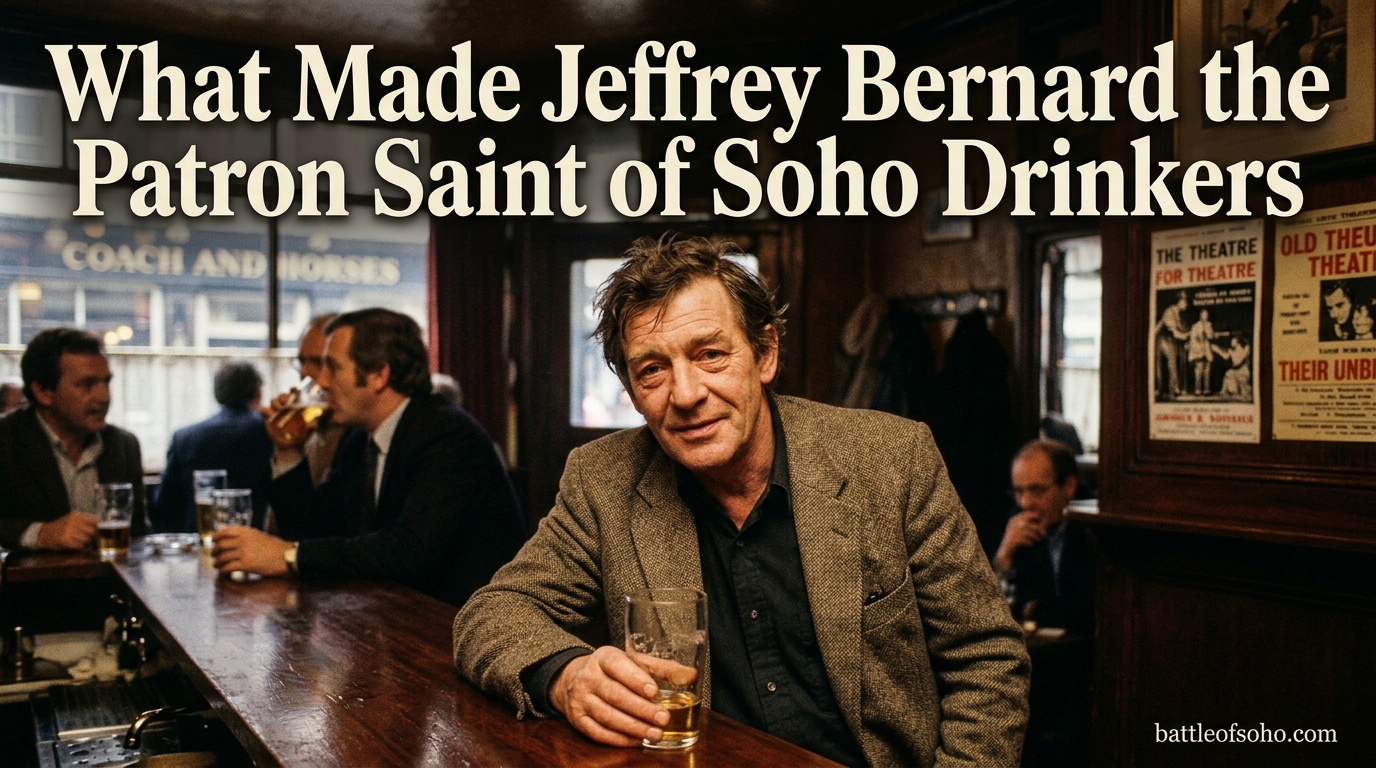
Jeffrey Bernard became known as the patron saint of Soho drinkers because he did something no one else had done before: he turned the daily ritual of sitting in Soho pubs from dawn to dusk into a literary art form. Through his weekly “Low Life” column in The Spectator, he documented the drinkers, publicans, artists, and layabouts who populated a few square blocks of central London with such honesty, gallows humour, and self-deprecating wit that his name became permanently fused with the neighborhood itself.
He was not a man who drank occasionally and wrote about it. He drank one-and-a-half to two bottles of vodka a day for decades, lost a leg to gangrene caused by diabetes, and still filed copy. He turned up at the Coach and Horses on Greek Street every single day, held court with Francis Bacon and Lucian Freud, and wrote about the whole sorry, glorious mess every week until his body finally gave out in 1997.
The “patron saint” label stuck because Bernard embodied something that every dedicated drinker in Soho aspired to: total commitment. He chose pubs over respectability, friendship over ambition, and honesty over self-preservation. For a certain kind of person who has whiled away an afternoon in a Soho boozer, wondering whether they should be doing something more productive, Bernard was proof that the pub itself was the point.
Table of Contents
The Short Answer: Why Jeffrey Bernard Earned the Title
Jeffrey Bernard earned the title “patron saint of Soho drinkers” through a rare combination of factors. He wrote the definitive literary record of Soho pub life through his Spectator column. He maintained a daily physical presence in Soho’s pubs for over thirty years. He refused to romanticize or hide his alcoholism, writing about it with unflinching honesty that resonated with fellow drinkers. And he became the last great symbol of a bohemian Soho that was already vanishing even as he wrote about it.
Here are the key facts at a glance:
- Born: 27 May 1932, in Surrey
- Died: 4 September 1997, aged 65
- Famous for: “Low Life” column in The Spectator (1975-1997)
- Soho headquarters: The Coach and Horses, 29 Greek Street
- Drink of choice: Vodka and soda (later just vodka and soda without the lime, due to diabetes)
- The phrase: “Jeffrey Bernard is unwell” appeared in The Spectator whenever he was too drunk or ill to file his column
- The play: Keith Waterhouse turned his life into “Jeffrey Bernard is Unwell,” starring Peter O’Toole in 1989
- Famous drinking companions: Francis Bacon, Lucian Freud, Peter Cook, Dylan Thomas (earlier era)
- Landlord: Norman Balon, self-proclaimed “rudest landlord in London”
Who Was Jeffrey Bernard? From Naval College Rebel to Soho Fixture
Jeffrey Joseph Bernard was born on 27 May 1932 into a comfortable middle-class family in Surrey. His father, Oliver Bernard, was a society photographer, and the household was one of cultured chaos. The young Jeffrey was sent to Pangbourne Nautical College, a naval training school in Berkshire, which was supposed to mould him into an officer.
It did not work. Bernard was expelled, and the rejection of authority that began at Pangbourne would define the rest of his life. He never went back to the establishment. He never tried to fit in. The naval college rebellion was the first act of a man who would spend the next five decades refusing to live by anyone else’s rules.
Before settling into journalism, Bernard tried his hand at a remarkable variety of careers. He worked as a fashion model, capitalizing on his tall, angular good looks. He boxed professionally, winning some fights and losing others. He spent time at the racetrack and became a racing columnist, which combined two of his great passions: horses and betting.
The racing world gave Bernard his entry into professional writing. He wrote for various racing publications and developed a style that was already marked by dark wit and a refusal to take anything, including himself, seriously. But it was Soho that would become his true territory, and the move from the racetrack to the pub stool was the most important journey of his life.
By the late 1960s, Bernard was a fixture in Soho. He had gravitated to the area because it was the one part of London where a man could drink all day, write in a pub, and be surrounded by people who did not care about respectability. Soho in that era was a district of greasy spoon cafes, strip clubs, Italian coffee bars, Irish pubs, and artists’ studios. It was cheap, dangerous, and completely ungentrified. It was exactly where Bernard belonged.
His personal life was as chaotic as his professional one. He was married four times. His wives included the actress Jacqueline Ellis, whom he married in 1959, and later Anna Wyndham, an Australian woman who became part of his Soho world. His relationships were passionate, volatile, and frequently destroyed by drink. The women in Bernard’s life loved a man who was by all accounts charming, intelligent, and funny when sober, and difficult, cruel, and unreliable when drunk, which was most of the time.
He also had a complicated relationship with his landlady in later years, Geraldine Norman, who rented him a flat above a shop near Berwick Street Market. She eventually evicted him, a story he turned into one of his most memorable columns. The details of his daily existence, debts, evictions, and mishaps became the raw material of his writing.
The Low Life Column: A Suicide Note in Weekly Instalments
The defining achievement of Bernard’s life was “Low Life,” his weekly column in The Spectator magazine. It began in 1975 and ran, with interruptions for illness and drunkenness, until his death in 1997. Over more than two decades, Bernard produced what amounts to one of the most sustained literary records of London lowlife ever written.
The column had a simple premise. Each week, Bernard wrote about whatever had happened to him: a drinking session, a fight, an illness, a conversation in the pub, a trip to the doctor, a memory of the racetrack. The genius was in the telling. He wrote with the economy of a journalist, the eye of a novelist, and the fatalism of a man who knew he was drinking himself to death and did not particularly care.
Richard Ingrams, the editor of The Spectator who hired Bernard, deserves enormous credit for giving him the column. Ingrams recognized that Bernard’s voice was unlike anything else in British journalism. Here was a man writing about his own failures, his own drunkenness, his own physical decline, with no self-pity and no apology. It was, as one critic memorably described it, “a suicide note in weekly instalments.”
Bernard’s writing style was deceptively simple. He used short sentences. He avoided adjectives. He wrote the way he spoke, which was slowly, deliberately, and with pauses for effect. His humor was dark, often bleak. He could describe a morning spent vomiting blood and make it funny. He could write about being thrown out of his flat and make it read like high comedy. This ability to find humor in catastrophe was essential to his appeal. Readers did not come to “Low Life” for tips on self-improvement. They came to read about a man who had given up on improvement entirely and was getting on with the business of living, or rather drinking, as best he could.
The column also built the legend of the “Jeffrey Bernard is unwell” phrase. When Bernard was too drunk, too ill, or too absent to produce his copy, The Spectator would print a simple notice in the space where his column should have appeared: “Jeffrey Bernard is unwell.” Over the years, this happened so frequently that the phrase entered the British cultural lexicon. It became a euphemism for being too drunk to function. It became a badge of honour. It became, eventually, the title of a West End play.
The column was not purely about drinking, though drink was its central subject. Bernard wrote about Soho’s characters with the affection of a man who knew them all. He wrote about Norman Balon, the famously rude landlord of the Coach and Horses. He wrote about Graham Mason, described as the drunkest man in the pub. He wrote about Francis Bacon’s rages and Lucian Freud’s silences. He wrote about the death of friends, the closure of old haunts, and the slow disappearance of the Soho he loved.
Soho Territory: The Lethal Triangle and the Dean Street Shuffle
To understand what made Jeffrey Bernard the patron saint of Soho drinkers, you have to understand the geography of his drinking. Bernard did not drink randomly across London. He operated within a tightly defined zone of Soho that he and his companions called the “lethal triangle,” a route between three or four pubs that could be walked in twenty minutes but typically consumed an entire day.
The anchor of Bernard’s Soho was the Coach and Horses, at 29 Greek Street. This was his headquarters, his office, his living room, and, on many nights, the place where he simply did not leave. The Coach was a traditional Soho pub with a reputation for literary clientele, terrible food, and a landlord who insulted his customers as a matter of principle. Bernard held court at a corner table, surrounded by cronies, drinking vodka and soda and writing his column on whatever scrap of paper was available.
The landlord during Bernard’s heyday was Norman Balon, a man who proudly described himself as the rudest landlord in London. Balon insulted customers, refused service to anyone he disliked, and treated the pub as his personal fiefdom. He and Bernard had a relationship that was part friendship, part warfare. Balon would throw Bernard out when he became too drunk or too argumentative, and Bernard would write about the experience in his next column. The dynamic became part of Soho mythology. Long-time patrons of the Coach recall that once you got past Balon’s exterior hostility, the pub was actually warm, welcoming, and full of character. But that exterior hostility was real, and it kept the wrong sort of customer away.
The second point of the lethal triangle was the French House, on Dean Street. This legendary pub, officially called The York Minster but known to everyone as the French, was famous for serving only half-pints and for its no-mobile-phone policy. It was the favoured drinking spot of artists, writers, and intellectuals. Francis Bacon drank there. Lucian Freud drank there. Dylan Thomas had drunk there a generation earlier. The French House had a betting book behind the bar in which regulars placed wagers on which of their drinking companions would be the next to die. This was Soho humour at its darkest, and Bernard was both a contributor to and a subject of the betting book.
The third point was the Colony Room Club, a private members’ drinking club at 41 Dean Street. Founded in 1948 by Muriel Belcher, the Colony Room was the inner sanctum of Soho bohemia. It was a tiny, green-painted room up a flight of stairs, open from lunchtime until late, and it served alcohol at hours when pubs were legally required to close. Francis Bacon was its most famous member. The Colony Room was where the real drinking happened, away from the eyes of tourists and casual visitors. It was the place where Bacon threw glasses, where Freud sat in moody silence, and where Bernard held forth with the confidence of a man among friends.
Beyond the lethal triangle, Bernard’s Soho included the Groucho Club on Dean Street, which opened in 1985 and represented a newer, slightly more polished version of Soho club culture. He also frequented Ketner’s restaurant, where champagne flowed, and various greasy spoons on Old Compton Street and Berwick Street where he ate the sort of cheap, fatty meals that constituted his diet.
The Dean Street shuffle was the term for the walk between these establishments. A man doing the Dean Street shuffle would start at the Coach and Horses in the morning, move to the French House at lunchtime, repair to the Colony Room in the afternoon, and end up back at the Coach or at the Groucho in the evening. It was a circuit that Bernard completed, in one form or another, almost every day for decades.
What are these places like today? The Coach and Horses is still open and still trades on its Bernard connection, though regulars complain that it has become more tourist-friendly and less genuinely Bohemian. The French House remains largely unchanged and is still considered one of the best pubs in London. The Colony Room closed in 2008 and was demolished in 2017, a loss that many see as the final nail in the coffin of old Soho. The Groucho Club continues as a members’ club. But the world that Bernard inhabited, the world of cheap rents, all-day drinking, and artists who lived within walking distance of their pubs, has largely vanished.
The Inner Circle: Bacon, Freud, and the Bohemian Set
Jeffrey Bernard did not drink alone. He was part of a circle of artists, writers, and performers who collectively defined bohemian Soho in the 1970s and 1980s. These drinking companions were not incidental to his legend. They were central to it. Bernard’s position in this circle gave him stories to tell, access to a world that most journalists could only dream of, and the social infrastructure that sustained his daily existence.
Francis Bacon was the most famous and most terrifying member of the group. Bacon, one of the greatest painters of the twentieth century, was a ferocious drinker with a violent temper. He would erupt in rages at the Colony Room, throw drinks, hurl insults, and then, an hour later, be charm personified. Bernard admired Bacon enormously and wrote about him with a mixture of awe and amusement. The two men understood each other. They shared a belief that excess was not a problem to be managed but a condition to be embraced.
Lucian Freud was a quieter but equally significant figure in the circle. Freud, grandson of Sigmund, was one of the foremost realist painters of his generation. He drank at the French House and the Colony Room, gambled, and maintained a social life that was as intense as his painting practice. Bernard and Freud moved in the same world, though Freud’s social circle was wider and more guarded. Both men were part of what became known as the School of London, a loose grouping of painters who lived and worked in the city and who all, in one way or another, spent significant time in Soho pubs.
The comedy world was also represented. Peter Cook, the groundbreaking satirist and comedian, was a Soho regular who drank at the same pubs and shared Bernard’s taste for absurdity. Cook’s club, The Establishment, had been a Soho institution in the early 1960s. Dudley Moore was occasionally part of the scene. Tony Hancock, the tormented comic genius, had drunk himself to death in 1968, but his ghost haunted the same bars.
Earlier generations of literary drinkers had paved the way. Dylan Thomas had been a Soho fixture in the 1940s and 1950s, drinking at the French House and other pubs before his own death from alcoholism in 1953 at age 39. Brendan Behan, the Irish playwright, had been another Soho drinker. Bernard was conscious of this lineage. He knew he was part of a tradition of writers who drank in Soho, and he wrote about that tradition with a mixture of pride and fatalism.
The lesser-known figures in Bernard’s circle were equally important to his daily life. Christopher Howse, a sub-editor at The Spectator, was the man who actually dealt with Bernard’s copy, chasing him for columns, deciphering his handwriting, and occasionally going to the pub to retrieve his work. Graham Mason was described as the drunkest man in the Coach and Horses, which, given the competition, was quite a title. Ron Lucas was another regular. Michael Heath, the cartoonist, drew for Private Eye and was part of the Soho set. These were the men who surrounded Bernard, who laughed at his jokes, who covered for him when he was too drunk to stand, and who appeared, under thin disguises, in his columns.
The French Pub betting book deserves special mention. Behind the bar at the French House, regulars maintained a book in which they placed bets on which of their drinking companions would be the next to die. Given that most of them were serious alcoholics, this was not a purely theoretical exercise. The betting book was Soho gallows humour at its finest, a way of staring death in the face and laughing. Bernard was both a participant and, as his health declined, a favoured subject of the bets.
The women in Bernard’s life are less frequently discussed but were essential to his story. His four wives endured his chaos. Anna Wyndham, his second wife, was a vivid presence in his columns. Geraldine Norman, though not a wife, was his landlady and a significant figure who eventually threw him out, an event he chronicled with his usual mix of outrage and dark comedy. Elizabeth Smart, the Canadian author of “By Grand Central Station I Sat Down and Wept,” was part of the earlier Soho literary scene that Bernard inherited. The women around Bernard were not passive figures. They were intelligent, strong-willed people who chose to be part of his world, even when that world was destructive.
The Price of the Patron Saint: Health Decline and Death
The physical cost of Bernard’s drinking was catastrophic, and he wrote about it with the same unflinching honesty that he applied to everything else. This willingness to chronicle his own destruction was central to his appeal. He did not hide the consequences. He did not pretend that drinking was glamorous. He showed his readers exactly what decades of alcoholism looked like, and they kept reading.
The medical cascade began with pancreatitis, a painful inflammation of the pancreas caused by alcohol abuse. Then came diabetes, which Bernard developed as a result of damage to his pancreas. The diabetes was the beginning of the end. He switched from vodka, lime and soda to just vodka and soda, dropping the lime because the sugar was bad for his diabetes. This was a tiny concession, made with the grim humour of a man who knew that the vodka itself was the real problem.
Kidney failure followed. Bernard underwent dialysis, a gruelling process that required him to be connected to a machine for hours at a time, several times a week. He wrote about dialysis with characteristic bluntness, describing the boredom, the discomfort, and the absurdity of trying to keep his body alive while continuing to pour vodka into it.
The most dramatic moment came when gangrene set in. Poor circulation, caused by diabetes and compounded by decades of smoking Senior Service cigarettes, led to the death of tissue in his right leg. The leg had to be amputated. Bernard lost first his toes, then his foot, and eventually the leg below the knee. He spent his final years in a wheelchair, missing a leg, still drinking, still writing, and still turning up at the pub when he could.
The image of the one-legged alcoholic being wheeled into the Coach and Horses is one of the most powerful in the Bernard legend. It is the image that separates romanticisation from reality. Here was a man who had given everything to drink, who had literally lost a limb to it, and who had no regrets. Or rather, he had regrets, but he did not let them change his behaviour. This combination of self-awareness and self-destruction is what made Bernard so compelling and so troubling.
Jeffrey Bernard died on 4 September 1997, at the age of 65. He had outlived many of his drinking companions, which was something he had not expected. The cause of death was renal failure and the accumulated effects of decades of alcohol abuse. His final columns, written from his wheelchair and his hospital bed, were among his best. He was writing about dying with the same clarity and dark wit that he had brought to writing about living. The Spectator published a tribute issue. The “Low Life” column space was left blank for one final week with the now-legendary words: “Jeffrey Bernard is unwell.”
Why He Became the Patron Saint: Legacy, the Play, and Modern Soho
The phrase “patron saint of Soho drinkers” was not one that Bernard gave himself. It emerged organically from the culture around him. It was the natural description for a man who had done more than anyone else to define what Soho drinking meant, both as a daily practice and as a cultural mythology. But the label was cemented by two things: the play that bore his name, and the disappearance of the world he represented.
In 1989, the playwright Keith Waterhouse, himself a veteran of Soho and Fleet Street, wrote “Jeffrey Bernard is Unwell.” The play is set entirely in the Coach and Horses, where Bernard’s character has been locked in overnight after closing time. Waking in the dark, drunk and confused, he delivers a monologue that ranges across his life, his drinking companions, his illnesses, and his philosophy. It is a love letter to Soho, a confession, and a black comedy all at once.
The original production starred Peter O’Toole, one of the great drinking actors of the twentieth century, in a piece of casting that was almost too perfect. O’Toole, who had his own legendary drinking history, brought a depth of understanding to the role that went beyond performance. He knew what it felt like to be a man whose talent was inseparable from his self-destruction. Audiences at the Apollo Theatre on Shaftesbury Avenue, and later at the Old Vic in revivals, responded powerfully. O’Toole’s performance was hailed as one of the great theatrical achievements of the era. The play has been revived many times since, including a production staged at the actual Coach and Horses pub, which was a formative experience for those who saw it.
The play was important because it took Bernard’s story out of the pages of The Spectator and put it on stage. It introduced him to a wider audience who had never read his column. It confirmed his status not just as a journalist but as a cultural figure, a character so vivid that his life could be dramatized. And it fixed the phrase “Jeffrey Bernard is unwell” permanently in the public consciousness.
But the real reason Bernard became the patron saint is that he represented something that was already disappearing. By the late 1980s, Soho was changing. Property prices were rising. The old strip clubs and coffee houses were being replaced by media companies and expensive restaurants. The artists who had lived in cheap Soho studios were being priced out. The pubs were getting tidier. The drinkers were getting more self-conscious.
Bernard wrote about this transformation with sadness and fury. He saw the Soho he loved being cleaned up, sanitized, and turned into a brand. The Colony Room, the spiritual home of bohemian Soho, finally closed its doors in 2008 and was demolished in 2017. The Coach and Horses still stands, but it now serves craft beer and quinoa salads alongside the pints of bitter. The French House has become a destination for tourists who have read about it in guidebooks.
Bernard stands as the patron saint of a lost world. When modern drinkers sit in a Soho pub and feel that something is missing, that the place is too clean, too expensive, too self-aware, they are feeling the absence of the world that Bernard chronicled. He is the patron saint because he is the last person who fully inhabited that world, and because he left behind a record of it so vivid and so honest that it can never be forgotten.
There is also the matter of Bernard’s philosophy, such as it was. He believed in living honestly, in not pretending to be something you were not, in choosing your friends carefully and your drinks carefully. He believed that a pub was a better place to spend an afternoon than an office. He believed that laughter was the only appropriate response to suffering. These beliefs, simple as they are, resonated with a certain kind of person. That person is the Soho drinker. And Jeffrey Bernard was, and remains, their patron saint.
FAQs
What was Jeffrey Bernard known for?
Jeffrey Bernard was known for his weekly ‘Low Life’ column in The Spectator magazine, which ran from 1975 until his death in 1997. The column chronicled his daily life as a heavy drinker in Soho’s pubs, his health problems, and the bohemian characters around him. He was also famous for his regular presence at the Coach and Horses on Greek Street and his friendships with Francis Bacon and Lucian Freud.
What was the play ‘Jeffrey Bernard is Unwell’ about?
Written by Keith Waterhouse in 1989, the play is set entirely inside the Coach and Horses pub, where Bernard’s character has been accidentally locked in overnight. Through a monologue, he reflects on his drinking life, his friendships with Soho figures like Francis Bacon, his health problems, and his philosophy of life. The original production starred Peter O’Toole and became a West End hit.
What was Jeffrey Bernard’s writing style?
Bernard wrote in short, direct sentences with dark humour and unflinching honesty. He avoided adjectives, wrote the way he spoke, and treated his own alcoholism and physical decline as material for black comedy. His style has been described as a ‘suicide note in weekly instalments’ for its fatalistic but funny approach to self-destruction.
Where did Jeffrey Bernard live?
Bernard lived in various flats and rooms in and around Soho for most of his adult life, including a flat near Berwick Street Market rented from Geraldine Norman, who eventually evicted him. In his final years, after his leg amputation, he lived in sheltered accommodation in London. He spent most of his waking hours not at home but at the Coach and Horses pub on Greek Street.
What did Jeffrey Bernard drink?
Bernard’s drink of choice was vodka and soda. He originally drank vodka, lime and soda but dropped the lime after being diagnosed with diabetes, because the sugar was bad for his condition. He was estimated to drink one-and-a-half to two bottles of vodka per day at the height of his drinking. He also smoked Senior Service cigarettes continuously.
Who were Jeffrey Bernard’s drinking companions?
Bernard’s inner circle included the painters Francis Bacon and Lucian Freud, comedian Peter Cook, Spectator sub-editor Christopher Howse, cartoonist Michael Heath, and a cast of Soho regulars including Graham Mason and Ron Lucas. His landlord at the Coach and Horses, Norman Balon, was both an antagonist and a companion.
Conclusion: The Last of the Soho Legends
What made Jeffrey Bernard the patron saint of Soho drinkers was not just that he drank more than anyone else, or that he wrote brilliantly about it, or that he surrounded himself with famous artists. It was that he represented a complete way of life: the commitment to the pub as the centre of existence, the refusal to conform, the willingness to suffer for your choices, and the ability to find humour in the whole grim spectacle. He was the patron saint of a Soho that no longer exists, and his columns remain the best record we have of that vanished world. For anyone who has ever sat in a Soho pub and felt the ghost of something wilder, something more honest, something more alive, Jeffrey Bernard is the man who can tell you what it was.