
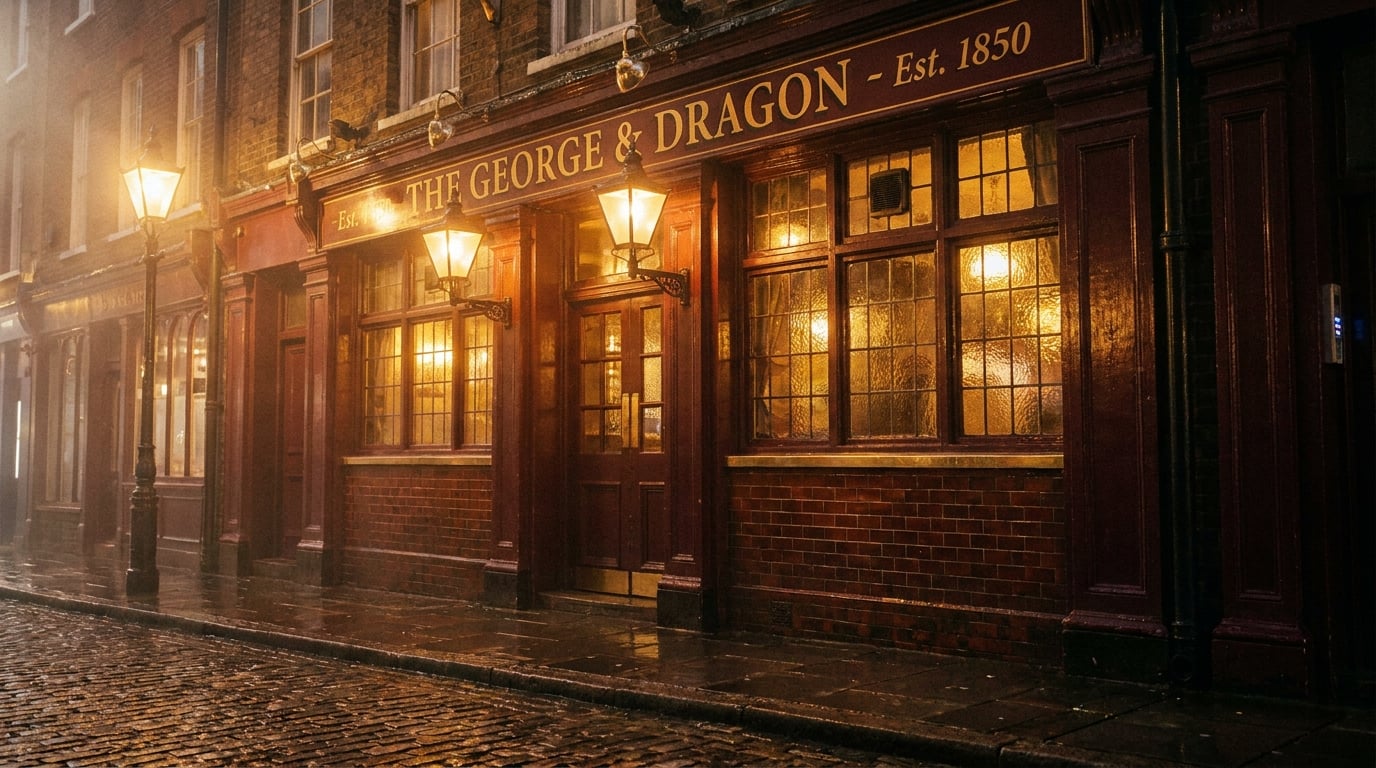
Walk down Dean Street on any given afternoon and you might miss it. There is no flashing sign, no music spilling onto the pavement, no crowd of tourists queuing outside. Just a modest pub front at number 49, tucked between the restaurants and bars that line one of Soho’s most storied streets. This is the French House pub Soho has cherished for over 130 years, and stepping through its door feels like crossing into another century.
I first visited the French House on a rainy Tuesday in 2026, looking for a quiet drink after a long day. What I found was something far more interesting than a quiet drink. I found a living museum of London’s bohemian past, a place where Francis Bacon once held court, where Charles de Gaulle drafted speeches, and where the walls still seem to vibrate with the conversations of artists, writers, and eccentrics who made Soho the cultural engine of twentieth-century Britain.
This is the story of the most bohemian pub in Soho. It is a tale that begins with a German landlord in 1891, winds through two world wars, brushes against some of the greatest artistic figures of the modern era, and arrives in 2026 largely unchanged. The French House Soho has survived because it refuses to change, and that stubbornness is exactly what makes it irreplaceable.
Table of Contents
The Origins: From York Minster to the French House (1891-1914)
The story of the French House begins in 1891, when a German wine merchant named Christian Schmitt opened a pub at 49 Dean Street. Back then it was called the York Minster, named after the famous cathedral in northern England. Schmitt catered to the growing community of European immigrants who had settled in Soho during the late nineteenth century, and the pub quickly became a gathering point for the area’s cosmopolitan crowd.
Soho in the 1890s was a neighbourhood of contradictions. It was crowded, poor, and rough around the edges, but it was also where waves of French, Italian, German, and Eastern European immigrants brought their food, their politics, and their culture. The York Minster sat right in the middle of this ferment. Schmitt’s pub served the local community and earned a reputation as a place where you could hear a dozen languages over a single drink.
The pub’s German character did not last long. When Christian Schmitt died, the York Minster passed into new hands, and those hands would transform it into something entirely different. But the foundation was already set: a pub on Dean Street that belonged to Soho’s outsider culture, a place that welcomed people who did not fit in anywhere else.
That spirit of openness to foreigners, artists, and misfits would define everything the French House became. The building itself, a narrow Soho townhouse with tight rooms and low ceilings, practically demanded intimacy. You could not sit in the York Minster without overhearing your neighbour’s conversation, and that accidental closeness bred a community that no other pub in London could replicate.
Victor Berlemont: The Belgian Who Changed Everything (1914)
In 1914, everything changed. A Belgian named Victor Berlemont took over the York Minster and began the transformation that would define the pub for the next century. Victor was, remarkably, the first foreigner ever to become the landlord of a British pub. In an era when licensing laws and social convention made that nearly impossible, Berlemont did it through sheer force of personality and a deep understanding of hospitality.
The timing was extraordinary. Britain was heading into the First World War against Germany, and Soho’s German community was facing suspicion and hostility. Victor Berlemont, as a Belgian, represented a country Britain had pledged to protect. He made the pub a refuge for displaced Belgians fleeing the German occupation, and the York Minster began its slow transformation from a German local into something unmistakably French.
Victor brought with him the traditions that still define the French House today. He stocked Ricard pastis, French wines, and champagne at a time when most London pubs served nothing stronger than mild ale. He encouraged a slower, more continental style of drinking, one that valued conversation over consumption. The pub became a salon as much as a bar, and the bohemian character of the French House Soho was born in those years between the wars.
Victor’s son Gaston grew up in the pub, learning the trade from behind the bar before he could even see over it. The Berlemont family would run the French House for three generations and over 75 years, a dynasty that gave the pub a stability and continuity almost unheard of in the London trade. When Victor finally handed over the keys, the York Minster was already one of the most beloved pubs in Soho, even if most of its regulars had never known it by any other name.
The War Years: Charles de Gaulle and the Free French
During the Second World War, the French House played a role in history that no other London pub can claim. After the fall of France in 1940, General Charles de Gaulle established the Free French Forces headquarters in London, and Soho became the heart of the French resistance in exile. The French House, with its already established French identity, became a natural meeting point.
De Gaulle himself was a regular. The pub’s dining room was rumoured to be one of the places where he and his officers discussed strategy and morale during the darkest days of the occupation. His famous Appeal of 18 June, broadcast from London to call on the French people to resist, cemented the connection between the Free French and the British capital. The French House stood as a small but meaningful symbol of that alliance.
The pub served as an unofficial embassy for Free French soldiers, sailors, and airmen passing through London. They came to the York Minster to drink Ricard, eat French food, and speak their own language in a city that had become their temporary home. Many of these men would never return to France, and the pub became a place of memory as well as celebration.
This wartime history is part of what gives the French House its weight. You are not just drinking in a bohemian pub. You are drinking in a place that witnessed one of the great alliances of the twentieth century, a tiny corner of Soho that helped keep a nation’s spirit alive from a thousand miles away.
Gaston Berlemont and the Golden Age (1951-1989)
When Victor Berlemont retired in 1951, his son Gaston took over and presided over what many consider the golden age of the French House. Gaston ran the pub from 1951 to 1989, a 38-year tenure that saw Soho transform around him while the French House remained a fixed point of bohemian culture. He was a legendary figure behind the bar, known for his charm, his firmness, and his uncanny ability to remember every regular’s name and preferred drink.
Under Gaston’s watch, the French House became the unofficial clubhouse of postwar British art and literature. Francis Bacon was perhaps the most famous regular, a man who treated the pub as his living room and held court at his usual spot for decades. Bacon would arrive in the early evening, drink champagne by the half-pint, and hold forth on painting, gambling, and life until the pub closed. The French House was where he met friends, argued with rivals, and conducted the social life that fed directly into his work.
Lucian Freud was another fixture. Freud and Bacon, two of the greatest painters of the twentieth century, drank in the same small pub on Dean Street for years, their parallel careers crossing paths over half-pints of lager and glasses of Ricard. The pub’s walls have witnessed conversations about art that would fill a library, and most of them happened over drinks that cost less than a pound.
Dylan Thomas drank here too, during his London years. The Welsh poet was drawn to Soho’s pubs the way moths are drawn to flame, and the French House was one of his favoured stops. Brendan Behan, the Irish playwright, was another literary regular whose reputation for hard drinking preceded him into every pub in Soho. These were not casual visitors. They were part of the fabric of the place, and Gaston Berlemont was the man who held that fabric together.
The pub’s reputation during this era was built on Gaston’s insistence on standards. He kept the drinks list focused on quality rather than variety. He refused to install slot machines, jukeboxes, or anything else that would distract from conversation. The French House was a place to talk, to drink well, and to be among interesting people. That philosophy has not changed.
The Famous Regulars of the French House Soho
The list of famous regulars at the French House reads like a who’s who of twentieth-century culture. Beyond Bacon, Freud, Thomas, and Behan, the pub has counted among its patrons an extraordinary range of artists, writers, actors, musicians, and intellectuals. The most bohemian pub in Soho attracted the most bohemian people in Britain, and they kept coming back because the pub treated them like everyone else.
The Roll of Honour includes:
- Francis Bacon – the painter who made the French House his second home for over four decades
- Lucian Freud – portrait master and Bacon’s contemporary, who drank here throughout his career
- Dylan Thomas – the Welsh poet who found in Soho’s pubs the fuel for both his work and his legend
- Brendan Behan – Irish playwright and raconteur whose drinking exploits were as famous as his writing
- John Hurt – the actor, a Soho resident who was a familiar face at the bar for years
- Jeffrey Bernard – the journalist whose Spectator column about Soho drinking made him a legend
- Tom Baker – the Doctor Who actor and Soho local
- Charles de Gaulle – wartime leader who used the pub as an informal meeting place
What is striking about this list is its diversity. Painters, poets, actors, politicians, and journalists all found something in the French House that they could not find anywhere else. The pub did not cater to any single scene or movement. It catered to anyone who valued good drink, good conversation, and the freedom to be themselves without judgement.
Reddit users who have visited often describe the same thing. One wrote: “It’s a nice atmospheric place if you can get a seat. Has a reputation of having an eccentric Soho crowd and being somewhere you can sit at the bar alone.” Another said: “French House is great, hard to get a reservation but keep trying.” The pub’s mystique has not dimmed, even as the celebrity roster has shifted from Bacon and Freud to a new generation of artists, writers, and Soho characters.
Why the French House Only Serves Half Pints
One of the most famous quirks of the French House is that it only serves beer in half-pints. There are no full pints on offer, and there never have been under the Berlemont regime. This tradition is so central to the pub’s identity that it has become a piece of Soho folklore, and visitors often ask about it with a mixture of curiosity and amusement.
The origin story is simple and practical. The Berlemonts believed that beer was best enjoyed fresh, and a half-pint drunk quickly tastes better than a full pint left to go warm. But there was also a cultural dimension. In France, beer is typically served in smaller measures, and the continental approach to drinking values quality and pace over volume. The half-pint tradition was a small act of cultural resistance against the British culture of the session drink.
There is a third reason that regulars understand instinctively. Half-pints mean you have to go back to the bar more often, and going back to the bar means you talk to more people. The French House is designed to create encounters, and the half-pint rule is a quiet mechanism for keeping the social energy of the pub constantly renewed. It is not a gimmick. It is architecture.
The same philosophy extends to the pub’s other rules. There is no music, no slot machines, no television, and crucially, no mobile phones. The French House is one of the few places left in central London where you can sit in silence with a drink and actually hear yourself think. For some, the no-phones policy feels restrictive. For most regulars, it is the entire point.
The York Minster Fire and the Name Change (1984)
The pub’s original name, the York Minster, survived for over 90 years until an event in 1984 forced a change. That year, the real York Minster cathedral in Yorkshire suffered a devastating fire that caused millions of pounds of damage and made headlines across Britain. The fire was a tragedy for one of England’s greatest medieval buildings, and its name was suddenly on everyone’s lips.
For the pub on Dean Street, this created an unexpected problem. People were confusing the two, and the association with a fire-damaged cathedral was not exactly the brand a Soho drinking establishment wanted. Gaston Berlemont decided to change the name officially to the French House, a name that had been used informally by regulars for decades because of the pub’s French character and clientele.
The name change was more than cosmetic. It acknowledged what the pub had actually been for most of its existence: a French institution in the heart of London. The York Minster name had always been something of an accident of history, a relic of Christian Schmitt’s original 1891 licensing. The French House was who the pub truly was, and Gaston’s decision simply made it official.
The Dining Room: From Fergus Henderson to Neil Borthwick
The French House is not just a pub. It is also a restaurant, and the dining room upstairs has its own remarkable story. The pub’s food reputation was built over decades, but it reached new heights when Fergus Henderson and Margot Henderson became involved with the kitchen. Fergus, the godfather of nose-to-tail eating and the founder of St. John restaurant, brought his philosophy of honest, French-influenced cooking to the French House dining room.
The dining room earned an AA Rosette, a significant mark of quality in the British restaurant world. It served classic French bistro dishes cooked with skill and conviction, from steak frites to boudin noir, all paired with the pub’s extensive list of champagnes and wines by the glass. The madeleines, cooked to order, became something of a legend among London food enthusiasts.
The kitchen has since passed to Neil Borthwick, a chef who trained under Fergus Henderson and continues the tradition of simple, excellent French cooking. Borthwick’s menu changes regularly but stays true to the pub’s character: unpretentious, generous, and deeply rooted in French technique. The connection to Angela Hartnett, one of Britain’s most respected chefs, has also been part of the dining room’s story, adding further culinary credibility.
For visitors, the dining room is a separate experience from the bar. You need a reservation, and getting one can be notoriously difficult. Reddit users repeatedly mention the challenge of securing a table, but those who manage it consistently describe the food as superb. The dining room is the French House’s quiet secret, a restaurant hiding above one of the most famous pubs in London.
The French House as Art World Salon
The French House has always been more than a pub. It has functioned as an unofficial art world salon, a place where artists, photographers, and creative people of all kinds gather, exchange ideas, and find community. This role has only deepened in recent decades as Soho has gentrified and the pubs that once served the creative community have disappeared one by one.
The pub’s art connections are documented and celebrated. John Claridge, the renowned photographer, created the Soho Faces project, a series of portraits of the characters who frequented the French House and the surrounding neighbourhood. Claridge’s work captured the pub’s regulars with a raw honesty that matched the pub’s own aesthetic, and his photographs have been exhibited and published widely.
The French House regularly hosts photography exhibitions on its walls, turning the bar into a rotating gallery of Soho life. This tradition reflects the pub’s belief that art is not something that belongs only in galleries. It belongs in the places where people actually live, drink, and talk. The staff themselves are often artists, musicians, or writers, and the pub has a long history of employing creative people who fit its unconventional spirit.
Contemporary artists continue to find a home here. The pub’s current community includes painters, photographers, sculptors, and writers who treat the French House as their living room, just as Bacon and Freud did before them. The baton has been passed, and the most bohemian pub in Soho remains exactly that: a place where creative people know they will find their own kind.
Lesley Lewis and the Modern French House
The current custodian of the French House is Lesley Lewis, who has run the pub for over three decades. Lewis took over the stewardship of this extraordinary institution and has dedicated herself to preserving everything that makes it special. In an era when London pubs are being converted into cocktail bars, chain restaurants, and luxury flats at an alarming rate, her commitment to continuity is nothing short of remarkable.
Lewis’s philosophy is simple: protect what works and resist the urge to modernise for the sake of it. The no-music, no-phones, no-machines rules have been maintained without compromise. The drinks list still focuses on quality over quantity, with thirty champagnes and wines available by the glass. Ricard is still poured in quantities that would have made Victor Berlemont proud. The pub still serves only half-pints of beer, and it still closes at traditional hours rather than staying open late to chase extra revenue.
Under Lewis’s watch, the French House has become something rare in modern London: a business that actively chooses its own limitations. Every rule the pub enforces is a rule that costs it money in the short term. No slot machines means less income. No music means a less obvious appeal to passing trade. Closing early means fewer hours of trading. But these choices are what make the French House worth visiting, and Lewis understands that better than anyone.
The pub’s survival is a testament to the idea that character is more valuable than convenience. In a city that has lost dozens of historic bohemian venues, the French House stands as proof that a pub can resist the tide of homogenisation if the people running it care enough about what they are protecting. Lewis has spent her career being that person, and the pub she has preserved is a gift to everyone who walks through its door.
FAQs
What is the history of the French House Soho?
The French House began in 1891 as the York Minster, a pub opened by German wine merchant Christian Schmitt at 49 Dean Street. In 1914, Belgian Victor Berlemont took over and became the first foreigner to run a British pub, giving it its French character. During WWII it served as a meeting point for Charles de Gaulle and the Free French Forces. Gaston Berlemont ran it from 1951 to 1989, presiding over its golden age with regulars like Francis Bacon and Lucian Freud. The pub was officially renamed the French House after the 1984 York Minster cathedral fire. It is now run by Lesley Lewis.
Why does the French House only serve half pints?
The French House only serves beer in half-pints as a tradition started by the Berlemont family. The reason is twofold: half-pints stay fresher and taste better than full pints left to warm, and the smaller measure follows the French approach to drinking that values quality over volume. It also encourages regulars to return to the bar more often, which keeps conversation flowing and the social atmosphere alive.
What famous people drank at the French House Soho?
The French House has counted Francis Bacon, Lucian Freud, Dylan Thomas, Brendan Behan, John Hurt, Jeffrey Bernard, and Charles de Gaulle among its famous regulars. Bacon and Freud were perhaps the most devoted, treating the pub as their living room for decades. The pub has always attracted artists, writers, actors, and bohemians of every generation.
Is the French House still open in Soho?
Yes, the French House is still open at 49 Dean Street in Soho. It operates as both a pub and a dining room, with the restaurant upstairs run by chef Neil Borthwick. The pub is currently managed by Lesley Lewis, who has maintained its traditions including the no-music, no-phones, and half-pint-only policies.
Who owns the French House pub Soho?
The French House is currently run by Lesley Lewis, who has been the pub’s custodian for over 30 years. Before Lewis, the Berlemont family owned and operated the pub for three generations, starting with Victor Berlemont in 1914 and continuing with his son Gaston from 1951 to 1989.
Is Soho still seedy?
Soho has changed significantly over the past few decades and is far less seedy than it was in its mid-twentieth-century heyday. Gentrification, rising rents, and the closure of historic venues have transformed the area. However, pockets of bohemian character remain, and the French House is one of the institutions that keeps Soho’s unconventional spirit alive.
Conclusion: Why the French House Still Matters
The story of the French House is the story of Soho itself. It begins with immigrants and outsiders, survives two world wars, becomes the favourite haunt of the greatest artists of the age, and refuses to die even as the neighbourhood around it transforms beyond recognition. The most bohemian pub in Soho earned that title through 130 years of stubborn, idiosyncratic, magnificent continuity.
What makes the French House pub Soho so special is not any single thing. It is the accumulation of details: the half-pints, the Ricard, the no-phones rule, the champagnes by the glass, the art on the walls, the dining room upstairs, and the people who keep choosing it over every other option in a city overflowing with places to drink. Each of these details was a deliberate choice, made by people who believed that a pub should be more than a place to buy alcohol.
If you are planning a visit, go with realistic expectations. The French House can be intimidating for newcomers, and it is not the place for a loud night out. It is the place for a quiet half-pint, a good conversation, and a glimpse into a version of London that has almost entirely disappeared. Sit at the bar, order a Ricard or a glass of champagne, and look around. The walls will not tell you their stories, but the atmosphere will.
The French House survives because it knows exactly what it is. In 2026, that kind of self-knowledge is rarer than ever. Victor Berlemont built something extraordinary in 1914, Gaston Berlemont nurtured it through its golden age, and Lesley Lewis has protected it for the modern era. The most bohemian pub in Soho is still open at 49 Dean Street, still serving half-pints, and still welcoming anyone who walks through the door with the right spirit. That, more than anything, is worth raising a glass to.