
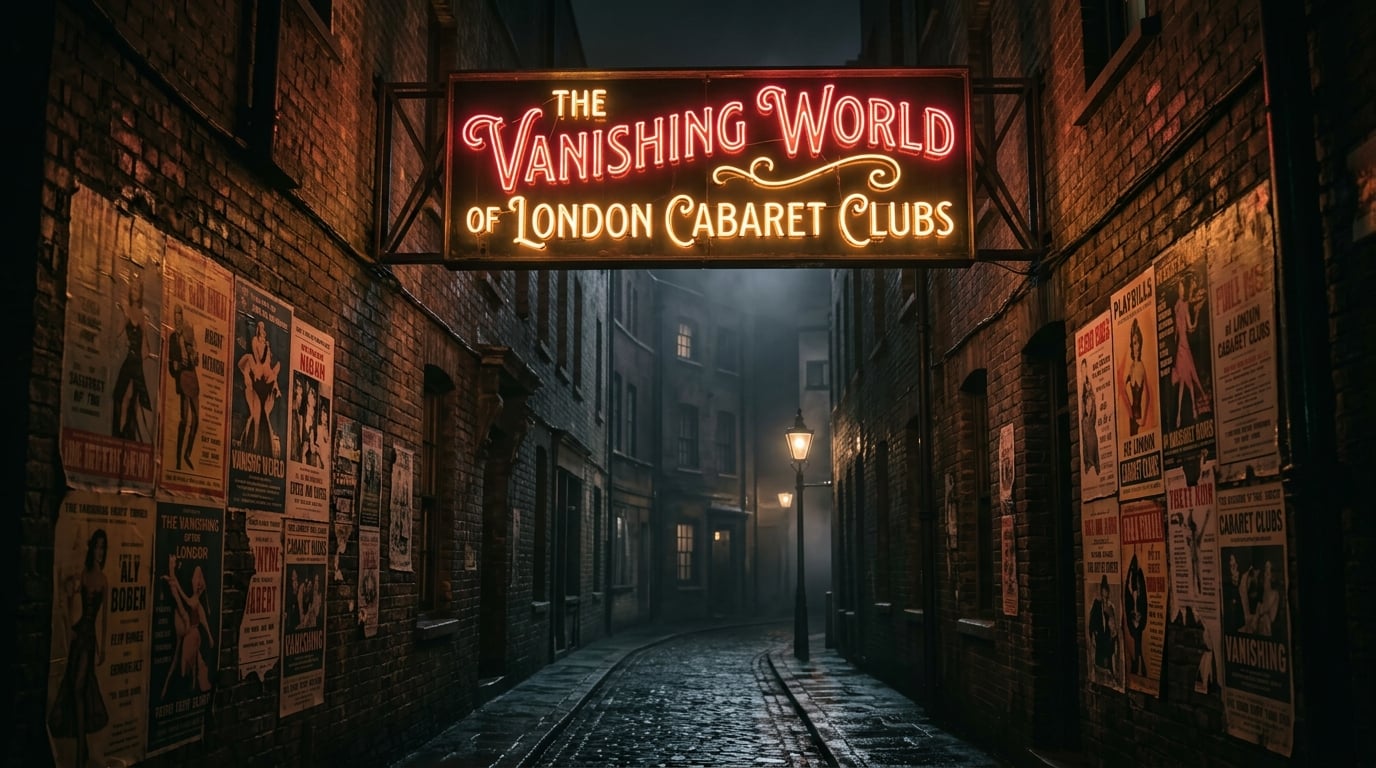
Walk down Beak Street in Soho today and you will find cocktail bars, coffee shops, and digital agencies. A century ago, this same stretch was the beating heart of London cabaret clubs, where sequined performers dazzled packed rooms until dawn. The music has gone quiet, and the buildings that once hosted the city’s most extravagant nightlife have been gutted, sold, and repurposed.
The vanishing world of London cabaret clubs is not just a story about buildings closing. It is about an entire culture, an ecosystem of performers, dancers, musicians, and audiences that made Soho the most thrilling entertainment district in Britain. Our team spent months tracing the histories of these venues, poring over archives, forum threads, and performer testimonies to understand what was lost.
What we found is a tale of ambition and excess, of venues that operated for decades before being swept away by rising rents, licensing crackdowns, and the relentless tide of gentrification. London cabaret clubs once rivaled Paris for their glamour and daring. Today, only fragments of that world remain.
This guide traces the rise, glory, and disappearance of London’s cabaret scene. Whether you are a history enthusiast, a nightlife researcher, or simply curious about what Soho used to sound like at midnight, you will find the full story here.
Table of Contents
What Were London Cabaret Clubs?
London cabaret clubs were intimate entertainment venues that combined live performance, dining, and drinking under one roof. Unlike traditional theaters where audiences sat in silence watching a scripted play, cabaret clubs offered variety. A single evening might feature a singer, a comedian, a dance troupe, and a burlesque act, all performing short sets in rapid succession.
The format drew inspiration from French cabaret but developed its own distinctly British character. Performers interacted directly with the audience, breaking the fourth wall that conventional theater maintained. Tables were set close to the stage, drinks flowed freely, and the atmosphere was closer to a dinner party than a formal performance.
Soho became the natural home for these venues because of its pre-existing reputation as London’s bohemian quarter. Artists, writers, gangsters, politicians, and visiting celebrities all rubbed shoulders in rooms that held anywhere from 80 to 300 people. The intimacy was the point. You were not watching a show. You were inside it.
What set cabaret apart from ordinary nightlife was the emphasis on theatrical performance. A pub had music and drinks. A cabaret club had costumes, choreography, scripted comedy, and trained professionals who rehearsed for weeks. It occupied a middle ground between the West End stage and the late-night bar, and for decades that middle ground was the most exciting place in London after dark.
The Golden Era of Soho Cabaret
The golden era of Soho cabaret spanned roughly from the mid-1930s through the late 1960s. During these decades, Soho was a dense grid of competing venues, each with its own personality, roster of performers, and loyal clientele. Beak Street, Gerrard Street, Walker’s Court, and Old Compton Street were lined with glowing marquees every evening.
World War II paradoxically boosted cabaret’s popularity. Londoners seeking escape from the Blitz and the privations of rationing flocked to clubs that offered glamour, laughter, and a few hours of forgetting. Performers worked through air raids, sometimes pausing mid-song as sirens wailed, then picking up exactly where they left off once the all-clear sounded.
The postwar years brought American influence. Jazz musicians arriving from New York and Chicago found enthusiastic audiences in Soho. GIs stationed in Britain had introduced London to a faster, brasher style of entertainment, and cabaret clubs adapted. Showgirls added feathers and rhinestones inspired by Las Vegas revues. Bands grew louder and tighter. The costumes, as archived photographs show, became more extravagant and increasingly daring.
By the 1960s, Soho cabaret was at its absolute peak. Clubs operated six nights a week with two shows per night. Waiting lists for tables stretched weeks ahead. Celebrities from the film and music industries treated these venues as their private living rooms. A performer who landed a regular slot at a top Soho club had effectively made it.
This golden era could not last forever. Changing social habits, the rise of discothèques, and shifting regulatory frameworks began eroding the foundations of cabaret culture. But for thirty extraordinary years, Soho was the cabaret capital of the English-speaking world.
Murray’s Cabaret Club: Soho’s Crown Jewel (1913-1990s)
Murray’s Cabaret Club was the longest-running and most iconic cabaret venue in London’s history. It opened in 1913 at 16-18 Beak Street, founded by a former shorthand typist named Percy Murray. The club occupied the basement of a Georgian townhouse, creating an underground world of music and spectacle that would endure for over eight decades.
Percy Murray understood something that many venue owners did not. He designed the space for intimacy. The room was small, the tables were close together, and the stage felt like it was in your lap. Audiences were not spectators. They were guests at a party, and the performers were their charismatic hosts.
In its early years, Murray’s featured jazz and variety acts. As decades passed, the shows evolved. The costumes became more elaborate, the routines more daring, and the productions more theatrical. By the 1950s and 1960s, Murray’s was famous for its showgirls, who performed intricately choreographed routines in hand-sewn costumes covered in sequins, feathers, and rhinestones. The archive of the club, maintained by former performers, documents how each costume was a work of art requiring hundreds of hours of labor.
The club’s audience was a cross-section of British society. Regulars included aristocrats, politicians, business tycoons, and visiting Hollywood stars. You might find a member of the royal family at one table and a Soho bookmaker at the next. Murray’s did not care about social hierarchy. It cared about whether you enjoyed the show.
What made Murray’s remarkable was its longevity. While dozens of competitors opened and closed around it, Murray’s kept going through two world wars, the Depression, the swinging sixties, and the economic turbulence of the 1970s. The club adapted its format repeatedly, shifting from jazz to variety to striptease and back again, depending on public taste.
The decline came slowly. Rising costs, an aging customer base, and the changing character of Soho all took their toll. By the 1980s and 1990s, the club operated in a diminished form, a ghost of its peak years. It eventually closed its doors, ending a run that had lasted over 80 years. The building on Beak Street still stands, but the basement that once held hundreds of spellbound audience members is silent.
The Murray’s Club Archive, maintained online by former performers and historians, preserves photographs, costume designs, and personal recollections from dancers who worked there. These testimonies provide one of the most intimate records of what working in a London cabaret club was actually like. Performers describe the camaraderie backstage, the nervous energy before each show, and the bond they formed with regular audience members who returned year after year.
The Raymond Revuebar Legacy (1958-2000s)
If Murray’s represented the elegant tradition of London cabaret, the Raymond Revuebar represented its provocative, boundary-pushing side. Opened in 1958 by Paul Raymond, the Revuebar was located in Walker’s Court, a narrow alley in the heart of Soho. Raymond was a showman and businessman who understood that controversy sold tickets.
The Raymond Revuebar specialized in striptease and nude reviews, pushing the limits of what was legally permissible in Britain at the time. Raymond fought repeated legal battles with authorities over licensing and obscenity, and his victories helped liberalize what could be shown on a London stage. The venue became a symbol of Soho’s anything-goes reputation.
During its peak years in the 1960s and 1970s, the Revuebar was one of the most famous nightspots in London. Tourists visiting from around the world had it on their itinerary alongside Big Ben and Buckingham Palace. The neon sign above the entrance became one of the most photographed landmarks in Soho.
What is less widely known is that the Revuebar also served as a cultural venue beyond adult entertainment. In the 1980s, part of the building was converted into the Boulevard Theatre, which hosted alternative comedy, fringe theater, and music events. Early performances by now-famous comedians took place in this intimate space. The venue had range that its reputation as a strip club did not fully capture.
Paul Raymond died in 2008, and the Revuebar’s era effectively ended with him. The building was eventually redeveloped into a mixed-use property. The neon sign, a piece of London nightlife history, was removed. Walker’s Court, once the most infamous alley in Britain, is now a quiet passage between offices and restaurants.
The loss of the Raymond Revuebar removed a major piece of Soho’s visual and cultural identity. It was not a tasteful venue by most standards, and not everyone mourned its passing. But it was authentically Soho, a product of the neighborhood’s refusal to conform to suburban respectability. Its closure marked the end of an era that no amount of boutique development can recreate.
Ronnie Scott’s and the Jazz Connection
No account of London cabaret culture would be complete without Ronnie Scott’s Jazz Club, the venue that bridged the gap between cabaret entertainment and serious music. Ronnie Scott and Pete King opened the club in 1959 at 39 Gerrard Street in Soho, before relocating in 1965 to its current home on Frith Street.
Ronnie Scott’s was not a cabaret club in the variety-show sense. It was a dedicated jazz venue that brought the same intimacy and audience connection to music that cabaret clubs brought to performance. The format was similar. Small tables, close proximity to the stage, drinks service throughout the performance, and a sense that you were part of something exclusive rather than merely a ticketholder.
The club hosted virtually every major jazz figure of the 20th century. Count Basie, Ella Fitzgerald, Stan Getz, and Chet Baker all performed there. British jazz musicians found a permanent home at Ronnie Scott’s, and the venue became the training ground for generations of UK talent. Unlike the cabaret clubs around it, Ronnie Scott’s survived because it offered something that could not be replicated elsewhere: world-class live jazz in a room designed for listening.
The connection between Ronnie Scott’s and the cabaret scene was not just geographical. Many performers moved between the two worlds. Singers who headlined at Murray’s or the Revuebar would sit in at Ronnie Scott’s on their nights off. Musicians from the jazz club accompanied cabaret shows elsewhere in Soho. The scenes overlapped constantly, sharing talent, audiences, and an ethos of live performance.
Ronnie Scott’s remains open today, one of the very few survivors of Soho’s golden age of nightlife. Its endurance is a testament to the power of a clear artistic mission. While cabaret clubs tried to be everything to everyone and eventually lost their audience, Ronnie Scott’s focused on doing one thing better than anyone else.
Timeline: The Rise and Fall of London Cabaret Clubs
The history of London cabaret clubs can be traced through a series of landmark openings and closures. This timeline captures the major moments that defined the scene over more than a century.
- 1913 Murray’s Cabaret Club opens at 16-18 Beak Street, Soho, establishing the template for London cabaret.
- 1930s Soho’s cabaret scene expands rapidly as multiple venues open along Beak Street, Old Compton Street, and Gerrard Street.
- 1939-1945 World War II boosts cabaret attendance as Londoners seek escape from bombing and rationing. Clubs operate through air raids.
- 1958 Paul Raymond opens the Raymond Revuebar in Walker’s Court, introducing a more provocative style of cabaret entertainment.
- 1959 Ronnie Scott’s Jazz Club opens at 39 Gerrard Street, adding a dedicated music venue to Soho’s nightlife ecosystem.
- 1960s The golden era peaks. Soho hosts dozens of cabaret venues operating nightly with full performance schedules.
- 1965 Ronnie Scott’s relocates to Frith Street, where it continues to operate today.
- 1970s Economic decline, changing licensing laws, and the rise of disco culture begin eroding cabaret audiences.
- 1980s The AIDS crisis, urban redevelopment pressures, and shifting social habits accelerate venue closures across Soho.
- 1990s Murray’s Cabaret Club closes after more than 80 years, marking the symbolic end of the traditional cabaret era.
- 2008 Paul Raymond dies. The Raymond Revuebar era effectively concludes, and the building is slated for redevelopment.
- 2010s Gentrification transforms Soho. Former cabaret and nightlife spaces are converted into offices, restaurants, and retail.
- 2026 Only a handful of venues carry forward the cabaret tradition. The Kit Kat Club production at the Playhouse Theatre represents the modern, theatrical interpretation of the form.
Why Did London’s Cabaret Clubs Disappear?
The disappearance of London cabaret clubs was not caused by a single factor. It was the result of several converging pressures that made it impossible for traditional venues to survive. Understanding these forces explains why the scene vanished so thoroughly and why it is unlikely to return in its original form.
Rising Rents and Property Values
Soho property values skyrocketed from the 1980s onward as London became one of the most expensive real estate markets in the world. Venues that occupied prime locations on Beak Street or Old Compton Street found themselves sitting on land worth far more than their nightly ticket sales could justify. Landlords raised rents aggressively, and clubs that had operated for decades could not cover the increase.
The pattern was predictable. A cabaret club would close, and the space would be converted into a restaurant, a retail shop, or an office. The new tenant paid higher rent because their business model generated more revenue per square foot. Cabaret, with its small audiences, live performers, and late-night hours, simply could not compete economically.
Licensing Crackdowns and Regulatory Pressure
Westminster Council, which governs Soho, tightened entertainment licensing throughout the 1990s and 2000s. Venues faced increasingly stringent conditions on noise levels, operating hours, capacity limits, and the type of performances they could host. Each license review was expensive, time-consuming, and uncertain.
Many traditional cabaret clubs operated on legacy licenses that had been granted decades earlier, under far more permissive regimes. When those licenses came up for renewal under modern standards, the venues often could not meet the new requirements without expensive renovations. Some chose to close rather than invest in buildings they did not own.
Gentrification and the Changing Character of Soho
The gentrification of Soho is perhaps the most visible cause of the cabaret scene’s disappearance. The neighborhood that once housed strip clubs, late-night bars, music venues, and cabaret rooms has been systematically cleaned up. Chain restaurants replaced independent venues. Corporate offices moved in. The sex shops and clip joints that once defined the seedy edge of Soho were pushed out, and the creative, boundary-pushing culture went with them.
This is the paradox of urban regeneration. Nobody misses the genuinely dangerous or exploitative elements of old Soho. But the cleanup did not distinguish between the harmful and the creative. Cabaret clubs, which were legitimate entertainment venues with professional performers, were swept away alongside the less savory operations. The neighborhood became safer and more prosperous, but it lost the cultural richness that made it famous.
Changing Tastes and the Rise of Alternative Entertainment
Audience habits shifted dramatically over the decades. The rise of discothèques in the 1970s drew younger audiences toward DJ-driven dance floors rather than seated cabaret shows. Home entertainment improved with color television, video recorders, and eventually streaming services. Why pay for a night out when you could be entertained at home?
The audience for traditional cabaret also aged. The loyal regulars who had attended shows since the 1950s and 1960s grew older, and younger generations did not replace them in sufficient numbers. Cabaret came to be seen as old-fashioned, a relic of a bygone era, rather than a living art form. Without fresh audiences, venues could not sustain themselves.
Loss of Performance Infrastructure
As venues closed, the ecosystem that supported cabaret performances collapsed. Dancers, costume makers, choreographers, and musicians who specialized in cabaret found fewer places to work. Training opportunities dried up. The institutional knowledge that had been passed down through decades of performance began to disappear as older performers retired and fewer newcomers entered the field.
This loss of infrastructure makes revival difficult. Even if a venue wanted to reopen as a traditional cabaret club today, finding trained performers, experienced stage managers, and skilled costume designers would be a significant challenge. The culture was not just in the buildings. It was in the people, and many of those people have moved on.
Traditional vs Modern Cabaret: What Changed?
The word cabaret still exists in London’s entertainment vocabulary, but it means something very different today than it did in Murray’s heyday. Understanding the gap between traditional and modern cabaret reveals exactly what was lost.
Traditional cabaret clubs were permanent venues with regular performance schedules, resident companies of performers, and a loyal local audience. You could walk into Murray’s on any given night and find a show running, just as you could any night of the week for decades. The venue was the institution. The performers rotated, but the room endured.
Modern cabaret in London tends to be event-based rather than venue-based. Performers hire spaces for limited runs. Shows like the Kit Kat Club production at the Playhouse Theatre offer an immersive, theatrical experience inspired by cabaret traditions, but they are fundamentally West End theater productions with high ticket prices and fixed runs. They are spectacular, but they are not the same thing.
Burlesque has experienced a revival in London, with performers like Dita Von Teese influencing a new generation of artists. Venues such as Proud Cabaret and The London Cabaret Club have attempted to recreate the dinner-and-show format. These are worthy efforts, but they operate in a fundamentally different economic and cultural context. They are special-occasion destinations, not the everyday neighborhood entertainment that Soho’s cabaret clubs once provided.
The intimacy is different too. Traditional cabaret clubs held 100 to 200 people in a basement room where you could reach out and touch the stage. Modern venues are often larger, more polished, and more self-consciously glamorous. The raw, anything-can-happen energy of a room where the performer could see every face in the audience is hard to replicate at scale.
What Remains: The Future of London Cabaret
The traditional London cabaret club is gone, but cabaret as an art form has not entirely vanished. It has fragmented, adapted, and found new expressions. The question for anyone who cares about this cultural heritage is what, if anything, can be preserved or revived.
Ronnie Scott’s continues to champion live performance in an intimate Soho setting. The Box in Soho offers a contemporary, provocative show that echoes the spirit of the Raymond Revuebar, though it caters to a very different clientele. Smaller venues across London host regular cabaret and variety nights, keeping the format alive even without a permanent home.
The real preservation work is happening in archives and online communities. The Murray’s Club Archive documents the history of performers, costumes, and shows through photographs and personal recollections. Forum discussions on Reddit and elsewhere show that there is genuine hunger for this history, with users sharing memories of vanished venues and debating what made them special.
There is also a growing recognition that London lost something valuable when it lost its cabaret clubs. Cultural commentators, historians, and former performers have argued that the city’s nightlife is poorer for their absence. Whether that recognition translates into concrete preservation action, such as protecting existing performance venues from redevelopment, remains an open question.
For now, the vanishing world of London cabaret clubs lives on in archives, memories, and the few surviving venues that carry fragments of the tradition forward. The buildings are gone or repurposed, but the stories remain. And stories, as any cabaret performer would tell you, are what make the show worth watching.
FAQs
What happened to London’s cabaret clubs?
London’s cabaret clubs disappeared due to a combination of rising Soho property values, stricter entertainment licensing by Westminster Council, gentrification that transformed the neighborhood, changing audience tastes, and the loss of performance infrastructure. Iconic venues like Murray’s Cabaret Club and the Raymond Revuebar closed as they could no longer compete economically with restaurants, retail, and offices that paid higher rents for the same square footage.
Why did Murray’s Cabaret Club close?
Murray’s Cabaret Club closed in the 1990s after operating for over 80 years on Beak Street. The closure resulted from rising operating costs, an aging customer base, changing social habits that reduced demand for traditional cabaret, and the broader transformation of Soho’s entertainment landscape. The building still stands but the basement performance space is no longer in use.
What was the Raymond Revuebar?
The Raymond Revuebar was a cabaret and striptease venue opened in 1958 by Paul Raymond in Walker’s Court, Soho. It became one of the most famous nightspots in London, known for pushing the boundaries of what could legally be performed on stage. The venue also hosted alternative comedy and fringe theater through its Boulevard Theatre. It closed after Raymond’s death in 2008 and the building was redeveloped.
When did Soho nightlife decline?
Soho nightlife began declining in the 1980s and accelerated through the 1990s and 2000s. Economic pressures, the AIDS crisis, licensing crackdowns, and gentrification all contributed. By the 2010s, many of the independent venues that defined Soho’s nightlife had been replaced by chain restaurants, corporate offices, and retail spaces.
Are there any traditional cabaret clubs left in London?
No traditional cabaret clubs from Soho’s golden era remain in operation. Ronnie Scott’s Jazz Club, open since 1959, is the closest surviving venue, offering live music in an intimate setting. Modern alternatives include The London Cabaret Club, Proud Cabaret, and immersive productions like the Kit Kat Club at the Playhouse Theatre, but these differ significantly from the traditional neighborhood cabaret clubs that once defined Soho.
What is the history of Soho London?
Soho developed as an entertainment district from the 19th century onward, becoming London’s bohemian quarter with a concentration of music venues, cabaret clubs, bars, and restaurants. From the 1910s through the 1960s it was the center of British nightlife, hosting venues like Murray’s Cabaret Club, the Raymond Revuebar, and Ronnie Scott’s. From the 1980s onward, gentrification transformed Soho into a more sanitized commercial district, replacing many historic entertainment venues.
Conclusion
The vanishing world of London cabaret clubs represents one of the most significant cultural losses in the city’s modern history. Venues like Murray’s, the Raymond Revuebar, and dozens of smaller clubs created an entertainment ecosystem that was uniquely Soho. For decades, these rooms hosted the most talented performers in Britain, entertaining audiences who came night after night.
Their disappearance was not inevitable. It was the result of specific economic forces, regulatory decisions, and cultural shifts that prioritized property values over performance spaces. Understanding how and why London cabaret clubs vanished is the first step toward appreciating what was lost and protecting what remains of the city’s nightlife heritage.
If this history interests you, explore the Murray’s Club Archive, visit the surviving venues like Ronnie Scott’s, and support the performers and producers who are keeping cabaret alive in new forms. The buildings may be gone, but the tradition does not have to die with them.