
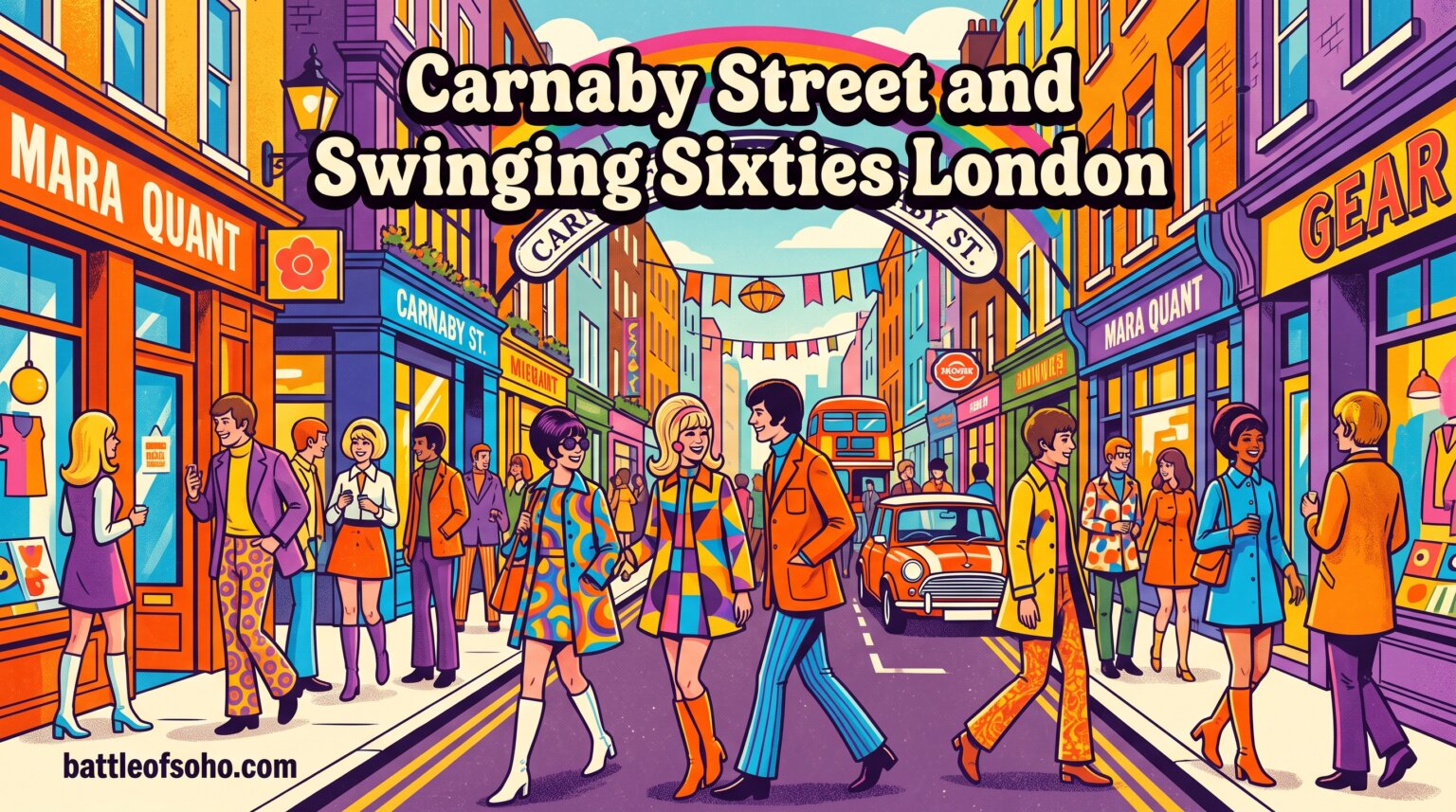
Picture a narrow lane in Soho, barely 500 metres long, tucked between Regent Street and Great Marlborough Street. In 1955, it was a quiet backwater with a bakery, a rag trade supplier, and not much else. By 1966, that same street was drawing 40,000 visitors every Saturday and had been declared the centre of the universe by Time magazine. This is the story of Carnaby Street and Swinging Sixties London, a tale of how one short road in Soho transformed global fashion, youth culture, and the way an entire generation expressed itself.
Carnaby Street became the epicenter of the Swinging Sixties because it offered something no other street in the world could: affordable, bold, youth-focused fashion sold in small independent boutiques where the shop owners knew your name. It was the place where post-war austerity collided with teenage spending power, and the explosion of colour, music, and confidence that followed changed fashion forever.
Historical accounts by Tom Salter and Paul Gorman, the Victoria and Albert Museum archives, and first-hand recollections from those who walked the street during its most electric years all confirm the same remarkable narrative: from its 17th-century beginnings through the boutique revolution of the late 1950s to the media explosion that made “Swinging London” a household phrase worldwide, Carnaby Street’s rise was nothing short of extraordinary.
Table of Contents
Before the Swinging Sixties: The Origins of Carnaby Street
The story of Carnaby Street begins long before the first mini skirt or mod parka appeared in its shop windows. The street was laid out in 1685, part of the southward expansion of Soho Fields that transformed rural land into residential plots for London’s growing population. The land was developed by Richard Tyler, a bricklayer, under a building agreement with a local worthy named Karnaby. That name, slightly anglicised over the centuries, stuck to the street itself.
For its first century, Carnaby Street was a respectable residential area. It sat within the broader Soho estate, which had been developing since the 1670s as London pushed westward. The houses were modest but comfortable, home to tradespeople, artisans, and small business owners who served the grander households around Golden Square and Soho Square. The street ran north-south, connecting Great Marlborough Street to Beak Street, and it crossed two smaller lanes: Kingly Street and Ganton Street.
By the early 19th century, the character of Soho was changing. The wealthy residents moved west to Mayfair and Belgravia, and Soho became increasingly industrial and working class. Carnaby Street followed this trajectory. The grand houses were subdivided into flats and workshops. Small manufacturing moved in, particularly the garment trade that Soho would become known for. Tailors, seamstresses, and fabric merchants occupied the street throughout the Victorian era.
The area suffered badly during the 1854 cholera outbreak, which was centred on the Broad Street pump (now Broadwick Street), just a few hundred metres from Carnaby Street. Dr John Snow’s famous investigation traced the outbreak to contaminated water, and the Soho district’s reputation as overcrowded and unsanitary was sealed. For decades afterward, Carnaby Street and the surrounding streets were considered a rough, undesirable part of London. The street was home to light industry, cheap lodgings, and the kind of small workshops where garment cutting and manufacturing took place.
This garment trade heritage is actually essential to understanding what came next. By the 1950s, Soho had a dense network of small clothing manufacturers, fabric suppliers, and skilled machinists. The infrastructure for making clothes existed in abundance. All that was missing was someone with the vision to turn that manufacturing capacity into something revolutionary. That person arrived in the mid-1950s, and his name was not the one most people remember.
Bill Green and Vince Man’s Shop: The Hidden Origin Story
Most accounts of Carnaby Street begin with John Stephen, and rightly so. But the true origin of the street’s transformation into a fashion destination starts with a man named Bill Green and a shop called Vince, located at 5 Newburgh Street, just around the corner from Carnaby Street itself. This part of the story is often overlooked, and it matters more than most people realise.
Bill Green opened Vince Man’s Shop in 1954. The shop specialised in casual menswear that was heavily influenced by American styles and, importantly, by a sensibility that was distinctly gay. Green sourced clothing that appealed to men who wanted to look stylish and provocative in a way that mainstream British menswear absolutely did not offer. The shop became a gathering place for a community that had nowhere else to express itself through fashion.
The LGBTQ+ roots of Carnaby Street fashion culture are real and significant. In the 1950s, homosexuality was criminalised in Britain. The Wolfenden Report, which would eventually recommend decriminalisation, was not published until 1957. Soho, with its existing culture of bars, clubs, and tolerance, was one of the few areas where gay men could socialise, and fashion provided both a livelihood and a form of expression. Bill Green’s Vince shop was at the centre of this world.
Green sourced his stock partly from the Gregson Brothers, who manufactured clothes in Soho. The clothing was colourful, fitted, and designed to be noticed. This was a radical departure from the grey, utilitarian menswear that dominated post-war Britain, where rationing had only ended in 1954 and most men wore variations of the same dark suit. Vince offered Hawaiian shirts, fitted trousers, and boldly patterned jackets that stood out on any street in London.
A young Glaswegian named John Stephen was a regular customer at Vince before he became a retailer himself. Stephen absorbed Green’s approach to bold, body-conscious menswear and took it in his own direction. The line from Bill Green’s Vince shop to the Carnaby Street revolution is direct and undeniable. Without Green’s pioneering work, the conditions that allowed Carnaby Street to explode would not have existed.
This is not a minor footnote. It is a reminder that cultural revolutions often start in communities that exist at the margins of society. The flamboyance, the willingness to break rules, the celebration of style for its own sake, all of these qualities that defined Swinging Sixties London were present in the gay culture of 1950s Soho before they reached the mainstream. Carnaby Street’s most famous export was the idea that men’s fashion could be fun, colourful, and bold. That idea started with Bill Green.
John Stephen: The Man Who Created Carnaby Street
John Stephen arrived in London from Glasgow in 1953 at the age of nineteen. He had left school at fourteen, served an apprenticeship as a pattern cutter, and came south looking for opportunity. He found work in London’s rag trade, but what he really wanted was to open his own shop. In 1957, he did exactly that.
Stephen’s first boutique was called His Clothes, and it opened at 5 Carnaby Street. The rent was low because nobody wanted retail space on a backstreet in Soho. Stephen had grown up watching Teddy Boys and their flamboyant drape jackets, and he understood that young men wanted clothes that expressed rebellion and individuality. His designs were slim-cut, colourful, and affordable. Trousers had narrow legs. Shirts had bold collars. Everything was cut close to the body.
The timing was perfect. Britain was emerging from post-war austerity. Young people had jobs and disposable income for the first time in a generation. The concept of teenage culture, which barely existed before the 1950s, was becoming a real economic force. Stephen’s shop gave those young men something their fathers’ tailors never would: clothes designed specifically for them, in styles that their parents hated.
Within months, His Clothes was a sensation. Stephen expanded rapidly, opening additional shops along Carnaby Street with different names and slightly different aesthetics. At his peak, he owned or controlled dozens of shops in the area. He was manufacturing his own clothing, employing local machinists, and turning over extraordinary amounts of money for a man still in his twenties. The press dubbed him the King of Carnaby Street, a title that stuck.
Stephen’s business model was as important as his designs. He understood that the traditional menswear industry, with its formal shops, fitting rooms, and conservative stock, was completely disconnected from young buyers. His boutiques were small, brightly lit, and filled with loud music. The staff were young. The clothes were ready to wear, off the rack, and priced for a working wage. You could walk in, grab something striking, pay a few pounds, and walk out looking like a pop star.
The prices were genuinely accessible. A shirt from a Carnaby Street boutique might cost 2 to 3 pounds, a jacket perhaps 7 to 10 pounds. For a young man earning a weekly wage of 12 to 15 pounds, this was attainable. Stephen was not selling luxury goods. He was selling identity, and he was selling it at a price that working-class and lower-middle-class kids could afford. This was the secret formula that made Carnaby Street explode.
Stephen’s empire eventually overextended. He went bankrupt in 1967, filed for bankruptcy again in 1975, and his direct involvement in Carnaby Street ended. But his influence was permanent. Every boutique that followed, every shop owner who opened on Carnaby Street in the 1960s, was building on the foundation he had laid. John Stephen proved that a single street in Soho could become a global fashion destination. Everyone else just followed his blueprint.
The Boutique Revolution: Key Shops That Defined an Era
John Stephen may have been first, but he was soon surrounded by a constellation of independent boutiques that each brought their own personality to Carnaby Street. These shops were the beating heart of the Swinging Sixties, and their stories deserve to be told in detail. Together, they created an ecosystem of fashion that was unlike anything the world had seen before.
Lord John was arguably the most visually spectacular boutique on the street. It was opened in 1964 by Warren Gold, Henry Moss, and Harry Fox, three partners who had previously been involved in the Soho garment trade. Lord John occupied a prominent corner site at 43 Carnaby Street, and its storefront was painted in electric colours that changed regularly. Inside, the shop was designed like a theatrical set, with bright lighting, mirrors, and pop art on the walls. Lord John sold menswear that pushed boundaries further than even John Stephen dared, with paisley shirts, velvet jackets, and trousers in colours that most British men had never seen before. The shop became a magnet for musicians, actors, and anyone who wanted to be seen at the centre of cool.
Lady Jane, opened in 1966 by Henry Moss and Harry Fox (the same pair behind Lord John), was the most important womenswear boutique on the street. Before Lady Jane, Carnaby Street was overwhelmingly a menswear destination. Moss and Fox recognised that women wanted the same access to bold, affordable, youth-focused fashion. Lady Jane’s window displays became legendary, with mannequins dressed in mini skirts, brightly coloured tights, and psychedelic prints that drew crowds of onlookers. The shop helped shift the balance of power on Carnaby Street and brought female shoppers into the heart of Soho in significant numbers.
I Was Lord Kitchener’s Valet was something else entirely. Opened by John Paul and Robert Ainsworth, this boutique specialised in Victorian and Edwardian military uniforms and antique clothing, repurposed and styled for the 1960s. The name itself was a provocative joke, and the concept was brilliant. Customers could buy genuine Hussar jackets, military braid, and Victorian frock coats, all styled to look contemporary. The shop appealed to the growing hippie and psychedelic movement that was taking over from mod culture by 1966 and 1967. The Rolling Stones, Jimi Hendrix, and members of The Beatles were all spotted shopping there.
Gear, opened by Tom Salter in 1965, took its name from the slang word that meant exactly what you think it meant. Gear was cool, essential, the right stuff. Salter’s boutique was one of the more tasteful shops on the street, with a carefully curated selection of menswear that leaned towards the Mod aesthetic. Salter was also a writer and historian of the street, and his book “Carnaby Street: 1960-2010” remains one of the most authoritative accounts of the era. His perspective as both retailer and documentarian gives us some of our best primary source material on what the street was actually like day to day.
Mates, opened by Irvine Sellar, was designed from the start to be a chain. Sellar was a former PE teacher and competitive swimmer who saw the commercial potential of Carnaby Street fashion and built a brand around it. Mates sold affordable menswear in a clean, modern shop environment. Sellar’s business was one of the more commercially successful operations on the street, and he later became a significant property developer, eventually planning the Shard at London Bridge. The trajectory from Carnaby Street boutique owner to one of Britain’s most prominent developers says something about the scale of ambition that the street fostered.
Carnaby Cavern, run by Danny Benjamin, added another dimension to the street. Benjamin’s boutique was known for its flamboyant displays and theatrical approach to retail. There are wonderful anecdotes from the era, including one famous story about Tom Jones visiting the shop accompanied by a cheetah on a lead. Whether every story is literally true matters less than the atmosphere they convey. Carnaby Street in the mid-1960s felt like anything could happen, and frequently did.
Kleptomania, opened in 1965, was one of the first shops on the street to embrace the psychedelic aesthetic fully. As mod culture gave way to the longer-haired, more experimental hippie movement, Kleptomania offered kaftans, beads, incense, and clothing that drew on Indian and Middle Eastern influences. The shop represented the second wave of Carnaby Street fashion, the shift from sharp mod tailoring to the looser, more expressive styles of 1967 and 1968.
What made these boutiques collectively revolutionary was their independence. They were not branches of chain stores. Each one was owned and operated by an individual with a distinct vision. The owners were often on the premises, talking to customers, adjusting stock, and responding to what people actually wanted. This direct relationship between designer, seller, and buyer was genuinely new in British retail, and it created a feedback loop that drove constant innovation. If something sold, more of it appeared within days. If a new look caught on, three shops would have their version by the weekend.
Swinging London: The Cultural Explosion
Carnaby Street did not exist in a vacuum. The story of Carnaby Street and Swinging Sixties London is inseparable from the broader cultural revolution that was happening across the city. To understand why this one street became so important, you need to understand what was happening in Britain in the early 1960s, and why the conditions were perfect for a fashion and cultural explosion.
Britain in 1960 was still recovering from the Second World War. Food rationing had only ended in 1954. Large parts of London still bore bomb damage. The conservative government of Harold Macmillan had presided over steady economic growth, and by the early 1960s, that growth was finally translating into real disposable income for young people. For the first time in British history, teenagers had money of their own and the freedom to spend it.
The baby boomer generation, born in the years immediately after the war, was coming of age. This was a generation that had not experienced the war directly, did not share their parents’ instinct for austerity and caution, and saw no reason to dress, think, or behave like the previous generation. They wanted their own music, their own clothes, their own culture. The term “youthquake,” coined by Vogue editor Diana Vreeland in 1965, captured the scale of this generational shift.
The Mod movement was central to this story. Mods were working-class and lower-middle-class young men and women who embraced Italian suits, scooters, American soul music, and a fastidious approach to personal appearance. The Mod aesthetic was sharp, clean, and unmistakable. Carnaby Street boutiques catered directly to the Mod market, offering the slim-cut suits, pointed collars, and polished shoes that defined the look. As author Paul Gorman documents in his book “The Look,” the Mod subculture was the first youth movement that was defined as much by what you wore as by what music you listened to.
The Peacock Revolution was the menswear equivalent of the broader cultural shift. The phrase, coined by fashion journalist George Frazier, described the growing acceptance that men could wear colour, pattern, and ornamentation without compromising their masculinity. Carnaby Street was ground zero for the Peacock Revolution. The boutiques offered men velvet jackets in jewel tones, shirts with lace collars, and trousers in colours that would have been unthinkable a decade earlier. This was not just fashion. It was a direct challenge to the grey, conformist masculinity of post-war Britain.
Music was the fuel that powered the whole engine. The British music scene exploded in the early 1960s with the rise of The Beatles, The Rolling Stones, The Who, The Kinks, and The Small Faces. These bands were not just playing music. They were wearing Carnaby Street fashion on stage, on television, and on album covers. When Mick Jagger wore a brightly coloured shirt from Lord John on Ready Steady Go, every young man in Britain wanted one. The relationship between music and fashion on Carnaby Street was symbiotic. The boutiques gave the bands their look, and the bands gave the boutiques their customers.
The Marquee Club, located on Wardour Street just a few minutes’ walk from Carnaby Street, was one of the most important music venues in the world during the 1960s. The Rolling Stones played their first gig there in 1962. The Who, David Bowie, Jimi Hendrix, and Led Zeppelin all performed at the Marquee. The proximity of this legendary venue to the boutiques of Carnaby Street created a cultural cluster that was incredibly powerful. Musicians shopped on Carnaby Street in the afternoon and played at the Marquee in the evening. Fans followed the same route, creating a continuous loop of fashion, music, and youth culture.
Ready Steady Go, the weekly music television show broadcast from 1963 to 1966, amplified everything. The show was filmed in London and featured the biggest acts in British pop music performing for a studio audience of sharply dressed young people. The show’s audience members were frequently dressed in Carnaby Street fashions, and the programme effectively broadcast the Swinging London aesthetic into living rooms across Britain every Friday evening. Combined with the rise of pirate radio stations like Radio Caroline and Radio London, which broadcast pop music around the clock, the media ecosystem of the 1960s ensured that what happened on Carnaby Street reached the entire country.
April 1966: When Time Magazine Crowned London
The moment that crystallised everything was the publication of Time magazine’s cover story on 15 April 1966. The headline was “London: The Swinging City,” and the article inside was a breathless, wide-eyed celebration of everything that was happening in the capital. Written by Piri Halasz, the article described a city that had recovered from the war and was now pulsing with youth, creativity, and confidence. It mentioned Carnaby Street by name and described the boutiques, the music, and the atmosphere that made the street extraordinary.
The impact of that single article was enormous. It was not the first international coverage of Swinging London, but it was the most widely read and the most influential. Time magazine had enormous cultural authority in 1966, and its endorsement told the world that London was the place to be. Tourists, journalists, fashion buyers, and celebrities from around the world descended on Carnaby Street. The 40,000 Saturday visitors figure comes from this period. The street was packed with people who had read about it in Time and wanted to experience it for themselves.
The celebrity presence on the street during its peak years was remarkable. The Beatles shopped there regularly. The Rolling Stones were frequent visitors. The Who, The Kinks, and The Small Faces were local boys who lived nearby. International stars made the pilgrimage: Brigitte Bardot, Elizabeth Taylor, Jimi Hendrix, Marc Bolan, Marianne Faithfull, and Twiggy all appeared on the street. In an era before celebrity security details and social media, stars mixed freely with ordinary shoppers. First-hand accounts from the period describe the electric feeling of standing on Carnaby Street and finding yourself shoulder to shoulder with someone you had watched on television the night before.
The Kinks captured the phenomenon perfectly in their 1966 hit “Dedicated Follower of Fashion.” Ray Davies wrote the song as a gentle satire of the fashion-obsessed crowd that descended on Carnaby Street, singing about a man who “thinks he is rather grand” and follows every trend “from Mayfair to Soho.” The song was both a celebration and a critique, and it cemented Carnaby Street’s place in the cultural lexicon. When your street is being sung about by one of the biggest bands in the world, you have arrived.
Carnaby Street vs King’s Road: The Rivalry That Shaped Fashion
Carnaby Street was not the only fashion destination in Swinging Sixties London. Just over a mile away in Chelsea, King’s Road was developing its own reputation as a centre of cutting-edge fashion. The two streets had different personalities, different customers, and different approaches to style, and the comparison between them reveals a great deal about how the Swinging Sixties actually worked.
King’s Road was anchored by Mary Quant’s boutique Bazaar, which opened at 138 King’s Road in 1955. Quant is often credited with inventing the mini skirt, and while the origins of that garment are disputed, there is no question that she popularised it. Bazaar was a more art-school-influenced operation than the boutiques on Carnaby Street. Quant had studied at Goldsmiths College, and her designs drew on the visual culture of fine art and graphic design. The King’s Road aesthetic was slightly more refined, slightly more middle class, and aimed more squarely at women.
Carnaby Street, by contrast, was unapologetically working class in its roots and attitude. John Stephen was a Glasgow pattern cutter, not an art school graduate. The boutiques on Carnaby Street were louder, brasher, and more accessible. They catered primarily to men, at least initially, and they offered clothes that were designed to be noticed from across a crowded room rather than appreciated for subtle design details. Where King’s Road offered elegant minis and sleek shift dresses, Carnaby Street offered velvet jackets in electric blue and shirts with collars so large they could be seen from the other end of the street.
The demographics differed too. King’s Road drew a Chelsea crowd that included artists, models, and the emerging professional class of Swinging London. Carnaby Street attracted Mods from the East End, office boys from the City, and teenagers from across Britain who saved up for a Saturday trip to Soho. Both streets were revolutionary, but they appealed to different segments of the youth market. Together, they covered the full spectrum of 1960s youth fashion.
In terms of lasting influence, both streets changed fashion permanently. King’s Road gave the world the mini skirt and the boutique as a concept for womenswear. Carnaby Street gave the world the peacock revolution in menswear and the idea that a short street could become a global brand. When Vivienne Westwood and Malcolm McLaren opened their shop on King’s Road in the 1970s (eventually renamed SEX), they were building on the boutique model that both streets had pioneered. The legacy of both streets lives on in every independent boutique that opens today.
Cranks and Cultural Innovation Beyond Fashion
Carnaby Street was not just about clothes. The street was a centre of broader cultural innovation that extended to food, lifestyle, and social attitudes. The most significant non-fashion establishment on the street was Cranks, the vegetarian restaurant that opened at 22 Carnaby Street in 1961.
Cranks was founded by David Canter and his wife Kay, along with their friend and chef Daphne Swann. At a time when vegetarianism in Britain was virtually unheard of and a meatless meal was considered eccentric at best, Cranks offered wholesome, plant-based food in a modern, stylish setting. The restaurant was decorated with contemporary art and attracted the same creative crowd that shopped in the boutiques. Cranks was not just a restaurant. It was a statement that the new generation was doing things differently, right down to what they ate.
The restaurant became an institution and eventually expanded to multiple locations across London. Its influence on British food culture was significant. The wholefood movement, the rise of vegetarianism, and eventually the organic food revolution all owe something to Cranks and its pioneering work on Carnaby Street. The restaurant closed its original Carnaby Street location in the 1990s, but its cultural impact was permanent.
Other establishments on the street contributed to the atmosphere in their own ways. Coffee bars, record shops, and small galleries all occupied premises along Carnaby Street and the surrounding lanes. The street was a complete cultural ecosystem, not just a shopping destination. You could buy clothes, eat vegetarian food, hear new music, and meet interesting people, all within a few hundred metres. This density of experience was what made the street feel magical, and it is what visitors to modern Carnaby Street often find missing.
The Decline and Revival of Carnaby Street
Nothing lasts forever, and by the late 1960s, the first signs of change were appearing on Carnaby Street. The golden age of the independent boutique was beginning to wane, and the factors that had made the street extraordinary were slowly being undermined by its own success.
The sheer volume of visitors became a problem. When 40,000 people descend on a 500-metre street every Saturday, the experience changes. The intimate, community atmosphere that early visitors described was replaced by crowds, queues, and a more transactional feel. The street became a tourist attraction before anyone had decided that was what it should be. Forum discussions from people who visited in the late 1960s often describe disappointment. The magic that had drawn people in the first place was being diluted by the very popularity it had generated.
The fashion itself was changing. By 1967 and 1968, the sharp mod look that had defined Carnaby Street was giving way to the longer-haired, looser hippie aesthetic. Some boutiques adapted successfully. Kleptomania and I Was Lord Kitchener’s Valet embraced the new style. Others did not. John Stephen’s empire collapsed in 1967. The turnover of shops on the street accelerated, and the sense of a stable community of independent retailers began to erode.
The economic model also shifted. The success of Carnaby Street attracted chain stores and larger operators who could afford higher rents. Independent boutiques, the lifeblood of the street, were priced out. By the 1970s, the character of the street was visibly different. The shops that had made it famous were gone, replaced by more commercial operations that lacked the individuality of the originals. The decline continued through the 1970s and 1980s. By the 1990s, Carnaby Street was widely regarded as a shadow of its former self, a tourist destination that traded on nostalgia rather than innovation.
Carnaby Street was pedestrianised in 1973, a change that improved the physical environment but could not restore the cultural atmosphere that had made the street special. The pedestrianisation was part of a broader trend of reclaiming urban spaces from traffic, and it did make the street more pleasant to walk through. But the shops had changed, and the visitors had changed, and the particular alchemy of the mid-1960s could not be recreated by simply closing the road to cars.
The modern revival of Carnaby Street has been partial and contested. The area is now managed as a retail destination, with efforts to attract interesting independent shops alongside the inevitable chain stores. The street still draws huge numbers of visitors, particularly tourists from around the world who want to walk where the Swinging Sixties happened. Some of the independent spirit has returned, with small boutiques and pop-up shops occasionally appearing. But the consensus among those who remember the original is that modern Carnaby Street is a tribute act, not the real thing.
Reddit communities dedicated to 1960s nostalgia frequently discuss this gap. One user who visited as a child in the 1970s recalled finding “not one groovy person on the street, no groovy shops, just lots of signs telling you you’re in a groovy tourist trap.” Others who visited in the 1960s describe the “electric” atmosphere where “anything could happen” and celebrities mixed freely with ordinary people. The contrast is stark, and it says something important about the nature of cultural moments. What happened on Carnaby Street in the 1960s was not just about the shops. It was about a specific convergence of social, economic, and cultural factors that will never quite be repeated.
The Enduring Legacy of Carnaby Street
The story of Carnaby Street and Swinging Sixties London is ultimately a story about how one short street in Soho became a global symbol of youth, creativity, and cultural change. From its quiet origins as a 17th-century residential lane, through the hidden LGBTQ+ influence of Bill Green’s Vince shop, to John Stephen’s boutique revolution, to the explosion of independent shops and the media frenzy that followed, Carnaby Street earned its place in history through the vision and energy of the people who built it.
What remains today is not just a shopping street in Soho. It is a reminder that cultural revolutions can start anywhere, that a single street with the right mix of ambition, independence, and timing can reshape the way an entire generation thinks about itself. The mini skirts, the velvet jackets, the Mod scooters, and the music that poured out of the Marquee Club may belong to the 1960s, but the spirit of independent creativity that produced them is timeless.
For anyone interested in exploring this history further, Tom Salter’s “Carnaby Street: 1960-2010” and Paul Gorman’s “The Look” remain essential reading. The Victoria and Albert Museum in London holds significant collections of 1960s fashion that can be viewed by appointment. And if you find yourself in Soho, walk down Carnaby Street with your eyes open. Look past the chain stores and the tourists, and try to imagine what it felt like when this narrow lane was the most exciting place on earth.
FAQs
Why was Carnaby Street popular in the 1960s?
Carnaby Street was popular in the 1960s because it offered affordable, bold, youth-focused fashion in independent boutiques that catered directly to the new teenage market. The street combined accessible prices, unique designs from shop owners like John Stephen, and a vibrant atmosphere enhanced by the nearby music scene, making it the epicenter of Swinging London youth culture.
Why is Carnaby Street so famous?
Carnaby Street is famous because it became the global symbol of 1960s youth culture and fashion revolution. It was the first street in the world built around independent boutiques selling affordable, daring fashion to young people. Time magazine declared it the heart of Swinging London in 1966, and bands like The Beatles and The Rolling Stones shopped there, cementing its legendary status worldwide.
What is the history of Carnaby Street?
Carnaby Street was laid out in 1685 as a residential lane in Soho, named after a local landowner. It remained a modest working-class area with garment workshops until the 1950s, when Bill Green opened Vince Man’s Shop nearby. In 1957, John Stephen opened His Clothes on Carnaby Street, launching the boutique revolution that made it the center of Swinging Sixties London and a global fashion landmark.
Why was it called the swinging 60s?
The term Swinging Sixties came from Time magazine’s 1966 cover story titled London: The Swinging City, which described the city’s explosion of fashion, music, and youth culture. The phrase captured the sense of energy, confidence, and social change that defined the decade, as post-war austerity gave way to prosperity, pop music, and a new generation determined to rewrite the rules of British society.